Abstract
Soybean is the main source of protein and oil for human and animal nutrition. However, antinutritional factors in the raw mature soybean are exist. Lipoxygenase protein is the main antinutritional factor in mature soybean seed. A new soybean cultivar, ‘Jinyang’ with yellow seed coat and free of lipoxygenase 1,2,3 protein was developed. It was selected from the population derived from the cross between ‘Jinpumkong2ho’ and GS301. ‘Jinyang’ has purple flowers, tawny pubescence, a determinate growth habit, oval leaflet shape, and light brown pods at maturity. The seed has yellow hilum and yellow seed coat color. Seed protein and oil content on a dry weight basis were 33.5% and 16.6%, respectively. It has shown a resistant reaction to soybean necrosis, soybean mosaic virus, cercospora leaf spot and blight, black root rot, pod and stem blight, and soybean pod borer. ‘Jinyang’ matured in 1 October with plant height of 65cm and a 100-seed weight of 21 g. Average yield of ‘Jinyang’ was 300 - 330 kg/10a in 2010 - 2012. ‘Jinyang’ has been registered as a new soybean cultivar (registration number: 4279, registration date: Dec. 28, 2012) by Korea Seed & Variety Service, Republic of Korea.
-
Key words: Soybean, Jinyang, Lipoxygenase, Yellow seed, Good taste
INTRODUCTION
Soybean [
Glycine max (L.) Merr.] is the main source of protein and oil for food and feed. Demand of soybean and soybean products has increased by high quantity and quality of soybean protein and oil. But antinutritional factors exist in the raw mature soybean. Lipoxygenase is the main antinutritional factor in mature soybean seeds. End-products of lipoxygenase activity are converted to many volatile compounds, which are responsible for the beany flavor associated with soybean products. Lipoxygenase proteins constitute about 1–2% of the protein in soybean seeds and can be isolated as three isoenzymatic forms. Lipoxygenase proteins are controlled by single dominant genes i.e.
Lox1, Lox2 and
Lox3, while absence is ascribed to corresponding recessive alleles (
lox1, lox2, lox3). The studies on inheritance and genetic elimination of lipoxygenase protein were reported (
Hildebrand & Hymowitz 1981,
Davies & Nielsen 1986,
Kitamura et al. 1983). Genotypes with lipoxygenase free are better accepted due to production of very low levels of hexanal compounds (
Kobayashi et al. 1995). Heat inactivation of the lipoxygenase at industrial level not only incurs extra cost but also affects the solubility and functionality of proteins (
MacLeod & Ames 1988). Development of genotypes with lipoxygenase free through genetic elimination is the key to get rid of the beany-flavour. So far, a few cultivars with lipoxygenase free have been developed (
Chung 2009). The new cultivar with traits of yellow seed coat and free of lipoxygenase 1,2,3 protein was developed.
MATERIALS AND METHODS
Two parents were used to improve new strains with traits of yellow seed coat and free of lipoxygenase 1,2,3 protein. The Cultivar ‘Jinpumkong2ho’ used as female has traits of yellow seed coat, and free of lipoxygenase 1,2,3 protein. GS301 used as male parent has yellow seed coat and lipoxygenase protein-present. F
1 seeds from the cross were obtained and were planted at greenhouse in 2003. Presence or absence of lipoxygenase protein in each of the F
2 seed was tested by SDS-PAGE protein analysis. And, F
2 seeds were planted in May 2004. Single F
2 plants were harvested based on plant type, height, maturity. Single plants with acceptable agronomical traits such as flowering date, maturity date, growth habit, plant type, lodging, and seed quality were selected in 2004. Pedigree selection method was used through F
3 and F
6 generation to select plants with yellow seed coat and free of lipoxygenase 1,2,3 protein. Agronomic traits of selected lines were tested at F
7 and F
8 generation. Yield, protein and oil content, and reaction to soybean disease and insect resistance were tested in Korea Seed & Variety Service. Selection procedures are shown in Fig.
1.
Fig. 1.Pedigree diagram of ‘Jinyang’ with the traits of yellow seed coat and free of lipoxygenase 1,2,3 protein.
RESULTS AND DISCUSSION
Agronomic performance
Qualitative trait of ‘Jinyang’ are shown in Table
1. ‘Jinyang’ has purple flowers, tawny pubescence, a determinate growth habit, oval leaflet shape, and light brown pods at maturity. The seed has yellow hilum and yellow seed coat color. Cotyledon color of mature seed is yellow.
Table 1.Qualitative traits of ‘Jinyang’ (New cultivar) and ‘Taekwangkong’ (Check cultivar).
Table 1.
|
Cultivar |
Growth habit |
Flower color |
Leaf shape |
Pubescence color |
Seed coat color |
Hilum color |
Cotyledon color |
|
|
‘Jinyang’ |
Determinate |
Purple |
Oval |
Brown |
Yellow |
Yellow |
Yellow |
|
‘Taekwangkong’ |
Determinate |
Purple |
Oval |
Tawny |
Yellow |
Yellow |
Yellow |
Quantative traits of ‘Jinyang’ are shown in Table
2. ‘Jinyang’ flowered in July 15, which is 5 days earlier than ‘Taekwangkong’. ‘Jinyang’ matured in October 2, which is about 18 days earlier than ‘Taekwangkong’. Plant height of ‘Jinyang’ was 65 cm compared to the check cultivar of 75 cm. ‘Jinyang’ had a lodging score of 1.0 versus ‘Taekwangkong’ with a lodging score of 1.7. The 100-seed weight of ‘Jinyang’ (21g) was less than that of ‘Taekwangkong’ (25g). ‘Jinyang’ had a shattering score of 4.0 versus ‘Taekwangkong’ with a score of 3.7. Average Yield of ‘Jinyang’ was 300 - 330 kg/10a in 2010 - 2012.
Table 2.Qualitative traits of ‘Jinyang’ (New cultivar) and ‘Taekwangkong’ (Check cultivar).
Table 2.
|
Cultivar |
Flowering date |
Maturity date |
Plant height (cm) |
Lodgingz (0-9) |
100-seed weight (g) |
Shatteringy (0-9) |
Yield (Kg/10a) |
|
|
‘Jinyang’ |
July 15 |
Oct. 2 |
65 |
1.0 |
21 |
4.0 |
300-330 |
|
‘Taekwangkong’ |
July 20 |
Oct.. 20 |
75 |
1.7 |
25 |
3.7 |
310-340 |
Traits for seed components of ‘Jinyang’ are shown in Table
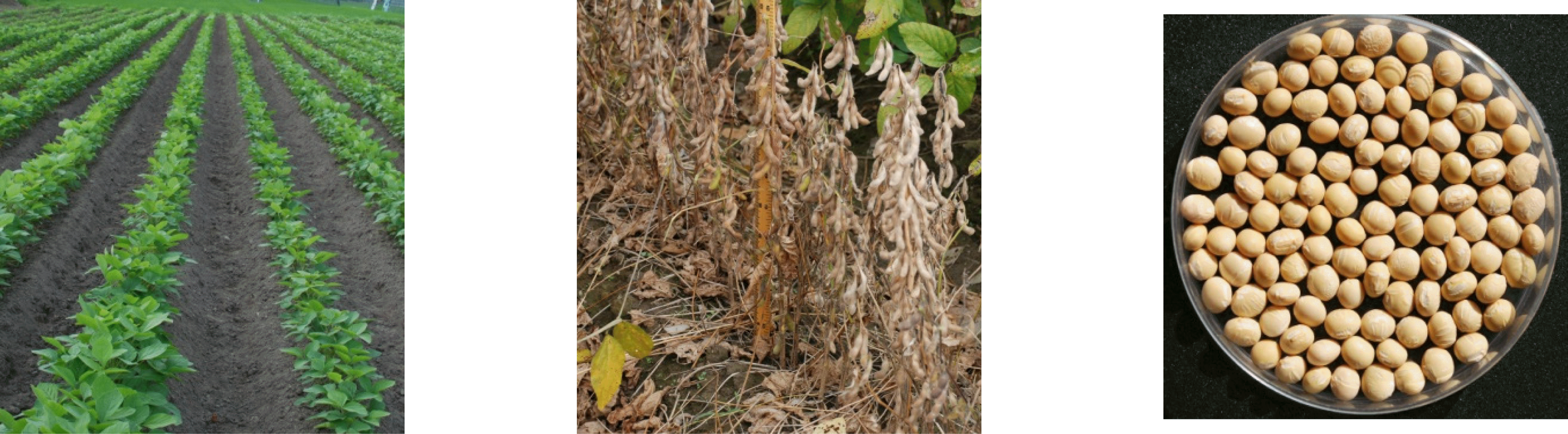
3. Average seed protein and oil content on a dry weight basis were 33.5% and 16.6%, respectively compared to 36.8% and 19.5% of the check cultivar, ‘Taekwangkong’. Lipoxygenase 1,2,3 protein was absent in ‘Jinyang’, but was present in ‘Taekwangkong’. Plants and seeds of ‘Jinyang’ are shown in Fig.
2.
Table 3.Traits for seed components of ‘Jinyang’ (New cultivar) and ‘Taekwangkong’ (Check cultivar).
Table 3.
|
Cultivar |
Crude protein (%) |
Crude oil (%) |
Lipoxygenase protein |
|
|
‘Jinyang’ |
33.5 |
16.6 |
1, 2, 3-absent |
|
‘Taekwangkong’ |
36.8 |
19.5 |
1, 2, 3-present |
Fig. 2.Plant and seed of ‘Jinyang’.
Disease and Insect Resistance
Reaction of ‘Jinyang’ to soybean disease and insects are shown in Table
4. ‘Jinyang’ was resistant (0.5 score) to soybean necrosis similar to check cultivar (1.0 score). Also, both cultivars ‘Jinyang’ and ‘Taekwangkong’ were resistant to soybean mosaic virus with the score of 0.5 and 1.0, respectively. ‘Jinyang’ was resistant to cercospora leaf spot and blight, black root rot, pod and stem blight, and soybean pod borer. Resistance to soybean pod borer in ‘Jinyang’ was higher than ‘Taekwangkong’ with a score of 0.2 and 1.0, respectively.
Table 4.Resistant degree of ‘Jinyang’ (New cultivar) and ‘Taekwangkong’ (Check cultivar) to soybean disease and insect.
Table 4.
|
Cultivar |
Necrosis (0-9) |
Mosaic virus (0-9) |
Cercospora leaf spot and blight (0-9) |
Black root rot (0-9) |
Pod and stem light (0-9) |
Soybean pod borer (0-9) |
|
|
‘Jinyang’ |
0.5 |
0.5 |
0 |
0 |
0 |
0.2 |
|
‘Taekwangkong’ |
1.0 |
1.0 |
0 |
0 |
0 |
1.0 |
ACKNOWLEDGEMENT
This work was supported by a grant (number: 111097-03-1-SB010) from IPET, Ministry of Agriculture, Food and Rural Affairs.
References
- 1. Chung JI. A new cultivar ‘Gaechuck#1’: black soybean cultivar with lipoxygenase2,3-free, Kunitz trypsin inhibitorfree and green cotyledon. Korean. J. Breed. Sci 2009. 41: 603-606.
- 2. Davies CS, Nielsen SS. Genetic analysis of a nullallele for lipoxygenase -2 in soybean. Crop Sci 1986. 26: 460-462.
- 3. Hildebrand DF, Hymowitz T. Soybeans lacking lipoxygenase. J. Am. oil Chem. Soc 1981. 58: 583-586.
- 4. Kitamura K, Davies CS, Kaizuma N, Nielsen NC. Genetic analysis of a null-allele for lipoxygenase-3 in soybean seeds. Crop sci 1983. 58: 583-586.
- 5. Kobayashi AT, Hirata N, Kubota K. Kitamura Aroma constituents of soybean milk lacking lipoxygenase isozymes. J Agri Food Chem 1995. 43: 2449-2452.
- 6. MacLeod G, Ames J. Soya flavor and its improvement. CRC Crit Rev Food Sci Nutr 1988. 27: 219-400.
Citations
Citations to this article as recorded by

- Soybean Cultivar ‘Baekse’ with Large Yellow Seeds and Low Stachyose Content, Free of Lipoxygenase, Lectin, Kunitz Trypsin Inhibitor, and 7S α' Subunit Proteins
Sarath Ly, Byeong Eon Park, Jae Gyeong Cho, Jong Il Chung
Journal of Agriculture & Life Science.2025; 59(3): 11. CrossRef - Breeding of Penta Null Soybean [Glycine max (L.) Merr.] for Five Antinutritional and Allergenic Components of Lipoxygenase, KTI, Lectin, 7S α′ Subunit, and Stachyose
Sang Woo Choi, Sarath Ly, Jeong Hwan Lee, Hyeon Su Oh, Se Yeong Kim, Na Hyeon Kim, Jong II Chung
Frontiers in Plant Science.2022;[Epub] CrossRef - Soybean Cultivar ‘Hayoung’ with Large Yellow Seeds and Low Stachyose Content, Free of Lipoxygenase, Kunitz Trypsin Inhibitor, and 7S α'-subunit Proteins
Sang Woo Choi, Sarath Ly, Jeong Hwan Lee, Hyeon Su Oh, Se Yeong Kim, Jong Il Chung
Korean Journal of Breeding Science.2022; 54(2): 130. CrossRef - Breeding of tetra null soybean (Glycine max) for lipoxygenase, kunitz trypsin inhibitor, lectin, and 7S α' subunit proteins
Sang Woo Choi, Won Gi Chae, Gyung Young Kang, Jong Il Chung
Plant Breeding.2021; 140(1): 123. CrossRef - Generation of seed lipoxygenase-free soybean using CRISPR-Cas9
Jie Wang, Huaqin Kuang, Zhihui Zhang, Yongqing Yang, Long Yan, Mengchen Zhang, Shikui Song, Yuefeng Guan
The Crop Journal.2020; 8(3): 432. CrossRef