Skip to main navigation Skip to main content

Korean. J. Breed. Sci. : Korean Journal of Breeding Science

OPEN ACCESS
ABOUT
BROWSE ARTICLES
EDITORIAL POLICIES
FOR CONTRIBUTORS

Articles

ARTICLE

조생 중립종 벼 신품종 ‘새오대’

An Early-Maturing and Medium-Grain Rice Variety ‘Saeodae’

Korean Journal of Breeding Science 2015;47(2):148-153.
Published online: May 31, 2015

1 국립식량과학원

1 National Institute of Crop Science(NICS), RDA, Suwon 441-857, Korea

2 농촌진흥청

2 Rural Development Administration(RDA), Jeonju 560-500, Korea

3 충청남도농업기술원

3 Chugcheongnamdo Agricultural Reserch & Extension, Yesan 234-861, Korea

4 전라북도농업기술원

4 Jeolabukdo Agricultural Reserch & Extension, Iksan 570-704, Korea

*Corresponding author (kimmk6690@korea.kr, Tel: +82-33-455-2031, Fax: +82-33-455-9166)
• Received: February 24, 2015   • Revised: May 13, 2015   • Accepted: May 13, 2015

© Korean Society of Breeding Science All rights reserved

This is an Open-Access article distributed under the terms of the Creative Commons Attribution Non-Commercial License (http://creativecommons.org/licenses/by-nc/3.0) which permits unrestricted non-commercial use, distribution, and reproduction in any medium, provided the original work is properly cited.

  • 70 Views
  • 0 Download
prev next
  • There are farmer’s demands to develop early-maturing cultivar in order to replace Odae variety to mid-northern inland plain and southern mountainous area of Korea. Saeodae was developed by the rice breeding team of Cheolwon Substation, National Institute of Crop Science (NICS), RDA in 2012. This cultivar was derived from the cross between Geuroobyeo and Suweon 472 in 2001 summer season, and selected by a promising line, SR27376-2-2-1-3, was selected and designated as the line of Cheolweon 81 in 2010. The local adaptability test of Cheolweon 81 was carried out at four locations from 2010 to 2012 and it was named as Saeodae. The heading date of Saeodae is July 25 in Cheolwon area, which is 2 days earlier than that of Odae. This variety has 66cm in culm length and 77 spikelets per panicle. Its 1,000 grain-weight of brown rice is 26.5 g, which is similar to that of Odae. Germination rate at low temperature of this variety is about 70%, and viviparous germination is 17.7%. Cold tolerance of this cultivar is still not good, just mediocre. It shows strong lodging resistance. And premature heading, occurrence of wilting during ripening stage, and leaf senescence at maturing are similar to those of Odae. This variety shows resistance to leaf blast disease, but susceptible to bacterial blight, virus disease and insect pest. This variety has translucent and clear milled rice kernel without white core and belly rice. The yield potential of Saeodae was about 5.26 MT/ha at ordinary fertilizer level in local adaptability test for three years. This variety would be adaptable to mid-northern inland plain and southern mountainous area of Korea.
1982년에 개발된 오대벼(RDA 1992)는 강원도 지역에서 ‘철원오대쌀’이라는 단일 품종명 브랜드로 성공하였다. 오대 벼 품종은 조생종 품종으로 우리나라 벼 조생종 재배지역에 서 매년 약 2만ha 정도가 재배되고 있는 실정이다. 오대벼 품 종 개발이후 국립식량과학원 철원출장소에서는 조생종 품종 으로 태봉(RDA 2002), 태성(Ryu et al. 2005), 평원(Ryu et al. 2009) 및 조운(Won et al. 2010) 등 새로운 품종을 개발 하여 보급하였지만 오대벼 품종을 대체하는데 어려움이 내재 하고 있다. 오대벼는 다른 품종에 비해 쌀알이 26 g정도로 굵 어 다른 조생종 품종과 구별이 되지만 쌀 외관이 다소 떨어지 는 문제점이 있다. 그래서 국립식량과학원 철원출장소에서는 오대벼 품종의 쌀 외관이 다소 불량한 단점을 해결하기 위하 여 쌀 굵기가 오대벼의 중립종 크기의 쌀에 외관이 맑은 조생 종 품종을 개발하여 오대벼 품종을 대체할 목적으로 조생종 이면서 쌀 외관이 양호한 중립종인 ‘새오대’를 육성하였기에 이 품종의 육성경위 및 주요특성을 보고하는 바이다. 이 품종 은 기존 오대 품종의 기존 특성을 유지하면서 쌀외관을 맑게 개선하였다는 점에서 조생종 벼 재배지역에 오대벼를 대체하 여 재배될 것으로 기대된다.
본 시험은 우량계통 ‘철원81호’를 2010년부터 2012년까지 3년간 중북부 중간지와 남부 중산지인 철원, 정선, 제천 및 상 주 4지역의 벼 지역적응시험포장에서 표준품종 ‘오대벼’를 함 께 공시하여 수행하였다. 시험지별 재배방법은 4월 20일 파 종하여 30일간 육묘한 후 5월 20일 재식거리 30×12 cm로 주 당 5본씩 이앙하였다. 시비량은 성분량으로 N-P2O5-K20 = 10-6.4-7.8 kg/10a를 시용하였고, 시비방법은 기비, 분얼비 및 수비를 각각 50%, 30% 및 20%로 분시하였다. 계통재배 는 농촌진흥청 표준재배법에 준하였다. 품종육성을 위한 주요 농업적 특성, 수량성, 생리장해 특성, 병충해 저항성, 도정특 성 및 품질분석 조사는 농촌진흥청 신품종개발공동연구사업 과제수행계획서 조사기준에 준하여 실시하였다(RDA 2010a, 2011a, 2012a).
육성경위
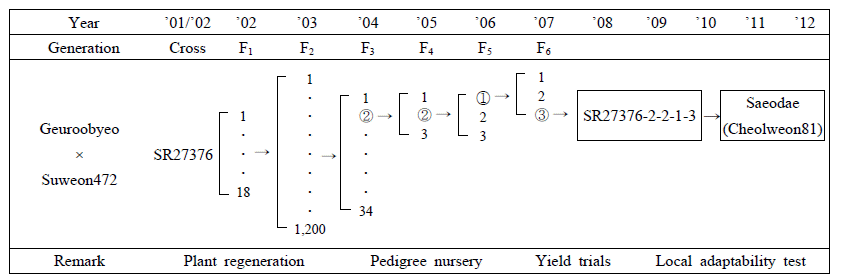
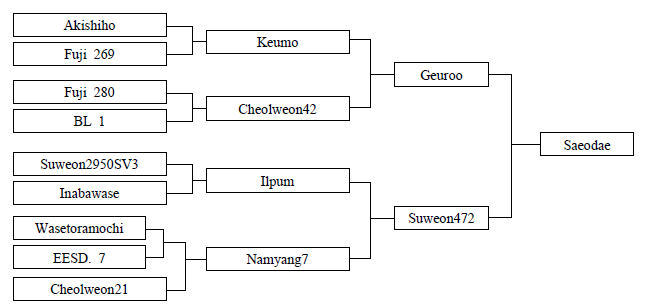
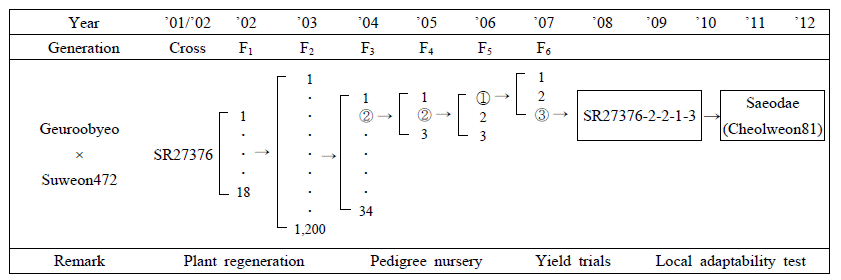
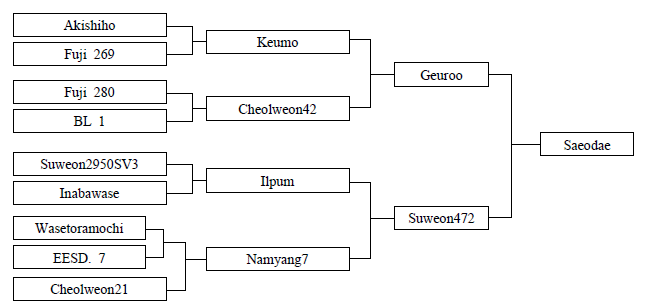
벼 품종 ‘새오대’는 중북부중간지에 적응하는 오대벼 품종 을 대체할 목적으로 2001년 하계에 조생종이면서 단기성 품 종인 그루벼와 중립종인 수원472호(남일벼)를 인공교배하여 18립의 인공교배립를 얻었다. 2002년에 F1세대 18개체를 양 성하였으며 2003년에 F2세대에서 1,200개체를 육성하여 34 개체를 선발하였고 2004년 F3세대 이후부터는 포장에서 계통 육종법에 의해 선발하면서 주요 병해충 및 미질검정을 병행 하였다. 선발된 우량계통에 대해 2008~2009년 2년간 생산 력검정시험을 실시한 결과 조생종이면서 쌀 외관이 양호한 중립종인 SR27376-2-2-1-3 계통을 철원81호 계통명을 부여 하였다. 2010~2012년 3년간 지역적응시험 실시한 결과 (RDA 2010b, 2011b, 2012b) 그 우수성이 인정되어 2012년 12월 농촌진흥청 농작물직무육성신품종선정위원회에서 국가 목록등재 품종으로 선정되어 ‘새오대’라 명명하였다. ‘새오대’ 의 육성 과정과 계통도는 Fig. 1 및 Fig. 2와 같다.
Fig. 1.
Pedigree diagram of ‘Saeodae’.
KJBS-47-148_F1.gif
Fig. 2.
Genealogical diagram of ‘Saeodae’.
KJBS-47-148_F2.gif
출수기 및 주요 농업적 특성
새오대의 출수기는 철원에서 7월 25일로 오대벼와 비교 2 일 빠른 조생종이다. 벼 키는 66 cm로 오대벼의 73 cm 보다 는 7 cm 작으며, 이삭수도 12개로 오대벼의 14개 보다 2개 적은 반면, 벼알수는 77개로 오대벼의 70개 보다 약간 많다. 또 현미천립중은 26.5 g으로 오대벼의 26.3 g과 비슷한 편이 다(Table 1).
Table 1.
Major agronomic traits and yield components in Cheolwon during 2010~2012.
Table 1.
Variety Heading date Culm length (cm) Panicle length (cm) No. of panicles /hill No. of spikelets /panicle Ratio of ripened grain (%) 1000-grain weight of brown rice (g)

Saeodae July 25 66* 21 12 77* 83.9 26.5
Odaebyeo July 27 73 20 14 70 79.4 26.3

*are significant at P = 0.05

생리장해 저항성
새오대의 수발아율 17.7%로 오대벼에 비해 약간 많이 되 지만, 불시출수 정도, 성숙기 하엽노화 및 위조현상은 오대벼 와 비슷하다. 13°C의 저온에서의 발아율은 70%로 오대벼에 비하여 양호하다. 춘천에서의 냉수처리 내냉성 검정 결과 냉 수구 임실율이 25%로 오대벼의 51% 대비 낮은 편이지만 출 수지연 등 기타 내냉성 특성은 오대벼와 비슷한 편이다(Table 2). 도복특성 검정에서 좌절중이 높고 도복지수는 약간 낮아 포장도복이 강한 편이다(Table 3).
Table 2.
Response to physiological and abiotic stresses.
Table 2.
Variety Germination rate at low tem. (13°C, %) Prema-ture heading (%) Occurrence of wilting Leaf senescence at maturing Cold tolerancey Viviparous germination (%)

Discolorationz B(1~9) Heading delay (day) Grain fertility (%)

Saeodae 70** 21.3 Strong Slow 5 11 25 17.7
Odaebyeo 54 20.2 Strong Slow 5 12 51 2.6

zEvaluation at maximum tillering stage (1: toterance; 9: susceptible)

yCold tolerance was evaluated at cold-water (17°C) irrigation nursery in Chuncheon.

**are significant at P = 0.01

Table 3.
Major characteristics related to lodging.
Table 3.
Variety Clum length (cm) Third internode length (cm) Breaking strength (g) Lodging index Lodging in the field (1~9)

Transplanting Direct seeding

Saeodae 66** 11.5* 716** 191* 1 9
Odaebyeo 75 14.6 541 213 1 9

*are significant at P = 0.05 and 0.01 respectively

**are significant at P = 0.05 and 0.01 respectively

병해충 저항성
전국 14개 장소에서 잎도열병 밭못자리 검정 결과 새오대 품종은 오대벼의 중정도의 저항성정도 보다 강한 반응을 보 였으며, 또 목도열병에 대해서도 오대벼보다 다소 강하였다 (Table 4). 기타 흰잎마름병, 바이러스 및 멸구류에는 저항성 이 없었다(Table 5).
Table 4.
Resistance reaction to blast disease and bacterial blight.
Table 4.
Variety Reaction at blastz nursery test Neck blasty (%) Bacterial blight


No. of tested sites Icheon Jecheon K1 K2 K3 K3a Field (0~9)

R x (0~3) M (4~6) S (7~9) Ave.

Saeodae 12 2 0 1.9** 12.4 0 S S S S S
Odaebyeo 4 9 1 4.3 1.5 31.4 S S S S S

zN fertilizer of blast nursery test : 240 kg/ha

yN fertilizer of neck blast : 220 kg/ha

xR : resistance, M : moderately resistance, S : susceptible

**are significant at P = 0.01

Table 5.
Reaction to virus disease and insect pests.
Table 5.
Variety Virus diseases Resistance to insectsz


Stripe Dwarf Black streak dwarf BPH WBPH SBPH

Saeodae Sy S S S S S
Odaebyeo S S S S S S

zBPH: brown planthopper, WBPH: white-backed planthopper, SBPH: small brown planthopper

yS : susceptible.

미질 특성 및 단백질 조성
새오대의 정조 및 현미의 장폭비는 오대벼와 비슷한 단원 립이다. 쌀의 외관으로 대비품종 오대벼의 심복백이 3/1로 미 질이 불량한데 새오대는 심복백이 없어 맑고 투명하다. 알카 리 붕괴도는 6.4, 단백질 함량은 6.4% 그리고 아밀로스 함량 은 20.0%로 오대벼와 비슷하다(Table 6).
Table 6.
Grain appearance, physicochemical properties of endosperm starch and grain quality of ‘Saeodae’.
Table 6.
Variety Brown rice White core/belly (0~9) Alkali digestive value (1~7) Protein content (%) Amylose content (%) Palatability of cooked rice (-3~+3)

Length (mm)c Width (mm) L/W ratio

Saeodae 5.32 2.88 1.85 0/0** 6.4 6.4 20.0 0.01
Odaebyeo 5.28 2.90 1.83 3/1 6.6 6.6 20.0 0.43

**are significant at P = 0.01

수량성
쌀수량은 2010년부터 2012년까지 철원, 정선, 제천 및 상 주 4지역에서 보통기 보비재배의 3년 평균이 5.26 MT/ha로 대비품종 5.16 MT/ha 보다 2% 증수되었다. 중부평야, 호남 평야 및 영남평야의 소득작물 후작재배에서 평균 쌀수량은 4.45 MT/ha 이었다(Table 7).
Table 7.
Milled rice yield of ‘Saeodae’ at local adaptability test.
Table 7.
Culture season Tested site Brown rice yield (MT/ha) Index (A/B)

Saeodae Odaebyeo


’09 ’10 ’11 Ave. (A) ’09 ’10 ’11 Ave. (B)

Ordinary season culture Cheolwon 5.39 4.57 5.27 5.08 4.69 5.03 5.23 4.98 102
Jeongseon 5.64 4.27 5.48 5.13 5.04 5.32 5.49 5.28 97
Jecheon 6.48 4.89 4.55 5.31 5.95 4.71 4.24 4.97 107
Sangju 5.34 5.65 5.36 5.45 4.99 5.43 5.20 5.21 105
Average 5.64 4.88 5.25 5.26 5.12 5.21 5.14 5.16 102

Extremely late season culture Suwon - - 4.98 4.98 - - (4.95) (4.95) 101
Iksan - - 3.81 3.81 - - (3.31) (3.31) 105
Milyang - - 4.56 4.56 - - (4.41) (4.41) 103
Average - - 4.45 4.45 - - (4.22) (4.22) 106

( ): deta of ‘Geumobyeo’

재배상 유의점
질소질 비료 과용시 미질저하, 등숙저하 및 병해충 발생이 우려되므로 적정 균형시비를 하여야 하며, 모내기 지연시에 불시출수와 수확기 장마에 수발아 등이 우려되므로 적기 모 내기 및 적기 수확을 하여야 하고, 냉수용출답이나 만식재배 는 피해야 한다. 흰잎마름병, 줄무늬잎마름병 및 멸구류에 저 항성이 없으므로 적기 기본방제를 하여야 한다. 또 주당수수 가 적은 편으로 초기생육 기간 수수 확보를 위한 재배가 필요 하다.
적 요
벼 품종 ‘새오대’는 중북부중간지에 적응하는 오대벼 품종 을 대체할 목적으로 조생종이면서 단기성 품종인 그루벼와 중립종인 수원472호(남일벼)를 2001년 인공교배하여 계통육 종법에 의해 선발하여 2008~2009년 2년간 생산력검정시험 을 실시한 후 쌀 외관이 양호한 중립종인 SR27376-2-2-1-3 을 철원81호로 계통명을 부여하였다. 2010~2012년 3년간 지역적응시험을 실시하여 2012년 12월 농촌진흥청 농작물직 무육성신품종선정위원회에서 국가목록등재 품종으로 선정되 어 ‘새오대’라 명명하였다. 이 품종의 주요특성과 수량성을 요약하면 다음과 같다.
‘새오대’벼 품종은 출수기가 철원에서 7월 25일로 오대벼 와 비교하였는데 2일 빠른 조생종이다. 벼 키는 66 cm로 오 대벼에 비하여 7 cm 작으며, 이삭수도 12개로 오대벼 보다 2개 적으며 벼알수는 77개로 오대벼 보다 약간 많고 또 현미 천립중은 26.5 g으로 오대벼의 26.3 g과 비슷하다. 수발아율 은 17.7%로 오대벼에 비해 약간 많이 되지만, 불시출수 정도, 성숙기 하엽노화 및 위조현상은 오대벼와 비슷하며 13°C의 저온에서 발아율은 70%로 양호하지만 냉수처리 내냉성 검정 결과 냉수구 임실율이 25%로 오대벼의 51% 대비 낮은 편이 다. 또 출수지연 등 기타 내냉성 특성은 오대벼와 비슷한 편 이다. 도복특성 검정에서 좌절중이 높고 도복지수는 약간 낮 아 포장도복이 강한 편이다. 잎도열병 밭못자리 검정 결과 ‘새오대’ 품종은 오대벼보다 강한 편이지만 기타 흰잎마름병, 바이러스 및 멸구류에는 저항성이 없다. 정조 및 현미의 장폭 비는 오대벼와 비슷한 단원립이고 쌀의 외관은 대비품종 오 대보다는 맑고 투명하다. 알카리 붕괴도와 단백질 함량 및 아 밀로스 함량도 오대벼와 비슷하다. 쌀수량은 보통기 보비재배 의 3년 평균 5.26 MT/ha로 대비품종 5.16 MT/ha보다 6% 증수되었다.
본 성과물은 농촌진흥청 연구사업(세부과제명: 중북부 중간지 적응 조숙 고품질 품종 개발, 세부과제번호: PJ009325042015) 의 지원에 의해 이루어진 것입니다. 새오대를 육성함에 있어 적극 협력하여 주신 국립식량과학원 벼맥류부와 기능성작물 부 벼품종육종연구실 및 각도 농업기술원 지역적응시험 담당 자분들과 농촌진흥청 연구정책국 관계관 여러분들께 깊은 감 사를 드리는 바이다.
  • 1. Rural Development AdministrationCommentary of Varieties of the Main Crops 1992. 194-199.
  • 2. Rural Development AdministrationCommentary of Varieties of the Main Crops 2002. 499-505.
  • 3. Rural Development AdministrationResearch Plan of Development New Variety of Summer Crop 2010a. 3-52.
  • 4. Rural Development AdministrationReport of New Cultivars Development and Research in Summer Crop 2010b. 3-118.
  • 5. Rural Development AdministrationResearch Plan of Development New Variety of Summer Crop 2011a. 3-53.
  • 6. Rural Development AdministrationReport of New Cultivars Development and Research in Summmer Crop 2011b. 3-126.
  • 7. Rural Development AdministrationResearch Plan of Development New Variety of Summmer Crop 2012a. 3-50.
  • 8. Rural Development AdministrationReport of New Cultivars Development and Research in Summmer Crop 2012b. 3-217.
  • 9. Ryu HY, Choi HC, Shin YS, Jung KH, Hwang HG, Moon HP, Lee JH, Jeon YH, Kim HY, Kang KH, Hong HC, Kim KW, Yea JD, Kim YG, Hahn HS, Song MT, Jeong EG, Jeong OY, Yang CI, Choi YH, Baek MK, Cho YC. A new early-maturing and high-quality rice cultivar, ‘Taeseongbyeo’. Korean J. Breed. Sci 2005. 37: 169-170.
  • 10. Ryu HY, Jeon YH, Jung KH, Shin YS, Hwang HG, Kim HY, Kim MK, Jeong OY, Won YJ, Kim YG, Yang CI, Lee JH, Lee JI, Lee JH, Choi YH, Yang SJ, Ahn EK. A new early-maturing, blast resistant and high quality rice cultivar, ‘Pyeongweon’. Korean J. Breed. Sci 2009. 41: 177-181.
  • 11. Won YJ, Ryu HY, Shin YS, Hong HC, Kim YG, Kim MK, Jung KH, Jeon YH, Cho YC, Ahn EK, Yoon KS, Lee JH, Kim JJ, Oh SK, Oh MK, Jeung JU, Chun AR, Park HM, Roh JH, Yoon YH. An extremely early-maturing, plain area adaptable, blast resistant and high grain quality rice cultivar, ‘Joun’. Korean J. Breed. Sci 2010. 42: 313-317.

Download Citation

Download a citation file in RIS format that can be imported by all major citation management software, including EndNote, ProCite, RefWorks, and Reference Manager.

Format:

Include:

An Early-Maturing and Medium-Grain Rice Variety ‘Saeodae’
Korean. J. Breed. Sci.. 2015;47(2):148-153.   Published online June 30, 2015
Download Citation

Download a citation file in RIS format that can be imported by all major citation management software, including EndNote, ProCite, RefWorks, and Reference Manager.

Format:
Include:
An Early-Maturing and Medium-Grain Rice Variety ‘Saeodae’
Korean. J. Breed. Sci.. 2015;47(2):148-153.   Published online June 30, 2015
Close

Figure

  • 0
  • 1
An Early-Maturing and Medium-Grain Rice Variety ‘Saeodae’
Image Image
Fig. 1. Pedigree diagram of ‘Saeodae’.
Fig. 2. Genealogical diagram of ‘Saeodae’.
An Early-Maturing and Medium-Grain Rice Variety ‘Saeodae’

Major agronomic traits and yield components in Cheolwon during 2010~2012.

Variety Heading date Culm length (cm) Panicle length (cm) No. of panicles /hill No. of spikelets /panicle Ratio of ripened grain (%) 1000-grain weight of brown rice (g)

Saeodae July 25 66* 21 12 77* 83.9 26.5
Odaebyeo July 27 73 20 14 70 79.4 26.3

*are significant at P = 0.05

Response to physiological and abiotic stresses.

Variety Germination rate at low tem. (13°C, %) Prema-ture heading (%) Occurrence of wilting Leaf senescence at maturing Cold tolerancey Viviparous germination (%)

Discolorationz B(1~9) Heading delay (day) Grain fertility (%)

Saeodae 70** 21.3 Strong Slow 5 11 25 17.7
Odaebyeo 54 20.2 Strong Slow 5 12 51 2.6

zEvaluation at maximum tillering stage (1: toterance; 9: susceptible)

yCold tolerance was evaluated at cold-water (17°C) irrigation nursery in Chuncheon.

**are significant at P = 0.01

Major characteristics related to lodging.

Variety Clum length (cm) Third internode length (cm) Breaking strength (g) Lodging index Lodging in the field (1~9)

Transplanting Direct seeding

Saeodae 66** 11.5* 716** 191* 1 9
Odaebyeo 75 14.6 541 213 1 9

*are significant at P = 0.05 and 0.01 respectively

**are significant at P = 0.05 and 0.01 respectively

Resistance reaction to blast disease and bacterial blight.

Variety Reaction at blastz nursery test Neck blasty (%) Bacterial blight


No. of tested sites Icheon Jecheon K1 K2 K3 K3a Field (0~9)

R x (0~3) M (4~6) S (7~9) Ave.

Saeodae 12 2 0 1.9** 12.4 0 S S S S S
Odaebyeo 4 9 1 4.3 1.5 31.4 S S S S S

zN fertilizer of blast nursery test : 240 kg/ha

yN fertilizer of neck blast : 220 kg/ha

xR : resistance, M : moderately resistance, S : susceptible

**are significant at P = 0.01

Reaction to virus disease and insect pests.

Variety Virus diseases Resistance to insectsz


Stripe Dwarf Black streak dwarf BPH WBPH SBPH

Saeodae Sy S S S S S
Odaebyeo S S S S S S

zBPH: brown planthopper, WBPH: white-backed planthopper, SBPH: small brown planthopper

yS : susceptible.

Grain appearance, physicochemical properties of endosperm starch and grain quality of ‘Saeodae’.

Variety Brown rice White core/belly (0~9) Alkali digestive value (1~7) Protein content (%) Amylose content (%) Palatability of cooked rice (-3~+3)

Length (mm)c Width (mm) L/W ratio

Saeodae 5.32 2.88 1.85 0/0** 6.4 6.4 20.0 0.01
Odaebyeo 5.28 2.90 1.83 3/1 6.6 6.6 20.0 0.43

**are significant at P = 0.01

Milled rice yield of ‘Saeodae’ at local adaptability test.

Culture season Tested site Brown rice yield (MT/ha) Index (A/B)

Saeodae Odaebyeo


’09 ’10 ’11 Ave. (A) ’09 ’10 ’11 Ave. (B)

Ordinary season culture Cheolwon 5.39 4.57 5.27 5.08 4.69 5.03 5.23 4.98 102
Jeongseon 5.64 4.27 5.48 5.13 5.04 5.32 5.49 5.28 97
Jecheon 6.48 4.89 4.55 5.31 5.95 4.71 4.24 4.97 107
Sangju 5.34 5.65 5.36 5.45 4.99 5.43 5.20 5.21 105
Average 5.64 4.88 5.25 5.26 5.12 5.21 5.14 5.16 102

Extremely late season culture Suwon - - 4.98 4.98 - - (4.95) (4.95) 101
Iksan - - 3.81 3.81 - - (3.31) (3.31) 105
Milyang - - 4.56 4.56 - - (4.41) (4.41) 103
Average - - 4.45 4.45 - - (4.22) (4.22) 106

( ): deta of ‘Geumobyeo’

Table 1. Major agronomic traits and yield components in Cheolwon during 2010~2012.

are significant at P = 0.05

Table 2. Response to physiological and abiotic stresses.

Evaluation at maximum tillering stage (1: toterance; 9: susceptible)

Cold tolerance was evaluated at cold-water (17°C) irrigation nursery in Chuncheon.

are significant at P = 0.01

Table 3. Major characteristics related to lodging.

are significant at P = 0.05 and 0.01 respectively

are significant at P = 0.05 and 0.01 respectively

Table 4. Resistance reaction to blast disease and bacterial blight.

N fertilizer of blast nursery test : 240 kg/ha

N fertilizer of neck blast : 220 kg/ha

R : resistance, M : moderately resistance, S : susceptible

are significant at P = 0.01

Table 5. Reaction to virus disease and insect pests.

BPH: brown planthopper, WBPH: white-backed planthopper, SBPH: small brown planthopper

S : susceptible.

Table 6. Grain appearance, physicochemical properties of endosperm starch and grain quality of ‘Saeodae’.

are significant at P = 0.01

Table 7. Milled rice yield of ‘Saeodae’ at local adaptability test.

( ): deta of ‘Geumobyeo’