Skip to main navigation Skip to main content

Korean. J. Breed. Sci. : Korean Journal of Breeding Science

OPEN ACCESS
ABOUT
BROWSE ARTICLES
EDITORIAL POLICIES
FOR CONTRIBUTORS

Articles

ARTICLE

분지발생이 많으면서 약용성분 함량이 많은 구기자 신품종 ‘청광’

A Chinese Matrimony Vine (Lycium chinense Miller) Cultivar with Many Branches and High Ingredients ‘Cheongkwang’

Korean Journal of Breeding Science 2015;47(3):318-323.
Published online: August 31, 2015

1 충남농업기술원 청양구기자시험장

1 Cheongyang Boxthorn Experiment Station, Chungnam-Do ARES, 33319, Cheongyang, Korea

2 충남농업기술원 기술개발국

2 Research and Development Bureau, Chungnam-Do ARES, 32418, Yesan, Korea.

*Corresponding author (cnswhtbar@korea.kr, Tel: +82-41-635-6384, Fax: +82-41-635-7933)
• Received: June 27, 2015   • Revised: July 26, 2015   • Accepted: August 6, 2015

© Korean Society of Breeding Science All rights reserved

This is an Open-Access article distributed under the terms of the Creative Commons Attribution Non-Commercial License (http://creativecommons.org/licenses/by-nc/3.0) which permits unrestricted non-commercial use, distribution, and reproduction in any medium, provided the original work is properly cited.

  • 2 Views
  • 0 Download
prev next
  • The new Chinese matrimony vine line, CB04340-64 was selected from the hybrids(F1) between CB02214-131 (IT232701) and Cheongyang 7 (IT232601) in 2004 to breed the cultivar with high quality and yielding. Its preliminary yield tests were performed from 2006 to 2008 and the selected line was named Cheongyang 14. Its regional yield trial was carried out in Cheongyang, Yesan and Jindo from 2009 to 2011 and Cheongyang 14 was registered as the new variety, ‘Cheongkwang’ in 2011. The specific characteristics were summarized as follows; The leaf was ellipsoidal and small size. The fruit type was oblong and middle size. The flowering time was June 26 with medium flowering. The branching by twice pruning was generated a lot more than the check variety, Cheongun. The resistances to anthracnose and eriophyidae mite were similar to that of the check variety. The content of betaine of dried-fruit and brix degree of fresh fruit were higher than that of the check. The dried-fruit yield was increased about 15 percent in preliminary yield tests and 6 percent regional yield trials. This variety has self-incompatibility. So, the companion variety, Cheongmyeong, was required as pollinizer. (Certificate on grant of plant variety rights: Grant number No.4794, Protection Period 10/02/2014∼09/02/2034).
구기자나무는 가지과(Solanceae)에 속하는 갈잎 떨기나무 로서 Lycium chinense Miller, L. barbarum L. 등 6종이 있 으며, 우리나라에서는 L. chinense Miller, 중국에서는 L. barbarum(영하구기)과 L. chinense 등을 재배하고 있다. 구 기자 재배면적(MAFRA 2014)은 121 ha로서 53개 약용작물 총 재배면적의 0.87%를 차지하고, 충남 청양, 예산과 전남 진 도가 주산단지이다. 한방에서는 열매를 구기자(Lycii fructus), 잎을 구기엽(Lycii Folium), 뿌리껍질을 지골피(Lycii cortex) 라고 하고, 영명으로는 Gojiberry 또는 Wolfberry라고도 부 른다. 현재 우리나라에서는 대부분 열매를 수확하기 위하여 재배되고 있고, 약주, 차, 음용수, 건강기능성 식품 등 다양한 제품에 이용되고 있으며, 지역연고산업의 주요 근간이 되는 지역특화작물이다.
구기자의 주요성분으로 베타인(Betaine), 제아잔틴(Zeaxanthin), 카로틴(Carotene), 티아민(Thiamine), 비타민 B1, B2, C, 다 량의 다당류 및 유기산 등이 함유되어 있다(Kim et al. 2005, Park et al. 2012, Wang 2009). 구기자는 오래 전부터 한방에 서 약재로 사용되던 생약자원으로 간 기능 개선 보호(Kang et al. 2006), 구기자 추출물의 항비만 및 혈당강하 효과(Hwang et al. 2009), 항산화와 항고혈압 효과(Cho et al. 2005), 항혈 당에 대한 효과(Kim & Kim 1994) 등이 있는 것으로 보고되 고 있다. 특히 구기자의 지표성분인 베타인(C5H11NO2: 117.15)은 간에서 Methionine의 생성을 위한 methyl group 의 공여체로 작용하여 간 기능 및 시력을 보호하고 숙취해소 에 탁월한 효능이 있는 것으로 보고되고 있다(Barak et al. 1996).
기후변화에 대응하고, 미래 수요에 부응하기 위하여 병충 해 저항성이면서 다수성인 구기자 신품종이 지속적으로 육성 되어야 한다. 이에 충남농업기술원 청양구기자시험장에서 2010 년도에 중생종이면서 탄저병에 중강이고 다수성인 구기자 신품 종 ‘청광(품종보호 제4794호, 2014.02.10.~2034.02.09)’을 선 발한 경위와 주요 특성을 보고하는 바이다.
본 시험에 사용된 계통은 2004년에 CB02214-131 (IT232701) 과 청양 7호(IT232601)를 인공 교배하여 선발한 ‘청양 14호’ 이고, 대비품종은 생산력검정 시험에서 ‘명안’, 지역적응시험 에서 ‘청운’으로 하였다. 생산력검정시험은 충남 청양군에 소 재한 청양구기자시험장에서 2006~2008년 3년간에 수행되 었고, 지역적응시험은 충남 청양, 예산, 그리고 전남 진도에서 2009부터 2011년까지 3개년간 실시하였다.
정식은 3월 중순에 120 cm 간격으로 높은 이랑을 만들고 비닐멀칭 한 후 40 cm 간격으로 약 15 cm 길이의 삽수를 1 본씩 꺾꽂이 하였다. 시비량은 N-P2O5-K2O를 40-30-30 kg/ 10a로 하였고, 이중 기비로 질소 60%, 인산 전량, 칼리 70% 시용하였으며, 추비는 질소 30%, 칼리 30%를 6월 하순에 시 용하였다. 기타 재배법은 청양구기자시험장의 구기자 표준재 배법에 준하였고, 생육 및 수량조사는 농촌진흥청 시험연구조 사기준(RDA 2012)에 준하였다.
구기자의 주요 지표성분인 베타인(IUPAC name: 2-trimetylammonioacetate) 함량 분석은 건조시료 10 g에 증류수 100 ml를 가하여 95°C water bath에서 추출한 후 여과하여 HPLC (Thermo separation products/Spetra system P2000) 로 분석하였다(Wollf et al. 1989). 분석조건은 Carbohydrate ES 5u (250 mm × 4.6 mm) column을 이용하여 이동상은 HPLC grade water : acetonitrile = 30 : 70, 검출기는 ELSD (Alltech 3300), 유속은 0.5 ml/min이며, 함량계산은 외부표 준법에 의하여 정량하였다. 이외에 엽록소는 Minolta SPAD- 502(-9.9~199), 색도는 Minolta SPAD-502 (-9.9~199), 당 도는 Refractometer (GMK-701AC), 산도는 전위차 측정기 (809 Titrando, Metrohm) 등을 이용하여 측정하였다.
육성경위
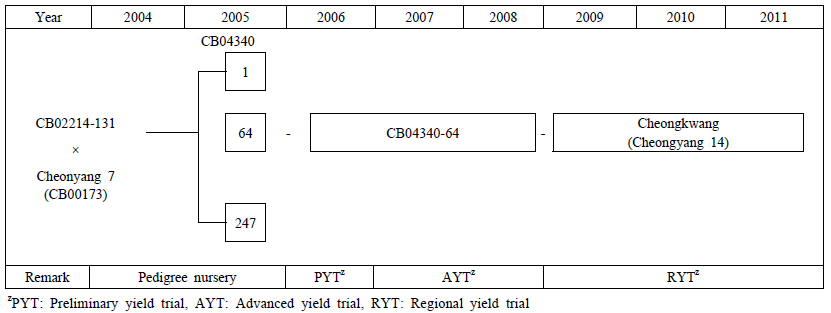
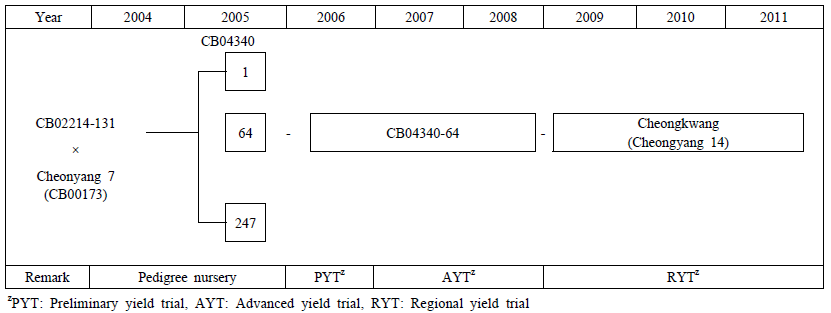
2004년에 CB02214-131 (IT232701)을 모본으로, 청양 7호 (IT232601)를 부본으로 하여 인공교배를 실시하였다. 2005년 에 F1인 종자 247립을 파종하여 그 중 64번 개체인 CB04340- 64를 선발하였고, 2006~2008년까지 생산력검정예비시험과 본시험을 실시한 결과 주요 생육특성이 우수하여 ‘청양 14호’ 로 계통명을 부여하였다. 충남 청양, 예산군, 전남 진도군 등 3지역에서 2009~2011년까지 3개년간 지역적응성을 검정한 결과 중생종이면서 내병충성, 지표성분 고함유, 다수성으로서 2011년 농촌진흥청 직무육성 신품종 선정위원회에서 신품종 으로 인정되어 ‘청광’으로 명명하였다. 구기자 신품종을 육성 하기 위한 인공교배, 계통육성, 생산력검정, 지역적응성검정 등 일련의 선발과정은 Fig. 1과 같다.
Fig. 1.
Pedigree diagram of the cultivar ‘Cheongkwang’.
KJBS-47-318_F1.gif
주요특성

고유특성

신품종 ‘청광’의 고유특성은 Table 1에서 보는 바와 같이 잎은 녹색이고 대비품종인 ‘청운’에 비하여 길이가 짧고 폭이 넓은 둥근 피침형이며 크기는 다소 작다. 수형은 반개장형(반 직립형)이고, 열매는 장타원형이다.
Table 1.
Inherent characteristics of the new cultivar ‘Cheongkwang’ and the check.
Table 1.
Cultivar Plant shape Leaf Branch habit Thorn Fruit shape

Color Shape Size

Cheongkwang Semi-spreading Green Round lanceolate Small High Present Long ellipsoidal
Cheongun Semi-spreading Green Round lanceolate Medium Medium Present ellipsoidal

개화기 및 농업적 특성

구기자 ‘청광’의 개화기는 6월 26일로 대비품종인 ‘청운’ 에 비하여 4일 빠르고, 중생종이다. 줄기는 약 108 cm로 ‘청 운’에 비하여 약 15 cm 작고 가늘며, 2회의 적심에 의하여 결 과지가 84개 발생되어 대비품종 ‘청운’에 비하여 분지 발생량 이 많았다(Table 2).
Table 2.
Flowering dates and agronomic characteristics of the Chinese matrimony vine cultivar ‘Cheongkwang’.
Table 2.
Cultivar Flowering date Leaf(cm) Stem No. of branch(ea/Plant)


Length (A) Width (B) Shape (B/A) Length (cm) Diameter (mm) 1st 2nd 3rd Total

Cheongkwang June 26 5.9 b 2.4 a 0.41 108 b 5.3 b 31 40 13 84 a
Cheongun June 30 6.9 a 2.1 b 0.30 123 a 6.3 a 24 30 11 65 b

zIn a column, same letters are not significantly different at the 5% level by DMRT

열매(과)의 100과 무게는 약 18.7 g로 대비품종 ‘청운’과 비슷하였다. 열매 모양은 폭/길이의 비율로 추정할 수 있는데 ‘청광’의 과형지수는 0.46으로서 대비품종인 ‘청운’ 0.55와 비교하면 길쭉한 장타원형이었다(Table 3).
Table 3.
Fruit characteristics of Chinese matrimony vine cultivar ‘Cheongkwang’.
Table 3.
Cultivar No. of fruit per plant (ea) 100-fruit wt. (g) Fruit (mm) Length of peduncle (mm)


Fresh Dried Dried Width (B) B/A

Cheongkwang 405 b 93.5 a 18.7 a 23.6 a 10.9 b 0.46 19.5 a
Cheongun 459 a 93.4 a 18.1 a 19.4 a 10.6 b 0.55 17.7 b

zIn a column, same letters are not significantly different at the 5% level by DMRT

구기자 열매의 색도(Table 4)를 보면 ‘청광’은 ‘청운’에 비 하여 생구기자(생과)의 명도(L)는 다소 높았으나 적색도(a)가 낮았고, 건구기자(건과)의 명도와 적색도는 모두 낮았다. 열매 의 붉은 정도는 적색도/황색도 비율로 비교할 수 있는데, ‘청 광’은 생과 1.04, 건과 1.12, ‘청운’은 생과 1.23, 건과 1.19로 서 ‘청광’의 붉은 정도가 대비품종에 비하여 다소 낮았다.
Table 4.
Fruit color value (D65) of the ‘Cheongkwang’.
Table 4.
Cultivar Fresh fruity Dried fruity


L A b L a b

Cheongkwang 38.2 a 28.1 b 27.0 a 30.2 a 17.5 b 15.6 a
Cheongun 37.2 a 30.3 a 24.6 b 31.1 a 19.1 a 16.1 a

zIn a column, same letters are not significantly different at the 5% level by DMRT

yL(Lightness): 0 (Black) ↔ 100 (White), a (Redness): + (Red) ↔ - (Green), b (Yellowness): + (Yellow) ↔ - (Blue)

병해충 저항성

병해충 저항성(Table 5)은 무방제 상태로 관리된 노지포장 에서 자연 발생 정도를 조사하였는데, 구기자 잎의 혹응애 발 생율은 27.8%, 열매의 탄저병 이병과율은 28.1% 로서 대비 품종인 ‘청운’과 비슷하였다. 구기자 재배에 있어서 병해충으 로 인한 피해가 수량감소의 가장 큰 요인으로 작용하는데 특 히 잎에서는 혹응애, 열매에서는 탄저병의 피해가 크다. 구기 자 나무의 혹응애는 년 6~7회 발생하고, 성충 상태로 충영내 에서 월동하여 5월 하순에 제1회 성충이 나타나며 생육기간 이 길수록 그 피해가 크게 나타난다(Kim 1968). 구기자 나무 의 탄저병은 Colletotrichum gloeosporioidesC. dematium (Fr.) Grove 등 2종이 동정되었고, 평균온도 25°C 이상의 다 습한 조건에서 발생이 많으며, 열매에 수침상의 흑색 병반과 포자층을 형성하여 수량감소에 큰 영향을 미친다(Lee et al. 1986). 따라서 구기자에 발생하는 병해충을 방제하기 위해서 는 비가림 하우스 재배(Choi et al. 1996), 화학적 방제(Cho et al. 1995, Koo 2008), 친환경 유기농자재 이용(Lee et al. 2011, Ryu et al. 2013) 등의 방법을 이용하여 예방 위주로 방제할 필요가 있다.
Table 5.
Resistance of the Eriophys macrodonis and the Anthracnose of the ‘Cheongkwang’.
Table 5.
Cultivar Eriophys macrodonis Infected rates of Anthracnose (%)

Rate of damaged leaf (%) No. of insect galls per damaged leaf (ea)

Cheongkwang 27.8 a 1.9 b 28.1 a
Cheongun 30.2 a 3.3 a 28.2 a

zIn a column, same letters are not significantly different at the 5% level by DMRT

수량성

2006년부터 2008년까지 3개년간 충남 청양구기자시험장 에서 생산력을 검정한 결과 ‘청광’의 건과수량은 198 kg/10a 로서 대비품종인 ‘명안’에 비하여 약 15% 증수되었다(Table 6).
Table 6.
Yield at preliminary yield trial (PYT) and advanced yield trial (AYT) of the Chinese matrimony vine cultivar ‘Cheongkwang’.
Table 6.
Cultivar PYT (kg/10a) AYT (kg/10a) Mean (kg/10a) Index (%)

Cheongkwang 220 a 176 a 176 a 115
Myeongan 195 b 149 b 172 100

zIn a column, same letters are not significantly different at the 5% level by DMRT

구기자의 주요 주산지인 충남 청양, 예산, 전남 진도 등 3 개 지역에서 2009~2011년 3년간 지역적응성을 검정한 결과 평균 건과수량은 124 kg/10a로서 대비품종인 ‘청운’보다 6% 증수되었다(Table 7).
Table 7.
Yield at regional yield trial of the Chinese matrimony vine cultivar ‘Cheongkwang’.
Table 7.
Cultivar Site Dried-fruit yield (kg/10a) Index (%)

year Cheongyang Yesan Jindo Mean

Cheongkwang 2009 114 133 123 123 106
2010 92 85 88 88
2011 129 152 196 159
Mean 112 123 136 124

Cheongun 2009 83 137 145 122 100
2010 61 76 74 70
2011 118 139 213 157
Mean 87 117 144 116

C.V. -------------------------------------------------------------------- 15.6

LSD(5%) -------------------------------------------------------------- 11.9

성분분석

구기자의 주요 성분으로 베타인, Fructose와 Glucose는 건 구기자로 분석하였고, 당도와 산도는 생구기자로 측정하였다. 구기자의 지표성분인 베타인 함량은 ‘청광’ 0.75%로서 대비 품종인 ‘청운’에 비하여 다소 높았고, Fructose는 약 1.0% 높 았으며, 당도는 약 2.1°Brix 높았고 산도는 비슷하였다(Table 8).
Table 8.
Chemical component of Chinese matrimony vine cultivar ‘Cheongkwang’.
Table 8.
Cultivar Betaine (%) Fruit acidity (%) Soluble solids (°Brix) Free sugar (%)

Fructose Glucose

Cheongkwang 0.75 0.36 15.3 23.9 10.9
Cheongun 0.63 0.37 13.2 22.9 10.4

재배시 유의사항

구기자는 자가불화합성이 있어 단일품종을 집단 재배하면 수정과 결실이 되지 않으므로 수분수 품종과 혼식하여 재배 할 필요가 있다(Choi et al. 2000). 수분수 품종은 개화기와 열매크기가 비슷하고, 두 품종의 혼식에 의하여 결실률이 높 은 품종으로 선정하였는데, 신품종 ‘청광’의 수분수 추천 품 종은 ‘청명’이 적합하였다. 건구기자의 외관 품질 향상을 위 하여 성숙 적기에 수확하고, 건조 온도 준수할 필요가 있다. 또한 혹응애와 탄저병 저항성은 중강이나, 예방 위주로 방제 를 실시할 필요가 있었고, 습해에 약하므로 높은 이랑으로 재 배하고 강우시 배수를 철저히 실시하여야 한다.
내병충, 다수성 계통인 CB02214-131 (IT232701)을 모본 으로 하고, 청양 7호(IT232601)를 부본으로 인공교배를 실시 하여 CB04340-64를 선발하고, 생산력검정 시험 결과 병충해 에 강하며 다수성으로 인정되어 ‘청양 14호’로 계통명을 부여 하였다. 구기자 우량계통 ‘청양 14호’는 청양, 예산, 진도 등 3지역에서 2009~2011년 3개년간 지역적응성을 검증한 결 과 생육이 양호하고 병해충에 강하며 약용성분이 많을 뿐만 아니라 수량성이 우수하여 ‘청광’으로 2012년에 품종보호출 원하였고, 국립종자원에 품종보호등록(품종보호 제 4794호, 2014.02.10~2034.02.09) 되었다. 주요특성을 요약하면 잎은 둥근 피침형이고 다소 작으며, 열매는 장타원형이고 중간크기 이었다. 개화기는 6월 26일로서 중생종이였다. ‘청광’은 대비 품종에 비하여 2회의 적심에 의하여 분지 발생이 많았다. 혹 응애와 탄저병 저항성은 중강으로 대비품종과 비슷하였다. 지 표성분인 베타인 함량은 0.75%, 당도는 15.3°Brix로 대비품 종에 비하여 다소 높았다. 건과수량은 대비품종에 비하여 생 산력 검정시험에서 15%, 지역적응시험에서 6% 증수되었다. 이 품종은 자가불화합성이 있으므로 수분수 품종으로 ‘청명’ 과 같이 혼식하여 재배하여야 한다.
  • 1. Barak AJ, Beckenhauer HC, Tuma DJ. Betaine, ethanol, and the liver. A Review Alcohol (New York). 1996. 13: 395-398.
  • 2. Cho IS, Paik SW, LEE BC, Seo GS, Yoon ST. Screening of chemicals for control of Colletotrichum gloeosporiodes in Lycium chinense Miller. Korean J Medicinal Crop Sci 1995. 3: 9-11.
  • 3. Cho YJ, Chun SS, Cha WS, Park JH, Lee KH, Kim JH, Kwon HJ, Yoon SJ. Antioxidative and anti-hypertensive effects Lycii fructus extracts. J Korean Soc Food Nutr 2005. 34: 1308-1313.
  • 4. Choi BJ, Han SH, Han KS, JU JI, Lee BC, Moon CS. Effects of the rain shelter and insect net on growth and yield of Lycium chinense Miller. Korean J Medicinal Crop Sci 1996. 4: 58-63.
  • 5. Choi JE, Kim YC, Lee EJ, You SJ, Lee BC. Self-incompatibility in Boxthorn (Lycium chinense Mill). Korean J. Breed. Sci 2000. 32: 122-126.
  • 6. Hwang EY, Hong JH, Choi JH, Lee EJ, Lee IS. Study on anti-obesity hypoglycemic effects of Lycium chinense Mill extracts. J Korean Soc Food Nutr 2009. 38: 1528-1534.
  • 7. Kang KI, Jung JY, Koh KH, Lee CH. Hepatoprotective effects of Lycium chinense Mill. fruit extracts and fresh fruit juice. Korean J Food Sci Technol 2006. 38: 99-103.
  • 8. Kim CH. Some biological notes on Eriphyes kuko KISHIDA (1) Its biology and life history. Plant Protection 1968. 5: 59-63.
  • 9. Kim SJ, Kim IH. The comparative studies on antidiabetic activities of Lycium drugs. Chung-ang J Pharm Sci 1994. 8: 5-15.
  • 10. Kim EH, Kim HW, Lee JC, Lee CH, Koh KH. Analysis of chemical composition of Bulro Kugi (Lycium chinense Mill.) fruit, leaf and root. Korean J Food Sci Technol 2005. 37: 154-163.
  • 11. Koo HM. Fungicide selection for control of Lycium chinense Anthracnose caused by Colletotrichum spp. Res Plant Dis 2008. 14: 26-31.
  • 12. Lee BH, Park YC, Lee SS, Kim YG, An YS, Yu SH. Studies on outbreak of disease and pests and effects of environmental friendly control materials in Boxthorn (Lycium chinense Mill.) organic cultivation. Korean J Organic Agri 2011. 19: 385-396.
  • 13. Lee JH, Yu SH, Back MK, Kim KS. Two species of Colletotrichum associated with Anthracnose of Lycium chinense. Korean J Plant Pathol 1986. 2: 31-36.
  • 14. Ministry of Agriculture2013 Industrial Crop Production Statistics 2014.
  • 15. Park SY, Park WT, Park YC, Ju JI, Park SU, Kim JK. Metabolomics for the quality assessment of Lycium chinense fruits. Biosci Biotechnol Biochem 2012. 76: 2188-2194.
  • 16. Rural Development Administration (RDA)Manual for agricultural investigation 2012. Suwon. Korea, 773-775.
  • 17. Ryu TH, Park SE, Ko NY, Kim JG, Shin HS, Kwon HR, Kim YG, Lee BH, Seo MJ, Yu YM, Youn YN. Seasonal occurrences of insect pests and control effects of eco-friendly agricultural materials (EFAMs) in the field of Lycium chinense under environment-friendly management. The Korean J Pesticide Sci 2013. 17: 402-410.
  • 18. Wang CC, Chang SC, Chen BH. Chromatographic determination of polysaccharides in Lycium barbarum Linnaeus. Food Chemistry 2009. 116: 595-603.
  • 19. Wollf SD, Yancey PH, Stanton TS, Balaban RS. A simple HPLC method for quantitating major organic solutes of renal medulla. Am J Physiol 1989. 256: 954-956.

Download Citation

Download a citation file in RIS format that can be imported by all major citation management software, including EndNote, ProCite, RefWorks, and Reference Manager.

Format:

Include:

A Chinese Matrimony Vine (Lycium chinense Miller) Cultivar with Many Branches and High Ingredients ‘Cheongkwang’
Korean. J. Breed. Sci.. 2015;47(3):318-323.   Published online September 30, 2015
Download Citation

Download a citation file in RIS format that can be imported by all major citation management software, including EndNote, ProCite, RefWorks, and Reference Manager.

Format:
Include:
A Chinese Matrimony Vine (Lycium chinense Miller) Cultivar with Many Branches and High Ingredients ‘Cheongkwang’
Korean. J. Breed. Sci.. 2015;47(3):318-323.   Published online September 30, 2015
Close

Figure

  • 0
A Chinese Matrimony Vine (Lycium chinense Miller) Cultivar with Many Branches and High Ingredients ‘Cheongkwang’
Image
Fig. 1. Pedigree diagram of the cultivar ‘Cheongkwang’.
A Chinese Matrimony Vine (Lycium chinense Miller) Cultivar with Many Branches and High Ingredients ‘Cheongkwang’

Inherent characteristics of the new cultivar ‘Cheongkwang’ and the check.

Cultivar Plant shape Leaf Branch habit Thorn Fruit shape

Color Shape Size

Cheongkwang Semi-spreading Green Round lanceolate Small High Present Long ellipsoidal
Cheongun Semi-spreading Green Round lanceolate Medium Medium Present ellipsoidal

Flowering dates and agronomic characteristics of the Chinese matrimony vine cultivar ‘Cheongkwang’.

Cultivar Flowering date Leaf(cm) Stem No. of branch(ea/Plant)


Length (A) Width (B) Shape (B/A) Length (cm) Diameter (mm) 1st 2nd 3rd Total

Cheongkwang June 26 5.9 b 2.4 a 0.41 108 b 5.3 b 31 40 13 84 a
Cheongun June 30 6.9 a 2.1 b 0.30 123 a 6.3 a 24 30 11 65 b

zIn a column, same letters are not significantly different at the 5% level by DMRT

Fruit characteristics of Chinese matrimony vine cultivar ‘Cheongkwang’.

Cultivar No. of fruit per plant (ea) 100-fruit wt. (g) Fruit (mm) Length of peduncle (mm)


Fresh Dried Dried Width (B) B/A

Cheongkwang 405 b 93.5 a 18.7 a 23.6 a 10.9 b 0.46 19.5 a
Cheongun 459 a 93.4 a 18.1 a 19.4 a 10.6 b 0.55 17.7 b

zIn a column, same letters are not significantly different at the 5% level by DMRT

Fruit color value (D65) of the ‘Cheongkwang’.

Cultivar Fresh fruity Dried fruity


L A b L a b

Cheongkwang 38.2 a 28.1 b 27.0 a 30.2 a 17.5 b 15.6 a
Cheongun 37.2 a 30.3 a 24.6 b 31.1 a 19.1 a 16.1 a

zIn a column, same letters are not significantly different at the 5% level by DMRT

yL(Lightness): 0 (Black) ↔ 100 (White), a (Redness): + (Red) ↔ - (Green), b (Yellowness): + (Yellow) ↔ - (Blue)

Resistance of the Eriophys macrodonis and the Anthracnose of the ‘Cheongkwang’.

Cultivar Eriophys macrodonis Infected rates of Anthracnose (%)

Rate of damaged leaf (%) No. of insect galls per damaged leaf (ea)

Cheongkwang 27.8 a 1.9 b 28.1 a
Cheongun 30.2 a 3.3 a 28.2 a

zIn a column, same letters are not significantly different at the 5% level by DMRT

Yield at preliminary yield trial (PYT) and advanced yield trial (AYT) of the Chinese matrimony vine cultivar ‘Cheongkwang’.

Cultivar PYT (kg/10a) AYT (kg/10a) Mean (kg/10a) Index (%)

Cheongkwang 220 a 176 a 176 a 115
Myeongan 195 b 149 b 172 100

zIn a column, same letters are not significantly different at the 5% level by DMRT

Yield at regional yield trial of the Chinese matrimony vine cultivar ‘Cheongkwang’.

Cultivar Site Dried-fruit yield (kg/10a) Index (%)

year Cheongyang Yesan Jindo Mean

Cheongkwang 2009 114 133 123 123 106
2010 92 85 88 88
2011 129 152 196 159
Mean 112 123 136 124

Cheongun 2009 83 137 145 122 100
2010 61 76 74 70
2011 118 139 213 157
Mean 87 117 144 116

C.V. -------------------------------------------------------------------- 15.6

LSD(5%) -------------------------------------------------------------- 11.9

Chemical component of Chinese matrimony vine cultivar ‘Cheongkwang’.

Cultivar Betaine (%) Fruit acidity (%) Soluble solids (°Brix) Free sugar (%)

Fructose Glucose

Cheongkwang 0.75 0.36 15.3 23.9 10.9
Cheongun 0.63 0.37 13.2 22.9 10.4
Table 1. Inherent characteristics of the new cultivar ‘Cheongkwang’ and the check.
Table 2. Flowering dates and agronomic characteristics of the Chinese matrimony vine cultivar ‘Cheongkwang’.

In a column, same letters are not significantly different at the 5% level by DMRT

Table 3. Fruit characteristics of Chinese matrimony vine cultivar ‘Cheongkwang’.

In a column, same letters are not significantly different at the 5% level by DMRT

Table 4. Fruit color value (D65) of the ‘Cheongkwang’.

In a column, same letters are not significantly different at the 5% level by DMRT

L(Lightness): 0 (Black) ↔ 100 (White), a (Redness): + (Red) ↔ - (Green), b (Yellowness): + (Yellow) ↔ - (Blue)

Table 5. Resistance of the Eriophys macrodonis and the Anthracnose of the ‘Cheongkwang’.

In a column, same letters are not significantly different at the 5% level by DMRT

Table 6. Yield at preliminary yield trial (PYT) and advanced yield trial (AYT) of the Chinese matrimony vine cultivar ‘Cheongkwang’.

In a column, same letters are not significantly different at the 5% level by DMRT

Table 7. Yield at regional yield trial of the Chinese matrimony vine cultivar ‘Cheongkwang’.

C.V. -------------------------------------------------------------------- 15.6

LSD(5%) -------------------------------------------------------------- 11.9

Table 8. Chemical component of Chinese matrimony vine cultivar ‘Cheongkwang’.