Skip to main navigation Skip to main content

Korean. J. Breed. Sci. : Korean Journal of Breeding Science

OPEN ACCESS
ABOUT
BROWSE ARTICLES
EDITORIAL POLICIES
FOR CONTRIBUTORS

Articles

ARTICLE

조사료용 다수성 총체밀 품종 ‘청우’

A High-Yield Wheat Cultivar ‘Cheongwoo’ for Whole Crop Forage

Korean Journal of Breeding Science 2015;47(3):339-344.
Published online: August 31, 2015

1 국립식량과학원 남부작물부

1 Coarse Cereal Crop Research Division, NICS, RDA, Miryang 627-803, Korea

2 국립식량과학원

2 National Institute of Crop Science, RDA, Jeonju, 560-500, Korea

3 국립식량과학원 중부작물부

3 Central Area Crop Breeding Division, NICS, RDA, Suwon, 441-707, Korea

4 국립축산과학원 난지축산연구소

4 Subtropical Animal Experiment Station, NIAS, RDA, Jeju 690-159, Korea

5 농업기술실용화재단,

5 Foundation of Agri. Tech. Commercialization & Transfer, Suwon 441-857, Korea

6 충북농업기술원

6 Chungcheongbuk-do, Agricultural Research and Extension Services, Cheongwon 363-883, Korea

7 충남농업기술원

7 Chungcheongnam-do, Agricultural Research and Extension Services, Yesan 340-861, Korea

8 전남농업기술원

8 Jeollanam-do Agricultural Research & Extension Services, Naju, 520-715, Korea

9 전북대학교

9 Department of Crop Science and Biotechnology, Chonbuk National University, Jeonju 561-756, Korea

*Corresponding author (k2h0331@korea.kr, Tel: +82-55-350-1173, Fax: +82-55-352-3059)
• Received: August 4, 2015   • Revised: August 21, 2015   • Accepted: August 22, 2015

© Korean Society of Breeding Science All rights reserved

This is an Open-Access article distributed under the terms of the Creative Commons Attribution Non-Commercial License (http://creativecommons.org/licenses/by-nc/3.0) which permits unrestricted non-commercial use, distribution, and reproduction in any medium, provided the original work is properly cited.

  • 3 Views
  • 0 Download
prev
  • “Cheongwoo”, a white winter wheat (Triticum aestivum L.) cultivar was developed by the National Institute of Crop Science, RDA. It was derived from the cross “Kanto75/8/Tapdong/4/Bb#1/Jangkwang// STRAMCHO/3/Suwon220/5/Suwon185/ CI12703//Kanto75///Suwon219/7/F1277” and “Keumkang” in 1998 at RDA. “Keumkang” is a semi-hard white winter wheat with high yield. And mother plant is a winter wheat with long culm length, high yield. “Cheongwoo” was evaluated as “Iksan326” in Advanced Yield Trial Test in 2007. It was tested in the regional yield trial test between 2008 and 2009. “Cheongwoo” is first whole crop wheat with long culm length, high-yield. The Heading date of “Cheongwoo” was similar to “Keumkang”. The average forage yield of “Cheongwoo” was about 14.8 ton ha-1 in dry matter in paddy field. This dry matter was higher than dry matter of “Keumkang” (13.2 ton ha-1). The cultivar had 97 cm of culm length, 1,070 spikes per m2 and it showed better rate of culm. Culm length of “Cheongwoo” were longer than “Keumkang”. This cultivar would be suitable for the area above the daily minimum temperature of -10°C in January in Korean peninsula. Our research will improve good-quality of silage by using winter cereal crops.
해외 곡물 사료 가격의 폭등에 대응하고자 겨울철 유휴지 를 활용하여 양질의 조사료를 생산하는 정책을 기반으로 조 사료용 청보리 품종을 육성하고 있다. 청보리는 수입 조사료 에 비하여 가격이 저렴하여 가격 경쟁력에서 유리하고, 사료 가치도 우수한 것으로 나타났다(Kim et al. 2007b, Kim & Seo 2006, Seo et al. 2007). 2002년 영양보리를 시작으로 까 락이 부드러운 우호보리, 까락이 삼차망인 유연보리, 엽이가 없는 다미보리 등 청보리 품종을 개발하였다(Choi et al. 2007, Kim et al. 2007a, Park et al. 2008, Park et al. 2009).
사료맥류 재배는 중북부 지역에서 한해가 예상되어 조사료 용 청보리를 재배하기가 어려운 반면, 밀은 보리에 비하여 한 해에 강하여 1월 최저 평균기온 -10°C 이상인 지역에서도 재 배가 가능하다. 또한, 사료맥류 수확시 청보리와 수확시기가 달라 논이용 작부체계의 다양화를 위해 총체밀 품종을 육성 하고 있다.
‘청우’ 품종의 출수기는 밀 표준품종인 금강밀과 유사하고, 청보리 품종인 영양보리에 비해서는 4일 늦어 수확적기가 4 ~5일 정도 늦다(Hyun et al. 2008). 건물수량면에서 ‘청우’ 는 금강밀과 영양보리에 비해서 높고, 한해에 강하여, 1월 최 저 평균기온 -10°C 이상인 전국 지역에서 재배가 가능하다. 품질면에서 ADF, NDF 모두 금강밀과 유사하나 TDN 수량 은 금강밀과 영양보리보다 높다. 이러한 ‘청우’ 품종의 육성 경위와 주요 특성을 보고하는 바이다.
육성 경위
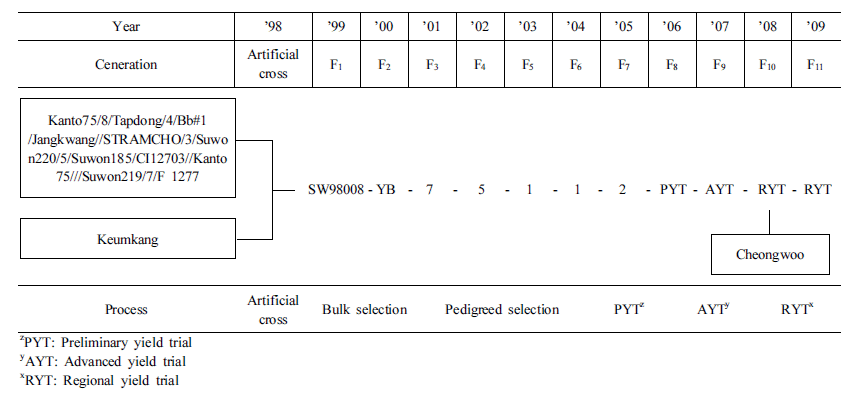
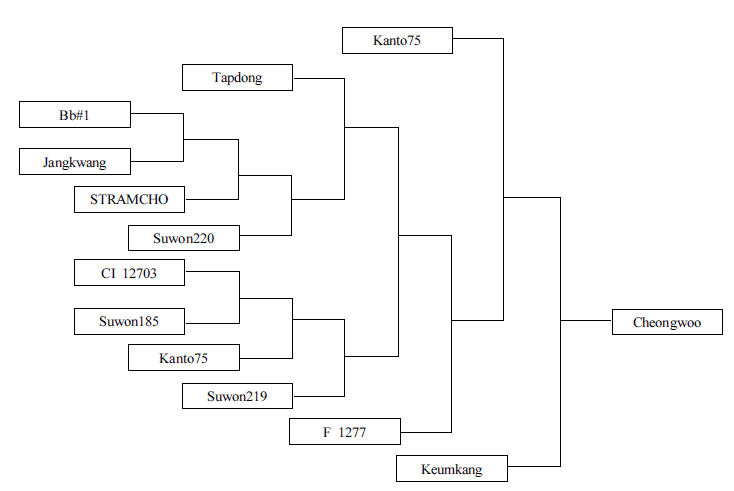
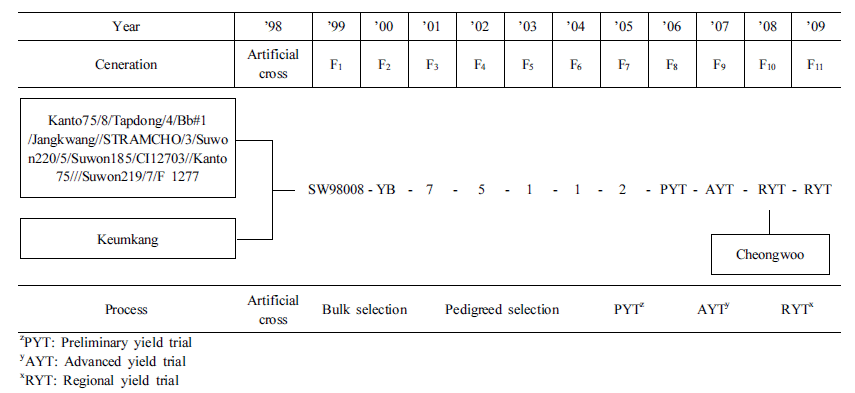
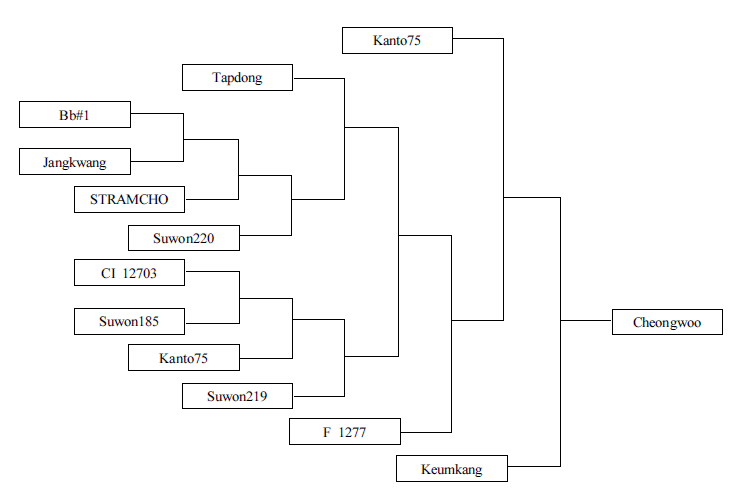
조사료용 밀인 ‘청우’는 농촌진흥청 국립식량과학원에서 총체생산성이 높은 밀 품종을 육성하기 위해 장간, 다수성인 “Kanto75/8/탑동밀/4/Bb#1/장광//STRAMCHO/3/수원220/5/ 수원185/CI12703//관동75///수원219/7/F 1277”에서 유래한 우량계통을 모본으로 하고, 중단간이면서 농업적 특성이 우수 한 식용 밀 표준품종인 금강밀을 부본으로 하여 1998년에 인 공교배를 실시하였다. 1999년에 SW98008 조합을 육성하였 고, 2000년에 집단육종법으로 F2세대를 전개하였다. 2001년 부터 2004년까지 계통육종법으로 전개하여 초형이 우수하고, 장간인 SW98008-YB-7-5-1-1-2 계통을 선발하였다. 3년간 생산력검정 예비시험과 생산력 검정 본시험을 실시한 결과, 총체수량이 우수하여 ‘익산326호’로 계통명을 부여하였다. 2008년부터 2009년까지 지역적응성 시험을 수행하여 총체수 량성이 높고 한해에 강한 계통으로 입증되어 2009년 12월 직 무육성품종 선정심의회에서 ‘청우’로 명명되었다. 그 후 국립 종자원의 재배심사를 거쳐 2013년 종자산업법 제55조에 따 라 품종보호 등록원부에 등록(품종보호 제4311호)되었다. 육 성 경위를 도식화하면 Fig. 12와 같다.
Fig. 1.
Pedigree diagram of cultivar ‘Cheongwoo’.
KJBS-47-339_F1.gif
Fig. 2.
Pedigree chart of wheat cultivar, “Cheongwoo”.
KJBS-47-339_F2.gif
시험방법
지역적응시험은 충북 청원, 충남 예산 및 제주 등 밭상태에 서 3개소, 전북 익산, 전남 나주 등 논상태의 2개소에서 실시 되었다. 파종기는 청원, 예산이 10월 중순, 익산, 나주는 10월 하순, 그리고 제주가 11월 상순이었다. 파종방법(휴폭×파폭× 휴장×열수)은 밭상태에서 25 cm × 5 cm × 6 m × 6열, 논상 태에서 150 cm × 120 cm × 6 m × 1열로 하였고, 파종량은 밭상태 180 kg/ha, 논상태 220 kg/ha으로 하였다.
시비량은 진단시비를 하여 곡실보리 표준시비량의 30%를 증비하였고, 시비방법은 질소를 제주, 청원, 예산이 기비 50 : 추비 50%로, 그리고 익산과 나주가 기비 40 : 추비 60% 분 시하였으며, 인산과 가리는 전량 기비로 시용하였다. 기타 생 육관리는 농촌진흥청 표준재배법에 준하였고 생육, 수량특성, 내한성 및 병충해 저항성 등의 관련 조사는 농진청 신품종개 발 공동연구사업 과제 수행계획서 조사기준(RDA 2008, RDA 2009) 에 준하여 실시하였다.
고유특성
잎색은 진녹색이며 잎폭은 중간 정도이고, 줄기는 길며 중 간 정도로 뻗은 직립형태이다. 이삭의 길이는 중정도이고, 까 락은 황백색이며 길이가 길고, 종실의 크기는 중간 정도이며 종실색은 백립계이다(Table 1).
Table 1.
Growth habit and morphological characteristics of ‘Cheongwoo’.
Table 1.
Cultivar Growth habit Plant type Leaf Culm Awn Kernel Spike length

Color Width Length Diameter Color Width Length Diameter

Cheongwoo III Mid-erect DGz Mx Lw M LWv M M Wu M
Keumkang III M Gy M M M LW M M W M

zDG: dark green

yyG: green

xxM: middle

wwL: long

vLW: light white

uW : white

출수기와 황숙기
출수기는 Table 2에서와 같이 지역적응시험 결과, 밭상태 에서 4월 22일로 대비품종인 금강밀보다 1일 빠르고, 논상태 에서는 4월 24일로 금강밀과 같다. 황숙기는 밭상태에서 5월 19일로 금강밀보다 2일 빠르고, 논상태에서에서는 5월 22일 로 1일 빠르다.
Table 2.
Heading and yellow ripe stage date of cultivar ‘Cheongwoo’
Table 2.
Field condition Region Heading date Yellow ripe stage date

Cheongwoo Keumkang Cheongwoo Keumkang

Upland Jeju April 7 April 7 May 7 May 7
Cheongwon April 29 April 29 May 24 May 25
Yesan May 2 May 3 May 28 May 31

Mean April 22 April 23 May 19 May 21

Paddy lksan April 21 April 22 May 28 May 30
Naju May 1 May 2 May 25 May 26

Mean April 26 April 27 May 26 May 28

Total April 24 April 24 May 22 May 23
내재해성 및 내병성
재해 저항성은 Table 3에서와 같이 도복 정도는 익산지역 을 제외한 지역에서 모두 0 또는 2정도의 수준으로 금강밀보 다 도복 저항성이 강하고, 고사주율은 고휴에서 0.0%, 저휴에 서 3.0%로 금강밀보다 낮아 내한성이 강하게 나타났다. 붉은 곰팡이병과 흰가루병은 금강밀과 같은 감수성을 보였다.
Table 3.
Winter hardiness, lodging and disease resistance of cultivar ‘Cheongwoo’.
Table 3.
Cultivara Degree of lodging (0~9)z Withered plant (%)y Disease resistance (S-R)

Iksan Jeju Cheongwon Yesan Naju High ridge Low ridge Fusarium head bligh Powdery mildew

Cheongwoo 1 0 0 0 2 0.0 3.0 M S
Keumkang 1 1 3 3 3 9.3 3.0 M S

zRating score: 0 = excellent or strong, 9 = worst or weak

yData tested at Yeoncheon

xS: susceptible, M: moderate, R: resistant

생초수량 구성 요소
초장은 91 cm로 표준품종인 금강밀보다 5 cm 더 길고, 수 장은 7.1 cm로 금강밀보다 0.9 cm 작은 편이지만, 경수는 1,070개/m 2로 많다.Table 4
Table 4.
Agronomic characteristics of cultivar ‘Cheongwoo’.
Table 4.
Cultivar Plant height (cm) Spike length (cm) Number of tillers per m2

Cheongwoo 91 7.1 1,070
Keumkang 86 8.0 963
수량특성
밭상태 조건인 제주, 청원, 예산 지역과 논상태 조건인 익 산과 나주 지역의 2개년 평균 건물수량은 Table 5와 같다. 전 국 평균수량은 ‘청우’가 14.8 MT/ha으로 표준품종인 금강밀 에 비해 12% 증수되었다. 재배 지역별로는 밭상태에서 ‘청 우’가 평균 14.7 MT/ha으로 금강밀보다 11%, 논상태에서 ‘청우’가 평균 14.9 MT/ha으로 금강밀보다 13% 정도 높은 건물수량을 나타내었다.
Table 5.
Forage dry matter yield of cultivar ‘Cheongwoo’ in the regional yield trials.
Table 5.
Field condition Cheongwoo(MT/ha) Keumkang(MT/ha)

Location 2008 2009 mean Index 2008 2009 mean

Upland Jeju 16.3 13.0 14.6 107 15.2 15.2 13.7
Cheongwon 13.4 18.1 15.8 112 12.1 16.0 14.1
Yesan 10.5 16.8 13.7 116 9.3 14.3 11.8

Mean 13.4a+ 16.0a 14.7a 111a 12.2a 14.1a 13.2a

Paddy Iksan 13.5 17.9 15.7 125 10.7 14.5 12.6
Naju 16.3 11.7 14.0 102 16.8 10.6 13.7

Mean 14.9a 14.8a 14.9a 113a 13.7a 12.6a 13.1a

Mean 14.0 15.3 14.8 112 12.8 13.5 13.2

+Values followed by the sample letter are not significantly different.

품질특성
황숙기 초기에 분석한 ‘청우’의 조사료 품질특성은 Table 6과 같다. ‘청우’의 사일리지 품질분석 결과 조단백질 함량은 7.4%, ADF는 26.4, NDF는 47.0, TDN은 68.0으로 표준품 종 금강과 유사하나, TDN 수량은 ha당 10.0 MT으로서 9.0 MT인 금강에 비해 높다.
Table 6.
Forage quality of the cultivar ‘Cheongwoo’
Table 6.
Cultivar Crude protein (%) ADFz (%) NDFy (%) TDNx (%) TDN yield (MT/ha)

Cheongwoo 7.4a+ 26.4a 47.0a 68.0a 10.0a
Keumkang 7.3a 26.5a 48.3a 68.0a 9.0a

zADF: Acid detergent fiber

yNDF: Neutral detergent fiber

xTDN: Total digestible nutrients.

+Values followed by the sample letter are not significantly different

적응지역 및 재배상 유의점
적응지역은 1월 최저 평균기온 -10°C 이상인 지역으로 중 부 산간지를 제외한 전국에서 재배가 가능하고, 붉은곰팡이병 과 흰가루병에 약하므로, 적정 시비량은 곡실용(N : P : K = 8.8~9.4 : 7.2~7.5 : 3.6~4.0)보다 30% 증가하여 시비하지 만, 이 시비량보다 더 늘리거나 밀식재배 하는 것은 피해야 한다.
총체생산성이 높은 밀품종을 육성하기 위해 장간, 다수성 인 Kanto75/8/탑동밀/4/Bb#1/장광//STRAMCHO/3/수원220 호/5/수원185호/CI 12703//관동75호///수원219호/7/F 1277에 서 유래한 우량계통을 모본으로 하고, 중단간이면서 농업적 특성이 우수한 식용 밀 표준품종인 금강밀을 부본으로 하여 1998년에 농촌진흥청 국립식량과학원에서 육성하였다. 계통 육종법으로 전개하여 초형이 우수하고, 장간인 SW98008-YB- 7-5-1-1-2 계통을 선발하였다. 3년간 생산력검정 예비시험과 생산력 검정 본시험을 실시한 결과, 총체수량이 우수하여 ‘익 산326호’로 계통명을 부여하였다. 2008년부터 2009년까지 지역적응성 시험을 수행하여 총체수량성이 높고 한해에 강한 계통으로 입증되어 2009년 12월 직무육성품종선정심의회에 서 신품종으로 선정됨과 동시에 ‘청우’로 명명하였다. 그 후 국립종자원의 재배심사를 거쳐 2013년 종자산업법 제55조에 따라 품종보호 등록원부에 등록(품종보호 제4311호) 되었다.
‘청우’는 잎색이 진녹색이고, 잎폭은 중간 정도이며, 줄기 는 길고 직립형태는 중간 정도로 뻗은 형태이다. 이삭은 중간 정도의 길이고, 이삭의 까락은 황백색이고 길이가 길며, 종실 의 크기는 중간 정도이고, 종실색은 백색을 띄는 백립계이다. 출수기는 밭상태에서 4월 22일로 대비품종인 금강밀보다 1일 빠르고, 논상태에서 4월 24일로 금강밀과 유사하였다. 황숙기 는 밭상태에서 5월 19일로 금강밀보다 2일 빠르고, 논상태에 서 5월 22일로 1일 빠르다. 초장은 91 cm로 표준품종인 금강 밀보다 장간형이고, 수장은 7.1 cm로 금강밀보다 0.9 cm 작은 편이지만, 경수는 1,070개/m 2로 많다. 건물수량은 14.8 MT/ha 으로 표준품종인 금강밀에 비해 12% 증수한 다수성이다. 조 사료 품질은 표준품종 금강과 비교하여 유사하나, TDN 수량 은 ha당 10.0 MT으로서 9.0 MT인 금강에 비해 높다.
  • 1. Choi JS, Kim JG, Baek SB, Park KH, Kwon YU, Park HH, Kang MS, Park TI, Heo HY, Seo JH, Cheong YK, Sung BR, Kim JG, Lee JJ, Kim SJ, Ryu IM, Ju JI, Kim DH, Jung KY, Lee SH. A ruminant palatable hood type barley cultivar “Yuyeon” for whole-crop-forage use. Korean J. Breed. Sci 2007. 39: 242-243.
  • 2. Hyun JN, Kwon SJ, Kim HT, Ko JM, Lim SG, Kim JG, Park HH, Hur HY, Kwon YU, Kim JG. A new whole crop silage barley cultivar, “Youngyang” with high yielding and BaYMV resistance. Korean J. Breed. Sci 2008. 40: 484-489.
  • 3. Kim JG, Choi JS, Park HH, Baek SB, Kang MS, Park KH, Kwon YU, Heo HY, Seo SJ, Nam JH, Lee JJ, Cheong YK, Sung BR, Kim JG, Ryu IM, Ju JI, Kim DH, Jung KY, Lee SH. A new smooth awn barley cultivar, “Wooho” suitable for whole crop forage use. Korean J. Breed. Sci. 2007a. 39: 238-239.
  • 4. Kim WH, Seo S. Cultivation and utilization of barley as the main winter crop in paddy field. Proceedings of the Korean society of grassland science conference. The Korean Society of Grassland and Forage Science 2006. 37-57.
  • 5. Kim WH, Seo S, Lim YC, Shine JS, Sung BR, Ji HC, Lee SJ, Park TI. Selection of promising barley cultivar for silage at paddy field of honam region. Journal of the Korean Society of Grassland and Forage Science 2007b. 27: 161-166.
  • 6. Park TI, Han OK, Seo JH, Choi JS, Park KH, Kim JG. New barley cultivars with improved morphological charateristics for whole crop in Korea. Journal of the Korean Society of Grassland and forage Science 2008. 28: 193-202.
  • 7. Park TI, Seo JH, Han OK, Choi JS, Kim JG, Park JC, Kim Hs, Heo HY, Baek SB, Kwon YU, Park HH, Kang MS, Park KG, Suh SJ. A new auricleless barley cultivar “Dami” for whole crop forage. Korean J. Breed. Sci 2009. 41: 349-353.
  • 8. RDA2008 Project plan for collaborative research program to develop new variety of winter crop 2008. 85-117.
  • 9. RDA2009 Project plan for collaborative research program to develop new variety of winter crop 2009. 79-114.
  • 10. Seo S, Kim WH, Kim JG, Choi GJ, Ko JM, Lim SG. Selection of promising forage crops and variety for forage production in paddy field. 3 yeongnam region. Journal of the Korean Society of Grassland and forage Science 2007. 27: 85-92.

Download Citation

Download a citation file in RIS format that can be imported by all major citation management software, including EndNote, ProCite, RefWorks, and Reference Manager.

Format:

Include:

A High-Yield Wheat Cultivar ‘Cheongwoo’ for Whole Crop Forage
Korean. J. Breed. Sci.. 2015;47(3):339-344.   Published online September 30, 2015
Download Citation

Download a citation file in RIS format that can be imported by all major citation management software, including EndNote, ProCite, RefWorks, and Reference Manager.

Format:
Include:
A High-Yield Wheat Cultivar ‘Cheongwoo’ for Whole Crop Forage
Korean. J. Breed. Sci.. 2015;47(3):339-344.   Published online September 30, 2015
Close

Figure

  • 0
  • 1
A High-Yield Wheat Cultivar ‘Cheongwoo’ for Whole Crop Forage
Image Image
Fig. 1. Pedigree diagram of cultivar ‘Cheongwoo’.
Fig. 2. Pedigree chart of wheat cultivar, “Cheongwoo”.
A High-Yield Wheat Cultivar ‘Cheongwoo’ for Whole Crop Forage

Growth habit and morphological characteristics of ‘Cheongwoo’.

Cultivar Growth habit Plant type Leaf Culm Awn Kernel Spike length

Color Width Length Diameter Color Width Length Diameter

Cheongwoo III Mid-erect DGz Mx Lw M LWv M M Wu M
Keumkang III M Gy M M M LW M M W M

zDG: dark green

yyG: green

xxM: middle

wwL: long

vLW: light white

uW : white

Heading and yellow ripe stage date of cultivar ‘Cheongwoo’

Field condition Region Heading date Yellow ripe stage date

Cheongwoo Keumkang Cheongwoo Keumkang

Upland Jeju April 7 April 7 May 7 May 7
Cheongwon April 29 April 29 May 24 May 25
Yesan May 2 May 3 May 28 May 31

Mean April 22 April 23 May 19 May 21

Paddy lksan April 21 April 22 May 28 May 30
Naju May 1 May 2 May 25 May 26

Mean April 26 April 27 May 26 May 28

Total April 24 April 24 May 22 May 23

Winter hardiness, lodging and disease resistance of cultivar ‘Cheongwoo’.

Cultivara Degree of lodging (0~9)z Withered plant (%)y Disease resistance (S-R)

Iksan Jeju Cheongwon Yesan Naju High ridge Low ridge Fusarium head bligh Powdery mildew

Cheongwoo 1 0 0 0 2 0.0 3.0 M S
Keumkang 1 1 3 3 3 9.3 3.0 M S

zRating score: 0 = excellent or strong, 9 = worst or weak

yData tested at Yeoncheon

xS: susceptible, M: moderate, R: resistant

Agronomic characteristics of cultivar ‘Cheongwoo’.

Cultivar Plant height (cm) Spike length (cm) Number of tillers per m2

Cheongwoo 91 7.1 1,070
Keumkang 86 8.0 963

Forage dry matter yield of cultivar ‘Cheongwoo’ in the regional yield trials.

Field condition Cheongwoo(MT/ha) Keumkang(MT/ha)

Location 2008 2009 mean Index 2008 2009 mean

Upland Jeju 16.3 13.0 14.6 107 15.2 15.2 13.7
Cheongwon 13.4 18.1 15.8 112 12.1 16.0 14.1
Yesan 10.5 16.8 13.7 116 9.3 14.3 11.8

Mean 13.4a+ 16.0a 14.7a 111a 12.2a 14.1a 13.2a

Paddy Iksan 13.5 17.9 15.7 125 10.7 14.5 12.6
Naju 16.3 11.7 14.0 102 16.8 10.6 13.7

Mean 14.9a 14.8a 14.9a 113a 13.7a 12.6a 13.1a

Mean 14.0 15.3 14.8 112 12.8 13.5 13.2

+Values followed by the sample letter are not significantly different.

Forage quality of the cultivar ‘Cheongwoo’

Cultivar Crude protein (%) ADFz (%) NDFy (%) TDNx (%) TDN yield (MT/ha)

Cheongwoo 7.4a+ 26.4a 47.0a 68.0a 10.0a
Keumkang 7.3a 26.5a 48.3a 68.0a 9.0a

zADF: Acid detergent fiber

yNDF: Neutral detergent fiber

xTDN: Total digestible nutrients.

+Values followed by the sample letter are not significantly different

Table 1. Growth habit and morphological characteristics of ‘Cheongwoo’.

DG: dark green

yG: green

xM: middle

wL: long

LW: light white

W : white

Table 2. Heading and yellow ripe stage date of cultivar ‘Cheongwoo’
Table 3. Winter hardiness, lodging and disease resistance of cultivar ‘Cheongwoo’.

Rating score: 0 = excellent or strong, 9 = worst or weak

Data tested at Yeoncheon

S: susceptible, M: moderate, R: resistant

Table 4. Agronomic characteristics of cultivar ‘Cheongwoo’.
Table 5. Forage dry matter yield of cultivar ‘Cheongwoo’ in the regional yield trials.

Values followed by the sample letter are not significantly different.

Table 6. Forage quality of the cultivar ‘Cheongwoo’

ADF: Acid detergent fiber

NDF: Neutral detergent fiber

TDN: Total digestible nutrients.

Values followed by the sample letter are not significantly different