적요
‘Sweet Gold’ is a new promising kiwifruit variety developed for high soluble solid content and firmness at the Research Institute of Climate Change and Agriculture, National Institute of Horticultural and Herbal Science, Rural Development Administration, Korea, in 2010. This variety was selected from seeds obtained by the cross between Actinidia chinensis ‘First Emperor’ and A. chinensis ‘Okcheon’ in 2000. Seedling and line selections were conducted from 2001 to 2008, and characteristic trials were carried out from 2009 to 2010. Shoots of ‘Sweet Gold’ sprouts were similar to those of ‘Jecy Gold’ with green leaves. The fruit shape was oblong and fruit skin color was yellow brown without hair. The average fruit weight was 88.7 ±12.37 g. The fruit had a central soft core, yellow or yellow green pericarp, and fragile and juicy flesh. The soluble solid content was higher than that of ‘Jecy Gold’ at 16.3° Brix when ripe and the firmness was higher, at 21.4N, than that of ‘Jecy Gold’. The harvesting time was about 7 days earlier than that of ‘Jecy Gold’. ‘Sweet Gold’ was officially registered as a new cultivar in 2014 in accordance with the Plant Variety Protection Act by the Commissioner of the KSVS (Grant Number 5151).
서언
전 세계 20여개국에서 재배되어 전체 과실 생산량의 1%를 차지하는 참다래는 유통품종이 대부분 ‘헤이워드(
Actinidia deliciosa cv. ‘Hayward’)’ 이다(
Ferguson 1999, FAOSTAT
2018). 이 품종은 재배가 쉽고 저장력이 뛰어나지만 calcium oxalate로 인하여 잘 후숙되지 않으면 먹기 힘든 단점이 있는 것으로 알려지고 있다(
Ferguson 1999,
Cui et al. 2002,
Kim et al. 2013). 따라서 1990년대 이후부터 당도가 높으면서 식미감이 좋은 품종들을 개발하기 위한 국가간 경쟁이 치열하게 진행되어 왔다(
Muggleston et al. 1999,
Wang et al. 2003,
Huang et al. 2004,
Kim et al. 2007a,
2007b,
Kim et al. 2009,
KSVC 2018). 뉴질랜드는 ‘Hort16A’를 개발하여 전 세계에 OEM방식으로 농가들과 계약재배를 실시하였으나 궤양병에 취약하여 ‘Gold3’ 품종으로 대체하고 있으며 중국은 ‘Gintao’와 ‘Hongyang’ 품종에 대한 품종수출을 실시하고 있다(
Muggleston et al. 1999,
Huang et al. 2002,
Wang et al. 2003,
USDA Foreign Agricultural Service 2016). 우리나라에는 1977년에 처음 도입되어 제주, 경남, 전남지역의 해안가를 중심으로 1300 ha 정도 재배가 이루지고 있으며 2000년대 이후부터 소비자들이 고당도의 맛있는 품종을 요구하면서 제시골드, 한라골드, 해금, 골드원 등이 육성되어 재배가 이루어지고 있으나 외국품종보다 당도와 품질이 낮다는 평가를 받고 있다(
Wang et al. 2003,
Kim et al. 2007,
2009,
Cho et al. 2016,
Kwack et al. 2017,
KSVC 2018).
따라서 농촌진흥청 국립원예특작과학원에서는 우리나라 소비자의 기호에 맞는 품종을 개발하여 외국품종에 대한 경쟁력을 높이고자 당도와 경도가 높은 신품종 ‘스위트골드’를 육성하였다.
재료 및 방법
육성경위
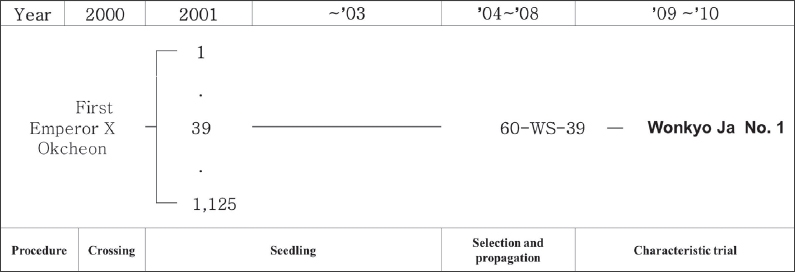
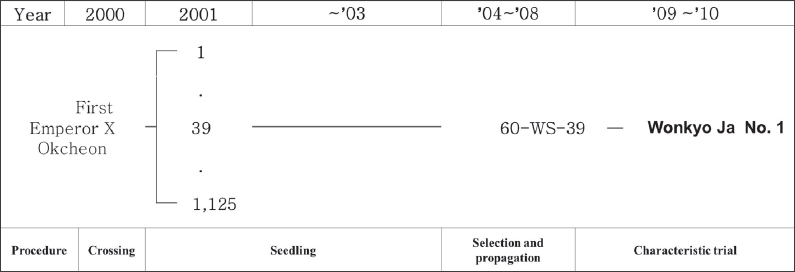
2000년에 온난화대응농업연구소 포장에서 4배체인
A. chinensis cv. ‘First Emperor’를 모본으로 하고
A. chinensis cv. ‘Okcheon’을 부본으로 하여 교배를 실시하였다. 2004년에 1,125개체의 실생을 양성하여 2004년부터 2008년까지 수확기가 빠르면서 당도가 높고 경도 아주 우수한 계통을 선발하여 원교자 1호로 계통명을 부여하였다. 선발된 원교자 1호는 2009년부터 2010년까지 농촌진흥청 국립원예특작과학원 온난화대응농업연구소의 비가림하우스에서 국립종자원의 신품종 심사를 위한 작물별 특성조사기준(KSVA 2011)에 따라 특성검정을 실시하였다. 6그루의 나무에서 중간크기의 과실을 10월말~11월초에 수확하여20°C에서 후숙을 실시한 후 각각 30개씩 조사하였다. 특성조사 결과를 바탕으로 원교자1호는 2010년 11월 최종 선발하였으며 농촌진흥청 직무육성신품종심의위원회에 상정하여 심의를 거친 후 품종명을 ‘스위트골드’로 명명하였다(
Fig. 1).
Fig. 1Pedigree diagram of ‘Sweet Gold’ kiwifruit variety.
결과 및 고찰
주요특성
1. 고유특성
‘스위트골드’의 수세는 우리나라에서 처음 육성되어 재배가 이루어지고 있는 ‘제시골드’와 비슷한 편이며 새로운 가지가 빨리 경화되는 특성을 나타낸다. 발아기는 3월 19일~20일로서 ‘제시골드’와 유사하다. 어린줄기에는 털이 거의 없으며 껍질은 부드럽다. 껍질눈의 크기는 ‘제시골드’와 유사하며 갈색을 띈다(Tables
1,
2). 잎은 아주 넓은 난형으로 넓은 난형인 ‘제시골드’와는 다르다. 기부의 열편은 ‘제시골드’는 접촉되고 있으나 ‘스위트골드’는 약간 떨어지는 특징을 나타낸다. 개화기는 5월 6일~12일로서 ‘제시골드’ 보다 3일 정도 빠르다. 수확기는 10월 20일~25일로서 개화에서 수확까지 175일~180일 정도 소요된다(
Table 3).
Table 1Species and ploidy of ‘Sweet Gold’ and ‘Jecy Gold’
Table 1
|
‘Cultivar |
Species |
Sex |
Ploidy |
Vigor |
|
Sweet Gold |
A. chinensis
|
Female |
Tetraploid |
Slightly weak |
|
Jecy Gold |
A. chienensis
|
Female |
Diploid |
Medium |
Table 2Characteristics of the young shoot and stem of ‘Sweet Gold’ and ‘Jecy Gold’
Table 2
|
Cultivar |
Young shoot |
Stem |
|
|
|
Hairiness |
Density of hair |
Roughness of bark |
Hairiness |
Size of lenticel |
Color of lenticel |
|
Sweet Gold |
Absent |
Sparse |
Smooth |
Absent |
Small |
Brownish |
|
Jecy Gold |
Absent |
Sparse |
Smooth |
Absent |
Small |
Brownish |
Table 3Leaf characteristics, flowering time, and harvesting time of ‘Sweet Gold’ and ‘Jecy Gold’
Table 3
|
Cultivar |
Leaf blade |
Flowering time |
Harvesting time |
|
|
Shape |
Arrangement of basal lobes |
|
Sweet Gold |
Very broad ovate |
Slightly apart |
May 6 ~ May 12 |
Oct. 25 ~ Nov.5 |
|
Jecy Gold |
Broad ovate |
Touching each other |
May 6 ~ May 15 |
Oct. 28 ~ Nov.12 |
2. 과실특성
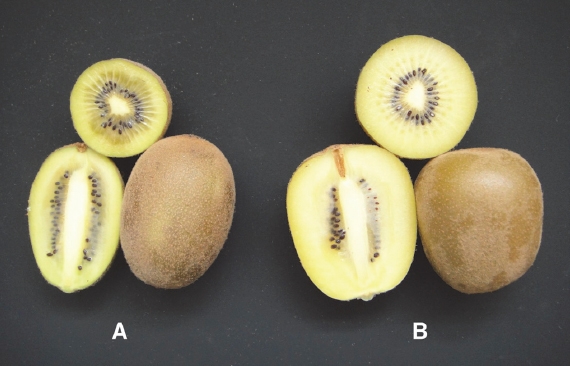
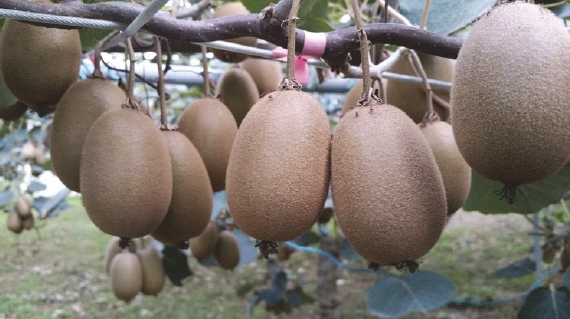
과실의 모양은 타원형으로서 ‘제시골드’의 도란형과는 다르다. 과중은 88.7±12.37 g으로 ‘제시골드’ 보다 15 g 정도 작다. 당도는 16.3±0.62°Brix로 당도가 제시골드 보다 1.5°Brix이상 높으며 특히 경도가 21.4±2.48N으로 제시골드의 2.6±0.70N 보다 매우 높다. 과육색은 녹황색 또는 황색을 나타낸다(
Table 4, Figs.
2,
3).
Table 4Fruit characteristics of ‘Sweet Gold’ and ‘Jecy Gold’
Table 4
|
Cultivar |
Fruit shape |
Fruit weight (g) |
SSC (oBrix) |
Acidity (%) |
Fruit firmnessz (N) |
Flesh color |
|
Sweet Gold |
Oblong |
88.7±12.37y
|
16.3±0.62 |
1.3±0.27 |
21.4±2.48 |
Yellow green or Yellow |
|
Jecy Gold |
Obovoid |
103.6±15.08 |
15.0±1.00 |
1.5±0.16 |
2.6±0.70 |
Yellow |
Fig. 2Comparison of the fruits between ‘Sweet Gold’ (A) and ‘Jecy Gold’ (B).
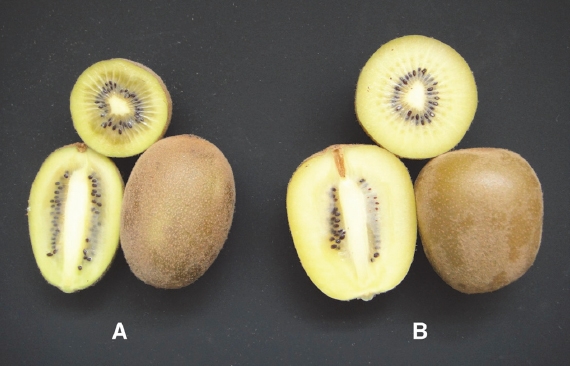
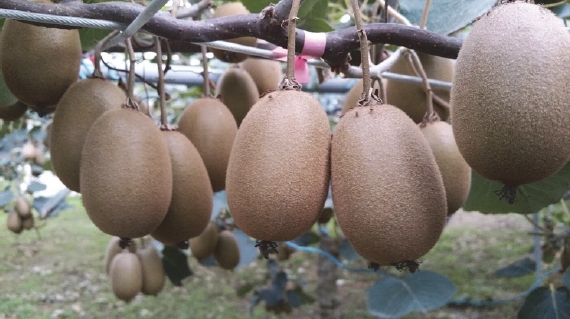
Fig. 3Fruit set of ‘Sweet Gold’ kiwifruit.
신품종의 재배상의 유의점
‘스위트골드’는 다른 품종들 보다 가지가 빨리 굳어지기 때문에 가지를 유인할 때 기부에서 부러질 수 있다. 또한 ‘스위트골드’ 품종은 제주와 전남 및 경남 일부지역의 비가림하우스에서 재배를 추천한다. 시설재배가 불가능할 경우에는 겨울 최저온도가 -10°C 이하로 내려가지 않으면서 발아와 신초생장이 이루어지는 3월 ~ 4월에 -1°C 이하로 떨어지지 않고 서리가 없는 곳이어야 한다. 또한 다른 골드품종과 마찬가지로 5월 초순에 적절히 꽃봉오리를 솎아 주어야 한다. 또한 개화시기가 빠르기 때문에 전년도에 채취하여 -20°C 이하에 보관하였던 꽃가루를 사용하여야 한다.
유용성
참다래 ‘스위트골드’ 품종은 2011년에 종자산업법 제26조 및 동법 시행규칙 제28조에 의하여 2011-124호로 품종보호출원을 실시하였고 2014년에 품종보호권등록(등록번호 제5151호)을 완료하였다(
KSVC 2018). 이 품종은 2014년 1월 국가품종보호권 전용실시를 하였으며 제주, 전라남도와 경상남도 지역에서 30 ha재배가 이루어지고 있다.
적요
‘스위트골드’는 농촌진흥청 국립원예특작과학원에서 2010년에 육성한 고당도의 경도가 높은 신품종이다. Actinidia chinensis cv. ‘First Emperor’를 모본으로 하고 A. chinensis cv. ‘Okcheon’을 부본으로 하여 2000년에 교배한 종자로부터 선발된 품종이다. 실생육성과 계통선발은 2001년에서 2008년까지 실시하고 2009년에서 2010년까지 특성검정을 실시하였다. 수세는 ‘제시골드’와 유사하며 잎의 상부는 녹색을 나타낸다. 과실의 형태는 타원형으로 과피는 녹황색을 나타내며 털이 거의 없다. 평균과중은 88.7±12.37 g 이다. 과심의 크기는 중간 정도이며 부드럽다. 과육은 황색 또는 녹황색으로 과즙이 많고 부드럽다. 당도는 16.3 oBrix로 고당도이며 경도가 매우 높다. 수확기는 10월 중하순에서 11월 초순으로 ‘제시골드’ 품종보다 7일정도 빠르며, 경도는 21.4N으로 ‘제시골드’ 보다 높다. 참다래 ‘스위트골드’ 품종은 2011년에 종자산업법 제26조 및 동법 시행규칙 제28조에 의하여 2014년에 품종보호권등록(등록번호 제5151호)을 완료하였다.
사사
본 연구는 농촌진흥청의 농업과학기술개발연구과제(과제번호: PJ009441)의 지원에 의해 이루어진 것으로 이에 감사드립니다.
References
- 1. Cho Y, Cho H, Park M, Kim E, Lim D, Jung B. 2016. Promotion of gold kiwifruit 'Haegeum'(Actinidia chinensisPlanch.) maturity using plastic house cultivation. Acta Horti 1130: 345-350.
- 2. Collins BH, Horská A, Hotten PM, Riddoch C, Collins AR. 2001. Kiwifruit protects against oxidative DNA damage in human cells andin vitro. Nutr Cancer 39: 148-153.
- 3. Collins AR, Harrington V, Drew J, Melvin R. 2003. Nutritional modulation of DNA repair in a human intervention study. Carcinogenesis 24: 511-513.
- 4. Cui Z, Huang H, Xiao X. 2002. Actinidia in China. China Agri. Sci Technol, Beijing.
- 5. Food and Agricultural Organization of United Nation. 2018. FAOSTAT. http://www.fao.org/faostat/en/#data/QC
- 6. Ferguson AR. 1999. Kiwifruit cultivars:Breeding and selection. Acta Hort 498: 43-51.
- 7. Ferguson AR, Bollard EG. In: Warrington I.J, Weston G.C. Domestication of the kiwifruit. (Eds). Kiwifruit:Science and management. 1990. pp. 165-246. Auckland, N.Z, Ray Richard Publ.
- 8. Hung H, Ferguson A. 2007. Actinidia in China:Natural diversity, phylogeographical evolution, interspecific gene flow and kiwifruit cultivar improvement. Acta Hortic 753: 31-40.
- 9. Huang H, Wang S, Huang R, Jiang Z, Zhang Z. 2002. Jintao, a novel, hairless yellow-fleshed kiwifruit. HortSci 37: 1135-1136.
- 10. Huang H, Wang Y, Zhan Z, Jiang Z, Wang S. 2004. Actinidiagermplasm resources and kiwifruit industry in China. HortSci 39: 1165-1172.
- 11. Kim CH, Kim SC, Jang KC, Song EY, Kim M, Moon DY, Seong KC, Lee JS, Suh HD, Song KJ. 2007a. A new kiwifruit cultivar, 'Jecy Gold'with yellow flesh. Korean J Breed Sci 39: 258-259.
- 12. Kim CH, Kim SC, Jang KC, Song EY, Ro NY, Moon DY, Lee JS, Seong KC. 2007b. A new kiwifruit cultivar, 'Jecy Green'. Korean J Breed Sci 39: 508-509.
- 13. Kim CH, Kim SC, Song EY, Ro NY, Kim M, Kang KH, Jang KC, Chun SJ. 2009. A new kiwifruit, 'Jecy Sweet'with high soluble solids content. Kor J Hort Sci Technol 39: 508-509.
- 14. Kim DG, Jin YG, Jin JY, Kim SC, Han CH, Lee YJ. 2011. Effects of theActinidia chinensison Loperamide-induced constipation in rat. Kor J Plant Res 24: 61-68.
- 15. Kim SC, Seong KC, Choa JH, Lim CK, Chun SJ, Kim CH, Choi IM. 2013. Courage against a giant. A global company and our kiwifruit, RDA.
- 16. Korea Seed and Variety Service (KSVC). 2011. Test guideline for kiwifruit. http://www.seed.go.kr/
- 17. Korea Seed and Variety Service (KSVC)2018. New plant varieties http://www.seed.go.kr/.
- 18. Kwack YB, Kim HL, Lee JH, Chung KH, Chae WB. 2017. 'Goldone', a yellow-fleshed kiwifruit cultivar with large fruit size. Hortic Sci Technol 35: 142-146.
- 19. Muggleston S, McNeilage M, Lowe R, Marsh H. 1999. Breeding new kiwifruit cultivars:the creation of 'Hort 16A'and 'Tomua'. West Australian Nut and Tree Crops Association's Yearbook 23: 63-68.
- 20. USDA Foreign Agricultural Service2016. Global agricultural information network. Gain Grport Number:NZ1601.
- 21. Wang M, Li M, Meng A. 2003. Selection of a new red-fleshed kiwifruit cultivar 'Hongyang'. Acta Hortic 610: 115-117.
Citations
Citations to this article as recorded by

- Effect of Plastic MAH Storage, 1-MCP, and Coating on Fruit Storability of ‘Sweet Gold’ and ‘Goldone’ Kiwifruit
Seok-Kyu Jung, Hye-Won Bang, Hyeon-Ji Hwang, Hyun-Sug Choi
Horticulturae.2025; 11(10): 1152. CrossRef - Comprehensive Comparison of the Nutrient and Phytochemical Compositions and Antioxidant Activities of Different Kiwifruit Cultivars in Korea
Jong-Bin Jeong, Du-Yong Cho, Hee-Yul Lee, Ae-Ryeon Lee, Ga-Yong Lee, Mu-Yeun Jang, Ki-Ho Son, Kye-Man Cho
Plants.2025; 14(5): 757. CrossRef - Development of maturity chart for kiwifruit using firmness at harvest
Haejo Yang, Siva Kumar Malka, Min-Sun Chang, Ji Hyun Lee, Yoonpyo Hong, Me-Hea Park
Environmental Biology Research.2024; 42(4): 574. CrossRef - Characteristics of Leaf Photosynthesis and Fruit Quality in‘Sweet Gold’Kiwifruit under Adjusted Soil Water Content at the Fruit Maturation Stage
Jae-Hong Park, Myung-Hyup Oh, Hyeok-Sang Go, Kwan-Jung Song
Journal of the Korean Society of International Agriculture.2023; 35(3): 207. CrossRef