적요
In ornamental crops, the color and shape of flowers are one of the important traits. Generally, flower colors are determined by accumulating pigments such as carotenoids, flavonoids, and betalains. Among them, flavonoids are responsible for broad ranges of colors. Chrysanthemums are one of the most popular ornamental crops in the world, and there have been many efforts to change their flower color. In chrysanthemum flowers, cyanidin-based anthocyanin confers pink or red color, whereas terpenoid-based carotenoids are mainly responsible for yellow and green colors. However, blue colored chrysanthemums do not occur in nature. To date, there have been attempts to obtain blue or violet-colored chrysanthemum flowers through the introduction of a novel gene for accumulating delphinidin-based anthocyanins, while other studies have reported changing endogenous metabolites through the reconstruction of flavonoid biosynthesis. Since various transcription factors are involved in the regulation of flavonoid biosynthesis, it is important to understand not only the structural genes, but also the transcription factors required for the modification of flavonoid-based flower color. Therefore, in this paper, we describe the flavonoid biosynthetic pathway and its regulation, and review previous studies on the change in flower color through modification of flavonoid biosynthesis. This effort could be an important milestone in successfully achieving the modification of chrysanthemum flower color by means of plant biotechnology.
서 언
국화(
Chrysanthemum morifolium)는 장미, 백합과 함께 세계 3대 화훼작물 중 하나이며, 유럽과 아시아에서 주로 생산된다. 국화는 6배체(2n=6x=54) 작물로, 꽃색과 꽃모양이 다양하고 화분용, 절화용, 정원용 등 다양한 용도로 사용되며, 세계적으로 200여 종이 보고되고 있다(
Anderson 2006,
Dowrick 1953). 2013년 보고에 의하면 국화는 전세계적으로 인도(18,000 ha), 중국(8,475 ha), 일본(5,230 ha), 멕시코(2,467 ha), 태국(2,199 ha) 순으로 재배되고 있으며, 유럽의 시장거래 규모액은 2억 5820만유로(약 3357억원)로 보고되고 있다(
Hanks 2015). 2017년도 보고에 의하면, 국내 국화 재배면적은 428 ha에 이르며, 약 523억원의 시장거래 규모액을 지니는 경제적으로 중요한 작물이다(
MAFRA 2017).
화훼 작물에서 꽃모양과 꽃색은 소비자들에게 심미적인 만족감을 부여하는 중요한 형질 중의 하나이다. 지금까지 새로운 꽃모양과 꽃색을 개발하기 위해 전통적 교배육종 또는 분자 육종을 바탕으로 한 노력들이 지속적으로 진행되고 있다. 꽃색의 경우, 식물의 이차대사물질 축적과 밀접하게 관련되어 있고, 화훼작물별로 물질 생산과 관련한 생합성 경로, 조절기작, 생리적 기능 등은 분자생물학 및 대사공학 분야에서 많은 연구가 진행되고 있다. 꽃색을 결정하는 물질은 플라보노이드(flavonoid), 카로티노이드(carotenoid), 베타라인(betalain) 등으로 알려져 있다(
Mol et al. 1998). 화훼작물은 교배육종과 돌연변이 육종을 통해 흰색, 노란색, 분홍색, 주황색, 빨간색, 초록색 등 다양한 꽃색의 품종들이 개발되어 왔다. 일반적으로, 붉은색 꽃잎의 주요 색소물질은 플라보노이드계 안토시아닌이며, 노란색 또는 초록색 꽃잎의 주요 색소물질은 카로티노이드계 물질들이다(
Park et al. 2015). 베타라인은 석죽목에 속하는 작물에서 주로 축적되며 밝은 노란색에서 보라색에 이르는 색을 나타낸다. 최근 베타라인 생합성 경로의 주요 유전자의 기능이 밝혀지고 베타라인이 축적된 담배 꽃이 최초로 보고되었다(
Polturak et al. 2017). 베타라인은 방향족 아미노산인 타이로신(tyrosine)을 기질로 하여 노란색을 띄는 베타잔틴과 붉은색을 띄는 베타시아닌이 생산된다. 베타잔틴 생성에 필수 유전자인 cytochrome (시토크롬) P450 계열의 CYP76AD6와 l-3,4-dihydroxyphenylalanine (l-DOPA) 4,5-dioxygenase를 도입하여 노란색의 담배 꽃을 개발하였고, 베타시아닌 생성에 필수 유전자인 시토크롬 P450 계열의 CYP76AD1과 l-DOPA 4,5-dioxygenase, 그리고 betanidin-5-
O-glucosyltransferase를 도입하여 붉은색의 담배 꽃을 개발하였다(
Polturak et al. 2017). 색소물질 베타라인의 생합성 기작 규명은 앞으로 화훼작물에서의 다양한 꽃색 개발에 응용되리라 예상된다.
기존의 교배육종을 통해서 개발되지 못하던 새로운 꽃색 개발은 최근 발전한 생명공학기술을 기반으로 다양한 화훼작물에서 이루어지고 있다(
Azadi et al. 2016). 한 예로, 전통적 교배육종으로는 개발할 수 없었던 파란색 장미의 경우, 장미의 내재
DFR 유전자의 발현을 억제시키고 파란 색소 물질인 델피니딘(delphinidin) 생합성 유전자인 제비꽃의
flavonoid 3’,5’-hydroxylase (
F3’5’H)와 붓꽃의
dihydroflavonol 4-reductase (
DFR)를 도입함으로 파란 장미가 개발되었다(
Katsumoto et al. 2007).
식물의 플라보노이드와 카로티노이드와 같은 이차대사물질들의 경우 서로 다른 독립적 생합성 경로를 지니지만 대사물질들의 생합성은 상호 영향을 주고받는다(
Bedon et al. 2010,
Ben Zvi et al. 2012). 최종 형질인 꽃색은 주요 색소물질과 조색소(copigment)의 축적 및 상호작용에 의해 생성된다. 따라서 물질 각각의 대사경로들을 명확히 이해하고 생명공학적 기술을 활용하여 꽃색 관련 대사물질의 생성을 정교하게 조절한다면 화훼작물의 새로운 꽃색 개발이 보다 효율적으로 달성될 수 있으리라 기대한다.
본 논문에서는 화훼작물의 플라보노이드계 물질 생합성에 초점을 맞추어 생합성 경로와 조절기작에 대해 전반적으로 서술하고, 지금까지 시도된 플라보노이드 물질 대사조절을 통한 다양한 꽃색 생성에 대한 선행 연구들을 검토함으로써 경제적으로 중요한 화훼작물인 국화의 다양한 꽃색개발을 위한 생명공학적 전략들을 제시하고자 한다.
플라보노이드 생합성 경로
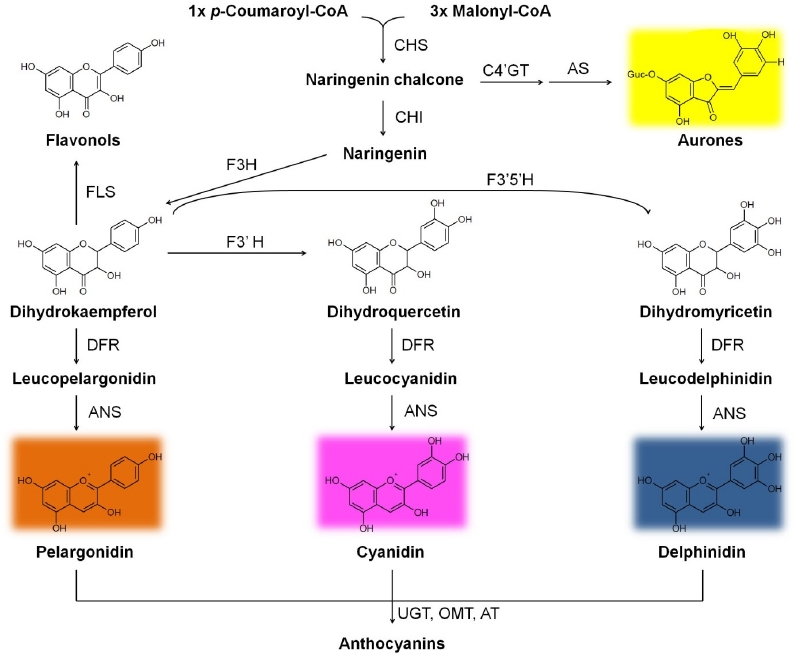
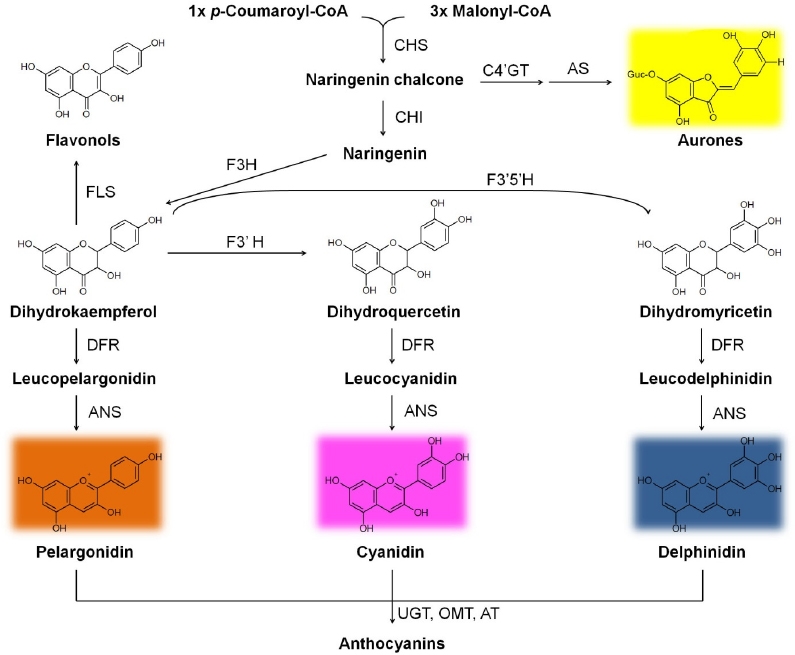
플라보노이드 생합성은 페닐프로파노이드(phenylpropanoid) 생합성 경로로부터 유래한 한 분자의
p-coumaroyl-CoA와 세 분자의 malonyl CoA들이 chalcone synthase (CHS) 활성에 의해 축합되어서 찰콘(chalcone)이 생성된다(
Fig. 1). 찰콘을 기질로 하여 chalcone isomerase (CHI)에 의해 플라바논(flavanones)이 생성되거나, chalcone 4’-
O-glucosyltransferase (C4’GT)와 aurone synthase (AS)의 순차적 활성에 의해 노란 색소물질인 오론(aurone)이 생성된다. 플라바논은 flavanone 3-hydroxylase (F3H)에 의하여 다이하이드로켐페롤(dihydrokaempferol, DHK)로 변환되며, 다이하이드로켐페롤은 flavonol synthase (FLS)와 DFR에 의해 경쟁적으로 촉매되어 각각의 조색소인 플라보놀(flavonol)과 안토시아니딘의 전구체인 루코안토시아니딘(luecoanthocyanidin)이 생성된다. DHK는 flavonoid 3’-hydroxylase (F3’H) 또는 F3’5’H의 활성에 의해 플라보노이드 B-ring에서 이중 또는 삼중 수산화(di- or tri-hydroxylation)를 촉매하여 플라보노이드 물질군의 다양성을 증가시킨다. 루코안토시아니딘은 anthocyanidin synthase (ANS) 효소에 의해 안토시아니딘(anthocyanidin)으로 변환된 후, 당화(UDP glycosyltransferase, UGT), 메틸화(
O-methyltransferase, OMT), 아실화(acyltransferase, AT) 효소에 의해 수식화(modification)됨으로써 최종적으로 안토시아닌이 생성되어 액포 내에 저장된다.
Fig. 1Flavonoid biosynthetic pathway in plants. ANS, anthocyanidin synthase; AS, aureusidin synthase; AT, acyltransferase; C4’GT, chalcone 4’-O-glucosyltransferase; CHI, chalcone isomerase; CHS, chalcone synthase; DFR, dihydroflavonol 4-reductase; F3H, flavanone 3-hydroxylase; F3’H, flavonoid 3’-hydroxylase; F3’5’H, flavonoid 3’,5’-hydroxylase; FLS, flavonol synthase; OMT, O- methyltransferase; UGT, UDP-glycosyltransferase. Painted colors indicated each compound.
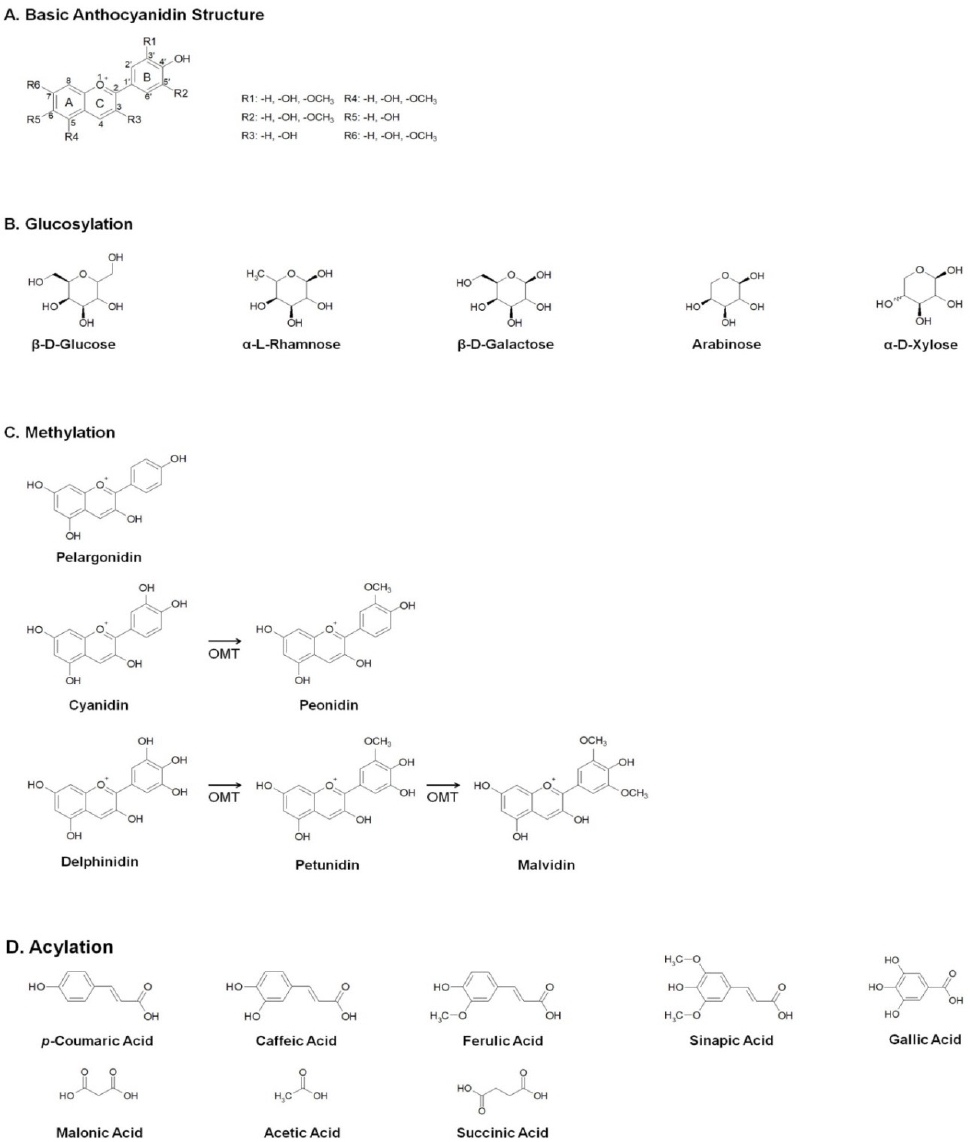
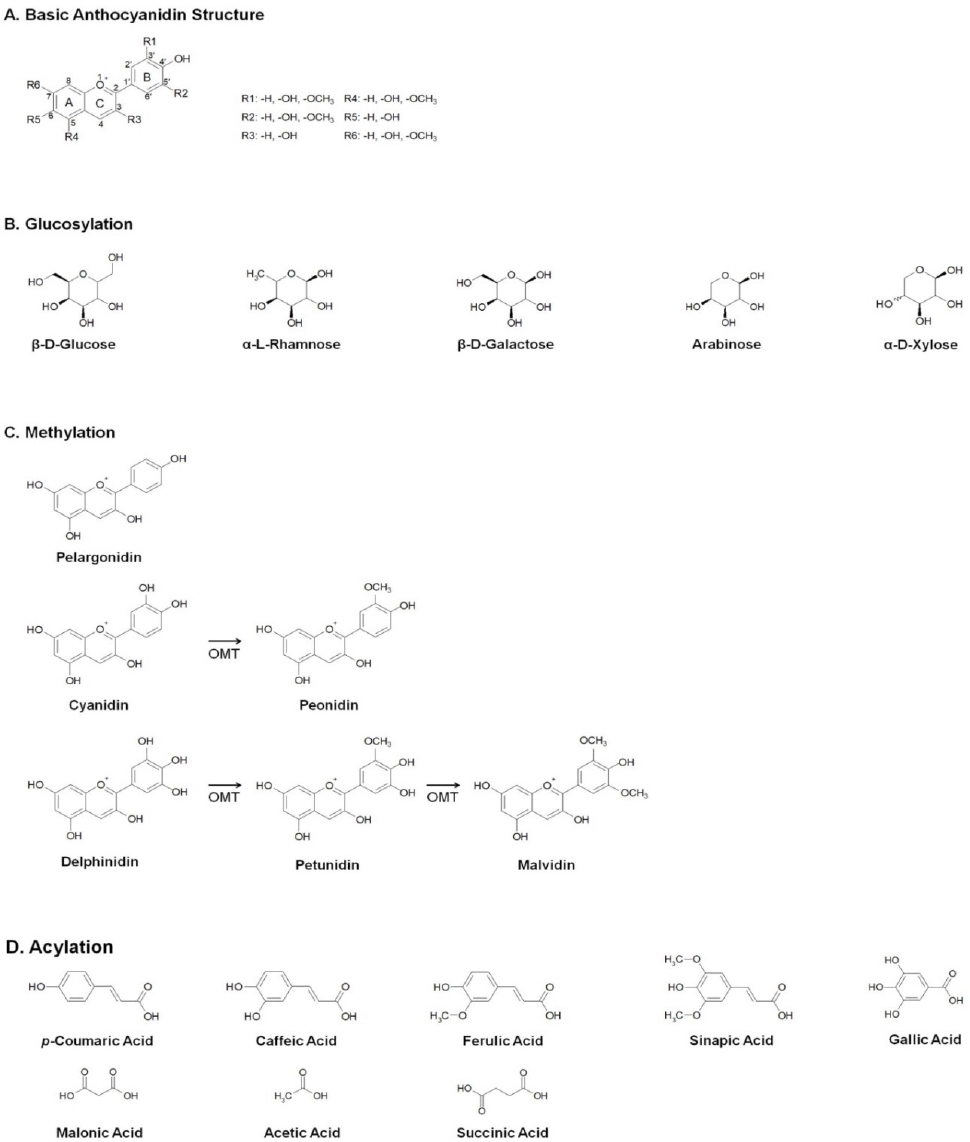
안토시아닌계 물질들은 안토시아니딘의 기본구조(
Fig. 2A)에 당화, 메틸화, 아실화 등의 수식화 과정 등을 통해서 구조적 다양성이 증가되며, 분자적 특성이 변경된다(
Grotewold 2006,
Lepiniec et al. 2006). 안토시아닌의 세포 내 안정적 축적을 위해서는 당화가 필수적이다. 안토시아닌의 당화는 글루코스(glucose), 람노스(rhamnose), 갈락토스(galactose), 아라비노스(arabinose), 자일로스(xylose) 순으로의 다중적 결합양상을 보인다(
Fig. 2B,
Ünligil & Rini 2000,
Zhang et al. 2014). 안토시아닌의 당화는 일반적으로 C3 위치와 C5 위치에서 일어난다. C3 위치의 당화는 안토시아닌의 안정성을 향상시키는 반면, C5 위치의 당화는 안정성을 감소시킬 수 있다(
Mazza & Brouillard 1987). 또한, C7 위치와 B-ring의 C3’ 위치 및 C5’ 위치에서도 당화가 될 수 있으며, 아실기가 당에 추가로 결합됨으로써 색소의 안정성을 증가시킨다(
Zhang et al. 2014). 플라보노이드계 물질들은 당 공여체로써 UDP-당을 사용하는
UDP
glycosyl
transferases (UGT)에 의해 당화된다(
Gachon et al. 2005,
Jadhav et al. 2012). UGT에는 당 공여체의 UDP 잔기에 기질을 결합시키는 44개의 아미노산으로 구성된
plant
secondary
product
glycosyltransferase (PSPG) 모티프가 관여하며, PSPG 모티프의 마지막 잔기에 의해 당 선택성이 결정된다(
Offen et al. 2006,
Wang 2009).
Fig. 2Modification of anthocyanin. (A) Basic structure of an anthocyanidin. Numbering indicate different carbon groups. (B) Major glycosyl units in anthocyanin modification. (C) Main anthocyanidins and their methylation pattern. (D) Acyl units involved in anthocyanin modification. The upper panel is an aromatic amino acid group and the lower panel is an aliphatic amino acid group.
식물의
UGT들은 거대 유전자군을 형성하며, 작용하는 기질에 따라 두 가지 유형으로 분류된다(
Liu et al. 2018). 첫 번째 유형은 flavonoid 3-
O-glycosyltransferase, flavonoid 3, 5-
O-glucosyltransferase와 같이 플라보노이드 아글리콘(aglycone)과 그 유도체에 직접적으로 당을 첨가하는 효소 그룹으로서, 지금까지 페튜니아의 PGT와 PH1, 포도의 UFGT, 장미의 RhGT1, 애기장대의 UGT73C6 등이 보고되었다(
Ford et al. 1998,
Jones et al. 2003,
Ogata et al. 2005,
Yamazaki et al. 2002). 두 번째 유형은 다이글리코사이드(diglycoside)를 생성하기 위해 플라보노이드 모노글리코사이드(monoglycosides)의 당원(glycogen)에 추가적으로 당을 결합하는 효소 그룹으로서, 대표적으로 나팔꽃의 3GGT와 페튜니아의 3RT 등이 이에 해당된다(
Kroon et al. 1994,
Morita et al. 2005).
식물의 메틸전이효소는 수산기와 카르복실기 부분을 메틸화하는
O-methyltransferases (OMTs)가 대부분이다(
Du et al. 2015). 안토시아닌은 B링의 C3’ 위치 또는 C5’ 위치의 수산기에서 메틸화될 수 있다(
Fig. 2C). 시아니딘의 C3’ 위치 수산기의 메틸화로 페오니딘(peonidin)이 생성되며, 델피니딘의 C3’ 위치 수산기의 메틸화로 페튜니딘(petunidin)이, C3’ 위치 수산기와 C5’ 위치 수산기의 메틸화로 말비딘(malvidin)이 생성된다. 이러한 메틸화는 안토시아닌 분자의 수용성에 영향을 미쳐 물질의 기능적 특성을 변화시킨다. 식물의 메틸전이효소는 서열 상동성과 기질 특이성에 따라 두 그룹으로 나누어진다(
Lam et al. 2007,
Noel et al. 2003). 첫 번째 그룹은 플라보노이드와 아이소플라보노이드(isoflavonoid)를 메틸화하는 효소로, 양이온에 독립적이며, 38-43 kDa 분자량을 지니고 있다(
Du et al. 2015). 안토시아닌의 메틸화는 이 그룹에 속하는 anthocyanin
O-methyltransferase (AOMT)에 의해 이루어진다(
Ibrahim et al. 1998). 두 번째 그룹은 리그닌 생합성에 관여하는 효소군으로 양이온에 의존적이며, 22-27 kDa의 분자량을 지니고 있다. 그러나 이 그룹의 구성원들 중 일부는 플라보노이드를 기질로 하여 OMT 활성을 보이는 것으로 보고되었다(
Hugueney et al. 2009,
Lee et al. 2008,
Ye et al. 1994).
아실화는 활성화된 공여체 분자를 통해 수용체 분자로 아실기를 전달하는 것으로 다양한 물질 생합성 과정에서 일어난다. 페놀 화합물은 아실 그룹의 공여체 또는 수용체가 될 수 있으며, 플라보노이드도 아실전이효소에 의해 아실화될 수 있다(
Bontpart et al. 2015,
Mugford & Milkowski 2012). 아실화는 수용성, 안정화, 색 변화와 같은 안토시아닌의 분자적 특성 변화에 중요한 영향을 미친다(
Nakayama et al. 2003). 안토시아닌의 당 잔기는 방향족산(
p-coumaric acid, caffeic acid, ferulic acid, sinapic acid, gallic acid) 또는 지방산(malonic acid, acetic acid, succinic acid)을 공여체로 하여 아실화된다(
Fig. 2D). 방향족산을 이용한 아실화는 안토시아닌의 파란 색조를 강화시키는 반면, 지방산을 이용한 아실화는 색 변화를 일으키지 않으나, 안토시아닌의 안정성을 증가시킨다(
Kondo et al. 1987,
Luo et al. 2007). 식물에서 검출되는 안토시아닌의 대부분은 아실화된 상태이며 액포 내에 존재한다(
Andersen & Markham 2006,
Nakayama et al. 2003). 아실전이효소들은 BAHD군과
serine
carboxy
peptidase-
like (SCPL)군으로 분류된다(
Bontpart et al. 2015). BAHD군은
BEAT (benzylalcohol
O-acetyltransferase),
AHCT (anthocyanin
O-hydroxycinnamoyltransferase),
HCBT (anthranilate N-hydroxycinnamoyl/benzoyltransferase),
DAT (deacetylvindoline 4-
O-acetyltransferase)와 같은 4개의 아실전이효소들을 포함하며 그룹명은 생화학적으로 특성화된 각각의 효소명으로부터 유래하여 명명하였다. 플라보노이드를 아실화하는 BAHD군은 acyl-CoA를 공여체로 사용하는 효소군으로서, 기질과 공유결합하는 HxxxD 모티프, 효소의 구조적인 특성을 지니는 DFGWG, NYFGNC의 모티프를 공유하고 있지만, 단백질 유사성은 10-30%로 낮으며, 단량체로서 기능하고 있음이 보고되었다(
Nakayama et al. 2003,
St-Pierre & De Luca 2000,
Unno et al. 2007). SCPL군은 클로로겐산(chlorogenic acid), 시나포일에스테르(sinapoylester), 갈로탄닌(gallotannin)과 같은 다양한 페놀릭 화합물의 생합성에 관여하며, serine, histidine, aspartic acid의 세 가지 비연속 아미노산으로 구성된 공통 모티프를 지니고 있다(
Bontpart et al. 2015,
Dahlbender & Strack 1984,
Gross 1983,
Kojima & Uritani 1972). 그러나 BAHD군과 비교하여 특성 규명된 효소들이 많지 않으며, 현재까지 오직 9개의 효소에서만 특성이 분석되었다(
Milkowski & Strack 2004,
St-Pierre & De Luca 2000).
플라보노이드 생합성 유전자들의 발현은 R2R3 MYB, basic helix-loop-helix (bHLH), WD40 전사인자로 구성된 MBW 중합체에 의해서 조절되는 것으로 알려져 있으며(
Davies 2008,
Grotewold 2006,
Koes et al. 2005,
Quattrocchio et al. 2006), 페튜니아, 다알리아, 나리 등과 같은 화훼작물 꽃잎의 색소발달에 이러한 전사인자군들이 관여하는 것으로 보고되고 있다(
Albert et al. 2014,
Ohno et al. 2011,
Yamagishi et al. 2010). 분홍 꽃색을 지니는 국화품종에서 분리된
CmMYB6 유전자의 경우, 꽃잎에서만 특이적으로 발현되며 꽃잎에서의
CmMYB6 유전자의 발현양상과 플라보노이드 생합성 유전자의 발현양상이 일치하였다(
Liu et al. 2015).
CmbHLH2 유전자는 꽃잎 전사체 분석을 통하여 선발되었고, 담배 잎에서의 일시발현검정 실험을 통해서
CmMYB6 유전자와
CmbHLH2 유전자가 안토시아닌 생합성에 양성조절자로 작용함이 확인되었다(
Xiang et al. 2015).
이외에도, subgroup 4에 속하는
MYB 유전자들이 안토시아닌 생합성의 음성조절자로 작용한다는 결과들이 보고되고 있다. 페튜니아의
PhMYB27 유전자를 RNA 간섭기술로 발현을 억제함으로써 꽃잎과 잎 조직에서 안토시아닌 생성이 증가되었다(
Albert et al. 2014). 또한, 딸기의
FaMYB1 유전자를 담배에 과발현했을 때 꽃잎에서 안토시아닌의 생성이 감소되었고, RNA 간섭기술로 발현을 억제함으로 딸기 과실에서 안토시아닌 생성이 증가되었다(
Aharoni et al. 2001,
Kadomura-Ishikawa et al. 2015). 국화의 경우에는 감마선처리로 인해 보라색이 생성된 꽃잎에서
CmMYB1 유전자의 발현이 크게 감소됨이 확인되었으며, CmMYB1의 아미노산 서열이 애기장대의 안토시아닌 생합성의 음성조절인자인 AtMYB4와 높은 유사성을 나타냈다(
Sung et al. 2013). 이러한 결과들은 국화 꽃잎에서 CmMYB1이 안토시아닌 생합성의 음성조절자로써 기능함을 시사한다.
국화의 안토시아닌 생합성 수준을 전반적으로 조절하기 위해서는 이와 같은 양성조절자와 음성조절자들간의 상호작용을 보다 폭넓게 이해해야 할 것이다. 따라서 국화의 MBW 중합체 구성원들 및 음성조절자들에 대한 분자적 특성 규명을 위한 체계적인 연구들이 요구된다.
다양한 환경조건의 안토시아닌 생합성 조절
안토시아닌의 생성은 온도에 영향을 받는다. 애기장대의 경우, 고온조건하에서 MBW 중합체를 양성조절하는 것으로 알려진 ELONGATED HYPOCOTYL 5 (HY5) 단백질이 분해되었으며 음성조절자인
MYBL2 유전자의 발현이 크게 증가하였다(
Kim et al. 2017). 또한 고온조건하에서의 HY5 단백질의 감소와 안토시아닌 함량감소가 유의한 상관관계를 나타내는 것으로 보고되었다. 국화의 경우에는 30°C 이상의 고온 재배 시 꽃잎에서의 안토시아닌 함량이 크게 감소하였다(
Nozaki et al. 2006). 이러한 현상은 온대 지역의 여름철과 열대 지역에서의 국화 품질에 심각한 악영향을 줄 수 있다. 분홍 꽃색을 지니는 국화품종을 고온 조건에 재배했을 때 품종별로 안토시아닌 감소반응은 다르게 나타났다(
Nozaki et al. 2006). 따라서 고온 조건에서 안정적인 꽃색을 유지하는 국화를 개발하기 위해서는 고온 반응과 관련한 유전자들에 대한 분자적인 기작 연구가 필요하다.
안토시아닌 생성은 빛의 영향을 받으며, 강광조건에서는 애기장대의 안토시아닌 생성이 촉진된다(
Maier & Hoecker 2015). 일반 광조건하에서는 MBW 복합체의 MYB 단백질에 특이적 E3 ligase인 COP1/SPA 복합체가 작용하여 안토시아닌 생성을 억제하였다(
Maier et al. 2013). 국화 꽃잎에 차광처리(shading treatment) 시 안토시아닌 함량이 급격히 감소하였으며 안토시아닌 생합성 유전자인
CmF3H,
CmDFR,
CmANS 및
Cm3GT 유전자의 발현과 양성조절자인
CmMYB6,
CmbHLH24,
CmCRY1a,
CmCOP1 및
CMHY5의 발현이 크게 감소되었다(
Hong et al. 2015). 이는 국화의 MBW 중합체가 빛에 반응하여 안토시아닌 생합성 조절에 관여할 수 있음을 시사한다. 따라서 온도와 빛과 같은 다양한 환경조건하에 안토시아닌의 생성기작에 대한 연구가 필요하며, 이러한 연구결과를 바탕으로 불량 환경조건하에서도 안정적인 꽃색을 나타내는 국화를 개발하는 것이 가능하리라 생각된다.
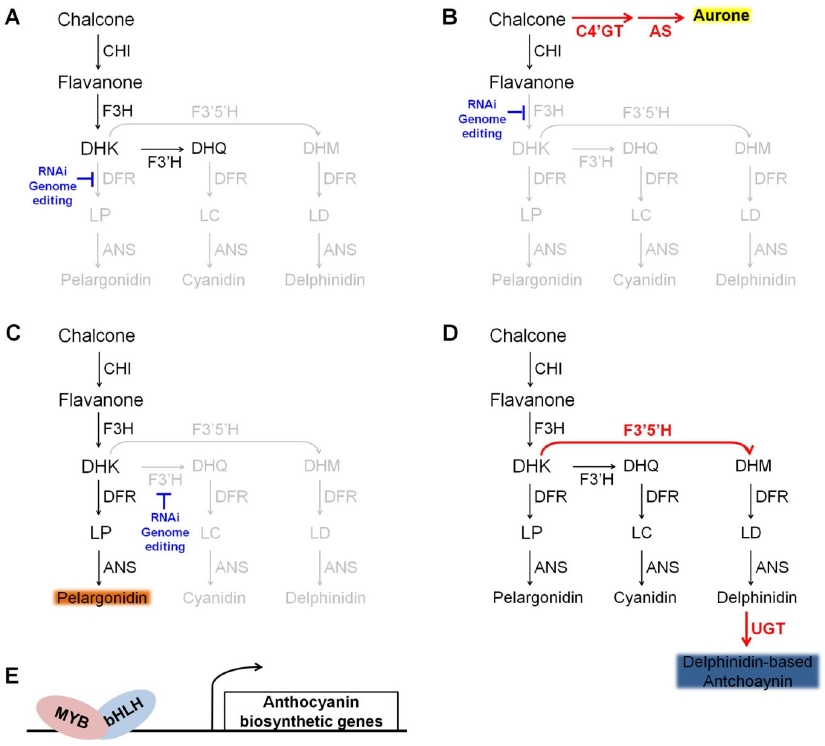
플라보노이드 대사공학을 통하여 새로운 꽃색을 생성한 다양한 연구들이 보고되었다. 현재까지 제시된 꽃색이 변경된 다양한 사례들과 전략들을 소개하고자 한다(Figs.
3,
4).
Fig. 3Strategies for modification of flower colors in chrysanthemum. Schematic diagram for obtaining white colored flower (A), yellow colored flower (B), orange colored flower (C), blue flower (D), and pink and red colored flower (E). Red arrows indicate the overexpression of target genes and blue solid lines with blunt end refer to suppress of target genes. Painted colors indicated each compound. Gray letters indicated suppressed enzymes and compounds. bHLH, basic helix loop helix; DHK, dihydrokaempferol; DHM, dihydromyricetin; DHQ, dihydroquercetin; LC, leucocyanidin; LD, leucodelphinidin; LP, leucopelargonidin.
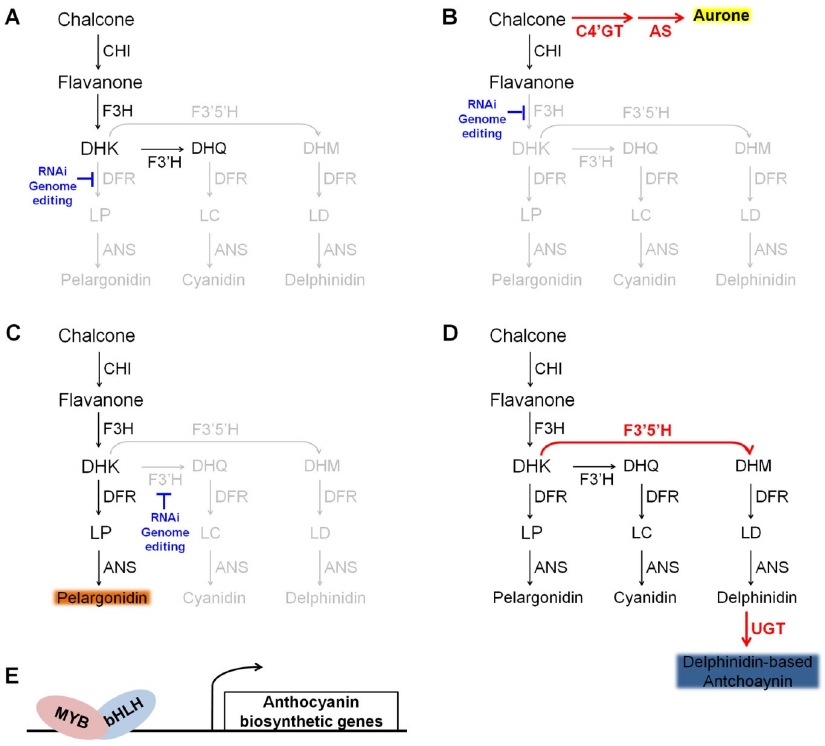
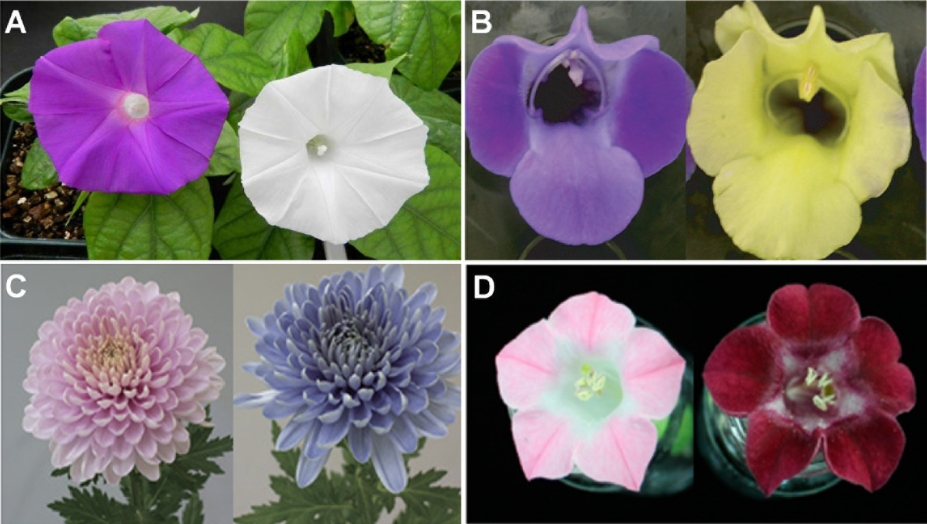
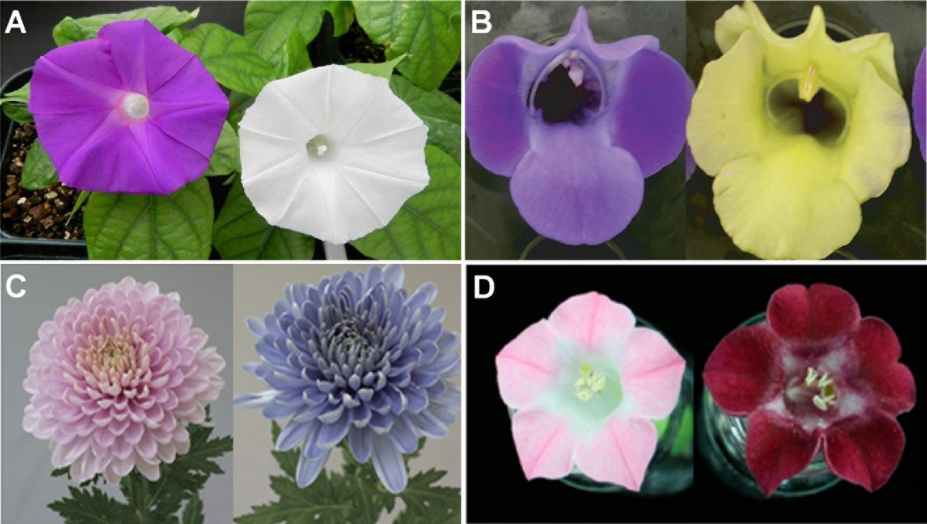
Fig. 4Flower color modification through genetic engineering of flavonoid biosynthetic pathway. (A) Flower color modification of morning glory. Left; host, right; Flower of CRISPR/Cas9-mediated
dfr-b mutants (
Watanabe et al. 2017). (B) Flower color was changed by accumulating aurones in torenia. Left; host, right; transgenic torenia with suppression of
ThF3H gene and co-expressed
AmC4’GT and
AmAS genes (
Ono et al. 2006). (C) Blue chrysanthemum. Left; host, right; blue chrysanthemum by overexpression of
CamF3’5’H and
CtUGT (
Noda et al. 2017). (D) Enhancing of flower color by simultaneous expression of
MYB and
bHLH transcription factors. Left; host, right; transgenic tobacco flower (
Kim et al. 2018).
흰색 꽃 개발
흰색 꽃은 일반적으로 안토시아닌과 카로티노이드계 색소물질이 모두 결여되어 있으며, 대부분 플라보노이드 물질인 플라본과 플라보놀을 함유한다(
Chen et al. 2012). 플라보노이드 생합성경로의 주요 유전자들의 발현을 억제시켜 꽃색을 변경시킨 다양한 결과들이 보고되고 있다.
Lim et al.(2016)은 RNA 간섭기술을 이용하여 내재
DFR 유전자의 발현을 억제하여 흰 꽃색이 생성되게 하였다(
Fig. 3A). 형질전환 담배의 꽃잎에서 플라보노이드 생합성 유전자들의 발현분석 결과, 내재
DFR 유전자의 발현이 크게 감소됨을 확인하였고, 색소물질인 안토시아닌과 프로안토시아니딘의 함량이 감소됨을 확인하였다. 최근 주목 받는 유전자 교정기술인
Clustered
Regularly
Interspaced
Short
Palindromic
Repeat/
CRISPR-
associated protein
9 (CRISPR/Cas9) 시스템을 이용하여 나팔꽃의
DFR 유전자를 돌연변이시켜 꽃색을 변경하였다(
Watanabe et al. 2017).
Fig. 4A에서처럼 대조구 나팔꽃은 보라색을 나타내는 반면, 형질전환체는 흰 꽃색이 생성되었다. 이러한 연구결과는 유전자 교정기술을 이용한 최초의 꽃색 변경 연구결과이며 유전자 교정기술을 이용하여 안정적으로 꽃색 변경이 가능하다는 것을 증명한다.
국화의 흰 꽃색을 가지는 품종(Keikai, Jinba)과 분홍 꽃색을 가지는 품종(H5)에 대해 플라보노이드 물질분석과 플라보노이드 생합성 유전자 발현분석을 실시하였다(
Chen et al. 2012). 흰 꽃색의 국화품종은 플라본이 주요 물질이었으며 플라보노이드 생합성 유전자들의 발현이 낮은 수준으로 확인되었다. 반면, 분홍 꽃색의 국화품종은 시아니딘계 안토시아닌이 주요 물질이었으며,
DFR과
GT의 발현이 증가되어 있음을 확인하였다. 흰 꽃색 국화품종인 Argus에 감마선 처리로 보라 꽃색을 나타내는 돌연변이개체인 ARTI-purple을 개발하였다(
Sung et al. 2013). ARTI-purple 개체는 Argus와는 달리 꽃잎에서 높은 함량의 안토시아닌이 검출되었고, 꽃잎 전사체 분석 결과 Argus에 비해 ARTI-purple개체에서
CmMYB1의 발현이 현저히 감소되었음을 확인하였다. 이러한 결과는 CmMYB1이 안토시아닌 생성에 음성조절자로 작용한다는 것을 의미하며, CmMYB1을 국화에서 과발현시킬 경우 흰 꽃색을 얻을 수 있다는 것을 예측케한다.
플라보노이드계 물질들 중 오론은 노란 색소물질이다(
Schwarz-Sommer et al. 2003). 일반적으로 다알리아, 금어초 등의 노란 꽃색은 오론 축적에 의해 나타난다. 국화의 경우, 노란색 꽃의 주요 색소물질은 카로티노이드이며, 국화 품종에서의 오론계 물질 존재여부는 확인되지 않았다(
Berman et al. 2016). 오론은 찰콘을 기질로 하여 C4’GT와 AS의 효소 활성에 의해 생성되어 액포에 저장된다(
Fig. 1).
Ono et al.(2006)은 보라색 토레니아의 내재
F3H 유전자의 발현을 억제시키고, 금어초 유래의
AmC4’
GT와
AmAS1을 동시에 발현시켜 노란색 토레니아를 개발하였다(
Fig. 4B). 국화의 오론 생합성 효소들의 유무는 아직 규명되지 않았으나, 만일 토레니아와 같은 경우라면,
F3H 유전자 발현 억제와 함께 오론 생합성 관련 유전자들을 도입함으로써 노란색 국화 개발이 가능할 것으로 기대된다(
Fig. 3B).
주황색 국화 개발을 위해서는 안토시아닌 물질 중 펠라고니딘 축적을 증가시키는 전략을 적용할 수 있을 것이다. 빨간 꽃색 국화의 경우,
F3’H 유전자의 높은 발현율에 의해서 시아니딘 계열의 안토시아닌이 주로 축적된다. 페튜니아 또한 시아니딘 계열의 안토시아닌을 축적하여 빨간 꽃색을 나타낸다.
Tsuda et al.(2004)은 내재
F3’H 유전자의 발현을 억제하고 DHK에 기질선호도를 보이는 장미의
RhDFR을 도입하여 펠라고니딘이 축적된 주황색 페튜니아를 개발하였다. 이러한 전략을 적용하여 플라보노이드 B-ring의 수산화를 억제하고, 펠라고니딘 축적을 유도함으로써 주황색 국화 생성이 가능하리라 예측한다(
Fig. 3C).
파란 꽃색의 구현을 위한 핵심 색소물질은 델피니딘으로, 플라보노이드 B-ring의 삼중 수산화에 관여하는 F3’5’H 활성이 필수적으로 요구된다. F3’5’H를 암호화하는 유전자는 페튜니아에서 가장 먼저 동정되었으며, 이 후 많은 식물 종에서 분리되었다(
Brugliera et al. 1999,
Holton et al. 1993). 국화과(Asteraceae)에 속하는 과꽃, 시네나리아 등은 F3’5’H 활성을 지니며 파란 꽃색을 나타낸다. 계통 발생 분석에 의하면 식물의 F3’5’H는 대개 속씨식물과 겉씨식물로 나뉘기 전에 F3’H로부터 진화되었다. 반면, 국화과의 F3’5’H는 국화과 내의 F3’H로부터 독립적으로 진화되어서 아미노산 서열이 다른 식물의 F3’5’H보다 F3’H서열에 대해 높은 유사성을 나타낸다(
Ohmiya 2018). 그러나, 국화과 식물들 중 국화속에 속하는 식물종들에서는 F3’5’H 활성을 지니지 않는다. 따라서 속간 교배를 통해서는 델피니딘 계열 안토시아닌을 생성하는 국화를 개발하기는 어렵다. 파란 장미와 더불어 현재 상업적으로 판매되는 파란색 카네이션은 흰색 꽃에 페튜니아의
PhF3’5’H와
PhDFR 유전자를 과발현시킴으로써 개발되었다(
Tanaka et al. 2009). 국화에서도 파란 꽃색을 개발하기 위한 다양한 연구가 진행되었다.
He et al.(2013)은 국화의 내재
F3’H 유전자의 발현을 억제시키고 국화과 식물인 세네시오(Senecio)의
ScF3’5’H를 과발현시켰으나 델피니딘은 축적되지 않았다. 그러나
Noda et al.(2013)은 초롱꽃의
CamF3’5’H를 과발현시켜 델피니딘이 생성된 국화를 개발하였으며
Brugliera et al.(2013)은 내재
F3’H를 억제시키고 팬지의
VtF3’5’H를 과발현시켜 국화에서 델피니딘이 축적되었으며 자주색 혹은 보라색의 국화가 생성되었다.
Fig. 4C에서처럼, 최근에 초롱꽃의
CamF3’5’H와 나비콩(butterfly pea)의 anthocyanin 3’,5’-
O-glucosyltransferase를 암호화하는
CtUGT를 국화에 도입하여 보라색 또는 파란색의 꽃잎을 지니는 국화가 개발되었다(
Noda et al. 2017). 유전자 발현분석 결과, 보라색 국화에서는
CamF3’5’H만 발현되고, 파란 꽃색을 나타내는 국화에서는
CamF3’5’H와
CtUGT 유전자가 모두 발현되었다. 이와 같은 결과는 파란색 국화를 얻기 위해서 F3’5’H 외에도 UGT활성이 필수적으로 요구됨이 확인되었다(
Fig. 3D).
시아니딘 계열 안토시아닌의 축적은 분홍색 혹은 빨간색을 나타낸다. 담배에서 꽃잎 특이 프로모터를 이용하여 애기장대 R2R3-MYB 전사인자
PAP1과 옥수수 bHLH 전사인자
B-peru를 동시발현시킴으로써 시아니딘 계열 안토시아닌의 함량을 증가시킨 연구가 최근 보고되었다(
Fig. 4D,
Fig. 4 Kim et al. 2018). 담배 형질전환체는 진한 붉은색 꽃을 생성하였으며, 안토시아닌 함량은 대조구와 비교하여 124배 증가되었다. 이러한 결과는 안토시아닌 생합성 양성조절자의 발현을 통해 색소의 축적을 극적으로 증가시킬 수 있음을 나타내고, 국화의 꽃색 강화에 있어서 전사인자의 중요성을 시사하는 사례라고 할 수 있다(
Fig. 3E).
결 론
꽃색은 화훼작물의 관상가치를 결정하는 산업적으로 중요한 형질 중의 하나이며, 생명공학기술을 기반으로 한 꽃색 변경은 매우 매력적인 연구분야이다. 성공적인 꽃색 변경을 위해서는 식물 생리에 대한 생물학적 이해 및 정교한 육종 기술과 생명공학기술의 적용이 필요하다. 식물의 대표적인 이차대사산물군인 플라보노이드와 카로티노이드계 물질들은 꽃색 결정에 관여할 뿐 아니라 식물의 생존 및 번식에 있어서 중요한 역할을 수행한다. 또한 각각의 물질들은 독립적인 생합성 경로를 지니고 있으면서도 서로 밀접하게 관련되어 조절 받는 것으로 알려져 있다. 본 논문에서는 플라보노이드계 물질 축적에 초점을 맞추어 생합성 대사경로 및 조절기작에 대해 전반적으로 서술하였다. 또한, 생명공학기술을 이용하여 여러 작물에서 꽃색 변경을 달성한 성공적인 사례들을 제시하고 생명공학기술이 전통적 육종 방식의 한계를 어떻게 극복했는지를 보여주고, 궁극적으로 국화의 꽃색 변경을 달성할 수 있는 전략들을 제시하였다. 식물의 이차대사물질은 식물의 종에 따라 심지어 같은 개체의 서로 다른 조직에서도 생육 환경에 따라 생합성과 조절양상이 다양하다. 따라서, 지금까지 알려진 정보들만으로는 식물체 내의 이차대사물질의 축적과 조절을 명확히 이해하기에는 많은 한계를 지니고 있으며 국화의 성공적인 꽃색 변경을 달성하기 위해서는 많은 부분들이 추가적으로 연구되어야 한다. 플라보노이드 물질 중 주요 색소물질군 이외의 조색소물질군인 플라본의 생합성 및 세포 내의 축적기작에 대한 연구는 다양한 색조의 꽃색 개발에 기여할 수 있을 것이다. 또한, 다양한 재배 환경에서도 안정적 꽃색 품질을 유지하기 위해서는 환경 스트레스에 대한 세밀한 연구도 수행되어야 할 것이다.
플라보노이드 대사공학을 통해 새로운 꽃색을 지니는 작물은 많은 화훼작물에서 개발되고 있으나, 실제적인 상업화는 몇몇 화훼작물에 국한되고 있다. 생명공학기술로 개발된 작물들의 상업화를 위해서는 연구 및 개발에 소요되는 비용과 맞먹는 안전성 평가비용이 소요된다. 하지만 생명공학작물 규제대상에서 벗어나는 유전자 교정기술을 활용한다면 형질 개량된 화훼작물이 보다 빠르게 시장에 진입할 수 있으리라 판단된다. 뿐만 아니라, 본 총설에서 제시된 플라보노이드 대사공학의 여러 가지 전략들을 카로티노이드 대사공학과 접목함으로 자연계는 존재하지 않는 새로운 꽃색의 국화작물을 개발할 수 있으리라 기대된다.
적 요
관상용 화훼작물에 있어서 꽃의 색깔과 형태는 중요한 형질 중 하나이다. 일반적으로 꽃색은 카로티노이드, 플라보노이드, 베타라인에 의해 결정된다. 그 중 플라보노이드는 보다 넓은 영역의 색을 나타낸다. 국화는 세계적으로 인기가 많은 관상용 화훼작물이며 꽃색을 바꾸기 위한 많은 연구가 진행되어 왔다. 국화의 경우, 시아니딘 계열 안토시아닌의 축적으로 분홍색 혹은 빨간색의 꽃색을 나타내며, 카로티노이드 계열 색소물질의 축적으로 노란색 또는 초록색의 꽃색을 나타낸다. 그러나 자연계에는 파란 꽃색의 국화는 존재하지 않는다. 지금까지 플라보노이드계 물질 생합성을 조절함으로써 파란색 꽃을 개발하기 위한 여러 연구가 시도되었다. 반면 그 외의 플라보노이드계 물질을 기반으로 한 새로운 꽃색 국화 개발연구는 거의 수행되지 않았다. 플라보노이드 생합성 조절에는 다양한 전사인자들이 관여하고 플라보노이드계 물질 기반 꽃색 변경을 위해서는 구조 유전자 및 전사인자들을 이해하는 것이 중요하다. 따라서 본 논문에서는 화훼작물의 플라보노이드 생합성 및 조절에 대하여 전반적으로 서술하였고, 그 동안 보고된 플라보노이드계 물질의 꽃색 변경 연구들을 검토하였다. 이러한 결과들은 생명공학기술을 기반으로한 국화 꽃색 변경 달성을 위한 중요한 길잡이가 될 수 있을 것이다.
사 사
본 연구는 농촌진흥청 차세대바이오그린 21 연구사업 (과제번호: PJ013360 및 PJ013346) 및 국립농업과학원의 연구사업 (PJ012458)의 지원에 의해 수행되었습니다.
References
- 1. Aharoni A, De Vos CHR, Wein M, Sun Z, Greco R, Kroon A, Mol JNM, O'connell AP. 2001. The strawberry FaMYB1 transcription factor suppresses anthocyanin and flavonol accumulation in transgenic tobacco. Plant J 28: 319-332.
- 2. Albert NW, Davies KM, Lewis DH, Zhang H, Montefiori M, Brendolise C, Boase MR, Ngo H, Jameson PE, Schwinn KE. 2014. A conserved network of transcriptional activators and repressors regulates anthocyanin pigmentation in eudicots. Plant Cell 26: 962-980.
- 3. Andersen OM, Markham KR. 2006. Flavonoid-protein interactions. In: Flavonoids chemistry, biochemistry and applications. CRC Press 464-522.
- 4. Anderson NO. 2006. Chrysanthemum. Flower breeding and genetics: Issues, challenges and opportunities for the 21st century. Springer, pp. 389-437.
- 5. Azadi P, Bagheri H, Nalousi AM, Nazari F, Chandler SF. 2016. Current status and biotechnological advances in genetic engineering of ornamental plants. Biotechnol Adv 34: 1073-1090.
- 6. Bedon F, Bomal C, Caron S, Levasseur C, Boyle B, Mansfield SD, Schmidt A, Gershenzon J, Grima-Pettenati J, Séguin A, MacKay J. 2010. Subgroup 4 R2R3-MYBs in conifer trees: Gene family expansion and contribution to the isoprenoid- and flavonoid-oriented responses. J Exp Bot 61: 3847-3864.
- 7. Ben Zvi MM, Shklarman E, Masci T, Kalev H, Debener T, Shafir S, Ovadis M, Vainstein A. 2012.
PAP1 transcription factor enhances production of phenylpropanoid and terpenoid scent compounds in rose flowers. New Phytol 195: 335-345.
- 8. Berman J, Sheng Y, Gómez LG, Veiga T, Ni X, Farré G, Capell T, Guitián J, Guitián P, Sandmann G. 2016. Red anthocyanins and yellow carotenoids form the color of orange-flower gentian (Gentiana luteaL. var aurantiaca). PLOS ONE 11: e0162410
- 9. Bontpart T, Cheynier V, Ageorges A, Terrier N. 2015. BAHD or SCPL acyltransferase? What a dilemma for acylation in the world of plant phenolic compounds. New Phytol 208: 695-707.
- 10. Brugliera F, Barri-Rewell G, Holton TA, Mason JG. 1999. Isolation and characterization of a flavonoid 3'-hydroxylase cDNA clone corresponding to the Ht1 locus of Petunia hybrida
. Plant J 19: 441-451.
- 11. Brugliera F, Tao GQ, Tems U, Kalc G, Mouradova E, Price K, Stevenson K, Nakamura N, Stacey I, Katsumoto Y. 2013. Violet/blue chrysanthemums-metabolic engineering of the anthocyanin biosynthetic pathway results in novel petal colors. Plant Cell Physiol 54: 1696-1710.
- 12. Chen SM, Li CH, Zhu XR, Deng YM, Sun W, Wang LS, Chen FD, Zhang Z. 2012. The identification of flavonoids and the expression of genes of anthocyanin biosynthesis in the chrysanthemum flowers. Biol Plant 56: 458-464.
- 13. Dahlbender B, Strack D. 1984. Nitrogen nutrition and the accumulation of free and sinapoyl-bound malic acid in Raphanus sativus cotyledons. Planta 161: 142-147.
- 14. Davies KM. 2008. Modifying anthocyanin production in flowers. Anthocyanins biosynthesis functions, and applications Springer. 49-80.
- 15. Dowrick GJ. 1953. The chromosomes of chrysanthemum, II: garden varieties. Heredity 7: 59-72.
- 16. Du H, Wu J, Ji KX, Zeng QY, Bhuiya MW, Su S, Shu QY, Ren HX, Liu ZA, Wang LS. 2015. Methylation mediated by an anthocyanin O-methyltransferase, is involved in purple flower coloration in Paeonia
. J Exp Bot 66: 6563-6577.
- 17. Dubos C, Le Gourrierec J, Baudry A, Huep G, Lanet E, Debeaujon I, Routaboul JM, Alboresi A, Weisshaar B, Lepiniec L. 2008. MYBL2 is a new regulator of flavonoid biosynthesis in Arabidopsis thaliana
. Plant J 55: 940-953.
- 18. Ford CM, Boss PK, Høj PB. 1998. Cloning and characterization of Vitis vinifera UDP-Glucose: flavonoid 3-O-glucosyltransferase, a homologue of the enzyme encoded by the maize bronze-1 Locus that may primarily serve to glucosylate anthocyanidins in vivo
. J Biol Chem 273: 9224-9233.
- 19. Gachon CM, Langlois-Meurinne M, Saindrenan P. 2005. Plant secondary metabolism glycosyltransferases: the emerging functional analysis. Trends Plant Sci 10: 542-549.
- 20. Gou JY, Felippes FF, Liu CJ, Weigel D, Wang JW. 2011. Negative regulation of anthocyanin biosynthesis in Arabidopsis by a miR156-targeted SPL transcription factor. Plant Cell 23: 1512-1522.
- 21. Gross GG. 1983. Synthesis of mono-, di- and trigalloyl-β-D-glucose by β-glucogallin-dependent galloyltransferases from oak leaves. Z Naturforsch 38: 519-523.
- 22. Grotewold E. 2006. The genetics and biochemistry of floral pigments. Annu Rev Plant Biol 57: 761-780.
- 23. Hanks G. A review of production statistics for the cut flower and foliage sector 2015 (Part of AHDB Horticulture funded project PO BOF 002a). The National Cut Flower Centre, AHDB Horticulture 102: 2015.
- 24. He H, Ke H, Keting H, Qiaoyan X, Silan D. 2013. Flower colour modification of chrysanthemum by suppression of F3'H and overexpression of the exogenous Senecio cruentus F3'5'H gene. PLOS ONE 8: e74395
- 25. Holton TA, Brugliera F, Lester DR, Tanaka Y, Hyland CD, Menting JG, Lu CY, Farcy E, Stevenson TW, Cornish EC. 1993. Cloning and expression of cytochrome P450 genes controlling flower colour. Nature 366: 276-279.
- 26. Hong Y, Tang X, Huang H, Zhang Y, Dai S. 2015. Transcriptomic analyses reveal species-specific light-induced anthocyanin biosynthesis in chrysanthemum. BMC Genomics 16: 202
- 27. Hugueney P, Provenzano S, Verriès C, Ferrandino A, Meudec E, Batelli G, Merdinoglu D, Cheynier V, Schubert A, Ageorges A. 2009. A novel cation-dependent O-methyltransferase involved in anthocyanin methylation in grapevine. Plant Physiol 150: 2057-2070.
- 28. Ibrahim RK, Bruneau A, Bantignies B. 1998. Plant O-methyltransferases: molecular analysis, common signature and classification. Plant Mol Biol 36: 1-10.
- 29. Jadhav SKR, Patel KA, Dholakia BB, Khan BM. 2012. Structural characterization of a flavonoid glycosyltransferase from Withania somnifera
. Bioinformation 8: 943
- 30. Jones P, Messner B, Nakajima JI, Schäffner AR, Saito K. 2003. UGT73C6 and UGT78D1, glycosyltransferases involved in flavonol glycoside biosynthesis in Arabidopsis thaliana
. J Biol Chem 278: 43910-43918.
- 31. Kadomura-Ishikawa Y, Miyawaki K, Takahashi A, Noji S. 2015. RNAi-mediated silencing and overexpression of the FaMYB1 gene and its effect on anthocyanin accumulation in strawberry fruit. Biol Plant 59: 677-685.
- 32. Katsumoto Y, Fukuchi-Mizutani M, Fukui Y, Brugliera F, Holton TA, Karan M, Nakamura N, Yonekura-Sakakibara K, Togami J, Pigeaire A. 2007. Engineering of the rose flavonoid biosynthetic pathway successfully generated blue-hued flowers accumulating delphinidin. Plant Cell Physiol 48: 1589-1600.
- 33. Kim DH, Park SK, Lee JY, Ha SH, Lim SH. 2018. Enhancing flower color through simultaneous expression of the B-peru and mPAP1 transcription factors under control of a flower-specific promoter. Int J Mol Sci 19: 309
- 34. Kim S, Hwang G, Lee S, Zhu JY, Paik I, Nguyen TT, Kim J, Oh E. 2017. High ambient temperature represses anthocyanin biosynthesis through degradation of HY5. Front Plant Sci 8: 1787
- 35. Koes R, Verweij W, Quattrocchio F. 2005. Flavonoids: A colorful model for the regulation and evolution of biochemical pathways. Trends Plant Sci 10: 236-242.
- 36. Kojima M, Uritani I. 1972. Elucidation of the structure of a possible intermediate in chlorogenic acid biosynthesis in sweet potato root tissue. Plant Cell Physiol 13: 1075-1084.
- 37. Kondo T, Kawai T, Tamura H, Goto T. 1987. Structure determination of heavenly blue anthocyanin, a complex monomeric anthocyanin from the morning glory ipomea tricolor, by means of the negative NOE method. Tetrahedron Lett 28: 2273-2276.
- 38. Kroon J, Souer E, De Graaff A, Xue Y, Mol J, Koes R. 1994. Cloning and structural analysis of the anthocyanin pigmentation locus Rt of Petunia hybrida: Characterization of insertion sequences in two mutant alleles. Plant J 5: 69-80.
- 39. Lam KC, Ibrahim RK, Behdad B, Dayanandan S. 2007. Structure, function, and evolution of plant O-methyltransferases. Genome 50: 1001-1013.
- 40. Lee YJ, Kim BG, Chong Y, Lim Y, Ahn JH. 2008. Cation dependent O-methyltransferases from rice. Planta 227: 641-647.
- 41. Lepiniec L, Debeaujon I, Routaboul JM, Baudry A, Pourcel L, Nesi N, Caboche M. 2006. Genetics and biochemistry of seed flavonoids. Annu Rev Plant Biol 57: 405-430.
- 42. Lim SH, You MK, Kim DH, Kim JK, Lee JY, Ha SH. 2016. RNAi-mediated suppression of dihydroflavonol 4-reductase in tobacco allows fine-tuning of flower color and flux through the flavonoid biosynthetic pathway. Plant Physiol Biochem 109: 482-490.
- 43. Liu X, Lin C, Ma X, Tan Y, Wang J, Zeng M. 2018. Functional characterization of a flavonoid glycosyltransferase in sweet orange (Citrus sinensis). Front Plant Sci 9: 166
- 44. Liu XF, Xiang LL, Yin XR, Grierson D, Li F, Chen KS. 2015. The identification of a MYB transcription factor controlling anthocyanin biosynthesis regulation in Chrysanthemum flowers. Sci Hortic 194: 278-285.
- 45. Luo J, Nishiyama Y, Fuell C, Taguchi G, Elliott K, Hill L, Tanaka Y, Kitayama M, Yamazaki M, Bailey P. 2007. Convergent evolution in the BAHD family of acyl transferases: Identification and characterization of anthocyanin acyl transferases from Arabidopsis thaliana
. Plant J 50: 678-695.
- 46. Maier A, Hoecker U. 2015. COP1/SPA ubiquitin ligase complexes repress anthocyanin accumulation under low light and high light conditions. Plant Signal Behav 10: e970440
- 47. Maier A, Schrader A, Kokkelink L, Falke C, Welter B, Iniesto E, Rubio V, Uhrig JF, Hülskamp M, Hoecker U. 2013. Light and the E3 ubiquitin ligase COP1/SPA control the protein stability of the MYB transcription factors PAP1 and PAP2 involved in anthocyanin accumulation in Arabidopsis. Plant J 74: 638-651.
- 48. Matsui K, Umemura Y, Ohme-Takagi M. 2008. AtMYBL2, a protein with a single MYB domain, acts as a negative regulator of anthocyanin biosynthesis in Arabidopsis. Plant J 55: 954-967.
- 49. Mazza G, Brouillard R. 1987. Recent developments in the stabilization of anthocyanins in food products. Food Chem 25: 207-225.
- 50. Milkowski C, Strack D. 2004. Serine carboxypeptidase-like acyltransferases. Phytochemistry 65: 517-524.
- 51. Ministry of Agriculture, Food and Rural Affairs (MAFRA)2017. Status of ornamental crops
http://www.mafra.go.kr/
.
- 52. Mol J, Grotewold E, Koes R. 1998. How genes paint flowers and seeds. Trends Plant Sci 3: 212-217.
- 53. Morita Y, Hoshino A, Kikuchi Y, Okuhara H, Ono E, Tanaka Y, Fukui Y, Saito N, Nitasaka E, Noguchi H. 2005. Japanese morning glory dusky mutants displaying reddish-brown or purplish-gray flowers are deficient in a novel glycosylation enzyme for anthocyanin biosynthesis, UDP-glucose: anthocyanidin 3-O-glucoside-2''-O-glucosyltransferase, due to 4-bp insertions in the gene. Plant J 42: 353-363.
- 54. Mugford ST, Milkowski C. 2012. Serine carboxypeptidase-like acyltransferases from plants. Methods in Enzymology. Elsevier 516: 279-297.
- 55. Nakayama T, Suzuki H, Nishino T. 2003. Anthocyanin acyltransferases: Specificities, mechanism, phylogenetics, and applications. J Mol Catal B Enzymatic 23: 117-132.
- 56. Noda N, Aida R, Kishimoto S, Ishiguro K, Fukuchi-Mizutani M, Tanaka Y, Ohmiya A. 2013. Genetic engineering of novel bluer-colored chrysanthemums produced by accumulation of delphinidin-based anthocyanins. Plant Cell Physiol 54: 1684-1695.
- 57. Noda N, Yoshioka S, Kishimoto S, Nakayama M, Douzono M, Tanaka Y, Aida R. 2017. Generation of blue chrysanthemums by anthocyanin B-ring hydroxylation and glucosylation and its coloration mechanism. Sci Adv 3: e1602785
- 58. Noel JP, Dixon RA, Pichersky E, Zubieta C, Ferrer JL. 2003. Structural, functional, and evolutionary basis for methylation of plant small molecules. Recent Advances in Phytochemistry. Elsevier 37: 37-58.
- 59. Nozaki K, Takamura T, Fukai S. 2006. Effects of high temperature on flower colour and anthocyanin content in pink flower genotypes of greenhouse chrysanthemum (Chrysanthemum morifolium Ramat.). J Hortic Sci Biotechnol 81: 728-734.
- 60. Offen W, Martinez-Fleites C, Yang M, Kiat-Lim E, Davis BG, Tarling CA, Ford CM, Bowles DJ, Davies GJ. 2006. Structure of a flavonoid glucosyltransferase reveals the basis for plant natural product modification. EMBO J 25: 1396-1405.
- 61. Ogata J, Kanno Y, Itoh Y, Tsugawa H, Suzuki M. 2005. Plant biochemistry: Anthocyanin biosynthesis in roses. Nature 435: 757
- 62. Ohmiya A. 2018. Molecular mechanisms underlying the diverse array of petal colors in chrysanthemum flowers. Breed Sci 68: 119-127.
- 63. Ohno S, Hosokawa M, Hoshino A, Kitamura Y, Morita Y, Park KI, Nakashima A, Deguchi A, Tatsuzawa F, Doi M. 2011. A bHLH transcription factor DvIVS is involved in regulation of anthocyanin synthesis in dahlia (Dahlia variabilis). J Exp Bot 62: 5105-5116.
- 64. Ono E, Fukuchi-Mizutani M, Nakamura N, Fukui Y, Yonekura-Sakakibara K, Yamaguchi M, Nakayama T, Tanaka T, Kusumi T, Tanaka Y. 2006. Yellow flowers generated by expression of the aurone biosynthetic pathway. Proc Natl Acad Sci USA 103: 11075-11080.
- 65. Park CH, Chae SC, Park SY, Kim JK, Kim YJ, Chung SO, Arasu MV, Al-Dhabi NA, Park SU. 2015. Anthocyanin and carotenoid contents in different cultivars of chrysanthemum (Dendranthema grandiflorum Ramat.) flower. Molecules 20: 11090-11102.
- 66. Polturak G, Grossman N, Vela-Corcia D, Dong Y, Nudel A, Pliner M, Levy M, Rogachev I, Aharoni A. 2017. Engineered gray mold resistance, antioxidant capacity, and pigmentation in betalain-producing crops and ornamentals. Proc Natl Acad Sci USA 114: 9062-9067.
- 67. Quattrocchio F, Baudry A, Lepiniec L, Grotewold E. 2006. The regulation of flavonoid biosynthesis. The science of flavonoids Springer. 97-122.
- 68. Schwarz-Sommer Z, Davies B, Hudson A. 2003. An everlasting pioneer: the story of Antirrhinum research. Nat Rev Genet 4: 655
- 69. St-Pierre B, De Luca V. 2000. Origin and diversification of the BAHD superfamily of acyltransferases involved in secondary metabolism. Recent Adv Phytochem 34: 285-315.
- 70. Sung SY, Kim SH, Velusamy V, Lee YM, Ha BK, Kim JB, Kang SY, Kim HG, Kim DS. 2013. Comparative gene expression analysis in a highly anthocyanin pigmented mutant of colorless chrysanthemum. Mol Biol Rep 40: 5177-5189.
- 71. Tanaka Y, Brugliera F, Chandler S. 2009. Recent progress of flower colour modification by biotechnology. Int J Mol Sci 10: 5350-5369.
- 72. Tsuda S, Fukui Y, Nakamura N, Katsumoto Y, Yonekura-Sakakibara K, Fukuchi-Mizutani M, Ohira K, Ueyama Y, Ohkawa H, Holton TA. 2004. Flower color modification of Petunia hybrida commercial varieties by metabolic engineering. Plant Biotechnol 21: 377-386.
- 73. Ünligil UM, Rini JM. 2000. Glycosyltransferase structure and mechanism. Curr Opin Struct Biol 10: 510-517.
- 74. Unno H, Ichimaida F, Suzuki H, Takahashi S, Tanaka Y, Saito A, Nishino T, Kusunoki M, Nakayama T. 2007. Structural and mutational studies of anthocyanin malonyltransferases establish the features of BAHD enzyme catalysis. J Biol Chem 282: 15812-15822.
- 75. Wang X. 2009. Structure, mechanism and engineering of plant natural product glycosyltransferases. FEBS Lett 583: 3303-3309.
- 76. Watanabe K, Kobayashi A, Endo M, Sage-ono K, Toki S, Ono M. 2017. CRISPR/Cas9-mediated mutagenesis of the dihydroflavonol-4-reductase-B (DFR-B) locus in the Japanese morning glory Ipomoea (Pharbitis) nil
. Sci Rep 7: 10028
- 77. Xiang LL, Liu XF, Li X, Yin XR, Grierson D, Li F, Chen KS. 2015. A novel bHLH transcription factor involved in regulating anthocyanin biosynthesis in Chrysanthemums (Chrysanthemum morifolium Ramat.). PLOS ONE 10: e0143892
- 78. Xu W, Dubos C, Lepiniec L. 2015. Transcriptional control of flavonoid biosynthesis by MYB-bHLH-WDR complexes. Trends Plant Sci 20: 176-185.
- 79. Yamagishi M, Shimoyamada Y, Nakatsuka T, Masuda K. 2010. Two R2R3-MYB genes, homologs of petunia AN2 regulate anthocyanin biosyntheses in flower tepals, tepal spots and leaves of Asiatic hybrid lily. Plant Cell Physiol 51: 463-474.
- 80. Yamazaki M, Yamagishi E, Gong Z, Fukuchi-Mizutani M, Fukui Y, Tanaka Y, Kusumi T, Yamaguchi M, Saito K. 2002. Two flavonoid glucosyltransferases from Petunia hybrida: molecular cloning, biochemical properties and developmentally regulated expression. Plant Mol Biol 48: 401-411.
- 81. Ye ZH, Kneusel RE, Matern U, Varner JE. 1994. An alternative methylation pathway in lignin biosynthesis in Zinnia
. Plant Cell 6: 1427-1439.
- 82. Zhang Y, Butelli E, Martin C. 2014. Engineering anthocyanin biosynthesis in plants. Curr Opin Plant Biol 19: 81-90.