적요
‘Aram’ is a soybean cultivar developed for soy-sprout. It was developed from the crossing of ‘Bosug’ (Glycine max IT213209) and ‘Camp’ (G. max IT267356) cultivars in 2007. F1 plants and F2 population were developed in 2009 and 2010. A promising line was selected in the F5 generation in 2011 using the pedigree method and it was evaluated for agronomic traits, yield, and soy-sprouts characteristics in a preliminary yield trial (PYT) in 2012 and an advanced yield trial (AYT) in 2013. Agronomic traits and yield were stable between 2014 and 2016 in the regional yield trial (RYT) in four regions (Suwon, Naju, Dalseong, and Jeju). Morphological characteristics of ‘Aram’ are as follows: determinate plant type, purple flowers, grey pubescence, yellow pods, and small, yellow, and spherical seeds (9.9 g 100-seeds-1) with a light brown hilum. The flowering date was the 5th of August and the maturity date was the 15th of October. Plant height, first pod height, number of nods, number of branches, and number of pods were 65 cm, 13 cm, 16, 4.5, and 99, respectively. In the sprout test, germination rate and sprout characteristics of ‘Aram’ were comparable to that of the ‘Pungsannamulkong’ cultivar. The yield of ‘Aram’ was 3.59 ton ha-1 and it was 12% higher than that of ‘Pungsannamulkong’ in southern area of Korea. The yield of ‘Aram’ in the Jeju region, which is the main region for soybean sprout production, was 20% higher than that of ‘Pungsannamulkong’. The height of the first pod and the tolerance to lodging and pod shattering, which are connected to the adaptation to mechanized harvesting, were higher in ‘Aram’ compared to those in ‘Pungsannamulkong’. Therefore, the ‘Aram’ cultivar is expected to be broadly cultivated because of its higher soybean sprout quality, and seed yield and better adaptation to mechanized harvesting. (Registration number: 7718)
서 언
콩[
Glycine max. (L.) Merr]은 단백질과 지방 함량이 높고 식품, 사료, 산업용으로 이용성이 다양하여 전세계적으로 널리 재배되고 있는 두과작물이다. 콩의 단백질 함량은 40% 수준으로 필수아미노산이 균형 있게 배합되어 있고, 칼슘, 인, 비타민B 등도 포함되어 있어 영양적으로 매우 우수하다. 이뿐만 아니라 건강 기능성 성분으로 알려진 이소플라본, 사포닌, 안토시아닌 등도 함유하고 있어 건강을 중시하는 소비 트렌드에 맞춰 많은 관심을 받고 있다(
Medic et al. 2014). 특히, 한국에서 콩은 된장, 간장, 두부, 콩나물, 두유, 콩밥 등 다양한 형태의 음식으로 가공되어 거의 매일 즐겨 먹는데 이것은 하나의 문화로서 음식 그 이상의 의미를 가지고 있다.
한국의 콩 식량 자급도는 감소 추세로 2012년에 30.8%에서 2017년에 22%로 감소하였다. 콩 수요량은 ‘12년 약 125만톤에서 ‘17년에 약 138만톤(잠정)으로 증가하였으나 재배면적과 생산량은 감소하고 있어 이를 극복하기 위한 노력이 필요하다(
MAFRA 2018). 품종 개발 측면에서는 병충해와 재해에 강하여 안정적인 수량을 확보하며 기계수확 적응성이 높아 생산성을 향상시킬 필요가 있다.
2018년 국내 콩 재배면적은 50,638 ha이며 생산량은 89,410톤이다(
KOSIS 2019). 그 중 나물용 콩 생산은 7천 ha에서 8천톤정도 생산되어 전체 콩 생산의 약 10%를 차지하고 있다. 또한 나물용 콩의 80%는 제주에서 생산되고 있어 제주가 나물용 콩의 주산지라고 할 수 있다(
KREI 2019).
제주는 토성과 지리적 기후로 인해 내륙의 환경과는 차이점이 있다. 제주는 토양의 70%가 화산회토로 자연 비옥도가 낮다(
Yang et al. 2012). 토양에는 굵은 자갈이 많아 기계를 이용한 토양 관리 작업에도 어려움이 있다. 지리적으로는 태풍의 길목에 위치하는 경우가 많고, 해풍이 심해 콩이 쓰러질 수 있는 가능성이 높다. 기계수확 적응성을 높이고 개체간 의지력을 향상시켜 쉽게 쓰러지지 않도록 하기 위해 대부분 농가에서는 일반 재배방법의 2배인 10 a에 약 10 kg의 콩 종자를 산파하여 밀식 재배하고 있다. 그럼에도 불구하고 토성으로 인해 원하는 수준의 경장과 착협고를 얻는 것이 어려워 기계수확에 어려움이 있다.
기계 수확 시 발생하는 수량 손실 중 품종 개량을 통해 개선할 수 있는 부분은 도복성, 탈립성 그리고 착협고이다. 착협고는 지면에서 자엽절을 제외한 첫번째 꼬투리 하단부 까지의 높이를 의미한다. 착협고는 파종기, 재식거리, 재배 연차에 따라서 변이가 나타나지만 품종에 의한 변이의 정도가 더 큰 형질이며, 유전력이 약 63%로 육종을 통해 개량할 수 있다(
Kang et al. 2017).
최근에는 콩의 재배적 특성뿐만 아니라 가공적성도 중요한 육종 목표이다. 원료곡의 사용자는 가공업체와 소비자이기 때문이다. 특히 콩나물용 콩은 재배특성이 우수하더라도 콩나물 가공특성이 감소되면 사용가치가 현저히 감소된다. 콩나물용 콩은 발아특성이 우수하고 배축의 신장속도가 빠르며 경실립, 부패립수가 적어야 한다(
Edward & Hartwig 1971,
Shin et al. 1995,
Kim et al. 2014). 개발된 나물용 콩의 100립중은 7~14 g으로 분포하고 있는데, 소립일수록 대체로 콩나물 배축 신장이 우수하고 수율이 높다. 하지만 대립이면서도 배축 신장이 우수한 품종도 있으며 수율은 소립, 중립, 대립 간 유의차가 없는 경우도 있어 소립 위주로 선발하되 다양한 요인을 고려해야 한다(
Lee et al. 2012).
2019년 현재까지 나물용 콩은 45품종이 개발되었으며 가장 널리 재배되고 있는 나물용 콩은 ‘풍산나물콩(
Suh et al. 1997)’이다. ‘풍산나물콩’은 도복에 약하고 착협고가 낮아 기계수확에 불리한 형질을 가지고 있다. 그럼에도 불구하고 종자의 안정성과 콩나물 가공적성이 우수하여 대부분의 재배면적을 차지하고 있다. 2010년에는 도복에 강하고 착협고가 높아 기계수확에 적합한 ‘해품(
Kim et al. 2018)’, 2015년에는 극소립 특성에 도복에 강하고 수량이 많은 ‘해원(
Lee et al. 2015)’ 등 우수한 품종이 개발된 바 있다.
국립식량과학원에서는 착협고가 높고 도복에 강하여 기계수확 적응성이 높으면서도 콩나물 재배적성이 우수한 콩 품종을 개발하고자 노력하여 소립 나물용 콩 ‘아람’을 개발하였다. ‘아람’은 경장이 크고 착협고가 높으면서도 도복에 강하고, 수량이 많으며 콩나물 가공적성도 우수하여 농가 생산성 향상 및 가공업체 수요에 만족시킬 수 있을 것으로 기대된다. 본 논문을 통해 ‘아람’의 육성경위와 주요특성을 소개하고자 한다.
재료 및 방법
육성 과정
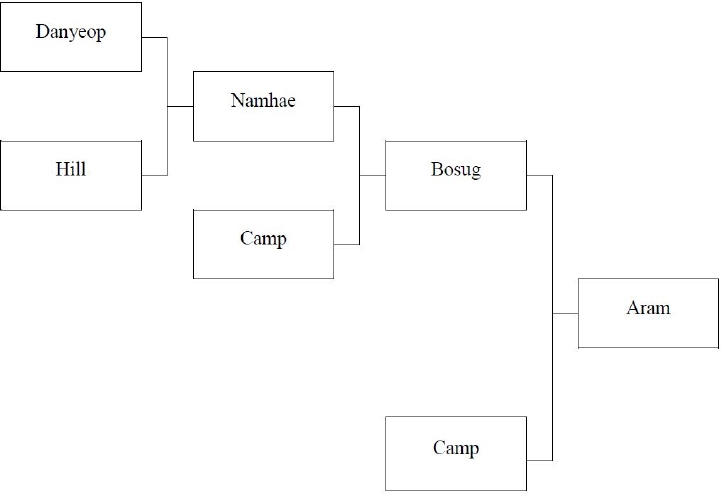
‘아람’은 보석(IT213209, 한남콩/Camp)을 모본으로, Camp(IT267356)를 부본으로 인공교배하고 계통육종법에 의해 개발한 품종이다(
Fig. 1). 2007년 인공교배를 시작으로 2008년 F
1 집단 전개, 2009년 F
2 분리집단을 전개하였다. 2010년에는 F
3~F
4세대를 세계 채소 센터(AVRDC, Asian Vegetable Research and Development Center)에서 세대촉진하여 2011년에 F
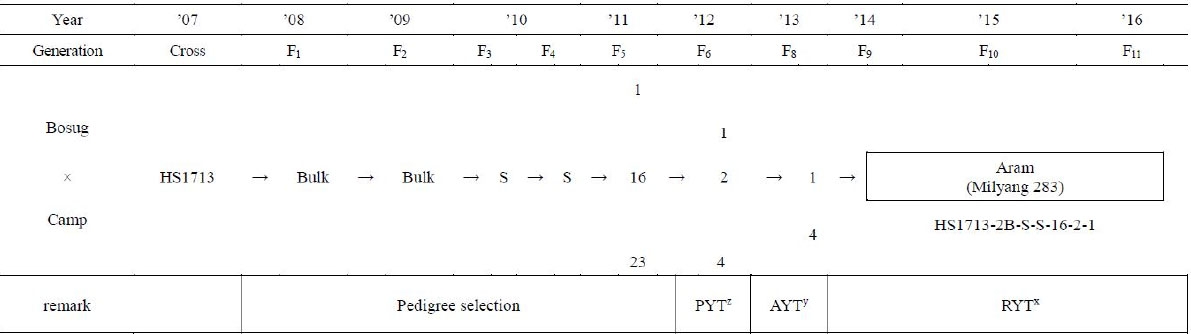
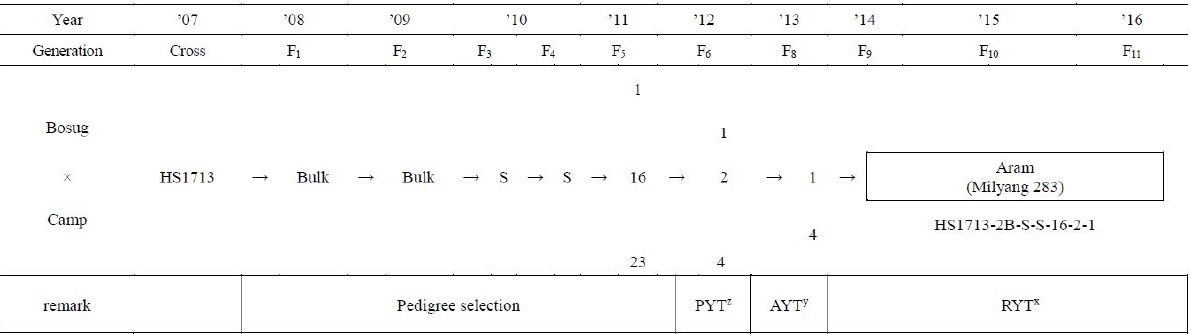
5 계통을 전개하고 농업적형질이 우수한 계통을 선발하였다. 선발된 계통은 생산력검정시험을 통해 표준품종 대비 수량이 우수한 것으로 평가되어 밀양283호(HS1713-2B-S-S-16-2-1)의 계통명을 부여하고 2014~2016년 3년간 지역적응시험을 수행하였다(
Fig. 2). 지역적응시험에서는 경장이 크고 착협고가 높으면서도 내도복성이 강해 기계수확 적응성이 높고 안정적인 수량을 확보할 수 있는 것으로 평가되어, 2016년 12월 농작물 직무육성 신품종 선정위원회에서 신규등록 품종으로 결정하고 탐스럽게 자란다는 순한글말인 ‘아람’을 품종명으로 명명하였다.
Fig. 1
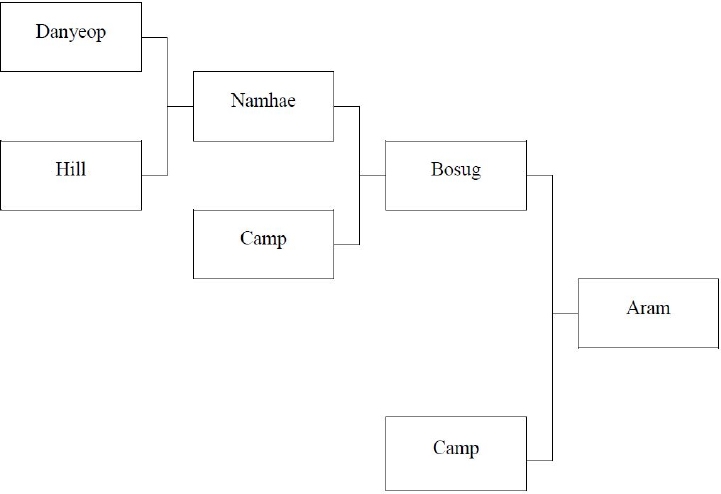
Fig. 2
Pedigree diagram of ‘Aram’.
zPreliminary yield trial, yAdvanced yield trial, xRegional yield trial.
생산력검정시험
2012년 생산력검정 예비시험(PYT, Preliminary Yield Trial), 2013년 생산력검정 본시험(AYT, Advanced Yield Trial)을 국립식량과학원 대구시험지(대구광역시 달성군 소재, 35° 54´ 18” N, 128° 26´ 42” E)에서 수행하였다. 생산력검정 예비시험은 시험구 면적 8.4 ㎡, 재식거리 70×15 cm, 1주2본으로 재배되고 난괴법 2반복으로 배치하였고, 생산력검정 본시험은 시험구 면적 11.2 ㎡, 재식거리 70×15 cm, 1주2본으로 재배되고 난괴법 3반복으로 배치하여 농업과학기술 연구조사분석기준에 따라 주요 생육특성과 수량성을 조사하였다(
RDA 2012).
지역적응시험(RYT, Regional Yield Trial)은 경기 수원, 전남 나주, 대구 달성, 제주 등 4개 지역에서 2014년부터 2016년까지 3년간 수행되었다. 재배 방법은 시험구 면적 11.2 ㎡, 재식 거리 70×15 cm, 1주2본으로 재배되고 달성, 수원은 난괴법 4반복으로 배치하였으며 나주와 제주는 난괴법 3반복으로 배치하였다. 파종기는 6월 중순이며 농업과학기술 연구조사분석 기준에 따라 생육특성 및 수량성을 조사하고 표준품종인 ‘풍산나물콩’과 비교하였다.
내병성검정
콩모자이크바이러스(SMV)와 불마름병(Bacterial pustule, Xanthomonas axonopodis pv.glycines)의 자연 이병률 평가를 위해 대구시험지 검정포장에 5월 상순에 파종하였다. 자연이병율은 병징이 나타난 개체 수를 조사하여 정도(0-9)로 평가하였다.
콩모자이크바이러스 인공접종 평가는 G5 (
Lim et al. 2003), G6H (
Seo et al. 2009), G7H (
Kim et al. 2003)를 이용하였으며 각각의 이병 잎을 마쇄하여 2 mole 농도의 인산 나트륨 버퍼에 녹인 후 즙액을 만들어 초생엽 전개시 Carborandom을 이용하여 잎 표면에 상처를 낸 후 접종 하였다. 접종 후 약 2주 뒤 접종한 하위엽과 상위엽을 병반 없음(-), 갈색 병반(L), 엽맥 병반(V), mosaic 증상(M), 고사(N), 5 가지 병징으로 판별 및 조사 하였다.
불마름병 인공접종 평가는 8ra 균계를 패트리디시에 증식 후 증류수에 희석한 흡광도 0.2-0.3의 접종액을 제 2본엽기~제 3본엽기에 충분히 분무접종하고 습식처리 후 10일이 경과하고 2회에 걸쳐 잎에 나타난 병징의 면적을 조사하고 정도(0-9)로 평가하였다.
검은뿌리썩음병(Root rot)은 과습포장에 재배하여 자연이병 개체수를 조사하고 전 개체수에 대한 백분율로 나타내었다. 종자 이병립율은 시험구에서 임의로 100립을 추출하여 3반복으로 자반병(Purple seed stain, Cercospora kikuchii), 갈반병(Seed mottling), 미이라병(Phomopsis seed decay, Phomopsis longicolla) 이병립수를 조사하였다. 콩나방 피해립율(Pod borer damage)은 경기도 연천 콩나방 상습 발병지(경기 연천)에서 피해립율을 조사하였다.
내도복성 및 내탈립성
내도복성 검정을 위해 70×7.5 cm로 2배 밀식 재배하여 시험구 2.8 ㎡로 난괴법 2반복 배치하여 도복 정도를 조사하였다. 도복 정도는 성숙기에 45° 이상 기울어진 개체의 비율로 등급화(1: 5% 이하, 3: 6~10%, 5: 11~50%, 7: 51~75%, 9: 76% 이상)하였다. 반복 및 연차 간 등급을 평균하여 1~9로 최종 등급을 표시하였다. 협개열 정도는 성숙한 꼬투리 20개를 성숙기에 채취하여 40℃ 건조기에 48시간 건조 후 꼬투리의 개열 정도를 조사하였다.
품질분석
단백질 함량은 질소 분석기(Elementar Analysen system, US/RapidN111, germany)를 이용하여 분석하였으며 지방함량 분석은 자동유지추출장치(Soxhlet System: BUCHI Labotechnik, B-811, AG, Switzerland)에 넣고 n-hexane으로 3시간 열수 추출한 후 지방함량을 구하였다. 그리고 지방산 조성 분석은 가스크로마토그래피(Agilent, GC 7890A, USA)로 분석하였다.
이소플라본은 성분 분석을 위해 분쇄한 시료 1.0 g을 50% methanol 용액 20 mL에 12시간 실온에서 교반한 뒤 추출액을 여과지(Whatman NO. 2)를 이용하여 여과하였다. 여과된 시료는 다시 HPLC 분석을 위해 0.45 ㎛ 로 재여과하였고 액체크로마토그래피(Agilent, 1100, USA)로 분석하였다. 이소플라본은 배당체와 비배당체의 함량을 모두 합하여 표시하였다.
발아 특성 및 콩나물 특성 평가
발아 특성은 패트리디시에 여과지(Whatman No.1)를 놓고 종자 50립을 치상하여 25℃ 항온 항습기에서 증류수로 종실이 마르지 않도록 관리하여 발아세 및 발아율을 4반복으로 조사 하였다. 발아세는 치상 후 2일째, 발아율은 5일째 종실의 상태를 확인하여 조사하였다. 발아율은 총 공시 종자에 대한 발아 종자의 백분율로 나타내었다. 발아 종자는 종피를 뚫고 유근이 출현한 것을 기준으로 조사하였다.
콩나물 특성은 바닥면에 구멍이 있는 플라스틱 박스(20×20× 20 cm)를 이용하여, 종자 300 g을 4시간 수침한 후 기온 20℃, 수온 20℃로 조절된 암실상태의 콩나물 재배기(㈜가라뫼)에 치상하여 5일간 재배하고 특성을 조사하였다. 관수는 매 4시간에 3회로 설정하였다.
콩나물 특성으로는 전장, 배축장, 근장, 배축 직경, 부패율, 불완전발아율, 경실립율, 수율을 조사하였다. 전장, 배축장, 배축 직경, 근장은 10개의 콩나물을 임의로 추출하여 조사하였으며 부패율, 경실률, 불완전 발아율, 콩나물 수율은 전구를 대상으로 조사하였다. 전장은 콩나물 전체 길이, 배축장은 콩나물 머리와 뿌리를 제외한 배축 길이, 배축 직경은 콩나물 배축 중 가장 두꺼운 부분의 직경, 근장은 콩나물 전장에서 배축장의 길이를 뺀 길이를 기준으로 조사하였다. 부패율과 경실률은 원료콩 립수에 대한 부패립수와 경실립수의 백분율을 계산하였고 불완전 발아율은 전장 5 cm 이하의 개체수를 원료콩 립수에 대한 백분율로 나타내고, 콩나물 수율은 전장 5 cm 이상 콩나물의 무게를 원료콩 무게에 대한 백분율로 조사하였다.
결과 및 고찰
고유특성 및 생육특성
‘아람’은 유한신육형이며 엽형은 삼각형, 화색은 자색, 모용색은 회색, 협색은 황색, 종실은 구형이며 종피색은 황색, 배꼽색은 담갈색이다(
Table 1). 개화기는 8월 5일, 성숙기는 10월 15일로 ‘풍산나물콩’ 대비 각각 1일, 7일 느리다. 경장은 65 cm, 착협고는 13 cm, 마디수는 16개, 분지수는 4.5개, 협수는 99개, 100립중은 9.9 g이다(
Table 2). 특히 착협고는 기계수확 적응성에 중요한 형질 중 하나로, 착협고가 낮을 경우에는 콤바인 기계 수확 시 꼬투리가 절단된 그루터기에 남게 되어 손실을 유발할 수 있다. 지역적응시험에서는 ‘아람’의 착협고가 ‘풍산나물콩’보다 통계적으로 차이 나지는 않았으나, 시험포장 및 제주 농가실증포장에서 착협고가 높아 기계수확에 적합한 것으로 평가되었다. 또한 ‘아람’의 초형은 표준 재배 시 분지 각도가 작고 분지길이가 긴 도원추형으로, 분지 각도가 넓은 타원형 초형인 ‘풍산나물콩’보다 분지가 잘 처지지 않아 기계수확에 적합한 초형이라 할 수 있다.
Table 1Morphological characteristics of ‘Aram’
Table 1
|
Cultivar |
Growth habit |
Leaflet shape |
Flower Color |
Pubescence Color |
Pod Color |
Seed coat color |
Hilum color |
Seed shape |
|
Aram |
Determinate |
Ovate |
Purple |
Grey |
Yellow |
Yellow |
Light brown |
Spherical |
|
Pungsannamulkong |
Determinate |
Lanceolate |
Purple |
Grey |
Yellow |
Yellow |
Yellow |
Spherical |
Table 2Quantitative characteristics of ‘Aram’ determined by regional yield trial in four regions from 2014 to 2016
Table 2
|
Cultivar |
Flowering Date (Month, Day) |
Maturity Date (Month. Day) |
Plant Height (cm) |
First Pod Height (cm) |
No. of nods |
No. of branches |
No. of pods |
Seed Uniformity (%)z
|
100-seed weight (g) |
Lodging at field (1-9)y
|
Shattering |
|
|
|
Normal culture |
Density culture |
Field (1-9)x
|
Ratio by Oven test (%) |
|
Aram |
8.5 |
10.15 |
65 |
13 |
16 |
4.5 |
99 |
82 |
9.9 |
1 |
3 |
1 |
8.1 |
|
Pungsannamulkong |
8.4 |
10.8 |
54 |
11 |
15 |
4.4 |
99 |
49 |
10.9 |
5 |
8 |
1 |
39.6 |
|
|
t-valuew
|
- |
- |
3.02** |
0.95ns
|
0.50ns
|
1.61ns
|
-0.07ns
|
3.84ns
|
-6.11** |
- |
- |
- |
- |
내도복⋅내탈립 및 내병충성
‘아람’의 내도복성은 표준재배 시 ‘1’, 밀식재배 시 ‘3’으로 평가되어 각각 ‘5’, ‘8’로 평가된 ‘풍산나물콩’보다 강하였다. 내탈립성은 포장평가에서 ‘1’, 실내평가에서 8.1%로 풍산나물콩(‘1’, 39.6%)보다 협개열 저항성이 강하였다(
Table 2). 도복이 심할 경우 콤바인 수확 시 식물체가 절단이 되지 않고 포장에 남아있게 되며, 탈립성이 심할 경우에는 콤바인 절단면과 식물체 간의 충격으로 종자 손실이 발생할 수 있다. 이러한 이유로 내도복성과 내탈립성은 기계 수확 적응성에 중요한 형질이며, ‘아람’은 이들 형질이 개선되어 ‘풍산나물콩’보다 기계 수확 적응성이 높다.
내병충성 검정결과 불마름병은 검정포장에서 ‘0’, 인공접종 시 ‘3’으로 평가되어 각각 ‘1’, ‘3’으로 평가된 풍산나물콩과 비슷하였다. 검은뿌리썩음병은 0.0%로 평가되어 풍산나물콩(1.1%)보다 강하였다. 콩모자이크바이러스는 포장에서 ‘0’으로 평가되었고, 인공접종 시 G5, G6H, G7H에서 하위엽 국부병반이 나타나고 상위엽에 모자이크 병징이 나타나 특정 계통의 콩모자이크바이러스에 약한 것으로 나타났다. 종실 이병립율 조사결과 자반병은 0.3%, 갈반병은 0.2%, 미이라병은 0.5%로 조사되어 표준품종보다 낮은 수준이다. 콩나방 피해립율은 4.3%로 ‘풍산나물콩’보다 낮았다(
Table 3).
Table 3The resistance of ‘Aram’ to the soybean diseases estimated from 2014 to 2016
Table 3
|
Cultivar |
Bacterial Pustule (0-9)z
|
Root rot (%)y
|
Soybean Mosaic Virusx
|
Percentages of damaged seed (%)y
|
|
|
|
|
Field |
Inoculation |
Inoculation |
Field (0-9)z
|
Purple seed stain |
Seed mottling |
Phomopsis seed decay |
Pod borer damage |
|
|
G5 |
G6H |
G7H |
|
Aram |
0 |
3 |
0.0 |
L/M |
L/M |
L/M |
0 |
0.3 |
0.2 |
0.5 |
4.3 |
|
Pungsannamulkong |
1 |
3 |
1.1 |
L/M |
L/M |
L/M |
1 |
0.2 |
1.4 |
0.1 |
4.7 |
종실 품질 및 가공 적성
‘아람’ 의 종실 단백질 함량은 40.9%, 지방 함량은 18.5%, 포화지방산은 15.8%, 불포화 지방산은 84.2%로 분석되었다. 이소플라본은 Daidzein계열 1,013 μg/g, Glycitein계열 499 μg/g, Genistein계열은 1,731 μg/g으로 총 함량은 3,243 μg/g으로 ‘풍산나물콩’(1,815 μg/g)보다 높았다(
Table 4).
Table 4Major component of seed in ‘Aram’ estimated from 2014 to 2016
Table 4
|
Cultivar |
Crude Protein (%) |
Crude Oil (%) |
Fatty acids (%) |
Isoflavone (μg/g) |
|
|
|
Saturated |
Unsaturated |
Daidzein |
Glycitein |
Genistein |
Total |
|
Aram |
40.9 |
18.5 |
15.8 |
84.2 |
1,013 |
499 |
1,731 |
3,243 |
|
Pungsannamulkong |
41.6 |
17.6 |
15.2 |
84.8 |
682 |
196 |
937 |
1,815 |
|
|
t-valuez
|
-0.40ns
|
2.51ns
|
0.94ns
|
-0.94ns
|
2.20ns
|
10.16** |
3.55* |
3.92* |
콩나물 특성 평가결과 발아세 93%, 발아율 96%로 ‘풍산나물콩’보다 우수하였다. 콩나물 전장은 20.3 cm, 배축장은 9.1 cm, 근장은 11.2 cm로 ‘풍산나물콩’보다 배축장이 짧고 근장이 길었으나 통계적 차이는 없었다. 배축 직경은 1.9 mm로 ‘풍산나물콩’보다 0.2 mm 가늘었다. 경실립은 나타나지 않았고 부패립율은 1.0%수준으로 평가되었다. 콩나물 수율은 598%로 ‘풍산나물콩’과 대등하였다(
Table 5).
Table 5Characteristics of sprouts of ‘Aram’ estimated from 2014 to 2016
Table 5
|
Cultivar |
2-day Germination Rate (%) |
5-day Germination Rate (%) |
Whole length (cm) |
Hypocotyl length (cm) |
Root length (cm) |
Hypocotyl thickness (mm) |
Hard seed rate (%) |
Decayed seed rate (%) |
Soy-sprout yield (%) |
|
Aram |
93 |
96 |
20.3 |
9.1 |
11.2 |
1.9 |
0.0 |
1.0 |
598 |
|
Pungsannamulkong |
91 |
94 |
20.4 |
9.5 |
10.8 |
2.1 |
0.8 |
0.0 |
598 |
|
|
t-valuez
|
2.83ns
|
2.14ns
|
0.13ns
|
-0.17ns
|
0.65ns
|
-2.0ns
|
-4.00ns
|
1ns
|
0.02ns
|
수량성
2012년~2013년에 실시한 생산력검정시험에서 평균 수량 4.29 ton ha
-1로 ‘풍산나물콩’ 대비 29% 증수된 결과를 얻었다(
Table 6). 2014년~2016년 전국 4개 지역에서 실시한 지역적응시험 결과 전국 평균 3.58 ton ha
-1로 ‘풍산나물콩’ 대비 11% 증수되었다. 수원을 제외한 남부지역 평균은 3.59 ton ha
-1이며 ‘풍산나물콩’ 대비 12% 증수되었다. 특히 주산지인 제주에서는 3.18 ton ha
-1로 ‘풍산나물콩’ 대비 20% 증수되어 나물콩 주산지 제주에서의 적응성이 우수한 것으로 평가되었다(
Table 7).
Table 6The result of yield trials carried from 2012 to 2013 in Milyang
Table 6
|
Cultivar |
Yield (ton ha-1) |
Indexx
|
|
|
PYT (’12)z
|
AYT (’13)y
|
Mean |
|
Aram |
3.98 |
4.59 |
4.29 |
129 |
|
Pungsannamulkong |
2.79 |
3.86 |
3.33 |
100 |
Table 7The result of regional yield trials carried from 2014 to 2016 in four regions
Table 7
|
Yield (Ton ha-1) |
|
|
Location |
Aram |
Pungsannamulkong |
|
|
|
2014 |
2015 |
2016 |
Mean |
Indexz
|
2014 |
2015 |
2016 |
Mean |
|
Suwon |
3.82 |
2.81 |
3.93 |
3.52 |
107 |
3.51 |
2.29 |
4.07 |
3.29 |
|
Naju |
4.17 |
4.83 |
3.04 |
4.01 |
113 |
2.88 |
4.49 |
3.28 |
3.55 |
|
Dalseong |
3.37 |
3.65 |
3.74 |
3.59 |
106 |
2.71 |
3.45 |
4.04 |
3.40 |
|
Jeju |
3.16 |
2.61 |
3.78 |
3.18 |
120 |
2.36 |
2.40 |
3.21 |
2.66 |
|
|
|
Overall mean |
3.63 |
3.48 |
3.62 |
3.58 |
111 |
2.87 |
3.16 |
3.65 |
3.22 |
|
|
|
t-valuey
|
- |
- |
- |
2.1* |
- |
- |
- |
- |
- |
적 요
‘아람’은 보석(IT213209)과 Camp (IT267356)를 모본으로 2007년 인공교배 하여 F1, F2 분리집단을 전개하고 F3-F4 세대는 세계 채소 센터(AVRDC, Asian Vegetable Research and Development Center)에서 세대촉진을 수행하고 F5 세대에서 계통을 선발하였다. 2012년~2013년 생산력검정시험을 통해 수량과 농업적 형질을 평가하고, 2014~2016년 수원, 나주, 달성, 제주에서 지역적응시험을 수행하여 지역별 적응성과 재배 안정성을 평가하였다.
아람은 유한신육형이며 엽형이 삼각형, 화색이 백색, 모용색이 회색, 협색은 황색이며 종실은 소립 구형으로 백립중이 9.9 g으로 풍산나물콩보다 1.0 g 가볍고 종피색은 황색, 배꼽색은 담갈색의 질적 특성을 가지고 있다. 개화기는 8월 5일, 성숙기는 10월 15일로 만숙종이며 풍산나물콩 보다 7일 느리다. 경장은 65 cm, 착협고는 13 cm, 마디수는 16개, 분지수는 4.5개이며 분지가 길고 각도가 작은 도원추형 초형이다.
내병성 검정결과 불마름병, 종자 이병립율, 검은뿌리 썩음병, 콩나방 저항성 등이 모두 강하였으며, 콩모자이크바이러스는 G5, G6H, G7H 접종 시 모자이크 증상이 나타났으나 3년간의 자연 이병 검정결과에서는 병징이 조사되지 않았다. 발아특성은 발아세와 발아율 모두 풍산나물콩보다 우수하였으며 콩나물 특성은 풍산나물콩과 비슷한 수준이었다. 수량성은 지역적응시험 결과 남부지역 평균 3.59 ton/ha로 풍산나물콩 대비 12% 증수되었다.
사 사
본 연구는 농촌진흥청 연구사업(과제명: 콩 전통식품 가공적성 신품종 육성, 과제번호: PJ01122502)의 지원에 의해 수행되었다.
References
- Edward CJ, Hartwig EE. 1971. Effect of seed size upon rate of germination in soybean. Agri J 63: 429-430.
- Kang BK, Kim HT, Choi MS, Koo SC, Seo JH, Kim HS, Shin SO, Yun HT, Oh IS, Kulkarni KP, Lee JD. 2017. Genetic and environmental variation of first pod height in soybean [Glycine max(L.) Merr.]. Plant Breed Biotech 5: 36-44.
- KOSIS (Korean Statistical Information Service). 2019. Pulse Production [Internet]. Statistics Korea, Daejeon, [cited 2019 May 12]. Available from http://kosis.kr/statisticsList/statisticsListIndex.do?menuId=M_01_01&vwcd=MT_ZTITLE&parmTabId=M_01_01&statId=1967001&themaId=F#SelectStatsBoxDiv
- KREI (Korea Rural Economic Institute). 2019. Agricultural prediction 'Soybean'[Internet]. Rural economic institute, Naju, [cited 2019 May 12]. Available from http://aglook.krei.re.kr/jsp/pc/front/observe/monthlyReport.jsp
- Kim HT, Baek IY, Hang WY, Ko JM, Lee YH, Jung CS, Oh YJ, Cho SK, Park KY, Lee BW, Sim HS, Jeon MK, Seo MJ, Kim DK, Kim ST, Kim YD. 2014. Sprout soybean cultivar 'Joyang 1', tolerant to bacterial pustule. Korea J. Breed. Sci 46: 290-294.
- Kim YH, Kim OS, Lee BC, Moon JK, Lee SC, Lee JY. 2003. G7H, a New soybean mosaic virus strain:its virulence and nucleotide sequence of ci gene. Plant Dis 87: 1372-1375.
- Kim HT, KO JM, Han WY, Baek IY, Yun HT, Lee YH, Lee BW, Ha TJ, Jung CS, Shin SO, Kim HS, Park JH, Seo JH, Kang BK, Yang WS, Gwak DY. 2018. Adaptation of mechanized and small seed soybean cultivar 'Haepum'for soy sprouts. Korean J Breed Sci 50: 249-255.
- Lee MS, Lim JS, Kim KC, Lee HI, Park EH. 2012. Sprout characteristics of recommended soybean cultivars classified by seed size. College of Natural Resources, Yeungnam University.
- Lee CY, Choi MS, Kim HT, Yun HT, Lee BW, Chung YS, Kim RW, Choi HK. 2015. Soybean [Glycine max(L.) Merrill]:Importance as a crop and pedigree reconstruction of Korean varieties. Plant Breed Biotech 3: 179-196.
- Lim WS, Kim YH, Kim KH. 2003. Complete genome sequences of the genomic RNA of soybean mosaic virus strains G7H and G5. Plant Pathol J 19: 171-176.
- MAFRA (Ministry of Agriculture, Food and Rural Affairs).2018. Agriculture, food and rural affairs statistics. MAFRA, Sejong, Korea: pp. 289.
- Medic J, Atkinson C, Hurburgh CR. 2014. Current knowledge in soybean composition. J Am Oil Chem Soc 91: 363-384.
- RDA (Rural Development Administration).2012. Agricultural science technology standards for investigation of research. RDA: Jeonju, Korea.
- Seo JK, Ohshima K, Lee HG, Son M, Choi HS, Lee SH, Sohn SH, Kim KH. 2009. Molecular variability and genetic structure of the population of soybean mosaic virus based on the analysis of complete genome sequence. Virology 393: 91-103.
- Shin DC, Park CK, Baek IY, Jung CS, Song SB, Suh HS, Oh YJ. 1995. Early maturity, resistant to disease and lodging, small seed size sprouting soybean variety “Hannamkong”. RDA A Agri Sci 37: 139-143.
- Suh SK, Kim HS, Oh YJ, Kim KH, Cho SK, Kim YJ, Kim SD, Park HK, Park MS, Cho SY. 1997. A new soybean variety for sprout with small seed and high yielding pungsannamulkong. Korean J Breed Sci 29: 503.
- Yang SH, Kang HJ, Lee SC, Oh HJ, Kim GY. 2012. Influence of N fertilization level, rainfall, and temperature on the emission of N2O in the jeju black volcanic ash soil with soybean cultivation. Korean J Soil Sci Fert 45: 451-458.