적요
‘Bodrami’ is a brown rice cultivar suitable for cooking, developed by crossing ‘Hwaseong’ and ‘Congsengla’ cultivars at Rural Development Administration, Korea, in 2003. Cooked brown rice of ‘Bodrami’ naturally has a soft texture, and after 24 hours of warm treatment, it maintained its soft texture and it was evaluated that the taste and texture of cooked brown rice were better than that of another rice cultivar. ‘Bodrami’ is a mid-maturing rice cultivar. The average heading date in ordinary planting was August 11th in Suwon, Korea, which also exhibits strong to blast leaf and rice stripe virus, and brown rice yield of ‘Bodrami’ had a yield of 5.56 MT/ha in ordinary planting. The advantages of eating brown rice are high intake of GABA (which is excellent for controlling blood), γ-oryzanol (which is good for Antioxidation), rice embryos (rich in fiber), and rice bran (rich in minerals). Another advantage of ‘Bodrami’ is that, compared to glutinous rice varieties (which is a higher glycemic index), it has a lower glycemic index and a smooth texture. The consumption of white rice has been decreasing recently, while interest in brown rice has been increasing as a consequence of these advantages. ‘Bodrami’ was developed in response to recent changes in consumption preferences. (Registration No. 5644)
서 언
쌀은 옥수수⋅밀⋅보리와 함께 세계적인 중요 식량작물이다. 아시아 지역을 중심으로 많은 나라에서 주식으로 삼고 있다. 우리나라도 선사시대부터 지금까지 쌀은 에너지원으로써만 아니라 문화의 한 축으로 자리매김 해왔다. 하지만 식문화 다양화에 따라 1979년 135.6 kg에 이르던 국내 1인당 연간 쌀소비량은 감소세가 이어져 2019년 현재 61 kg까지 떨어진 상태이다(
KOSIS 2019). 식문화 다양화에는 여러가지 요인이 있지만 그 중 건강에 대한 인식 변화도 큰 비중을 차지한다. 그 결과 백미보다 상대적으로 건강에 좋은 영양소를 더 많이 가진 현미에 대한 관심이 증가하는 추세이다(Food today 2017).
우리가 쌀을 섭취하기 위해서는 벼를 수학한 후 껍질을 벗겨내는 도정을 거쳐야한다. 정조에서 왕겨만 벗겨내고 호분층(쌀겨)과 배아(쌀눈)를 남긴 것이 현미이며 백미보다 손실이 적어 단백질⋅무기질⋅비타민⋅식이섬유 등 영양분이 풍부하다(
Mo et al. 2006,
Moon et al. 2010). 우리나라의 주식인 쌀은 국민이 섭취하는 열량의 65% 이상을 담당한다(
KCDC 2015). 많은 연구에서 탄수화물 섭취 시 양 뿐 아니라 질적인 차이에 따라 당뇨⋅비만 등의 질병과 관계가 있는 것으로 밝혀지고 있다(
Graesser 2007,
McKeown et al. 2009,
Youn et al. 2012). 대표적 성인병인 당뇨는 식후 혈당 반응을 수치화한 혈당지수(glycemic index, GI)와 밀접한 관련이 있으며 탄수화물의 질과 양에 따라 지수값의 변화가 발생한다. 여러 연구 결과에서 혈당지수의 높고 낮은 식단의 섭취에 따라 혈당의 변화가 생기며 혈당지수가 높고 식이섬유가 낮은 식단은 2형 당뇨를 증가시킨다고 보고하였다(
Salmerón et al. 1997,
Murakami et al. 2006,
Song et al. 2012). 또한 식이섬유 함량이 높은 현미밥을 계속해서 섭취하였을 때 일반쌀에 비해 식후 혈당농도가 크게 낮아졌다는 연구 결과가 지속적으로 보고 되고 있다(
Lee & Shin 2002). 건강 기능성 식단에 대한 관심은 높아졌지만 백미에 비해 식이섬유가 풍부한 현미 소비량은 크게 늘지는 않고 있다(
Kim et al. 2012). 그 이유로 거친 식감과 소화흡수성 저하를 꼽을 수 있는 데 이는 단단한 피층과 피틴산에 의해 발생한다. 또한 보온밥솥에 오래 밥을 보관할수록 경화되는 특성도 현미밥을 꺼리는 요인이라 할 수 있다(
Mo et al. 2006). 현미밥의 단점을 극복하고자 다양한 방법이 연구되었는데 발아현미도 그 중 하나이다. 취반 하기 전 현미를 미리 발아시키면 조직이 연하게 돼 거친 식감과 소화흡수성이 개선되고 발아과정에서 효소들의 활성화로 인해 식이섬유⋅
γ-amiaminobutyric acid (GABA) 등의 영양성분이 증가되는 것으로 알려져 있다(
Kim et al. 1998,
Kim et al. 2001,
Oh 2002,
Lim & Kim 2009). 이러한 전처리는 현미를 물에 불린 후 취반을 해야 하기 때문에 시간이 더 소요된다. 미리 발아시킨 현미를 구매해도 되지만 판매 가격이 비싼 측면이 있다. 또 다른 개선책으로 현미가 부드러운 찰⋅반찰 벼 품종이 있지만 혈당지수가 높아 건강 기능식으로는 바람직하지 않다.
따라서, 본 연구에서 밥의 경도가 낮아 식감이 부드러운 현미밥 전용 멥쌀 품종 ‘보드라미’를 육성하였다. ‘보드라미’는 전기압력밥솥을 사용할 경우 쌀을 미리 불리지 않아도 되며 현미의 영양은 그대로 섭취하면서 좋은 식감을 느낄 수 있어 소비자들도 편하게 먹을 수 있다. 이에 그 육성경위와 주요특성을 보고하고자 한다.
재료 및 방법
시험재료 및 재배방법
‘보드라미’는 밥의 물성이 부드럽고 현미 취반에 적합한 벼 품종을 육성하기 위해 중생종인 ‘화성’을 도입종 ‘콩셍글라’와 교배하여 F
3 계통을 육성하였다. 이들 F
3 계통 중 우수 계통을 다시 ‘화성’과 교배하고 F
1 개체군을 양성하였다. F
1 개체의 이삭에서 약을 채취하고 배양하여 약배양 개체를 공시하였다. 배양된 개체를 포장에 이앙하고 이후부터는 계통육종법으로 우수계통을 선발하였으며 주요 병해충 및 미질검정을 병행하여 저항성과 외관품위를 검정하여 선발과 도태를 결정하였다. 선발된 우량계통을 ‘화성’을 대비품종으로 2008~2009년 2년간 생산력검정시험을 수행하였다. 재배방법은 재식거리 30×15 cm, 주당 3본씩 이앙 하였고 시비량은 N-P
2O
5-K
2O를 90-45-57 kg/ha 시용하였으며 질소는 기비⋅분얼비⋅수비를 각각 50%⋅20%⋅30% 비율로 분시하였다. 생산력검정시험 이후 2010~2012년 3년간 보통기보비재배로 중부평야지 4개지역 호남평야 1개지역에서 ‘화성’을 비교품종으로 지역적응시험을 실시하였다. 재배방법⋅시비량⋅농업형질⋅수량구성요소⋅병해충특성⋅수량성⋅생리장해⋅도정특성은 농촌진흥청 신품종개발공동연구사업 과제수행계획서와 농업과학기술 연구조사분석기준에 준하여 수행하였다(
RDA 2010,
2011,
2012a,
2012b).
‘보드라미’의 일반성분 분석은 AOAC법(
AOAC 2000)으로 수행하였다. 단백질 함량은 Kjeldahl 질소정량법으로 아밀로스 함량은 Juliano의 요오드 비색정량법으로 측정하였다. 윤기치는 백미 33 g을 취하여 토요식미계(MIDO meter, MA-90B, Toyo)로 측정하였다.
백미는 전기밥솥의 백미취사모드로, 현미는 전기압력밥솥의 현미취사모드(57~85℃, 15~20분 예열 후 취반)를 사용하였다. 물의 양은 백미는 시료무게의 1.2배, 현미는 실험에 따라 1.4배, 1.6배로 하였다. 현미 종피 파열률은 무작위로 100알을 선택하여 종피가 터진 립수를 조사하였다. 경도 측정은 물성측정기(My Boy II System, Taketomo Co. Ltd., Tokyo, Japan)를 사용하였다. 취반한 밥 10 g을 Φ42×135 mm 트레이에 1 cm로 압축하고 2분간 둔 후 2.5 ㎠ puncture probe 장착하여 20 kgw의 하중으로 밥의 경도(hardness)를 측정하였다.
호화점도 분석
‘보드라미’의 호화점도 특성은 신속점도측정계(Rapid Visco Analyzer ; RVA-3D, Newport Scientific, Warriewood, Australia)로 측정하였다. 현미 시료를 마쇄하고 100 mesh 체를 통과하는 고운 가루 3 g을 증류수 25 mL가 담긴 용기에 넣고 분산시켰다. 50℃에서 1분간 두고 50℃에서 95℃까지 12.2℃/min씩 상승시킨 후 95℃에서 2.5분간 유지시켰다. 다시 12.2℃/min씩 50℃로 냉각시키고 2분동안 50℃를 유지시키며 최고점도(peak viscosity), 최저점도(trough), 최종점도(final viscosity), 강하점도(breakdown) 및 치반점도(setback)를 Themocline (Ver. 1.2, Newport Scientific Pty Ltd., Warriewood, NSW, Australia) 프로그램으로 조사하였다.
침지시간에 따른 쌀의 수분흡수율 측정
수분흡수율은 25℃ 에서 백미⋅현미를, 57℃ 에서는 현미를 측정하였다. 시험관에 쌀 1.0 g과 증류수 25 ml를 넣고 즉시 시료를 각각 25℃⋅57℃ 수온의 항온수조에 담궈 25℃에서는 10분⋅15분⋅20분⋅25분⋅30분⋅16시간, 57℃에서는 10분⋅20분⋅30분⋅40분⋅50분⋅60분 간격으로 침지시간을 설정하여 반응시켰다. 침지시간 간격으로 시험관을 항온수조에서 꺼내 수분을 제거하고 쌀의 무게를 측정하여 다음의 식으로 수분흡수율을 계산하였다.
시차주사열량계(Differential Scanning Calorimetry, DSC) 측정
‘보드라미’ 전분의 DSC는 Thermal analyzer (DSC; TA Q1000, TA instrument, Newcastle, DE, USA)로 측정하였다. 증류수 40 µL에 쌀가루 20 mg를 알루미늄 펜에 넣고 밀봉하여 1시간 동안 상온에 둔 후 30℃에서 120℃까지 10℃/min 수준으로 온도를 상승시켜 흡열 피크를 얻었다. DSC thermogram으로 호화개시온도(TO), 호화정점온도(TP), 호화종결온도(TC)를 얻고 흡열피크 면적에서 호화엔탈피(ΔH, J/g)를 구하였다.
현미밥 관능평가
현미밥의 관능평가는 ‘추청’을 기준 대비품종으로 하고 ‘화성’, ‘삼광’, ‘하이아미’와 같이 비교 평가하였다. 경도 측정과 동일한 조건으로 취반한 후 훈련된 패널요원 10명을 대상으로 실시하였다. 관능적 품질평가항목은 냄새⋅모양(윤기 및 색깔)⋅찰기⋅질감⋅밥맛⋅총평이며 평가 척도는 매우나쁨(-3점), 나쁨(-2), 약간나쁨(-1), 보통(0), 약간좋음(1), 좋음(2), 매우좋음(3)으로 평가하였다.
통계분석
본 실험에서 측정된 실험값은 SAS 프로그램(Ver. 9.2)으로 평균⋅표준편차⋅t-test⋅분산분석(ANOVA)⋅DMRT (Duncan’s multiple range test)를 실행하였으며 p<0.05 수준에서 유의성을 검증하였다.
결과 및 고찰
육성 경위
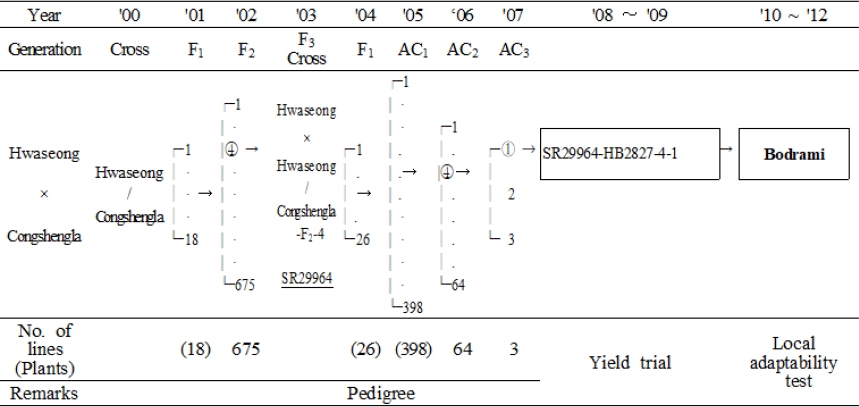
‘보드라미’는 밥의 물성이 부드럽고 현미 취반에 적합한 벼 품종으로 육성을 위해 2000년에 중생종인 ‘화성’을 도입종 ‘콩셍글라’와 교배하여 675개의 F
3 계통을 육성하였다. 이들 계통의 작물학적 성능을 평가하여 2003년 유망한 계통을 다시 ‘화성’과 교배하고 26개의 F
1 개체군을 양성하였다. 2004년 F
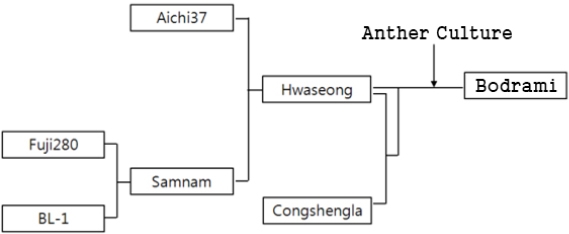
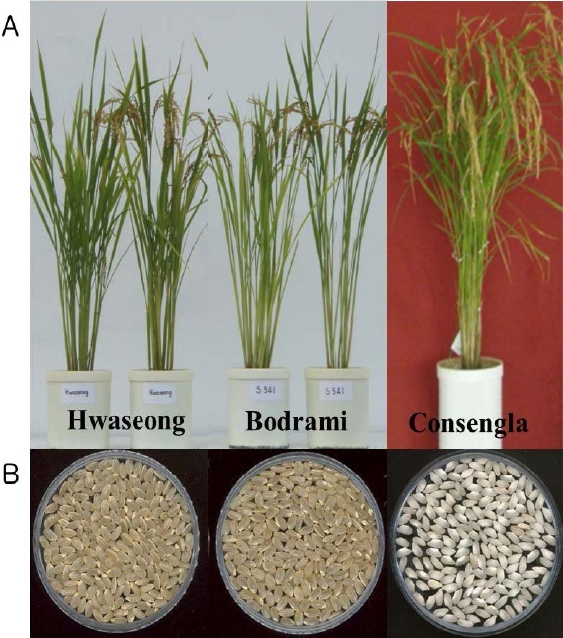
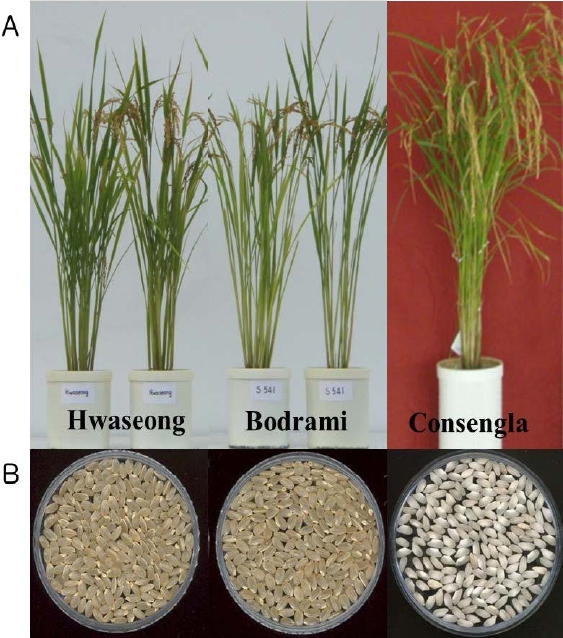
1 개체 이삭에서 약을 채취하고 배양하여 2005년 총 398개의 약배양 개체를 공시하였다. 2006년부터는 포장에서 계통육종법에 의해 유망계통을 선발하면서 도열병⋅벼흰잎마름병⋅줄무늬잎마름병 등 주요 병해충 특성검정과 물성 관련 미질검정을 함께 수행하였다. 2008년 고정계통 ‘SR29964-HB2827-4-1’을 선발하였고 2008~2009년 2년간 생산력검정시험을 실시하였다. 수행결과 ‘SR29964-HB2827-4-1’은 초형과 수형이 우수하며 현미밥 물성이 부드러워 ‘수원541호’로 계통명을 부여하였다(Figs.
1,
2,
3). 2010~2012년 수행된 3년간 지역적응시험을 실시한 결과 ‘수원541호’의 우수성이 인정되어 2013년 12월 농촌진흥청 농작물직무육성 신품종선정위원회에서 신품종으로 선정되었으며 ‘보드라미’라 명명하였다.
Fig. 1Genealogical diagram of ‘Bodrami’
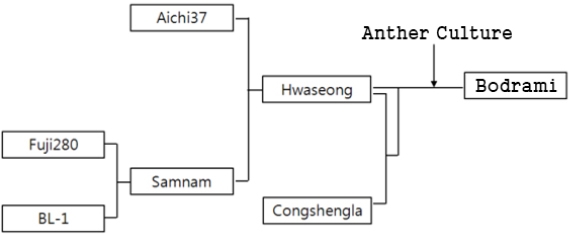
Fig. 2Pedigree diagram of ‘Bodrami’
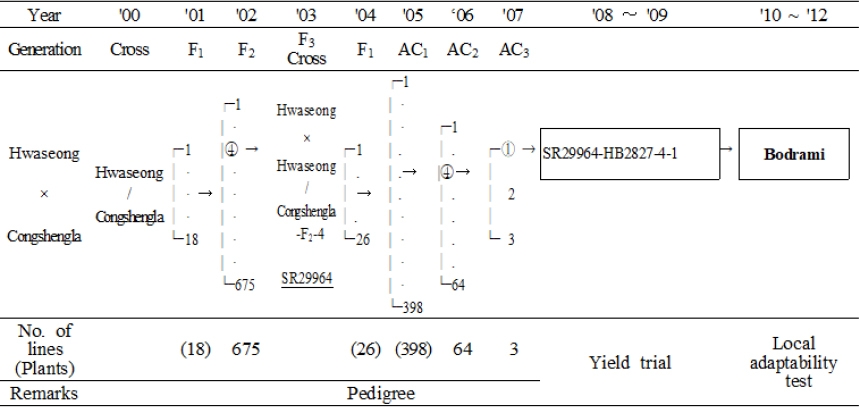
Fig. 3Representative phenotype of ‘Bodrami’ and parents. A) Plants at maturity. B) Brown rice.
출수기 및 주요 농업적 특성
‘보드라미’의 모본은 중생종인 ‘화성’으로 두번 여교배를 수행하였으며 출수기는 2010~2012년 평균 8월 11일로 비교품종인 ‘화성’보다 2일 늦고 ‘남평’보다 5일 빠른 중생종이다. 보통기보비재배 중부평야지 4개 지역에서 8월 11일이며 호남평야지 1개 지역에서 8월 9일이다. 출수가 가장 빠른 지역은 청원으로 8월 6일이며 수원과 춘천에서는 8월 14일이다. 간장은 83 cm로 ‘화성’보다 2 cm 작고 수장은 22 cm 로 ‘화성’과 같다. 주당수수는 15개로 ‘화성’보다 1개 많으며 수당립수는 106개로 ‘화성’보다 13개 많다. 등숙비율은 74.4%로 ‘화성’의 77.1%보다 낮다. 현미천립중은 22.2 g으로 ‘화성’보다 0.2 g 무겁다. 주요 농업적 특성 중 수당립수는 ‘화성’과 비교하여 통계적으로 유의하였다(
Table 1).
Table 1Major agronomic traits and yield components
Table 1
|
Cultivar |
Heading date (mm.dd) |
Culm length (cm) |
Panicle length (cm) |
Panicle number per hill (ea) |
Number of grains per panicle (ea) |
Percent ripened grain (%) |
1000-grain weight of brown rice (g) |
|
Bodrami |
8.11ns,z
|
83ns
|
22ns
|
15ns
|
106* |
74.4ns
|
22.2ns
|
|
Hwaseong |
8.09 |
85 |
22 |
14 |
93 |
77.1 |
22.0 |
생리장해 저항성
‘보드라미’는 위조와 불시출수는 나타나지 않았으며 성숙기 하엽노화은 늦은 편이다. 내냉성 검정 결과 출수지연은 ‘화성’보다 3일 늦은 14일 이며 임실율은 48%로 ‘화성’보다 6% 낮은 수준이다. 저온발아성은 94%로 ‘화성’의 50%와 비교하여 매우 높았으며 수발아율도 47.1%로 ‘화성’의 17.1%보다 높았다. 통계적으로도 두 농업형질은 ‘화성’과 유의성을 나타냈다. 도복 특성은 벼키(간장+수장)가 105 cm, 3절간장이 10 cm로 ‘화성’보다 각각 2 cm 작았다. 좌절중과 도복지수는 각각 676 g, 196으로 ‘화성’의 623 g, 179 보다 높았다. 포장 도복은 ‘보드라미’와 ‘화성’ 모두 강한 특성을 보였다(Tables
2,
3).
Table 2Response to environmental and physiological stress
Table 2
|
Cultivar |
Premature Heading (%) |
Appearance of Wilting |
Viviparous Germinatioz (%) |
Cold Temp. Germinationy (%) |
Cold tolerancew
|
|
|
Clum length Shortening rate (%) |
Heading Delay (days) |
Grain Fertility (%) |
PAv
|
|
Bodrami |
0 |
Resistant |
47.1*x
|
94* |
10.1* |
14* |
48ns
|
6 |
|
Hwaseong |
0 |
Resistant |
17.1 |
50 |
17.1 |
11 |
54 |
6 |
Table 3Lodging tolerance traits of ‘Bodrami’
Table 3
|
Cultivar |
Plant heightz (cm) |
Length of 3rd internode (cm) |
Breaking weight of 3rd internode (g) |
Lodging index |
Field lodging (1-9) |
|
Bodrami |
105nsy
|
10 |
676 |
196 |
1 |
|
Hwaseong |
107 |
12 |
623 |
179 |
1 |
병해충 저항성
2010~2012년 전국 14개소에서 수행한 잎도열병 밭못자리검정에서 강 10개소, 중 4개소로 ‘화성’보다 강한 저항성 반응을 보였다. 이삭도열병 포장검정에서도 발병이 적어 저항성이 있는 것으로 판단되었다(
Table 4). 내구저항성 검정에서는 내구성 정도는 ‘화성’과 비슷한 수준이었으나 30개의 접종균주 중 친화성균주는 8개로 19개의 ‘화성’보다 적었다. 벼흰잎마름병은 K1 균계에 강하였으나 K2⋅K3⋅K3a 균계에는 약한 반응을 보였다. 모본인 ‘화성’이 K1 균계에 감수성인것으로 보아 부본인 ‘콩생글라’의 저항성을 이어받은 것으로 판단된다. 벼줄무늬잎마름병은 강한 저항성을 가지고 있는데 이는 모본인 ‘화성’이 가지고 있는 저항성 특성을 이어 받은 것으로 판단된다. 기타 바이러스병인 오갈병과 검은줄오갈병에는 감수성 반응을 보였다. 벼멸구과 애멸구에는 저항성이 없다(Tables
4,
5,
6).
Table 4Reaction to leaf and panicle blast
Table 4
|
Cultivar |
Reaction to leaf blast at blast nursery (0-9) |
Reaction to neck blast |
|
|
|
No. of tested sites (14) |
Rate of infected panicles (%) |
|
|
|
Rz
|
M |
S |
Mean |
Icheon |
Jecheon |
Iksan |
|
Bodrami |
10 |
4 |
0 |
3.8 |
0.8nsy
|
0.3ns
|
0.0ns
|
|
Hwaseong |
0 |
12 |
2 |
5.8 |
4.9 |
8.7 |
11.0 |
Table 5Reaction of durable resistance to leaf blast
Table 5
|
Cultivar |
Percentage of diseased leaf area based on sequential seeding (%) |
Durable resistance index (0~10) |
No. of virulence isolate (No. of inoculated isolate: 30) |
|
|
1st
|
2nd
|
3rd
|
4th
|
5th
|
6th
|
7th
|
|
Bodrami |
75 |
50 |
25 |
15 |
25 |
5 |
0.2 |
6 |
8 |
|
Hwaseong |
85 |
75 |
75 |
45 |
55 |
45 |
45 |
7 |
19 |
Table 6Reaction to major disease and insect pest
Table 6
|
Cultivar |
Bacterial blight |
Virus disease (%) |
Planthopper |
|
|
|
|
K1 |
K2 |
K3 |
K3a |
RSVz
|
RDV |
RBSDV |
BPHy
|
SBPH |
|
Bodrami |
Rx
|
S |
S |
S |
R (6.7) |
S (83.4) |
S (79.0) |
S |
S |
|
Hwaseong |
S |
S |
S |
S |
R (14.1) |
S (72.2) |
S (91.1) |
S |
S |
미질 및 도정특성
‘보드라미’의 입형은 현미장폭비가 1.89로 ‘화성’의 1.79와 비슷한 단원형이며 통계적으로 유의성은 없다. 현미 길이와 두께는 각각 5.22 mm, 1.83 mm으로 ‘화성’과는 통계적으로 유의성이 있다. 미질은 심복백이 없으며 쌀알이 맑고 투명하였다 ‘화성’과 비교시 알카리붕괴도는 동일하며 호화엔탈피는 ‘화성’보다 낮은 값을 보였다. 도정율은 72.5%로 ‘화성’의 74.8% 보다 낮았으나 백미완전립률과 완전미도정수율은 각각 83.8%, 61.6%로 ‘화성’보다 높으며 통계적으로 유의성을 나타냈다. 비교품종으로 ‘추청’을 공시한 현미 밥맛 관능검정에서 ‘보드라미’의 총평은 0.84로 ‘화성’(-0.11)은 물론 ‘삼광’(0.5)과 ‘하이아미’(0.5) 보다 양호한 것으로 평가되어 우수한 밥맛을 지닌 것으로 평가되었다(Tables
7,
8,
9).
Table 7Grain quality and gelatinization enthalpy
Table 7
|
Cultivar |
Translucency (1-9) |
White core/belly (0-9) |
Amylose content (%) |
Protein content (%) |
Gelatinization enthalpyy (J/g) |
|
Bodrami |
1 |
0/0 |
20.0nsz
|
7.0ns
|
4.9** |
|
Hwaseong |
1 |
2/0 |
20.6 |
6.9 |
6.1 |
Table 8Milling properties and grain shape
Table 8
|
Cultivar |
Milling recovery ratio (%) |
HRMRR (%) |
Brown rice |
|
|
|
BRz
|
MB |
MR |
HR |
Length (mm) |
Width (mm) |
Thickness (mm) |
L/W ratio |
|
Bodrami |
80.6 |
90.0 |
72.5 |
83.8**y
|
61.6* |
5.22** |
2.76ns
|
1.83* |
1.89ns
|
|
Hwaseong |
83.2 |
89.9 |
74.8 |
73.8 |
55.2 |
4.98 |
2.79 |
1.99 |
1.79 |
Table 9Sensory evaluation on cooked brown rice
Table 9
|
Cultivar |
Appearance |
Flavor |
Taste |
Stickiness |
Texture |
Overall |
|
Bodrami |
0.65 |
0.55 |
0.69 |
0.38 |
0.46 |
0.84 |
|
Hwaseong |
-0.26 |
0.31 |
0.08 |
-0.03 |
-0.12 |
-0.11 |
|
Samkwang |
0.80 |
0.50 |
0.47 |
0.28 |
0.51 |
0.50 |
|
Hiami |
0.59 |
0.34 |
0.40 |
0.35 |
0.37 |
0.50 |
수량성
3년 간(2010~2012년) 실시한 지역적응시험 보통기보비재배 중부평야지 4개소ㅎ현미수량은 5.56MT/ha으로 ‘화성’보다 2% 증수하였으나 호남평야지 1개소에서는 ‘남평’보다 수량이 4% 적었다. 지역별로는 춘천에서 5.93MT/ha로 가장 높았고 수원에서는 5.29MT/ha로 가장 낮은 수량을 보였다. 연차 간 차이는 수원에서 가장 큰 194 kg/10a를 보였다(
Table 10).
Table 10Yield summary during 3 years local adaptability trials (2010~2012)
Table 10
|
Culture season |
Region |
Trial sites |
Brown Rice Yield (MT/ha) |
Index (A/B)×100 |
|
|
Bodrami (A) |
Hwaseong (B) |
|
|
|
|
2010 |
2011 |
2012 |
Mean |
2010 |
2011 |
2012 |
Mean |
2010 |
2011 |
2012 |
Mean |
|
Ordinary Planting Culture |
Middle Plain |
Suwon |
4.42 |
6.37 |
5.09 |
5.29 |
4.87 |
5.25 |
5.36 |
5.16 |
91 |
121 |
95 |
103 |
|
Hwaseong |
5.34 |
5.94 |
5.71 |
5.66 |
5.18 |
5.23 |
6.08 |
5.50 |
103 |
114 |
94 |
103 |
|
Chuncheon |
5.80 |
5.72 |
6.28 |
5.93 |
6.05 |
5.50 |
5.97 |
5.84 |
96 |
104 |
105 |
102 |
|
Cheongwon |
4.77 |
5.93 |
5.36 |
5.35 |
4.95 |
5.6 |
5.51 |
5.31 |
96 |
109 |
97 |
101 |
|
Mean |
5.08 |
5.99 |
5.61 |
5.56 |
5.26 |
5.36 |
5.73 |
5.45 |
97 |
112 |
98 |
102 |
|
|
Honam Plain |
Yesan |
5.43 |
6.33 |
5.04 |
5.60 |
5.22 |
6.41 |
5.80 |
5.81 |
104 |
99 |
87 |
96 |
|
|
Grand Mean |
5.14 |
6.05 |
5.52 |
5.57 |
5.26 |
5.36 |
5.73 |
5.45 |
97 |
112 |
98 |
102 |
|
(5.22) |
(6.41) |
(5.80) |
(5.81)z
|
104 |
99 |
87 |
96 |
쌀의 이화학적 특성
‘보드라미’는 ‘화성’과 ‘삼광’에 비해 현미 경도가 매우 낮았으며 통계적으로도 유의성을 보였다. 윤기치는 가장 높았으며 통계적으로는 ‘삼광’과 같은 수준으로 나타났다. 단백질과 아밀로스 함량은 ‘화성’과 ‘삼광’보다 높았으나 부본인 ‘콩셍글라’보다 단백질 함량은 높고 아밀로스 함량은 크게 낮은 것으로 보아 모본인 ‘화성’의 특성을 이어 받은것으로 판단되었다(
Table 11).
Table 11Physicochemical properties
Table 11
|
Cultivar |
Hardness (Brown rice, g) |
Toyo value |
Protein content |
Amylose content |
|
Bodrami |
6,274bz
|
70a
|
6.9a
|
18.7b
|
|
Hwaseong |
8,481a
|
63b
|
6.6b
|
18.2c
|
|
Samkwang |
8,453a
|
68a
|
6.5b
|
18.2c
|
|
Consengla |
- |
- |
5.9c
|
26.2a
|
백미밥과 현미밥의 조건에 따른 경도비교
‘보드라미’, ‘화성’, ‘삼광’, ‘하이아미’의 백미와 현미로 취반하고 취반 직후와 24시간 보온 저장한 후의 경도를 측정하였다. 백미 더운밥의 경우 ‘보드라미’와 ‘하이아미’의 경도가 비슷하였으나 24시간 보온 후에는 ‘하이아미’와 통계적으로 유의성는 없었지만 ‘보드라미’의 경도가 가장 낮았다. 현미 더운밥은 ‘하이아미’와 통계적으로 유의성이 없었지만 ‘보드라미’의 경도가 가장 낮았으며 24시간 보온 후에는 ‘하이아미’와 통계적으로 유의성이 있으면서 경도가 낮아 비교품종과 차이가 유의하게 관찰되었다(
Table 12). 반찰 품종인 ‘백진주’를 가수량을 달리하여 현미밥을 취반하고 경도를 비교해 본 결과 ‘보드라미’의 경도가 ‘백진주’에 비해 통계적으로 매우 유의하게 높았는데 이는 취반 중 ‘백진주’의 현미 종피가 ‘보드라미’보다 심하게 파열되는 특성에 따른 것으로 판단되었다(
Table 13).
Table 12Comparison of the hardness of cooked white and brown rice
Table 12
|
Cultivar |
Hardness of rice (g/cm2)z
|
|
|
Cooked white content |
Cooked brown contenty
|
|
|
|
Warm cooked rice |
Warm stored (24 h) |
Warm cooked rice |
Warm stored (24 h) |
|
Bodrami |
1,608cx±97 |
1,751c±30 |
1,875b±99 |
1,919c±127 |
|
Hwaseong |
2,032a±54 |
2,075a±52 |
2,277a±98 |
2,636a±242 |
|
Samkwang |
1,793b±71 |
1,857b±23 |
2,184a±76 |
2,656a±136 |
|
Hiami |
1,619c±28 |
1,820bc±43 |
1,963b±97 |
2,237b±108 |
|
|
ANOVA |
F=26***,w R2=0.91 |
F=38*** R2=0.94 |
F=12** R2=0.82 |
F=17*** R2=0.86 |
Table 13Comparison of the hardness of cooked brown rice by water content
Table 13
|
Cultivar |
Hardness of cooked brown rice (g/cm2)z
|
|
|
1.6 X water contenty
|
1.4 X water contentx
|
|
|
|
Warm cooked rice |
Warm stored (24 h) |
Warm cooked rice |
Warm stored (24 h) |
|
Bodrami |
1,916**w±82 |
2,297**±103 |
2,196**±13 |
2,509**±71 |
|
Baegjinju |
1,399±106 |
1,397±139 |
1,741±116 |
1,926±45 |
|
ANOVA |
F=45*** R2=0.92 |
F=81*** R2=0.95 |
F=46*** R2=0.92 |
F=140*** R2=0.97 |
쌀가루의 호화점도 특성
‘보드라미’, ‘화성’, ‘삼광’, ‘콩셍글라’의 쌀가루 호화 점도를 측정한 결과 최고점도는 ‘보드라미’가 가장 낮은 값을, ‘삼광’이 가장 큰 값을 보였으며 통계적으로 ‘보드라미’와 ‘콩셍글라’는 같은 그룹에 속하였다. 최저점도는 ‘삼광’, ‘보드라미’, ‘콩셍글라’, ‘화성’ 순이었으며 ‘화성’은 통계적으로 유의차가 있는 값을 나타냈다. 최종점도는 4개 품종 모두 통계적으로 유의성이 있으며 ‘콩셍글라’가 289.2 RVU로 가장 높은 값을, ‘화성’이 223.2 RVU로 가장 낮은 값을 나타냈으며 ‘보드라미’는 234.6 RVU로 중간 값을 보였다. 강하점도는 ‘보드라미’가 80.2 RVU로 가장 낮았고 ‘콩셍글라’도 85.0 RVU로 비슷한 값을 가진 반면 ‘화성’과 ‘삼광’은 각각 114.0 RVU, 104.2 RVU로 통계적으로 유의차가 있었으나 ‘보드라미’ 현미밥의 낮은 경도에 대한 뚜렷한 증거로 보기에는 무리가 있다고 판단된다(
Table 14).
Table 14Gelatinization properties of rice flour
Table 14
|
Cultivar |
Peak viscosity (RVU) |
Hold viscosity (RVU) |
Final Viscosity (RVU) |
Breakdown (RVU) |
Setback (RVU) |
|
Bodrami |
228.0c z
|
147.9a
|
234.6c
|
80.2c
|
6.6b
|
|
Hwaseong |
242.8b
|
128.8b
|
223.2d
|
114.0a
|
-19.6d
|
|
Samkwang |
255.8a
|
151.6a
|
242.0b
|
104.2b
|
-13.8c
|
|
Consengla |
229.9c
|
144.9a
|
289.2a
|
85.0c
|
59.4a
|
침지조건에 따른 수분흡수율
침지 시 쌀이 수분을 균등하게 흡수하게 되면 열전도율이 상승되고 식감을 좌우하는 밥의 경도가 감소하기 때문에 품종이 가지고 있는 쌀의 수분흡수특성을 정확하게 파악하는 것은 매우 중요하다(
Yoon et al. 2014). 현미는 호분층이 있어 수분흡수율이 백미보다 낮았다. 백미조건(25℃)에서 침지 15분까지는 ‘보드라미’, ‘화성’, ‘삼광’ 모두 통계적으로 큰 차이가 없다가 20분 이후부터는 ‘삼광’의 수분흡수율이 가장 높았다. 현미조건(25℃)에서는 30분까지 큰 차이가 없었고 16시간 침지 시 ‘화성’과 ‘삼광’이 ‘보드라미’보다 수분흡수율이 높았다. 57℃의 현미조건에서는 침지 10분부터 ‘화성’과 ‘삼광’이 ‘보드라미’보다 수분흡수율이 높았다. 또한 ‘보드라미’의 수분흡수율 증가속도는 도정유무 및 온도조건과 관계없이 ‘화성’과 ‘삼광’보다 빠르지 않았다. 따라서 ‘보드라미’의 부드러움은 현미의 수분흡수율이 관여하지 않는 것으로 판단되었다(
Table 15).
Table 15Increase of water absorption rate (%) by steeping conditions
Table 15
Steeping
condition |
Cultivar |
Steeping time |
|
|
10 min |
15 min |
20 min |
25 min |
30 min |
16 hour |
Milled rice
(25°) |
Bodrami |
12.9az
|
19.0a
|
21.1b
|
22.9b
|
22.8c
|
25.3b
|
|
Hwaseong |
12.0a
|
17.7a
|
21.7b
|
25.9a
|
27.9b
|
30.3a
|
|
Samkwang |
12.3a
|
18.6a
|
23.6a
|
26.6a
|
29.1a
|
31.9a
|
|
Brown rice
(25°) |
Bodrami |
2.7a
|
3.6a
|
3.9a
|
4.2a
|
5.3a
|
25.3b
|
|
Hwaseong |
2.5a
|
3.0a
|
3.5a
|
2.8a
|
4.8a
|
29.3a
|
|
Samkwang |
2.5a
|
3.8a
|
4.0a
|
4.2a
|
5.2a
|
29.5a
|
|
Brown rice
(57°) |
|
10 min |
20 min |
30 min |
40 min |
50 min |
60 min |
|
|
Bodrami |
8.5b
|
12.5c
|
15.3c
|
18.3c
|
19.9bc
|
21.0c
|
|
Hwaseong |
9.7a
|
13.7b
|
17.3b
|
19.7b
|
20.6b
|
22.3b
|
|
Samkwang |
10.3a
|
14.5a
|
18.3a
|
21.2a
|
23.1a
|
24.6a
|
|
Hiami |
- |
- |
- |
17.3c
|
19.4c
|
21.0c
|
시차주사열량계 분석
취반 결과 ‘보드라미’의 부드러움을 확인 할 수 있었지만 쌀가루의 호화점도 특성과 침지조건에 따른 수분흡수율을 분석해 보았을 때 부드러움의 원인이라고 특정하기에는 어려웠다. 호화엔탈피는 전분이 열과 수분에 의해 팽창되어 그 물리 화학적 성질이나 구조가 변하여 점도⋅수용성⋅부피 등이 증가하는 쪽으로 변화하는 과정에 필요한 열에너지이다. 만약 동일한 조건의 취반시 다른 품종과 달리 ‘보드라미’에서 낮은 호화엔탈피가 측정된다면 ‘보드라미’의 부드러움을 설명할 수 있는 요인으로 해석 할 수 있다. 따라서 시차주사열량계 분석을 통해 ‘보드라미’와 ‘화성’의 호화엔탈피를 구하였다. 측정 결과 배유전분의 완전호화에 필요한 에너지인 호화엔탈피가 ‘화성’보다 유의하게 낮게 나왔으며 ‘보드라미’의 부드러움에 영향을 준 것으로 판단하였다(
Table 7).
‘보드라미’는 밥의 경도가 낮아 식감이 부드러워 24시간 보온 후에도 일반쌀보다 식감의 거침이 덜하여 현미 밥맛 검정 결과에서도 일반쌀보다 밥맛과 질감이 좋은 것으로 평가되었다. 현미는 혈당조절에 탁월한 GABA, 비타민, 미네랄 성분이 풍부한 쌀눈, 활성화 작용에 좋은 감자올리자놀, 섬유질을 다량 함유하고 있는 쌀겨의 영양을 한 번에 취할 수 있는 장점이 있기 때문에, 최근 쌀 소비는 줄고 있지만 현미를 찾는 소비자는 늘 것으로 생각된다. ‘보드라미’는 이러한 소비패턴 변화에 대응하여 육성된 멥쌀 품종으로 식감은 부드럽지만 높은 혈당지수를 보이는 찹쌀현미밥을 대체하는 건강 기능식으로 활용 될 수 있을것으로 판단된다.
적응지역 및 재배상 유의점
‘보드라미’는 중생종으로 중부평야지에 적합한 품종이다. 질소질 비료 과용시 미질 및 등숙저하, 숙색불량, 병해충 발생이 우려되므로 적정 균형시비 하여야 한다. 도열병, 흰잎마름병(K1), 줄무늬잎마름병에는 강하나 흰잎마름병(K2, K3, K3a), 멸구류, 기타 바이러스병(오갈병, 검은줄오갈병)에는 약하므로 종자소독 및 적기 방제를 실시하여야 한다. 수발아율이 높아 등숙기에 비가 지속 될 시 수발아가 우려되므로 적기수확 하여야 하며 냉해에 약하므로 출수지연이 우려되는 냉수 용출답 재배는 피해야 한다.
적 요
‘보드라미’는 2003년 농촌진흥청 국립식량과학원에서 밥의 물성이 부드럽고 현미 취반에 적합한 벼 품종을 육성하기 위해 중생종인 ‘화성’과 도입종 ‘콩셍글라’를 교배하여 육성한 벼 품종이다. ‘보드라미’는 밥의 경도가 낮아 식감이 부드러워 진 것으로 평가되었는데, 24시간 보온 후에도 일반 쌀보다 거친맛이 덜했으며, 밥맛 검정 결과에서도 일반 쌀보다 밥맛과 질감이 좋은 것으로 평가되었다. ‘보드라미’는 8월11일(수원)경에 이삭이 패는 중생종으로 도열병과 줄무늬잎마름병, 쓰러짐에 강하며 현미수량은 10a 당 556 kg 정도이다. 현미는 혈당조절에 탁월한 GABA, 비타민, 미네랄 성분이 풍부한 쌀눈, 활성화 작용에 좋은 감마오리자놀, 섬유질을 다량 함유하고 있는 쌀겨의 영양을 한 번에 취할 수 있는 장점이 있기 때문에 최근 쌀 소비는 줄고 있지만 현미를 찾는 소비자는 늘 것으로 생각된다. ‘보드라미’는 이러한 소비패턴 변화에 대응하여 육성된 멥쌀 품종으로, 식감은 부드러우나 상대적으로 높은 혈당지수를 보이는 찹쌀현미밥의 단점까지 개선하였다.
사 사
본 연구는 농촌진흥청 연구사업(세부과제명: 호남지역 벼 우량계통 지역적응시험 및 특성검정시험, 세부과제번호:PJ00650302)의 지원에 의해 이루어진 것이며 ‘보드라미’가 육성되기까지 힘써주신 국립식량과학원 벼 육종팀과 모든 벼 관련 관계관님께 깊은 감사를 드립니다.
References
- AOAC.2000. Official methods of analysis. 17th ed. Association of Official Analytical Chemists, Washington DC, USA: pp. 33-36.
- Foodtoday. 2017. A 20-year-old 'Hetbahn'become a home food for 'Honbapjok'(the tribe of people who eat alone). Available from: http://www.foodtoday.or.kr/news/article.html?no=146415. Accessed April 18 2017
- Gaesser GA. 2007. Carbohydrate quantity and quality in relation to body mass index. J Am Diet Assoc 107: 1768-1780.
- Kim JM, Yu M, Shin M. 2012. Effect of mixing ratio of white and germinated brown rice on the physicochemical properies of extruded rice flours. Korea J Food Cook Sci 28: 813-820.
- Kim SL, Son YK, Son JR, Hur HS. 2001. Effect of germination condition and drying methods on physicochemical properties of sprouted brown rice. Korean J Crop Sci 46: 221-228.
- Kim SS, Kim YK, Lee WJ. 1998. Microwave vacuum drying of germinated brown rice as a potential raw material for enzyme food. Korean J Food Sci Technol 30: 1107-1113.
- KOrean Statistical Information Service. 2019. Accessed May 18 2019. Available from: http://kosis.kr/statisticsList/statisticsListIndex.do?menuId=M_01_01&vwcd=MT_ZTITLE&parmTabId=M_01_01#SelectStatsBoxDiv
- Korea Centers for Disease Control and Prevention. Korea Health Statistics. 2015. Korea National Health and Nutrition Examination Survey (KNHANES VI-3) [Internet]. Korea Centers for Disease Control and Prevention;2015. [cited 2017 Mar 31]. Available from: https://knhanes.cdc.go.kr/knhanes/index.do
- Lee C, Shin JS. 2002. Effects of different fiber content of rice on blood glucose and triglyceride levels in normal subject. J Korean Soc Food Sci Nutr 31: 1048-1051.
- Lim SD, Kim KS. 2009. Effects and utilization of GABA. Korean J Dairy Sci Technol 27: 45-51.
- McKeown NM, Meigs JB, Liu S, Rogers G, Yoshida M, Saltzman E, Jacques PF. 2009. Dietary carbohydrates and cardiovascular disease risk factors in the Framingham offspring cohort. J Am Coll Nutr 28: 150-158.
- Mo KH, Choi YM, Choi SG, Lee JS. 2006. The change of some compounds in brown rice germinated by filtrate of loess suspension. J Agric Life Sci 40: 41-48.
- Moon GS, Kim MJ, Jin MH, Kim SY, Park SY, Ryu BM. 2010. Physicochemical and sensory properties of rice stored in an unused tunnel. Korean J Food Cook Sci 26: 220-228.
- Murakami K, Sasaki S, Takahashi Y, Okubo H, Hosoi Y, Horiguchi H, Oguma E, Kayama F. 2006. Dietary glycemic index and load in relation to metabolic risk factors in Japanese female farmers with traditional dietary habits. Am J Clin Nutr 83: 1161-1169.
- Oh YS. 2002. Study on nutritional properties of sprouting brown rice. MS thesis, Kongju National University, Gongju, Korea.
- RDA2010. 2010 Project plan for collaborative research program to develop new variety summer crop.
- RDA2011. 2011 Project plan for collaborative research program to develop new variety summer crop.
- RDA2012a. 2012 Project plan for collaborative research program to develop new variety summer crop.
- RDA2012b. Manual for standard evaluation method in agricultural experiment and research.
- Salmerón J, Ascherio A, Rimm EB, Colditz GA, Spiegelman D, Jenkins DJ, Stampfer MJ, Wing AL, Willett WC. 1997. Dietary fiber, glycemic load, and risk of NIDDM in men. Diabetes Care 20: 545-550.
- Song SJ, Choi HN, Lee SY, Park JM, Kim BR, Paik HY, Song YJ. 2012. Eatablishing a table of glycemic index values for common Korean foods and an evaluation of the dietary glycemic index among the Korean adult population. Korean J Nutr 45: 80-93.
- Yoon MR, Lee JS, Lee JH, Kwak J, Chun A, Won YJ, Kim BK. 2014. Comparison of textural properties in various types of brown rice. Korean J Food & Nutr 27: 294-301.
- Youn S, Woo HD, Cho YA, Shin A, Chang N, Kim J. 2012. Association between dietary carbohydrate, glycemic index, glycemic load, and the prevalence of obesity in Korean men and women. Nutr Res 32: 153-159.