적요
Amphidiploid Brassica juncea (AABB, 2n=36) contains the synthesized genome of the diploid ancestors of Brassica rapa (AA, 2n=20) and Brassica nigra (BB, 2n=16), proven the ‘triangle of U’ model. Varieties of the B. juncea include vegetables, oilseed crops, and medicinal plants in South Asia, China, and other regions. ‘Dolsangat’, one of the cultivars of B. juncea is widely used as the main ingredient for ‘KatKimchi’, a kind of Korean traditional food Kimchi. To develop an efficient polyploidization protocol of B. juncea, we used twenty accessions. Among them, we could induce the amphidiploid plants with 0.23% in natural. A successful of polyploidization, it is essential of chromosome doubling regent treatment of B. juncea. At first, we tried to colchicine treatment in the embryo stage and it was very harmful to the embryo and could get few plants. The second, we made the regeneration plants from embryo to rooting phase and shocked them in 0.34% colchicine contained distilled water. We could induce amphidiploid plants with a success rate of 63.4%. Also, we surveyed glucosinolate content and JB1, Alsami, and JD6 showed high total contents. These plants will use for genetic materials for breeding, genetic and molecular studies.
서 언
배추속 작물은 뚜렷한 자가불화합성을 가져 타식의 특성을 가지므로 배추, 양배추 여러 아종의 품종들은 유용한 특성을 가진 양친의 교잡을 통해 F1을 육성한다. 반면, 원하는 유전형질을 가지고 있는 고정된 자원을 양친으로 활용하는데 고정된 자원을 육성하기 위해서는 최소 4~5년이 걸린다.
소포자배양(microspore culture) 기술은 꽃가루가 성숙하여 비산되기 전 상태의 초기 소포자만을 배양하는 방법이다(
Seo et al. 2015). 약 내의 소포자는 분화 발달 과정을 거치면서 생식세포와 영양세포로 발달하는 과정을 통해 다양한 반수체가 형성될 수 있다(
Joosen et al. 2007). 즉 배추와 같은 타식성 작물에서 원하는 육종형질을 가진 분리 계통의 소포자(microspore)를 배양하여 빠르고 다양하게 고정자원을 육성할 수 있다. 배추(
Brassica rapa, 2n=20), 양배추(
Brassica olerace, 2n=18), 유채(
Brassica naupus, 2n=38), 갓(
Brassica juncea, 2n=36), 등의 배추속 식물들에서 소포자배양을 통한 doubled haploid (DH) 성공을 최초로 보고하였다(
Lichter 1982,
Burnett et al. 1992,
Lionneton et al. 2001,
Wei et al. 2008,). 식물의 소포자배양을 통한 배 형성에는 배양 배지의 조성이나 배양상태, 유전형 그리고 소포자배양의 시기 등 다양한 요인이 영향을 미치는 것으로 알려져 있다(
Takahata & Keller 1991,
Lee & Kim 2000).
배추속은 이배체종(diploid) 배추, 양배추, 흑겨자(
Brassica nigra, 2n=16)와 복이배체종(amphidiploid) 유채, 갓, 겨자(
Brassica carinata, 2n=34)종으로 분류된다. Baille et al. (1992)은 배추 아종 중 하나인 유지배추(
B. rapa ssp
olifera)에서 1,000여개의 재분화 된 식물을 얻었는데 그 중 80%가 반수체로서 임성이 없었고 이들을 콜히친 처리하였을 때 90% 생존율과 75%의 이배체 식물들이 생산됨을 보고하였다.
Burnett et al. (1992)은 같은 유지배추 소포자배양을 연구하였는데 식물 유전형, 시기, 배지조성과 배양온도 등에 대한 소포자 재분화율을 조사하였지만 배수성 분화 식물에 대한 보고는 없었다. 다른 배추 아종인 박초이(
B. rapa ssp
chinensis) 12계통에 대한 소포자배양을 배지조성과 소포자배양 온도 및 호르몬 첨가 유무, 배수성을 분석 보고하였다. 각 계통마다 배수화 정도가 달랐고 Siyuebai 계통은 69% (11/16), Aijiaohuang 계통은 17% (1/6)의 이배체 식물체를 얻었다(
Cao et al. 1994). 또한 양배추의 아종 중 케일(
B. olereacea var.
acephala)의 배지조성 및 배배양 전 열처리 온도와 배배양 시간 및 콜히친 처리 농도(50, 100 mg/L, 48hr)에 대한 고찰 결과를 발표하였으나 배수성 식물 획득에 대한 보고는 없었다(
Zhang et al. 2008,
Tuncer & Yanmaz 2011). 양배추종은 유전형에 따른 소포자배양 방법 즉 배배양 전 고온처리와 시간, 배 채취 시기 등의 조건을 확립하는데 오래걸렸다(
Tuncer et al. 2016).
Bhatia 등(2018)은 백색 양배추 네 개 계통에 대하여 소포자배양을 하였고 221개 식물체를 생산하였다. 배수성 검정을 통해 41.9% 이배체 식물 생성을 보고하였다. 이와 같이 이배체 종들은 아종 및 계통 등에 따라 다르지만 조직배양 과정 중에서 콜히친 처리 없이도 적게는 17%에서 많게는 69%까지 자연적인 배수화가 일어났다. 반면, 복이배체종들의 경우 유채의 소포자배양 방법과 배수화 조건에 대한 연구가 많이 수행되었는데, 유채 네 개의 계통에서 콜히친 처리를 안 한 경우 두 개 계통에서 복이배체 유전형(4n, AABB)이 하나도 생성되지 않았고, 다른 한 계통에서 0.45%, 나머지 다른 한 계통에서 1.42% 생성됨이 보고되었다(
Möllers et al. 1994). 또한 다른 복이배체 종 향신료 갓(brown condiment mustard)의 6개 유전형에 대하여 재분화된 식물체 214개에 대해 콜히친을 처리하여 배수성을 검정한 결과, 낮게는 0%에서 많게는 22%의 이배체 생성을 보고하였다(
Lionneton et al. 2001). 이러한 논문 결과에 따라 배추속 복이배체종들의 안정적인 동형 배수화 식물을 확보하기 위해서는 콜히친 처리 조건 확립이 필요하다는 것을 알게 되었다.
콜히친 처리 시기 및 조건을 확립하기 위하여 우리는 먼저 돌산갓 20개 자원에 대한 표현형을 조사하고 소포자배양을 수행하여 식물체 분화율이 높을 뿐 아니라 갓 식물의 주요 유전특징인 만추대, 엽형, 엽색, 배 발생 및 식물체 분화율이 높은 계통을 선발하였다. 본 논문에서는 선정한 복이배체들에 대한 고정 계통의 생산을 위하여 소포자배양 과정의 전처리와 재분화 단계에서 콜히친을 처리한 후 각각의 복이배체 생산률을 분석하여 소포자배양을 통한 4배체 돌산갓의 생산 조건을 확립하고자 하였다.
재료 및 방법
식물 재료
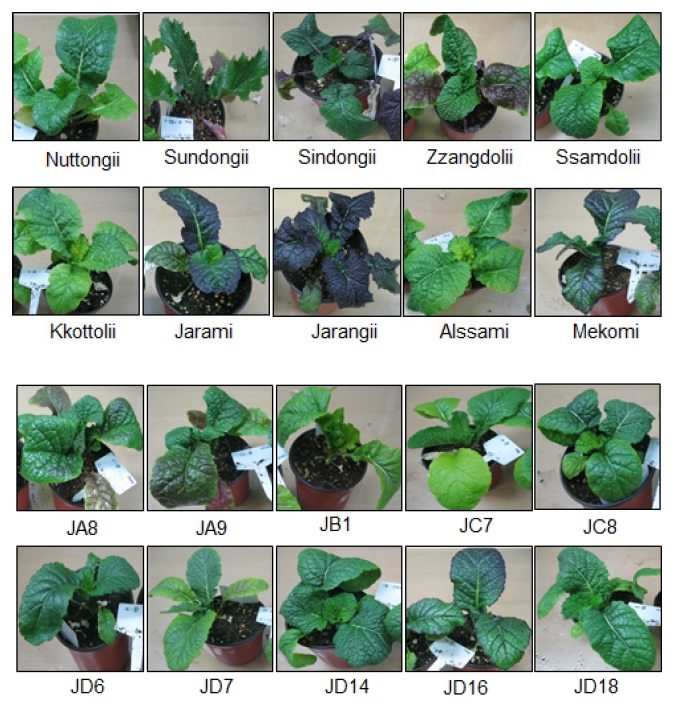
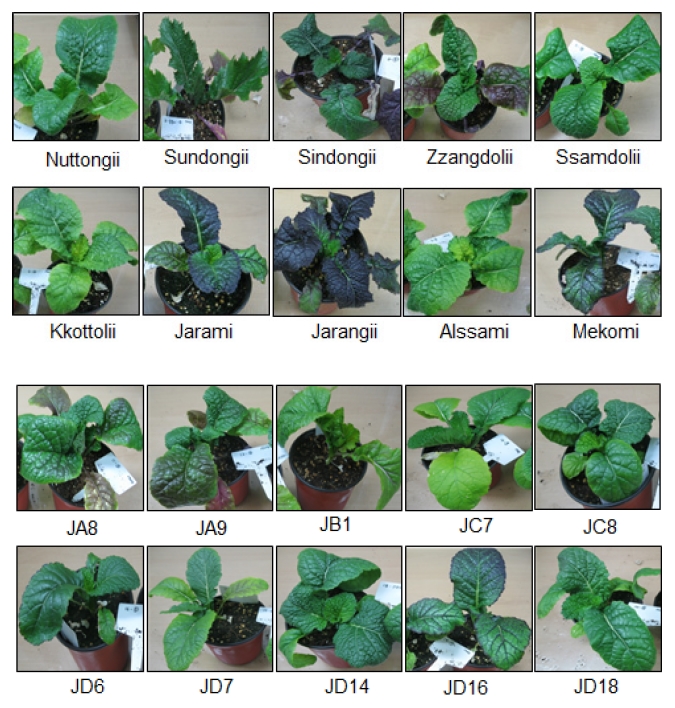
돌산갓 20개 자원을 전남여수농업기술센터에서 분양받았다. 이 돌산갓 20개 자원에 대한 고정 계통을 육성하기 위하여 자원별로 종자를 파종하고 온실에서 3주 키운 후 4℃, 16시간 광주기 조건으로 35일간 저온처리를 하여 좀 더 큰 화분에 정식하였다(
Fig. 1). 정상적인 생육과정을 거쳐 개화가 시작된 식물체의 꽃봉우리 중에서 수술의 길이가 주두의 길이보다 짧거나 같은 화뢰를 자원별로 수집하였다.
Fig. 1Phenotype of 20 accessions of Brassica juncea received from Yeosu Agriculture Technology Center.
소포자배양에 의한 고정 식물체 육성
수집된 화뢰의 소포자배양은
Seo et al. (2014)의 방법을 일부 수정하여 사용하였다. 다른 점으로 소포자배양 초기 온도를 32℃에서 2일간 암 배양한 후, 25℃ 배양기에서 15일간 암 배양하여 소포자 배 발생을 유도하였다. 유도된 배는 25℃ 교반기에서 30 rpm으로 48~72시간 명 조건에서 현탁 배양한 후, MS (Murashige & Skoog 1962) 기본 배지에 치상하여 25℃에서 16시간/일 광주기로 4주간 배양하였다. 완전한 잎으로 형성된 식물체들은 0.7% phyto agar와 0.5% MS 배지를 넣은 마젠타 박스에 치상하여 뿌리를 유기하였다. 뿌리가 재분화된 식물체들은 증류수로 세척하여 인공 상토에 순화시켰다. 3주간 온실에서 키운 식물의 어린 잎의 일부를 채취한 후 DAPI 염색 버퍼로 염색한 후 Flow Cytometry (CyFlow Ploidy Analyzer, Partec, Germay)를 이용하여 배수성을 검정하였다.
배양 과정을 통해 생산된 반수체로부터 자연배가가 어려운 4배체 식물의 경우 인위적으로 염색체를 배가시키는 방법을 사용한다(
Eng & Ho 2019). 본 연구에서는 돌산갓 소포자배 과정에서 생산된 반수체(2n, AB)로부터 염색체 배가를 통해 복이배체(4n, AABB) 식물을 생산하기 위하여 콜히친을 처리하였다. 복이배체 고정 계통의 생산을 위하여 소포자배양 과정의 전처리와 재분화 단계에서 콜히친을 처리하여 복이배체 식물체를 생산하였다. 전처리 과정에서는 NLN 액체 배지에 0.25%와 0.5% 콜히친을 첨가한 후 agarose 활성탄 용액을 혼합하였다. 소포자액과 교반하여 소포자배양에 의한 고정 식물체 생산 방법으로 소포자 배발생을 유도하였다. 두 번째로 재분화 단계에서 콜히친을 처리하기 위하여 소포자 배로부터 재분화한 식물체를 계대배양하고, 식물체 뿌리가 완전히 활착될 때가지 배양하였다. 일반적으로 50~60일 배양하였다. 온실로 순화하기 위하여 배지로부터 식물체를 꺼내고 뿌리에 붙어 남아있는 배지 조성액을 증류수로 깨끗이 세척하였다. 뿌리들이 잠길 수 있도록 0.34% 콜히친을 첨가한 멸균수에 3시간, 5시간, 24시간 동안 침적하였다. 처리가 끝난 뿌리를 세정하고 포트에 이식하였다. 포트에 이식한 식물체는 약 3주 동안 온실에서 생육한 후 새롭게 유기된 어린잎에 대해 배수성 검정을 실시하였다. 4n 배수성이 확인된 재분화 식물체들은 유식물체는 4℃, 35일간, 16시간/일 광주기로 저온처리하고 식물체를 다시 온실 16시간/일 광주기로 개화를 유도하여 뇌수분에 의해 종자를 확보하였다.
소포자배양을 통해 생산된 복이배체 고정 계통 식물체들은 배추의 대표적 항산화 기능성 물질로 알려진 글루코시놀레이트 함량을 분석하였다(
Cartea et al. 2010,
Seo & Kim 2017). 온실에서 재배 중인 유식물체로부터 잎을 채취한 후 동결건조 후 마쇄하여 물질 분석에 사용하였다. 분말화된 샘플 100 mg에 끓인 70% aqueous MeOH 1.5mL를 가한 후 69℃ 항온수조에서 5분간 처리 후 10분간 원심분리하고 상층액을 추출한 후 arylsulfatase 용액을 첨가한 후 16시간 이상 처리 후 HPLC로 분석하였다. HPLC는 Shimadzu 시스템을 사용하였고 wavelength는 227, column은 Inertail ODS-3 5 μm (250 *4.6 mm), 40℃로 사용하였고 이동상은 물과 acetonitrile을 사용하였다.
결과 및 고찰
콜히친 무처리 돌산갓 소포자배양
여수 농업기술센터로부터 분양받은 20개의 돌산갓 자원을 파종하고 표현형을 분석하였다. 온실에서 16시간 명, 8시간 암인 일장으로 3주간 육성한 유식물체를 저온처리 룸으로 옮겨 동일한 광주기로 4℃에서 35일간 저온처리하였다. 큰 화분에 정식하기 전에 식물체의 표현형을 분석하였다. 자원에 따라 엽색, 자색의 유무, 엽형, 무 결각 유무 등에 대한 정도를 숫자화하여 판독하였다. 정식한 식물들은 동일한 광주기로 식물체들을 육성하였고 각 자원별로 개화일을 조사하였다. 뇌수분에 의해 종자를 채종하였고 그 꼬투리 특성을 종자모양 함몰형(strict), 파고형(undulate), 그리고 매끈한형(smooth)으로 구분 판독하였다(
Table 1). 20개 자원 중 가장 빨리 개화한 순동이는 파종 후 73일만에 개화하였고 가장 늦은 자원은 JD6로서 105일이 되어야 개화하였다. 갓 자원은 사계절 모두 생산 가능한 품종을 목표로 하는데 가장 문제가 되는 형질 중 하나가 만추대이다. 식물들이 겨울 또는 이른 봄 늦추위의 저온에 감응하여 추대하면 그 상품가치가 현저히 떨어지게 된다. JD6와 같이 만추대 형질은 좋은 육종 소재라 할 수 있었다.
Seo et al. (2014) 방법에 따라 개화된 식물체의 화뢰를 수확하여 소포자배양을 실시한 결과 계통에 따라 소포자 배 발생과 잎 재분화 효율에 차이가 관찰되었다(
Table 2). 가장 낮은 재분화율을 보이는 JD6 자원의 경우 화뢰 140개를 배양하여 5개의 소포자 배를 확인하였고 이들 소포자 배로부터 한 개만 식물체로 재분화하였다. JD14 자원은 95개의 화뢰로부터 840개의 높은 소포자 배 발생율을 보였고 이들 소포자 배로부터 32개 식물체가 재분화되어 3.81%의 재분화율을 보였다. 식물체 분화율이 가장 높은 자원은 Zzangdolii로서 27개 소포자배에서 8개의 식물체가 분화되어 29.63%의 분화율을 보였다. 재분화된 식물체들은 순화 후 상토에 이식하고 온실에서 재배하였다. 상토에서 3주간 배양된 식물체의 배수성을 검정하였다.
Table 1Phenotype traits of 20 accessions of Brassica juncea after vernalization treatments.
Table 1
|
No |
Accessions |
Leaf type |
Amount of greenz
|
Amount of purpley
|
Sinusx
|
Flowering time |
Bud type |
|
1 |
Nuttongii |
Oval-long |
2 |
1 |
0 |
88 |
Smooth |
|
2 |
Sundongii |
Oval-long |
3 |
2 |
Serrated |
73 |
Undulate |
|
3 |
Sindongii |
Oval-long |
4 |
3 |
3 |
77 |
Strict |
|
4 |
Zzangdolii |
Oval-long |
2 |
3 |
1 |
91 |
Undulate |
|
5 |
Ssamdolii |
Oval-long |
3 |
1 |
1 |
88 |
Strict |
|
6 |
Kkottolii |
Oval-long |
2 |
0 |
0 |
85 |
Strict |
|
7 |
Jarami |
Oval-long |
4 |
4 |
2 |
98 |
Undulate |
|
8 |
Jarangii |
Round |
4 |
4 |
4 |
86 |
Strict |
|
9 |
Alsami |
Round |
2 |
0 |
1 |
91 |
Smooth |
|
10 |
Mekomi |
Oval-long |
4 |
3 |
2 |
95 |
Undulate |
|
11 |
JA8 |
Oval-long |
3 |
2 |
2 |
84 |
Undulate |
|
12 |
JA9 |
Oval-long |
3 |
2 |
2 |
86 |
Strict |
|
13 |
JB1 |
Round |
2 |
1 |
4 |
81 |
Smooth |
|
14 |
JC7 |
Oval-long |
2 |
1 |
3 |
91 |
Strict |
|
15 |
JC8 |
Round |
4 |
0 |
3 |
87 |
Smooth |
|
16 |
JD6 |
Oval-long |
4 |
2 |
0 |
105 |
Undulate |
|
17 |
JD7 |
Oval-long |
4 |
1 |
2 |
91 |
Strict |
|
18 |
JD14 |
Round |
4 |
0 |
3 |
86 |
Smooth |
|
19 |
JD16 |
Oval-long |
4 |
2 |
2 |
98 |
Smooth |
|
20 |
JD18 |
Oval-long |
4 |
0 |
0 |
87 |
Strict |
Table 2Plant regenerations efficiency in 20 accessions of Brassica juncea without colchicine treatment.
Table 2
|
No |
Accessions |
Number of cultured buds |
Number of obtained embryos |
Number of regenerated plants |
Plant regeneration efficiency |
Number of amphidiploid plants (4n) |
|
1 |
Nuttongii |
130 |
57 |
8 |
14.04 |
2 |
|
2 |
Sundongii |
700 |
179 |
27 |
15.08 |
2 |
|
3 |
Sindongii |
480 |
27 |
4 |
14.81 |
1 |
|
4 |
Zzangdolii |
145 |
27 |
8 |
29.63 |
0 |
|
5 |
Ssamdolii |
220 |
24 |
4 |
16.67 |
0 |
|
6 |
Kkottolii |
255 |
146 |
12 |
8.22 |
0 |
|
7 |
Jarami |
105 |
793 |
2 |
0.25 |
0 |
|
8 |
Jarangii |
420 |
129 |
17 |
13.18 |
0 |
|
9 |
Alsami |
370 |
405 |
10 |
2.47 |
1 |
|
10 |
Mekomi |
205 |
545 |
9 |
1.65 |
0 |
|
11 |
JA8 |
120 |
19 |
1 |
5.26 |
0 |
|
12 |
JA9 |
200 |
70 |
5 |
7.14 |
0 |
|
13 |
JB1 |
340 |
157 |
17 |
10.83 |
3 |
|
14 |
JC7 |
140 |
676 |
28 |
4.14 |
1 |
|
15 |
JC8 |
155 |
131 |
18 |
13.74 |
0 |
|
16 |
JD6 |
140 |
5 |
1 |
20.00 |
0 |
|
17 |
JD7 |
245 |
835 |
3 |
0.36 |
1 |
|
18 |
JD14 |
95 |
840 |
32 |
3.81 |
1 |
|
19 |
JD16 |
150 |
95 |
14 |
14.74 |
0 |
|
20 |
JD18 |
275 |
52 |
20 |
38.46 |
0 |
|
|
Total |
|
4,890 |
5,212 |
240 |
234.48 |
12 |
|
Mean |
245.5 |
260.6 |
12 |
11.72 |
20개 자원들에 대한 소포자배양을 수행한 결과 8개 자원은 4배체인 식물체로 재분화한 반면 12개 자원들은 4배체를 가진 재분화 식물체를 생산하지 못했다. 4배체로 고정계통을 생산한 8개 자원 중 JB1에서 3개체, Nuttongill와 Sundongii 에서 2개체씩 그리고 Sindongill, Alsami, JC7, JD6, 그리고 JD7 에서 각 한 개체 복이배체 식물을 생성하였다(
Table 2). 위의 결과를 요약하면 생성된 배 5,212개 중 식물체 분화율은 240개, 4.6%이고 4n 배수성으로 확인된 식물체는 12개, 0.23%임을 확인하였다.
배추 아종 다양한 유전형에 대한 소포자배양을 하여 동형 이배체종들을 다수 확보하였을 뿐 아니라(
Seo et al. 2014) 유지배추와 청경채 교잡 F1 여러 계통에서 소포자배양을 하였고 배수성 검정한 결과 동형 이배체(80%) 및 4배체 식물도(6.7%) 육성한 바 있었다(
Kim et al. 2017;
Seo et al. 2017a). 또한 양배추 네 개 유전형에 대한 소포자배양, 배수성 검정에서 3배체(1.9%), 4배체(6.8%) 생성을 보고하였다(
Bhatia et al. 2018). 따라서 동일조건으로 복이배체 돌산갓 소포자배양을 수행하더라도 자연 배수화되어 4n 식물이 최소 5% 이상 생성될 것이라 추정하였다. 그러나 돌산갓 20개 계통에 대한 소포자배양 결과 배수성이 확인된 식물은 0.23% 이었다. 이는 복이배체 식물들은 소포자가 2n (AB) 유전형이어서 식물 스스로 haploid의 불안정성을 인지하지 못하는 자연적 매카니즘을 갖는 것이라 추정하였다. 따라서 복이배체인 돌산갓은 소포자배양 과정에서 콜히친 처리가 반드시 필요함을 알 수 있었다.
돌산갓 20개 계통 중에서 표현형이 중만추대 계통이고 엽색, 엽형, 무결각, 계통 당 종자수확량 등이 높을 뿐 아니라(
Table 1), 소포자배양 효율이 비교적 우수한 12개 계통을 선발하였다(
Table 2). 선발한 12계통에 대하여 콜히친 처리 시기, 시간 및 농도 등에 대한 처리 조건을 검토하였다.
소포자 배 형성 기간에 콜히친 0.25%와 0.5%를 NLN배지에 첨가하여 32℃에서 전처리를 수행하였다. 소포자 배 발생에 미치는 콜히친의 농도를 고려하여 0.25% 처리 구는 48시간, 0.5%는 24시간 동안 전처리를 수행하여 소포자 배를 유도하였다. 실험의 결과
Table 2와 같이 전처리 과정에서 콜히친을 첨가한 경우, JD6를 제외한 대부분의 자원들에서 Table 1의 무처리구와 비교하여 소포자로부터 배 발생 효율과 배로부터 식물체 재분화 효율이 현저하게 감소하는 것을 알 수 있었다. 이 들 재분화 식물체를 대상으로 배수성 검정을 실시한 결과, Zzandolii에서 4개체, JD6와 JD7에서 각 한 개체, 그리고 JD15에서 2개체의 4n 식물체를 확인할 수 있었다(Table 3). 같은 계통에서 콜히친 0.25%에서 48시간과 0.5%에서 24시간 처리구를 비교했을 때 배 분화율은 콜히친 농도 보다 시간이 크게 영향을 끼쳐서 0,25%, 48시간 처리구는 배 분화율이 16.5% (187/1130)이고, 0.5%, 24시간 처리구는 배 분화율이 77% (905/1175)로서 콜히친 처리농도보다는 지속시간이 배발생에 생리장해를 가져옴을 알 수 있다. 반면에 첫 번째 처리구에서 12자원의 187개 배로부터 16개체 (8.6%)의 식물이 분화되었다, 두 번째 처리구는 905개 배로부터 19개체(2%)의 식물이 분화되었다. 복이배체 배수성이 확인된 갓은 첫 번째 처리구에서 4개, 두 번째 처리구에서 5개로서 치상한 화뢰수에 비해 효율이 너무 떨어져, 배배양 처리전에 고온처리 시기에 콜히친을 공동 배양하는 것은 지양하기로 하였다. 실제로, 콜히친 농도와 처리시간은 배수화를 가져오는데 반해 높은 치사율을 가져온다(
Gantait et al. 2011,
Zhou et al. 2017).
Table 3Amphidiploidy efficiency with 12 accessions of Brassica juncea with colchicine treatment in pre-embryo culture.
Table 3
|
Accessions |
Colchicine treatment (%. h) |
Number of cultured buds |
Number of obtained embryos |
Number of regenerated plants |
Number of amphidiploid plants (4n) |
|
Nuttongii |
0.25, 48 |
50 |
1 |
0 |
0 |
|
0.5, 24 |
30 |
0 |
0 |
0 |
|
Zzangdolii |
0.25, 48 |
140 |
33 |
11 |
4 |
|
0.5, 24 |
65 |
18 |
0 |
0 |
|
Ssamdolii |
0.25, 48 |
105 |
6 |
0 |
0 |
|
0.5, 24 |
50 |
2 |
1 |
0 |
|
Jarami |
0.25, 48 |
150 |
40 |
0 |
0 |
|
0.5, 24 |
260 |
541 |
11 |
1 |
|
Mekomi |
0.25, 48 |
110 |
36 |
4 |
0 |
|
0.5, 24 |
75 |
39 |
0 |
0 |
|
JA9 |
0.25, 48 |
70 |
2 |
0 |
0 |
|
0.5, 24 |
50 |
0 |
0 |
0 |
|
JC7 |
0.25, 48 |
45 |
4 |
1 |
0 |
|
0.5, 24 |
60 |
15 |
3 |
0 |
|
JC8 |
0.25, 48 |
40 |
0 |
0 |
0 |
|
0.5, 24 |
40 |
1 |
0 |
0 |
|
JD6 |
0.25, 48 |
115 |
17 |
0 |
0 |
|
0.5, 24 |
180 |
155 |
3 |
1 |
|
JD7 |
0.25, 48 |
105 |
25 |
0 |
0 |
|
0.5, 24 |
190 |
62 |
6 |
1 |
|
JD14 |
0.25, 48 |
20 |
0 |
0 |
0 |
|
0.5, 24 |
35 |
0 |
0 |
0 |
|
JD16 |
0.25, 48 |
180 |
23 |
0 |
0 |
|
0.5, 24 |
140 |
73 |
6 |
2 |
소포자배양을 통해 생산된 유식물체의 콜히친 처리 효과
Eng & Ho (2019)는 콜히친을 이용한 원예작물의 다배체화 연구에 대한 리뷰로 원예작물의 기본 조직인 종자, 뿌리, 잎과 분열이 활발하게 이루어지고 있는 조직들인 정단 분열조직(shoot-tip), 캘러스(callus), 체세포 배(somatic embryo), 액아(axillary bud), 발아시킨 종자(germinating seed) 등에 대한 배수화 결과를 분석하였다.
In vitro 배양배지 및 배양액에 적게는 0.05%에서 많게는 1% 콜히친 농도와 4시간부터 96시간까지의 처리를 한 후 결과를 분석하였다. 거베라 shoot에서 0.1% 콜히친 용액, 8시간 처리 했을 때 64%의 배수성 식물(4n)을 보고 하였고, 카사바(
Manihot esulenta Grantz) shoot에서 0.05% 콜히친 용액, 48시간 처리하여, 63%의 4n 식물을 보고하였다(
Gantait et al. 2011,
Zhou et al. 2017). 배추속 콜히친 처리에 의한 배수성 검정은 유채에서 0.5% 콜히친 농도에서 24시간 처리, 0.25%에서 24시간 처리가 가장 효율적이라고 보고된 바 있다(
Mollers et al. 1994,
Zaki & Dickson 1995). 갓은 소포자배양 후 재분화된 식물체를 기내에서 55~60일 키운 식물들과 온실에서 정식하여 115~120일 키운 식물들 두 그룹에 대하여 콜히친 처리 농도와 시간을 달리하여 분석하였다. 두 그룹에 대하여 콜히친 농도를 0.1%에서 24시간, 0.34%에서 2~3시간 달리 처리한 결과 두 그룹 중에 기내배양을 통해 육성한 식물의 이배체화 식물 생성률이 높았고 콜히친 처리 농도와 시간은 낮은 농도에서 긴 처리보다 는 0.34%에서 2~3시간 처리가 더 이배체화율과 식물 생성율이 높음을 알 수 있었다(
Prem et al. 2008).
본 논문에 기술한 방법으로 소포자배양과 재분화를 수행한 후 식물에서 뿌리 유기가 완전히 이루어진 식물들에 대하여 온실 순화 전에 콜히친 처리를 하였다. 콜히친 0.34% 용액에 뿌리가 잠기도록 침수하여 3, 5, 그리고 24시간 동안 25℃에서 처리하였다(
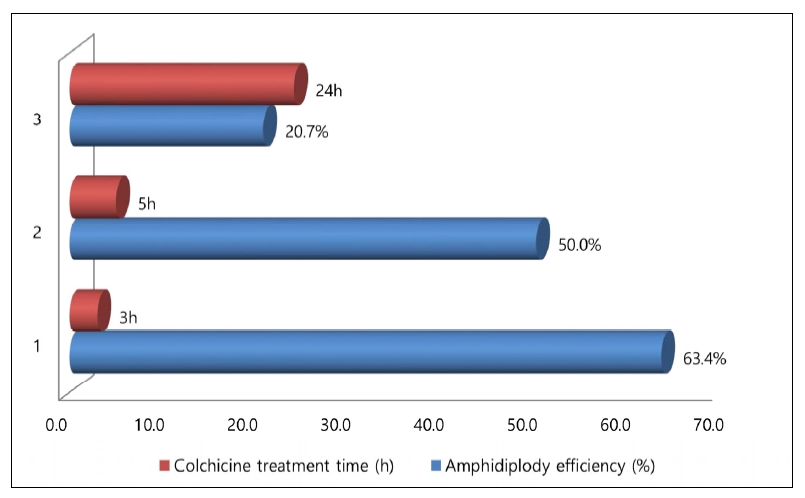
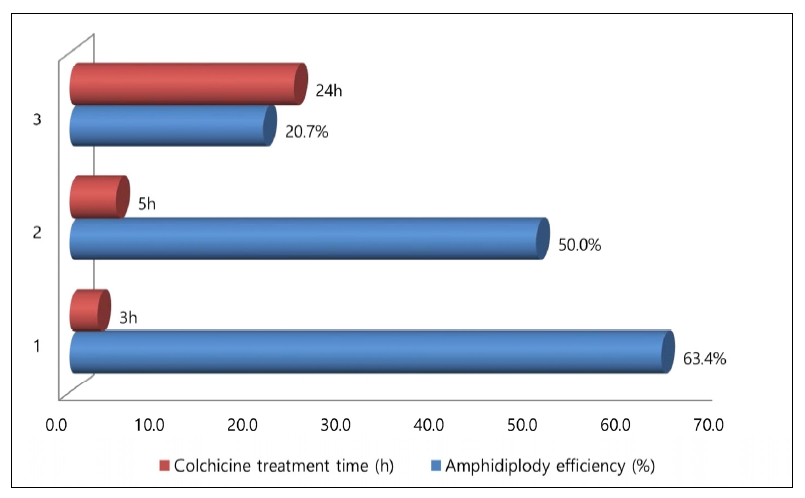
Table 4). 소포자배양 효율이 높아 많은 식물체가 형성된 JC7, JC8, JD7, 그리고 JD14에서 콜히친 처리 시간을 달리하였을 때 24시간 처리구에서 급격히 식물체가 고사하였고, 5시간 처리구에서도 일부 생육 저해가 관찰되었다. 자원 당 재분화 식물체가 낮아 10개 미만만 확보한 경우에는 콜히친 처리 시간을 3시간만 반응하였다. 분열과정에서 유도된 유식물체에 콜히친 처리를 한 식물은 총 154개였다. 이 중 3시간 처리한 조건에서 93개 식물체로부터 59개 식물체가(63.4%) 복이배체화 되었다. 또한 5시간 처리구와 24시간 처리구는 32개와 29개 식물체에서 16 (50%), 6 (20.7%)개의 배수화 식물체를 확인하였다(
Fig. 2). 콜히친 처리는 비대칭 세포분열(asymmetric division)을 설계하고 조절하는 미세관 시스템(microtubular system)을 파괴한다. 이는 배아를 형성할 수 있는 대칭 세포분열을 못하게 할 수도 있다. 또한 콜히친 처리는 높은 수준의 전 배아 형성을 유도하지만, 재생 가능한 배아에서 배아로 성장하는 것은 비교적 낮음이 보고되었다(
Zaki & Dickinson 1995). 본 실험을 통하여 소포자배양을 통해 유기된 고정 식물체를 계대 배양하여 뿌리가 완전히 활착하게 한 후 온실로 이식하기 전 유식물체 뿌리에 0.34% 콜히친 용액에 3시간 침지한 후 멸균수로 콜히친 용액을 완전히 제거하여 상토에서 재배는 조건을 확립할 수 있었다. 배수화 검정은 새로운 잎이 자란 3주 후에 수행하였다.
Table 4Amphidiploidy efficiency with 12 accessions of Brassica juncea with colchicine treatment in post-embryo culturez.
Table 4
|
Accessions |
Number of buds |
Number of embryos |
Number of regenerated plants |
Colchicine treatment time* (h) |
Number of amphidiploid plants (4n) |
|
Nuttongii |
180 |
22 |
6 |
3 |
4 |
|
Zzangdoli |
105 |
- |
- |
- |
- |
|
Ssamdolii |
120 |
13 |
1 |
3 |
0 |
|
1 |
5 |
1 |
|
Jarami |
250 |
571 |
29 |
3 |
21 |
|
8 |
5 |
4 |
|
2 |
24 |
- |
|
Mekomi |
180 |
88 |
5 |
3 |
4 |
|
JA9 |
130 |
7 |
3 |
3 |
2 |
|
JC7 |
140 |
90 |
16 |
3 |
11 |
|
1 |
5 |
- |
|
5 |
24 |
1 |
|
JC8 |
70 |
36 |
6 |
3 |
1 |
|
5 |
5 |
3 |
|
4 |
24 |
1 |
|
JD6 |
290 |
4 |
- |
- |
- |
|
JD7 |
320 |
377 |
9 |
3 |
6 |
|
9 |
5 |
3 |
|
5 |
24 |
1 |
|
JD14 |
70 |
55 |
14 |
3 |
8 |
|
8 |
5 |
5 |
|
13 |
24 |
3 |
|
JD16 |
250 |
31 |
4 |
3 |
2 |
Fig. 2Amphidiploidy efficiency with 12 accessions of Brassica juncea with colchicine treatment in post-embryo culture with three different times.
고정 계통에서 글루코시롤레이트 함량 분석
갓김치 가공 적성에 부합하는 만추대 개화형질, 자색이 없는 초록색의 긴 엽형과 글루코시놀레이트 함량이 높은 고정 계통을 분리집단의 양친 및 돌산갓 유전체 분석의 레퍼런스 재료로 선정하고자 복이배체로 고정된 갓 계통들에 대한 글루코시놀레이트 17종의 함량을 분석하였다. 글루코시놀레이트 17종 중에서 9종의 글루코시놀레이트는 미함량 성분으로 확인되었다(
Table 5). Aliphatic 글루코시놀레이트 3종, indolic 글루코시놀레이트 4종, 그리고 aromatic 글루코시놀레이트 1종을 확인할 수 있었다. 먼저 복이배체 배수성이 확인된 콜히친 처리 없이 자연 배가된 8개 유전자원 중 종자를 확보한 11개 계통에 대한 글루코시롤레이트 함량을 분석하였다(
Table 5). JB1 자원에서 생산된 JB1 세 계통은 다른 계통보다 글루코시놀레이트 합성량이 높아서 각각 28.51, 17.04, 21.39 μmol/g dry weight이고, 세 계통의 평균은 22.31 μmol/g dry weight로 분석한 계통 중에서 제일 높았다. 다음으로 Alsami 19.81, JD6 19.32 μmol/g dry weight 를 보였다. 일반적으로 식용 엽채소 중 배추는 12.75 μmol/g dry weight, 청경채는 9.38 μmol/g dry weight를 보이므로(
Seo et al. 2017b) 돌산갓 JB1, Alsami, JD6 자원은 두 배 정도 높아서 기능성 육종자원으로 활용 가능하다.
Table 5Glucosinolate contents in 11 amphidiploid plants of B. juncea.
Table 5
|
Glucosinolatez
|
Nuttongii |
Sundongii (1) |
Sundongii (2) |
Sindongii |
Alssami |
JB1 (1) |
JB1 (2) |
JB1 (3) |
JC7 |
JD6 |
JD7 |
|
SG |
9.20 |
11.09 |
11.67 |
14.89 |
17.82 |
27.17 |
16.11 |
19.81 |
8.03 |
17.65 |
10.17 |
|
4HG |
0.25 |
0.23 |
0.19 |
0.12 |
1.00 |
0.56 |
0.23 |
0.37 |
0.44 |
0.23 |
0.16 |
|
GE |
0.01 |
0.00 |
0.00 |
0.01 |
0.00 |
0.00 |
0.00 |
0.00 |
0.00 |
0.00 |
0.00 |
|
GB |
0.01 |
0.01 |
0.01 |
0.00 |
0.09 |
0.02 |
0.01 |
0.02 |
0.04 |
0.01 |
0.01 |
|
GN |
0.41 |
0.14 |
0.23 |
0.18 |
0.44 |
0.44 |
0.49 |
0.82 |
0.53 |
1.00 |
0.48 |
|
GR |
0.20 |
0.01 |
0.02 |
0.08 |
0.23 |
0.15 |
0.07 |
0.14 |
0.16 |
0.14 |
0.09 |
|
MG |
0.07 |
0.05 |
0.05 |
0.02 |
0.04 |
0.14 |
0.10 |
0.14 |
0.14 |
0.17 |
0.10 |
|
NG |
0.02 |
0.06 |
0.08 |
0.03 |
0.20 |
0.04 |
0.03 |
0.09 |
0.10 |
0.11 |
0.02 |
|
ALI |
9.41 |
11.10 |
11.69 |
14.98 |
18.05 |
27.32 |
16.18 |
19.95 |
8.19 |
17.79 |
10.25 |
|
IND |
0.36 |
0.35 |
0.32 |
0.17 |
1.33 |
0.76 |
0.38 |
0.61 |
0.72 |
0.51 |
0.28 |
|
AR |
0.41 |
0.14 |
0.23 |
0.18 |
0.44 |
0.44 |
0.49 |
0.82 |
0.53 |
1.00 |
0.48 |
|
Total |
10.18 |
11.59 |
12.23 |
15.32 |
19.81 |
28.51 |
17.04 |
21.39 |
9.44 |
19.30 |
11.01 |
JD6 자원은 20개 자원 중에서 가장 만추대 형질을 보인 자원이며, 글루코시놀레이트 함량이 높고, 엽색은 저온처리가 끝난 후에도 자색이 없이 청색이며 엽형도 요철없이 긴엽형이어서 돌산갓 표준품종으로 선정하였다. 갓 우수자원을 이용하여 소포자배양 방법과 배수화 조건을 확립하였고, 김치 가공적성에 맞으며, 기능성이 물질을 많이 함유한 계통들을 확보하여 갓 유전체 분석 및 육종 분자표지 개발에 이용할 계획이다.
적 요
배추속은 이배체종(diploid)인 배추, 양배추, 흑겨자와 복이배체종(amphidiploid)인 유채, 갓, 겨자로 이루어져 있다. 갓은 이배체종 배추의 ‘A’와 흑갓의 ‘B’와 합쳐진 ‘AB’ 반수체 유전형을 가지고 있다. 본 연구에서는 소포자배양 중에 자연적으로 반수체가 이배체로 되는 배추와는 달리, 복이배체종 갓은 배수화되는 빈도가 매우 낮아 0.23%만이 자연배수화가 됨을 관찰하였다. 따라서 소포자배양을 통하여 안정적인 유전형인 ‘AABB’을 획득하기 위해서는 인위적인 배수화가 필요하였다. 콜히친은 대표적인 염색체 배가를 가져오지만 식물에 대한 생리장해를 가져오는 물질이다. 배배양 전에 콜히친을 처리하면 그 농도와 처리시간(0.25%에서 48h, 0.5%에서 24h), 모두에서 생리적 장해를 받아, 배 발생률과 식물 재분화율이 현격히 떨어졌다. 그러나 소포자배양을 통해 식물체가 재분화된 후 계대 배양하고 뿌리가 충분히 성숙하였을 때 콜히친 0.34%, 3시간을 처리하면 식물체 재분화율도 크게 떨어지지 않고 재분화되어 식물체의 63%가 배수화됨을 관찰하였다. 또한 복이배체가 확인된 갓 동형체에 대하여 배추속 주요 항산화물질 중 하나인 글루코시놀레이트 함량을 분석하였다.
사 사
본 연구는 농촌진흥청 국립농업과학원 어젠다 사업(과제번호: PJ0131562019)의 지원에 의하여 수행되었습니다. 본 연구에 활용한 자원을 분양해주신 여수시농업기술센터 특산품육성과 돌산갓연구팀에 감사드립니다.
References
Reference
- 1. Baillie AMR, Epp DJ, Hutcheson D, Keller WA. 1992. In vitro culture of isolated microspores and regeneration of plants in Brassica campestris. Plant Cell Rep 11: 234-237.
- 2. Bhatia R, Dey SS, Parkash C, Sharma K, Sood S, Kumar R. 2018. Modification of important factors for efficient microspore embryogenesis and doubled haploid production in field grown white cabbage (Brassica oleracea var. capitate L.) genotypes in India. Sci Hortic 233: 178-187.
- 3. Burnett L, Yarrow S, Huang B. 1992. Embryogenesis and plant regeneration from isolated microspores of Brassica rapa L ssp. oleifera. Plant Cell Rep 11: 215-218.
- 4. Cao MQ, Li Y, Liu F, Dore C. 1994. Embryogenesis and plant regeneration of pakchoi (Brassica rapa L. ssp. chinensis) via in vitro isolated microspore culture. Plant Cell Rep 13: 447-450.
- 5. Cartea ME, Francisco M, Soengas P, Velasco P. 2010. Phenolic compounds in brassica vegetables. Moleules 16: 251-280.
- 6. Eng W-H, Ho W-S. 2019. Polyploidization using colchicine in horticultural plants: A reiview. Sci Hortic 246: 604-617.
- 7. Gantait S, Mandal N, Bhattacharyya S, Das PK. 2011. Induction and identification of tetraploids using in vitro colchicine treatment of Gerbera jamesonii Bolus cv. Sciella. Plant Cell Tiss Organ Cult 106: 485-493.
- 8. Joosen R, Cordewener J, Supena EDJ, Vorst O, Lammers M, Maliepaard CH, Zeilmaker T, Miki B, America T, Custers J, Boutilier K. 2007. Combined transcriptome and proteome analysis identifies pathways and robust markers associated with the establishment of Brassica napus microspore-derived embryo development. Plant Physiol 144: 155-172.
- 9. Kim JS, Seo MS, Won SY, Shon SH. 2017. Unraveling the molecular development platform using Comparative genomics in Brassicaceae . The Report on National Institute of Agricultural Sciences PJ010157.
- 10. Lee SS, Kim AJ. 2000. Effects of cultural vessel, plant growth regulator, illuminating and shaking on embryo induction and growth in microspore culture of heading Chinese cabbage. J Kor Soc Hort Sci 41: 16-20.
- 11. Lichter R. 1982. Induction of haploid plants from isolated pollen of Brassica napus. Z. Pflanzenphysiol 105: 427-434.
- 12. Lionneton E, Beuret W, Delaitre C, Ochatt S, Rancillac M. 2001. Improved microspore culture and doubled-haploid plant regeneration in the brown condiment mustard (Brassica juncea). Plant Cell Rep 20: 126-130.
- 13. Möllers C, Iqbal MCM, Röbbelen G. 1994. Efficient production of doubled haploid Brassica napus plants by colchicine treatment of microspore. Euphytica 75: 95-104.
- 14. Murashige T, Skoog F. 1962. A revised medium for rapid growth and bio-assays with tobacco tissue culture. Physiol Plant 15: 473-497.
- 15. Prem D, Gupta K, Sarkar G, Agnihotri A. 2008. Activated charcoal induced high frequency microspore embryogenesis and efficient doubled haploid production in Brassica juncea. Plant Cell Tiss Organ Cult 93: 269-282.
- 16. Seo M, Kim JS. 2017. Understanding of MYB transcription factors involved in glucosinolate biosynthesis in Brassicaceae. Moleules 22091549.
- 17. Seo MS, Won SY, Kang SH, Kim JS. 2017a. Analysis of flavonoids in double haploid population derived from microspore culture of F1 hybrid of Brassica rapa. J Plant Biotechnol 44: 35-41.
- 18. Seo MS, Jin M, Shon S-H, Kim JS. 2917b. Expression profiles of BrMYB transcription factors related to glucosinolate biosynthesis and stress response in eight subspecies of Brassica rapa. FEBBS Open Bio 7: 1646-1659.
- 19. Seo MS, Won SY, Kang SH, Sohn SH, Kim JS. 2015. Development of tissue culture technology for haploid production in Brassica species. Korean J Int Agric 27: 522-528.
- 20. Seo MS, Sohn SH, Park BS, Ko HC, Jin M. 2014. Efficiency of microspore embryogenesis in Brassica rapa using different genotypes and culture conditions. J Plant Biotechnol 41: 116-122.
- 21. Takahata Y, Keller WA. 1991. High frequency embryo-genesis and plant regeneration in isolated microspore culture of Brassica oleracea L. Plant Sci 74: 235-242.
- 22. Tuncer B, Yammaz R. 2011. Effect of colchicine and High temperature treatments on isolated microspore culture in various cabbage (Brassica oleracea) types. Int. J Agric Bio 13: 819-22.
- 23. Tuncer B, Cig A, Yammaz R, Yasar F. 2016. Effect of heat shock treatment on microspore embryogenesis in Brassica oleracea Species. Tar. Bilim. Derg. J Agric Sci 22: 548-554.
- 24. Wei Z, Qiang F, Xigang D, Manzhu B. 2008. The culture of isolated microspores of ornamental kale (Brassica oleracea var. acephala) and the importance of genotype to embyo regeneration. Sci Hortic 117: 69-72.
- 25. Zaki M, Dickison H. 1995. Modification of cell development in vitro: The effect of colchicine on anther and isolated microspore culture in Brassica napus. Plant Cell Tiss Organ Cult 40: 255-270.
- 26. Zhang W, Qiang F, Xigang D, Manzhu B. 2008. The culture of isolated microspores of ornamental kale (Brassica oleracea var.acephala) and the importance of genotype to embryo regeneration. Sci Hortic 117: 69-72.
- 27. Zhou HW, Zeng WD, Yan HB. 2017. In vitro induction of tetraploids in cassava variety 'Xinxuan 048' using colchicine. Plant Cell Tiss Organ Cult 128: 723-729.