적요
To compare agronomic and seed traits of 135 common bean landraces originating from Korea, Bulgaria, and El Salvador, we evaluated 20 morphological traits and performed principal component analysis (PCA). In the PCA, the first and second principal components accounted for 55.15% and 15.97% of the total variance, respectively. The first component showed a strong positive correlation with seed size and 100-seed weight, whereas the second component produced a strong negative correlation with days to flowering and days to maturity, indicating that these traits may explain the differences between landraces originating from different countries. Landraces from Korea showed higher variation in days to flowering and days to maturity; those from Bulgaria produced larger and heavier seeds; those from El Salvador produced smaller and lighter seeds and flowering and maturity occurred earlier. In addition, the landraces from El Salvador had relatively lower diversity compared to those from other countries, as they were grouped within a small cluster in the PCA. These evaluation results may provide important information for selecting breeding materials, and diversity analyses of landraces from different countries provide information for securing genetic resources.
서 언
강낭콩 종자는 단백질뿐만 아니라 탄수화물, 무기질, 비타민 등 다양한 성분들을 가지고 있어 영양학적 가치가 높다고 알려져 있으므로 강낭콩 육종에 있어 영양성분은 중요한 목표이다(
Bareke 2019,
Broughton et al. 2003). 강낭콩 육종에 있어 종자의 크기, 형태, 색깔 등 형태 특성 또한 이용측면에서 중요한 형질 중 하나이다. 가령, 한국에서는 강낭콩이 주로 밥밑콩으로 이용되고 있으며(
Lee et al. 2001), 밥밑콩으로 쓰이는 강낭콩의 경우 종자의 크기가 크고, 색이 진한 품종이 선호되고 있다(
Kim et al. 2021).
농업형질 중 성숙일수는 강낭콩 재배시 조생종 및 만생종을 결정짓는 요소이다. 강낭콩의 경우 생육일수가 90에서 130일로 정도로 다른 작물에 비해 짧아 강낭콩 재배 후 가을채소 등을 재배할 수 있어(
Choi et al. 2015,
Shin et al. 2008) 강낭콩 조생종 품종 육성은 농가소득 향상을 위한 중요한 육종목표가 된다. 이러한 품종 육성을 위해서는 다양한 유전자원에 대해 육종목표에 맞는 형질들에 대한 면밀한 특성평가가 선행되어야 할 것이다.
본 연구는 농업유전자원센터 보유 한국, 불가리아, 엘살바도르 원산의 강낭콩 재래종 자원들에 대해 형태적 특성평가를 수행하고, 특성평가 결과를 원산지별로 비교하여 지역별 특성 및 형태적 다양성을 분석하고자 한다. 다양한 원산지 자원들에 대한 형태적 특성평가 결과는 강낭콩 품종 육성시 육종소재를 선발하는데 중요한 기초정보로서 활용될 수 있을 것이다. 또한, 원산지별 형태적 다양성 분석은 농업유전자원센터 보유 자원에 대한 다양성 평가 및 다양성 확보 계획수립에 중요한 자료로 활용될 것이다.
재료 및 방법
공시재료
농촌진흥청 농업유전자원센터(
http://genebank.rda.go.kr)에서 보유하고 있는 강낭콩 중에서 대륙별로 가장 높은 비율을 차지하는 나라인 한국(아시아), 불가리아(유럽), 엘살바도르(북아메리카)에서 수집된 재래종을 실험재료로 선정하였으며, 남아메리카, 아프리카, 오세아니아 자원들은 5자원 미만으로 제외하였다. 이 연구에서 사용한 강낭콩 자원은 135자원이며, 한국 40자원, 불가리아 50자원, 엘살바도르 45자원이다(
Table 1).
강낭콩 유전자원은 2020년 4월 9일에 20립씩 육묘상자에 파종하여 3주동안 키운 후 농업유전자원센터 시험 포장에 자원별 10 개체씩 정식하였다. 강낭콩 형태적 특성 조사는 농업유전자원센터 특성평가 기준 표준안에 따라 수행하였다(
Table 2). 형태적 조사 항목은 식물체, 꽃, 꼬투리, 종자에 대해 이루어졌는데, 특히 주로 종자로 이용되는 강낭콩에 대한 유용한 정보를 제공하고자 종자 형질에 대해 중점적으로 특성평가를 수행하였다. 종자형질 중 종자면적(Seed area, SA), 종자둘레(Seed perimeter, SP), 종자길이(Seed length, SL), 종자너비(Seed width, SW), 장폭비(Length/width ratio, L/W)는 ImageJ (
Abramoff et al. 2004) 프로그램을 이용하여 자원당 20반복으로 측정하였다(
Supplementary Fig. 1).
이 연구에서 수행한 모든 통계분석은 R 소프트웨어(버전 4.0.2.)를 이용하였다. 강낭콩 재래종의 원산지별 양적형질의 평균을 비교하기 위해 분산분석을 수행하였고, 양적형질들 간의 유의성을 분석하기 위해 상관분석을 수행하였다. 또한, 원산지별 강낭콩 재래종의 특성을 가장 잘 설명하는 주요인을 찾기 위해 양적형질들에 대해 주성분분석을 수행하였다.
결과
원산지별 강낭콩 유전자원의 농업 및 종자 형질 변이
한국, 불가리아, 엘살바도르 원산 재래종 강낭콩 135자원에 대해 10개의 농업 형질과 10개의 종자 형질(9개 질적, 11개 양적)에 대한 특성 평가를 수행하였다. 특성평가 결과는 질적형질과 양적형질로 나누어 나타내었다(
Fig. 1,
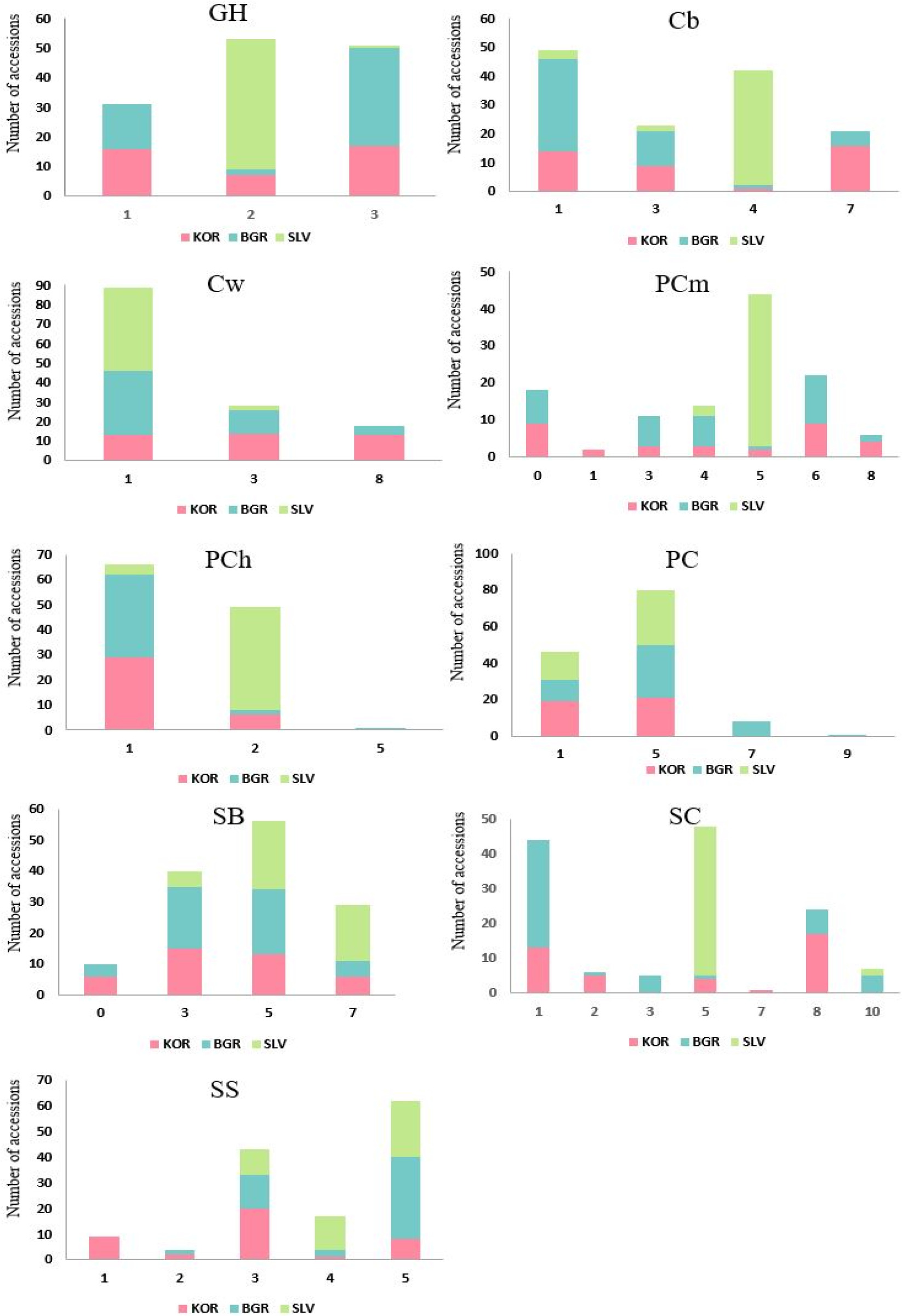
Table 3). 9가지의 질적형질에 대해서 강낭콩 재래종 자원은 다양성을 보였으며 각 형질별 차지하는 원산지의 비율도 다양했다(
Fig. 1). 전체 자원에 대해, 신육형(GH)의 경우 유한 부시형(determinate bush) 31자원(23%), 무한 부시형(indeterminate bush) 53자원(39.3%), 무한 직립형(indeterminate upright) 51자원(37.8%)으로 나타났다. 기판(Cb)과 익판(Cw)의 색상은 백색이 전체 자원 중 각각 49자원(36.3%), 89자원(65.9%)에서 나타나 가장 많았다. 협색(PCm)의 경우 진홍색이 44자원(32.6%), 협2차색(PCh)의 경우 황색이 66자원(48.9%)으로 가장 높은 비율을 차지하였다. 전체자원들 중 협만곡(PC)은 약간굽음형(80자원, 59.3%)이 가장 많았으며, 종피광택(SB)이 강하며(56자원, 41.5%), 종피색(SC)이 적자색(48자원, 35.6%) 또는 흰색(44자원, 32.6%)인 자원들이 높은 비율을 차지하였다. 종자모양(SS)는 끝이 뾰족한 형(truncate fastigiate, 62자원, 45.9%)과 입방형(cuboid, 43자원, 31.9%)이 높은 비율을 차지했다. 11개의 양적형질에 대해서 강낭콩 유전자원들은 원산지별로 다양한 변이를 보였다(
Table 3,
Supplementary Table 1). 개화일수(DTF)와 성숙일수(DTM)의 경우, 엘살바도르 원산 자원의 개화일수 및 성숙일수가 각각 49.78일과 78.53일로 한국과 불가리아 원산 자원보다 짧았다. 협장(PL)과 협폭(PW)의 경우 불가리아 원산의 자원이 한국 및 엘살바도르 원산보다 크기가 컸으며, 협당립수(SNPP)의 경우 불가리아 원산 자원이 제일 적었고 엘살바도르 원산 자원이 가장 많았다. 종자면적, 종자둘레, 종자높이, 종자너비, 백립중은 원산지별로 불가리아, 한국, 엘살바도르 순으로 작아지는 경향을 보였다.
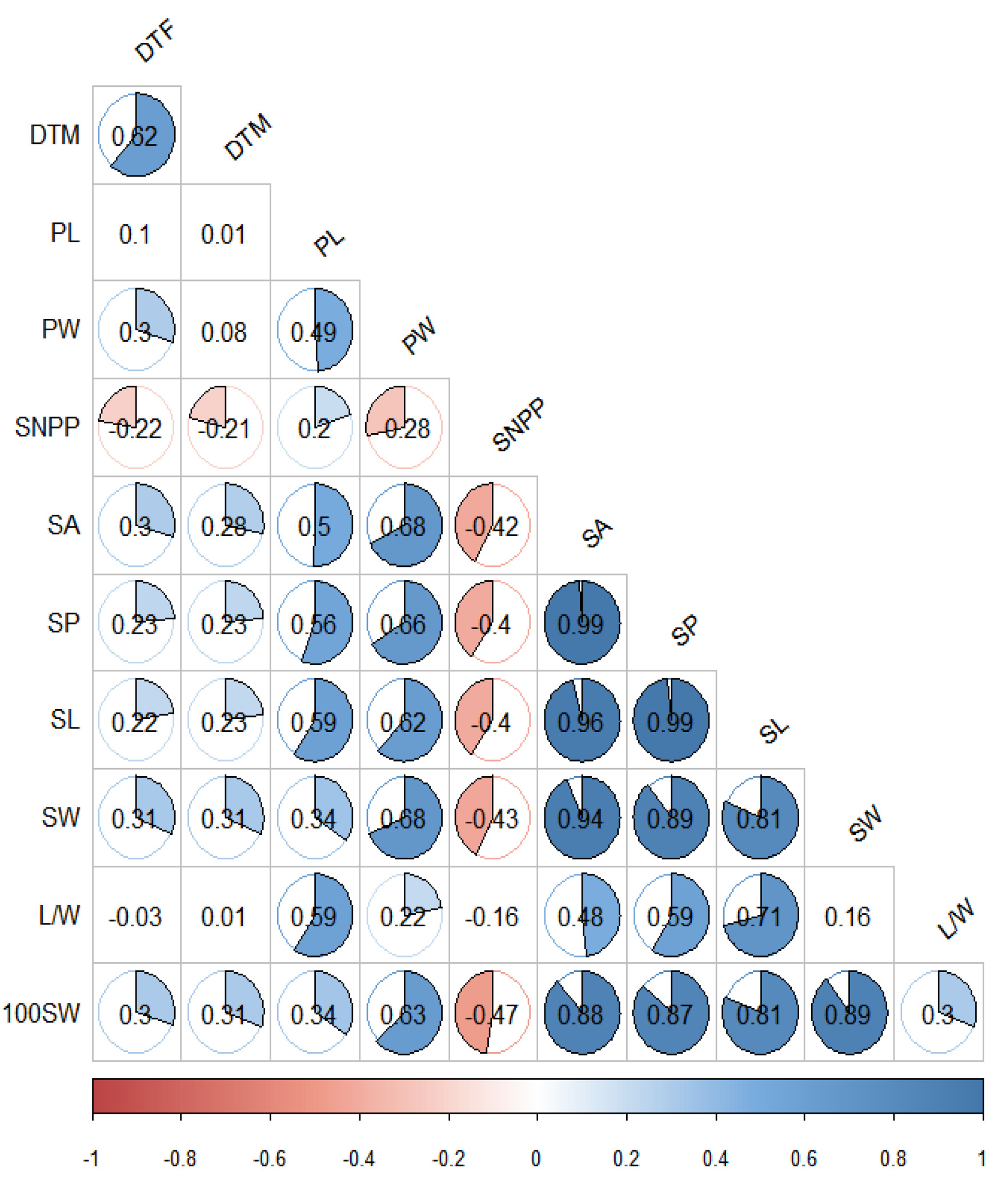
재래종 강낭콩 유전자원의 양적형질을 이용해 상관분석을 수행한 결과는
Fig. 2와 같다. 개화일수와 성숙일수의 경우 높은 양의 상관관계(0.62)를 보였으며, 종자의 크기를 나타내는 종자면적, 종자둘레, 종자길이, 종자너비와 백립중(100SW)들은 서로 높은 양의 상관관계(0.81~0.99)를 보였다. 장폭비의 경우, 협장(0.59), 협폭(0.22), 종자면적(0.48), 종자둘레(0.59), 종자길이(0.71), 백립중(0.3)과 양의 상관관계를 보였으나, 개화일수, 성숙일수, 협당립수, 종자너비와는 상관관계를 보이지 않았다. 협당립수의 경우 협장과 장폭비를 제외한 나머지 양적형질에 대해 음의 상관관계(-0.47~-0.21)를 보였다(
Fig. 2).
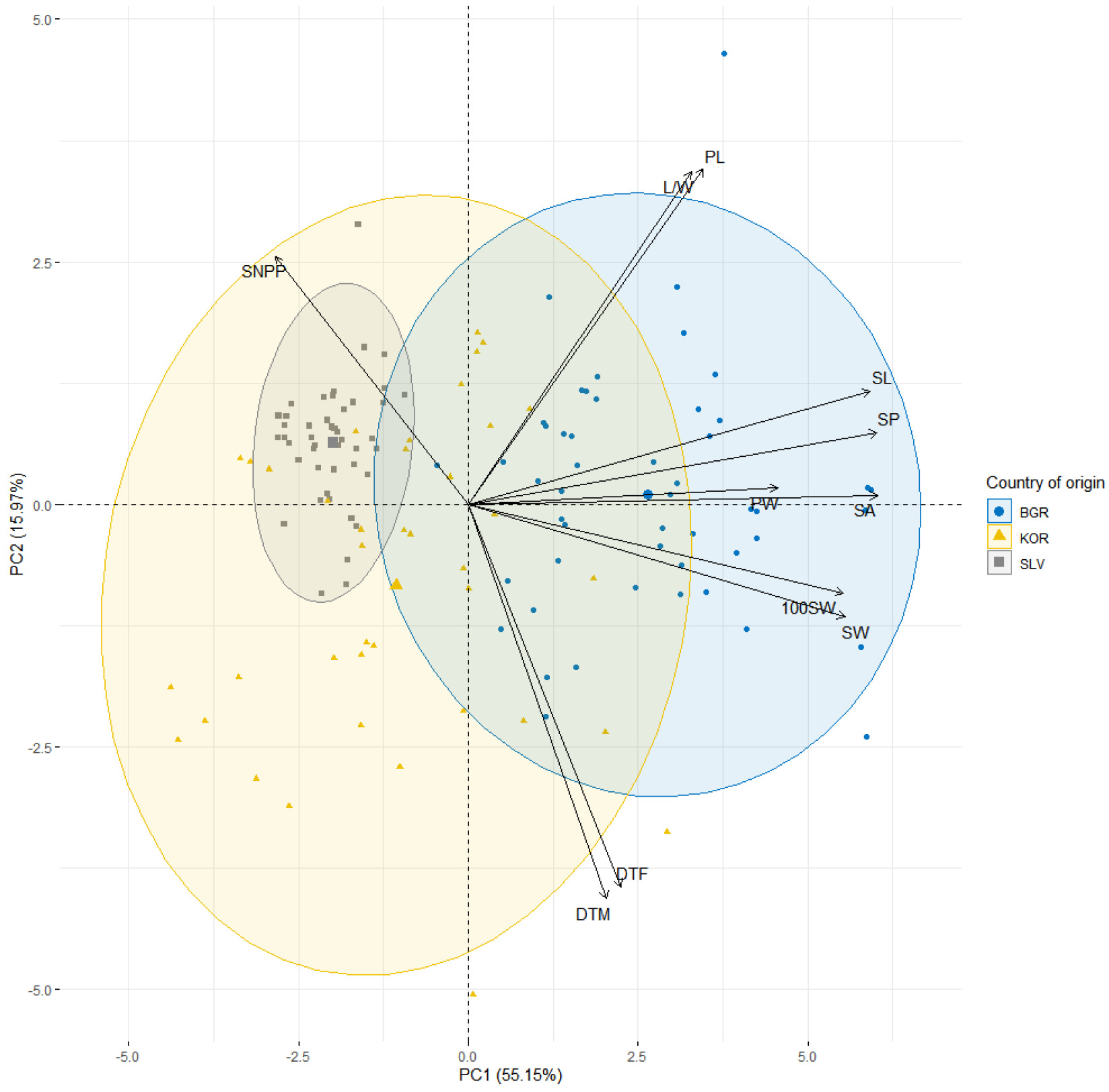
강낭콩 유전자원에 대해 특성평가한 10개의 양적형질 데이터를 이용하여 주성분분석(Principal component analysis, PCA)을 수행하였다(
Table 4,
Fig. 3). 그 결과, 제1주성분(PC1), 제2주성분(PC2), 제3주성분(PC3)은 각각 전체 변이의 55.15%, 15.97%, 10.29%를 설명하여 세가지 주성분은 전체의 81.41%의 변이를 설명하였다(
Table 4). 주성분과 양적형질들의 상관관계를 보면, PC1에서는 협당립수(-0.46)를 제외한 모든 양적형질들이 양의 방향으로 상관관계를 나타냈고, 종자크기와 무게에 대한 형질들인 종자면적(0.98), 종자둘레(0.98), 종자길이(0.96), 종자너비(0.90), 백립중(0.90)은 매우 높은 양의 상관관계를 보여주었다. PC2에서는 협장(0.56)과 장폭비(0.56)가 양의 방향으로, 성숙일수(-0.66)와 개화일수(-0.64)가 음의 방향으로 다른 양적형질보다 높은 상관관계를 나타내었다. PC3에서는 협당립수(0.54), 개화일수(0.51), 협장(0.49), 성숙일수(0.48) 형질이 양의 방향으로 높은 상관관계를 보였다. 또한, 주성분분석에서 원산지별로 그룹핑을 수행한 결과, 원산지별로 명확하게 구분이 되지는 않았으나, 원산지별 자원의 특성을 확인할 수 있었다(
Fig. 3). PC1을 기준으로 볼 때 불가리아의 자원이 한국과 엘살바도르 자원보다 대체로 종자크기와 종자무게가 크고, 협당립수가 적다는 것을 알 수 있었다. PC2를 기준으로 볼 때 한국 원산의 경우 개화일수 및 성숙일수의 변이가 큰 반면에 엘살바도르 자원들은 대체로 개화일수 및 성숙일수가 짧음을 알 수 있었다. 전체 그룹핑된 모양을 보면 한국원산 자원의 경우 PC2방향으로 넓게 분포해 있고, 불가리아 원산은 오른쪽으로 치우져 있었으며, 엘살바도르 자원의 경우 왼쪽의 위쪽에 좁게 분포한 것을 볼 수 있었다.
고찰
한국, 불가리아, 엘살바도르 원산 강낭콩 재래종 자원에 대한 특성평가를 수행하고, 원산지별 형태적 변이를 비교분석 하였다. 그 결과, 엘살바도르 원산 강낭콩 자원의 경우 조숙성, 작은 꼬투리 및 작은 종자 등과 같이 한국 및 불가리아 원산과는 차이나는 형질들을 보임을 알 수 있었다(
Fig. 1,
Table 3). 이러한 차이는 엘살바도르 원산 자원이 메소아메리카 유전자풀에 속하기 때문이라고 생각되었다. 강낭콩은 과거 독립적인 순화 과정을 겪으면서 메소아메리카와 안데스 유전자풀로 나뉘었다(
Schmutz et al. 2014). 메소아메리카 지역은 엘살바도르를 포함하는 멕시코에서 파나마까지의 지역을 말하며, 안데스 지역은 남아메리카 지역을 말한다. 이러한 두 개의 주요 유전자풀에 속하는 강낭콩들은 서로 다른 종자 형질을 가진다. 메소아메리카 유전자풀의 강낭콩은 백립중이 40 g 미만 정도의 소립에서 중립 정도의 무게를 가지는 반면에 안데스 유전자풀의 경우 백립중이 40 g 이상인 대립종자를 가지는 것으로 알려져 있다(
Lioi & Piergiovanni 2013). 이 연구에서 사용된 모든 엘살바도르 원산의 강낭콩 재래종들은 백립중이 40 g 미만으로 메소아메리카 자원의 특성과 일치했다(
Supplementary Table 1). 또한, 대부분의 메소아메리카 자원들과 무한 부시형 생육습성을 가진 자원들은 단일식물(short day plants) 보다는 중일성 식물(day neutral plants)이라고 알려져 있다(
Gonzalez et al. 2021,
White & Laing 1989). 이 연구에서 사용한 엘살바도르 원산의 자원들의 신육형은 대부분이 무한 부시형을 가진 자원들이었다(
Fig. 1). 이러한 근거들을 기반으로 중일성 식물인 엘살바도르 원산의 자원들이 엘살바도르보다 높은 위도인 한국에서 재배가 된다면 이들의 개화일수는 일장보다는 온도에 의해 상대적으로 더 영향을 받게 될 것이다. 한국은 일장이 긴 여름과 일장이 짧은 겨울을 가진 고위도 지역이다(
Nakamichi 2015). 그러므로 한국과 같은 상대적인 고위도 지역에서 재배된다면, 광에 민감한 단일식물의 경우 늦게 성숙하지만 엘살바도르 원산 자원과 같이 열에 민감한 자원들은 고위도에서 일찍 성숙하게 되었을 것이다.
이 연구에서 조사한 양적형질들의 유의성을 분석하기 위해 상관분석을 수행하고, 원산지별 강낭콩 재래종의 특성을 가장 잘 설명하는 주요인을 찾기 위해 양적형질들에 대해 주성분분석을 수행하였다. 그 결과 상관분석에서는 개화일수와 성숙일수 간에, 종자면적, 종자둘레, 종자길이, 종자너비, 백립중 간에 서로 높은 양의 상관관계를 보였으며(
Fig. 2), 주성분분석에서는 PC1의 경우 종자크기(종자면적, 종자둘레, 종자길이, 종자너비)와 백립중이, PC2에서는 개화일수 및 성숙일수가 해당 주성분과 높은 상관관계를 보였다(
Table 4). 이를 통해 볼 때 농업형질인 개화일수 및 성숙일수와 종자의 크기 및 무게 형질은 한국, 불가리아, 엘살바도르 재래종 자원들의 특성들을 설명해주는 주요한 요인임을 알 수 있다. 또한, 원산지별 재래종 자원들의 그룹핑 결과를 보면 한국 원산 자원의 경우는 PC2 방향으로 길게 분포하고 있으며, 불가리아 원산 자원의 경우 PC1의 양의 방향에 위치해있으며, 엘살바도르 원산의 경우 PC1의 음의 방향 및 PC2의 양의 방향에 위치해있었다. 이를 통해 한국원산 자원의 경우 개화일수 및 성숙일수의 변이가 넓은 특성을 가지며 불가리아 원산의 경우 다른 원산들보다 종자의 크기 및 무게가 크며, 엘살바도르 원산의 경우 종자크기 및 무게가 적고, 개화일수 및 성숙일수가 짧은 특성을 지닌다는 것을 알 수 있다.
원산지별 주요 특성은 강낭콩 품종 육성시 유용한 자원을 선발하는 데 이용될 수 있을 것이다. 먼저, 기존의 연구들을 통하여 강낭콩의 백립중과 수량 간에 높은 상관관계를 갖는다는 것이 알려져 있다(
Assefa et al. 2015,
Assefa et al. 2019,
Rao et al. 2017). 따라서, PC2의 양의 방향에 위치하고 있는 불가리아 원산자원들은 수량성이 높은 자원을 육성하는데 유용한 자원으로 이용될 수 있을 것이다. 또한, 이 자원들은 종자크기가 크기 때문에 밥밑콩 자원 육성시에도 유용하게 사용될 수 있을 것이다. 강낭콩 재배시 유리한 조숙성 품종의 개발을 위해서는 PC2의 양의 방향에 위치하고 있는 자원들이 품종 육성 소재로서 유용할 것이며, 특히 엘살바도르 자원들의 경우 다른 원산지 자원들보다 가장 일찍 성숙하는 특성을 가지고 있어 조숙성 육성소재로서 유용할 것이라고 생각한다.
원산지별 형태적인 다양성 측면에서, PCA 분석에서 그룹핑별의 분포도를 보면 엘살바도르 자원의 경우 한국, 불가리아 원산자원들과 다르게 비교적 적은 영역에 그룹핑 된 것을 볼 수 있다. 이는 엘살바도르 자원의 형태적 다양성이 다른 원산의 자원보다 적기 때문이다.
적 요
본 연구는 한국, 불가리아, 엘살바도르 원산 재래종 135자원에 대해 형태적 특성평가를 수행하였다. 또한, 특성평가 결과를 원산지별로 비교분석하기 위해 주성분분석을 이용하여 원산지별 차이를 가장 잘 설명할 수 있는 주요인을 분석하였고, 주성분분석의 그룹핑 결과를 이용하여 각 원산지의 형태적 다양성을 분석하였다. 그 결과, 한국 원산 재래종 자원의 경우 개화일수 및 성숙일수의 변이가 큰 특성을, 불가리아 원산 자원의 경우 종자의 크기 및 무게가 큰 특성을, 엘살바도르 원산 자원의 경우 종자 크기 및 무게가 작고, 개화일수 및 성숙일수가 짧은 특성을 지님을 알 수 있었다. 또한, 주성분분석 결과 엘살바도르 원산의 경우 다른 원산자원들보다 작은 면적에 그룹핑 되어 형태적 다양성이 상대적으로 적음을 알 수 있었다. 따라서 본 연구에서 수행한 특성평가 결과는 강낭콩 품종 육성시 육종소재를 선발하는데 중요한 기초정보로서 활용될 수 있을 것이며, 원산지별 형태적 다양성 분석은 농업유전자원센터 보유 자원에 대한 다양성 평가 및 다양성 확보 계획수립에 중요한 자료로 활용될 것으로 기대한다.
보충자료
본문의 Supplementary Table 1과 Supplementary Fig. 1은 한국육종학회지 홈페이지에서 확인할 수 있습니다.
사 사
본 논문은 농촌진흥청 농업과학기반기술개발(과제번호: PJ 01424201)의 지원으로 연구하였습니다.
Fig. 1Distribution of qualitative traits according to country of origin. Legends of each graph follow qualitative trait description in
Table 2. KOR, Korea; BGR, Bulgaria; SLV, El Salvador; GH, Growth habit; Cb, Banner color; Cw, Wing color; PCm, Pod color at maturity stage; PCh, Pod color at harvest stage; PC, Pod curvature; SB, Seed brilliance; SC, Seed color; SS, Seed shape.
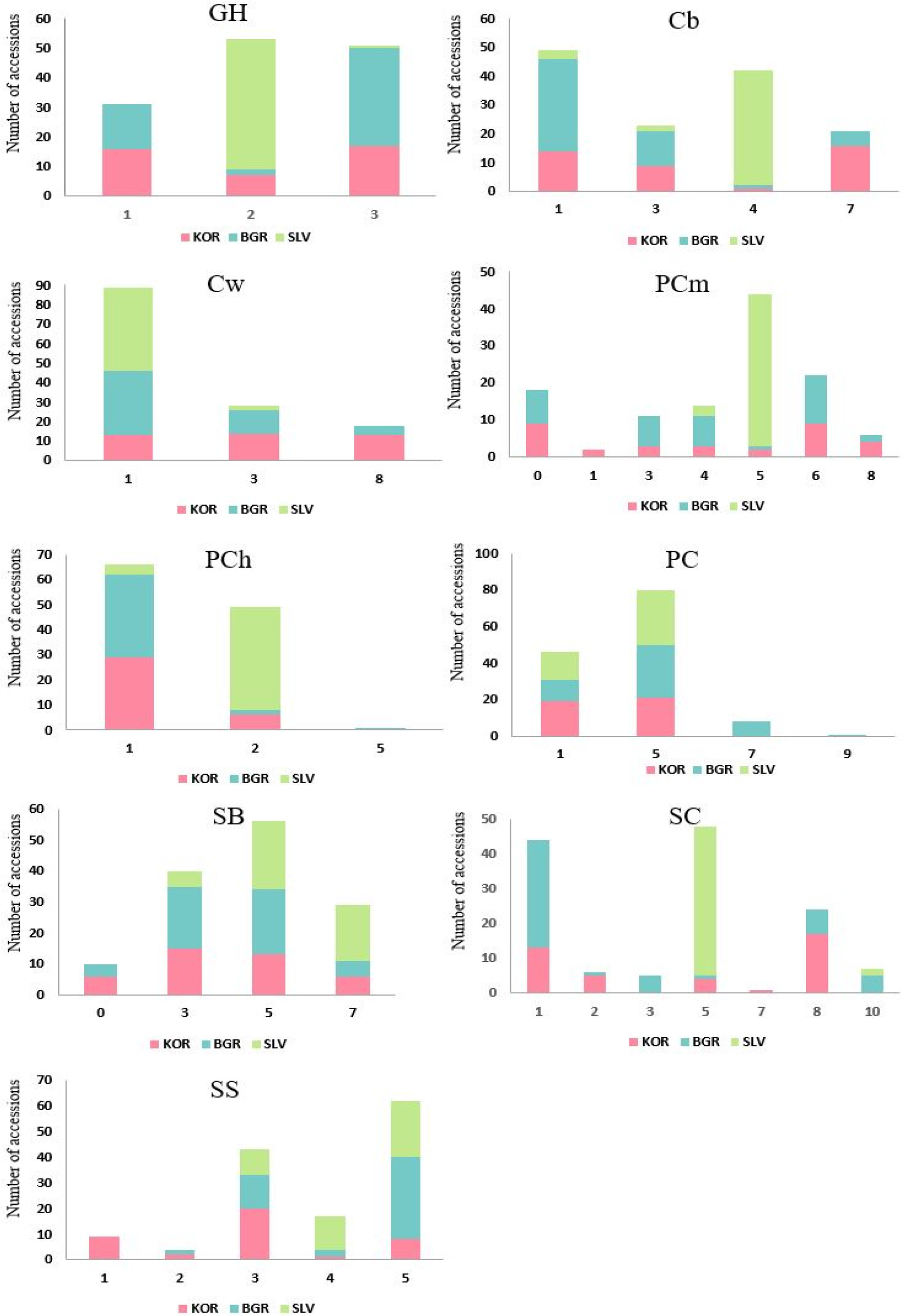
Fig. 2Correlation analysis among quantitative traits. DTF, days to flowering; DTM, days to maturity; PL, pod length; PW, pod width; SNPP, seed number per pod; SA, seed area; SP, seed perimeter; SL, seed length; SW, seed width; L/W, length/width ratio; 100SW, 100- seed weight.
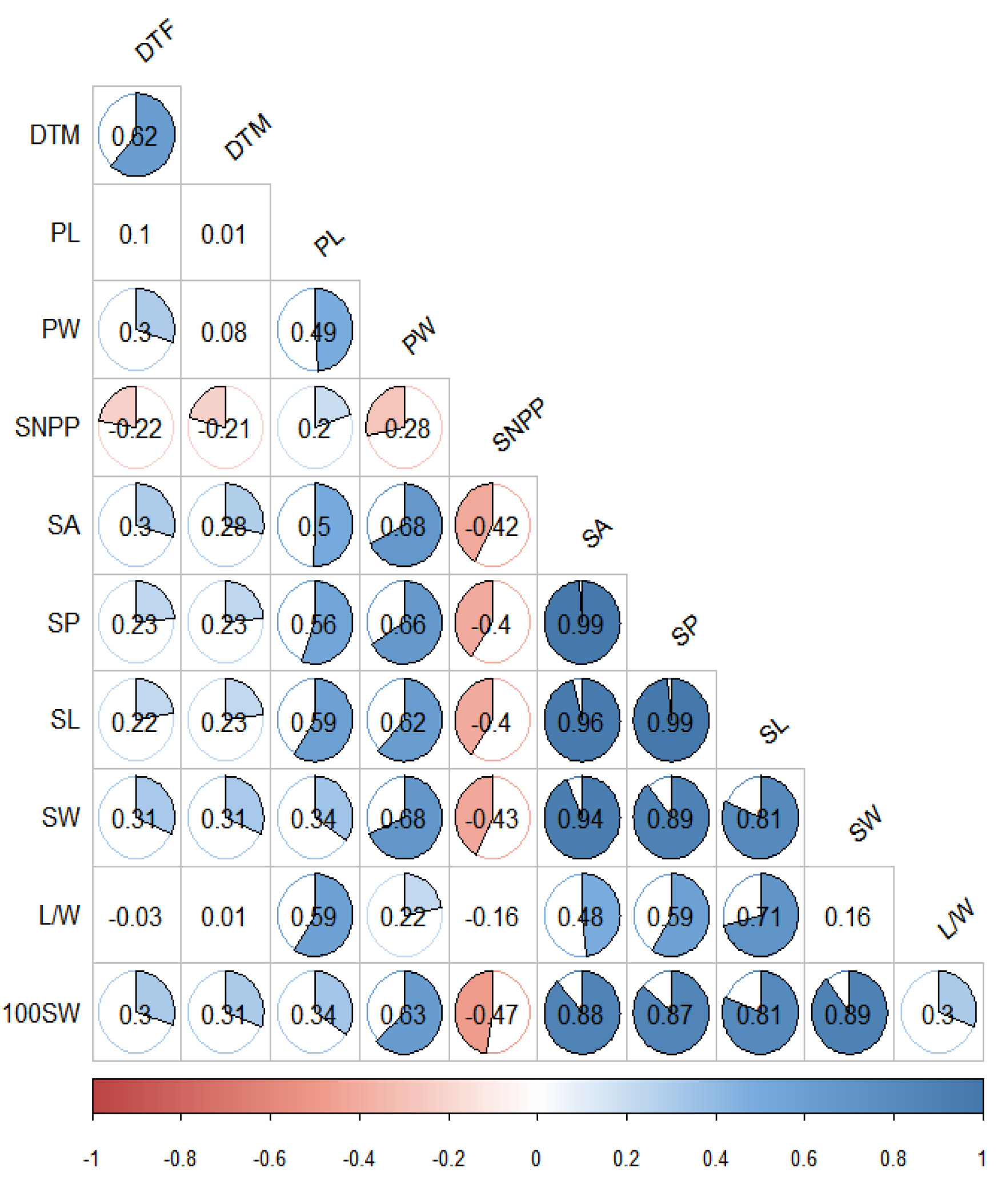
Fig. 3The biplot of principal component analysis (PCA) of 135 common bean accessions based on morphological traits.
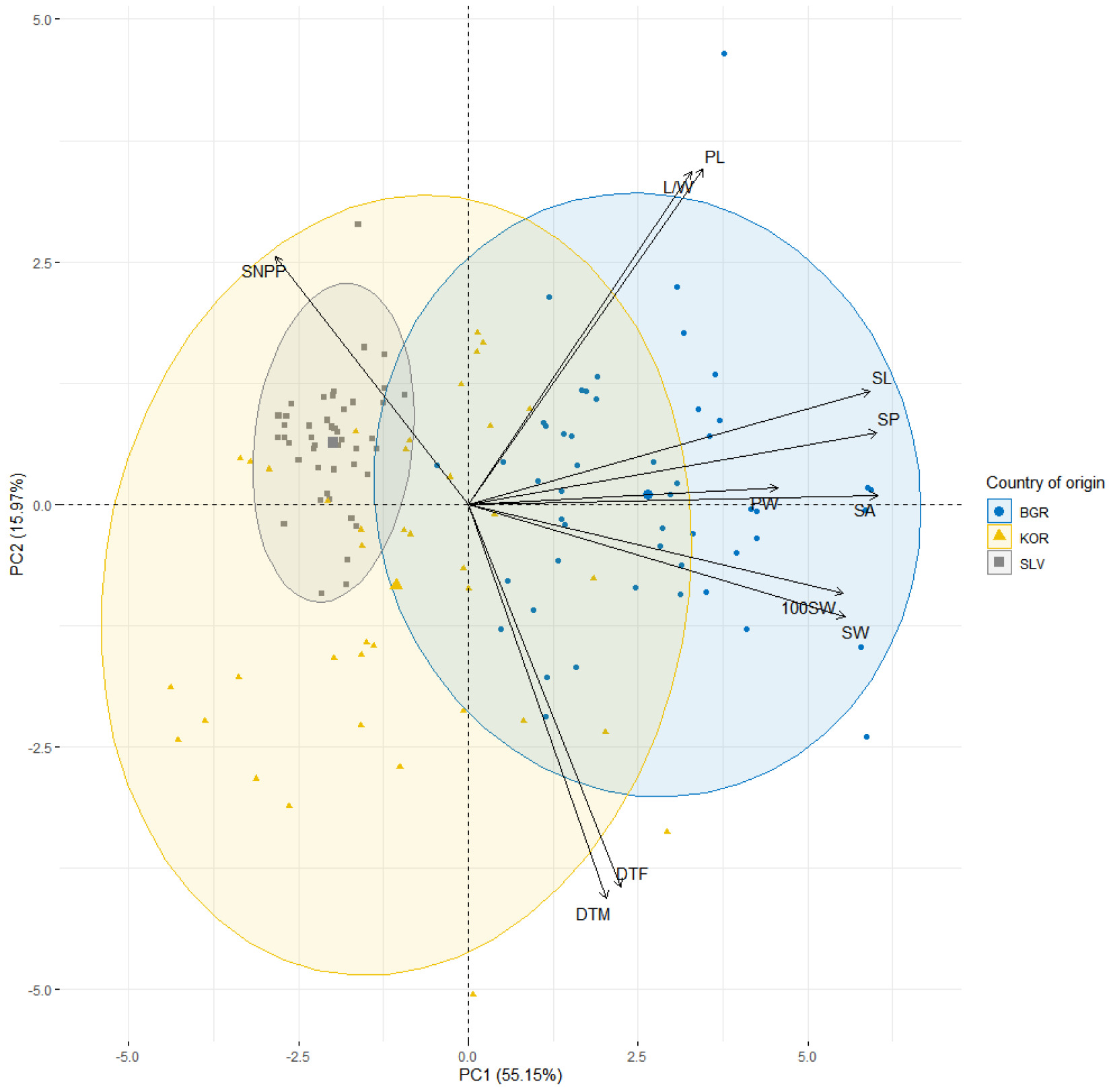
Table 1List of common beans used in this study
Table 1
|
Accession No. |
Country of origin |
Accession No. |
Country of origin |
Accession No. |
Country of origin |
|
101029 |
Korea |
301837 |
Korea |
K156165 |
Bulgaria |
|
103070 |
Korea |
301838 |
Korea |
K156199 |
Bulgaria |
|
103601 |
Korea |
305226 |
Korea |
K156235 |
Bulgaria |
|
104302 |
Korea |
229451 |
Bulgaria |
K156454 |
Bulgaria |
|
104587 |
Korea |
229452 |
Bulgaria |
K156552 |
Bulgaria |
|
105200 |
Korea |
230269 |
Bulgaria |
K156577 |
Bulgaria |
|
105463 |
Korea |
230561 |
Bulgaria |
K156592 |
Bulgaria |
|
105800 |
Korea |
230564 |
Bulgaria |
230575 |
Bulgaria |
|
105875 |
Korea |
230570 |
Bulgaria |
230859 |
Bulgaria |
|
108897 |
Korea |
230577 |
Bulgaria |
250143 |
Bulgaria |
|
108950 |
Korea |
230853 |
Bulgaria |
260952 |
Bulgaria |
|
109179 |
Korea |
230856 |
Bulgaria |
276437 |
Bulgaria |
|
168098 |
Korea |
230860 |
Bulgaria |
305400 |
Bulgaria |
|
168117 |
Korea |
230863 |
Bulgaria |
305401 |
Bulgaria |
|
175918 |
Korea |
230868 |
Bulgaria |
305403 |
Bulgaria |
|
180488 |
Korea |
230869 |
Bulgaria |
305532 |
Bulgaria |
|
180579 |
Korea |
230870 |
Bulgaria |
328910 |
El Salvador |
|
180807 |
Korea |
230872 |
Bulgaria |
K223238 |
El Salvador |
|
180812 |
Korea |
230873 |
Bulgaria |
K223245 |
El Salvador |
|
191171 |
Korea |
230874 |
Bulgaria |
K223249 |
El Salvador |
|
209143 |
Korea |
230876 |
Bulgaria |
300985 |
El Salvador |
|
209144 |
Korea |
230879 |
Bulgaria |
300986 |
El Salvador |
|
212057 |
Korea |
230880 |
Bulgaria |
300987 |
El Salvador |
|
231363 |
Korea |
230882 |
Bulgaria |
300990 |
El Salvador |
|
900080 |
Korea |
230884 |
Bulgaria |
300993 |
El Salvador |
|
910869 |
Korea |
237420 |
Bulgaria |
300994 |
El Salvador |
|
K041614 |
Korea |
250141 |
Bulgaria |
300997 |
El Salvador |
|
100888 |
Korea |
250152 |
Bulgaria |
300999 |
El Salvador |
|
103779 |
Korea |
289266 |
Bulgaria |
301001 |
El Salvador |
|
108701 |
Korea |
K136865 |
Bulgaria |
301002 |
El Salvador |
|
112802 |
Korea |
K136875 |
Bulgaria |
301003 |
El Salvador |
|
180810 |
Korea |
K136937 |
Bulgaria |
301004 |
El Salvador |
|
185484 |
Korea |
K139667 |
Bulgaria |
301006 |
El Salvador |
|
189599 |
Korea |
K146625 |
Bulgaria |
301007 |
El Salvador |
|
208907 |
Korea |
K146639 |
Bulgaria |
301011 |
El Salvador |
|
290025 |
Korea |
K146879 |
Bulgaria |
301012 |
El Salvador |
|
301610 |
Korea |
K156153 |
Bulgaria |
301013 |
El Salvador |
|
301014 |
El Salvador |
328884 |
El Salvador |
328895 |
El Salvador |
|
301015 |
El Salvador |
328885 |
El Salvador |
328896 |
El Salvador |
|
301016 |
El Salvador |
328886 |
El Salvador |
328897 |
El Salvador |
|
301017 |
El Salvador |
328887 |
El Salvador |
328898 |
El Salvador |
|
301018 |
El Salvador |
328889 |
El Salvador |
328903 |
El Salvador |
|
301019 |
El Salvador |
328890 |
El Salvador |
328905 |
El Salvador |
|
301021 |
El Salvador |
328891 |
El Salvador |
328907 |
El Salvador |
|
328883 |
El Salvador |
328892 |
El Salvador |
328908 |
El Salvador |
Table 2Descriptor of 20 agronomic and seed traits used in this study
Table 2
|
Trait |
Abbreviation |
Organ |
Description |
|
Growth habit |
GH |
- |
1: determinate bush; 2: indeterminate bush; 3: indeterminate upright |
|
Banner color |
Cb |
Flower |
1: white; 2: green; 3: purple; 4: white with purple dots or red stripes; 5: dark purple with purple stripes; 6: orange; 7: red purple |
|
Wing color |
Cw |
Flower |
1: white; 2: green; 3: purple; 4: orange; 5: white with purple dots or red stripes; 6: red; 7: dark purple with purple stripes; 8: red purple |
|
Pod color at maturity |
PCm |
Pod |
0: light yellow; 1: dark red purple; 2: orange; 3: green with red purple stripes; 4: green with red stripes; 5: dark red; 6: green; 7: grey green; 8: yellow |
|
Pod color at harvest |
PCh |
Pod |
1: yellow; 2: brown; 3: dark green; 4: dark brown; 5: others |
|
Pod curvature |
PC |
Pod |
1: straight; 5: slightly curved; 7: curved; 9: recurving |
|
Days to flowering |
DTF |
Flower |
Days from sowing to flowering in 2-3 plants |
|
Days to maturity |
DTM |
Pod |
Days from sowing to pod maturity in 2-3 plants |
|
Pod length |
PL |
Pod |
Average pod length (cm) of 10 immature pods |
|
Pod width |
PW |
Pod |
Average pod width (mm) of 10 immature pods |
|
Seed brilliance |
SB |
Seed |
0: matt; 3: weak; 5: medium; 7: shiny |
|
Seed color |
SC |
Seed |
1: white; 2: yellow; 3: green; 4: red; 5: red purple; 6: navy; 7: brown; 8: black; 9: pink; 10: bicolor |
|
Seed shape |
SS |
Seed |
1: round; 2: oval; 3: cuboid; 4: kidney shaped; 5: truncate fastigiate |
|
Seed number per pod |
SNPP |
Seed |
Average number of seeds in 10 mature pods |
|
Seed area |
SA |
Seed |
Average area (mm2) of 20 seeds |
|
Seed perimeter |
SP |
Seed |
Average perimeter (mm) of 20 seeds |
|
Seed length |
SL |
Seed |
Average of the longest length (mm) of 20 seeds |
|
Seed width |
SW |
Seed |
Average of the shortest length (mm) of 20 seeds |
|
Length/width ratio |
L/W |
Seed |
Calculated by dividing seed length by seed width |
|
100-seed weight |
100SW |
Seed |
Average weight (g) of 100 seeds |
Table 3Quantitative traits of agronomic and seed traits according to country of origin
Table 3
|
Quantitative Traitsz |
Mean±SDy
|
|
Korea |
Bulgaria |
El Salvador |
|
DTF |
53.9±5.4a
|
56.0±5.2a
|
49.8±3.3b
|
|
DTM |
91.5±13.6a
|
88.9±10.2a
|
78.5±4.1b
|
|
PL (cm) |
9.9±1.5c
|
12.7±2.3a
|
10.7±1.6b
|
|
PW (mm) |
10.4±1.0b
|
13.5±2.9a
|
10.1±1.0b
|
|
SNPP |
5.1±0.9b
|
4.7±0.9b
|
5.9±0.4a
|
|
SA (mm2) |
62.6±14.5b
|
94.3±16.1a
|
57.2±4.4b
|
|
SP (mm) |
31.2±3.9b
|
39.0±3.4a
|
30.4±1.2b
|
|
SL (mm) |
11.1±1.6b
|
14.5±1.4a
|
10.7±0.4b
|
|
SW (mm) |
7.1±0.8b
|
8.2±0.8a
|
6.8±0.3b
|
|
L/W |
1.6±0.2b
|
1.8±0.2a
|
1.6±0.1b
|
|
100SW (g) |
31.9±12.0b
|
43.9±9.5a
|
25.7±2.9c
|
Table 4Principal component analysis of quantitative traits in common bean, eigen values, and percentage of variation for three principal components
Table 4
|
Quantitative traits |
Principal components |
|
PC1 |
PC2 |
PC3 |
|
Days to flowering |
0.37 |
-0.64 |
0.51 |
|
Days to maturity |
0.33 |
-0.66 |
0.48 |
|
Pod length (cm) |
0.56 |
0.56 |
0.49 |
|
Pod width (mm) |
0.74 |
0.03 |
-0.03 |
|
Seed number per pod |
-0.46 |
0.42 |
0.54 |
|
Seed area (mm2) |
0.98 |
0.02 |
-0.07 |
|
Seed perimeter (mm) |
0.98 |
0.12 |
-0.06 |
|
Seed length (mm) |
0.96 |
0.19 |
-0.01 |
|
Seed width (mm) |
0.90 |
-0.19 |
-0.18 |
|
Length/width ratio |
0.53 |
0.56 |
0.18 |
|
100-seed weight (g) |
0.90 |
-0.15 |
-0.18 |
|
Eigen value |
6.07 |
1.76 |
1.13 |
|
Proportion of variance (%) |
55.15 |
15.97 |
10.29 |
|
Cumulative proportion (%) |
55.15 |
71.12 |
81.41 |
References
- Abramoff MD, Magalhaes PJ, Ram SJ. 2004. Image processing with ImageJ. Biophotonics Int 11: 36-42.
- Assefa T, Assibi Mahama A, Brown AV, Cannon EKS, Rubyogo JC, Rao IM, Blair MW, Cannon SB. 2019. A review of breeding objectives, genomic resources, and marker-assisted methods in common bean (Phaseolus vulgaris L.). Mol Breeding 39: 20
- Assefa T, Wu J, Beebe SE, Rao MI, Marcomin D, Rubyogo JC. 2015. Improving adaptation to drought stress in small red common bean: Phenotypic differences and predicted genotypic effects on grain yield, yield components and harvest index. Euphytica 203: 477-489.
- Bareke T. 2019. Diversity and genetic potential of various morphological traits among common bean (Phaseolus vulgaris, Fabaceae) landraces. Biodiversitas 20: 3237-3245.
- Broughton WJ, Hernandez G, Blair M, Beebe S, Gepts P, Vanderleyden J. 2003. Beans (Phaseolus spp.) - Model food legumes. Plant Soil 252: 55-128.
- Castro-Guerrero NA, Isidra-Arellano M, Mendoza-Cozatl DG, Valdes-Lopez O. 2016. Common bean: A legume model on the rise for unraveling responses and adaptations to iron, zinc, and phosphate deficiencies. Front Plant Sci 7: 600
- Chavez-Servia JL, Heredia-García E, Mayek-Pérez N, Aquino- Bolaños EN, Hernández-Delgado S, Carrillo-Rodríguez JC, Gill-Langarica HR, Vera-Guzmán AM. In: Goyal AK 2016. (Ed). Diversity of common bean (Phaseolus vulgaris L.) landraces and the nutritional value of their grains. Grain legumes IntechOpen, London, United Kingdom: pp. 1-33.
- Choi YM, Lee S, Hyun DY, Yoon M, Oh S, Lee MC, Lee J, Ko H, Huh O. 2015. Comparison of agricultural traits and SSR diversity of common bean (Phaseouls vulgaris L.) from Korea, China and El Salvador. Korean J Breed Sci 47: 245-254.
- Gonzalez AM, Yuste-Lisbona FJ, Weller J, Vander Schoor JK, Lozano R, Santalla M. 2021. Characterization of QTL and environmental interactions controlling flowering time in Andean common bean (Phaseolus vulgaris L.). Front Plant Sci 11: 599462.
- Kim J, Shin I, Lee J, Ha B, Lee J, Choung M, Moon J, Kang S. 2021. Soybean cultivar 'Noksim' with green cotyledons and a black seed coat for cooking with rice. Korean J Breed Sci 53: 69-76.
- Lee HB, Choi BR, Kang CS, Kim YH, Choi YJ. 2001. Determination of seed protein and oil concentration in kidney bean by near infrared spectrosopic analysis. Korean J Crop Sci 46: 248-252.
- Lioi L, Piergiovanni AR. In: Singh M, Upadhyaya HD, Bisht IS. 2013. European common bean. (Eds). Genetic and genomic resources of grain legume improvement. Elsevier, Amsterdam, Netherlands: pp. 11-40.
- Nakamichi N. 2015. Adaptation to the local environment by modifications of the photoperiod response in crops. Plant Cell Physiol 56: 594-604.
- Negri V, Maxted N, Veteläinen M. In: Veteläinen M, Negri V, Maxted N. 2009. European landrace conservation: An introduction. (Eds). European landraces: On-farm conservation, management and use. Bioversity International, Rome, Italy: pp. 1-22.
- Rao IM, Beebe SE, Polania J, Grajales M, Cajiao C, Ricaurte J, Garcia R, Rivera M. 2017. Evidence for genotypic differences among elite lines of common bean in their ability to remobilize photosynthate to increase yield under drought. J Agric Sci 155: 857-875.
- Schmutz J, McClean PE, Mamidi S, Wu GA, Cannon SB, Grimwood J, Jenkins J, Shu S, Song Q, Chavarro C, Torres- Torres M, Geffroy V, Moghaddam SM, Gao D, Abernathy B, Barry K, Blair M, Brick MA, Chovatia M, Gepts P, Goodstein DM, Gonzales M, Hellsten U, Hyten DL, Jia G, Kelly JD, Kudrna D, Lee R, Richard MM, Miklas PN, Osorno JM, Rodrigues J, Thareau V, Urrea CA, Wang M, Yu Y, Zhang M, Wing RA, Cregan PB, Rokhsar DS, Jackson SA. 2014. A reference genome for common bean and genome-wide analysis of dual domestications. Nat Genet 46: 707-713.
- Shin DC, Kang ST, Han WY, Baek IY, Choung MG, Park KY, Kang NS, Hwang YH, Ko JM, Suh DY, Kim HY. 2008. A new pod edible kidney bean variety "Hwangheob 2" with yellow pod color. Korean J Breed Sci 40: 470-473.
- Singh SP, Gepts P, Debouck DG. 1991. Races of common bean (Phaseolus vulgaris, Fabaceae). Econ Bot 45: 379-396.
- White JW, Laing DR. 1989. Photoperiod response of flowering in diverse genotypes of common bean (Phaseolus vulgaris). Field Crop Res 22: 113-128.