적요
Globally, wheat (Triticum aestivum) is a major food crop for humans with no regional restrictions. However, it is still difficult for Korea to achieve self-sufficiency owing to production limitations. Moreover, food security is unstable owing to the unpredictable climate and unstable international economy. Pre-harvest sprouting (PHS) is among the factors that occurs frequently due to irregular climates, and damages the value of wheat. In this study, RNA-seq was conducted on PHS-treated samples (for Korean representative cultivar ‘keumgang’) and PHS-resistant mutation line ‘Jeonju 377ho’. Gene functional annotation and DEGs analysis were performed using 234,131,980 mapped reads. Associated transcripts were analyzed using Kyoto Encyclopedia of Genes and Genomes (KEGG) analysis and were mainly used to search for genes associated with ATP synthesis and starch and sucrose metabolism related to seed germination and seed dormancy. Candidate DEGs were compressed through cluster set analysis, and gene expression was conducted to search for genes related to seed germination and dormancy to explain them in greater detail based on biological and chemical mechanisms.
서 언
밀(
Triticum aestivum)은 식량 작물 중 두 번째로 많이 생산되며 옥수수, 벼와 함께 세계 3대 식량 작물이다. 보통밀, 빵밀로도 불리며 밀 속(
Triticum)에서도 가장 많이 재배된다(
Kang et al. 2010). 밀은 추파 또는 춘파, 적립계 또는 백립계 등 유전적 특성을 가진 다양한 품종들이 가진 장점과 높은 수량성 및 품질을 보유하고 있다(
Lee et al. 2002). 이처럼 오늘날 요구되는 식량작물로서의 광범위한 기능적 요소를 모두 충족하는 장점으로 인해 오래 전부터 인류 생존과 관련하여 필수적인 작물 중 하나로 널리 소비되고 있다(
Choi et al. 2018).
밀은 타 작물과 다르게 대부분의 경우 가공의 단계를 거쳐야 식품으로서의 가치가 높아지기 때문에 가공적성(end use quality)은 밀에서의 주요한 요인으로 여겨지며 특히 생물적, 비생물적 스트레스 피해는 수확량 뿐만 아니라 식품으로서 밀의 가치를 떨어뜨리는 주요 방해 요소가 될 수 있다(
Kang et al. 2008). 최근 이상 기후로 인한 재배 환경 변화와 강수량의 변화로 밀의 피해는 더 심화되고 있는 추세이며, 태풍이나 기습적 폭우 등의 환경적 요인에 의해 작물의 도복이나 과습 피해의 발생 조건이 빈번해지면서 식량 작물의 대표적 수분장해인 수발아의 발생과 그로 인한 피해는 점차 확대되고 있다(
Shin et al. 2013). 수발아(pre-harvest sprouting; PHS)는 종실이 출수기 이후 수확을 앞둔 등숙 기간에 잦은 강수로 인한 과수분 조건과 발아억제물질의 용해 및 분해되어 종자의 휴면타파와 함께 이삭에 달린 채로 발아가 진행되는 것을 말하며(
Schopfer et al. 1979,
Nielsen et al. 1984,
Biddulph et al. 2008,
Kang et al. 2014) 수발아가 시작되면 배유의 α-amylase의 활성 증가와 함께 탄수화물이 당으로 분해되면서 밀 종실의 품질을 극도로 저하 시키는 재해로 전세계적으로 광범위한 피해를 일으키는 대표적인 비생물적 스트레스라고 할 수 있다(
Andreoli et al. 2006,
Farashah et al. 2011,
Kang et al. 2014). 특히 국내 밀의 육종 방향은 균일하고 빠른 발아가 주된 목적 형질이었으며 주요 장려품종들은 휴면(seed dormancy)에 약하여 수발아에 취약한 점이 있어 최근의 기후 문제와 더불어 보완이 필요한 것으로 판단된다.
최근 작물 분자 육종 연구에서 생물정보학의 활용은 트렌드를 넘어 필수적인 연구 요소 중 하나이다. 특히 RNA 분석 연구에서 마이크로어레이(microarray) 기술과 더불어 NGS 기술을 통해 정량화된 mRNA를 시퀀싱하는 RNA-seq 기술은 후보 유전자의 주석화(annotation) 및 각 유전자의 정확한 발현량 분석이 가능하다. 특히, 알려져 있는 유전자의 범위를 벗어난 분석도 가능하기때문에 밀과 같이 유전체 연구가 완벽하지 않은 작물에서도 유전자 선발 및 육종 소재 개발에 많은 도움이 되고 있다(
Duan et al. 2012,
Pearce et al. 2015).
본 연구는 수발아에 감수성인 국내 장려 품종 ‘금강’과 금강을 모본으로 돌연변이 육종을 통해 수발아 내성을 가진 ‘전주 377호’를 대상으로 수발아 조건 실험을 실시하였으며 이를 대상으로 대량전사체 분석을 하였다. 수발아 조건에서의 발현 유전자 기작(mechanism) 및 기능 분석을 실시하였으며 수발아 관련 후보 DEGs (differentially expressed genes) 발굴을 통한 발현 양상을 파악하여 밀의 휴면과 발아에 대한 이해를 통해 향후 저항성 밀 품종 육성에 이용하고자 위함이다.
재료 및 방법
식물 재료 및 수발아 처리
본 실험에서는 국립 식량과학원에서 분양 받은 국내 장려 품종 ‘금강’과 수발아 내성 품종인 ‘우리’ 그리고 돌연변이 육종법으로 개발된 금강 돌연변이 계통 ‘전주 377호’를 대상으로 실시하였다. 각 계통은 4°C 에서 42일 간 춘화처리(vernalization) 후 포트에 1개체 씩 파종하였고 각 개체 당 첫 이삭(main tiller)을 기준으로 출수 후 40일(Days after fertilization)까지 생육하였다.
‘전주 377호’는 국립식량과학원에서 2007년 국내 장려 품종인 ‘금강’밀을 방사선 처리하여 개발하였다. 돌연변이원은 Co60이며 100 Gy의 선량을 이용하여 M1 변이체를 만든 후 bulk 재배로 M4까지 세대를 진전시켰으며 이후 수발아 저항성 선발을 통하여 계통 진행으로 F8 세대까지 진전하여 개발한 돌연변이 밀 계통이다(RDA 2017).
수발아 실험은 2021년 6월 16일부터 7일간 공주대 온실에서 실시되었다. 800×1100 cm 규격의 배드에 원예용 상토를 살포하여 평균 2 cm 높이의 인공적인 노지 환경을 조성하였고 직경 5.5 cm의 분수 호스를 활용하여 일평균 12시간 급수하여 강우 조건을 유지하였다. 샘플은 수발아 처리가 1일된 ‘금강’(K1), ‘전주377호’(KM1)의 식물체를 포함한 이삭을 대조군으로 사용하였으며, 7일간 수발아 처리한 ‘금강’(K7), ‘전주377호’(KM7) 이삭을 실험군으로 정하였다. 시료는 수발아 처리 전 후에 품종 당 독립적인 3개체씩 수확하였으며 액화질소를 활용해 급속 냉각하여 다음 실험 전까지 -70°C 초저온냉동고에서 보관하였다.
RNA-seq 라이브러리 구축 및 시퀀싱
Total RNA 추출은 GeneAll 사의 RibospinTM Seed/Fruit (GeneAll® Biotechnology, Seoul, Korea)를 이용해 수행하였으며 제조사의 프로토콜에 따라 추출하였다. cDNA 합성은 Power cDNA Synthesis Kit (iNtRON Biotechnology, Seoul, Korea)를 사용하여 수행하였다. RNA-seq 분석을 위한 라이브러리는 TruSeq™ RNA library prep kit (Illumina, CA, USA)를 사용하여 구축되었고 100-bp paired end sequencing은 Illumina HiSeqTM- 2500 platform (Illumina, CA, USA)에서 수행되었다.
RNA-seq 데이터 전처리 (read mapping and filtering)
De novo assembly는 velvet, oases 어셈블러(Zerbino et al. 2008,
Schulz et al. 2012)를 이용하여 진행되었으며, 이후 Short reads의 전처리 과정을 위하여 SolexaQA (v.1.13) package (
Cox et al. 2010)의 DynamicTrim과 LengthSort 프로그램을 사용하였다. Assembly 서열에 bowtie2 (v2.-1.0) software (Langmead et al. 2012)를 활용하여 read mapping을 하였으며, DESeq library (Anders et al. 2010)를 이용하여 Normalization을 실시하였다.
RNA-seq 데이터 및 DEGs 분석
Assembled transcript의 기능적 분류 및 파악을 위해 유전자 서열을 활용하여 KOG (eukaryotic orthologous groups) 및 GO (gene ontology) 분석을 수행하였고(
Ashburner et al. 2000), 근연종인 벼(
Oryza sativa)의 orthlog 유전자 서열을 통해 KEGG (Kyoto encyclopedia of genes and genomes) 분석을 수행하였다.
샘플 간 유의하게 발현되는 유전자(DEGs; differentially expressed genes)선발은 DESeq library에 포함된 방법론(Anders et al. 2010)을 사용하여 분석하였다. 각 유전자에 mapping된 발현 값이 샘플 간에 비교에서 2배 이상 발현의 차이를 구분하는 2 fold change방법과 adjust E-value이 0.01 이하를 만족하는 binomial test 방법을 사용하였다. log2 Fold Change의 값이 1보다 크면 up-regulation, -1보다 작으면 down-regulation 되었다고 판단하였다. 유의하게 발현된 유전자 정보를 이용하여 유전자 발현 패턴을 확인하기 위하여 R의 amap (
Lucas 2018)과 gplot (Warners et al. 2015) library를 이용하여 hierarchical clustering 분석을 실시하였으며 피어슨계수(pearson’s correlation)를 이용하여 발현 유사 정도를 분석하였다.
Quantitative Real-time PCR은 QIAGEN의 Rotor-Gene Q (QIAGEN, Hilden, Germany) Real Time-PCR machine을 이용하였으며 Rotor-Gene SYBR Green PCR kit (QIAGEN, Hilden, Germany)를 사용하여 실시하였다. 선발된 DEGs 특이 프라이머는 Primer3 소프트웨어를 사용하여 설계하였으며 qRT-PCR 조건은 제조사에서 제시한 thermal cycling 조건을 따랐다. Housekeeping gene으로는 TaActin을 활용하여 유전자 발현을 정규화 시켰으며 각 sample에 대하여 생물학적 반복(biological repeat), 기술적 반복(technical repeat)을 각각 3회 실시하고 상대 발현 수준은 2-ΔΔCt 방법(Livak et al. 2001)을 통해 정규화(normalization)하여 분석하였다.
결과 및 고찰
수발아 처리 및 발아에 따른 표현형 측정
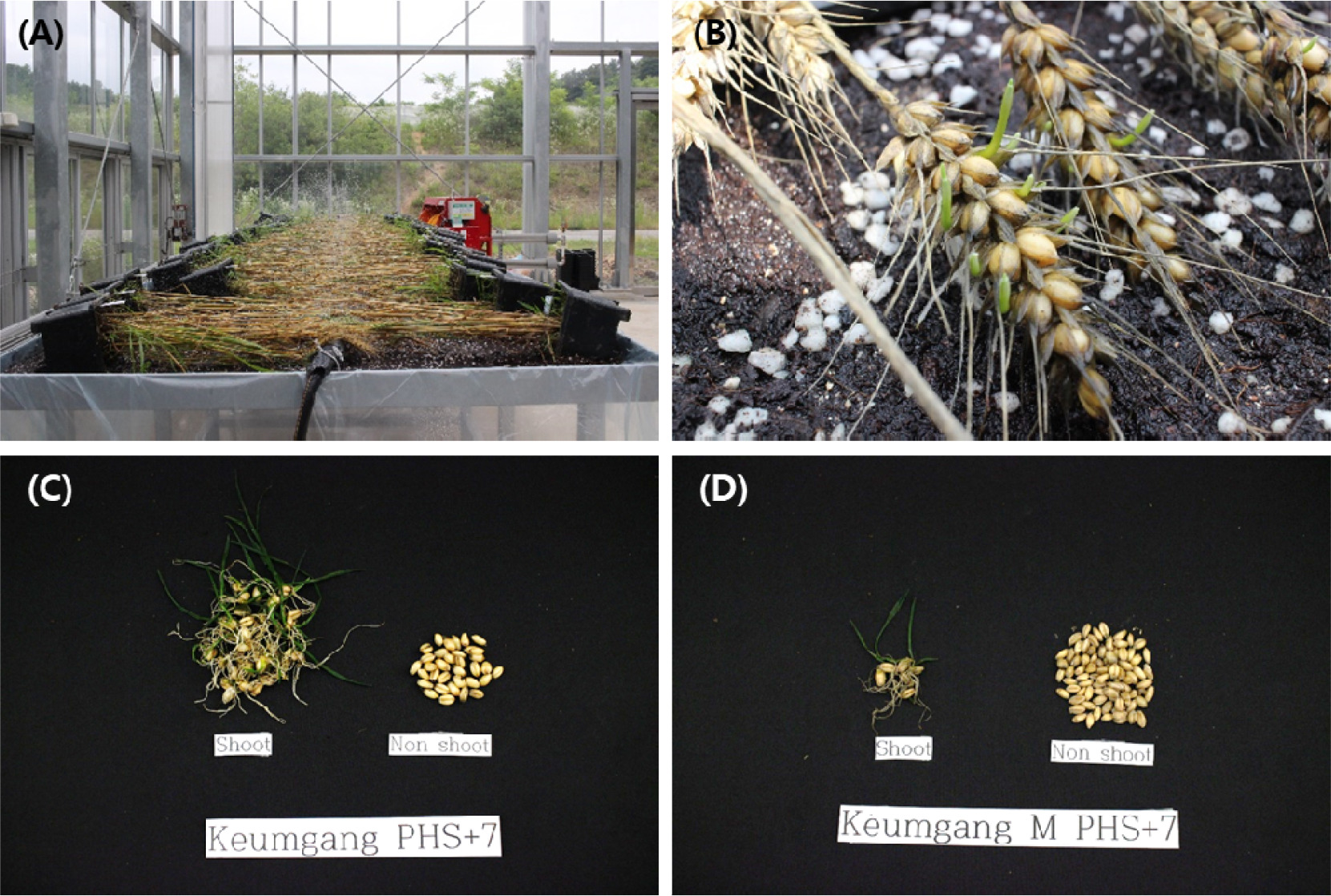
RNA-seq 진행을 위하여 국내 장려품종이자 수발아 감수성인 ‘금강’과 수발아 저항성으로 알려진 ‘전주377호’를 대상으로 수발아 실험을 실시하였다. 실험은 온실에서 진행되었으나 노지 수발아 환경을 최대한 구현하기 위하여
Nakamura et al. (2011)의 실험 방법을 따랐으며 생육 온도는 28°C/15°C으로 조성하였다. 또한 식물체를 실제로 도복 시켜 발아가 적합한 저녁시간(21:00~09:00)의 관수 처리를 통하여 수발아 처리를 실시하였다(
Figs. 1A,
1B) 수발아 처리가 완료된 두 품종에서 임의로 이삭 3수씩을 선정하여 수발아 피해 여부를 판단하기 위해 종자를 이삭에서 분리하여 scoring을 실시하였다. ‘금강’ 총 111개의 종자 중 75개가 발아하여 발아율 67.6%로 수발아에 감수성이 높은 것으로 확인되었다. 반면 ‘전주 377호’는 총 종자 수 81개 중 7개가 발아하여 발아율 8.6%로 확연한 발아 차이를 보여주었다(
Figs. 1C,
1D). 수발아 저항성 적립계 품종인 ‘우리’의 경우 9.4%의 발아율(170종자 중 16개 발아)로 나타내며, ‘전주 377호’와 비슷한 발아율을 나타내었다.
이는 ‘전주 377호’가 모계 품종인 ‘금강’에 비해 수발아 처리시 발아율이 현저히 낮아 지는 것을 확인할 수 있으며, 수발아 저항성 품종인 ‘우리’와 비교하였을 때도 비슷한 양상의 발아율을 보였기 때문에 ‘전주 377호’는 충분히 수발아 저항성 이 높은 특성을 확인할 수 있었다. 이번 연구에서 진행된 수발아 처리는 일반적으로 수발아 검정에 자주 활용되고 있는 모래묻이 검정법(
Baier et al. 1987)과 인공 수조 수발아 실험 결과와 비교하였을 때 비슷한 양상으로 나타났다(
Park 2020,
Lee et al. 2021).
대량 전사체 분석을 위하여 ‘금강’과 ‘전주 377호’를 수발아 처리 후 1일이 경과된 시기를 K1, KM1으로 하였으며, 수발아 처리 후 7일이 경과된 ‘금강’과 ‘전주 377호’ 샘플을 각 K7, KM7로 정하였다.
두 품종 간 수발아 처리 후 서로 차등하게 표현 유전자(DEGs) 탐색 및 관련 유전자의 functional annotation은 4개의 샘플에서 RNA-seq을 통해 생성된 총 326,224,844개의 short reads를 이용하여 분석하였다. Quality 체크와 trimming 소프트웨어인 SolexaQA package의 dynamicTrim을 활용하여 read의 phred score ≥20를 기준으로 cut-off 하였으며 LengthSort data 분석을 통해 Trimming 후 short read length ≥25 bp에 해당되는 데이터를 제외하여 cleaned read 작업을 실시하였다. 각 샘플 별 total transcripts 서열에 cleaned read를 mapping하여 발현 값 계산 및 normalization을 수행하여 최종적으로 4가지 샘플은 평균 85.21% (234,131,980)의 mapping coverage로 해당 샘플에 대한 기능 분석과 DEGs 선발에 나타내는 것을 확인하였다(
Table 1).
Annotation은 이전 연구에서
de novo assemble 분석을 통해 형성되었던 금강 representative transcripts 104,542개를 대상으로 진행하였으며(
Lee et al. 2021), 이 중 발현 값을 가지는 representative transcripts 개수는 91,097 개이고 functional description을 가진 유전자의 개수는 32,786개로 확인하였다. 이를 대상으로 functional annotation analysis를 진행하였으며, transcripts를 이용하여 KOG 39,072 개, KEGG 분석에 8,006 개, Gene ontology 분석에 44,631 개 사용되었다.
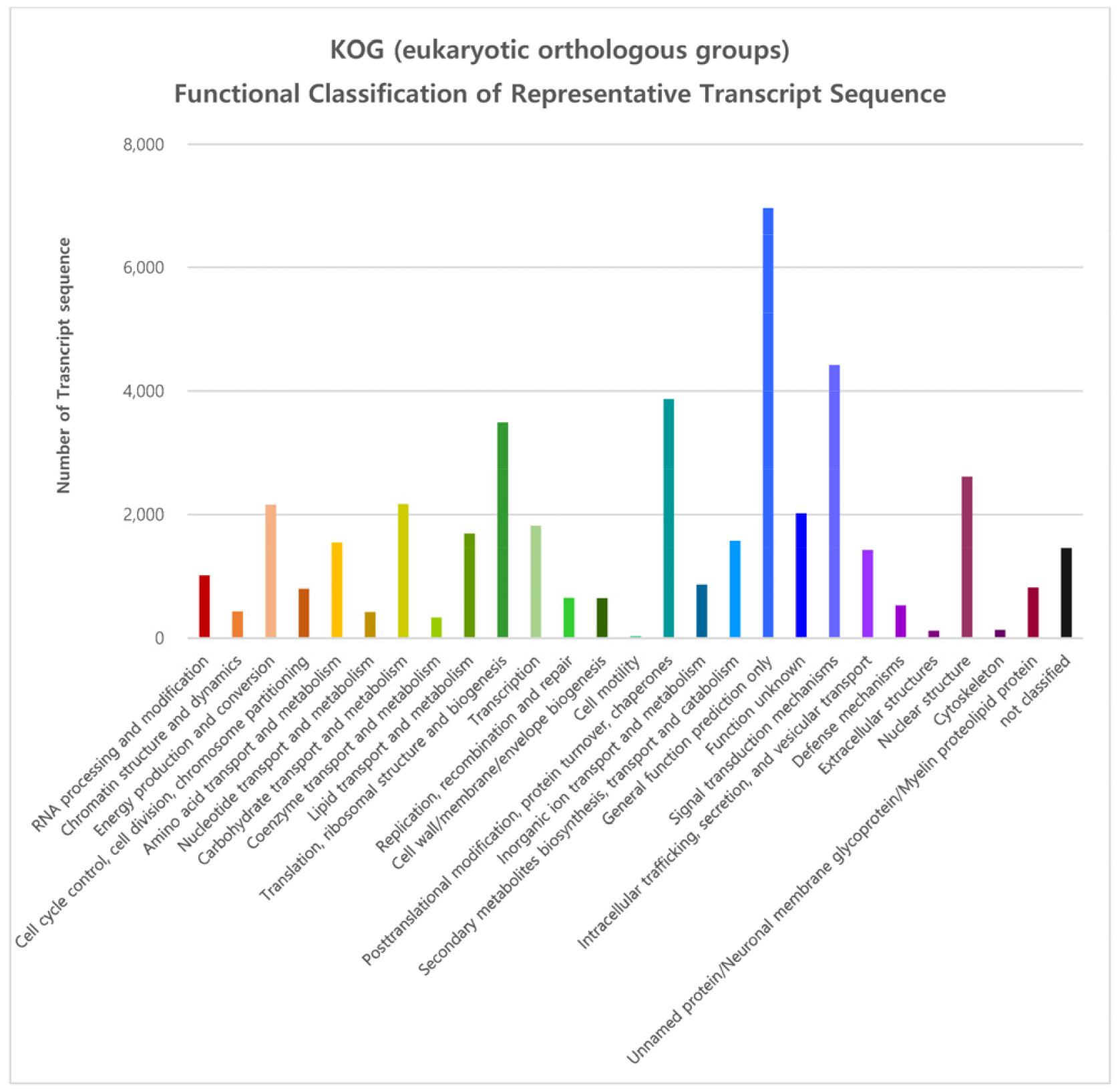
KOG 분석 결과 총 26 항목의 functional annotation이 확인되었으며, 특히 general function prediction only에서 가장 많은 6,969개의 transcripts의 분류되었으며, signal transduction mechanisms (4,420), Posttranslational modification, protein turnover, chaperones (3,868), Translation, ribosomal structure and biogenesis (3,487) 등에 annotation이 47.9%로 절반에 가까운 수치를 나타내었다(
Fig. 2).
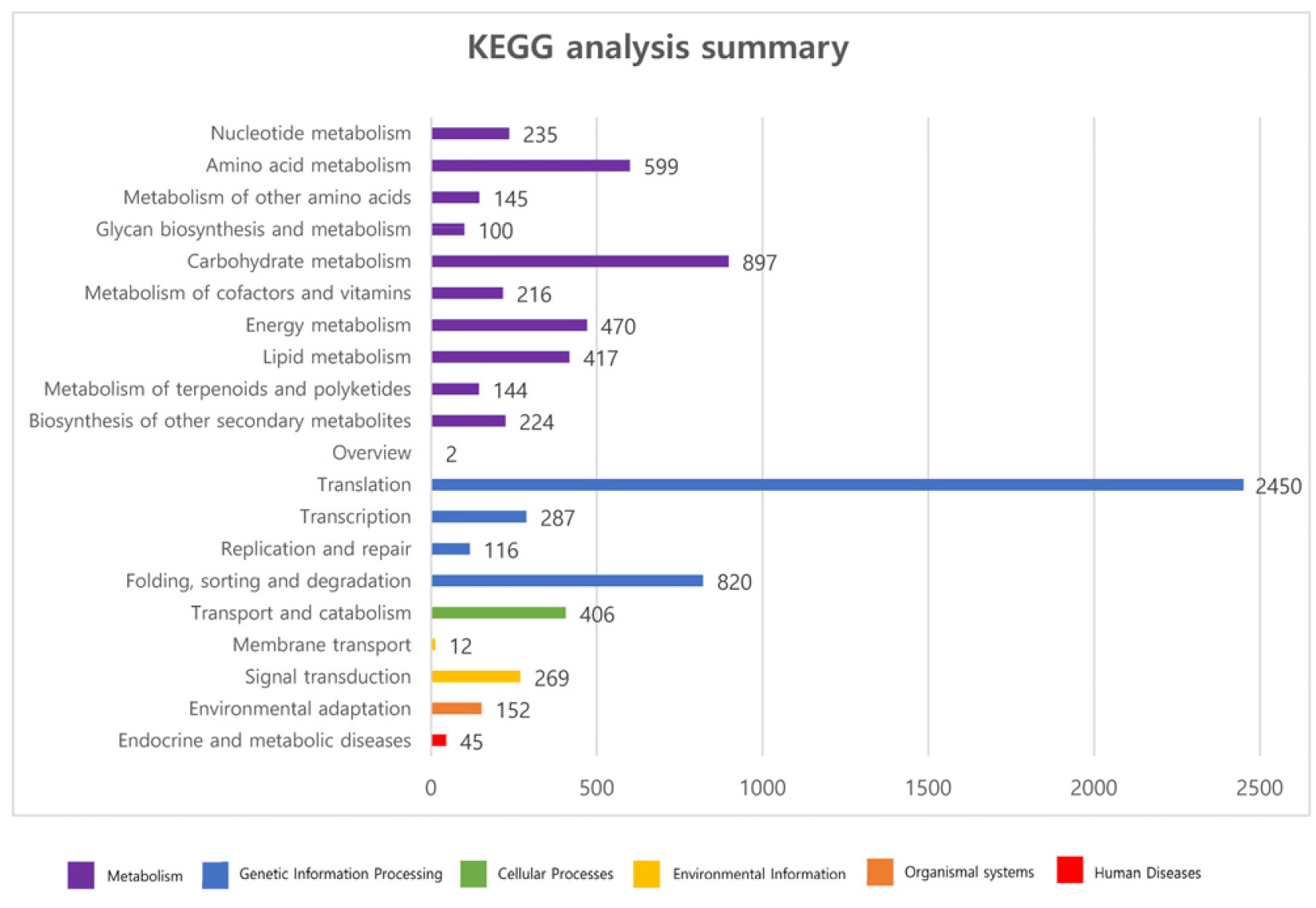
KEGG 분석 결과 Metabolism (3,449), Genetic Information Processing (3,673), Cellular Processes (406), Environmental Information (281), Organismal systems (125), Human Diseases (45)의 6가지 항목으로 크게 나뉘었으며, Genetic Information Processing에서도 Ribosome (1,713), RNA transport (360) 등으로 이루어진 Translation와 Folding, sorting and degradation에 해당되는 Proteasome (215), Protein processing in endoplasmic reticulum (200)과 관련된 transcripts가 주로 확인되었다. Metabolism의 카테고리에서는, 탄수화물 대사(Carbohydrate metabolism), 아미노산 대사(Amino acid metabolism), 에너지 대사(Energy metabolism), 지질대사(Lipid metabolism)와 운송 및 이화작용(Transport and catabolism)의 순으로 많이 확인되었다(
Fig. 3).
KEGG 분석을 통해 RNA의 번역과 단백질 합성에 관련된 transcripts의 탐색과 carbohydrate metabolism에 해당되는 에너지 대사인 ATP 합성과 관련된 대표적인 대사 물질인 glycolysis, TCA cycle 관련 transcripts가 탐색되었으며, 특히 starch and sucrose metabolism과 관련된 transcripts가 발현되는 것을 확인하였다(
Jiang et al. 2015). Glycolysis는 식물 세포에서 에너지 생산을 위한 주요 경로 중 하나이며, 이 경로에 관여하는 핵심 효소는 glyceraldehyde-3-phosphate dehydrogenase- (GAPDH)로 세포 ATP 수치와 탄수화물 대사(carbohydrate metabolism)의 균형 유지에 필수적인 역할을 한다. GAPDH는 glycolysis의 촉매 역할을 하며 벼 종자의 발아 후 GAPDH의 축적이 이루어짐을 확인한 바 있다(
Kim et al. 2009,
Zhang et al. 2017). 탄수화물, 지방, 단백질 대사를 통일하는 핵심 대사 경로인 TCA 회로 또한 멜라토닌(melatonin)에 의한 조절에 따른 에너지 이화작용을 통해 종자 발아에 영향을 미치는 것으로 알려져 있다(
Zhang et al. 2017).
곡물에서의 전분(starch)은 식물의 1차 탄소 저장고 역할을 하며, 발아에 관련하여 중추적인 에너지원으로서 작용한다(
Kossmann & Lloyd 2000). 전분 축적은 종자의 발달(seed development)과 동시에 진행되며, 출수 후(day after fertilization) 35일까지 최대치를 나타내고, 이후 중단되는데, 그 시기에 수발아 발생은 전분 분해에 의한 당 합성을 유도한다(
Olsen 1999,
Olsen 2001,
Sabelli & Larkins 2009,
Sreenivasulu et al. 2010,
Thitisaksakul et al. 2012). 수발아를 포함한 지속적인 비생물적 스트레스는 전분 및 당 관련 대사에 영향을 주어 광합성을 통한 물질 생산에 손상을 주기도 한다. 또한 α-amylase 활성 과도 밀접한 연관이 있어 종자에서의 에너지 공급 및 발아 메커니즘에 중추적인 대사 작용을 한다(
Andreoli et al. 2006,
Detje 2008,
Thitisaksakul et al. 2012,
Kim et al. 2021). 주요하게 탐색된 pathway와 대사작용 및 이화작용 관련 transcripts를 참고하였을 때 수발아 실험에 따른 종자 발아 관련 메커니즘이 활발히 이루어졌음을 확인할 수 있다.
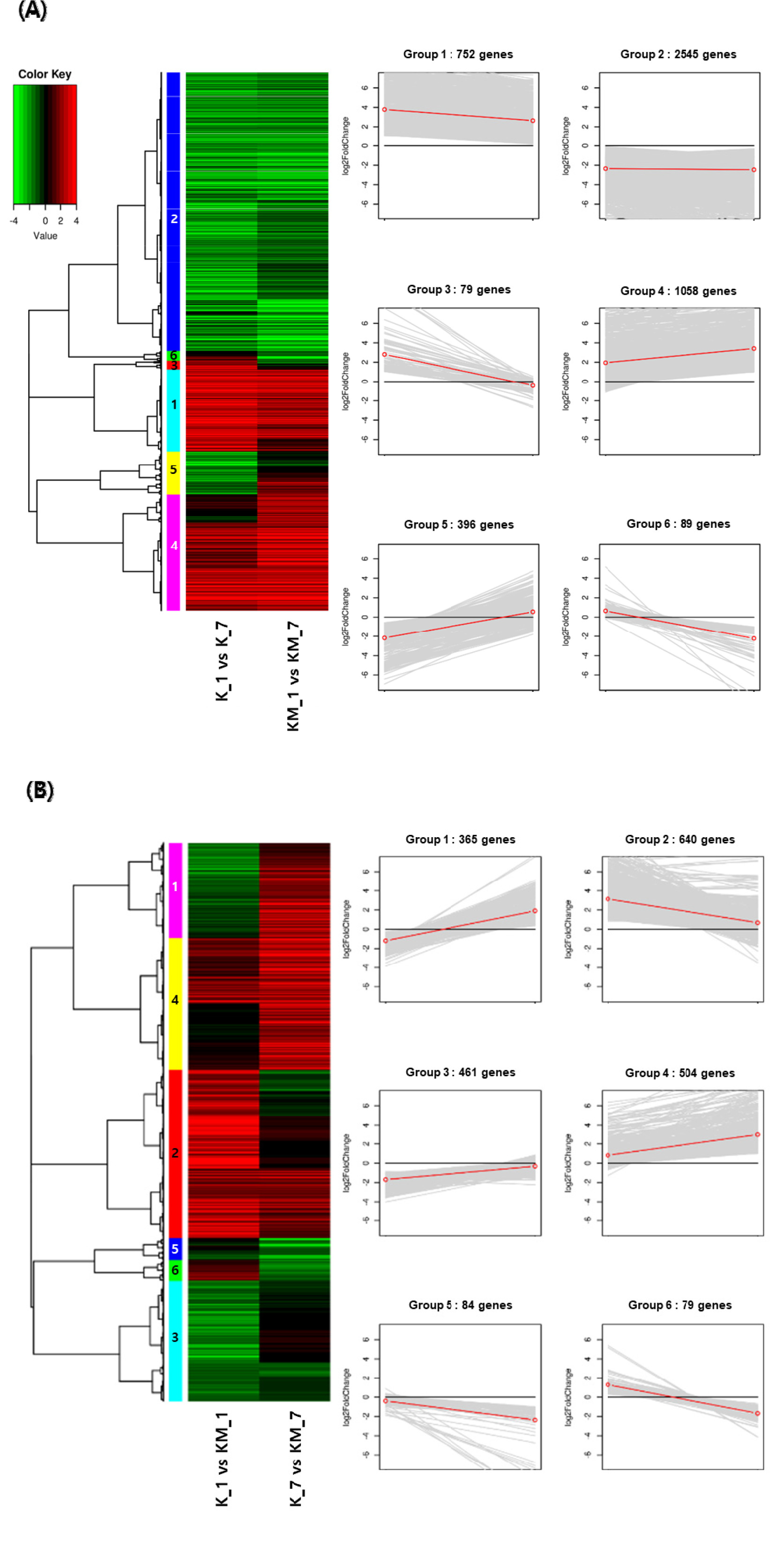
Clustering은 4가지 조건의 샘플을 대상으로 진행되어 두개의 그룹으로 나뉘었다. Cluster setⅠ은 샘플의 처리 시기별 차이를 기준으로 정하였고 유전자 발현 패턴은 K1 vs K7 와 KM1 vs KM7 비교 조합의 순으로 column을 정렬하여 DEGs를 선발하였다. 선발된 유전자 4,919개 유전자를 이용하여 clustering 분석을 수행하였으며 이 중 기능 주석이 달린 DEGs는 3,480개가 확인되었다. Cluster set Ⅱ는 샘플의 동일한 처리 조건에서의 품종 간 차이를 기준으로 분석하였다. Cluster setⅠ과 동일한 방법을 통해 비교 샘플 K1 vs KM1 와 K7 vs KM7 비교 조합 순으로 정렬된 column으로 분석하여 선발된 DEGs 총 2,133개 유전자를 이용하였으며 그 중 1,240개의 annotated DEGs가 선발되었다(
Table 2).
Cluster set I, Ⅱ의 비교 조합 간 데이터 표현은 heatmap을 통해 상대적 발현 값으로 표현되었으며, heatmap에서 표현된 cluster를 line plot을 활용하여 분석한 결과 두 cluster에서 6개의 다른 패턴에 따라 그룹으로 분류하여 표현되었으며 그룹별로 해당 DEGs가 분포되어 있다(
Fig. 4). 특히 Cluster set Ⅱ의 2번째 그룹은 cluster 내에서 가장 많은 분포를 보이는 DEGs (640개)로 구성되어 있으며, 수발아 처리 전 ‘금강’에 비해 ‘전주 377호’에서 유전자 발현이 높게 나타나고 발아 후 발현은 ‘금강’과 비슷한 수준이거나 감소하는 추세를 나타내는 그룹이다. 이는 종자 휴면과 가장 밀접한 관련이 있는 발현 패턴을 보여주고 있다(
Fig. 4B).
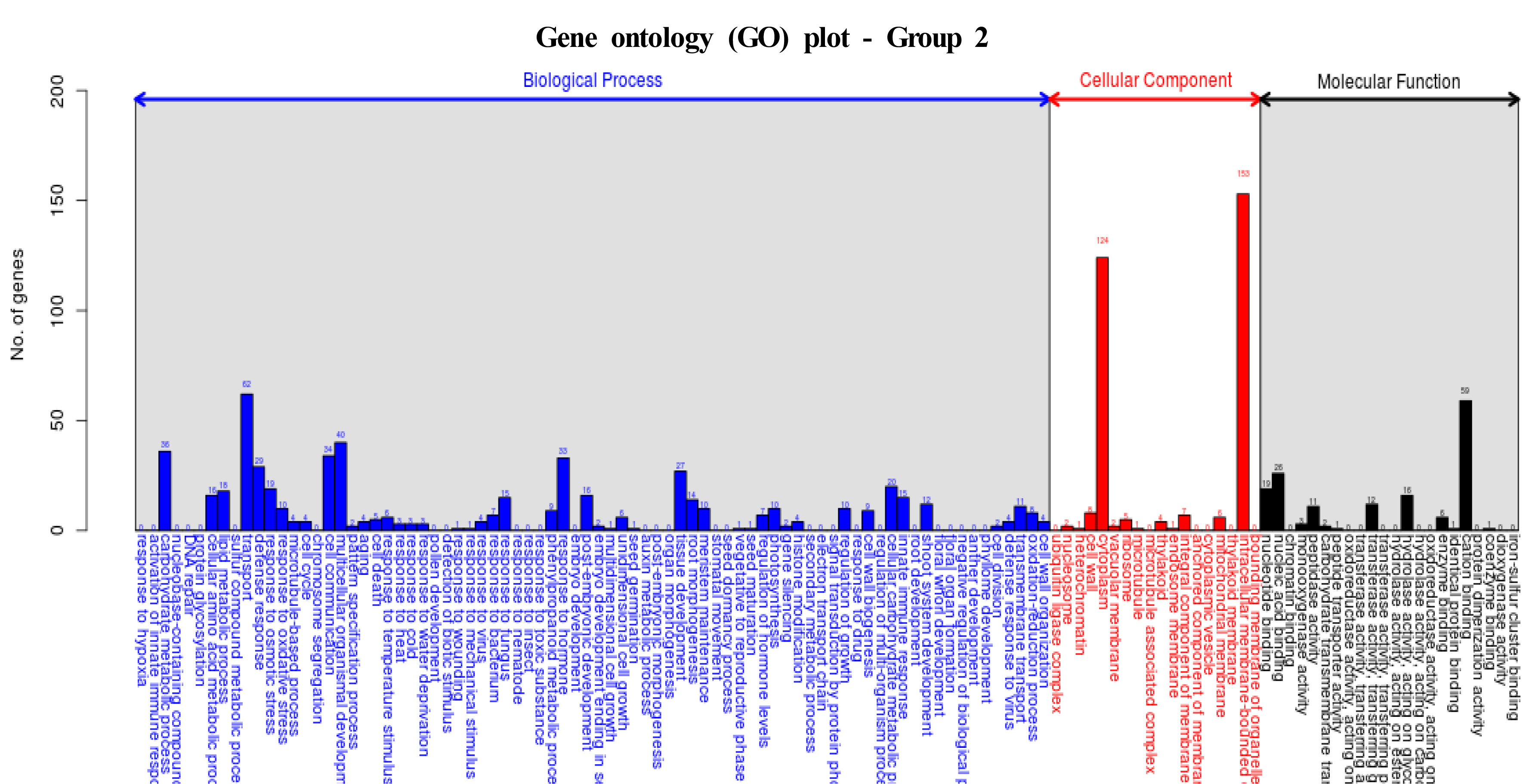
Gene Ontology 분석은 3가지 functional category인 Biological Process (BP), Cellular Component (CC), Molecular Function (MF)의 항목으로 구분하여 분석하였다. K1 vs KM1 와 K7 vs KM7 비교 조합인 cluster Ⅱ에서 수발아 전에 높은 발현을 나타낸 2번 그룹을 대상으로 실시하였다. Cluster Ⅱ에서는 3가지 항목에서 각 78개, 18개, 22개의 GO term을 확인했으나 2번 그룹에 해당되지 않는 GO term은 분석에서 제외하여 BP에서 49개, CC, MF에서 각각 12개의 GO Term으로 표현된 관련 DEGs 총 1,036개를 분석하였다(
Fig. 5). 그룹 2에서는 BP 카테고리에 해당되는 DEGs가 주로 탐색되었는데 특히 종자 발아와 관련된 carbohydrate metabolic process (GO:0005975), cellular carbohydrate metabolic process (GO:0044262)의 탄수화물 대사 유전자 56개와 response to hormone (GO:0009725) 33개로 비교적 많은 유전자를 나타냈는데 이는 KEGG에서 표현된 결과와 비슷한 양상을 보여주었다. 그 외에도 종실의 수분 흡수와 관련된 response to osmotic stress (GO:0006970), shoot system development (GO:0048367)에서 각각 19개, 12개의 DEGs가 확인되었다. 이 중 종자 휴면과 발아와 관련된 기능인 embryo development ending in seed dormancy (GO:0009793)에서 2개 의 DEGs를 탐색하였으며, seed germination (GO:0009845)에 해당되는 DEG로 기존 수발아 연구에서 휴면 기작을 통해 저항성 유전자로 인정 받는
MFT 유전자가 유일하게 그룹 2에서 확인되었다.
CC 카테고리에서는 세포와 세포질과 관련된 intracellular membrane-bounded organelle (GO:0043231)와 cytoplasm (GO: 0005737)의 GO term이 두드러지게 분포하였는데, 알려진 바에 따르면 종자에서는 단백질 저장 배액(protein storage vacuoles; PSV)이라고 불리는 세포 소기관(membrane-bounded organelles)에 단백질을 저장하며 배아에서 형태학적, 기능적 재구성을 통해 씨앗 발달 중에 형성된다(
Feeney et al. 2018,
Kusumaatmaja et al. 2021). Molecular function (MF)에서는 다른 두 카테고리에 비하여 유전자의 분포가 적게 나타났다. 59개 유전자는 cation binding (GO:0043169)과 연관 있으며 핵산 결합과 관련된 nucleic acid binding (GO:0003676), nucleotide binding (GO:0000166)는 45개의 유전자가 분포하는 것을 확인하였다. 또한 MF 카테고리 중 hydrolase activity, acting on glycosyl bonds (GO:0016798), transferase activity, transferring glycosyl groups (GO:0016757)도 GO term에 탐색되었다. Glycosyl groups은 탄수화물 합성의 다양한 매개체로서의 역할을 하며 최근 대사작용 및 효소 결합, 약물 분자학에서도 관심을 갖고 있다(
Roy et al. 2016). 식물과 종자 발달 과정에서의 glycosyl group 중 하나인 glycosyltransferase는 uridine diphosphate glucose (UDP-glucose)에 의해 촉매되는데 이는 식물 발아와 큰 관련이 있다(
Mock & Strack, 1993). UDP-glucose:sinapate glucosyltransferase (SGT) 효소 활성에 의해 생성된 1-
O-sinapoylglucose는 종자 발달 과정에서 sinapoylcholine으로 가수분해되어 세포 내 효소 반응을 일으킨다(
Shirley & Chapple 2003). 이러한 과정은 궁극적으로 발아에 영향을 주는 것으로 알려져 있으며(
Milkowski & Strack 2010,
Roy et al. 2016) 이는 모델 식물인 애기장대(
Arabidopsis)와 십자화과인 유채(
Brassica napus)에서도 확인한 바 있다(
Milkowski et al. 2000,
Meißner et al. 2008). Cluster Ⅱ에서 총 17개의 UDP-glucose 관련 DEGs를 확인하였으며, glycosyl groups 과 UDP-glucose의 상관 관계를 고려하였을 때 종자 발달과 발아에 깊은 연관이 있다고 판단된다. 상기 언급된 유전자 기능 별 주요 카테고리와 해당 DEGs는
supplementary Table 1에 자세히 정리하였으며, 종자 휴면과 밀접한 연관이 예상되는 amylase와 UDP-glucose 관련 DEGs를
supplementary Table 2에 나열하였다(
Supplementary Table 1,
Supplementary Table 2).
후보 DEGs 선발은 종자 휴면에 대해 중점적으로 탐구하기 위해 진행되었으며 품종 간 발현 비교를 보기 위해 분석된 Cluster Ⅱ를 대상으로 발아 전 상태인 K1 vs KM1에서 up regulation log2 Fold change 3 이상, down regulation log2 Fold change 1.5 이하로 cut-off를 정하였다. DEGs 선발은 총 2,135개의 assembled transcripts를 대상으로 up-regulation 290개, down-regulation 296개를 선별하였으며, 이 중 gene description, E-value 값이 없는 DEGs 및 중복 DEGs를 제외하였다. Blast 분석을 통해 partial이 아닌 95% 이상 일치하는 유전자 중 보통밀(
Triticum aestivum)이나 애기장대(
Arabidopsis thaliana)의 TAIR 및 근연종인 벼(
Oryza sativa)의 gene description 정보를 기반으로 K1 vs KM1 up-regulation 35개, down-regulation 26개를 선발하여 RT-PCR을 수행하였다. 위와 같은 기준으로 압축된 후보 DEGs군은 크게 두가지 패턴의 유의미한 발현 양상을 보이는 것으로 확인되었으며 총 18개의 후보 DEGs를 최종 선정하였다(
Table 3). DEGs 발현 검정에 사용된 프라이머는 RNA-seq의 assembled total transcript 파일을 기반으로 EnsemblPlants blast search program (
https://plants.ensembl.org/index.html)에서 수집하여 디자인하였다.
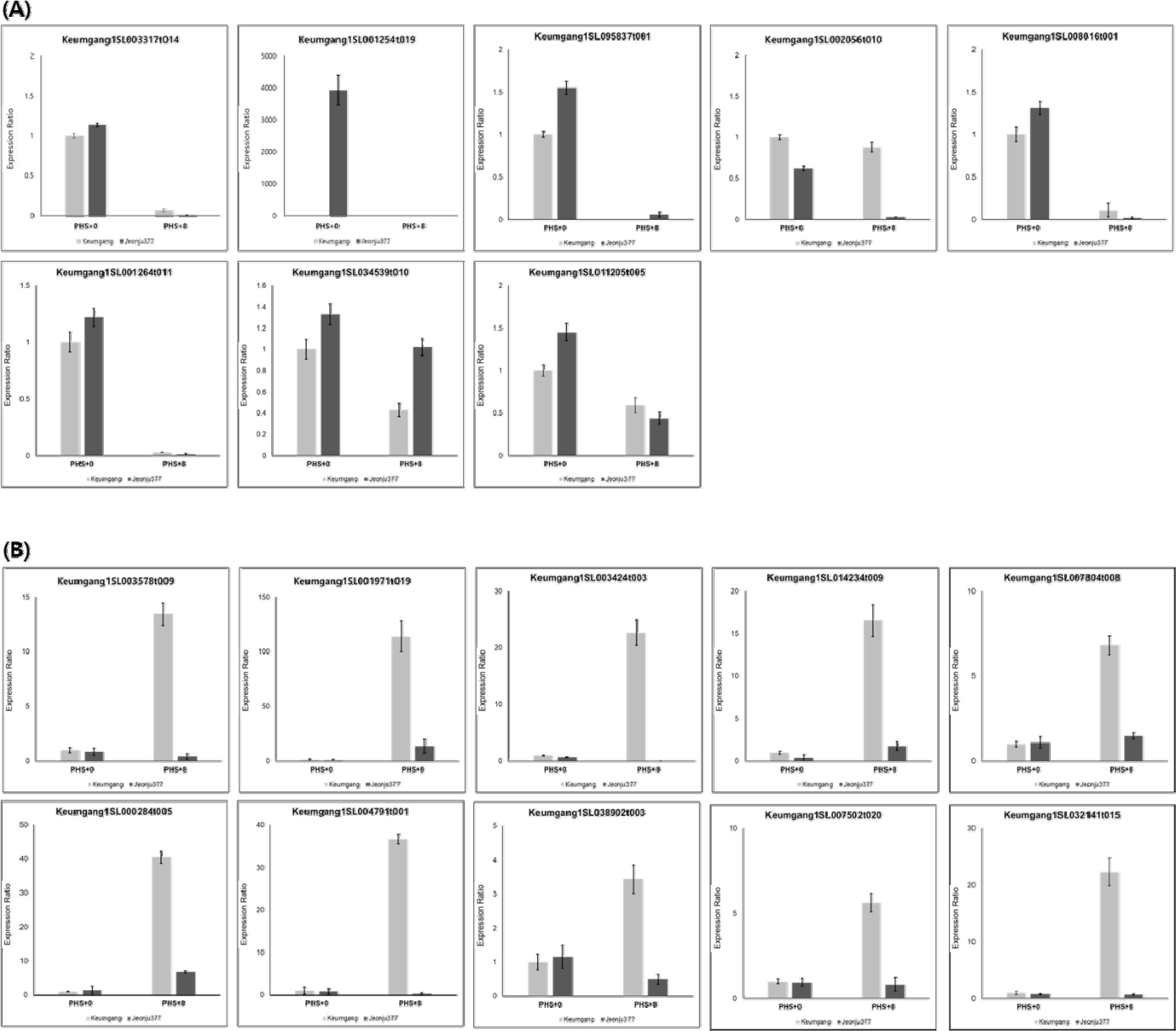
qRT-PCR을 활용한 발굴 후보 유전자의 발현 프로파일링 검정 결과 종자의 초기 발달과 발아에 영향을 주는 탄수화물 및 단백질 가수분해 관련 유전자와 휴면에 관련된 유전자가 다수 확인되었다. 크게 KM1이 K1에 비해 높은 발현을 나타내는 DEGs군과 K7에서 발현 패턴이 높게 나타나는 DEGs군으로 나뉘었다.
KM1이 높게 발현된 DEGs군 중 β-amylase (Keumgang1SL0012 54t019)는 종자 발아에서 가장 빠르게 발현되는 유전자 중 하나로서 전분 가수분해에서 1차적으로 작용하여 α-amylase의 발현이 높아지는 것으로 보고되고 있다(
Goswami et al. 1977). 이는 β-amylase는 효소 활성을 조절하는 이항력(diastic power) 조절자로서의 역할을 수행하기 때문이며 종자 발달 동안 축적되어 종자 활력에 영향을 미친다(
Giese & Hejgaard 1984, Ziefler 1999) 쌀과 보리의 배유에서의 발현을 확인한 바 있으며(
Bilderback 1974,
Okamoto & Akazawa 1979, Sricastava & Kayastha 2014) 밀 배반(scutella)에서도 발아 초기 α-amylase보다 더 중요한 역할을 하는 것으로 나타났다(
Nandi et al. 1995). 특히 쌀의 초기 발아 중에 급격히 증가하였다가 이후 감소되는 것으로 보고된 바 있는데(
Okamoto & Akazawa 1980) 이는 β-amylase (Keumgang1SL0012 54t019)의 qRT-PCR 발현 양상과 일치하였으며 ‘전주377호’의 KM1 샘플에서 β-amylase의 발현이 K1 샘플보다 높은 이유는 ‘금강’의 초기 종자 발아 기작이 더 빠르기 때문에 K1 β-amylase 발현이 이미 감소한 것으로 추론된다. 또는 β-amylase는 8시간 이내에서 합성되어 역할을 수행하는 것으로 수발아 감수성인 ‘금강’의 경우 활발한 발현 후 감소하였으나, ‘전주377호’에서는 β-amylase 활성이 24시간이 지난 시점에서도 여전히 발현이 높은 것으로 보아 β-amylase 활성 시기가 종자 발아 정도에 따라 다를 것으로 예상된다.
MOTHER OF FT AND TFL1 (Keumgang1SL002056t010;
MFT)는 식물에서 phosphatidylethanoamine-binding protein (PEBP) 유전자군 속하며 주로 종자 발달 및 발아에서 기능하는 것으로 알려져 있다(
Chardon & Damerval 2005,
Tao et al. 2014). 수발아와 종자 휴면 관련 양적형질유전자좌(QTL; Quantitative Trait Loci)는 모든 염색체의 다수의 위치에서 보고되고 있으며 특히 염색체 3AS와 4AL에서 주동 QTL이 확인되었고(
Kato et al. 2001,
Mori et al. 2005) 그 중 QPhs.ocs-3A의 후보 유전자가
MFT로 밝혀지면서 품종 간 프로모터 영역 내의 SNP 차이로 인한 발아 지연을 확인한 바 있다(
Nakamura et al. 2011). 또한 수발아 처리에 따른 식물생장호르몬 생합성(synthesis) 및 신호전달(pathway) 분석은 수발아에 대한 주요 요인이 ABA 및 ABI에 의한 조절을 제시한 바 있다(
Lee et al. 2021).
MFT의 qRT- PCR 발현이 K1에서 KM1보다 높게 나타나는데(
Fig. 6A), 이 결과는
MFT는 종자 발아보다 휴면에 직접적인 영향을 나타내는 유전자이기 때문에 ‘전주 377호’에서는 또 다른 메커니즘이 관여했을 것으로 사료된다.
또다른 ABA 관련 유전자인 Tubby F-box like protein (Keumgang 1SL034539t010; TLP)은 다양한 진핵생물에서 자주 발견되며 C-말단 영역에 있는 Tubby 도메인을 가지고 있는 것이 특징이다(
Kleyn et al. 1996, Liu 2008,
Zhang et al. 2020). 모델 식물체인 애기장대와 벼에서 각각 11개, 14개의 TLPs family를 확인하였으며 그 중 애기 장대의
AtTLP9는 염과 한발 스트레스 반응에 관여함을 확인하였을 뿐만 아니라
AtTLP3와
AtTLP9 사이에서 중복적으로 ABA와 삼투압 반응에 관여하는 것 밝혀진 바 있다(
Lai et al. 2004,
Liu 2007). 최근 오이
CsTLP8를 애기장대에 도입된 과발현(overexpression) 검정을 통해 ABA 정도에 따른 기공 폐쇄가 민감하게 반응하는 것을 확인하였는데 이는 삼투압 스트레스에 의한 종자 발아를 조절을 확인할 수 있었으며 추가로 진행된 yeast two hybrid system을 통해
CsTLP8이 SCF complex (SKP-Cullin- F-box containing complex) gene인
SKP1과의 상호작용을 확인하였다(
Li et al. 2021).
CULL1과 F-box 단백질을 연결하는 핵심 성분인
TaSKP1은 SCF 복합체(SCF complex)를 구성하며 세포 주기 조절, 스트레스 반응, 신호 전달, 대사 조절, 세포 분화 등 다양한 세포 과정에 중요한 역할을 수행한다(
Moon et al. 2004). 최근 F-box 단백질이 자스몬산 신호(jasmonate signaling), 꽃 형태, 잎 노화 등 식물의 전반에 걸친 SCF 대사경로 연구가 활발하다(
Hershko & Ciechanover 1998,
Moon et al. 2004, Hong et al. 2013). 밀의 경우 F-box 유전자에 대한 게놈 기반 연구는 복잡한 유전자 구조와 17 Gb의 밀 게놈 사이즈로 어려웠으나 최근 Tubby F-box like protein이 포함된 F-box family에 대한 연구가 이루어져 있는데 애기장대, 벼 등과 마찬가지고 가뭄 내성, 개화 등에 관여하며 특히 DEGs Clustering 패턴에 따라 구성된 결과 종자 발달 단계에서 높은 발현을 나타내었다(
Hong et al. 2020).
Sucrose는 수용성 이당류로 탄수화물 분배를 위한 에너지원 역할과 광합성에 의한 주요 생산물 중 하나이며 식물의 초기 발달과 비생물적 스트레스 반응에도 관여한다(
Lastdrager et al. 2014,
Navabpour & Jalali 2019). 특히 체관부에서의 당 수송의 필수적인 역할을 하는 동시에 식물의 성장 및 저장 단백질 합성에 관여하는 Sucrose Transporter (Keumgang1SL011205t005;
SUT) 역할은 매우 중요하다(
Aoki et al. 2006).
SUT에 의해 촉매되는 운반체
SUC는 turgor-gated mechanism에 영향을 주며 압력에 따라 종자 내 양분 흡수 제어 역할을 수행한다.
SUC의 발현으로 세포내 압력이 높아져 아포플라즘의 용질 농도가 높아지면 양분 방출에 관여하는 운반체를 활성화시켜 발아가 지연되는 것으로 알려져 있다(
Ayre 2011). 마찬가지로
SUC를 조절하는
SUT 또한 sink to source transition의 대사작용과 함께 조절되며 이로 인해 단백질 축적 조절과 조숙한 발아를 방지하는데 관여한다고 알려져 있으며(
Wolswinkel 1992) 유채에서 종자 발달 초기에 전분과 지방의 축적에도 영향을 주는 것으로 확인하였다(
Li et al. 2011).
SUT/SUC 에 의한 Membrane-Transport Systems은 종자 발아에서 주요한 영향을 줄 것으로 예측되며 추후 초기 생육과 발아에 필수적 역할을 하는
SUT 관련 유전자를 대상으로 수발아 및 휴면에서의 연관성 검증이 필요할 것으로 판단된다. 선행연구에서
MFT와
SUT은 서로 상호 결합하는 단백질이므로
MFT와
SUT가 같은 발현 양상을 보이는 DEGs로 선발된 것으로 보아 DEGs 선발과 분석이 제대로 수행되었다고 판단한다(
Park 2020).
같은 양상의 발현 패턴을 보여주는 DEGs인 Keumgang1SL 003317t014, Keumgang1SL095837t001, Keumgang1SL008016t001, Keumgang1SL001264t011에 대한 연구도 추가적으로 이루어져야 할 것으로 보여진다.
반면 K7에서 발현이 증가된 DEGs군의 Starch branching enzyme (Keumgang1SL003578t009;
SBE)은 ‘금강’의 K7에서 발현이 높은데 이는 수발아가 빠르게 진행되고 있음을 보여준다(
Fig. 6B). SBE는 구조적으로 α-amylase superfamily에 속하며, 전분의 대사 조절에 관련된 고유 영역의 아미노산 서열을 포함하고 있다(
Tetlow & Emes 2014). 그렇기 때문에
SBE의 발현은 α-amylase가 종실에 저장된 전분을 충분히 작용할 수 있게 만든 것이며(Xia et al. 2011) ‘금강’의 K7에서
SBE의 발현이 높은 이유는 수발아에 대하여 감수성 임을 간접적으로 나타낸다.
Zinc finger protein (Keumgang1SL007502t020) 도메인은 비교적 작은 단백질 모티브로, 표적 분자와 탠덤(tandem) 접점을 만드는 여러 개의 손가락 모양의 돌기가 있으며 DNA 인식, RNA packing, 전사 활성화, 단백질 접힘 및 조립, 지질 결합 등의 역할을 수행한다고 알려져 있다(
Lin et al. 2011). Zinc finger protein 모티브의 많은 슈퍼 패밀리가 있으며, 순서와 구조 모두 다양하다(
Klug 1999,
Matthews & Sunde 2002,
Brown 2005,
Hall 2005, Gamsiaeger et al. 2007). Zinc finger protein은 애기장대에서 CCH zinc finger protein 관련 유전자
AtTZF1,
AtTZF4,
AtTZF5,
AtTZF6가 부분적으로 ABA와 GA 대사를 조절하여 종자 발아에 관여하는 것을 확인하였으며(
Lin et al. 2011,
Bogamuwa & Jang 2013). 벼에서도
OsTZF1가 종자 발아를 억제하는 것으로 나타났다(
Jan et al. 2013). 밀의 경우 본 연구에서 확인된 C3HC4 유형은 아니지만 최근 같은 family인 CH3 유형에서 연구가 진행된 바 있으며 zinc finger protein CH3 식물의 성장과 발육을 조절하는 데 중요한 역할을 하며 애기장대나 벼에서 생물학적/비생물학적 스트레스 반응을 조절하는 것으로 알려져 있다(
Li & Thomas 1998). 애기장대 zinc finger protein CH3 의 88개 유전자를 도입한 밀을 대상으로 수발아 처리하여 발현 검정을 실시하였으며 전사체 데이터, qRT-PCR, ABA 반응 분석을 통해 발아 억제 유전자 3개(
TaC3H4/
-18/
-72)와 발아를 상향 조절하는 2개 유전자(
TaC3H37/
-51)가 종자 휴면과 발아에 밀접한 관련이 있는 후보 유전자로서의 가능성을 시사하였다(
Cheng et al. 2020). 그 외 동일한 발현 양상을 나타내는 Keumgang 1SL001971t019, Keumgang1SL003424t003, Keumgang1SL014234t009, Keumgang1SL007804t008, Keumgang1SL000284t005, Keumgang 1SL004791t001, Keumgang1SL038902t003, Keumgang1SL000284t005의 수발아 및 휴면 연관성에 대한 유전자 연구가 지속적으로 이루어져야 할 것으로 보인다.
적 요
밀은 지역에 국한되지 않고 세계적으로 널리 소비되고 있는 식량 작물로 다양한 식료품의 원재료로 사용되고 있다. 특히 국내에서의 밀은 1990년 대부터 현대에 이르기 까지 1인당 소비량이 감소세 없이 소비되는 작물로 국내에서도 식량작물로서의 매우 중요한 위치에 자리잡고 있다. 하지만 밀 경작지의 급격한 감소와 자급률의 한계로 인한 불안은 여전히 지속되고 있고 있으며, 최신 지구온난화로 인한 이상 기후와 불안정한 국제 경제 시황은 식량안보에 큰 위협으로 다가오고 있다. 특히 전 세계적으로 이상기후로 대표적 수분 장해인 수발아의 발생이 빈번해지며 식량으로서 밀의 가치를 손상시키는 요인 중 하나이다.
본 연구에서는 국내 장려 품종 ‘금강’과 수발아에 강한 특징을 보이는 돌연변이 계통 ‘전주 377호’를 수발아 처리한 샘플을 대상으로 RNA-seq을 통해 mapping된 234,131,980 개의 reads를 활용하여 유전자 기능 주석과 DEGs 분석을 실시하였다.
De novo assembly를 통하여 조립된 transcript를 대상으로 KOG 및 KEGG 분석을 진행하였으며 탄수화물 대사, 종자 내 에너지 공급 및 발아 메커니즘에 중추적인 전분 및 당 분해 대사 등이 주로 나타나는 것을 확인하였다. 또한 GO 분석을 통해 탄수화물 대사와 식물에서 종자 발달 과정에 관여되는 glycosyl group의 uridine diphosphate glucose와 관련된 DEGs 총 21개를 Cluster Ⅱ에서 확인하였다.
탐색된 DEGs를 대상으로 형성된 cluster 별 분석으로 종자 휴면과 밀접할 것으로 예측되는 후보 DEGs를 선발하였으며, 발현 검정을 통하여 수발아에 의한 종자 내 생물학적⋅화학적 기작을 분석 하였다. 특히 종자 휴면에 관련된 MFT의 경우 지속적인 연구를 통해 종자 발아와 휴면 관련 메커니즘 구명이 필요하며 기존에는 잘 알려지지 않거나 다른 기능으로 알려진 유전자 Tubby F-box like protein, Zinc finger protein family, SUT 등은 종자 발아(seed germination)와 종자 휴면성(seed dormancy)의 관점으로 활발한 연구와 증명이 이루어져야 할 것으로 사료된다.
본 연구를 기초 자료로 활용하여 종자 발아와 휴면 간 메커니즘 이해와 유전적 요인을 파악한다면 미래 농업에서의 밀의 가치는 더욱 높아질 것으로 판단된다.
보충자료
사 사
본 논문은 농촌진흥청 연구사업(과제명: 수발아 저항성 밀 육종소재 개발, 과제번호: PJ016528012022)에 의해 이루어진 것임
Fig. 1Pre-harvest sprouting induction experiment for RNA-seq analysis. (A) An artificial environment was provided to maintain optimal conditions for PHS induction. (B) The PHS induction experiment caused early germination of ‘Keumgang’. (C) Confirmation of germinated seed rate in ‘Keumgang’ Day after PHS+7. (D) Confirmation of germinated seed rate at Day after PHS+7 of ‘Jeonju 377ho’.
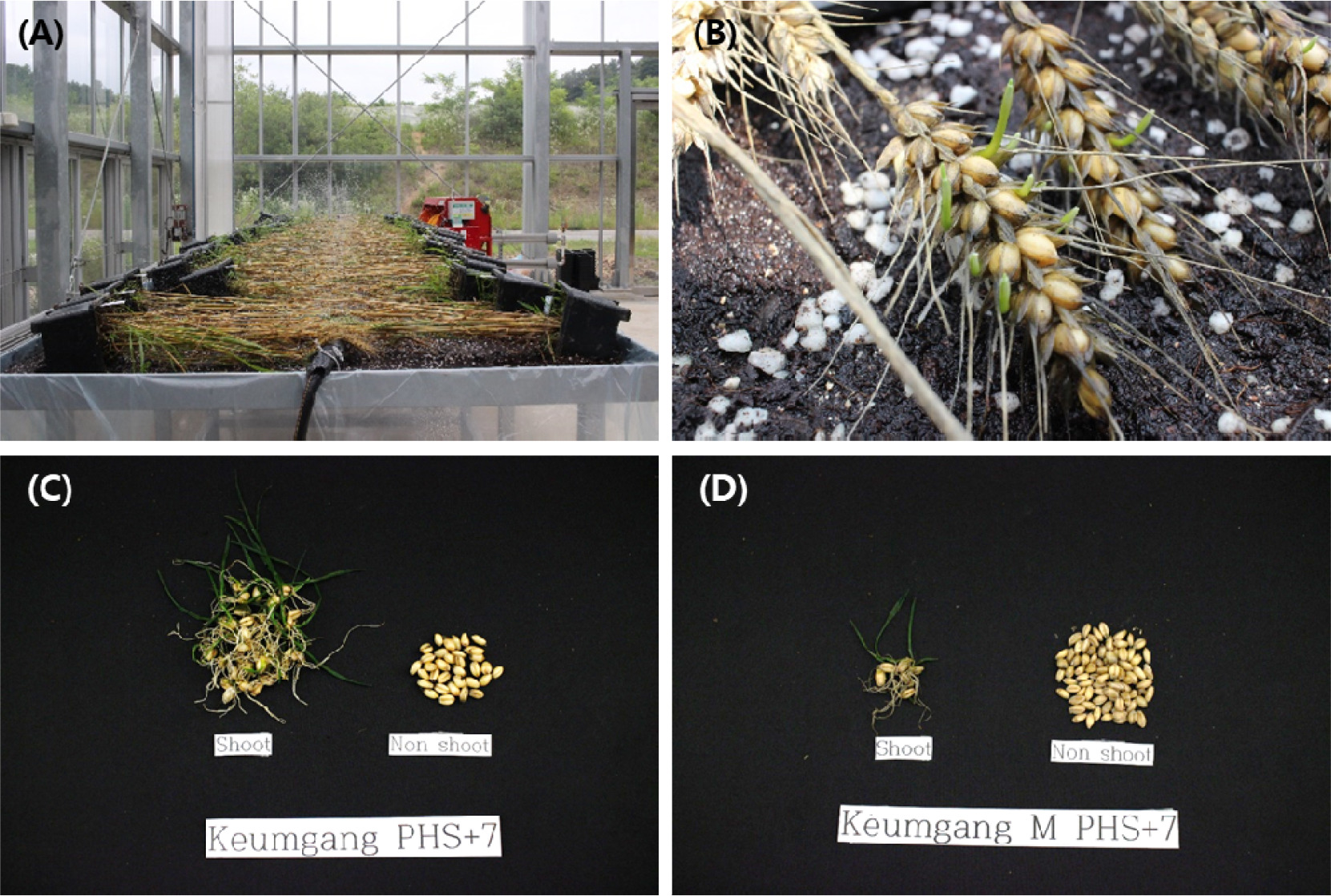
Fig. 2Functional annotation classification was shown using KOG (eukaryotic orthologous groups) analysis based on representative transcripts. As a result, a total of 26 functions were identified.
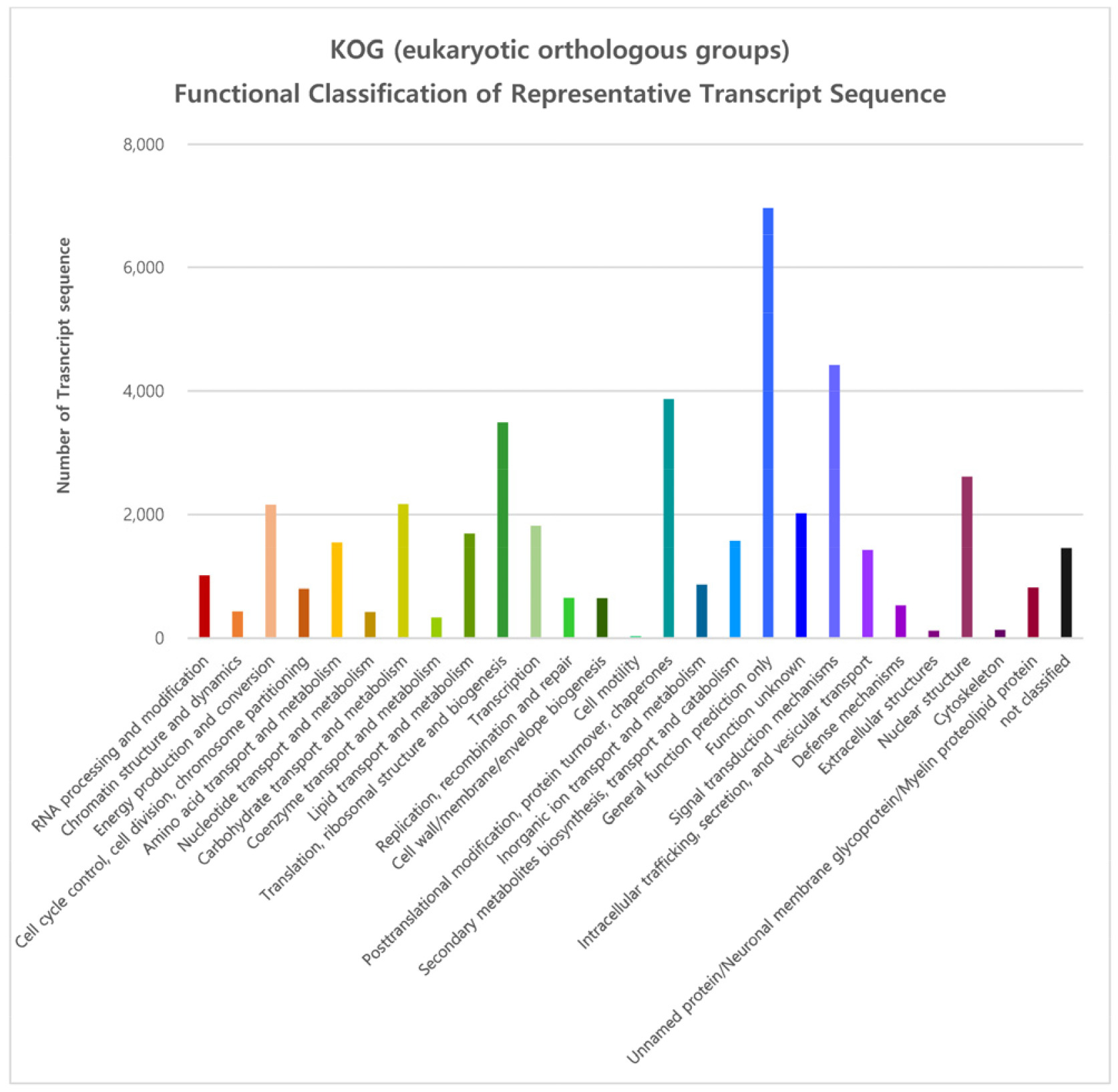
Fig. 3Analysis metabolism and pathways were confirmed through KEGG (Kyoto encyclopedia of genes and genomes) analysis targeting representative transcripts.
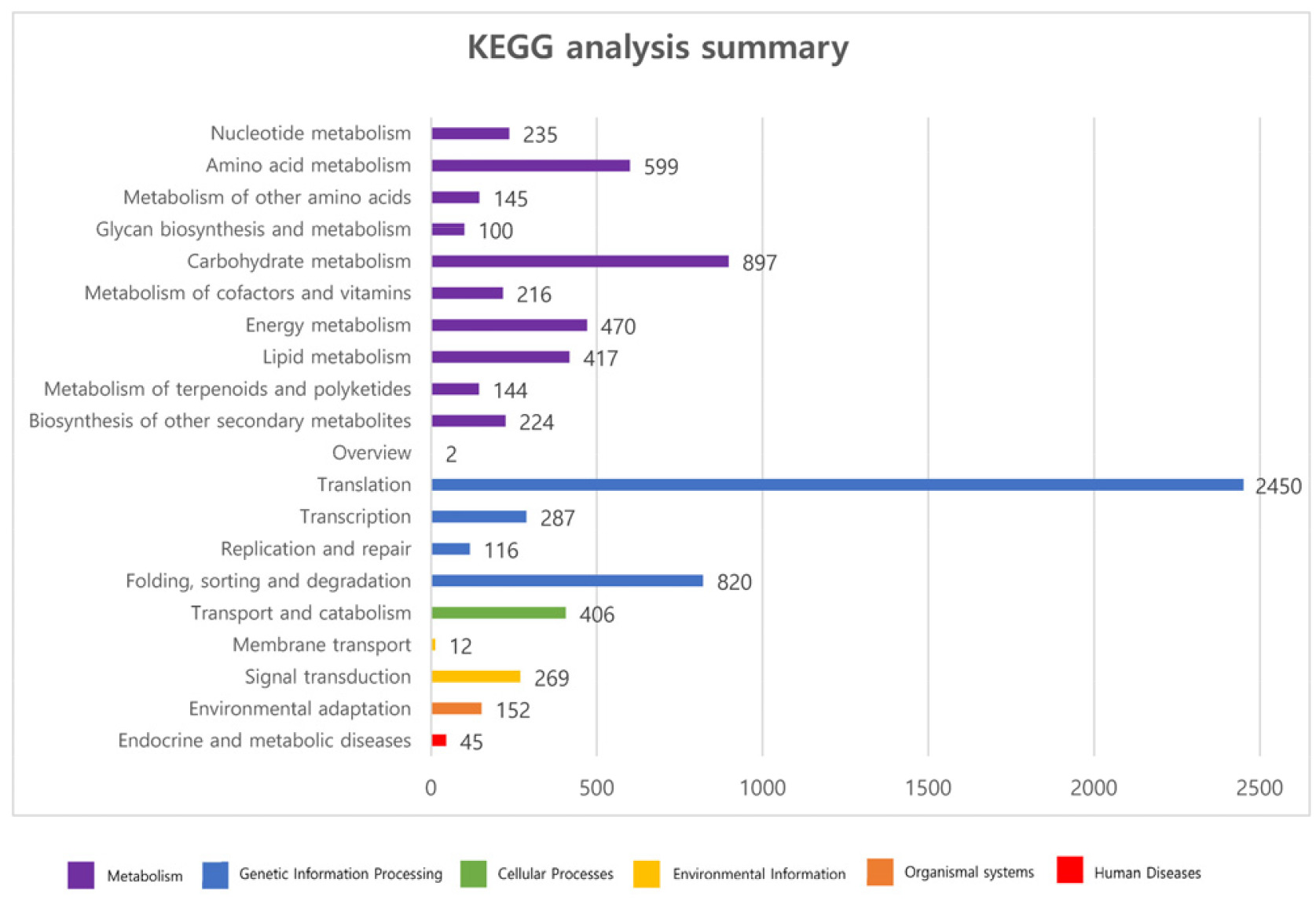
Fig. 4Heatmap and line plot analysis for cluster sets I and Ⅱ. (A) The expression patterns for PHS treatment of Keumgang (K_1 vs K_7), Joenju 377ho (KM_1 vs KM_7) were compared and analyzed, and each showed six expression patterns. (B) The differences in expression between cultivars caused by PHS treatment before and after (K_1 vs KM_1 and K_7 vs KM_7) were compared and analyzed, and each of the six expression patterns was shown.
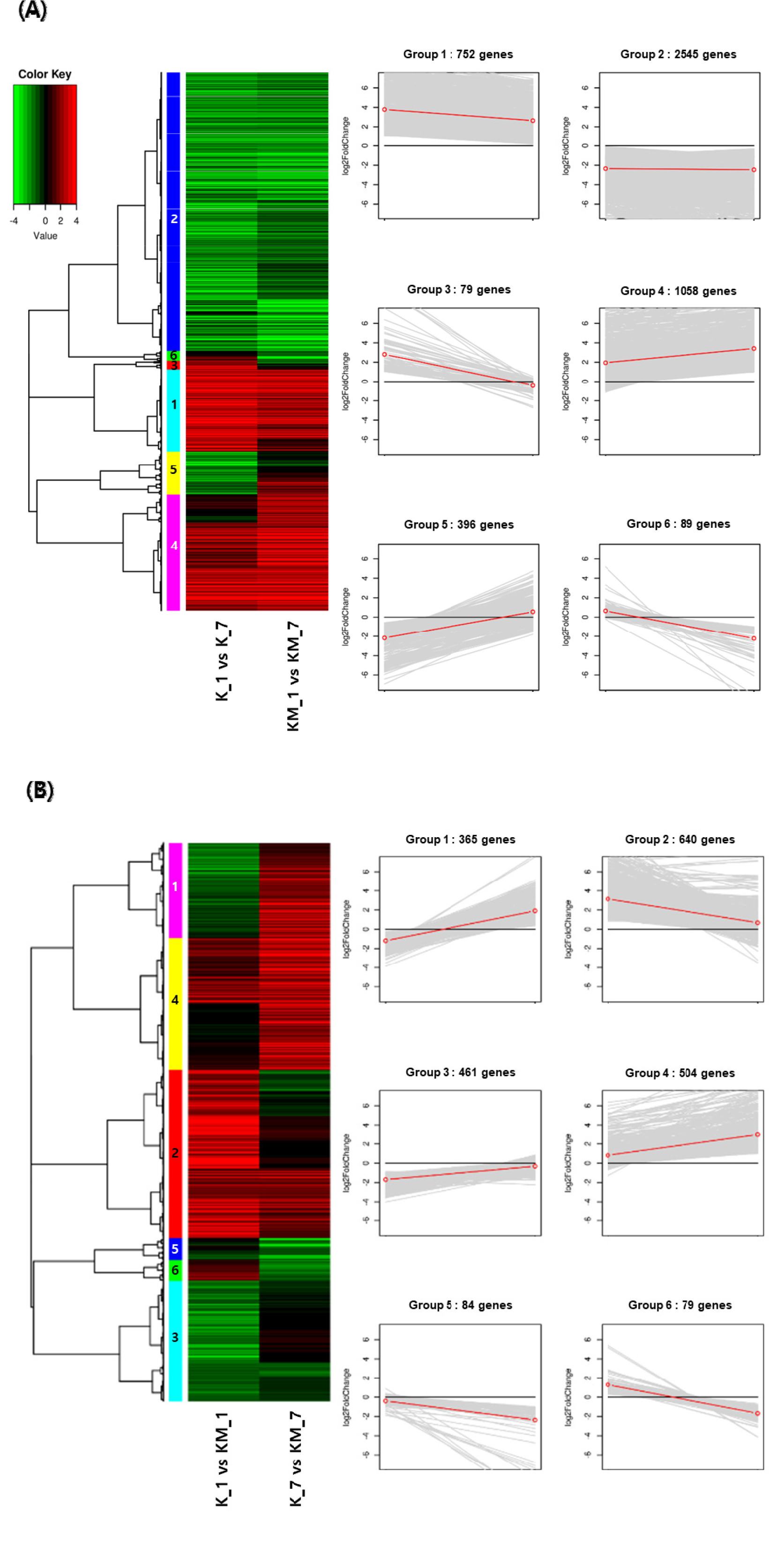
Fig. 5Gene Ontology (GO) analysis is divided into three functional categories: Biological Process (BP), Cellular Component (CC), and Molecular Function (MF). In cluster II, a total of 1,036 related DEGs expressed as 49 GO Term in BP and 12 GO Term in CC and MF were analyzed.
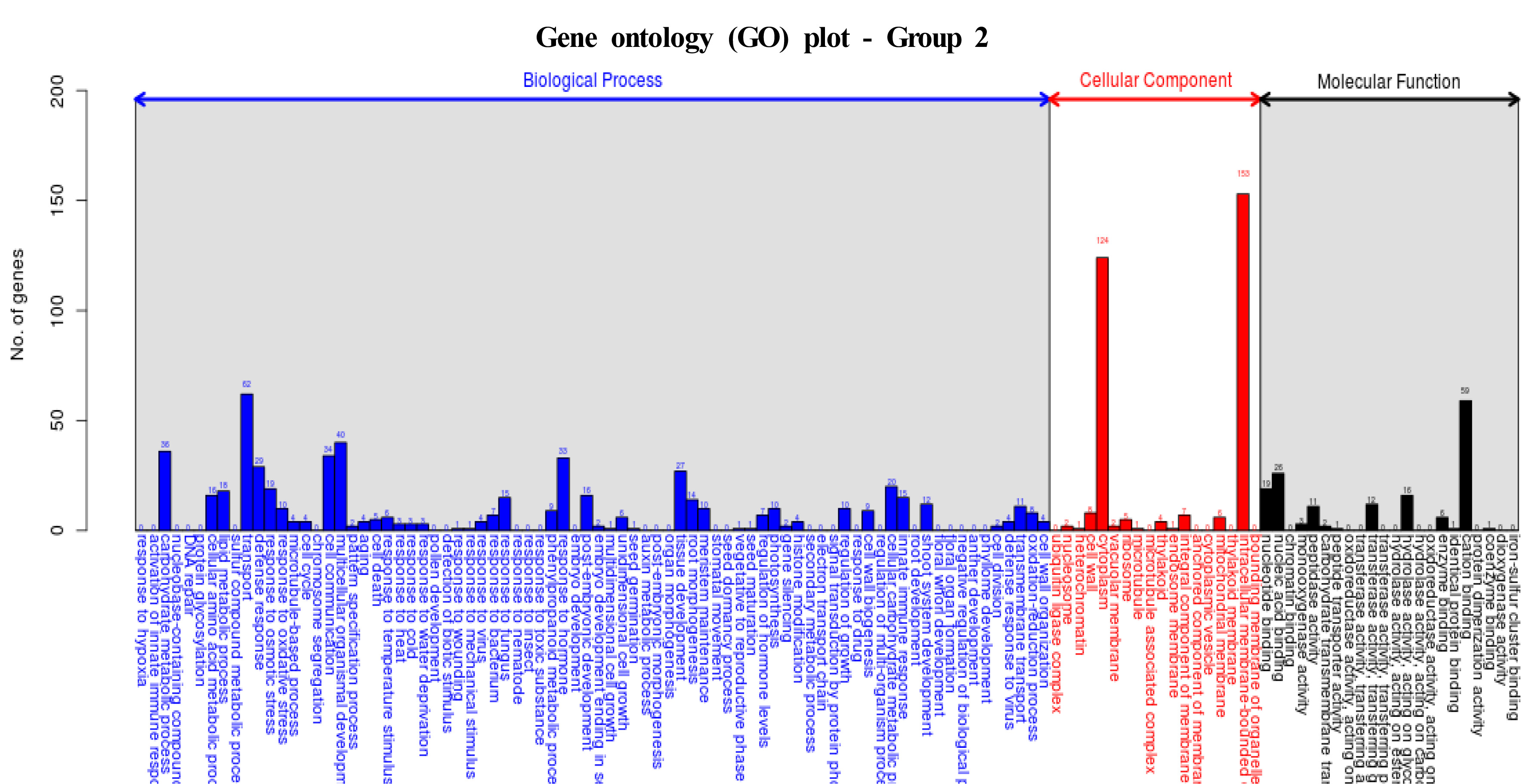
Fig. 6Validation of PHS and seed dormancy related selected DEGs using quantitative real-time PCR analysis. (A) A group of candidate DEGs showed high expression on day 1 and low expression on day 7 of PHS treatment in ‘Jeonju 377ho’. (B) A group of candidate DEGs showed low expression on day 1 and high expression on day 7 of PHS treatment in ‘Keumgang’.
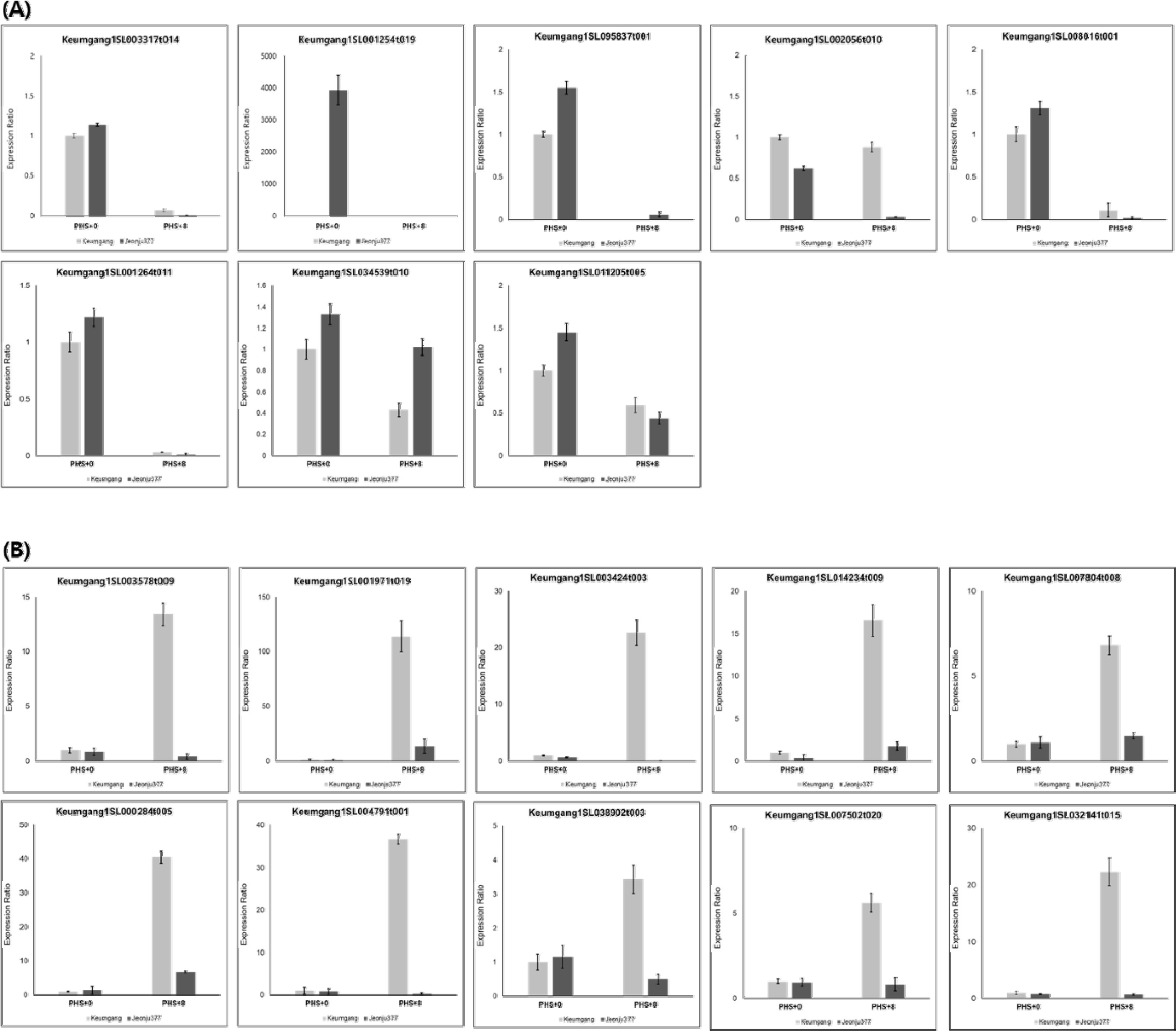
Table 1Number of raw data reads and mapping reads
Table 1
|
Sample ID |
Total reads |
Aligned 0 times |
Aligned exactly 1 time |
Aligned ≥1 times |
Mapping rate |
|
Reads (ea) |
Percent (%) |
Reads (ea) |
Percent (%) |
Reads (ea) |
Percent (%) |
Reads (ea) |
Percent (%) |
|
K1 |
26,058,109 |
2,426,020 |
9.31% |
1,444,724 |
5.54% |
22,187,365 |
85.15% |
23,632,089 |
90.69% |
|
26,058,109 |
2,523,271 |
9.68% |
1,496,487 |
5.74% |
22,038,351 |
84.57% |
23,534,838 |
90.32% |
|
KM1 |
33,131,971 |
4,040,234 |
12.19% |
2,086,507 |
6.30% |
27,005,230 |
81.51% |
29,091,737 |
87.81% |
|
33,131,971 |
4,018,507 |
12.13% |
2,093,121 |
6.32% |
27,020,343 |
81.55% |
29,113,464 |
87.87% |
|
K7 |
41,079,207 |
4,473426 |
10.89% |
2,453,590 |
5.97% |
34,152,191 |
83.14% |
36,605,781 |
89.11% |
|
41,079,207 |
4,572,891 |
11.13% |
2,505,519 |
6.10% |
34,000,797 |
82.77% |
36,506,316 |
88.87% |
|
KM7 |
37,108,988 |
9,237971 |
24.89% |
1,896,424 |
5.11% |
25,974,593 |
70.00% |
27,871,017 |
75.11% |
|
37,108,988 |
9,332,250 |
25.15% |
1,921,987 |
5.18% |
25,854,751 |
69.67% |
27,776,738 |
74.85% |
|
4ea |
274,756,550 |
40,624,570 |
14.79% |
15,898,359 |
5.79% |
218,233,621 |
79.43% |
234,131,980 |
85.21% |
Table 2The number of DEGs detected through clustering set I, II analysis and the number of annotation DEGs
Table 2
|
Group |
Cluster I |
Cluster II |
|
Num. of DEGs in cluster |
Annotated DEGs |
Num. of DEGs in cluster |
Annotated DEGs |
|
1 |
752 |
495 |
365 |
240 |
|
2 |
2,545 |
1,866 |
640 |
282 |
|
3 |
79 |
44 |
461 |
308 |
|
4 |
1,058 |
757 |
504 |
300 |
|
5 |
396 |
271 |
84 |
64 |
|
6 |
89 |
47 |
79 |
46 |
|
Total |
4,919 |
3,480 |
2,133 |
1,240 |
Table 3Descriptions of candidate DEGs and primer design for gene expression analysis
Table 3
Genes
(Assembled transcripts) |
Gene description |
Forward (5' → 3') |
Reverse (5' → 3') |
Tm |
|
K1 vs KM1 Up-regulation DEGs |
|
Keumgang1SL003317t014 |
PROLM24 - Prolamin precursor |
AGCAGCAAGGGCAAAGTTTC |
TGTCATGGGGATGCTGTAGATG |
60℃ |
|
Keumgang1SL001254t019 |
beta-amylase |
GCCCTTCTCGAATTTGTTGTCG |
ACGCAAGCCAGTGTTTGTAG |
60℃ |
|
Keumgang1SL095837t001 |
ANAC087, Arabidopsis NAC domain containing protein 87 |
TCGTCAACCCACATTGCATG |
TATTGGAAGCGGCATTTGCG |
60℃ |
|
Keumgang1SL002056t010 |
MFT, PEBP family protein |
AACAGCACCAGCACGTAGC |
TGGCTGGTGGTTAACATACCTG |
60℃ |
|
Keumgang1SL008016t001 |
Serine protease inhibitor, potato inhibitor I-type family protein |
AGCAAGCTTGATGTGCATGG |
GGAAAGTACATCCATGGCATGC |
60℃ |
|
Keumgang1SL001264t011 |
ATCRA1,CRA1,CRU1, RmlC-like cupins superfamily protein |
AGTGGTGTAGATGCTTGTAGCC |
TGGCACAACTGTTTGGCATG |
60℃ |
|
Keumgang1SL034539t010 |
Tubby-like F-box protein |
AAAGATGTCGTCGCTTGTGC |
CGACACCGGAAAAGTGAGTTTC |
60℃ |
|
Keumgang1SL011205t005 |
ATSUC3,ATSUT2,SUC3,SUT2, sucrose transporter 2 |
ACCTTGCACAGTGTTGTTGG |
TCTGCATTGCTGTTGTGGTC |
60℃ |
|
K1 vs K7 Up-regulation DEGs |
|
Keumgang1SL003578t009 |
Starch branching enzyme 2.2 |
GCTCTGATGTTTGGTGGACATG |
TTCCGCTTTTTCCTCAACGC |
60℃ |
|
Keumgang1SL001971t019 |
BETA-VPE,BETAVPE, vacuolar-processing enzyme precursor |
TCGCCAAAAACGACCTCAAC |
AGTAACCGCGGTTTTGTTCC |
60℃ |
|
Keumgang1SL003424t003 |
fatty acid hydroxylase |
TTTCCAGTTCTCCCTCCATTCG |
ATTTGACGGTTCCCACATGC |
60℃ |
|
Keumgang1SL014234t009 |
4-alpha-glucanotransferase |
TGCTGGTTTTTGGGCAGTTC |
ACAGCTTTGAACAGCGCATC |
60℃ |
|
Keumgang1SL007804t008 |
ACT domain containing protein |
TATTGCGGAGATTGAGGGCTAC |
TTGCATTTGAGGCTCGCAAG |
60℃ |
|
Keumgang1SL000284t005 |
AtCOR47,COR47,RD17, cold-regulated 47 |
CAAACACAACACACGCCAAC |
TGCCTGGTTACCACAAGACAG |
60℃ |
|
Keumgang1SL004791t001 |
thiaminC, thiamine biosynthesis protein |
TGTGTGGTCCCAAGTTTTGC |
AGCTTCACCATGTTGTTCGC |
60℃ |
|
Keumgang1SL038902t003 |
CAMK includes calcium/ calmodulin depedent protein kinases |
AGAACCTCATGTCCATGTACCG |
TTCCAAGAGAGGGTTCGGAATG |
60℃ |
|
Keumgang1SL007502t020 |
zinc finger, C3HC4 type domain containing protein |
ACAATGGGCATGCCAAATGG |
ACATTGCTTTGACGCTGAGG |
60℃ |
|
Keumgang1SL000284t005 |
aldehyde dehydrogenase |
AACCACTTTGACTGCAGTGC |
ATGCTTGCATTGTGCTGGAC |
60℃ |
|
Housekeeping gene |
|
TaActin
|
Housekeeping gene |
GCTGTTCCAGCCATCTCATGT |
CGATCAGCAATTCCAGGAAAC |
60℃ |
References
- 1. Anders S, Huber W. 2010. Differential expression analysis for sequence count data. Genome Biol 11: R106
- 2. Andreoli C, Bassoi MC, Brunetta D. 2006. Genetic control of seed dormancy and pre-harvest sprouting in wheat. Sci Agric 63: 564-566.
- 3. Aoki N, Scofield GN, Wang XD, Offler CE, Patrick JW, Furbank RT. 2006. Pathway of sugar transport in germinating wheat seeds. Plant Physiology 141: 1255-1263.
- 4. Ashburner M, Ball CA, Blake JA, Botstein D, Butler H, Cherry JM, Davis AP, Dolinski K, Dwight SS, Eppig JT, Harris MA, Hill DP, Issel-Tarver L, Kasarskis A, Lewis S, Matese JC, Richardson JE, Ringwald M, Rubin GM, Sherlock G. 2000. Gene ontology: Tool for the unification of biology. Nat Genet 25: 25-29.
- 5. Ayre BG. 2011. Membrane-transport systems for sucrose in relation to whole-plant carbon partitioning. Mol Plant 4: 377-394.
- 6. Baier AC. 1987. Pre-harvest sprouting. Annual Wheat Newsletter 33: 274
- 7. Biddulph TB, Plummer JA, Setter TL, Mares DJ. 2008. Seasonal conditions influence dormancy and preharvest tolerance of wheat (Triticum aestivum L.) in the field. Field Crops Res 107: 116-128.
- 8. Bilderback DE. 1974. Amylases from aleurone layers and starchy endosperm of barley seeds. Plant Physiol 53: 480-484.
- 9. Bogamuwa S, Jang JC. 2013. The Arabidopsis tandem CCCH zinc finger proteins AtTZF4, 5 and 6 are involved in light-, abscisic acid- and gibberellic acid-mediated regulation of seed germination. Plant Cell Environ 36: 1507-1519.
- 10. Brown RS. 2005. Zinc finger proteins: Getting a grip on RNA. Curr Opin Struct Biol 15: 94-98.
- 11. Chardon F, Damerval C. 2005. Phylogenomic analysis of the PEBP gene family in cereals. J Mol Evol 61: 579-590.
- 12. Cheng X, Cao J, Gao C, Gao W, Yan S, Yao H, Xu K, Liu X, Xu D, Pan X, Lu J, Chang C, Zhang H, Ma C. 2020. Identification of the wheat C3H gene family and expression analysis of candidates associated with seed dormancy and germination. Plant Physiol Biochem 156: 524-537.
- 13. Choi CH, Yoon Y-M, Son J-H, Cho S-W, Kang C-S. 2018. Current status and prospect of wheat functional genomics using next generation sequencing. Korean J Breed Sci 50: 364-377.
- 14. Cox MP, Peterson DA, Biggs PJ. 2010. SolexaQA: At a glance quality assessment of Illumina second generation sequencing data. BMC Bioinform 11: 485. https://doi.org/10.1186/1471-2105-11-485.
- 15. Detje H. 2008. Effects of varying nitrogen rates on pre-harvest sprouting and α-Amylase activity in cereals. J Agron Crop Sci 169: 38-45.
- 16. Duan J, Xia C, Zhao G, Jia J. 2012. Optimizing de novo common wheat transcriptome assembly using short-read RNA- Seq data. BMC Genom 13: 392. https://doi.org/10.1186/1471-2164-13-392.
- 17. Farashah HD, Afshari RT, Sharifzadeh F, Chavoshinasab S. 2011. Germination improvement and alpha-amylase and beta-1,3-glucanase activity in dormant and non-dormant seeds of Oregno (Origanum vulgare). Aust J Crop Sci 5: 421-427.
- 18. Feeney M, Kittelmann M, Menassa R, Hawes C, Frigerio L. 2018. Protein storage vacuoles originate from remodeled preexisting vacuoles in Arabidopsis thaliana. Plant Physiol 177: 241-254.
- 19. Gamsjaeger R, Liew CK, Loughlin FE, Crossley M, Mackay JP. 2007. Sticky fingers: zinc-fingers as protein-recognition motifs. Trends Biochem Sci 32: 63-70.
- 20. Giese H, Hejgaard J. 1984. Synthesis of salt-soluble proteins in barley. Pulse-labeling study of grain filling in liquid- cultured detached spikes. Planta 161: 172-177.
- 21. Goswami AK, Jain MK, Paul B. 1977. α- and β-Amylases in seed germination. Biol Plant 19: 469-471.
- 22. Hall TM. 2005. Multiple modes of RNA recognition by zinc finger proteins. Curr Opin Struct Biol 15: 367-73.
- 23. Hershko A, Ciechanover A. 1998. The ubiquitin system. Annu Rev Biochem 67: 425-479.
- 24. Holloway T, Steinbrecher T, Perez M, Seville A, Stock D, Nakabayashi K, Leubner-Metzger G. 2021. Coleorhiza- enforced seed dormancy: A novel mechanism to control germination in grasses. New Phytol 229: 2179-2191.
- 25. Hong MJ, Kim J-B, Seo YW, Kim DY. 2020. F-Box genes in the wheat genome and expression profiling in wheat at different developmental stages. Genes 11:
- 26. Hong MJ, Kim DY, Seo YW. 2013. SKP1-like-related genes interact with various F-box proteins and may form SCF complexes with Cullin-F-box proteins in wheat. Mol Biol Rep 40: 969-981.
- 27. Huh SM, Han HJ, Kim B-G, Kwon TY, Lee GS, Yoon IS. 2016. Quantitative Trait Loci (QTL) genes related to seed dormancy and pre harvest sprouting. Korean J Breed Sci 48: 1-10.
- 28. Jan A, Maruyama K, Todaka D, Kidokoro S, Abo M, Yoshimura E, Shinozaki K, Nakashima K, Yamaguchi-Shinozaki K. 2013. OsTZF1, a CCCH-Tandem zinc finger protein, confers delayed senescence and stress tolerance in rice by regulating stress-related genes. Plant Physiol 161: 1202-1216.
- 29. Jiang S Y, Chi Y H, Wang J Z, Zhou J X, Cheng Y S, Zhang B L, Ma A, Vanitha J, Ramachandran S. 2015. Sucrose metabolism gene families and their biological functions. Sci Rep 5: 17583
- 30. Kang C-S, Cheong Y-K, Kim K-H, Kim H-S, Kim Y-J, Kim K-H, Park J-C, Park H-H, Kim H-S, Kang S-J, Choi H-J, Kim J-G, Kim K-J, Lee C-K, Park K-G, Park K-H, Park C-S. 2014. A wheat variety, 'Sooan' with good noodle quality, red grain wheat, higher winter hardiness and pre- harvest sprouting resistance. Korean J Breed Sci 46: 260-267.
- 31. Kang C-S, Kim H-S, Cheong Y-K, Kim J-G, Park K-H, Park C-S. 2008. Flour characteristics and end-use quality of commercial flour produced from Korean wheat and imported wheat. Korean J Food Preserv 15: 687-693.
- 32. Rural Development Administration (RDA)2017. Development of new wheat variety and promotion of breeding efficiency TRKO201700006246.
- 33. Kang C-S, Park C-S, Park J-C, Kim H-S, Cheong Y-K, Kim K-H, Kim K-J, Park K-H, Kim J-G. 2010. Flour characteristics and end-use quality of Korean wheat cultivars I. flour characteristics. Korean J Breed Sci 42: 61-74.
- 34. Kato K, Nakamura W, Tabiki T, Miura H, Sawada S. 2001. Detection of loci controlling seed dormancy in group 4 chromosomes of wheat and comparative mapping with rice and barley genomes. Theor Appl Genet 102: 980-985.
- 35. Kim KH, Kim JY. 2021. Understanding wheat starch metabolism in properties, environmental stress condition, and molecular approaches for value-added utilization. Plants 10: 2282. https://doi.org/10.3390/plants10112282.
- 36. Kim ST, Wang YM, Kang SY, Kim SG, Rakwal RD, Kim YC, Kang KY. 2009. Developing rice embryo proteomics reveals essential role for embryonic proteins in regulation of seed germination. J Proteome Res 8: 3598-3605.
- 37. King RW, von Wettstein-Knowles P. 2000. Epicuticular waxes and regulation of ear wetting and pre-harvest sprouting in barley and wheat. Euphytica 112: 157-166.
- 38. Kleyn PW, Fan W, Kovats SG, Lee JJ, Pulido JC, Wu Y, Berkemeier LR, Misumi DJ, Holmgren L, Charlat O, Woolf EA, Tayber O, Brody T, She P, Hawkins F, Kennedy B, Baldini L, Ebeling C, Alperin GD, Deeds J, Lakey ND, Culpepper J, Chen H, Glücksmann-Kuis MA, Carlson GA, Duyk GM, Moore KJ. 1996. Identification and characterization of the mouse obesity gene tubby: A member of a novel gene family. Cell 85: 281-290.
- 39. Klug A. 1999. Zinc finger peptides for the regulation of gene expression. J Mol Biol 293: 215-218.
- 40. Kossmann J, Lloyd J. 2000. Understanding and influencing starch biochemistry. Crit Rev Plant Sci 35: 141-196.
- 41. Kusumaatmaja H, May AI, Feeney M, McKenna JF, Mizushima N, Frigerio L, Knorr RL. 2021. Wetting of phase-separated droplets on plant vacuole membranes leads to a competition between tonoplast budding and nanotube formation. PNAS 118: e2024109118.
- 42. Lai CP, Lee CL, Chen PH, Wu SH, Yang CC, Shaw JF. 2004. Molecular analyses of the Arabidopsis TUBBY-like protein gene family. Plant Physiol 134: 1586-1597.
- 43. Langmead B, Salizberg SL. 2012. Fast gapped read alignment with Bowtie2. Nat Methods 9: 357-359.
- 44. Lastdrager J, Hanson J, Smeekens S. 2014. Sugar signals and the control of plant growth and development. J Exp Bot 65: 799-807.
- 45. Lee CK, Nam JH, Kang MS, Koo BC, Kim JC, Park KK, Park MW, Kim YH. 2002. Current wheat quality criteria and inspection systems of major wheat producing countries. Korean J crop sci 47: 63-94.
- 46. Lee YJ, Park SY, Kim DY, Kim JY. 2021. Differential expression analysis of phytohormone-related genes of Korean wheat (Triticum aestivum) in response to preharvest sprouting and abscisic acid (ABA). Appl Sci. 11: https://doi.org/10.3390/app11083562.
- 47. Li Z, Thomas TL. 1998. PEI1, an embryo-specific zinc finger protein gene required for heart-stage embryo formation in Arabidopsis. Plant Cell 10: 383-398.
- 48. Li F, Ma C, Wang X, Gao C, Zhang J, Wang Y, Cong N, Li X, Wen J, Yi B, Shen J, Tu J, Fu T. 2011. Characterization of Sucrose transporter alleles and their association with seed yield-related traits in Brassica napus L. BMC Plant Biol 11: 168. https://doi.org/10.1186/1471-2229-11-168.
- 49. Li S, Wang Z, Wang F, Lv H, Cao M, Zhang N, Li F, Wang H, Li X, Yuan X, Zhao B, Guo Y-D. 2021. A tubby-like protein CsTLP8 acts in the ABA signaling pathway and negatively regulates osmotic stresses tolerance during seed germination. BMC Plant Biol 21: 340. https://doi.org/10.1186/s12870-021-03126-y.
- 50. Lin P-C, Pomeranz MC, Jikumaru Y, Kang SG, Hah C, Fujioka S, Kamiya Y, Jang I-C. 2011. The Arabidopsis tandem zinc finger protein AtTZF1 affects ABA- and GA-mediated growth, stress and gene expression responses. Plant J 65: 253-268.
- 51. Liu Q. 2007. Identification of rice TUBBY-like genes and their evolution. FEBS J 275: 163-171.
- 52. Livak KJ, Schmittgen TD. 2001. Analysis of relative gene expression data using real-time quantitative PCR and the 2−ΔΔCT method. Methods 25: 402-408.
- 53. Lucas A. 2018. Amap: Another multidimensional analysis. https://cran.r-project.org/web/packages/amap/amap.pdf
- 54. Matthews JM, Sunde M. 2002. Zinc fingers-folds for many occasions. IUBMB Life 54: 351-355.
- 55. Meißner D, Albert A, Böttcher C, Strack D, Milkowski C. 2008. The role of UDP-glucose: hydroxycinnamate glucosyltransferases in phenylpropanoid metabolism and the response to UV-B radiation in Arabidopsis thaliana. Planta 228: 663-674.
- 56. Milkowski C, Baumert A, Strack D. 2000. Identification of four Arabidopsis genes encoding hydroxycinnamate glucosyltransferases. FEBS Lett 486: 183-184.
- 57. Milkowski C, Strack D. 2010. Sinapate esters in brassicaceous plants: Biochemistry, molecular biology, evolution and metabolic engineering. Planta 232: 19-35.
- 58. Mock HP, Strack D. 1993. Energetics of the uridine 5′- diphosphoglucose: Hydroxycinnamic acid acyl-glucosyltransferase reaction. Phytochemistry 32: 575-579.
- 59. Moon J, Parry G, Estelle M. 2004. The ubiquitin-proteasome pathway and plant development. Plant Cell 16: 3181-3195.
- 60. Mori M, Uchino N, Chono M, Kato K, Miura H. 2005. Mapping QTLs for grain dormancy on wheat chromosome 3A and the group 4 chromosomes, and their combined effect. Theor Appl Genet 110: 1315-1323.
- 61. Nakamura S, Abe F, Kawahigashi H, Nakazono K, Tagiri A, Matsumoto T, Utsugi S, Ogawa T, Handa H, Ishida H, Mori M, Kawaura K, Ogihara Y, Miura H. 2011. A wheat homolog of MOTHER of FT and TFL1 acts in the regulation of germination. Plant Cell 23: 3215-3229.
- 62. Nandi S, Das G, Sen-mandi S. 1995. β-Amylase activity as an index for germination potential in rice. Ann Bot 75: 463-467.
- 63. Navabpour S, Jalali P. 2019. Expression profiling of two sucrose transporter genes during post-anthesis in wheat. Zemdirbyste-Agriculture. 106: 265-272.
- 64. Nielsen MT, McCrate AJ, Heyne EG, Paulsen GM. 1984. Effect of weather variables during maturation on pre harvest sprouting of hard white wheat. Crop Sci 24: 779-782.
- 65. Okamoto K, Akazawa T. 1979. Enzymic mechanism of starch breakdown in germinating rice seeds: 8. Immunohistochemical localization of β-amylase. Plant Cell Physiol 64: 337-340.
- 66. Okamoto K, Akazawa T. 1980. Enzymic mechanism of starch breakdown in germinating rice seeds: 9. DE NOVO SYNTHESIS OF β-AMYLASE. Plant Physiol 65: 81-84.
- 67. Olsen OA, Linnestad C, Nichols SE. 1999. Developmental biology of the cereal endosperm. Trends Plant Sci 4: 253-257.
- 68. Olsen OA. 2001. Endosperm development: Cellularization and cell fate specification. Annu Rev Plant Phys 52: 233-267.
- 69. Park SY. 2020. Study on traditional and molecular breeding for pre-harvest sprouting resistance in Korean wheat. Master's degree Kongju National University.
- 70. Pearce S, Vazquez-Gross H, Herin SY, Hane D, Wang Y, Gu YQ, Dubcovsky J. 2015. WheatExp: An RNA-seq expression database for polyploid wheat. BMC Plant Biol 15: 299. https://doi.org/10.1186/s12870-015-0692-1.
- 71. Roy JL, Huss B, Creach A, Hawkins S, Neutelings G. 2016. Glycosylation is a major regulator of phenylpropanoid availability and biological activity in plants. Front Plant Sci 7: 735. https://doi.org/10.3389/fpls.2016.00735.
- 72. Sabelli PA, Larkins BA. 2009. The development of endosperm in grasses. Plant Physiol 149: 14-26.
- 73. Schopfer P, Bajracharya D, Plachy C. 1979. Control of seed germination by abscisic acid: I. Time course of action in Sinapis alba L. Plant Physiol 64: 822-827.
- 74. Schulz MH, Zerbino DR, Vingron M, Birney E. 2012. Oases: Robust de novo RNA-seq assembly across the dynamic range of expression levels. Bioinformatics 28: 1086-1092.
- 75. Shin S-H, Kim K-H, Kang C-S, Park J-C, Hyun J-N, Park C-S. 2013. Effects of agronomic characteristics and grain morphology on pre-harvest sprouting in Korean wheat cultivar. Korean J Breed Sci 45: 346-357.
- 76. Shirley AM, Chapple C. 2003. Biochemical characterization of Sinapoylglucose: Choline Sinapoyltransferase, a Serine Carboxypeptidase-like protein that functions as an acyltransferase in plant secondary metabolism. J Biol Chem 278: 19870-19877.
- 77. Sreenivasulu N, Borisjuk L, Junker BH, Mock HP, Rolletschek H, Seiffert U, Weschke W, Wobus U. 2010. Barley grain development toward an integrative view. Int Rev Cell Mol Bio 281: 49-89.
- 78. Srivastava G, Kayastha AM. 2014. β-Amylase from starchless seeds of Trigonella Foenum-Graecum and its localization in germinating seeds. PlosS one 9: e88697.
- 79. Tao Y-B, Luo L, He L-L, Ni J, Xu Z-F. 2014. A promoter analysis of MOTHER OF FT AND TFL1 1 (JcMFT1), a seed-preferential gene from the biofuel plant Jatropha curcas. J Plant Res 127: 513-524.
- 80. Tetlow IJ, Emes MJ. 2014. A review of starch-branching enzymes and their role in amylopectin biosynthesis. IUBMB Life 66: 546-558.
- 81. Thitisaksakul M, Jiménez RC, Arias MC, Beckles DM. 2012. Effects of environmental factors on cereal starch biosynthesis and composition. J Cereal Sci 56: 67-80.
- 82. Warnes GR, Bolker B, Bonebakker L, Gentleman R, Huber W, Liaw A, Lumley T, Maechler M, Magnusson A, Moeller M. 2015. Gplots: Various R programming tools for plotting data. R Package,
- 83. Wolswinkel P. 1993. Sink strength: A discussion concentrated on developing seeds. Plant Cell Environ 16: 1021-1022.
- 84. Wolswinkel, P1992. Transport of nutrients into developing seeds: A review of physiological mechanisms. Seed Sci Res 2: 59-73.
- 85. Zerbino DR, Birney E. 2008. Velvet: algorithms for de novo short read assembly using de Bruijn graphs. Genome Res 18: 821-829.
- 86. Zhang Y, He X, Su D, Feng Y, Zhao H, Deng H, Liu M. 2020. Comprehensive profiling of tubby-like protein expression uncovers ripening-related TLP genes in tomato (Solanum lycopersicum). Int J Mol Sci 21: 1000. https://doi.org/10.3390/ijms21031000.
- 87. Zhang N, Zhang HJ, Sun QQ, Cao YY, Li XS, Zhao B, Wu P, Guo YG. 2017. Proteomic analysis reveals a role of melatonin in promoting cucumber seed germination under high salinity by regulating energy production. Sci Rep 7: 503. https://doi.org/10.1038/s41598-017-00566-1.
- 88. Ziegler P. 1999. Cereal β-amylases. J Cereal Sci 29: 195-204.