적요
This study was performed to determine the optimum transplanting dates of ‘Bbareumi’ in the Chungnam Plain area. ‘Bbareumi’ was transplanted into a rice research field of Chungnam Agricultural Research and Extension Services at intervals of approximately 15 days from April 17th to August 1st in 2019 and 2020. The heading dates of ‘Bbareumi’ were June 23rd to September 2nd depending on transplanting dates. The highest milled-rice yield was 5.61 MT/ha on May 1st and the lowest was 3.65 MT/ha on August 1st. As the transplanting date was delayed, protein content increased; however, the number of days from transplanting to heading decreased. Protein content and the number of days from transplanting to heading showed a highly significant correlation (R2 = 0.802**). Therefore, it was found that early transplanting was beneficial to produce lower protein content because head rice percentage was 84-87% for early (April 17th to May 16th), 74-80% normal (June 1st to June 16th), and 86-95% for the late transplanting date (July 1st to August 1st). The mean temperature during the ripening stage differed according to the transplanting dates, and early transplanting showed a lower temperature than the normal one (May 16th to June 15th) and a higher head rice percentage. Therefore, extremely early maturing rice cultivars should be transplanted between late April and early May to obtain lower protein content and higher head rice percentage. These results will be useful for rice breeding programs, as it is generally recognized that early transplanting results in poor rice quality; however, this study revealed contrasting results.
서 언
우리나라의 곡물자급률은 2020년 20.2%로 쌀과 서류를 제외한 대부분 농산물을 수입에 의존하는 실정이다(
KOSIS 2022). 통계청에서 발표된 자료에 따르면 2021년 농경지는 1,547천 ha로 1975년 2,240천 ha 대비 30.9% (693천 ha) 감소하였고 그 중 논 면적은 1,277천 ha에서 780천 ha로 38.9% 줄어들었으며, 농경지 이용률도 1972년 140.4%에서 2021년 107.3%로 단작 위주의 농사가 주를 이루고 있다(
KOSTAT 2022). 따라서 우리나라의 식량안보를 강화하기 위해서는 단위면적당 생산량을 높일 수 있는 이모작 활성화가 필요하다(
Yu et al. 2020).
동계작물 수확 후 벼를 재배하는 논 이모작은 전남 등 남부지역에서는 활발히 이루어지고 있지만, 충남과 중부지역에서는 동계작물 수확 후 조생종 벼 재배시 수확시기가 늦어지면 동계작물과의 파종작업이 원활하지 못하기 때문에 제한요인이 된다(
Kim et al. 2019). 따라서 충남지역에서 논 이모작 활성화를 위해서는 벼 수확 후 동계작물 파종 전 충분한 작업기간이 필요하므로 조생종 벼 품종보다 생육기간이 짧은 극조생종 벼가 유리할 수 있다(
Yun et al. 2022b). 극조생종 벼를 이용한 이모작은 논의 형태는 그대로 유지하면서 타작목 재배를 통해 단위면적당 생산성 향상시켜 곡물자급률을 높일 수 있고, 중만생종 벼 품종 대비 수량이 낮아 쌀생산 과잉에 따른 정부의 쌀 수급 조절 측면에서도 장점이 될 수 있다.
극조생종 벼의 짧은 생육기간은 본답에서의 담수기간을 중만생종 벼 품종 대비 현격히 줄여 메탄가스 발생량을 감소시킬 수 있고 농업용수와 비료를 절약할 수 있어, 충청남도에서는 ‘빠르미’ 벼를 기후변화 적응품종으로 선정하여 보급을 추진하고 있다(
Yun et al. 2022b). 따라서 본 연구는 기후변화 대응 및 곡물자급률 향상을 위한 극조생종 벼 품종의 다양한 활용방안을 모색하기 위해, ‘빠르미’ 벼 이앙시기에 따른 출수기 등 생육과 품질특성을 파악하여 적정 이앙시기를 설정하고 이모작 활성화를 위한 자료로 활용하고자 수행하였다.
재료 및 방법
시험지역 및 재배방법
본 연구는 충남평야지에서 극조생종 ‘빠르미’ 이앙시기에 따른 수량성과 품질조사를 통해 적정 이앙시기를 설정하고 이모작 활성화를 위한 기초자료로 활용하고자 충청남도 예산군에 위치한 충청남도농업기술원 벼 연구포장에서 2019년과 2020년 2회에 걸쳐 시험을 수행하였다. 4월 17일부터 8월 1일까지 약 15일 간격 총 8번의 이앙시기를 확률화블록설계 3반복으로 14.7 m
2 크기로 구획을 만든 후 각각의 이앙시기 3일전 시험구를 조성하고 비료와 제초제를 살포하였다. 키다리병 등 종자로 전염되는 병을 방제하기 위해, 전년도 수확한 종자를 소독망에 130 g씩 담아 2일간 찬물에 침종 후 종자소독약(Tebuconazole + Prochloraz copper chloride)을 처리하는 ‘침종 후 소독’ 방법으로 종자를 소독하였다(
Yun et al. 2022a). 종자소독을 마친 종자는 육묘상자에 파종 후 이동식출아기(153C, Namjin Agri., Korea)로 30℃에서 3일간 처리한 뒤 다목적온실에서 2~3주 육묘 후 30×14 cm의 재식거리로 주당 4~6본 손으로 이앙하였고 시비량은 N-P
2O
5-K
2O=90-45-57 kg/ha수준으로 관리하였다.
‘빠르미’ 이앙시기에 따른 출수기, 간장, 수장 등 주요 농업적 형질은 농촌진흥청 농업과학기술 연구조사 분석기준(
RDA 2012)에 준하여 조사를 진행하였다. 수량을 조사하기 위해 시험구별 50주를 수확하고 탈곡, 건조, 탈망, 정선과정을 거친 정조의 수분을 측정한 후 무게를 조사하였으며, 제현비율은 정조 500 g을 현미기(SY88-TH, Ssangyong, Korea)에 투입 후 왕겨를 제외한 무게를 측정하여 계산하였다. 현백비율은 도정작업 숙련자가 200 g의 현미를 10분도로 세팅된 정미기(MC-90A, Toyo, Japan)에 투입 후 미강의 상태를 확인하면서 추가적으로 작동한 후 가공된 쌀의 무게를 측정하여 계산하였다. 쌀수량은 정조를 수분 15% 기준으로 보정 후 제현비율과 현백비율을 적용하여 구하였다.
쌀의 외관품질은 품위분석기(Cevitec 1625 Grain Inspector, Foss, Sweden), 단백질 함량은 성분분석기(Infratec 1241 Grain analyzer, Foss, Sweden), 취반윤기치는 토요식미기(MA-90B, Toyo, Japan)를 이용하여 각 분석기기의 분석 매뉴얼에 따라 측정을 진행하였다.
기상자료
‘빠르미’ 이앙시기에 따른 등숙기간 평균온도 등 벼 생육기간 기상환경을 조사하여 작물의 생육에 미치는 영향을 파악하고 품질과의 상관성을 분석하기 위해 기상청 홈페이지(
https://www.weather.go.kr)에 등록된 충남 천안의 기상자료를 활용하였다. ‘빠르미’ 이앙시기에 따른 출수기까지 적산온도 및 등숙기간 평균온도는 연구가 수행된 2019년과 2020년 기상자료를 이용하였고, 벼 재배기간 기상 및 품종의 조만성에 따른 등숙기간 평균기온은 2012년부터 2021년까지의 데이터를 활용하였다.
본 연구의 모든 형질의 값은 3반복으로 2년간(2019년, 2020년) 조사하였으며, 연도별 데이터의 평균값을 사용하여 분석을 진행하였다. 통계분석을 위해 SPSS 통계프로그램(IBM SPSS Statistics Version 20, USA)을 사용하였으며, 이앙시기별 생육 및 품질 비교는 분산분석(ANOVA: analysis of variance) 후 덩컨의 다중범위검정(DMRT: Duncan's multiple range test)을 실시하여 5% 유의수준에서 평균값을 비교하였고, 벼 재배기간과 단백질 함량, 등숙기간 평균온도와 완전립 비율 간의 관계를 구명하기 위해 상관분석을 진행하였다.
결과 및 고찰
기상자료
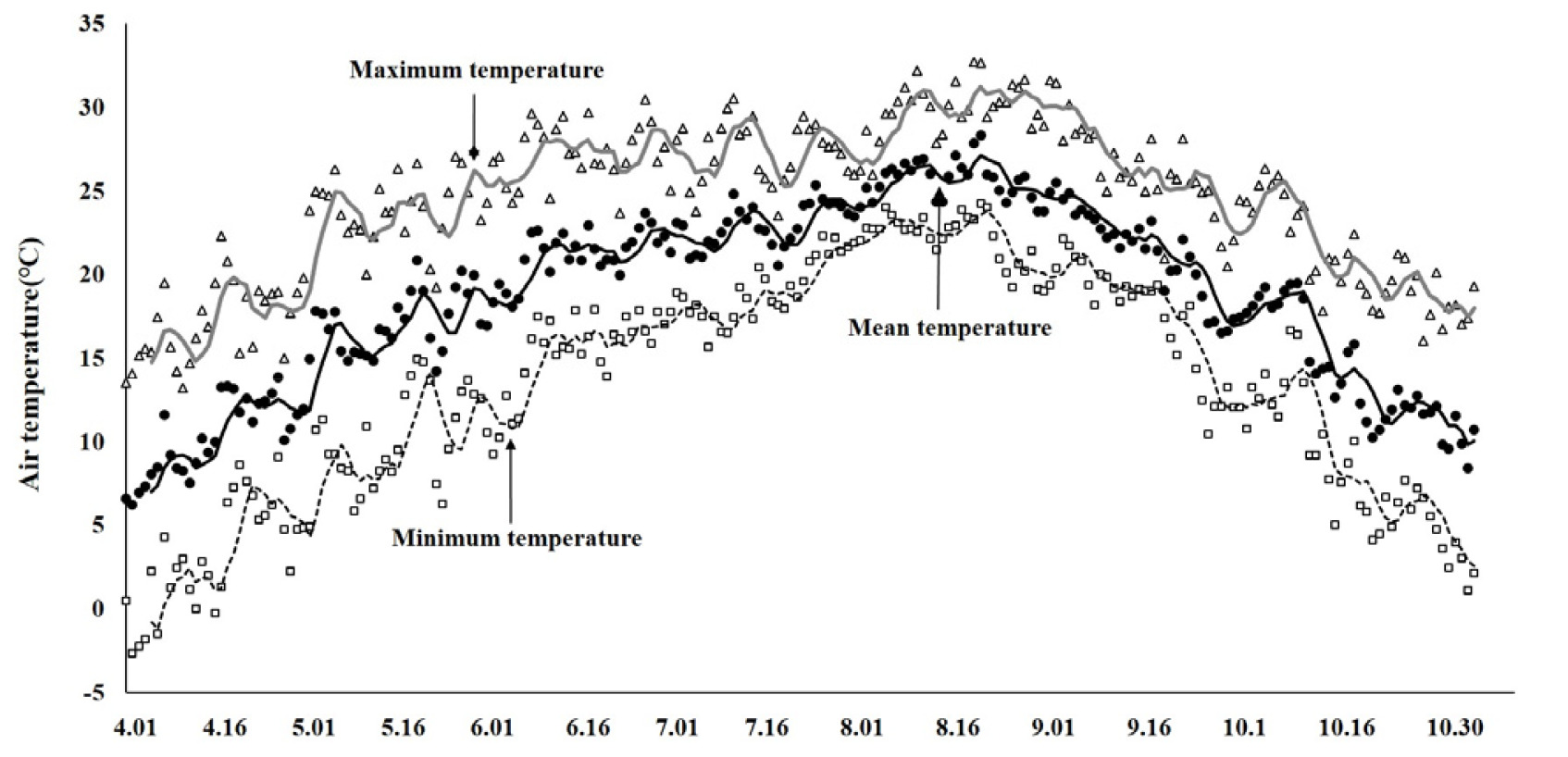
시험포장에서의 벼 생육기간 최저, 최고, 평균기온 변화를 조사하기 위해, 최근 10년(2012~2021) 충남 천안지역의 기상자료를
Fig. 1에 정리하였다. 일교차(최고온도-최저온도)는 4월 상순부터 6월 중순까지 비슷한 수준으로 유지되다가 8월 상순까지 줄어드는 경향을 보인 후 조금씩 증가하는 경향을 보였다. 최저기온은 4월 중순까지 영하를 유지하다가 조금씩 상승하기 시작하여 4월 하순 5℃ 정도를 나타내었고 평균기온은 5월 중순 이후부터 15℃ 이상을 유지하다가 10월 상순 이후 15℃ 이하로 낮아졌다. 벼 생육 전반기에 걸쳐 최고기온과 평균기온이 가장 높은 시기는 8월 중순으로 나타났다.
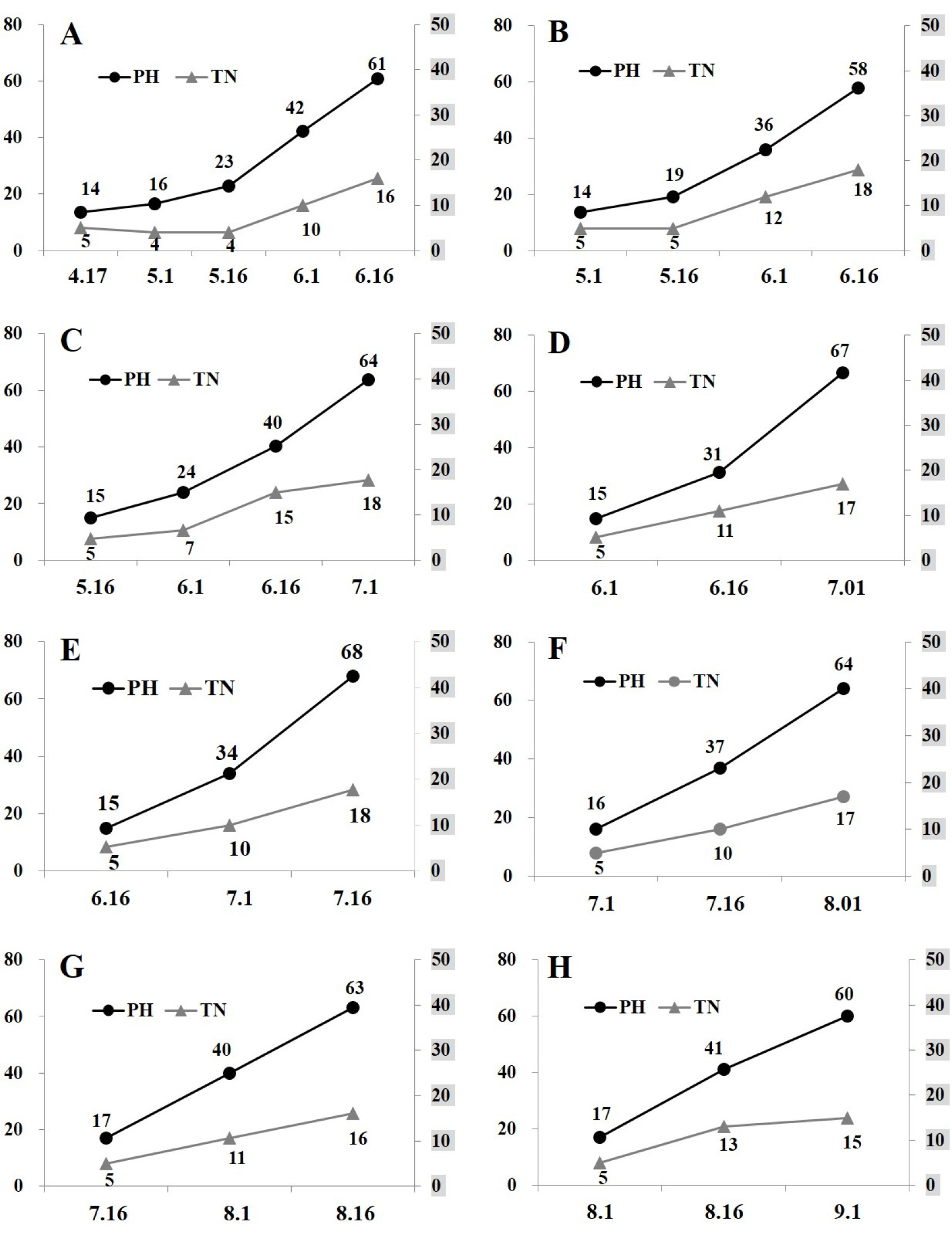
극조생종 ‘빠르미’ 이앙시기에 따른 초장과 주당경수의 변화를 알아보기 위해, 이앙 후 출수 전까지 15일 간격으로 생육조사 후 그 결과를
Fig. 2에 나타냈다. 충남지역에서 4월 17일과 5월 1일 조기 이앙에서는 5월 중순까지 경수가 전혀 늘어나지 않는 상태를 유지하다가 6월 1일 조사에서 급격히 증가하는 경향을 보였다. 반면에 5월 16일 이앙에서는 생육 초기부터 경수가 조금씩 늘어나기 시작하였고, 6월 1일 이후의 이앙에서는 이앙 후부터 출수기 전까지 경수가 활발히 증가하는 경향을 보였다. 조기이앙 시 경수의 증가가 늦어지는 원인은, 분얼을 위한 최저온도가 10~15℃이지만 5월 상순 이전까지 최저온도는 5℃ 미만이고 평균온도는 15℃ 미만이므로 저온에 의해 생장이 억제되어 생육이 지연되기 때문이다(
Shimono et al. 2002,
Cruz et al. 2006,
Ye et al. 2009). 특히, 4월 17일 이앙에서는 이앙 후 잎이 심하게 시들고 모가 고사하는 저온피해가 발생하여 5월 1일 조사결과 주당경수가 줄어들었다. 5월 1일 이앙에서는 저온피해로 잎이 약간 시들기는 하였지만 고사하지는 않았으며 두 이앙시기 모두 5월 중순 이후에 회복되는 경향을 보였다. ‘빠르미’의 초장도 경수와 비슷한 경향으로 변화하였는데, 4월 17일과 5월 1일 조기 이앙한 처리구에서는 생육 초기 생장이 느리게 진행되다가 5월 중순 이후 급격히 증가하였으며, 5월 16일 이후의 이앙에서는 생육초기부터 생육이 활발히 진행되었다.
이앙시기에 따라 ‘빠르미’의 출수기는 6월 23일부터 9월 2일까지 71일 차이가 발생하였으며, 4월 17일 이앙과 5월 1일 조기이앙에서는 각각 6월 23일과 6월 24일로 비슷하였고, 5월 15일 이앙부터 약 15일 정도 이앙이 늦어짐에 따라 출수기는 8일~16일 늦어지는 경향을 보였다. 이앙시기별 ‘빠르미’의 생육을 조사한 결과, 간장과 수장, 수수는 6월 1일 이앙이 가장 길고 큰 경향을 보였고, 그 이후 점진적으로 감소하기 시작하여 8월 1일 이앙에서 가장 작았다. 이삭당 영화수는 4월 17일에 87.0 개로 가장 많았지만, 단위면적당 이삭수는 6월 1일에서 36,053개/m
2로 가장 많고 8월 1일에서 24,302개/m
2로 가장 적었다. 등숙비율과 천립중은 이앙시기에 따라 큰 차이를 보이지는 않았지만, 가장 늦게 이앙한 8월 1일에서 가장 낮은 것으로 나타났다(
Table 1).
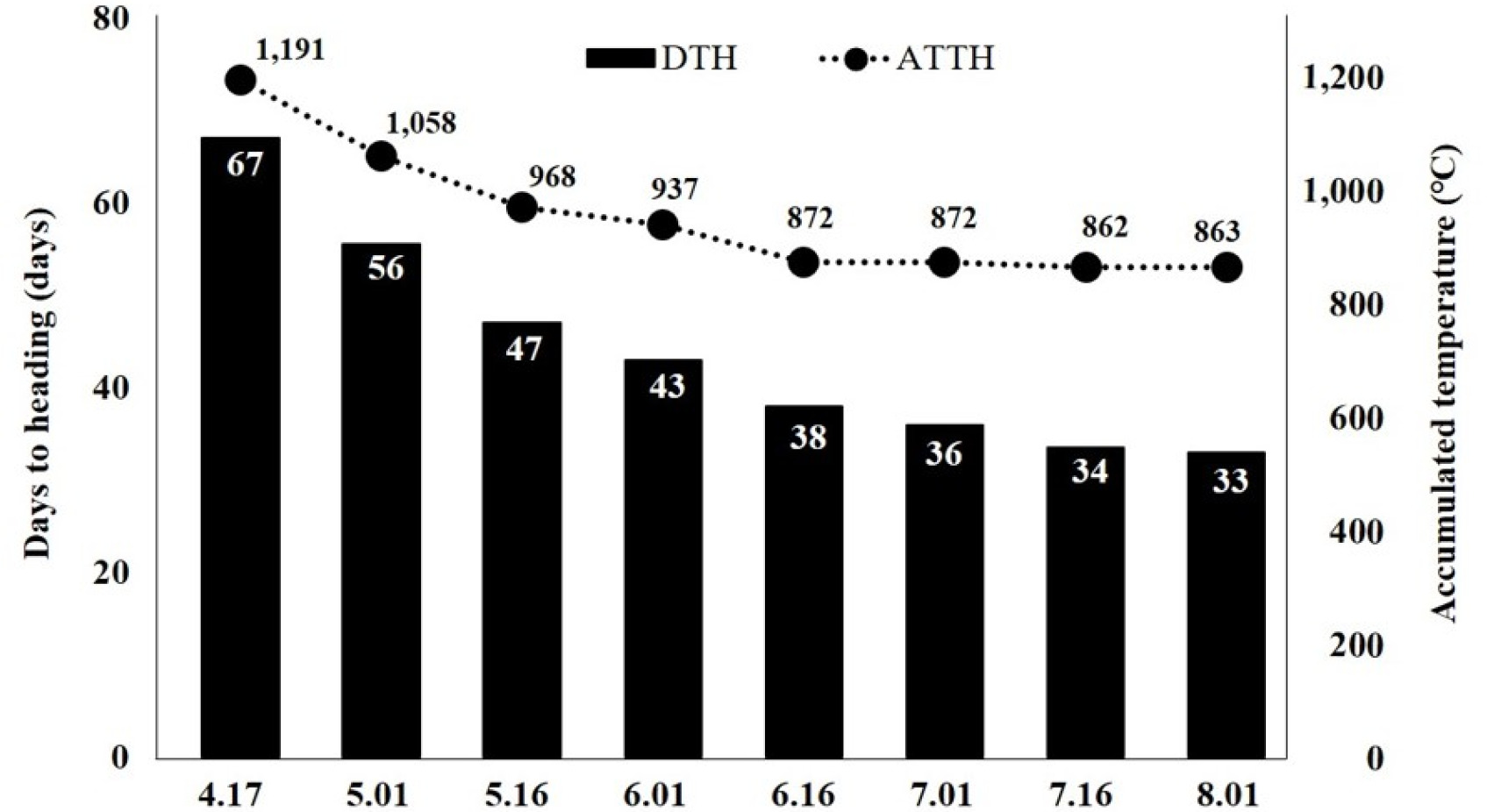
본 연구는 이앙시기(4월 17일~8월 1일)의 기간이 길고 그에 따른 출수기의 차이(6월 23일~9월 2일)가 크게 발생하였기 때문에 이앙시기에 따른 출수소요일수와 적산온도의 변화를 알아보기 위해
Fig. 3에 그래프로 나타내었다. 출수기까지 적산온도는 4월 17일이 1,191시간으로 가장 길었고 이앙이 늦어짐에 따라 계속해서 줄어들어 5월 16일 이후에 이앙하면 적산온도가 1,000℃ 이하, 6월 16일부터는 900℃ 이하에서 출수가 되었다. 출수소요일수는 4월 17일 이앙에서 67일로 가장 길었으며, 이앙이 늦어짐에 따라 지속적으로 줄어들어 마지막으로 이앙한 8월 1일에 33일로 가장 짧았다. 기존 조생종 벼 품종을 이용한 이앙시기 연구에서도 조기재배는 보통기 재배와 늦심기 재배보다 출수소요일수가 긴 경향을 보였는데(
Yun et al. 2015,
Seong et al. 2022),
Figs. 1,
2에서 알 수 있듯이 조기재배시 이앙 후 저온으로 5월 중순까지 생장 둔화가 지속되었기 때문으로 판단 할 수 있다.
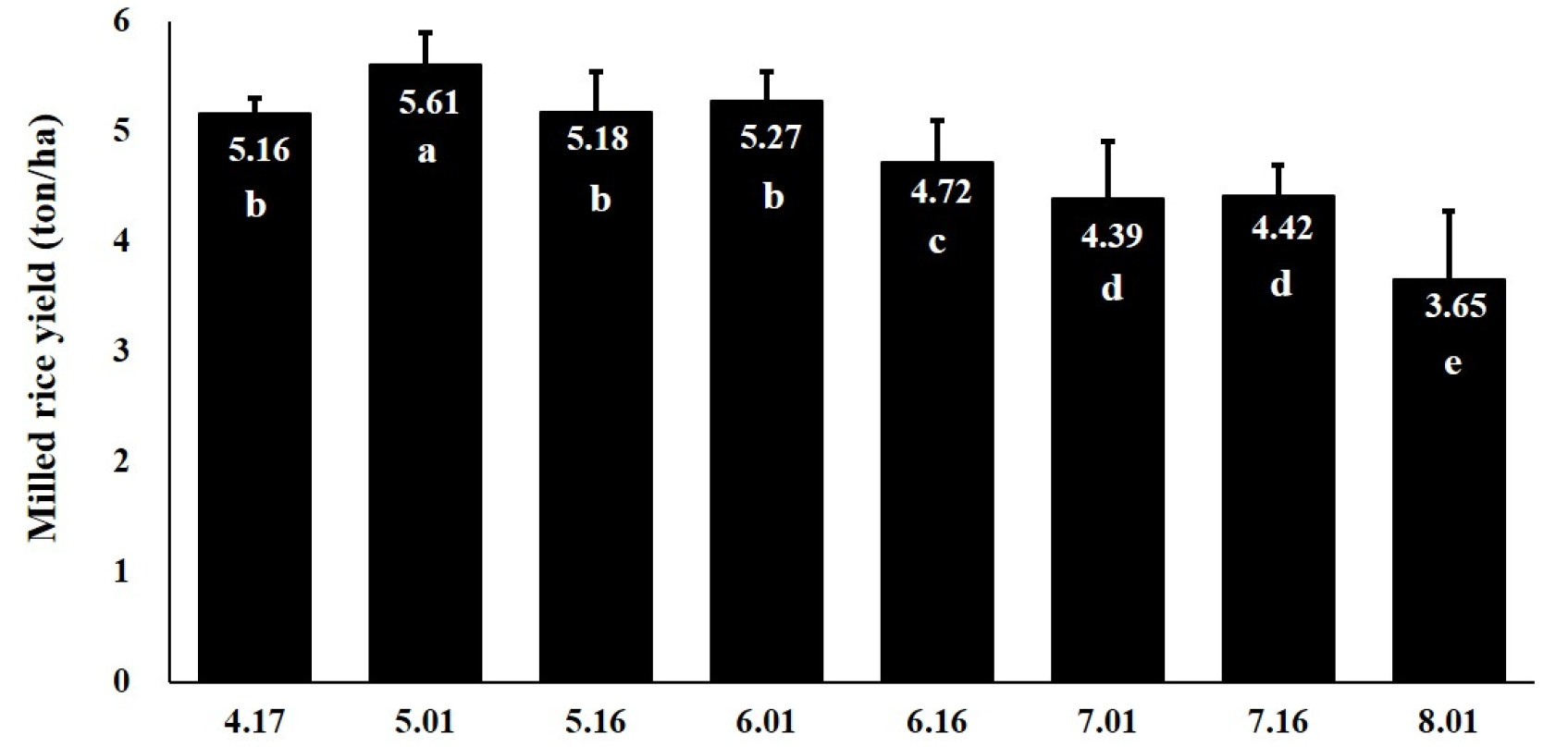
‘빠르미’ 벼 이앙시기에 따른 수량성을 살펴보면(
Fig. 4), 5월 1일 이앙에서 5.61 MT/ha로 가장 높았으며, 이앙이 늦어짐에 따라 감소하는 경향을 보이다가 8월 1일 이앙에서 3.65 MT/ha로 가장 낮았다. 이러한 원인은
Fig. 3에서 이앙이 늦어짐에 따라 출수까지 생육기간이 짧아지고 적산온도가 감소하면서 8월 1일 이앙한 ‘빠르미’가 충분한 생육을 확보하지 못하여 이삭수와 영화수가 적어지는 원인이 되었다. 게다가 출수기가 9월 2일로 충남지역 안전출수한계기인 8월 26일(
CNARES 2011)보다 늦어 등숙기간 후기 평균온도가 20℃ 이하로 낮아지면서 등숙비율과 천립중에 영향을 미쳐 수량구성요소가 전반적으로 양호하지 못해 수량이 감소한 것으로 판단할 수 있다. 따라서 4.00 MT/ha 이상의 수량성을 확보하기 위해서는 7월 중순까지, 5.00 MT/ha 이상의 수량성을 기대하기 위해서는 6월 상순까지는 이앙해야 하는 것으로 나타났다.
이앙시기에 따른 ‘빠르미’의 단백질 함량 결과를 보면(
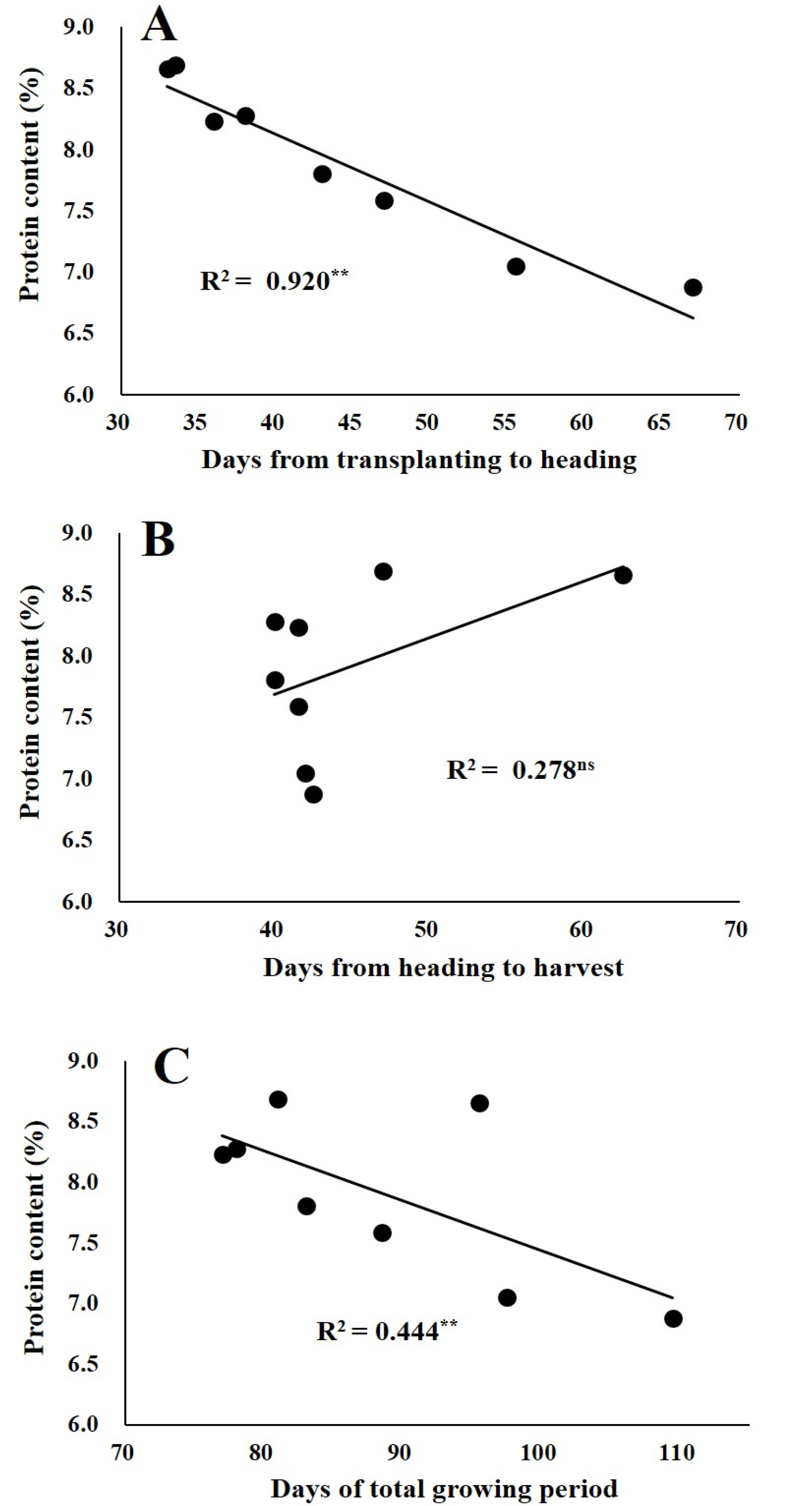
Table 2), 조기재배인 4월 17일 이앙에서 6.9%로 가장 낮았고 이앙이 늦어짐에 따라 증가하는 경향을 보였으며, 7월 16일과 8월 1일 이앙에서 8.7%로 가장 높은 경향을 보였다. 이앙시기에 따라 단백질 함량이 차이가 발생하는 원인을 파악하기 위해, 이앙시기별 생육기간을 ‘이앙 후 출수기’, ‘출수 후 수확기’, ‘이앙 후 수확기’로 구분하여 단백질 함량과의 상관분석을 진행하였다(
Fig. 5). ‘출수 후 수확기’까지의 기간은 단백질 함량과 통계적으로 유의한 상관성을 보이지 않았지만, ‘이앙 후 출수기’와 ‘이앙 후 수확기’까지의 기간은 단백질 함량과 부의 상관성을 보였다. 특히, ‘이앙 후 출수기’까지의 기간은 고도로 유의한 부의 상관성(R
2=0.802
**)을 보였기 때문에 질소시비량이 동일한 조건에서 이앙시기에 따른 단백질 함량의 차이는 등숙기간 보다 이앙 후 출수기까지의 기간이 더 큰 영향을 미친다는 결과를 얻을 수 있다. 기존 연구에서도 이앙시기가 늦을수록 단백질 함량이 높게 나타났는데(
Yun et al. 2015,
Yang et al. 2019,
Seong et al. 2022), 이앙 후 출수기까지의 소요 일수가 줄었기 때문으로 예상할 수 있다.
일반적으로 쌀알의 단백질 함량은 식미와 부의 상관성을 보이는데, 함량이 높으면 경도가 높아지고 밥의 노화가 빨라지기 때문이다(
Lee et al. 2003,
Kim et al. 2009). 본 연구에서 조기재배에는 단백질 함량이 6.9~7.1% 수준이었지만, 동계작물 수확 후 이앙이 가능한 6월 하순에 ‘빠르미’를 재배하면 단백질 함량이 8.0% 이상으로 높아지는 문제가 발생하게 된다. 따라서 충남 평야지에서 극조생종을 활용한 이모작 활성화를 위해서는, 재배방식(조기재배, 이모작, 만식재배 등)에 따라 안정적인 수량성을 나타내면서 단백질 함량이 양호한 수준에서 쌀을 생산할 수 있는 재배법이 개발되어야 할 것으로 판단된다.
쌀의 외관품질은 소비자가 쌀을 고를 때 가장 쉽게 눈으로 파악할 수 있는 품질항목으로, 쌀알이 맑고 투명하며 금이 가거나 깨지지 않으면서 완전한 쌀의 형태를 75% 이상 가진 완전립이 가장 중요하다. 완전립 비율은 4월 17일~5월 16일 이앙에서 84~87% 수준이었으며, 6월 1일~6월 16일은 74~80%로 낮아졌고, 7월 1일 이후에는 86~95%로 높아지는 경향을 보였다. 완전립 비율이 가장 높은 이앙시기는 8월 1일로 95%를 나타냈으며, 6월 1일 이앙에서는 73.5%로 가장 낮았다(
Table 3).
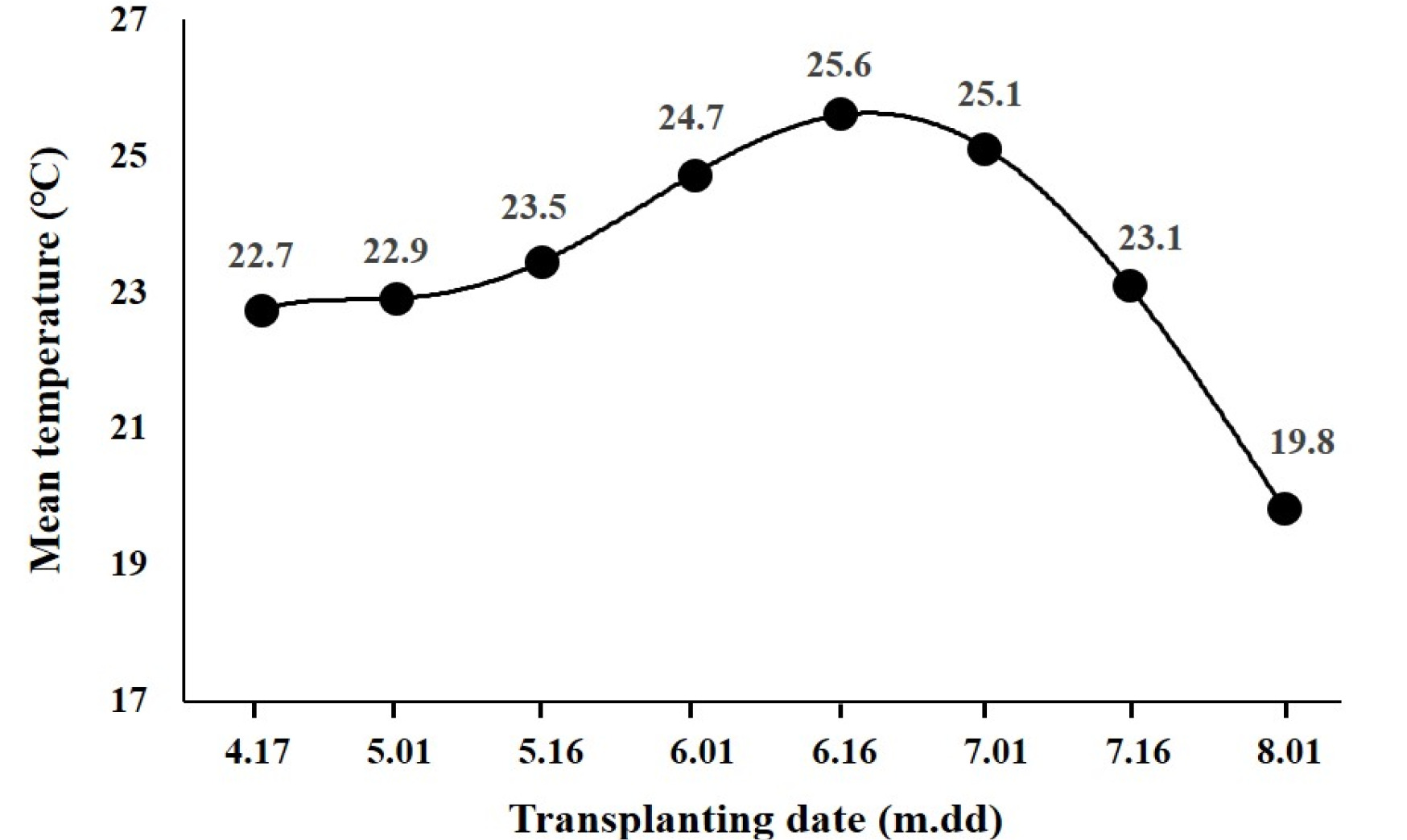
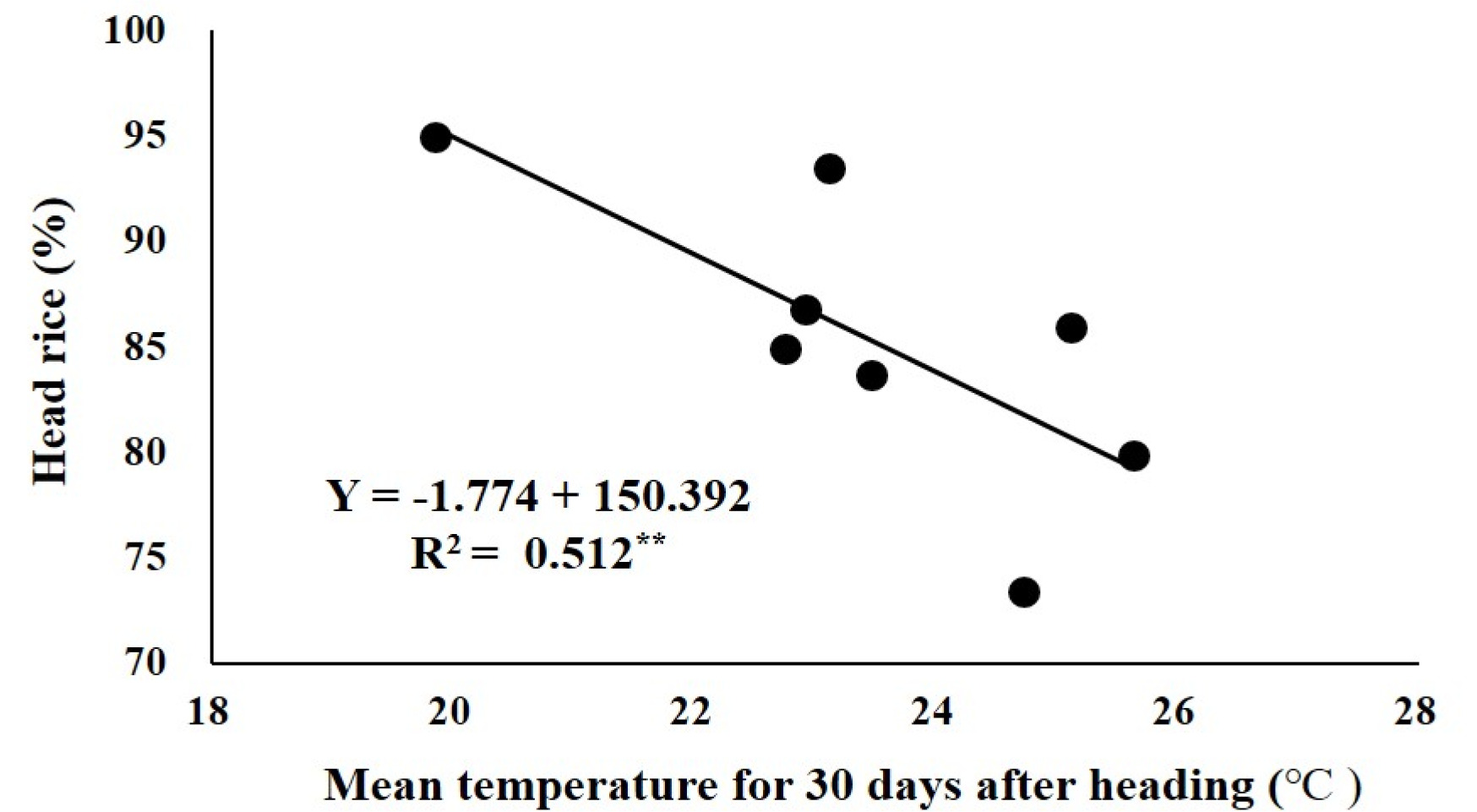
Choi et al. (2011)의 연구결과에 따르면 전국 27 개 지역의 벼의 등숙과 품질관련 형질에 대한 연구결과 출수 후 40일까지의 평균온도보다 30일간의 평균온도가 조사형질들의 변이를 더욱 잘 설명한다고 하였다. 따라서 ‘빠르미’ 이앙시기에 따른 등숙기간 평균온도와 외관품질과의 관계를 분석하기 위해, 이앙시기별 등숙기간(출수 후 30일)의 평균온도를 조사한(
Fig. 6) 후 등숙기간 평균온도와 완전립비율 간 상관분석을 진행하였다(
Fig. 7). 이앙시기에 따른 등숙기간 평균온도를 보면, 4월 17일부터 이앙이 늦어짐에 따라 22.7℃에서 조금씩 증가하기 시작하여 6월 16일 25.6℃로 가장 높았고, 이후 차츰 감소하기 시작하여 8월 1일 이앙에서는 19.8℃로 가장 낮아졌다. 등숙기간 평균온도와 완전립 비율과의 상관관계를 분석한 결과를 보면, 기존 연구결과와 동일하게 평균온도가 높아짐에 따라 쌀의 완전립 비율이 낮아지는 경향을 보였고 통계적으로 상관성이 인정되었다(
Jin et al. 2005,
Guo et al. 2011,
Cho et al. 2015,
Yang et al. 2015,
Yun et al. 2015). 따라서 조기에 이앙한 ‘빠르미’는 6월 중순 이앙보다 등숙기간 평균온도가 낮아 완전립 비율이 높은 것으로 판단할 수 있다.
출수기에 따른 등숙기간 평균온도
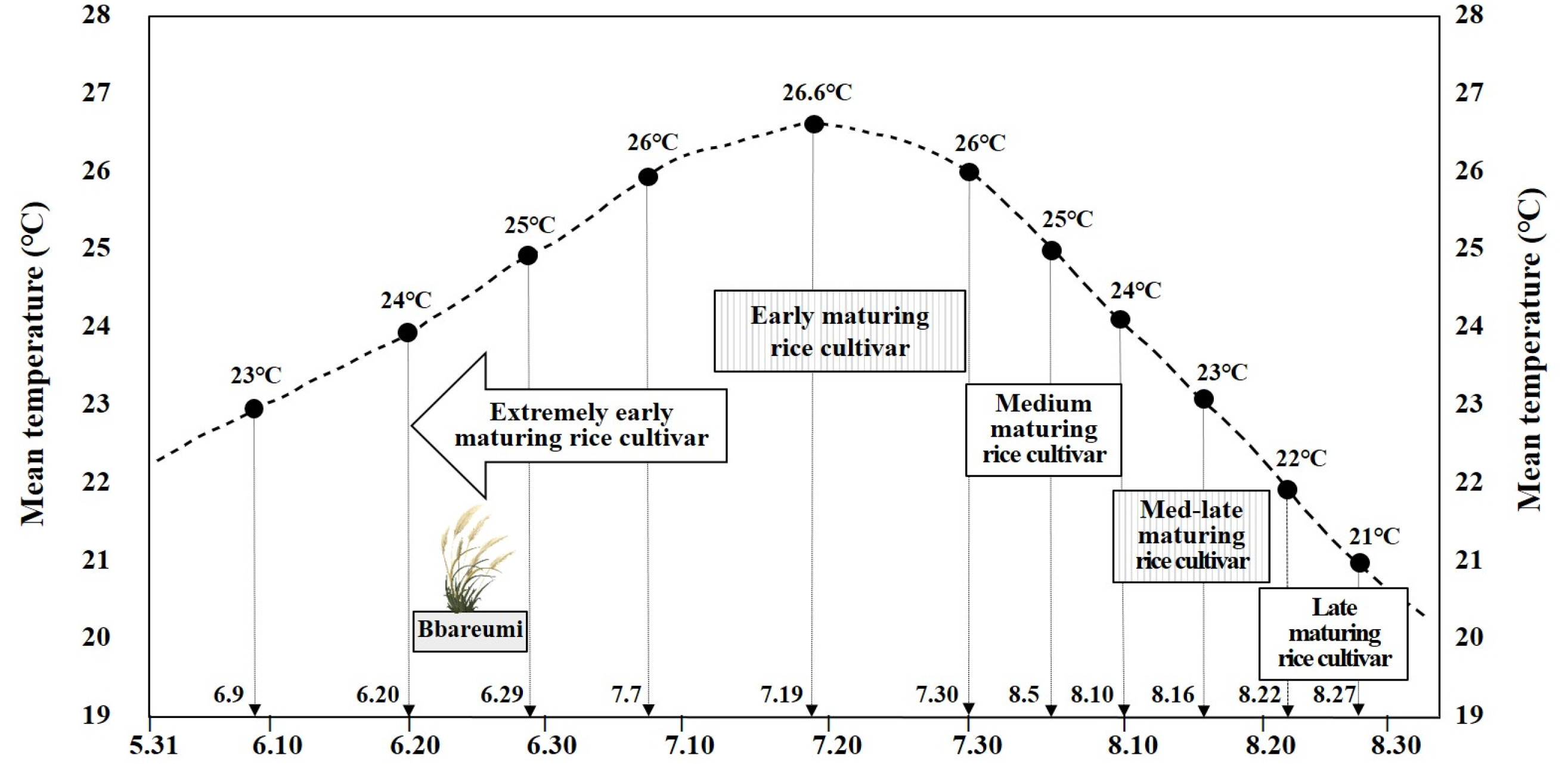
일반적으로 벼의 출수는 기본영양생장성, 감온성, 감광성에 따라 결정되며, 품종의 조만성은 출수기에 의해 결정되고 벼 품종별 조만성에 따라 극조생(Extremely early), 조생(Early), 중생(Medium), 중만생(Med-late), 만생(Late)으로 구분하고 있다. 충남 천안기상청의 10년(2012년~2021년) 평균기온을 이용하여 벼 출수기에 따른 등숙기간(출수 후 30일간)의 평균기온을 그래프로 나타내었고, 충남지역에서 벼 품종의 조만성에 따라 일반적으로 재배되는 이앙시기를 기준으로 극조생과 조생은 조기이앙(4월 하순~5월 상순), 중생종·중만생종·만생종은 보통기이앙(5월 하순) 한 경우의 출수기를 이용하여 조만성에 따른 출수 범위를 그래프에 표시하였다(
Fig. 8). 벼 등숙기간 평균온도는 23.0℃인 6월 9일부터 지속적으로 상승하여 7월 19일 26.6℃로 가장 높았고, 이후 차츰 감소하여 8월 27일 21.0℃로 낮아지는 경향을 보였다. 7월 19일을 기준으로 등숙기간 평균온도가 전환되는 경향을 보였는데, 6월 20일과 8월 10일에는 평균기온이 24℃로 동일하였고, 6월 29일과 8월 5일은 25℃로 같음을 알 수 있었다. 일반적으로 완전립 비율은 등숙기간 평균온도에 따라 많은 영향을 받기 때문에 7월 중·하순 출수가 되는 조생종 벼는 등숙기간 평균온도가 26℃ 이상으로 완전립 비율이 떨어지고, 8월 중순 이후에 출수가 되는 중만생종과 만생종은 평균온도가 23℃ 미만이므로 높은 완전립 비율을 예상할 수 있다. 극조생종 ‘빠르미’는 조기에 이앙하면 출수기가 6월 하순으로 등숙기간 평균온도는 25℃ 미만이 되어 조생종보다는 양호하고 중생종과 비슷한 수준의 외관품위를 기대할 수 있게 된다. 따라서 쌀의 외관품위는 출수기에 따른 등숙기간 평균온도를 기반으로 작성한
Fig. 8을 활용하면 설명이 가능한 부분이 많아진다. 조생종 운광을 평야지에서 조기에 이앙하면 7월 하순 출수되어 등숙기간 고온으로 쌀의 외관품질이 떨어지지만, 6월 중순 이앙하면 8월 15일경 출수되어 등숙기간 평균기온이 23℃ 이하로 낮아져 외관품질이 향상되며(
Choi et al. 2008,
CNARES 2009), 조생종 8품종을 조기이앙(4월 25일)과 보통기이앙(5월 25일)에 따른 수량과 품질변화를 비교한 결과, 조기 이앙으로 7월 15일 이전에 출수된 품종들은 7월 하순 출수 된 보통기이앙보다 등숙기간 평균기온이 낮았고 완전립 비율도 높은 경향을 보였다(
Yun et al. 2015).
일반적으로 동계작물 수확 후 6월 중순에 조생종을 이앙하면 8월 중순 출수되어 외관품질이 양호하지만, ‘빠르미’는 출수소요일수가 짧아 7월 하순 출수가 되어 등숙기간 고온으로 완전립 비율이 낮아진다. ‘빠르미’의 완전립 비율을 높이기 위해 7월 중순 이앙하면 8월 중순 출수가 되어 외관품질은 양호하지만, 단백질 함량이 높아져 식미가 떨어지는 다른 문제점이 발생하게 된다. 결론적으로 ‘빠르미’를 후작으로 이용한 이모작 재배시 수확에는 문제가 없지만, 고품질 쌀에 대한 소비자의 요구도가 높은 최근의 트렌드를 반영하면 바람직하지 못한 것으로 판단된다(
Yoshinobu et al. 2007,
Lee et al. 2012). 따라서 동계작물 수확 후 ‘빠르미’를 재배하는 방식이 아닌 ‘빠르미’를 조기에 재배하여 수확한 뒤 타작목을 재배하는 방식의 연구에 대해서도 접근해 볼 필요가 있다(
Yun et al. 2022b). 8월 1일 조파한 들깨의 수량성은 83 kg/10a로 6월 15일 파종한 들깨의 96 kg/10a 보다 15.7% 감소하였지만, 리놀센산 함유율이 64.8%로 10% 정도 높은 결과를 보였고(
Kwak et al. 2018), 가을감자 재배는 중부지방 8월 상순~중순, 남부지방 8월 중순~9월 상순에 파종을 권장하고 있다(
RDA 2018). ‘빠르미’ 수확 후 동일한 논에 타작목을 재배한 연구결과에 따르면, 일반재배 대비 옥수수(미백2호)의 수량성은 879 kg/10a로 90%, 다유 들깨는 54.9% 수준으로 나타났다(
CNARES 2021). 이러한 연구결과들을 종합적으로 판단해보면, 8월 상순 논 재배에 적합한 작물과 품종을 선발하고 재배법이 개발된다면 농업인은 고가에 햅쌀 원료곡을 판매하고 추가적인 농산물 생산으로 농업소득을 높이면서 국가적인 차원에서는 단위면적당 곡물생산량 증대를 통해 식량안보에도 기여할 수 있을 것으로 판단한다.
조생종 품종들의 가장 큰 문제는 등숙기 고온으로 외관품질이 떨어지는 것이다(
Nagara et al. 2004,
Lee et al. 2008,
Lin et al. 2010,
Yun et al. 2016). 극조생종 ‘빠르미’의 경우 7월 중순 이앙하면, 8월 17일 출수되어 적온에서 등숙되므로 외관품위는 좋아질 수 있지만, 단백질 함량이 높아지는 문제점이 발생하게 되어 식미가 떨어지게 된다. 하지만 6월 내 출수가 되면 등숙기간 평균온도가 25℃ 이하가 되므로 7월 하순경 출수되는 조생종 벼 품종보다 외관품질이 양호해지면서 생육초기 저온으로 총 생육기간이 늘어나 단백질 함량이 낮아지는 효과로 품질이 양호한 원료곡을 생산할 수 있었다. 따라서 단백질 함량이 낮으면서 완전립 비율도 양호한 ‘빠르미’ 원료곡 생산이 가능한 이앙시기는 4월 하순~5월 상순으로 예상할 수 있다.
본 연구결과 극조생종 벼는 생육기간이 짧아 다양한 작물과의 이모작에 유리할 순 있지만, 이앙이 늦어짐에 따라 단백질 함량이 증가하여 식미가 떨어지는 문제점이 발생할 수 있어 관련 연구가 더욱 필요할 것으로 판단된다. 또한 6월 내 출수가 이루어지는 극조생종 벼는 7월 하순 출수가 되는 조생종 대비 등숙기간 평균온도가 낮아져 외관품질을 향상시킬 수 있다는 것을 제시함으로써 기후변화에 대응한 극조생종 벼 품종개발시 유용한 자료로 활용될 수 있을 것이다. 결론적으로 극조생종 벼를 활용한 이모작 활성화를 위해서는 이앙시기에 따라 품질변이가 적으면서 양호한 수량성을 가진 신품종개발과 재배기술 연구가 지속적으로 추진되어야 할 것이다.
적 요
본 연구는 극조생종 ‘빠르미’ 벼 이앙시기에 따른 출수기 등 생육과 품질특성을 파악하여 적정 이앙시기를 설정하고 이모작 활성화를 위한 자료로 활용하고자 4월 17일부터 8월 1일까지 약 15일 간격으로 총 8회에 걸쳐 2019년과 2020년 2회에 걸쳐 이앙하였다. 이앙시기에 따라 ‘빠르미’의 출수기는 6월 23일부터 9월 2일까지 71일 차이가 발생하였으며, 4월 17일과 5월 1일 조기이앙에서는 각각 6월 23일과 6월 24일로 비슷하였고, 5월 15일 이앙부터 약 15일 정도 이앙이 늦어짐에 따라 출수기는 8일~16일 늦어지는 경향을 보였다. 수량성은 5월 1일 이앙에서 5.61 MT/ha로 가장 높았으며, 이앙이 늦어짐에 따라 감소하는 경향을 보이다가 8월 1일 이앙에서 3.65 MT/ha 가장 낮았다. 따라서 4.00 MT/ha 이상의 수량성을 확보하기 위해서는 7월 중순까지, 5.00 MT/ha 이상의 수량성을 기대하기 위해서는 6월 상순까지는 이앙해야 하는 것으로 나타났다.
질소시비량이 동일한 조건에서 이앙시기에 따른 단백질 함량의 차이는 등숙기간 보다 이앙 후 출수기까지 기간이 더 큰 영향을 미친다(R2=0.802**)는 결과를 알 수 있다. 완전립 비율은 4월 17일~5월 16일 이앙에서 84~87%수준이었으며, 6월 1일~6월 16일은 74~80%로 낮아졌고, 7월 1일 이후에는 86~95%로 높아지는 경향을 보였다. 완전립 비율이 가장 높은 이앙시기는 8월 1일로 95%를 나타냈으며, 6월 1일 이앙에서는 73.5%로 가장 낮았다. 단백질 함량이 낮으면서 완전립 비율도 양호한 ‘빠르미’ 원료곡 생산이 가능한 이앙시기는 4월 하순~5월 상순으로 예상할 수 있다.
극조생종 벼는 생육기간이 짧아 다양한 작물과의 이모작에 유리할 수 있지만, 이앙시기가 늦어짐에 따라 단백질 함량 증가로 식미가 낮아지는 문제점이 발생할 수 있어 이앙시기에 따른 품질변이가 적은 신품종이 개발되어야 이모작 활성화가 가능할 것이다. 또한 본 연구에서 6월 내 출수가 이루어지는 극조생종은 7월 하순 출수가 되는 조생종 대비 등숙기간 평균온도가 낮아져 외관품질을 향상시킬 수 있다는 것을 제시함으로써 기후변화에 대응한 극조생종 벼 품종개발시 유용한 자료로 활용될 수 있을 것이다.
사 사
본 연구는 충청남도농업기술원 시험연구사업(과제명: 극조생 벼 신품종 안정재배 기술개발, 과제번호: LP0042352020)의 지원으로 수행된 결과입니다.
Fig. 1Daily temperature during rice growing season in the average of ten years from 2012 and 2021. Black, gray, and broken lines indicate mean air temperature, maximum, and minimum temperature, respectively. Data were obtained from the website of the Korean Meteorological Administration (
https://www.weather.go.kr).
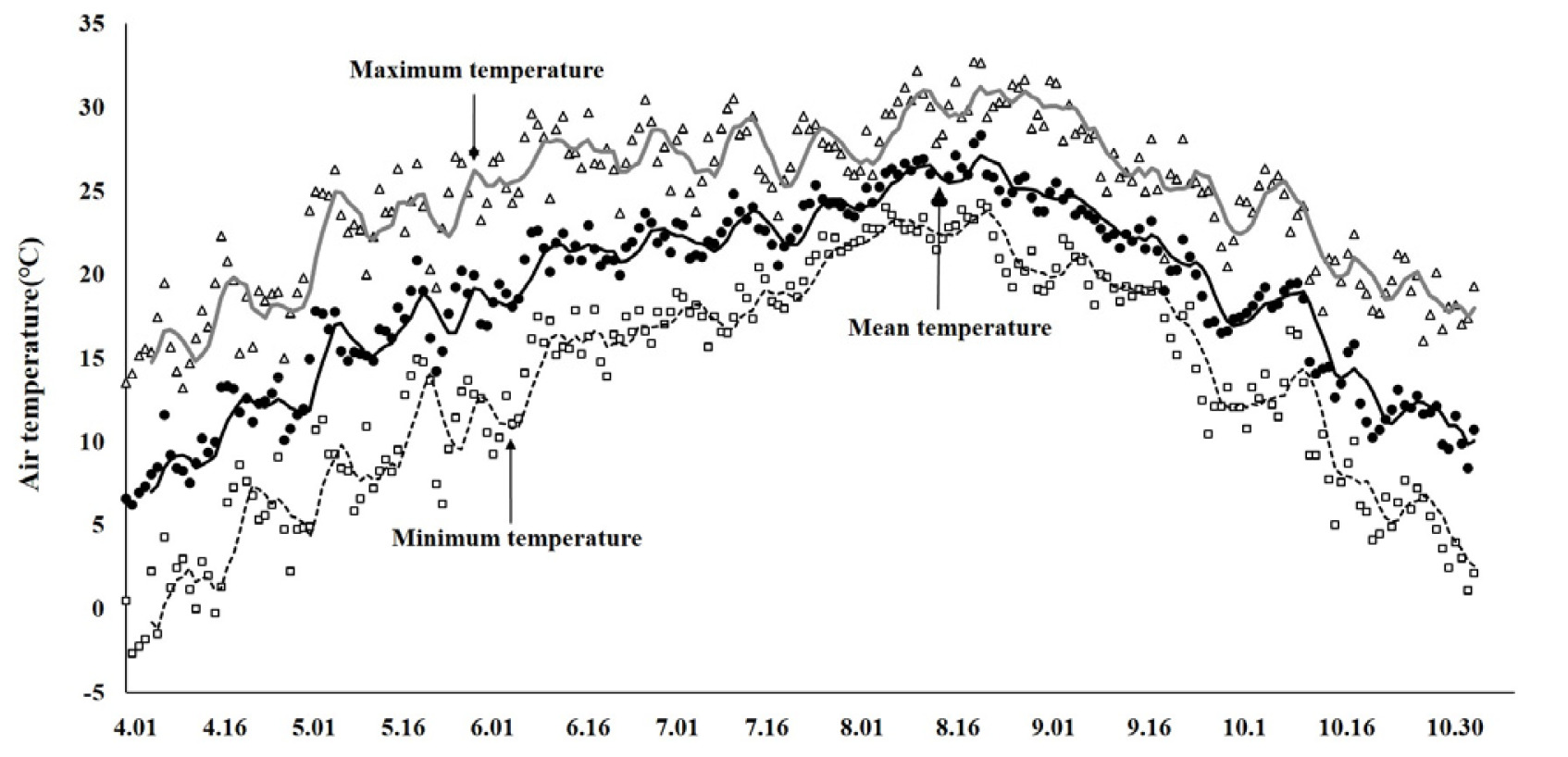
Fig. 2Changes of plant growth according to the transplanting dates. ‘Bbareumi’ was transplanted on 4.17(A), 5.01(B), 5.17(C), 6.01(D), 6.16(E), 7.01(F), 7.16(G), 8.01(H), respectively. PH: plant height, TN: Tiller number per plant. Each data point is the mean of 2 years.
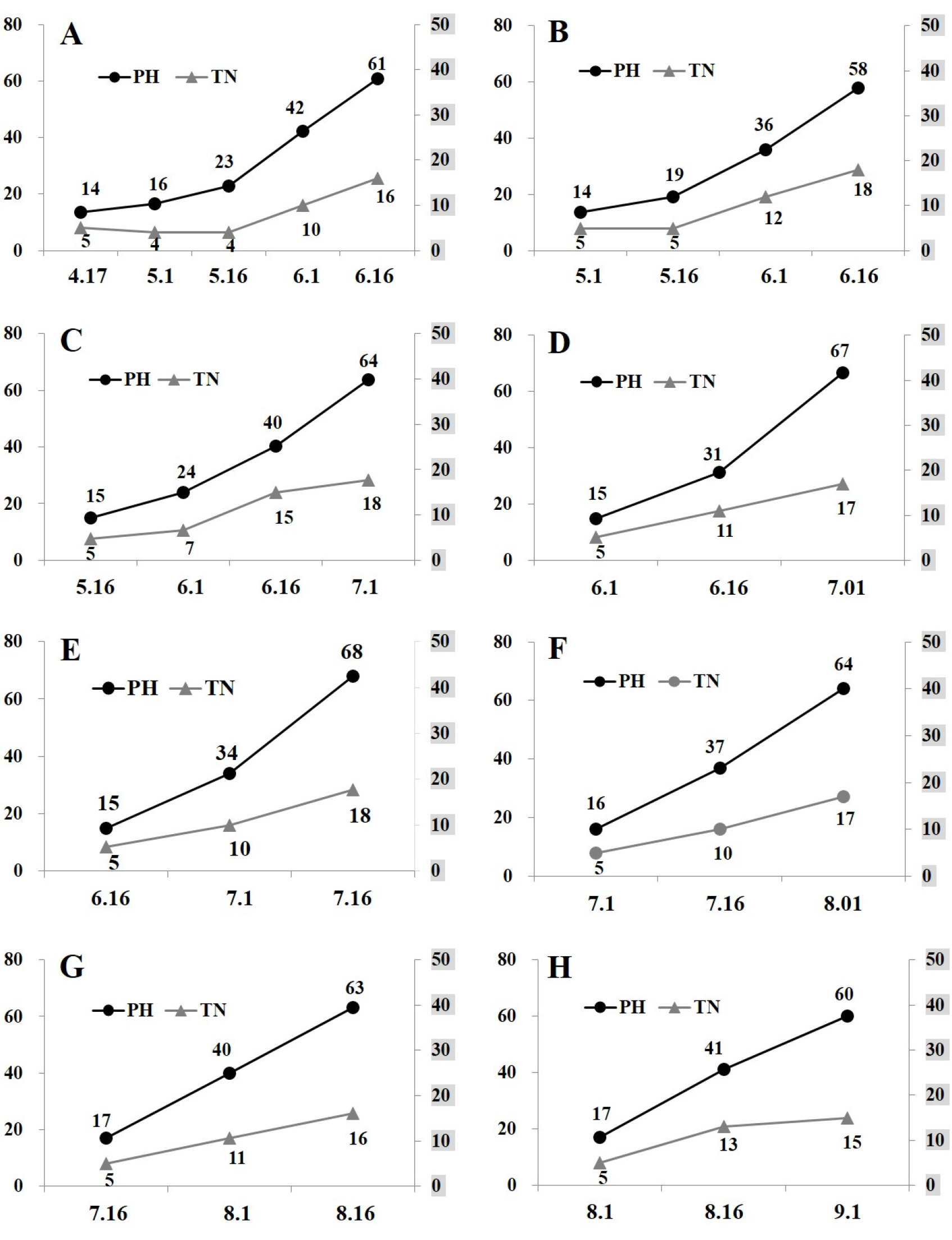
Fig. 3Days to heading and accumulated temperature from transplanting to heading according to transplanting dates. DTH: Days to heading after transplanting. ATTH: Accumulated temperature from transplanting to heading. Data of heading date and mean temperature for 2 years from 2019 to 2020 were used, and each data point is the mean of 2 years.
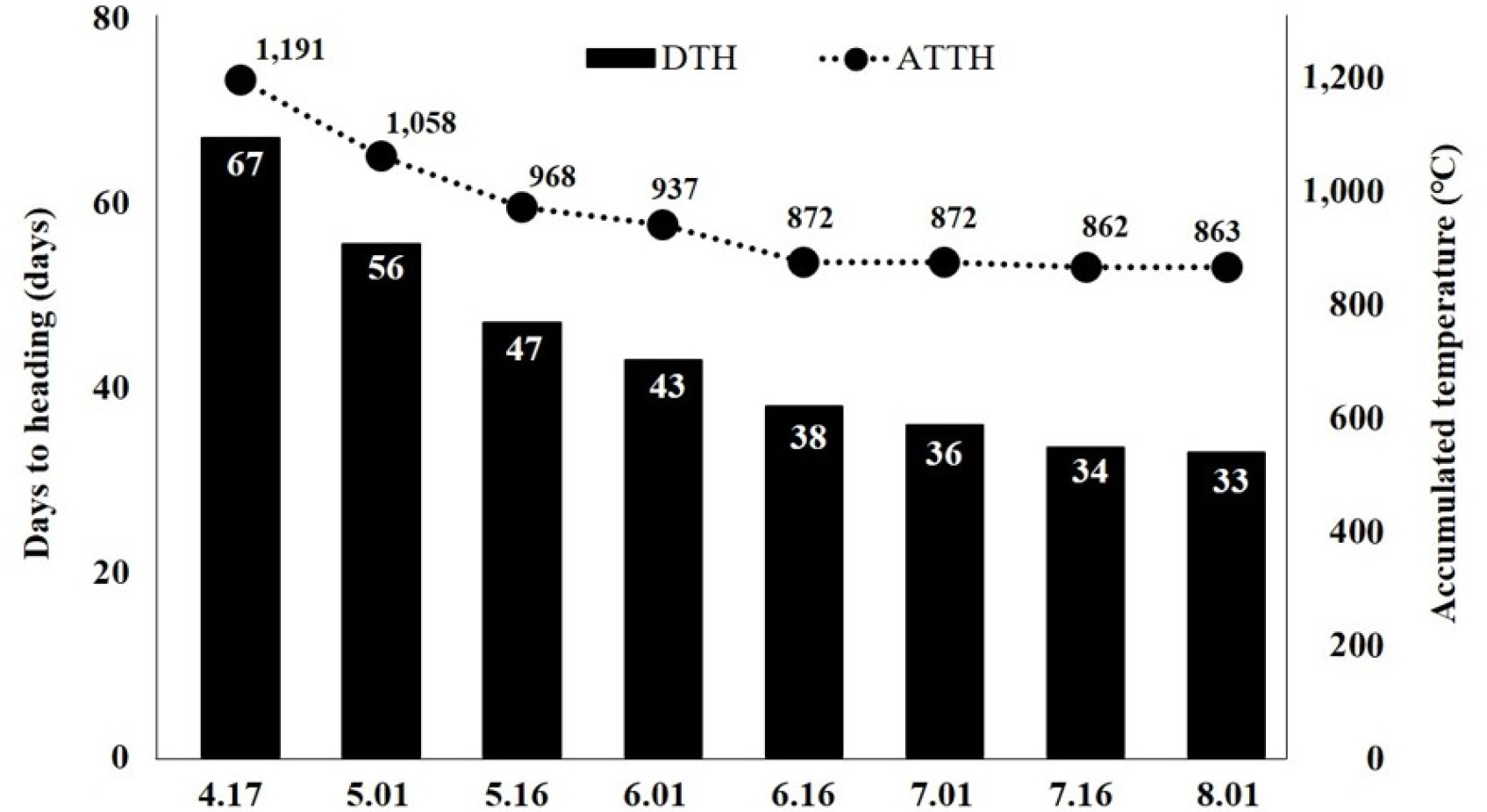
Fig. 4Milled rice yield of ‘Bbareumi’ according to the transplanting dates. Each data is the mean of 2 years. Numbers followed by the same letter in each column are not significantly different based on Duncan’s multiple range at p<0.05.
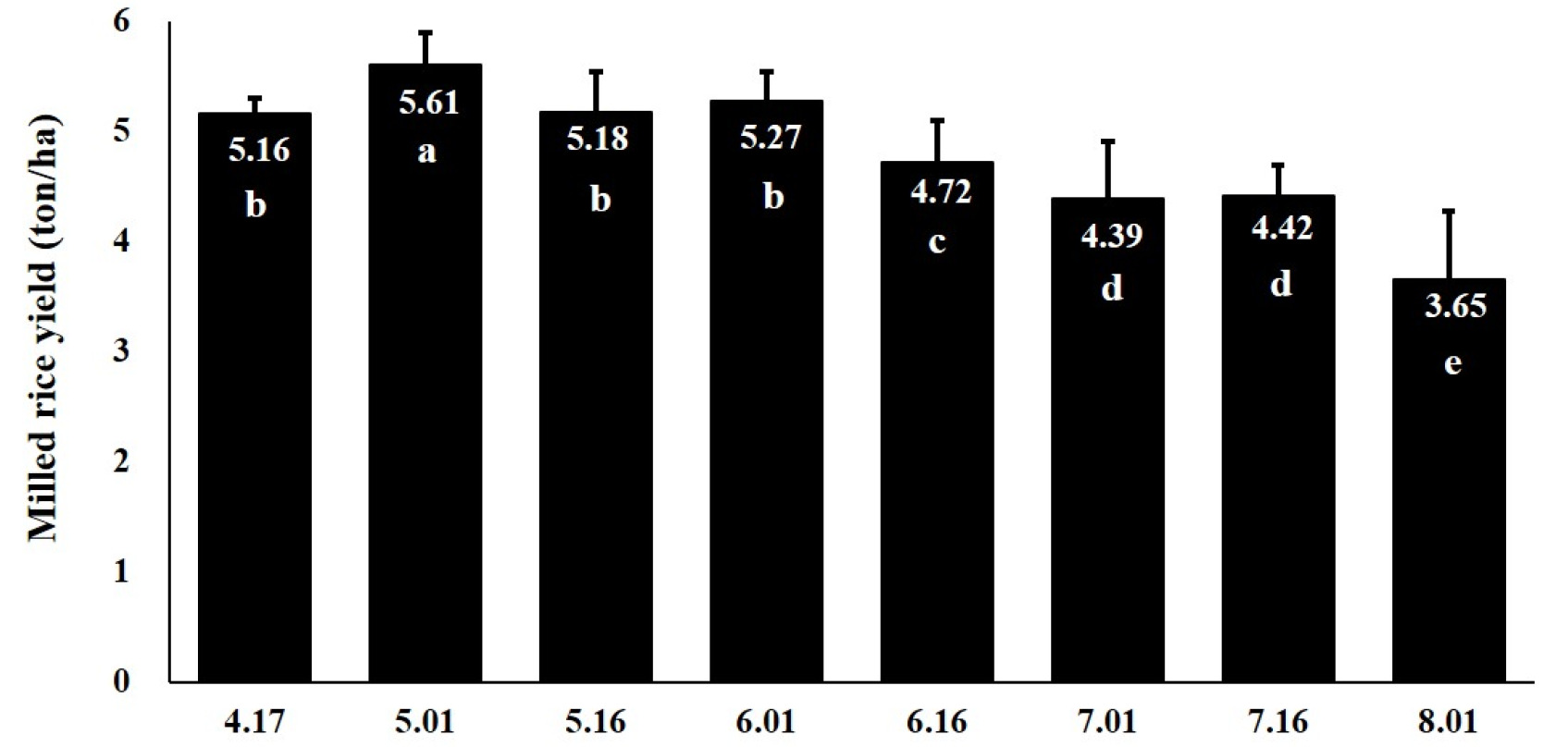
Fig. 5Correlation between protein content and growing periods of ‘Bbareumi’ (A: Number of days from transplanting to heading, B: Number of days from heading to harvest, C: Number of total growing period). Harvest was determined when accumulated temperature reached to 1,000℃ after heading. Each data point is the mean of each year. **: significant at p<0.01, ns: not significant.
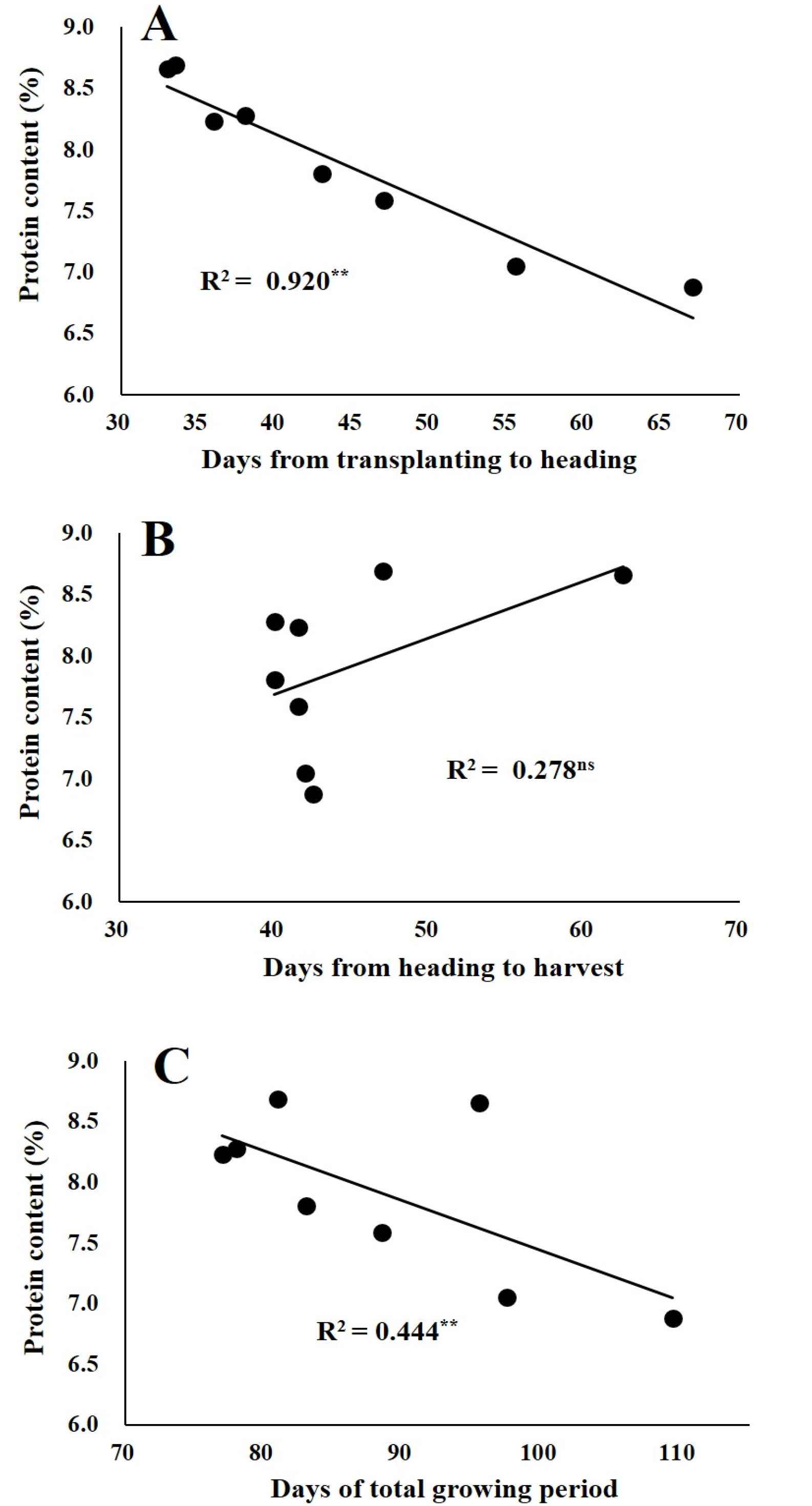
Fig. 6Mean temperature during ripening stage (30days after heading) according to the transplanting dates. Data of heading date and mean temperature for 2 years from 2019 to 2020 were used, and each data point is the mean of 2 years.
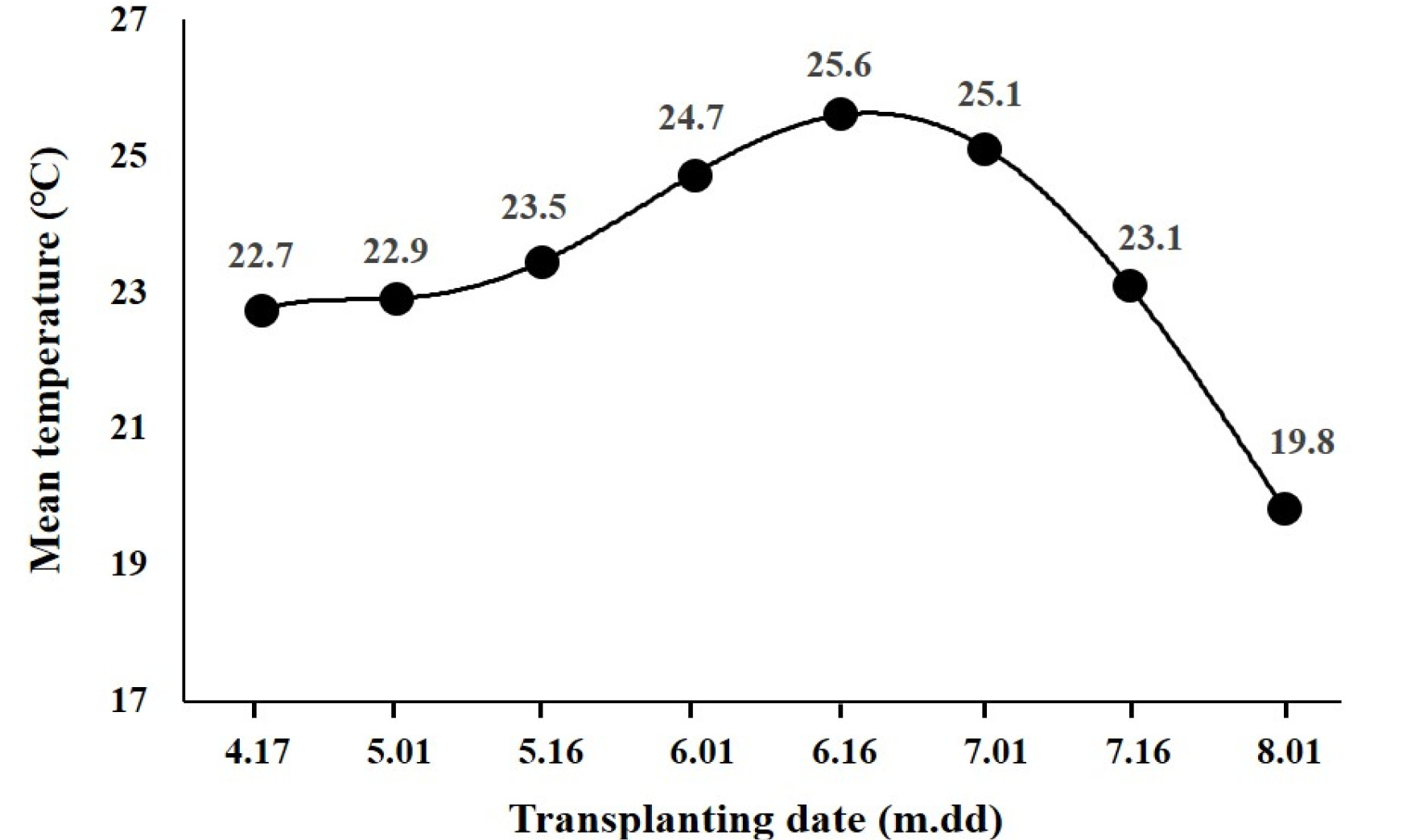
Fig. 7Correlation between mean temperature during ripening stage (30days after heading) and head rice percentage. Data of head rice percentage and mean temperature for 2 years were used, and each data point is the mean of each year. **: significant at p<0.01.
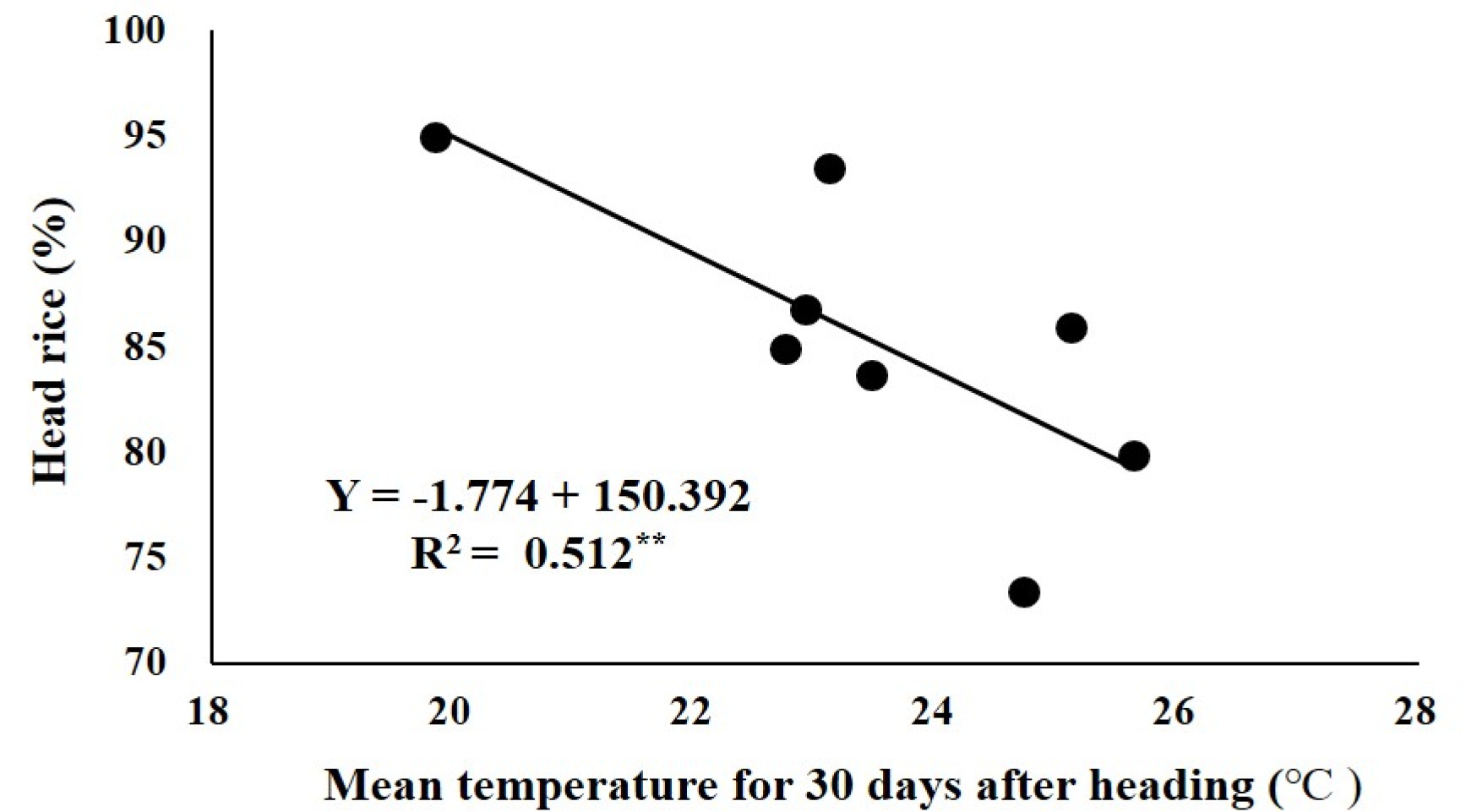
Fig. 8Mean air temperature for 30 days after heading in the Chungnam plain area. Data for 10 years from 2012 to 2021 were obtained from the website of the Korean Meteorological Administration (
https://www.weather.go.kr). Heading date of extremely early and early maturing rice cultivar was indicated based on early transplanting (Late April to early May). Heading date of medium, medium-late and late maturing rice cultivar was indicated based on normal transplanting (Late May).
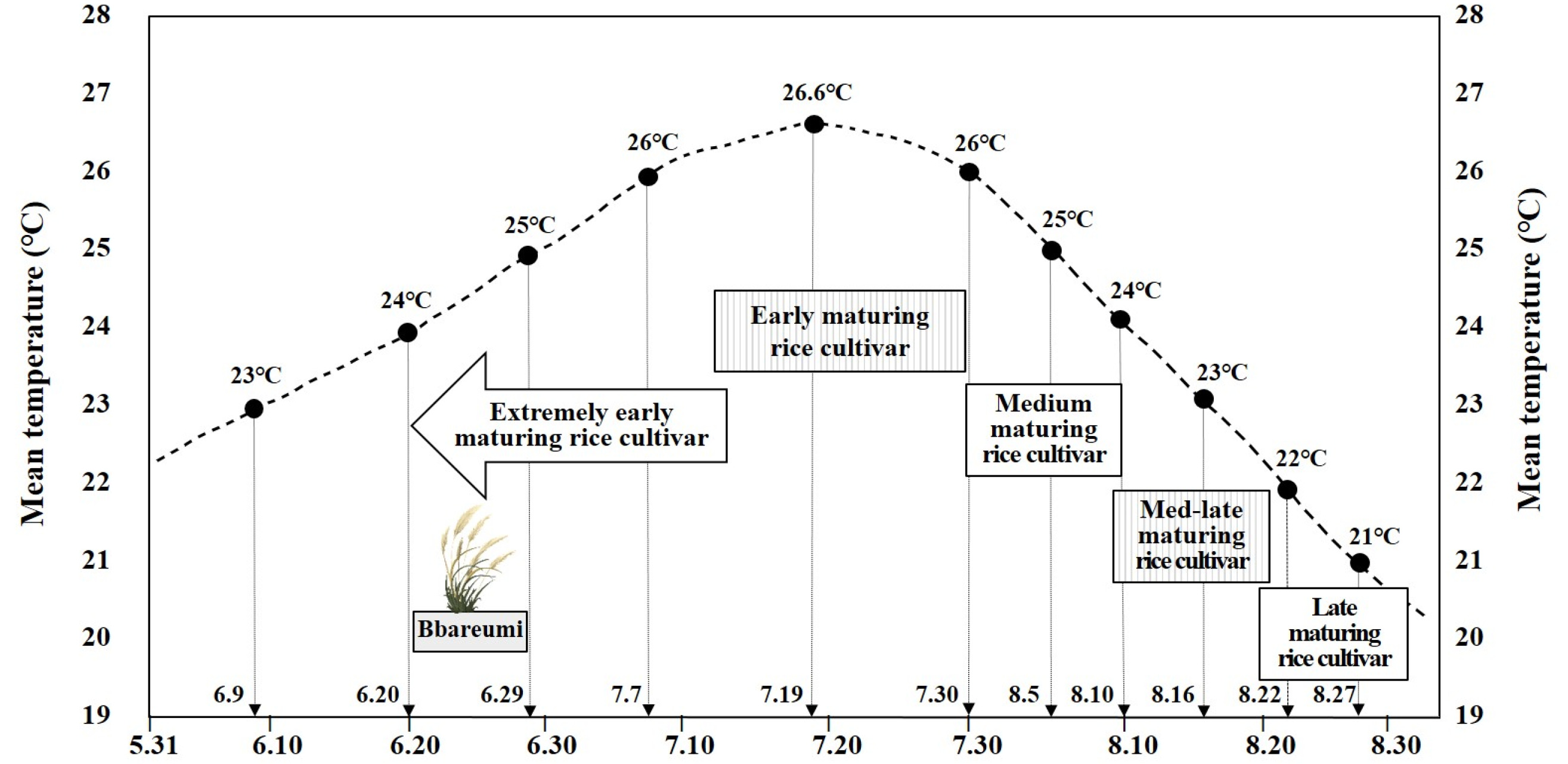
Table 1Growth of ‘Bbareumi’ according to the transplanting dates.
Table 1
|
T.Dz
(m.dd) |
Heading date
(m.dd) |
Culm length
(cm) |
Panicle length
(cm) |
No. of panicle (ea/plant) |
No. of spikelet |
Ripened grain
(%) |
1,000 grains weight (g) |
|
ea/panicle |
ea/m2
|
|
4.17 |
6.23 |
64.7b |
18.8a |
13.6c |
87.0a |
32,974b |
79.5ab |
20.4a |
|
5.01 |
6.24 |
66.0ab |
19.0a |
15.8a |
81.5b |
35,828a |
81.7a |
20.1ab |
|
5.16 |
7.02 |
67.1a |
18.8a |
15.4ab |
82.6b |
35,439a |
77.3b |
20.0ab |
|
6.01 |
7.13 |
68.5a |
18.9a |
16.1a |
80.5b |
36,053a |
76.3b |
20.3a |
|
6.16 |
7.23 |
65.6ab |
18.6a |
16.0a |
80.2b |
35,658a |
76.3b |
20.5a |
|
7.01 |
8.04 |
61.7c |
17.7b |
14.9b |
78.8bc |
32,618b |
77.2b |
19.8b |
|
7.16 |
8.17 |
60.8c |
17.9b |
14.2c |
76.7c |
30,229c |
78.5ab |
19.7b |
|
8.01 |
9.02 |
57.6d |
16.8c |
12.2d |
71.9d |
24,302d |
67.2c |
19.3c |
Table 2Protein content of ‘Bbareumi’ according to the transplanting dates.
Table 2
|
Transplanting dates (m.dd) |
4.17 |
5.01 |
5.16 |
6.01 |
6.16 |
7.01 |
7.16 |
8.01 |
Protein content
(%) |
6.9e |
7.1d |
7.6c |
7.8c |
8.3b |
8.2b |
8.7a |
8.7a |
Table 3Appearance traits of ‘Bbareumi’ according to the transplanting dates.
Table 3
Transplanting date
(m.dd) |
Appearance traits (%) |
|
Head |
Chalky |
Broken |
Damaged |
|
4.17 |
85.0b |
9.6c |
5.1a |
0.3d |
|
5.01 |
86.8b |
10.1c |
2.7bc |
0.4cd |
|
5.16 |
83.7b |
11.8bc |
3.9ab |
0.6b |
|
6.01 |
73.5d |
24.1a |
2.0cd |
0.5b |
|
6.16 |
79.9c |
15.2b |
4.1ab |
0.8a |
|
7.01 |
86.0b |
12.7bc |
1.1d |
0.3d |
|
7.16 |
93.5a |
4.3d |
1.5cd |
0.7a |
|
8.01 |
95.0a |
3.7d |
0.8d |
0.5bc |
References
- 1. Cho SW, Jeong JU, Kang KH, Kim HS, Kim BK. 2015. Evaluation on early-maturing Korean Japonica cultivars for high-temperature tolerance during grain filling stage. Korean J Crop Sci 60: 146-152.
- 2. Choi KJ, Park TS, Lee CK, Kim JT, Kim JH, Ha KY. 2011. effect of temperature during grain filling stage on grain quality and taste of cooked rice in mid-late maturing rice varieties. Korean J Crop Sci 56: 404-412.
- 3. Choi WY, Kim JH, Back NH, Choi MG. 2005. Optimum transplanting date for production quality rice in Honam plain area. Korean J Crop Sci 50: 435-441.
- 4. Choi WY, Kim SS, Ku BI, Choi MG, Park HK, Kim YD, Lee KS, Kim KG. 2008. Changes of rice yield and quality of "Unkwangbyeo" as affected by transplanting date in Honam plain area. Korean J Intl Agri 57: 231-234.
- 5. Chungcheongnam-do Agricultural Research and Extension Services (CNARES)2009. Report of experiment and research 88-95.
- 6. Chungcheongnam-do Agricultural Research and Extension Services (CNARES)2011. Report of experiment and research 71-78.
- 7. Chungcheongnam-do Agricultural Research and Extension Services (CNARES)2021. Report of experiment and research 35-39.
- 8. Cruz RPD, Milach SCK, Federizzi LC. 2006. Inheritance of rice cold tolerance at the germination stage. Genetics and Molecular Biology 29: 314-320. doi: 10.1590/S1415-47572006000200020.
- 9. Guo T, Liu XL, Wan X, Weng J, Liu S, Liu X, Chen M, Li J, Su N, Wu F, Cheng Z, Guo Z, Guo X, Lei C, Wang J, Jiang L, Wan J. 2011. Identification of a stable quantitative trait locus for percentage grains with white chalkiness in rice (Oryza sativa L.). J Intergr Plant Biol 53: 598-607.
- 10. Jin ZX, Qian CR, Yang J, Liu HY, Jin XY. 2005. Effect of temperature at grain filling stage on activities of key enzymes related to starch synthesis and grain quality of rice. Rice Sci 12: 261-266.
- 11. Kim CS, Lee JH, Kwak DY, Jeon MG, Kang JR, Yeo US, Shin MS, Oh BG. 2008. Changes of milling quality of rice varieties according to the transplanting time and good resources with high milling quality in Yeongnam plain paddy. Korean J Crop Sci 53(S):1-8.
- 12. Kim JI, Choi HC, Kim KH, Ahn JK, Park NB, Park DS, Kim CS, Lee JY, Kim JK. 2009. Varietal response to grain quality and palatability of cooked rice influenced by different nitrogen applications. Korean J Crop Sci 54: 13-23.
- 13. Kim YB, Yang J, Yoon ST. 2019. Wheat-rice double cropping system in rice fields of the Cheonan area for the production of domestic wheat. Korean J Crop Sci 64: 234-245.
- 14. Korea Statistics (KOSTAT)2022. SDGs in the Republic of Korea: Progress Report 2022 25-27.
- 15. Korean Statistical Information Service (KOSIS). 2022. Available from:https://kosis.kr/statHtml/statHtml.do?orgId=101&tblId=DT_1EB001&vw_cd=MT_ZTITLE&list_id=K1_15&scrId=&seqNo=&lang_mode=ko&obj_var_id=&itm_id=&conn_path=MT_ZTITLE&path=%252FstatisticsList%252FstatisticsListIndex.do. Accessed June 23rd, 2022
- 16. Kwak SK, Han WY, Ryu JS, Bae JW, Park JS, Baek IY. 2018. An establishment of the optimum sowing time for a machine harvest of Perilla for seed. Korean J Int Agric 30: 370-375.
- 17. Lee JH, Choi JH, Kim SY, Lee JY, Kim CS, Yeo US, Song YC, Shon YB, Oh MK, Kang HW, Nam MH. 2012. Correlation analysis between head rice ratio and agronomic traits in RILs for developing a promising rice cultivar adaptable to the early-transplanting cultivation. Korean J Crop Sci 57: 1-6.
- 18. Lee JH, Park DS, Kwan DY, Yeo US, Song YC, Kim CS, Jeon MG, OH BG, Shin MS, Kim JG. 2008. Yield and grain quality of early maturing rice cultivars as affected by early transplanting in Yeongnam plain area. Korean J Crop Sci 53: 326-332.
- 19. Lee KB, Jun DK, Chae JC. 2003. Effect of nitrogen fertilization on quality characteristics of rice grain and aroma-active compounds of cooked rice. Korean J Crop Sci 48: 527-533.
- 20. Lin CJ, LI CY, Lin SK, Yang FH, Huang JJ, Liu YH, Lur HS. 2010. Influence of high temperature during grain filling on the accumulation of storage proteins and grain quality in rice (Oryza sativa L.). J Agric Food Chem 58: 10545-10552.
- 21. Nagara K, Takita T, Yoshinaga S, Terashima K, Fukuda A. 2004. Effect of air temperature during the early grain-filling stage on grain fissuring in rice. Japan J Crop Sci 73: 336-342.
- 22. Rural Development Administration (RDA).2012. Standard of analysis and survey for agricultural research. pp. 315-338.
- 23. Rural Development Administration (RDA).2018. Standard textbook for agronomy; Potato. pp. 157-161.
- 24. Seong DG, Kim YG, Yun SM, Kim HC, Lee JJ, Kim CS, Chung JS. 2022. Studies on how changing the transplanting time affects rice quality and yield. Korean J Breed Sci 54: 177-183.
- 25. Shimono H, Hasegawa T, Iwama K. 2002. Response of growth and grain yield in paddy rice to cool water at different growth stages. Field Crops Res 73: 67-79.
- 26. Yang WH, Choi KJ, Shon JY, Kang SG, Shin SH, Shim KB, Jung HY, Jang JH, Jung JS, Lee CY, Yun YT, Kwon SJ, An KN, Shin JH, Bae SM. 2015. Effects of temperature and sunshine hours during grain filling stage on the quality-related traits of high quality rice varieties in Korea. Korean J Crop Sci 60: 273-281.
- 27. Yang WH, Kim MK, Kang SG, Park JH, Kim SJ, Choe JS, Yang CIm Baeg NH. 2017. Changes in flowering date and yielding characteristics affected by transplanting date in the early-maturing rice cultivar 'Joun' in the mid-northern inland of Korea. Korean J Crop Sci 62: 304-310.
- 28. Yang WH, Park JH, Choi JS, Kang SG, Kim SJ. 2019. Yield characteristics and related agronomic traits affected by the transplanting date in early maturing varieties of rice in the central plain area of Korea. Korean J Crop Sci 64: 165-175.
- 29. Ye C, Fukai S, Godwin I, Reinke R, Snell P, Schiller J, Basnayake J. 2009. Cold tolerance in rice varieties at different growth stages. Crop Pasture Sci 60: 328-338.
- 30. Yoshinobu T, Nonoue Y, Ebitani T, Suzuki K, Aoki N, Sato H, Ideta O, Hirabayashi H, Hirabayashi M, Ohta H, Nemoto H, Kato H, Ando I, Ohtsubo K, Yano M, Imbe T. 2007. QTL detection for eating quality including glossiness, stickiness, taste and hardness of cooked rice. Breeding Sci 57: 231-242.
- 31. Yu CJ, Um JB, Ko HS, Park SY. 2020. Profitability analysis based on cropping system of the land use changes in paddy field. Journal of Korea Academia-Industrial Cooperation Society 21: 216-222.
- 32. Yun YT, Chung JT, Lee YJ, Na HJ, Lee JC, Lee DH, Lee KW, Kang JW, Ahn SN. 2015. Variation of yield and quality in early maturing rice cultivars by transplanting date in Chungnam plain area in Korea. Plant Breed Biotech 3: 47-57.
- 33. Yun YT, Chung CT, Lee YJ, Na HJ, Lee JC, Lee SG. 2016. QTL mapping of grain quality traits using introgression lines carrying Oryza rufipogon chromosome segments in japonica rice. Rice 9: 62. doi: 10.1186/s12284-016-0135-0.
- 34. Yun YT, Chung CT, Kim GC, Kim BR. 2022a. Improving efficiency and effectiveness of disinfection by soaking seeds before rice seed disinfection. Korean J Crop Sci 67: 137-146.
- 35. Yun YT, Chung CT, Kim GC, Yun TS. 2022b. 'Bbareumi', an extremely early-maturing rice cultivar adaptable for early transplanting, in the Chungnam plain area. Korean J Breed Sci 54: 238-243.