적요
Climate change caused by global warming, is predicted to have severe consequences for ecosystems and economic sectors. In the agricultural industry, it is predicted that there will be decreased crop yields resulting from shifting planting seasons, as well as higher temperature and water stress which significantly reduce crop productivity. Kimchi cabbage, a cold-loving plant, is particularly vulnerable to high-temperature stress which can lead to stunted growth, increased susceptibility to pests like soft rot, reduced yield, and lower quality that will negatively impact the Kimchi cabbage market. Kimchi cabbage can be cultivated in highland regions with low summer temperatures and reduced pest occurrence, but rising temperatures and water stress are expected to increase pest pressure, resulting in a rapid decrease in the potential cultivation area of Kimchi cabbage. Currently, research is being conducted around the world to identify physiological mechanisms of heat tolerance at the molecular level, selection of heat-tolerant material, and studies on cellular responses of plants under high-temperature conditions. Despite numerous studies on physiological and biochemical responses of Brassica crops to high temperatures, there is a need to develop heat-tolerant Kimchi cabbage cultivars that can adapt to rapidly changing climates, new strategies for pest control under high-temperature conditions, and mitigation measures to ensure stable cultivation and production.
서언
배추는 한국의 주요 부식 채소로 생육 초기의 적정온도는 18-20℃, 결구기인 생육 후기의 적정온도는 15-18℃인 호냉성 채소이며, 고온에 의해 생육이 저하되거나 생산량이 감소하는 경우가 있어 온도는 배추 재배에 큰 영향을 미치는 요소이다. 현재 세계적인 이상기후로 인한 고온은 배추의 생육, 품질, 수량, 재배 작기의 변동 이외에도 바이러스 및 병해충 발생 가능성을 높이며 여름철 서늘한 기온을 이용하는 고랭지 배추 재배에서는 현재보다 높은 곳으로 재배지가 이동하고 있으며 고랭지 배추 재배지 면적이 감소할 것으로 전망되어 안정적인 배추 수급에 영향을 미칠 것이다. 이러한 지구온난화의 문제점이 대두되면서 기후변화 및 고온이 작물에 미치는 영향에 대한 연구가 활발하게 이루어지고 있다. 배추의 고온 스트레스에는 고온으로 인한 광합성, 물질대사, 호르몬 신호 전달 등의 생리적 과정의 저하 및 단백질의 변성, 합성 저해 및 분해 등의 복합적 요인이 작용하며 이를 극복하기 위해서는 내서성 품종 생산 및 재배 기술 연구 등 여러 방면에서 연구개발이 필요하다. 또한, 지구온난화로 인해 고랭지 배추 재배지의 온도가 상승하여 병해충 피해도 늘어날 전망으로 이에 대한 대비책이 시급하다. 본 논문은 이상기후로 인한 고온이 배추 재배에 미치는 영향과 재배 환경의 변화 및 피해에 대한 정보를 제공하고 이에 대한 대비와 새로운 재배 기술 연구 및 내서성 품종의 개발을 위한 배추의 고온 스트레스 반응 등에 대해 정리, 기술하였다.
기후변화로 인한 국내 배추 재배 현황
한국의 대표적인 부식 채소 중 하나인 배추(
Brassica rapa subsp.
pekinensis)는 김치의 주재료로 활용되며 국내 가을배추 재배면적은 2023년 기준 13,152 ha, 전체 배추 생산량은 약 2,191,000 ton이다. 배추는 성분의 90-95%가 수분으로 이루어져 있으며 적정 발아온도는 20-25℃, 생육에 적합한 온도는 20℃ 전후로 온도에 적응할 수 있는 범위가 좁은 것으로 알려져 있다(
Angadi et al. 2000,
Kim et al. 2008,
Mahmud et al. 1999). 이와 같이 배추는 호냉성 작물로 구분되며 대부분의 품종은 일평균 기온이 25℃를 초과하면 결구가 형성되지 않는다(
Wi et al. 2020). 고령지농업연구소(National Institute of Highland Agriculture, NIHA)에 따르면 여름 배추의 파종 시기는 5월부터 7월 하순, 수확시기는 7월부터 10월 상순까지로, 여름철 고온기에는 일반 평지 지역에서의 배추 재배가 어려워 서늘한 고랭지 지역(해발 600 m 이상)에서 배추 재배가 이루어지고 있으며(
NIHA 2000), 단기간 내에 고소득을 얻을 수 있는 작물로 인식되어왔다. 또한, 서늘한 고랭지에서 재배하는 특성 때문에 각종 병해충에 의한 피해를 줄이기 위한 방제 연구가 수행되었고, 일반적인 병충해에 내성을 지닌 품종이 개발되면서 준고랭지 지대(해발 400-600 m)까지 재배면적이 증가되었다(
Jeon et al. 2005,
Lee & Kim 2008,
NIHA 2000,
Yun et al. 2005).
국내 고랭지 배추는 주로 강원도, 전라북도, 경상북도에서 재배되고 있으며, 주산지인 강원도에서 국내 총생산량의 90% 이상이 재배되고 있다. 하지만 기후변화에 따른 온도 상승으로 고랭지 배추의 재배가 점차 어려워져 재배면적이 줄어드는 추세이며, 특히 최근 10여 년간 재배면적은 절반 가까이 감소하였으며 남부지역의 고랭지 지역은 기온상승으로 인해 재배 감소 폭이 크고, 이로 인한 강원도 지역의 고랭지 배추 재배에 대한 의존도가 높아지고 있다(
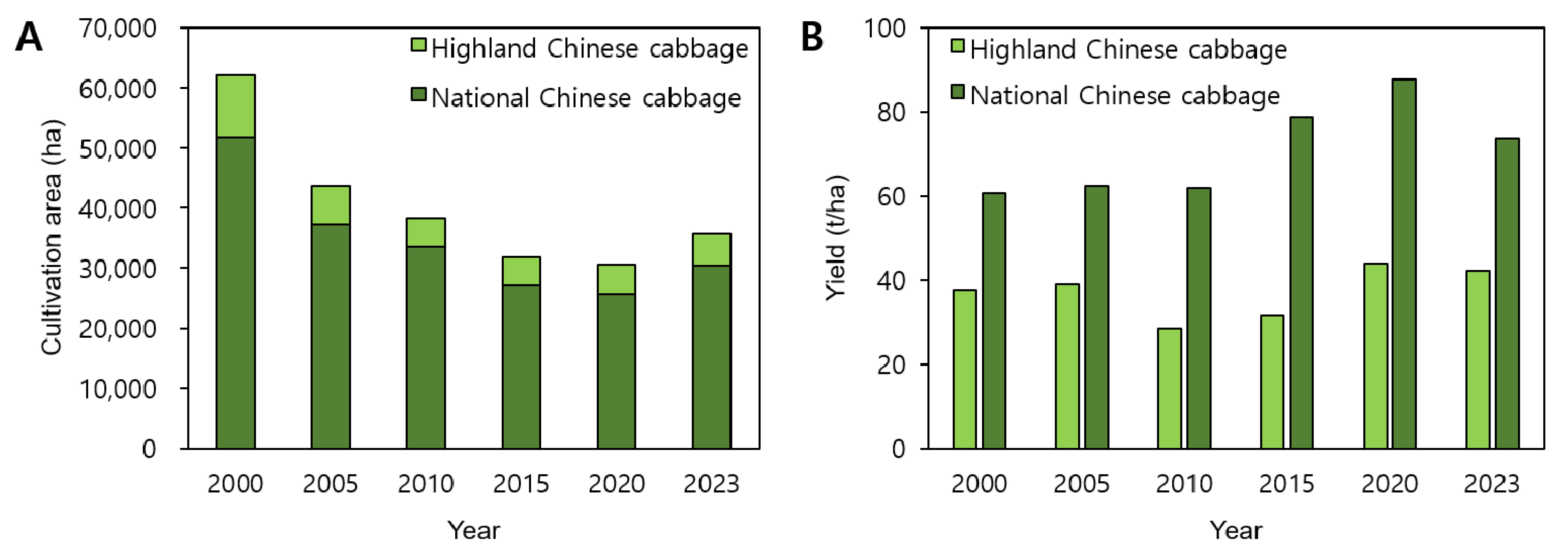
KREI 2014). 고랭지 배추의 재배면적은 1990년대(9,302 ha), 2000년대(7,713 ha), 2010년대(4,985 ha), 그리고 2021년 4,824 ha에 이르기까지 지속적으로 재배면적이 감소하는 추세이고(
KOSIS 2024,
KREI 2022,
Lee & Heo 2018) (
Fig. 1A), 주산지인 강원도 내 재배면적도 2022년 기준 4,069 ha로 2020년도의 4,423 ha에서 감소하였고 생산량 또한 281,280 ton (2000년)에서 197,148 ton (2020년)으로 지속적인 감소 추세를 보이고 있다(
KOSIS 2022,
KREI 2022). 여름철 배추 재배는 고온 및 다습으로 인한 생리장해와 병해충 발생 등으로 고랭지 지역에서 집중적으로 재배되기 때문에 고랭지 지역에 가뭄이나 집중 호우 시, 배추의 품질 저하와 시장가격에 큰 영향을 미친다(
Hwang et al. 2003). 농촌진흥청은 기후변화로 인해 연평균 기온이 2℃ 이상 오르게 되면 고랭지 배추의 안전 재배 지역이 20,626 ha에서 6,314 ha로 감소할 것으로 예측한 바 있다(
RDA 2006). 배추의 단위 면적당 생산량은 화학 비료 및 재배 기술의 발달로 인해 2000년(60.8 ton/ha), 2010년(62.1 ton/ha) 그리고 2020년(87.6 ton/ha)로 꾸준히 증가하였으나, 고랭지 배추의 단위 면적당 생산량은 2000년의 37.7 ton/ha에 비하여 2005년 39.1 ton/ha로 증가하였다가 2010년 28.4 ton/ha와 2015년 31.8 ton/ha로 감소하는 등, 단위 면적당 불안정한 생산량을 보이고 있다(
KOSIS 2024,
KREI 2022) (
Fig. 1B).
현재 국내 배추는 생산량에 따른 가격변동이 매우 심한 작물로, 10% 생산량 차이로 약 3배 가격까지 차이가 발생하는 작물이다(
Lee & Heo 2018). 또한, 잦은 이상기상 발생으로 인한 큰 생산량 변동은 불안정한 배추 시장의 주요 원인으로 여겨지고 있다. 세계기상기구(World Meteorological Organization, WMO)는 2023년 지구의 평균 기온은 1850-1990년의 평균보다 약 1.45℃ 높았다고 보고하였고, 기후변화에 관한 정부 간 협의체(Intergovernmental Panel on Climate Change, IPCC)는 인류의 온실가스 배출로 인해 지구온난화가 야기되었으며 2011-2020년의 10년 평균 지구 표면 온도는 1850-1990년 산업화 이전 기준치보다 1.1℃ 높은 것으로 추정하였다(
IPCC 2023).
이와 같이 지구온난화는 식물의 생육에 직접적인 영향을 미치며 이는 곧 식량 문제와 직결되어 전 세계적으로 심각한 문제가 되고 있다(
Oh et al. 2014). 현재 전 세계적인 고온 스트레스로 인해 농작물들의 손실이 발생하고 있고, 우리나라 또한 온대 기후에서 점차 아열대 기후로 변하면서 지역별 재배되는 농작물이 바뀌고 있는 상황이다(
Oh et al. 2014). 특히 노지 작물인 배추는 기상 요인에 직접적으로 노출되어, 이상기상에 따른 생장 지연, 생리장해 발생 등이 생산량 및 품질 저하의 주요 원인으로 알려져 있다(
Lee et al. 2014).
국내 배추의 내서성 및 고온 스트레스
농작물의 재배에 있어 기후조건은 생산량 및 품질에 지대한 영향을 끼치는 중요한 환경 요인 중 하나이다. 지구온난화로 인한 이상기후 현상은 농작물 생산에 부정적인 영향을 미치고(
Baldocchi & Wong 2008,
Luedeling et al. 2009,
Theurillat & Guisan 2001) 지역별 기후변화에 따라 주요 작물의 주산지 또한 점차 이동하고 있다(
Kim et al. 2010,
Kim & Lee 2017). 기후는 작물 생장에 중요한 요인으로 각 생육단계에 미치는 영향이 크며(
Lee et al. 2008) 기온, 강수량과 일조량 등은 작물의 생육과 형태, 생⋅화학적 반응에 영향을 미친다(
Hosoi & Tamagata 1973,
Moe & Guttormsen 1985,
Rosen et al. 2005). 온도는 식물 재배환경에 영향을 미치는 가장 중요한 변수 중 하나로 다양한 방식으로 작물의 성장과 수확량에 영향을 주며(
Fu et al. 2012,
Lopez & Dejong 2007,
Mazurczyk et al. 2003), 온도에 따라 생육 양상 및 생리적 반응이 크게 달라지고(
Son et al. 2015) 온도가 일정 수준보다 높거나 낮으면 고온 또는 저온 스트레스를 받게 된다(
Oh et al. 2014). 이와 같이 각 농작물 생산은 기상환경 조건에 따라 작황이 결정되고(
Lee & Kim 2008), 그중 고온은 식물의 잎, 줄기 분화, 뿌리를 포함한 식물의 생장 및 최종 생산량에 제한적인 요소로 영향을 미친다(
Wahid et al. 2007).
배추는 호냉성 채소로 서늘한 기후를 선호하고 고온에 취약한 작물이지만(
Lagerctantz & Lydiate 1996), 생육 초기 단계에서는 대기 온도의 +4℃와 +7℃의 환경조건은 엽수, 엽길이 및 결구 형성 등에 긍정적 결과를 초래하나 수확 단계에서는 생체중 감소 및 무름병 발생 증가를 야기한다는 보고가 있다(
Oh et al. 2014). 정상 생육을 방해하는 요인 중, 온도 및 수분 조건이 가장 큰 문제이며, 고온 스트레스는 작물의 생육을 방해하여 재배 단계에서 피해를 입힌다(
Hwang et al. 2003,
IPCC 2001,
Mckersie & Leshem 1994,
Thomashow 1998). 고온에 노출된 식물의 경우, 온도가 식물체 내성 한계에 가까워질수록 식물 세포의 항상성을 낮추고 식물체의 생장 및 발달을 저해해 심할 경우 죽음에까지 이르게 한다. 특히 배추는 같은
Brassica 속의 식물들보다 고온에 민감하며, 심한 고온 스트레스는 치명적인 세포 손상을 유발하여 세포의 사멸을 초래한다(
Yang et al. 2006). 배추는 생육 적온인 20℃보다 높은 기온에서 고온 스트레스를 받으면 결구 형성에 영향을 받고, 무름병(soft-rot disease)의 원인이 되는 세균(
Erwinia carotovora subsp.
carotovora)의 감염으로 생산량 감소 및 품질 저하가 나타나며(
Angadi et al. 2000,
Jiao et al. 2004,
Kim et al. 2008,
Morrison 1993,
Opeña et al. 1988,
Thomashow 1998), 밤 온도가 상승한 상태에서는 줄기가 좁고 잎이 짧으며 생체량과 엽록소 함량, 평균 종자 무게가 감소한다(
Schwanberg et al. 2023). 배추의 결구는 배춧잎이 여러 장으로 겹쳐서 둥글게 속이 드는 것으로, 결구가 잘 되어있는 배추일수록 시장에서 상품성이 높지만, 고온이 배추의 결구 형성과 생육 저하를 유도하여 상품성을 떨어뜨린다(
Kang et al. 2002). 또한 배추는 결구 개시기에 많은 수분을 필요로 하므로, 결구 시기에는 토양이 건조하지 않은 상태를 유지하는 것이 중요하다(
Angadi et al. 2000,
Erickson & Markhat 2002,
Kim et al. 2008).
고온 스트레스에 의한 배추 세포 손상 및 사멸 가능성(
Oh et al. 2014), 생육 저하와 결구 불량(
Lee et al. 2009), 석회 흡수 패턴과 Heat Shock Protein (HSP)의 발현(
Hwang et al. 2003), 그리고 갓을 40℃ 이상 고온처리 시 생육과 엽록소 함량이 20% 이상 감소된다는 연구(
Hayat et al. 2009)가 있으며, 식물의 스트레스에 대응하는 long noncoding RNA (lncRNA)가 고온 시 배추에서 빠르게 발현되며 그 경로에 관여하는
HSP 유전자와 유사한 패턴을 보여 고온 스트레스 내성에 기여하고(
Song et al. 2021), 배추의 microRNA (miRNA) 분석을 통해 배추의 스트레스 적응과 내성에 miRNA의 중요한 역할을 확인한 연구(
Ahmed et al. 2019)와 같은 유전자 발현 조절 연구가 보고되고 있다. 또한, 고온 스트레스 환경에서 내서성 배추 품종인 ‘268’의 Peroxidase (POD), Superoxide dismutase (SOD) 등의 항산화효소 발현이 증가하여 reactive oxygen species (ROS) 제거에 기여하고(
Zhang et al. 2022), 또 다른 내서성 배추 품종인 ‘XK’에서 내서성에 핵심적인 기능을 할 것으로 기대되는
NAC069 유전자의 발견(
Wang et al. 2016) 등 내서성 품종을 활용한 연구 결과들이 있다. ROS는 식물의 성장과 발달, 생물적 또는 비생물적 스트레스의 지표로 활용될 뿐만 아니라 신호 분자로 다양한 대사물질과 높은 상관관계가 있다(
Baxter et al. 2014,
Oukarroum et al. 2015).
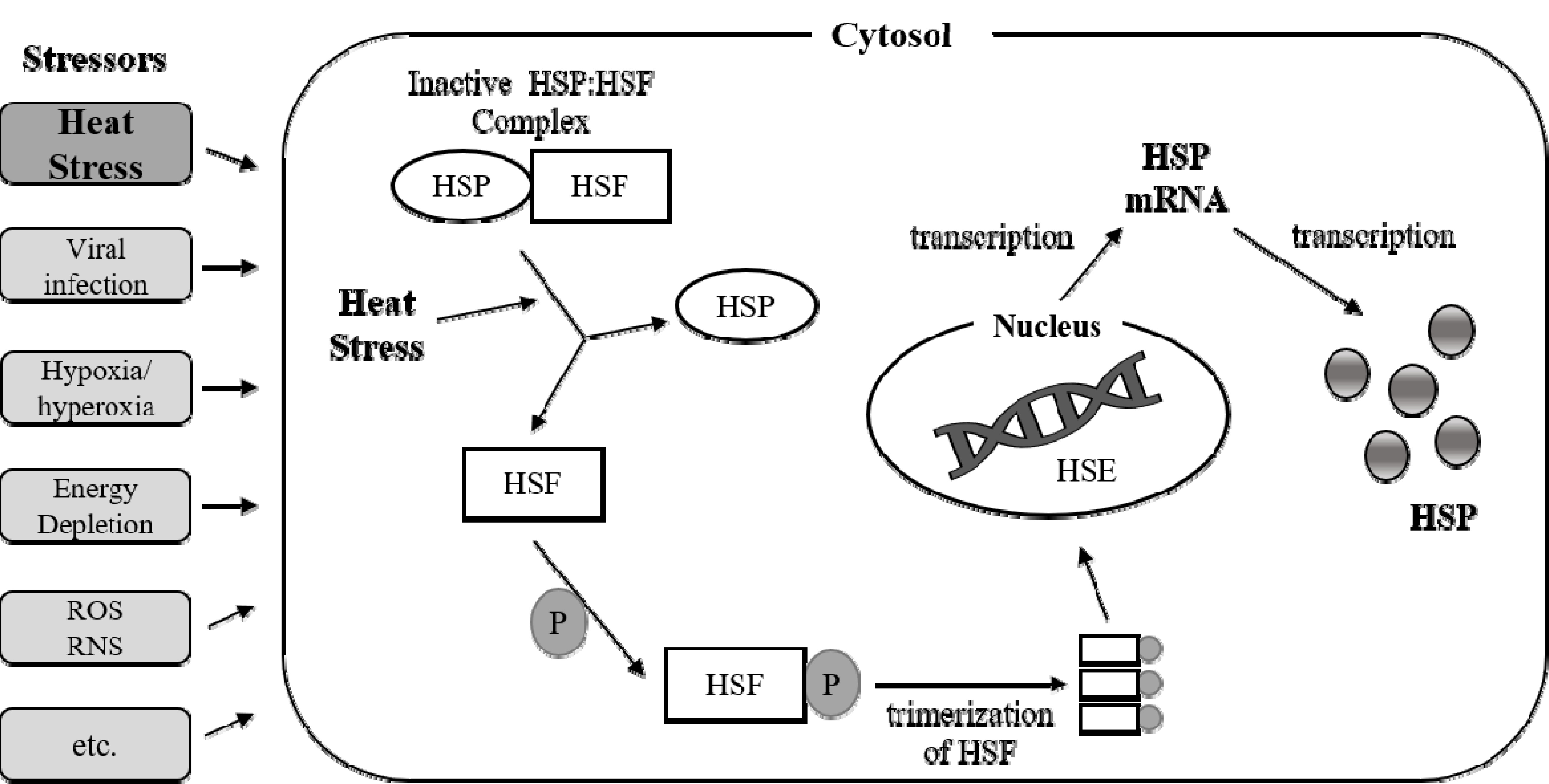
HSP 전사는 열충격 전사 인자(Heat Shock Transcription Factors, HSFs)에 의해 조절되는데, 고온 스트레스를 받으면 세포질의 HSP, HSFs 복합체가 분리되고 HSFs가 인산화되어 삼량체를 형성하여 핵으로 이동한 뒤,
HSP 전사를 위한 특정 DNA 염기 서열에 결합함으로써
HSP가 발현된다고 알려져 있다(
Al-Whaibi 2011,
Khan et al. 2021,
Morimoto 1993,
Richter et al. 2010) (
Fig. 2).
Li et al. (2023)이 수행한 다양한 고온 처리시간에 대한 배추의 생리학적 변화와 전사 프로파일링 분석 결과에서, SOD, Catalase (CAT), POD 활성이 점진적으로 증가하였으며, 잎의 CAT 활성과 Hydrogen peroxide (H
2O
2) 함량은 고온 4시간 처리에서 가장 높았고 12시간 처리에서 감소하였으며 1,241개의 발현 유전자가 고온 처리시간과 관련이 있는 것으로 보고되었다. 이처럼 온도와 가뭄 스트레스로 인한 배추과 작물의 생리⋅생화학적 반응에 대한 다양한 연구가 있지만, 복합적인 환경에서 세포, 생리적 반응 및 생육장애에 대한 연구는 부족한 실정이다(
Lee et al. 2015). 뿐만 아니라 내서성 배추 품종의 개발과 연구가 오래전부터 진행되고 있지만, 현재의 기후변화에 적응하고 대응할 수 있는 품종 또한 부족하다. 이와 같이 지구온난화로 인해 우리나라의 고랭지 배추 재배면적 및 생산량이 점차 감소하는 시점에서 배추의 안정적인 재배와 생산을 위해 내서성 배추의 품종 개발과 육종, 생리장해와 관련된 연구를 통해 피해 평가 기준과 대응 기술 개발이 필요한 실정이다(
Lee et al. 2009).
고온 조건하의 세포 신호전달
식물의 고온 민감성
식물체의 고온에 대한 민감성은 영양생장부터 생식생장 단계에 걸쳐 다양하게 나타난다. 고온은 식물체의 세포 항상성을 방해하고, 증산과 증발을 증가시켜 탈수 현상을 일으키며, 싹과 뿌리의 성장 억제 등 생장 과정의 심각한 생육 부진을 초래한다. 또한, 광합성, 물질대사, 호르몬 신호전달 등 여러 생리 과정을 저해하며 단백질, 세포막 및 세포 구조 등의 안정성을 파괴하고(
Lee et al. 2018), 잎, 줄기 및 뿌리를 포함한 식물의 생장과 최종적 작물 생산량에 제한적 요소로 영향을 미친다(
Wahid et al. 2007). 특히 대부분의 식물체 조직들은 생육환경의 온도가 45℃ 이상 이를 경우 고온 스트레스를 받고, 일정 시간 이상 노출되면 죽게 된다(
Levitt 1980). 유채의 경우, 낮 기온 30℃, 밤 기온 25℃에서 발아율, 종자 활력, 천립중이 유의미하게 감소하였고(
Rashid et al. 2018) 순무에서도 고온에서 노출 시간이 길어질수록 종자의 품질이 낮아지는 것으로 나타났다(
Khan et al. 2005). 이러한 고온에 의한 장해는 기온이 올라가고 토양이 건조됨에 따라 식물체는 증산작용에 의해 일부 양분이 과도하게 축적되어 유발된다고 알려져 있으며 가뭄, 기온상승, 양분과잉 및 결핍 등의 복합적 원인들로 나타난다(
Shin et al. 2007). 식물은 환경의 변화로부터 생존하기 위해 스트레스에 대한 반응 기작을 가지고 있으며(
Kim et al. 2014), 고온에 저항하기 위해 생리적, 분자적 조절 메커니즘을 사용한다(
Guan et al. 2013,
Song et al. 2014). 이러한 반응은 POD, CAT 및 SOD와 같은 유리기 제거 효소(Free Radical Scavenging Enzymes, FRSEs)의 활성 증가와 Malondialdehyde (MDA), 유리 아미노산(free amino acids), 수용성 당(Soluble Sugar, SS), 프롤린(Proline)의 축적으로 열 스트레스로 인한 피해를 효과적으로 줄일 수 있다(
Bita & Gerats 2013). 또한 식물체는 기온상승에 반응해 스트레스 관련 단백질이 급격하게 변화를 일으키는데, 분자생물학적 연구에 따르면 여러 개의 열 센서(heat sensor), 식물호르몬, 샤페론(chaperones) 및 2차 대사산물과 관련한 네트워크가 보고되었고(
Locato et al. 2009), HSP (
Pareek et al. 1995), ATPase (
Jiao et al. 2004), Glutathione S-transferase (
Edwards et al. 2000,
Mang et al. 2004) 등의 단백질이 발현된다고 알려져 있다. 고온 스트레스는 광계II (Photosystem II)와 같은 광합성에 관여하는 단백질 복합체에도 직⋅간접적으로 손상을 입히며(
Takahashi & Murata 2008,
Yoshioka et al. 2006), 고온에 노출된 작물은 광합성량의 감소로 인하여 생산량이 줄어든다(
Oh et al. 2014). 틸라코이드막에 존재하여 명반응의 시작이 일어나는 다중 단백질 복합체인 광계II는 온도가 높아질수록 불활성도가 증가하여 광합성을 위한 전자전달에 쓰이는 에너지가 감소됨으로써 고온 스트레스에 취약해진다(
Oh et al. 2014). 이러한 광계II의 반응을 분석하기 위해 엽록소 형광 분석을 활용함으로써 식물의 고온 스트레스에 대한 생리적 반응 및 광합성 기구의 활성에 대한 정보를 제공한다고 알려져 있다(
Strasser & Strasser 1995).
내서성과 고온 민감성의 배추 유전자 발현 분석은 고온 스트레스의 표지로 활용될 수 있으며, 내서성 품종을 선택할 수 있는 지표를 제공하는 동시에 육종에 필요한 정보를 제공할 수 있다.
Eom et al. (2021)은 RNA-sequencing (RNA-seq)을 통해 배추의 lncRNA를 분석하였고 비생물적 및 생물학적 스트레스에 대한 반응에 lncRNA가 중요한 역할을 하며, 일부 확인된 lncRNA는 고온 스트레스에 반응하여 샤페론(chaperone protein DnaJ) 및 전사(transcription)에 중요한 mediator of RNA polymerase II transcription subunit 33A 단백질을 만드는 messenger RNA (mRNA)와 동일한 발현양상을 보인다는 것을 근거로, 배추의 고온 스트레스 반응에 중요한 역할을 수행하리라 예상하였다. 내서성 양배추(
Brassica oleracea L.) 품종인 ‘HO’와 고온 민감성 양배추 품종인 ‘JK’의 Genechip 분석을 통해, ‘JK’품종에서 고온 스트레스에 반응하는
BoHSP70과 전사인자
BoGRAS (
SCL13) 유전자가 발견되었고, 흥미롭게도 이 유전자들은 실험에 사용된 모든 고온 민감성 양배추 품종에서 강하게 발현되었다(
Park et al. 2013). 또한, 배추의 내서성 유전형인 ‘2013-33’과 고온 민감성 유전형인 ‘AM160’을 비교하였을 때, ‘2013-33’에서 더 많은 가용성 당과 단백질이 축적되었으며,
BrHSF 그룹의
23,
30,
33 유전자의 프로모터 영역에서 두 유전형 사이에 차이가 있음을 보여 고온에 대한
HSF의 차별된 반응이 유전자의 프로모터 차이에 기인함을 시사하였다(
Song et al. 2019).
Ikram et al. (2022)은 고온 스트레스에 대한 시간별 배추 전사체 분석을 통해 3,205개의 유전자가 발현의 차이를 보이며, 특히 1,078개의 유전자가 고온 처리 1, 6, 12시간에, 내서성과 고온 민감성 배추 품종에서 유의미한 발현 차이를 보이는 유전자들(differentially expressed genes, DEGs)임을 보고하였다.
식물은 생존을 위해 고온에 반응하는 복잡한 메커니즘을 가지게 되었다(
Qi et al. 2021). 식물 세포는 외부 환경 스트레스를 견딜 수 있도록 스트레스 반응성 유전자의 활성화를 위해 상호 연결된 신호전달 경로가 내재되어 있으며(
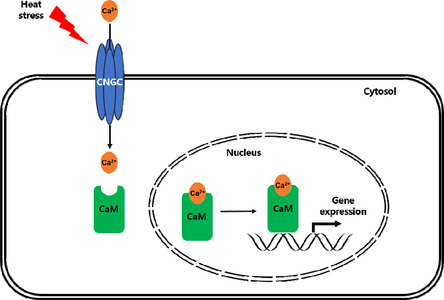
Hasanuzzaman et al. 2013), 세포막에서 환경 스트레스를 감지하며 신호를 세포 내부로 전달한다. 고온은 세포막에 존재하는 고리형 뉴클레오타이드 개폐 이온 통로(Cyclic Nucleotide-Gated Channels, CNGC)를 활성화시키고 외부 칼슘 이온이 내부로 들어오게 된다. 이후 칼슘 이온은 칼모듈린(Calmodulin, CaM) 단백질과 결합하여, 다양한 목표 단백질과 상호작용한다(
Stevens 1983,
Chin & Means 2000) (
Fig. 3). 칼모듈린 단백질은 칼슘 이온을 조절인자로 하는 칼슘 센서로 동식물계 전반에 걸쳐 발견되며
Dieter (1984)는 세포 내 자유 칼슘 이온의 농도변화가 식물 세포의 대사를 변화시킨다고 보고하였다. 이 과정은 애기장대 뿌리털의 성장과 옥신 신호전달에도 관여한다고 알려져 있으며(
Tan et al. 2020), 온도 상승에 의한 칼슘 이온 유입은 담배, 애기장대, 이끼, 벼 유묘 등 다양한 식물에서 관찰되었다.
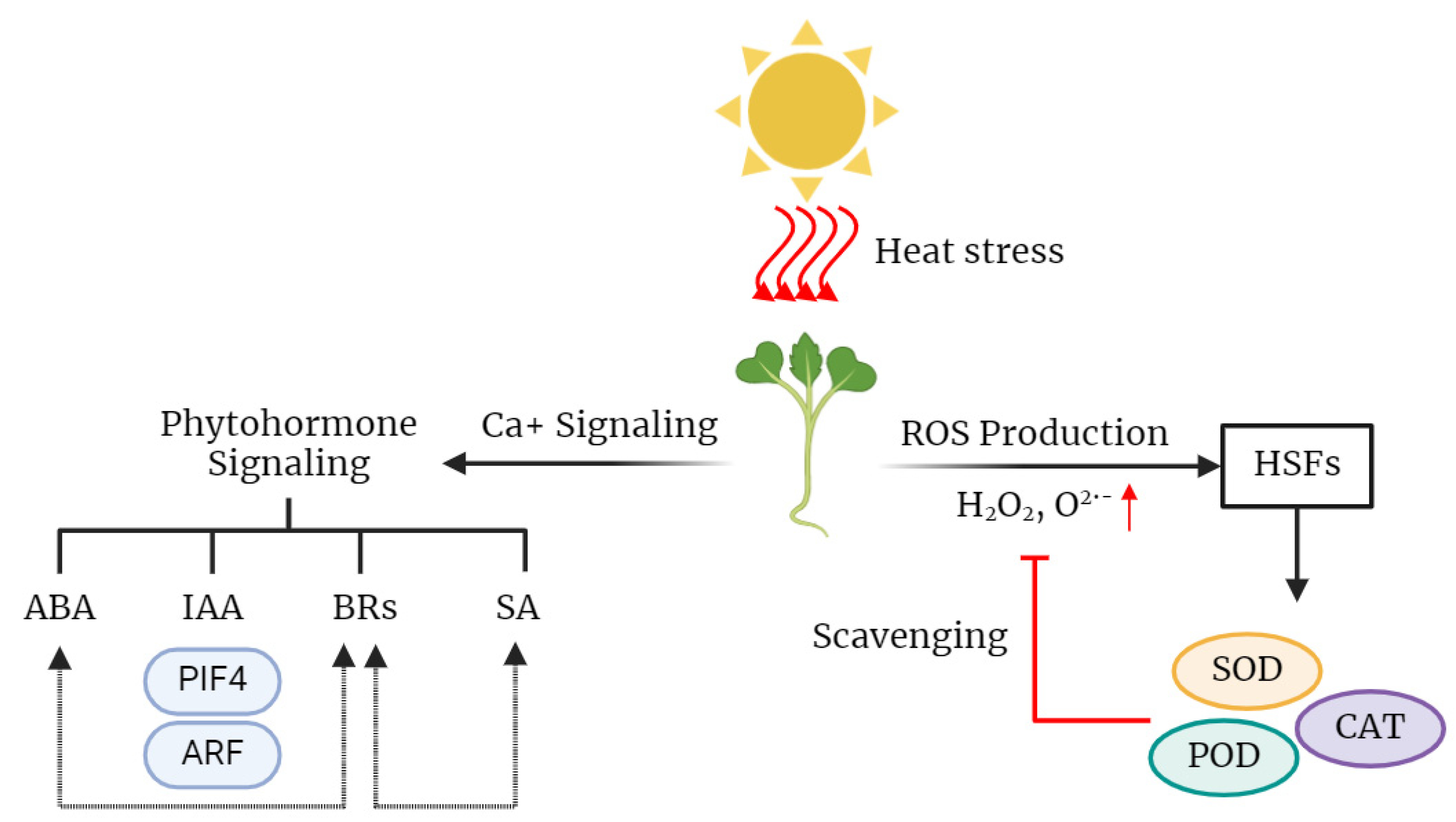
식물호르몬(Phytohormone)은 비생물적 스트레스 환경에 대응을 위해 스트레스 신호전달과 유전자 발현을 조절하여 내서성을 향상시킨다(
Fig. 4). 고온 스트레스는 Phytochrome Interacting Factor 4 (PIF4)를 통해 옥신(Auxin, IAA) 생합성과 옥신 수용체의 안정화를 유도하며, Auxin Response Factor (ARF)를 통한 옥신 신호전달은 고온 의존성 하배축 신장을 매개한다(
Xi et al. 2021,
Zeng et al. 2023). 고온 처리를 하였을 때, 애기장대의 앱시스산(Abscisic acid, ABA) 생합성 또는 신호전달 돌연변이들 중
aba1,
aba2,
aba3,
abi1,
abi2가 저하된 내서성 표현형을 나타내고(
Larkindale et al. 2005), 브라시노스테로이드(Brassinosteroids, BRs)는 고온 조건에서 ABA의 축적을 촉진하여 배추의 내서성을 강화할 수 있다는 연구 결과가 있다(
Zhang et al. 2022). 또한 37℃의 고온 처리를 한 배추에서 lncRNA, mRNA, miRNA간 상호작용을 연구한 결과에서 살리실산(Salicylic acid, SA)과 BRs 신호 전달 경로가 내서성에 관련되어 있으며, 10개의 고온 반응성 유전자와 공동 발현을 보이는 25개 lncRNA를 발견하였다(
Wang et al. 2019). 식물의 스트레스 신호전달과 반응 조절에 있어 식물호르몬의 역할에 대한 이해를 높인다면 배추의 내서성 메커니즘도 분자생리학적 수준에서 좀 더 자세히 밝힐 수 있을 것으로 기대한다.
HSP는 고온 스트레스뿐만 아니라 여러 환경 스트레스에 의해서도 발현되며(
Gatenby & Viitanen 1994,
Sabehat et al. 1998), 특히 그 종류에 따라 스트레스를 받는 즉시 발현되거나, 일정 시간이 지난 후 발현되는 것들이 있고, 발현 후 존재 지속시간 또한 HSP의 종류 및 스트레스의 유형에 따라 차이가 크다. 이외에도 에너지 고갈, 저산소증, ROS 및 바이러스 감염 등의 요인들도 HSP와 HSF를 통해 작물의 내서성에 영향을 끼칠 수 있다고 보고되었다(
Kregel 2002). HSP는 분자량에 따라 HSP100, 90, 70, 60과 소형계열의 다섯 가지로 분류된다.
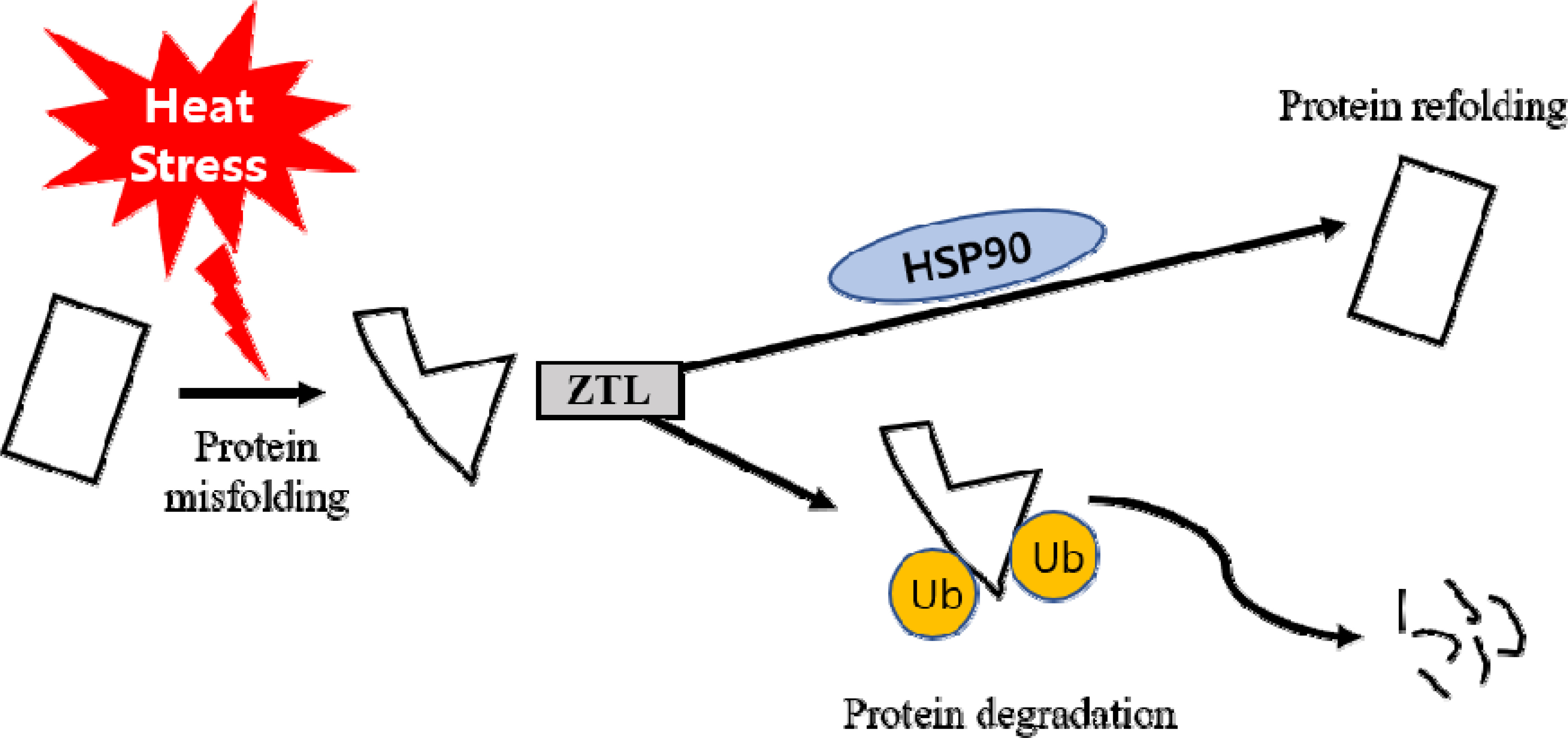
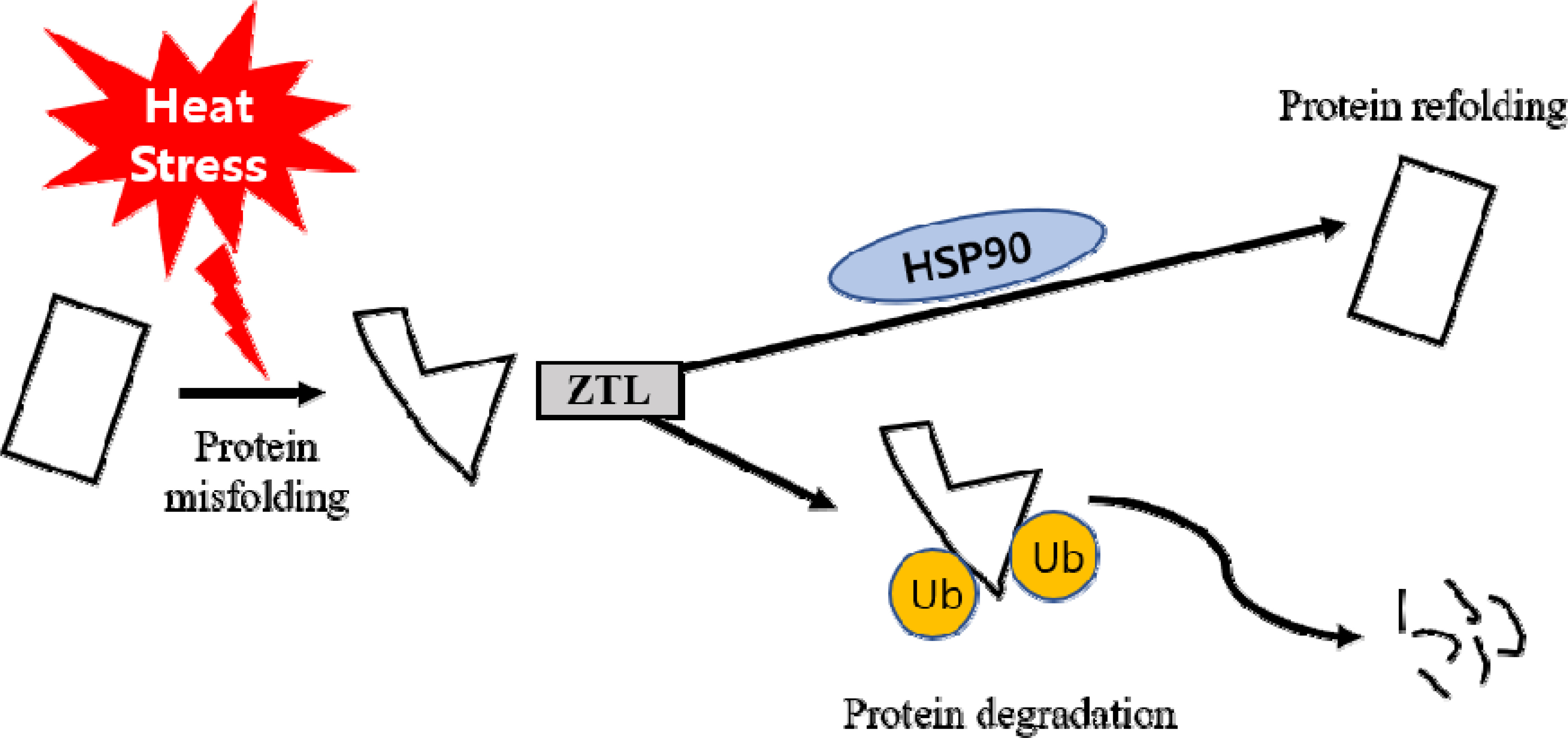
분자 샤페론(molecular chaperone)의 한 종류인 HSP는 식물 생체시계 조절인자 중 단백질 항상성을 조절하는 자이트루페(ZEITLUPE, ZTL) 단백질의 활성 변화 및 안정성에도 관여한다. ZTL 단백질은 주기에 따른 반복성 발현패턴을 보이는 생체시계 인자로 식물 성장, 개화와 같은 생장조절 뿐만 아니라 환경 스트레스 내성을 광범위하게 조절하며, 식물은 ZTL 단백질을 통해 지구온난화로부터 야기되는 다양한 환경 스트레스에 대응한다는 보고가 있다(
Cha et al. 2017). 이것은 세포 내 단백질 항상성 조절을 통해 환경 스트레스 저항성 작물의 개발이 가능함을 시사한다. 고온 스트레스로 인해 구조가 변형된 단백질은 ZTL에 의해 인식 및 ubiquitination되고, 이렇게 ubiquitin이 붙은 단백질은 단백질 분해효소에 의해 아미노산 조각으로 분해된다(
Gil et al. 2017). 동시에 HSP가 변형된 단백질의 소수성기에 결합하여 3차 구조 형성을 위한 정상적인 접힘을 유도함으로써 단백질의 응집을 방지하여 스트레스로부터 단백질의 구조 및 기능성을 유지하도록 돕는다(
Al-Whaibi 2011,
Roy et al. 2019,
Scharf et al. 2012) (
Fig. 5). 이와 같은 과정으로 식물은 ZTL, HSP 등을 통해 고온 스트레스 조건에서 단백질의 변성을 막고 세포 손상을 최소화한다.
국내외에서도 HSP를 이용한 고온 스트레스 저항성 품종의 육성 및 작물의 내서성 향상을 위한 연구가 진행 중이다.
HSP101 유전자를 이용해 형질 전환을 시도한 연구 사례(
Hur & Min 2010), 배추의 환경 스트레스 저항성 육종 소재 개발(
Kim et al. 2021), 암세포에서 HSP90의 특정 억제제로 작용하는 Geldanamycin이 애기장대의 유묘에서는 HSP70과 HSP90의 합성을 유도하여, Geldanamycin의 농도가 높아질수록 효과가 증가하여 내서성에 영향을 주고(
Kozeko 2014,
Murano et al. 2017), HSP70의 억제제로 작용하는 VER-155008이 밀 배아 추출물과 인간 세포에서는 HSP의 활성을 억제하였으나, 애기장대 유묘에서는 HSP의 합성을 증가시켜 고온 스트레스에 의한 엽록소 감소의 개선(
Matsuoka et al. 2019) 등의 결과들이 보고되었다.
식물의 기공 변화는 이산화탄소의 흐름, 엽온과 수분을 조절하기 위한 환경 스트레스에 대한 대응으로 알려져 있다. 잎의 온도는 환경적 요소 및 증산작용에 의해 결정되는데 식물체가 불리한 환경일 경우 기공에서의 증산작용을 통해 체내의 수분 상태를 조절하며, 증산작용은 기공을 통해 물이 기체상태로 식물체 밖으로 빠져나가는 현상으로 잎의 온도를 낮추게 된다(
Song 1992). 일반적으로 식물은 고온 조건에서는 증산작용으로 잎의 온도를 내리기 위해 기공전도도를 증가시키고, 가뭄 조건에서는 수분 손실을 막기 위해 반대로 작용한다(
Mittler & Blumwald 2010). 하지만 온도에 대한 식물 기공의 반응은 동일 종이라고 하더라도 재배 환경에 따라 다양하게 나타나고 온도의 변화에 따라 기공전도도는 변화하거나 혹은 그렇지 않은 경우도 있다(
Silim et al. 2010).
Oh et al. (2014)의 연구에서는 배추 재배 시, 대기 온도보다 4℃와 7℃ 높은 환경에서 증산율, 기공전도도가 더 높았고, 수분이용효율은 낮았다고 보고하였다. 또한 양구슬냉이(
Camelina sativa)와 담배(
Nicotiana tabacum)도 고온에서 재배했을 때 CO
2 고정률은 감소하지만, 증산율과 기공전도도는 증가한다고 보고되었다(
Carmo-Silva & Salvucci 2012). 배추와 같은 속인 갓(
Brassica juncea L.)에서도 30℃와 40℃의 고온 환경에서 수분이용효율이 감소하는 것으로 알려져 있다(
Hayat et al. 2009). 이는 배추의 고온 재배 시, 기공전도도와 증산율이 증가하여 수분이용효율이 감소하고 수분 요구량이 높아짐을 시사한다.
식물의 CO
2 고정률은 작물의 재배, 생육환경에서 스트레스로 작용하는 온도, 광 등의 환경에서 식물의 광합성을 평가하는 지표로 중요하며(
Oh et al. 2014), CO
2 고정률과 함께 호흡률은 고온에 민감한 식물을 선별함에 있어 중요하다고 보고되었다(
Prange et al. 1990). 많은 식물 종의 호흡률은 대기 온도에 의존적으로 변화하며, 특정한 온도보다 고온 조건에서 감소하고 저온에서 증가하는 경향을 보이며(
Atkin & Tjoelker 2003), 활엽초본, 목초, 상록 교목 및 관목에서도 일정한 온도 범위(14-28℃)에서는 CO
2 고정률이 차이가 없거나 증가하였으나, 호흡률은 전반적으로 감소했다고 보고되었다(
Campbell et al. 2007). 자작나무(
Betula papyrifera), 포플러(
Populus tremuloides) 및 미국낙엽송(
Larix laricina) 등의 한대성 식물도 18℃에 비해 30℃에서 호흡률이 감소하였다는 연구 결과가 있다(
Tjoelker et al. 1999).
고온 피해경감제 연구사례
배추의 생리장해, 대사이상의 대부분은 superoxide (O
2-), hydroxyl radicals (OH), H
2O
2와 같은 활성산소종의 축적과 이로 인한 세포 손상, 광합성 억제를 통해 발생한다(
Baxter et al. 2014). 이러한 활성산소종은 식물이 스스로를 보호하기 위해 생성한 CAT, Glutathione peroxidase (GPx), POD, SOD 등의 항산화효소 및 비타민, 식물성 화합물, 미네랄 등 다양한 항산화 물질에 의해 제거된다(
Xie et al. 2019). 이를 통해 환경 스트레스로 인한 산화 스트레스를 경감시키는 연구가 진행 중이고, 이를 위해 다양한 호르몬, 항산화 물질 등의 생리 활성제가 활용되고 있다(
Lee et al. 2021).
고온 건조 조건에서 배추의 멜라토닌(Melatonin) 경엽처리는 엽록소 함량을 높게 유지하여 광합성 능력을 향상시키고, 스트레스에 의한 생육 저하를 경감시키는 효과를 보이며(
Dai et al. 2020), 다양한 종류의 ROS와 활성 질소종(Reactive nitrogen species, RNS)을 효율적으로 제거하여 작물의 산화 스트레스를 경감시키는 역할을 한다(
Galano et al. 2011).
Lee et al. (2021)은 고온 건조 조건에서 배추에 멜라토닌 경엽처리는 광합성 향상, 생체중 증가, Ascorbate peroxidase (APX)와 SOD 등의 항산화효소 활성 증가 및 프롤린 축적 증가 등 스트레스 피해 경감에 긍정적 작용을 한다는 것을 보였고, 여러 수준의 농도(5, 10 및 20 mg/L) 중, 10 mg/L 농도의 멜라토닌을 처리하였을 때, 배추의 생체중과 엽면적이 대조구에 비해 각각 22.7%, 13.9%가 증가하였고 광합성 특성은 광합성 속도와 증산율이 대조구에 비해 유의한 차이를 보이게 증가하였으며, 항산화 효소인 APX와 SOD의 활성 또한 증가하여, 멜라토닌의 처리 농도별 효과를 고려했을 때 10 mg/L 농도의 멜라토닌 처리가 고온 건조 스트레스 환경에서 배추 생육에 가장 효과적인 결과를 보였다고 보고하였다.
Lee et al. (2019)은 고온 환경 내에서의 생화학제 처리가 배추의 생장에 미치는 영향에 대한 연구를 통해, 글루탐산(Glutamic acid)과 질산칼슘(Calcium nitrate)을 혼합하여 경엽처리 하였을 때, 고온처리 동안 항산화효소인 CAT, POD 및 SOD의 활성이 대조구 대비 각각 26, 16 및 45% 증가하였고, 배추의 생체중과 건물중이 각각 20%와 26% 증가 및 광합성 속도 증가 등 고온 스트레스 피해 경감효과를 나타냈다고 보고하였다. 또한 100 nM BRs 과 1 mM SA을 배추 엽면살포했을 때, 고온처리 종료 후 고온 처리 대조구에 비해 실험구(고온+BRs, 고온+SA 살포)에서 고온 처리 종료 후, CAT 활성이 3-6% 높았고, 33-98% 증가된 POD 활성이 엽면살포 후 3일까지 유지되었으며, 배추의 결구 생체중과 건물중 또한 고온 처리 대조구에 비해 각각 1.4배와 1.6배, 그리고 단위 면적당 수확량은 약 1.6배 높은 결과를 보였다(
Lee et al. 2018).
Lee et al. (2019)은 고온에 노출된 배추에 BR, Methyl jasmonate (MeJA), SA, Sodium nitroprusside (SNP)의 엽면살포가 배추의 생육, 수량, 광합성 특성 및 항산화 효소 활성에 미치는 영향을 조사했고, 엽면살포 후 5일간 고온(30/25℃)과 정상조건(주/야 평균기온 21.2±1.6℃)에 노출시켰을 때 BR (200 nM)이 처리된 실험구의 새순 생체중이 2,123 g으로 1,422 g인 대조구에 비해 무거웠고, 결구배추의 무게와 수확량 역시 SA (2 mM) 처리된 실험구가 대조구에 비해 높았으며, 위와 같은 생리 활성제의 엽면살포가 광합성 능력 향상에 도움을 줄 뿐만 아니라 고온 스트레스 후 3일 간 CAT와 POD 효소활성이 대조구에 비해 평균 1.76-2.08배까지 증가함을 보임으로써 생리 활성제 엽면살포가 고온 스트레스에 의한 작물의 생리적 손상을 줄이고 황산화 효소의 활성을 높여 배추의 내서성을 개선시킬 수 있다고 보고하였다. 더불어 최근에는 15 mM 글라이신 베테인(Glycine betaine, GB)과 0.2 mM 베타-아미노뷰티르산(β-aminobutyric acid, BABA)을 각각 배추에 경엽처리 하였을 때, 대조군과 비교해 프롤린 함량과 항산화효소 활성이 증가하여 고온 스트레스에 의한 세포막 손상의 완화뿐만 아니라 건물중 또한 각각 36% (GB), 45% (BABA) 증가함이 보고되었다(
Quan et al. 2022).
Todaka et al. (2024)은 에탄올 전처리를 통해 애기장대, 카사바의 비생물적 스트레스 내성이 증가하였으며, 토마토에 에탄올 용액을 전처리한 후 열 스트레스를 가했을 때 대조구에 비해 식물의 생존율이 매우 높았고 열매 수도 많았으며, 방어 반응(defense response), 수분 부족(water deprivation), ROS 대사 과정 등과 같은 스트레스 관련 유전자들의 발현이 증가하였다고 보고하였고, 유제놀(Eugenol)과 정향 에센셜 오일(Clove essential oil)을 배추에 처리하였을 때 방어 반응, 호르몬 신호 경로 및 잎 노화에 큰 영향을 미쳤고, 고온에 의한 잎의 노화 및 총 엽록소 함량 감소 완화 등 배추의 내열성을 효과적으로 향상시켰다는 연구결과(
Hsieh et al. 2024)가 있다.
Sim et al. (2022)은 광/암의 온도 수준을 최적(20/16℃), 중간(28/24℃) 및 고온(36/32℃)의 세가지 환경에서 키토산을 200 mg/L 농도로 엽면살포 하였을 때 키토산 무처리구인 대조구에 비해 중간 온도 및 고온 조건에서 잎의 ABA 대사산물인 Phaseic acid (PA), Dihydrophaseic acid (DPA) 및 ABA glucose ester (ABA-GE)의 함량이 더 높아 배추의 고온 노출 시, 키토산의 엽면살포는 고온 스트레스로 인한 피해를 완화시킨다고 보고하였다.
이러한 다양한 생화학제 처리는 배추의 생장 증진 및 생리적 활성을 촉진시켜 이상기상에 대응할 수 있는 피해 경감 기술로 활용될 수 있다고 사료된다.
결과 및 고찰
예측할 수 없는 기상이변으로 각종 농작물에 다양한 피해가 보고되고 있으며 다른 작물과 마찬가지로 배추 재배도 고온에 악영향을 받고 있다. 고온 환경에 따른 병해충의 증가 문제 또한 배추 재배의 안정성을 저해할 가능성이 매우 높다. 또한, 지구온난화 문제로 인하여 국내 배추 재배면적이 급격히 줄어들고 있는 상황을 고려할 때, 지속 가능한 안정적인 배추의 재배 및 생산전략이나 내서성 품종 개발 및 육성, 고온 스트레스 피해를 최소화할 수 있는 재배 기술 및 종합적인 병해충 방제 대책이 마련되어야 할 것이다. 전 세계적으로 고온 건조 스트레스 내성에 관한 연구가 진행 중이지만, 고온이 식물에 미치는 영향에 관련한 연구들이 대부분이며 아직 농가에서 재배할 수준으로 효과적인 내서성 작물의 개발은 해결해야 할 난제로 남아있는 실정이다. 점차 심각해지는 기후변화에 따라 국내 여름철 고온 피해는 증가할 전망이며, 내서성을 지닌 유전자원의 탐색 및 확보와 이 자원들을 적극 활용하여 유전체 해독, 단백체 및 대사체 분석 등을 통해 내서성에 대한 분자유전학, 생리학적 기작을 구명하고, 내서성 표현형의 분석과 고온 스트레스 관련 유전자를 이용한 유전자 교정과 같은 신육종 기술, 분자마커 등을 이용한 고효율의 육종방법 등 다각적 접근을 통해 미래 기후에 적응하는 실용적인 배추 품종이 신속히 개발되고 이에 맞춘 적합한 재배 기술이 개발되어야 한다.
적요
기후변화로 지구의 평균 기온이 증가하여, 앞으로 예측되는 지속적 온난화에 따른 농업생산은 고온 스트레스에 의해 위협받을 것이다. 배추는 호냉성 식물로 고온 스트레스를 받으면 결구 형성에 영향을 받고 생육이 불량하게 되며 무름병 등과 같은 병해충 피해의 발생으로 생산량 감소 및 품질이 저하되어 배추 시장에 악영향을 미친다. 고온기에 자주 나타나는 배추의 병해충 피해는 배추의 생육, 수량 및 품질에 심각한 피해를 초래한다. 여름철 기온이 비교적 낮은 고랭지 지역의 배추에서는 병해충이 쉽게 발생하지 않아 배추 재배에 유리하지만, 온난화로 인한 기온상승은 병해충 발생 가능성을 높임과 동시에 고랭지 배추 재배면적의 감소를 야기한다. 이러한 배추의 병해충 피해를 방지하기 위해 효율적인 방제체계에 관한 연구가 필요하다. 고온 조건에서의 세포 반응 및 열충격단백질 발현과 조절에 대한 연구가 지속적으로 진행되고 있으며, 이러한 연구 결과를 바탕으로 내서성을 가진 유전자원을 탐색, 활용하여 내서성에 대한 유전학, 생리학적 기작 구명과 함께 내서성 배추 품종의 개발이 요구된다. 고온 스트레스로 인한 배추과 작물의 생리적, 생화학적 반응에 대한 연구들이 있었지만 급변하는 미래기후에 적응할 수 있는 품종개발까지 이어지는 경우는 많지 않으며, 배추의 안정적인 생산을 위한 내서성 배추의 개발과 육성, 고온 피해 경감제에 대한 연구 및 이와 결합된 고온 스트레스 대응 재배기술 개발이 필요한 실정이다.
사사
This work was supported in part by a grant from the World Vegetable Center Korea Office (WKO #10000379) and long-term strategic donors to the World Vegetable Center: Taiwan, United Kingdom aid from the United Kingdom government, United States Agency for International Development (USAID), Australian Centre for International Agricultural Research (ACIAR), Germany, Thailand, Philippines, South Korea, and Japan.
Fig. 1Cultivation area (A) and production per area (B) of Kimchi cabbage and highland Kimchi cabbage in Korea (2000-2023). Source: KREI 2022, KOSIS 2024.
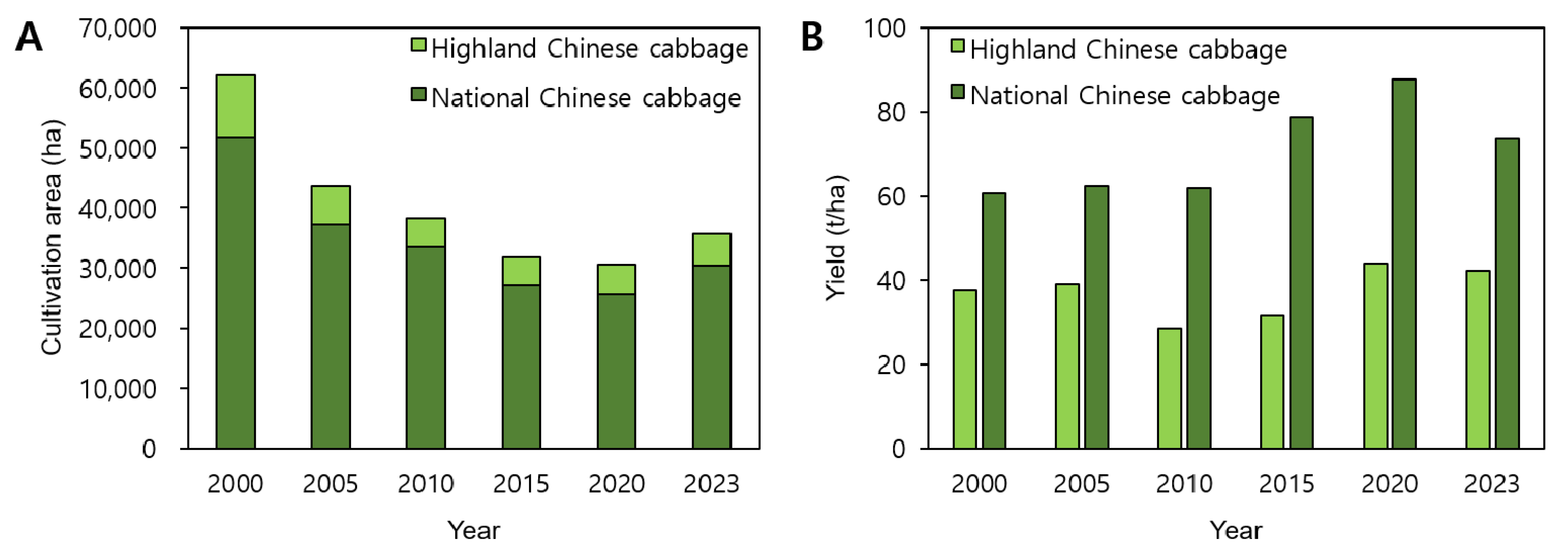
Fig. 2Summarizes the some of the major physiological signals that activate heat shock protein (HSP) synthesis and the process by which
HSP are expressed in cells. Heat shock factors (HSFs) in the cytoplasm bind to heat shock proteins (HSPs) and remain inactive. Various stimuli (“stressors”) activate HSF, causing it to dissociate from HSPs. HSFs are phosphorylated (P) by protein kinases to form trimers. These HSF trimers translocate to the nucleus and bind to heat shock elements (HSE) in the promoter region of
HSP genes.
HSP mRNA is transcribed and translocated to the cytoplasm, where it is synthesized into new HSP. ROS, Reactive oxygen species, RNS, Reactive nitrogen species. Source:
Kregel 2002.
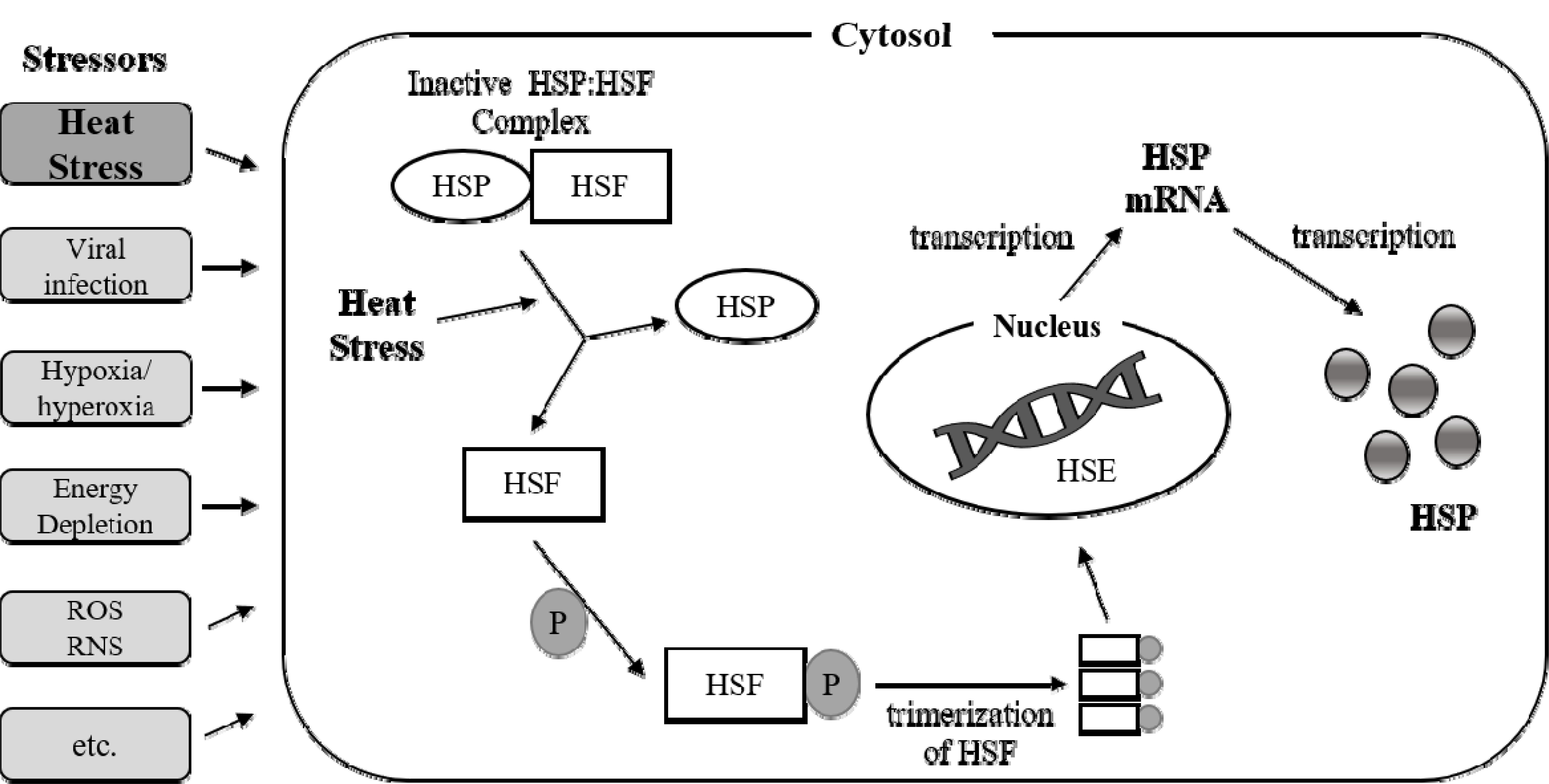
Fig. 3Mechanisms of transcriptional regulation mediated by Ca
2+ and CaM in plants. The Ca
2+ and CaM elicited by developmental cues and environmental stresses mediate plant responses by regulating the transcriptional process in various ways. The Ca
2+-loaded CaM binds to DNA and functions as a transcription factor. CaM, Calmodulin, CNGC, Cyclic nucleotide-gated channels. Source:
Kim et al. 2009.
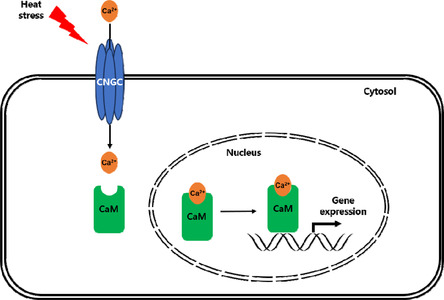
Fig. 4Summarizes the mechanism whereby plants activate heat shock factors (HSFs) upon exposure to heat stress, leading to the synthesis of superoxide dismutase (SOD), catalase (CAT), and peroxidase (POD) to mitigate reactive oxygen species (ROS) production. Additionally, it illustrates the influence of plant hormone signaling on gene expression regulation, elucidating the interplay between abscisic acid (ABA), indole-3-acetic acid (Auxin, IAA), brassinosteroids (BRs), and salicylic acid (SA) in plant responses to heat stress. The diagram was created using BioRender (
https://biorender.com, accessed on 30 April 2024). PIF4, Phytochrome-interacting factor 4, ARF, Auxin response factor. Source:
Quan et al. 2022,
Wang et al. 2019,
Xi et al. 2021,
Zeng et al. 2023.
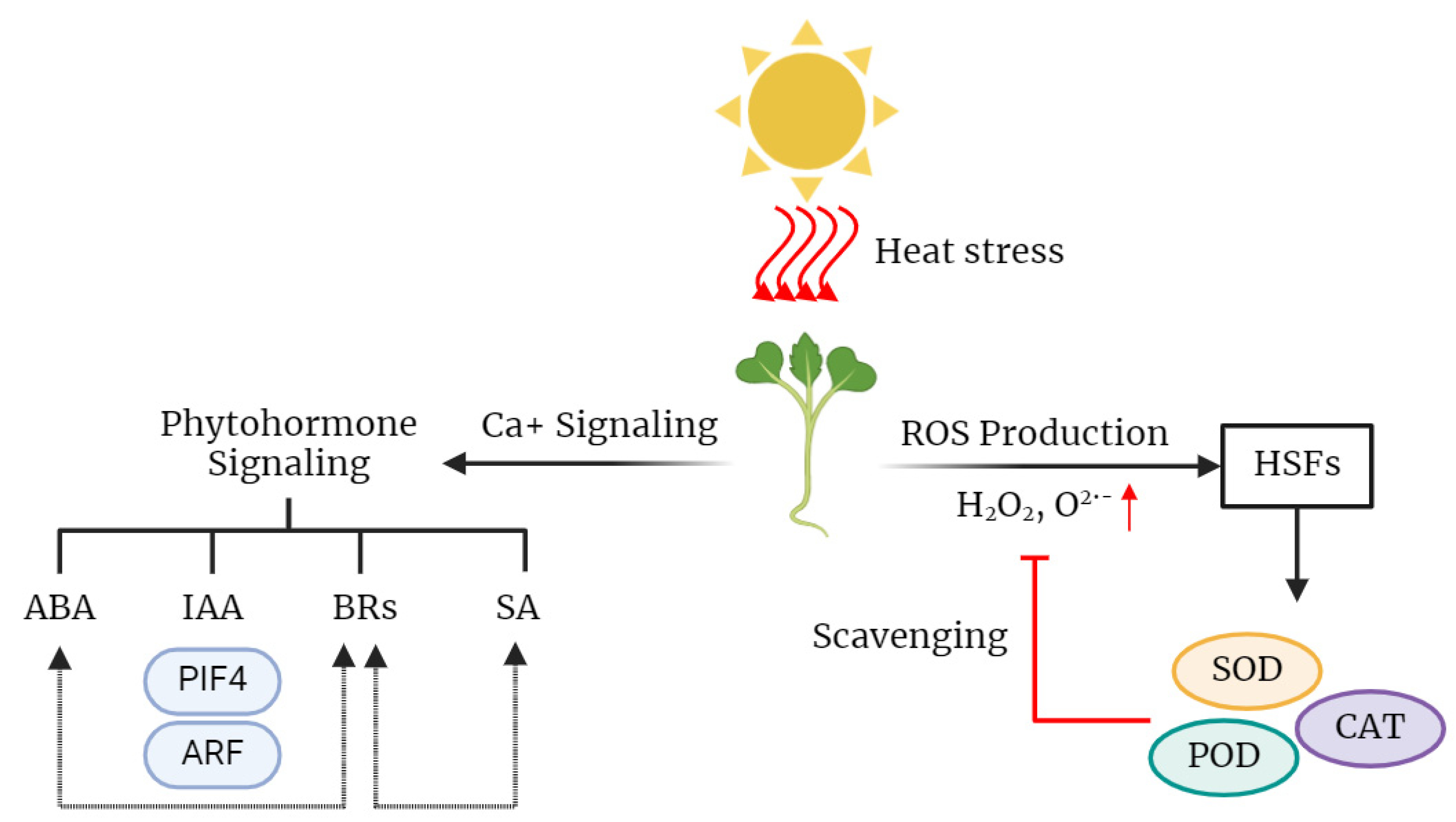
Fig. 5The ZTL-HSP module in protein quality control under heat stress condition. ZTL, Zeitlupe, HSP90, Heat shock protein 90, Ub, Ubiquitin. Source:
Gil et al. 2017.
References
- 1. Ahmed W, Xia Y, Zhang H, Li R, Bai G, Siddique KH, Guo P. 2019. Identification of conserved and novel miRNAs responsive to heat stress in flowering Chinese cabbage using high-throughput sequencing. Sci Rep 9: 14922
- 2. Al-Quraan NA, Locy RD, Singh NK. 2010. Expression of calmodulin genes in wild type and calmodulin mutants of Arabidopsis thaliana under heat stress. Plant Physiol Biochem 48: 697-702.
- 3. Altschuler M, Mascarenhas JP. 1982. Heat shock proteins and effects of heat shock in plants. Plant Mol Biol 1: 103-115.
- 4. Al-Whaibi MH. 2011. Plant heat-shock proteins: a mini review. J King Saud Univ Sci 23: 139-150.
- 5. Angadi SV, Cutforth HW, Miller PR, McConkey BG, Entz MH, Brandt SA, Volkmar KM. 2000. Response of three Brassica species to high temperature stress during reproductive growth. Can J Plant Sci 80: 693-701.
- 6. Atkin OK, Tjoelker MG. 2003. Thermal acclimation and the dynamic response of plant respiration to temperature. Trends Plant Sci 8: 343-351.
- 7. Baldocchi D, Wong S. 2008. Accumulated winter chill is decreasing in the growing regions of California. Clim Change 87: 153-166.
- 8. Baninasab B. 2010. Induction of drought tolerance by salicylic acid in seedlings of cucumber (Cucumis sativus L.). J Hortic Sci Biotechnol 85: 191-196.
- 9. Barnett T, Altschuler M, McDaniel CN, Mascarenhas JP. 1979. Heat shock induced proteins in plant cells. Dev Genet 1: 331-340.
- 10. Baxter A, Mittler R, Suzuki N. 2014. ROS as key players in plant stress signaling. J Exp Bot 65: 1229-1240.
- 11. Bita CE, Gerats T. 2013. Plant tolerance to high temperature in a changing environment: scientific fundamentals and production of heat stress-tolerant crops. Front Plant Sci 4: 273-273.
- 12. Campbell C, Atkinson L, Zaragoza-Castells J, Lundmark M, Atkin O, Hurry V. 2007. Acclimation of photosynthesis and respiration is asynchronous in response to change in temperature regardless of plant functional group. New Phytol 176: 375-389.
- 13. Carmo-Silva AE, Salvucci ME. 2012. The temperature response of CO2 assimilation, photochemical activities and rubisco activation in Camelina sativa, a potential bioenergy crop with limited capacity for acclimation to heat stress. Planta 236: 1433-1445.
- 14. Cha JY, Kim JS, Kim TS, Zeng Q, Wang L, Lee SY, Kim WY, Somers DE. 2017. GIGANTEA is a co-chaperone which facilitates maturation of ZEITLUPE in the Arabidopsis circadian clock. Nat Commun 8: 3
- 15. Chin D, Means AR. 2000. Calmodulin: A prototypical calcium sensor. Trends Cell Biol 10: 322-328.
- 16. Czarnecka E, Gurley WB, Nagao RT, Mosquera LA, Key JL. 1985. DNA sequence and transcript mapping of a soybean gene encoding a small heat shock protein. Proc Natl Acad Sci USAPNAS 82: 3726-3730.
- 17. Dai L, Li J, Harmens H, Zheng X, Zhang C. 2020. Melatonin enhances drought resistance by regulating leaf stomatal behaviour, root growth and catalase activity in two contrasting rapeseed (Brassica napus L.) genotypes. Plant Physiol Biochem 149: 86-95.
- 18. Dieter P. 1984. Calmodulin and calmodulin-mediated processes in plants. Plant Cell Environ 7: 371-380.
- 19. Edwards R, Dixon DP, Walbot V. 2000. Plant glutathione S-transferases: enzymes with multiple functions in sickness and in health. Trends Plant Sci 5: 193-198.
- 20. Eom SH, Lee HJ, Wi SH, Kim SK, Hyun TK. 2021. Identification and functional prediction of long non-coding RNAs responsive to heat stress in heading type Chinese cabbage. Zemdirbyste-Agriculture 108: 371-376.
- 21. Erickson AN, Markhart AH. 2002. Flower developmental stage and organ sensitivity of bell pepper (Capsicum annum L.) to elevated temperature. Plant Cell Environ 25: 123-130.
- 22. Fu W, Li P, Wu Y. 2012. Effects of different light intensities on chlorophy II fluorescence characteristics and yield in lettuce. Sci Horitic 135: 45-51.
- 23. Galano A, Tan DX, Reiter RJ. 2011. Melatonin as a natural ally against oxidative stress: a physicochemical examination. J Pineal Res 51: 1-16.
- 24. Gatenby AA, Viitanen PV. 1994. Structural and functional aspects of chaperonin mediated protein folding. Plant Mol Biol 45: 469-491.
- 25. Gil K-E, Kim W-Y, Lee H-J, Faisal M, Saquib Q, Alatar AA, Park C-M. 2017. ZEITLUPE contributes to a thermoresponsive protein quality control system in Arabidopsis. Plant cell 29: 2882-2894.
- 26. Gong M, Van der Luit AH, Knight MR, Trewavas AJ. 1998. Heat-shock- induced changes in intracellular Ca2+ level in tobacco seedlings in relation to thermotolerance. Plant Physiol 116: 429-437.
- 27. Guan Q, Lu X, Zeng H, Zhang Y, Zhu J. 2013. Heat stress induction of miR398 triggers a regulatory loop that is critical for thermotolerance in Arabidopsis. Plant J 74: 840-851.
- 28. Hasanuzzaman M, Nahar K, Alam MM, Roychowdhury R, Fujita M. 2013. Physiological, biochemical, and molecular mechanisms of heat stress tolerance in plants. Int J Mol Sci 14: 9643-9684.
- 29. Hayat S, Masood A, Yusuf M, Fariduddin Q, Ahmad A. 2009. Growth of indian mustard (Brassica juncea L.) in response to salicylic acid under high-temperature stress. Braz J Plant Physiol 21: 187-195.
- 30. Hosoi N, Tamagata N. 1973. The study of interaction of environmental factors for rice plant leading. Jpn J Breed 23: 198-199.
- 31. Hsieh LC, Soh ZT, Tsai WA, Chen TF, Lin HH, Lin JS. 2024. Enhancement of stress response in Chinese cabbage through eugenol and clove essential oil. Curr Plant Biol 37: 100324.
- 32. Hur SH, Min BH. 2010. Chinese cabbage transformation of HSP101 gene using mannose selection system. J Plant Biotechnol 37: 236-241.
- 33. Hwang SW, Lee JY, Hong SC, Park YH, Yun SG, Park MH. 2003. High temperature stress of summer Chinese cabbage in alpine region. Korean J Soil Sci 36: 417-422.
- 34. Ikram M, Chen J, Xia Y, Li R, Siddique KH, Guo P. 2022. Comprehensive transcriptome analysis reveals heat-responsive genes in flowering Chinese cabbage (Brassica campestris L. ssp. chinensis) using RNA sequencing. Front Plant Sci 13: 1077920.
- 35. Intergovernmental Panel on Climate Change (IPCC).2001. Working Group Ⅰ. Climate change: The scientific basis. rojection of future climate change. Geneva Switzeland. http: //www.grida.no/climate/ipp_tar/wg1/339.htm.
- 36. Intergovernmental Panel on Climate Change (IPCC)2023.
- 37. Jahan MS, Shu S, Wang Y, Chen Z, He M, Tao M, Sun J, Guo S. 2019a. Melatonin alleviates heat-induced damage of tomato seedlings by balancing redox homeostasis and modulating polyamine and nitric oxide biosynthesis. BMC Plant Biol 19: 1-16.
- 38. Jahan MS, Wang Y, Shu S, Zhong M, Chen Z, Sun J, Guo S. 2019b. Exogenous salicylic acid increases the heat tolerance in Tomato (Solanum lycopersicum L.) by enhancing photosynthesis efficiency and improving antioxidant defense system through scavenging of reactive oxygen species. Sci Hortic 247: 421-429.
- 39. Jeon HY, Kim HH, Yang CY, Jang HI, Mok IG, Yiem MS. 2005. Damage and control threshold of the diamondback moth (Plutella xylostella L.) Chinese cabbage. Hortic Sci Technol 23: 333-336.
- 40. Jiao S, Hilaire E, Guikema JA. 2004. Identification and differental accumulation of two isoforms of the CF1-β subunit under high light stress in Brassica rapa. Plant Physiol Biochem 42: 883-890.
- 41. Kang HJ, Lee JS, Ryu KR, Lee JT. 2002. Chinese cabbage cultivation. RDA Suwon, Korea..
- 42. Kaya C. 2021. Nitrate reductase is required for salicylic acid-induced water stress tolerance of pepper by upraising the AsA-GSH pathway and glyoxalase system. Physiol Plant 172: 351-370.
- 43. Key JL, Lin CY, Chen YM. 1981. Heat shock proteins of higher plants. Proc Natl Acad Sci USA 78: 3526-3530.
- 44. Khan MM, Iqbal MJ, Abbas M. 2005. Loss of viability correlates with membrane damage in aged turnip (Brassica rapa) seeds. Seed Sci Technol 33: 517-520.
- 45. Khan S, Jabeen R, Deeba F, Waheed U, Khanum P, Iqbal N. 2021. Heat shock proteins: Classification, functions and expressions in plants during environmental stresses. Bioresour Technol 8: 85-97.
- 46. Kim AR, Lim HM, Park SH, Ji HS, Yoon UH, Kim TH, Cho JI, Kim CK, Lee GS. 2014. Molecular Characterization of a Putatively Stress-related Gene BrTSR53 Isolated from Chinese Cabbage (Brassica rapa). Korea J Breed Sci 46: 143-151.
- 47. Kim HJ, Lee SH. 2017. The agricultural production and possibility of food security in North Korea. J Clim Res 12: 289-304.
- 48. Kim JH, Jang YA, Lee JH, Park SH. 2021. Development of the resistant Kimchi cabbage against Abiotic/biotic stress. Korean J Hortic Sci 39 (Conference abstract): 100..
- 49. Kim MC, Chung WS, Yun DJ, Cho MJ. 2009. Calcium and calmodulin-mediated regulation of gene expression in plants. Mol Plant 2: 13-21.
- 50. Kim SK, Jin JH, Lim CK, Hur JH, Cho SY. 2009. Evaluation of insecticidal efficacy of plant extracts against major insect pests. Korean J Pestic Sci 13: 165-170.
- 51. Kim SY, Heo IH, Lee SH. 2010. Impacts of temperature rising on changing of cultivation area of apple in Korea. J KARG 16: 201-215.
- 52. Kim YS, Zheng ZB, Shin DH. 2008. Growth inhibitory effects of kimchi (Korean traditional fermented vegetable product) against Bacillus cereus, Listeria monocytogenes, and Staphylococcus aureus. J Food Protect 71: 325-32.
- 53. Korea Rural Economic Institute (KREI).2014. Factors and prospects for changes in vegetable area in highland areas. KREI Policy research. Kor. pp. 192-192..
- 54. Korea Rural Economic Institute (KREI).2022. Chapter 13 Supply and Demand Trends and Outlook for Leafy Greens. Korea Rural Economic Institute. https://www.krei.re.kr/krei/researchReportView.do?key=67&pageType=010101&biblioId=529339.
- 55. Korean Statistical Information Service (KOSIS).2022. Area of cultivation of outdoor vegetables. (In Korean). https://kosis.kr/statHtml/statHtml.do?orgId=101&tblId=DT_1ET0028&vw_cd=MT_ZTITLE&list_id=K1_19&scrId=&seqNo=&lang_mode=ko&obj_var_id=&itm_id=&conn_path=MT_ZTITLE&path=%252FstatisticsList%252FstatisticsListIndex.do.
- 56. Korean Statistical Information Service (KOSIS).2024. Area of cultivation of outdoor vegetables. (In Korean). https://kosis.kr/statHtml/statHtml.do?orgId=101&tblId=DT_1ET0028&vw_cd=MT_ZTITLE&list_id=K1_19&scrId=&seqNo=&lang_mode=ko&obj_var_id=&itm_id=&conn_path=MT_ZTITLE&path=%252FstatisticsList%252FstatisticsListIndex.do.
- 57. Kozeko LY. 2014. Changes in heat-shock protein synthesis and thermotolerance of Arabidopsis thaliana seedlings resulting from Hsp90 inhibition by geldanamycin. Cell and Tissue Biology 8: 416-422.
- 58. Kregel KC. 2002. Invited Review: Heat shock proteins: modifying factors in physiological stress responses and acquired thermotolerance. J Appl Philos 92: 2177-2186.
- 59. Lagerctantz U, Lydiate D. 1996. Comparative genome mapping in brassica. Genetics 144: 1903-1910.
- 60. Larkindale J, Hall JD, Knight MR, Vierling E. 2005. Heat stress phenotypes of Arabidopsis mutants implicate multiple signaling pathways in the acquisition of thermotolerance. Plant Physiol 138: 882-897.
- 61. Lee HJ, Lee JH, Lee SG, An SW, Lee HS, Choi CK, Kim SK. 2019. Foliar application of biostimulants affects physiological responses and improves heat stress tolerance in Kimchi cabbage. Hortic Environ Biote 60: 841-851.
- 62. Lee JH, Lee HJ, Lee SG, Kim SK, An SW, Lee HS, Choi CK. 2018. Promotion of growth and physiological activity responses by biochemical foliar spray treatment as exposed to extreme air temperature and drought stresses. Hortic Sci 36: 84-84.
- 63. Lee JH, Lee HJ, Wi SH, Jang YA, An SW, Chun H, Lee HS, Lee SG. 2019. Changes in growth and physiological responses of kimchi cabbages by glutamic acid and calcium foliar application as exposed to heat stress. Hortic Sci 37: 101-101.
- 64. Lee JH, Lee HJ, Wi SH, Yu IH, Yeo KH, An SW, Jang YA, Jang SH. 2021. Enhancement of growth and antioxidant enzyme activities on Kimchi cabbage by melatonin foliar application under high temperature and drought stress conditions. Hortic Sci 39: 583-592.
- 65. Lee JS. 1987. Molecular Characterization of Plant Genes. Proceedings of Symposia on Plant Biotechnology, Korea. pp. 19-49. https: //scienceon.kisti.re.kr/srch/selectPORSrchArticle.
- 66. Lee SG, Choi CS, Lee JG, Jang YA, Lee HJ, Chae WB, Do KR. 2014. Influence of shading and irrigation on the growth and development of leaves tissue in hot pepper. Korean J Hortic Sci 32: 448-453.
- 67. Lee SG, Lee HJ, Kim SK, Choi CS, Park ST, Jang YA, Do KR. 2015. Effects of vernalization, temperature, and soil drying periods on the growth and yield of Chinese cabbage. Korean J Hortic Sci 33: 820-828.
- 68. Lee SG, Moon JH, Jang YA, Lee WM, Cho IH, Kim SY, Ko KD. 2009. Photosynthetic characteristics and cellular tissue of Chinese cabbage are affected by temperature and CO2 concentration. J Bio-Env Con 18: 148-152.
- 69. Lee SH, Heo IH, Lee KM, Kim SY, Lee YS, Kwon WT. 2008. Impacts of climate change on agriculture on phonology and growth of crops: In the case of Naju. J Geol Soc Korea 43: 20-35.
- 70. Lee SH, Heo IH. 2018. Impact of climate on yield of highland Chinese cabbage in Gangwon province, South Korea. J Geol Soc Korea 53: 265-282.
- 71. Lee SH, Kim SY. 2008. Impacts of climate change on highland agriculture over Taeback mountainous region. The Geographical Journal of Korea 42: 621-633.
- 72. Levitt J. 1980. Responses of plants to environmental stresses. Volume 1: Chilling, freezing and high temperature stresses. Academic Press,
- 73. Li Q, Zhang G, Zhao Y, Gu L, Wang Y, Yu X, Abdullah S. 2023. Hub gene identification and heat-stress-related transcriptional regulation mechanism in cabbage (Brassica oleracea L.). Horticulturae 9: 977
- 74. Liu HT, Gao F, Cui SJ, Han JL, Sun DY, Zhou RG. 2006. Primary evidence for involvement of IP3 in heat-shock signal transduction in Arabidopsis. Cell Res 16: 394-400.
- 75. Lobato AKS, Barbosa MAM, Alsahli AA, Lima EJA, Silva BRS. 2021. Exogenous salicylic acid alleviates the negative impacts on production components, biomass and gas exchange in tomato plants under water deficit improving redox status and anatomical responses. Physiol Plant 172: 869-884.
- 76. Locato V, de Pinto MC, De Gara L. 2009. Different involvement of the mitochondrial, plastidial and cytosolic ascorbate-glutathione redox enzymes in heat shock responses. Physiol Plant 135: 296-306.
- 77. Lopez G, Dejong TM. 2007. Spring temperature have a major effect on early stages of peach fruit growth. J Hortic Sci Biotech 82: 507-512.
- 78. Luedeling E, Zhang M, Girvetz EH. 2009. Climatic change lead to declining winter chill for fruit and nut tree in California during 1950-2099. Plos One 4: e6166.
- 79. Mahmud TMM, Atherton JG, Wright CJ, Ramlan MF, Ahmad SH. 1999. Pak Choi (Brassica rapa ssp Chinensis L.) quality response to pre-harvest salinity and temperature. J Sci Food Agr 79: 1698-1702.
- 80. Mang HG, Kang EO, Shim JH, Kim S, Park KY, Kim YS, Bahk YY, Kim WT. 2004. A proteomic analysis identifies glutathione S-transferase isoforms whose abundance is differentially regulated by ethylene during the formation of early root epidermis in Arabidopsis seedlings. BBA-Gene Struct Expr 1676: 231-239.
- 81. Mardani H, Bayat H, Saeidnejad AH, Rezaie EE. 2012. Assessment of salicylic acid impacts on seedling characteristic of cucumber (Cucumis sativus L.) under water stress. Not Sci Biol 4: 112-115.
- 82. Matsuoka E, Kato N, Hara M. 2019. Induction of the heat shock response in Arabidopsis by heat shock protein 70 inhibitor VER-155008. Funct Plant Biol 46: 925-932.
- 83. Mazurczyk W, Lutomirska B, Wierzbicka A. 2003. Relationship between air temperature and length of vegetation period of potato crops. Agr Forest Meteorol 118: 169-172.
- 84. McKersie BD, Leshem YY. 1994. Stress and stress coping in cultivated plants. Kluwer Academic Publishers, Dordrecht-Boston-London.:
- 85. Mittler R, Blumwald E. 2010. Genetic engineering for modern agriculture: challenges and perspectives. Annu Rev Plant Biol 61: 443-462.
- 86. Moe R, Guttormsen G. 1985. Effect of photoperiod and temperature on bolting in Chinese cabbage. Sci Hortic-Amsterdam 27: 49-54.
- 87. Morimoto RI. 1993. Cells in stress: transcriptional activation of heat shock genes. Science 259: 1409-1410.
- 88. Morrison MJ. 1993. Heat stress during reproduction in summer rape. Can J Bot 71: 303-308.
- 89. Murano H, Matsubara T, Takahashi I, Hara M. 2017. A purine-type heat shock protein 90 inhibitor promotes the heat shock response in Arabidopsis. Plant Biotechnol Rep 11: 107-113.
- 90. National Institute of Highland Agriculture (NIHA).2000. Highland vegetable cultivation technology.
- 91. Oh SJ, Moon KH, Son IC, Song EY, Moon YE, Koh SC. 2014. Growth, photosynthesis and chlorophyll fluorescence of Chinese cabbage in response to high temperature. Kor J Hortic Sci Technol 32: 318-329.
- 92. Opeña RT, Kuo CG, Yoon JY. 1988. Breeding and seed production of Chinese cabbage in the tropics and subtropics. Technical Bul. No. 17. Asian Vegetable Research and Development Center (AVRDC). Shanhua, Taiwan..
- 93. Oukarroum A, Bussotti F, Goltsev V, Kalaji HM. 2015. Correlation between reactive oxygen species production and photochemistry of photosystems I and II in Lemna gibba L. plants under salt stress. EEB 109: 80-88.
- 94. Pareek A, Singla SL, Grover A. 1995. Immunological evidence for accumulation of two high- molecular-weight (104 and 90 kDa) HSPs in response to different stresses in rice and in response to high temperature stress in diverse plant genera. Plant Mol Biol 29: 293-301.
- 95. Park HJ, Jung WY, Lee SS, Song JH, Kwon SY, Kim H, Kim C, Ahn JC, Cho HS. 2013. Use of heat stress responsive gene expression levels for early selection of heat tolerant cabbage (Brassica oleracea L.). Int J Mol Sci 4: 11871-11894. PMID: 23736694; PMCID: PMC3709761.
- 96. Prange RK, McRae KB, Midmore DJ, Deng R. 1990. Reduction in potato growth at high temperature: Role of photosynthesis and dark respiration. Amer Potato J 67: 357-369.
- 97. Qi W, Zhang C, Wang W, Cao Z, Li S, Li H, Zhu W, Huang Y, Bao M, He Y, Zheng R. 2021. Comparative transcriptome analysis of different heat stress responses between self-root grafting line and heterogeneous grafting line in rose. Hortic Plant J 7: 243-255.
- 98. Qi ZY, Wang KX, Yan MY, Kanwar MK, Li DY, Wijaya L, Alyemeni MN, Ahmad P, Zhou J. 2018. Melatonin alleviates high temperature induced pollen abortion in solanum lycopersicum. Molecules 23: 386-386.
- 99. Quan J, Zheng W, Wu M, Shen Z, Tan J, Li Z, Zhu B, Hong SB, Zhao Y, Zhu Z, Zang Y. 2022. Glycine betaine and β-aminobutyric acid mitigate the detrimental effects of heat stress on Chinese cabbage (Brassica rapa L. ssp. pekinensis) seedlings with improved photosynthetic performance and antioxidant system. Plants 11: 1213
- 100. Rashid M, Hampton JG, Rolston MP, Khan KM, Saville DJ. 2018. Heat stress during seed development affects forage brassica (Brassica napus L.) seed quality. J Agron Cop Sci 204: 147-154.
- 101. Richter K, Haslbeck M, Buchner J. 2010. The heat shock response: Life on the verge of death. Mol Cell 40: 253-266.
- 102. Rochester DE, Winter JA, Shah DM. 1986. The structure and expression of maize genes encoding the major heat shock protein, hsp70. EMBO J 5: 451-458.
- 103. Rosen CJ, Fritz VA, Gardner GM, Hecht SS, Carmella SG, Kenney PM. 2005. Cabbage yield and glucosinolate concentration as affected by nitrogen and sulfur fertility. Hortic Sci 40: 1493-1498.
- 104. Roy S, Mishra M, Dhankher OP, Singla-Pareek SL, Pareek A. 2019. Molecular chaperones: Key players of abiotic stress response in plants. In: Genetic enhancement of crops for tolerance to abiotic stress: Mechanisms and approaches. Volume 1. pp. 125-165,
- 105. Rural Development Administration (RDA).2006. Main research results of agricultural science and technology development project. Kor. Rural Development Administration. Jeonju, Korea..
- 106. Sabehat A, Lurie S, Weiss D. 1998. Expression of small heat-shock protein at low temperature: a possible role in protecting against chilling injuries. Plant Physiol 177: 651-658.
- 107. Saidi Y, Finka A, Muriset M, Bromberg Z, Weiss YG, Maathuis FJ, Goloubinoff P. 2009. The heat shock response in moss plants is regulated by specific calcium-permeable channels in the plasma membrane. Plant Cell 21: 2829-2843.
- 108. Scharf KD, Berberich T, Ebersberger I, Nover L. 2012. The plant heat stress transcription factor (Hsf) family: Structure, function and evolution. BBA-Gene Regul Mech 1819: 104-119.
- 109. Schoffl F, Raschke E, Nagao RT. 1984. The DNA sequence analysis of soybean heat-shock genes and identification of possible regulatory promoter elements. EMBO J 3: 2491-2497.
- 110. Schwanberg S, Burgau T, White M, Ronken J, Holman D, Hong HA, Carrington A, Sime M, Lara J, Longton M. 2023. Overnight warming negatively impacts growth and reproduction in Brassica rapa. Bios 94: 57-64.
- 111. Shin PG, Hong SC, Chang AC, Kim SH, Lee KS. 2007. Proteomic analyses of Chinese cabbage (Brassica campestris L. pekinensis) affected by high temperature stresses in highland cultivation during summer in Korea. J Life Sci 17: 1649-1653.
- 112. Silim SN, Ryan N, Kubien DS. 2010. Temperature responses of photosynthesis and respiration in Populus balsamifera L.: Acclimation versus adaptation. Photosynth Res 104: 19-30.
- 113. Sim HS, Jo JS, Woo UJ, Jo WJ, Moon YH, Lee JG, Lee HJ, Wi SH, Kim SK. 2022. Abscisic acid, carbohydrate, and glucosinolate metabolite profiles in Kimchi cabbage treated with extremely high temperatures and chitosan foliar application. Sci Hortic 304: 11311
- 114. Son IC, Moon KH, Song EY, Oh SJ, Seo HH, Moon YE, Yang JY. 2015. Effects of differentiated temperature based on growing season temperature on growth and physiological response in Chinese cabbage 'Chunkwang'. Korean Journal of Agricultural and Forest Meteorology 17: 254-260.
- 115. Song BH. 1992. Changes in metabolites of horticultural crops with environmental conditions. Agricultural Experiment Reports in NIAST. National Institute of Agricultural Science and Technology, Suwon, Korea..
- 116. Song Q, Yang F, Cui B, Li J, Zhang Y, Li H, Qiu N, Wang F, Gao J. 2019. Physiological and molecular responses of two Chinese cabbage genotypes to heat stress. Biol Plant 63: 548-55.
- 117. Song X, Hu J, Wu T, Yang Q, Feng X, Lin H, Feng S, Cui C, Yu Y, Zhou R, Gong K. 2021. Comparative analysis of long noncoding RNAs in angiosperms and characterization of long noncoding RNAs in response to heat stress in Chinese cabbage. Hortic Res 8: 48
- 118. Song Y, Chen Q, Ci D, Shao X, Zhang D. 2014. Effects of high temperature on photosynthesis and related gene expression in poplar. BMC Plant Biol 14: 2014
- 119. Stevens FC. 1983. Calmodulin: an introduction. Can J Biochem Cell Biol 61: 906-910.
- 120. Strasser BJ, Strasser RJ. 1995. Measuring fast fluorescence transients to address environmental questions: The JIP test. In: P. Mathis (Ed.). Photosynthesis: From light to biosphere. Kluwer Academic, Dordrecht, Netherlands. pp. 977-980,
- 121. Takahashi S, Murata N. 2008. How do environmental stresses accelerate photoinhibition? Trends Plant Sci 13: 178-182.
- 122. Tan YQ, Yang Y, Zhang A, Fei CF, Gu LL, Sun SJ, Xu W, Wang L, Liu H, Wang YF. 2020. Three CNGC family members, CNGC5, CNGC6, and CNGC9, are required for constitutive growth of Arabidopsis root hairs as Ca2+-permeable channels. Plant Commun 1 100001.
- 123. Theurillat JP, Guisan A. 2001. Potential impacts of climate change on vegetation in the European Alps: a review. Clim Change 50: 77-109.
- 124. Thomashow MF. 1998. Role of cold-responsive genes in plant freezing tolerance. Plant Physiol 118: 1-8.
- 125. Tjoelker MG, Reich PB, Oleksyn J. 1999. Changes in leaf nitrogen and carbohydrates underlie temperature and CO2 acclimation of dark respiration in five boreal tree species. Plant Cell Environ 22: 767-778.
- 126. Todaka D, Quynh DT, Tanaka M, Utsumi Y, Utsumi C, Ezoe A, Takahashi S, Ishida J, Kusano M, Kobayashi M, Saito K. 2024. Application of ethanol alleviates heat damage to leaf growth and yield in tomato. Front Plant Sci 15: 1325365.
- 127. Wahid A, Gelani G, Ashraf M, Foolad MR. 2007. Heat tolerance in plant: An overview. Environ Exp Bot 61: 199-223.
- 128. Wang A, Hu J, Gao C, Chen G, Wang B, Lin C, Song L, Ding Y, Zhou G. 2019. Genome-wide analysis of long non-coding RNAs unveils the regulatory roles in the heat tolerance of Chinese cabbage (Brassica rapa ssp. chinensis). Sci Rep 9: 5002
- 129. Wang A, Hu J, Huang X, Li X, Zhou G, Yan Z. 2016. Comparative transcriptome analysis reveals heat-responsive genes in Chinese cabbage (Brassica rapa ssp. chinensis). Front Plant Sci 7: 939
- 130. Wi SH, Lee HJ, An SW, Kim SK. 2020. Evaluating growth and photosynthesis of Kimchi cabbage according to extreme weather conditions. Agronomy 10: 1846
- 131. Wu HC, Jinn TL. 2010. Ethylesterase activity and cytosolic Ca2+ oscillation are crucial for plant thermotolerance. Plant Signal Behav 5: 1252-1256.
- 132. Xi Y, Yang Y, Yang J, Zhang X, Pan Y, Guo H. 2021. IAA3-mediated repression of PIF proteins coordinates light and auxin signaling in Arabidopsis. PLoS Genet 17: e1009384.
- 133. Xie Z, Chu Y, Zhang W, Lang D, Zhang X. 2019. Bacillus pumilus alleviates drought stress and increases metabolite accumulation in Glycyrrhiza uralensis Fisch. Environ Exp Bot 158: 99-106.
- 134. Xu W, Cai SY, Zhang Y, Wang Y, Ahammed GJ, Xia XJ, Shi K, Zhou YH, Yu JQ, Reiter RJ, Zhou J. 2016. Melatonin enhances thermotolerance by promoting cellular protein protection in tomato plants. J Pineal Res 61: 457-469.
- 135. Yang KA, Lim CJ, Hong JK, Park CY, Cheong YH, Chung WS, Lee KO, Lee SY, Cho MJ, Lim CO. 2006. Identification of cell wall genes modified by a permissive high temperature in Chinese cabbage. Plant Sci 171: 175-182.
- 136. Yoshioka M, Uchiba S, Mori H, Komayama K, Ohira S, Morita N, Nakanish T, Yamamoto Y. 2006. Quality control of photosystem II: Cleavage of reaction center D1 protein in spinach thylakoids by FtsH protease under moderate heat stress. J Biol Chem 281: 21660-21669.
- 137. Yun HK, Seo TC, Zhang CH, Huang HZ. 2005. Effect of selenium application on growth and quality of Chinese cabbage (Brassica camperstis L.) grown hydroponically in perlite media. Kor J Hortic Sci Technol 23: 363-366.
- 138. Zeng Y, Wang J, Huang S, Xie Y, Zhu T, Liu L, Li L. 2023. HSP90s are required for hypocotyl elongation during skotomorphogenesis and thermomorphogenesis via the COP1-ELF3-PIF4 pathway in Arabidopsis. New Phytol 239: 1253-1265.
- 139. Zhang L, Dai Y, Yue L, Chen G, Yuan L, Zhang S, Li F, Zhang H, Li G, Zhu S, Hou J. 2022. Heat stress response in Chinese cabbage (Brassica rapa L.) revealed by transcriptome and physiological analysis. Peer J 10: e13427.
- 140. Zhang W, Zhou RG, Gao YJ, Zheng SZ, Xu P, Zhang SQ, Sun DY. 2009. Molecular and genetic evidence for the key role of AtCaM3 in heat-shock signal transduction in Arabidopsis. Plant Physiology 149: 1773-1784.
- 141. Zhang Z, Lan M, Han X, Wu J, Wang-Pruski G. 2020. Response of ornamental pepper to high-temperature stress and role of exogenous salicylic acid in mitigating high temperature. J Plant Growth Reg 39: 133-146.