Skip to main navigation Skip to main content

Korean. J. Breed. Sci. : Korean Journal of Breeding Science

OPEN ACCESS
ABOUT
BROWSE ARTICLES
EDITORIAL POLICIES
FOR CONTRIBUTORS

Articles

ARTICLE

Genetic Analysis on the Blast Resistance Gene of ‘Suweon506’ Derived from a Wild Relative, Oryza minuta


Published online: February 28, 2014

Rice Research Division, NICS, RDA, Suwon 441-100, Republic of Korea JFIFddDuckydqhttp://ns.adobe.com/xap/1.0/ Adobed     ! 1AQa"q 2#w8B36v7XRr$9bCt%u&Ws'(xy4T5fH  !1AQaq"2B Rbr#u67Ѳ3sTt5v8Sc$4ĂCÔ%UӅFV ?_Aנj- H>>,m*>fzp"TrKkr^r.|_&]|*vPuܶvoQ1mwVJUhu-I"=LniAƕ8"۲ k*ҿ[yu:.vUQ+)%F DHyVBk>Hy8jݹ q~9D4KRmzQ)^ʔ.J%k_tVi5NTjg!'ky|5asOȻ)R۸ߩFMԿ3L4j6dڜ#NIwUF]JqB/(FafJRzq3\G՛ ?~\ 6)6W4m[O^L0E&rRMض*C .]Unl-1 1r#Rj/&QɈ׉˩s6Rj=5Tg.y.·Pӡ:JJS:C8-2u]d&vUz;7p9 5VnL֢"y)">iי(IDDd| Yj0; LRfS:ktYK%*N2^m|&dğth":ey)uPQZW)gcC3Pv&MMWd&Ŵ۲mvTRoժM03*F3Yd6\8,\hݻ kߔi<k NTwSԪmljj[>->ptU%'LR>&EBH$MQAUx[$Z6vi&_a.KIQ{hyƒ j"JOC9eFҝfj;˚Ω<[3_m% lQ@4g=5$(J]Yc-OMq<Ǎ wSzڗ)k$7VIP붾ͯnV+卵*t]iЎD31~SA1éC2u)ʼnQn-Uoi3:grI8ؓWm*G zܕ)ZקJ}Y YlGeJ6cB2I NS3Q>k=KTBT]W6+SOXQgGR? telˊ%-Re\hѯ2TF"C/OJΩ6r[N.0{SpljjX1“jOsӥ;ҭhe}xu`Ք&.)yO̒ Fߑ.$Qw;9Iw2o+RVJMSOj[SoҌZ%;`d$blQ{Ro{Imڌ>3egf\O֝Uzx"䢸g+mv%Gʆ:|V[N'&ס-ޝ'kfE|K,G&˳98Juin/\\Qݿ̋v~Ǩ!rtWU d|E߫R4d}.qPw*Ӭv5YEcn~f5c%MTMkb-F>5JT,})QHg%{("ӔȸWMsYyWNRrkkJr0XドnͫT}r-jj,Ŕʍ\Q2Ri>v$5!]"JB2WɅ)]VԜUc8i|.jeRO6^V.¸ Q&#|ܶ-*uOG%JAtRZRr]FFG\۩w+?'zչSѧt jz>KW&ot{7P&2D;&\\>Q2JzܗAKSfeNn[jRrԕf6,q,F1tRfԗ>vֶևj-&R'Zi2=xv~Elbsvm8=ӛ"ū񕜈BȩlWau[]ٷBߨF~J!|Ipr3R̴#Yp)={7:G{+:\W}n|Q#%)7^-h"Ƒq:M*%J&$T軨I333׎g_- ucBwwjp[6i25$̏bU’ٱRv?G\~#Iͪb7<<}Ezt" q_Inw,7-d,G÷%T* Wg1"䥱kq/A.,_KhqŒxwvo u2ۥۧ.bQ}XκA$֣ +K״ZUNmڸII{.v{5z5ѮRme[moyƾd~cRݾK'j.\i&/S6f|b=5: p!6i_ 4j6=.si˧eƾtS^c.Y^RJVS-Vi3,esi08?H$GvZgg?gi䤟2adw릿:"۪lkSN>q-4kI܋ێe̊qۅgDoѨ9; #T.Q;7#~_Ufstb_'w~Xw1Xk,vcOt._}v}8"(4Z\ۘgk?J?bm_c!g{HZV]Fkk%~gEt)b秴vΰB|꽸}mp~E6ݹv;7P٤v+ri*3Ԣ|'O14_~7nP{7ZU\Vű[ +7󖱅o#:ǥŬ\|3r%TJX]V7ez¨Y]lc|O3V! R zbJ'PnGqVJ"19WVeOF埜EaEJωqCN5Z g-9[S<$sUK5b|7sn\7x qmv##FF\ w[=-43$^ooVSiXօv7iB۴yg>]Vf"r$J3""32!Zh[K%7GvNLs+4nB/B{vlsobJaҺJR:0g%&zR\ S3T[&ִor*ⷳc3ʊO[iozW٨%$gn:ܶWwFBԹjHP&z u&F2\f;ipW73 [; '_̽b;vib!oec dC-tS__$Xs]l9&z$2/N>%'[}b{h/{`{Ji׉׏ YJB/X%}.|+{(S:qz]4_Kѵo`^tY_4S#* ^zvݾMr+TrkQ g.8Ͽ^i>ӈǙvix>$o( ^qt*&t1oJVu-ql5U6jCЉmĻ*"?JT=K'O/|=Vo}l0b}}f?X[?/\JSBe,kP8ETJ==?.p5ފgbU9}ǶdNKk—_$8̸͓ۍ8Di\BԿ-1v{FF]|.^ۅ{vl12׏z7-R7wE?\nh\jN/Kձr_oBw"N QMBZqe-m:ӨSn6j4%!hQ;sv'm4kcM=!8\m[M4{SMliۇ%eֽR&N:{2A8)THLK3Zj[jPBx#BگMf:G1\`edcʮ?|w(-̮vXt,bW2;.ιNHRR#YwTM"<;mk\.foIDjmlJ;vxy7o7i\,KQŊ9d^Mmgc L*.T6tLeIuOH3SJQ3=F/ʿ<9\JM6mN6=<{xkP!F1QR[I$6ُimXu2An2yԒMU q f[IB-'䤯jYm52&JG\zд\~vdg QtHGXw&1Lw+nDEdC1w|YJmvP)HZ>i0BPβә?R:QO["]I_Jʏۍ>QKyu^bycBq4lXF~l [\*N>-J6,Gq(Zr5h]CwYӤU~ʶߑ u*SIv%ZfJ7)! FS*s_\|IŸZ)J ]ܜi4"z[+Z,MOZ))}|Ʀ(RUNIII.S'ˍO~˨rn}M)xxӕ0 eyҵ7YMAB]ӣU:/ѭ*6bcwP͵ "+qēVjŹO|GtY4V j[mLV M -m>",B$ GD1~j6O4|LxnNmqATNR3ε|DŽa[fmn-ڭ+FiK7Pcm;r5 l8r{#-]'nrFh2ruycb;pW=njRqRJ(d mnpckNnʹ+6]tz~E=ʕ l ZZ5jSi3#47.Lcfe`9؏v囜.F\-UZ:*0_<Νu9Lӵm&)_3\^ҹ3"1n1v_|uRʞͫr'iȧN_kH׺8xXrj=\МH)V\ˬ.Xʸ oVRC}ySU9/OBY먌5 ٿwޞ)rw8Ӫi5*5ZΗcGƱ !ZۄlmpjJ -l <R̵/JAպZuq\IdUS 48wXJJtcg4cI~aqߓwŷrm-v)G7yS^7H^-\mŌAq|"m9IBnF㏉9[N+mmy/!KKۉ%n +BdddfFF6FQRN-U5;Sv'm4kcM=Mn)\qιqUd9F%",6MGdT%-+~ f%+y֛^3SrF>6lc(֪vۊN;g._0Sѧ]ETWرkQKzGe9ʨsKA"yC y2\[5 rԭ7Gk5Mzw_4sM3hxЊ'oÍ5jsub )ͪ~tR2H]R͍>̋m6=%(˿(Wrr-܅y5(ܔJ޺YunW̹븹NsqK ]/QR#"ZMDfD|43Qw|._ԡSqTZBg??O Ϥ)/E_U|i}2 9Z?¹0:x'3,whǣ?C y-A~=daJј&M?D1_PS+Oi&;a @;Dž7[ zZC"bv:jjMQk$M RԸ3uA\=wI.AwC"^.{?-\NSiˏ"b}T/}q/ o.1M}R%:-ZniʒL$SgrBW*,Mw'N\ɇ{s\j]VryG'8f`}'N<*/`U숻z CwHq18J+vԕKss4R53/&XTt1bZƟo\=%nO)h$rBi-nKĪ^ ջڜlwkYm[̑+/QrZo%TQ;TLs($2C:s.%+eoNttq۰kK7O0m_t_pZ1SsSM7"mevFZ[w -FJ*T*jФQRg BSu|]g:ɵzjqwmltL.e3sRMچkSmjkmWœިm++¦'tILk*բQ D,PB\lI[9{%Gb R6öۍmX-MaʉA931cs..G4CujQտ[9 }G-xwl)IQz j Ó"rqe&=]꾧֎c)<kӳ+0JrRR3'TnXi^xMF Bު*tIL.[h"2"nKzZe'ZV/RrNYz]8죝n]Ķܩ>^Ժ]u-7^\mZjܣ9+Rmn ߑv?oꋘ?&ƪy^N4o=3-ؔ̿*`}V݁ ƒPu8%$ ݗ]wt;\y\>='OjPIp/nJU8{϶FNMsf"ίNqƹ(+ ݮF2Km |jܴZs%zf*eȫ?]4)I۵nR&FX + [jDh(#哑9q9Eծj8noǕZf\J-l&Z˫}`ӎhyrΉn\űn]9pʌӣ"׮Wt?N4_I_~54#/my1Xr*척aS#DT >q ssΛW;3oUaJSRMDgQnt:Ql,/ ܷfRqiM Ȼ>Cob;A>ڦWقM9X~/!'MW.}Vrߔꔵ!5|iB(0-zF=}okڢE$^wW~nokY߮\6՜̌{i-AF*9)\t9IV6۸5ZUF6R$ŨQIq砳YUZ]eyv >hI櫥N )&l JulwE1GDOuFN2| }馥uC1rޫV+^gdb&W[4<^e4YW,d|htͮsUM)۸8:{3d{AѢ)~ \#J=NdƮꮓ90 |1K$v*?мS ]i$J,C,SG?/_՜pMSƯM|mG1V1$~K>CSvkuj=&) -,yLjuFHK{c駗.SOua;BrSqj-ۍZ#'Jys7[g2z/.u4+XV2VQ.ޕ)$"(%)#Z7suZ%j }BǬݕe)Jvz8zJf:hIN|svO1O#IEcۍjݽ:SdὮvu^@:o^5cs>i/VqmVm]ؔܢn6'vޑ̗J4Wn@OlKbX ;n:hgJ9ŻyǑz8f܌q&Y fN0N;[69 rbׅC2/#kE l&2~èMR.*%g=Ft.%؝e8<.e=Uv{~㻏"EˑnvDѭ͜Lu3u0:U֝$[M5<:oi+V4V9 6nXvx&_ q Qqw3W:uϔ2yb/(ɳ|5zQiJ#r|Hw#.W?4aDŲ\ugWG;Cw鐢K|xg)##=O.dF˟jMUvWĻsr.z]kPc9"]R)mkfOd*uYf١RsB Aîh=k]ʳUrrZsq`d#r$/Ը3o^&lRWȍyuW̦Y4QDUMJ65ƒ[+ygk XK_±k#y:8(TJOSQhJt2.DR}"5[) r)6V6u5k:eXZmv𭤔!푊Q[qQ}ҹLE- 8qIZG|UM4j}Mܕ[Vwm{} Naqµ"ԈM zOpKѰ?IAD3Ir0'/q1itoB5{%wkOBn-ۜduqIzYK60{+DʕܞqIt";r1mG/\/ym[6JƫR \L=S=OT@Ix[TMm{>ݾտ֒ݸӉLYIx>+"JVNzx||5rI?C{oz8۹e\R-^\A2F R+N9 vlT]"ۭ d)t֞i #E2jB@׵=#/N+!ĕhx}I!cM`ąZ*ŻɄҒ߮Y.Z}='/oۙ3IpW̮hT7cTSuz9>B}΄&h!>lӵn~j˅IvU.'v'CSZw8QK3G> ,J59ٷ+HSg䧎hJdzvwv-cvxS5[̊n~ؿ%ַX?O0\6ne 6kn9.ϯ} *h 8_QhLݣ7q +=XBҲ5?[[)+F`=4 }B,sNg==u*Nj9k_GJ)+R~GSPBȒZ:(K]heL=vKPӢwq(NrG^ثϣ?#tC?.ͼ[ۅo؞y#%ǛjVyLSw%T*s92JTM%"YkQО.q)gCͲn8cgi6j1MѾ[{9h^vƘǚםidfi.^RHmg&rׇz:}݃}xT$ضk'5s-狶,\vpbPD،=Okf.c#cdz2FK5T!&)|ntD<+OŹU i-G[EE*FDfeaf2QƤM\UG_{ǹm%\yrGy:.\4wjPGUJޕUV7Do\7Vy_13w;[?c]H\$IJ,*L]3b%L{y.JRKG2sq,B6T}(#nW|km+q5] r㪍bJ@y{byz,b踊3ϻJ,'^xd،)JVw#.Vټc''ÝպWtbRؒJz۠8!o9IۄS95E9ؔ-e9JR{dmnッ<[~n${~Њ$W?&ՐY_? #a.ߑv?oꋘ?&ơ|y^N4o=3t=~7!/M3>n8W홎2M`Qx+ z qy8%]7_~540ۦ彷]Wq CѡwkďyF5Dum_}~P(5.(X,K9vᯐ?leB9;Jhm#3{CxGE-S{;@Fz˙]=O'!ɿ]' r`:7'2bЖ>Iy,/eTy/V<.H?UYY{\^#ѣr9^7?xoRȆ7EoS_&??zϾM?(~Q-K&>"~aߨ t7Emsϛ+?;fCr)fY+>z$tIkjn_>vnrֳki-˹l= t;'EyC¥|/BLwBJdgjۛ$s S1|ɍV%JI6KvəhzIlBYɒ|0"Sy0F>eo5W)O+X˻u';v)2vVq۳kۮws?UʑBǴYO漪e2MIjPAک\b1)DDؚKm6ZWΨgȕ۶yjڳ 2ضN[C[|r@9Jfo<_eI7q.|cÊV߷:i.:$ȋ)1%%)ADZCEBxJ0MJۥy(bNsKM9k43IwNt.\%N簤I'.j|ƃ2$grBEٌ\}9:v*!n7M(ɽ]7c@XxƱԨ37īf62cTTfFK]9wntQHͮvٱI/f|j=7}\_V5U^+:uljSȃY(XI.ȱmo1甅jڎIZ2>#\*:gY|4k\8ZwSqtyA!+];бޞKծË¥e)#5ap.QK^8VdU{*ѽL\=qmjnB5>{ Ӟ`v±5 ^k&O~Oshɷ,;6nOW>u6{RqS`)S%jp\ipdEBLfTWy$GIYw~䲭J.1vSY5z.V>^+Ǎvc.I[R{QsNR3ӎfhd>y?UJ*}~[e\i5U^͛E]G_FS(Iɿ]i8:4zj~շsW,ˆsy:%O}iur]iF5~3M:Ӟ#N06)4ߧgdawIotiz:1r5YDZLHBSi;NQc44la=Y kQIT*ըl:tq2(է9VO4뒳܂~2rq'nrVZŦ[t7\oլfb/mlpc.I8콚q^1iE~䰳mi[dۧw֤ICfdFeCsg:i| 6擣׋* 96lust^{%99UNRvaMܽo ammi$em4D6DD\nA%$$#}۷/ݕr99JMն[oT޲E"KTaP+HGkŴj5TM5xƱOS-k`ۛkٝWz;{kS}F;~q|~^_|euwnE'pSupUP)V]vE+t =ZRaVdG6= *.ϼnj9:UɷbېmF_tޫgHjVS'śǕًdkkѻ_]Kv?nT>)^e=Ar1'3ԔILyD?:-^in):{7.؂\.:V }#뺾.3r̸*xbFM aȵz 6SQ:ײj[ 8nn iFMw rR"5M5I旘35f^j='j:nNW.ʭocZvZKV^ɚJ.cM1ZI7E'6rg탸5oZ=[m Z`\hbMUR١Ȗĉ):Jin!_7Dй+f̷eKҷvͨBPR(V`y6tw*MRΝcB.ڭTnc;P$8nFvm4(D(R#R-L -2:FP lxZKQc6I("Km%$E, 78uXIFA$RQI$JbInG]c[ֹ:ZM+n^')JmJMJRu{e)7jQDw~%yQl}BZujSSf۩QZ+Dzhd5o%BIc'GZ?}΍:>Ɵivז-%݌J5MqGWTVʦh݇ܟ~Օ_6 n'{3~mϬj'J11OȻn߃r Qr\3y٘+WӍ'WxEs^O3 o~[|7>]]H9݇ZomT@]?5B:Z߂'`V_+/MSKX߆ޠk3?o7y:4R/7þ] iG߬aBRU&?r&/} cQߥGj2?C5Yśe7hU=?+ x龳f-܈czW^7p%-(\D4h{UK&ӡn^m]Fݢ:`δvj俜F+) y[{{ 7 tu>gvrěOj'5 iRg[ͶFjGe n~qT$ci ۚ0oԹc*jL[sVWqj\ݻ&6"WoK:cnWmrv)o>66(F>=W^bf#c zzʞtپy%mՉPël e}J.\Zk4ttt>oEM=q)hJjI=ͥ(%]脼_88ф;͛gWG;Cw~˘$4=uWdĜTثNDkiQL9U*O"4XP`02,Ge-k5$h>ܼ]3vr6!9RQPIVSnM(ۓ{>;/Qͱv{3&-[rc)ܚI$n{Sv3[j00)-D3z}MRzVQпj,T[uVs0\}Sid;r(ݝJ>æʺL&c[jPK0~d(FKÝW\m]GTcF|Iׁ)I3~#oX%vҦEݑؼ5Żv2qAZTE^..M{ʐfȏ2##.R}*KʛZz^ӞN*lPťLf\G6[WVQquV]XAi)5J!,$iJ6o$tPZc;Kjx_n3`qIelV~vLy{fn匋Ѿn%;zV.n'-ұdd2߽1bZksPe3TI9)$ԩIN9Vơ\=2885N\ p)/a柛w9g_lױo8ݷ iixJV& ғRi{N^_oAŮE6Y7I$Nk$|Q)-*4Z)^¸%4Qm [I%.c-OV+C֧R#%ѨCe3i;w$G+_dy| Fzj$DI(=OA gj%v/]8qԯNIS*֩',Q%\44ZZ%D|Ǧʴ6&vֵI$%8(ԬƾS&#Z. }6z?b/|Jl{ץv&mpx4Z$”ڝ4-H%dGKfM:sKSRWeJAn]>s6应-W9'H]'uȫYvgK^\czp|My\鏩w/ËQ.)]\QiS`8uL뚛̸=J"ܻi\å'-)54Ue]:K\퓡vK xwBqrH\*֕TnzC.mT=t-H]SČ~Nu╏NÅ3f|͡G~B+Xm[Q7U{9"~jgK Zoʰ7"qJ,ekSeNGgϳ] ^.6:s}_,%eRg<5⿨z{ZPun#jRІ.6g T.!]xa c#jN$Zpl̋H WZu8WmMRýsĮ?Mco~sx TU҆Q :KDG4n42.<3/'^?6/ܠڒ^yrrÿr2\D}}B]^E~^T cɛ7϶Y[<֞[7d}2%QPqOLEQR\CIsj1?\}%tJ0e~ *sk"*)&ۓEi#{1J8Hrt|'ܝRr8)=ƔN'RVz:cf]F7bZyZUȘ4x8,#JG̒?.W9XnO]KO]%]ƻ O5Γ/3qÓj؍/r̺rƵ 5\&m6h.xoeX[=<3%< lZ"2h\Z[&jW3ejm?k&[]ųj+{N{66leu_+lj]q* 7g*knأYv= q ەdxЬZ|%GUrQ3jLŒqET]1% qkXYūYc[7Ś]QY\jko\</Lc7+'hMSUc6qXyؙ~6#ѯv.0$BQi5YyIhɍiy=KD!n3Vm[V%W-B%swa97ajۗ m+9~]fKq|Ddaˑ0A]_v޺mM5* F-BYHJ5}q>ʉ.6hyDmpD׬'-_v5;5[8K[viJ.3dR:oYHHh9I7:۽fi+wm^ [)odPѱ52CZUJicSw\&_s0uBȍh32džzQflcd^m|7GѹE!fO5]]H9݇ZomT@]?5B:Z߂'`V_+/MSKX߆ޠk3?o7y:4R/7þ] iG߬aBRU&?r&/} cQߥGj2?C5Yśe7hU=?+ x龳f-܈czW^7p%5|Y:SJE\U-(a_cƣUǽXXKiȞNlmۊڭڄR!**ܤMeȽ$|X5(Ź\rJ~ܮ]>'HB0cp XFr_c?f?7<ukSgov¥iG>>䙗i.+t+bOjIܶ . i^:nm}s}(3>NZ$2Qg([".>i.ƾ)B̋M8+"- >eE6DݥJnJˣt׻ 5.˅nJGwZD~!i۶a,Db3ZQ3O#KO5/֍ozuK'GbRi᝘NV_ҝcvם ZoX}F6z 7e5_e:ۓj=AB+iܔERadMBq*ԯ DwI/Gy*mĥiRKg6skY/#SN4e$-yXM YL?^ĸNNӪ{$r1JJRSLO]Aqm>V/s[~i/j+m>z}eI"Qvp]{ZԼ:{vPAG2=T͡@ڐ#u"E*>C;o$~C#_d/HBq^YRٽzIKbOm\~żjFFGdiQ(*/i*#.FF]©m=BmpQQQSP&Ҫ!T&^>:y)$ˑÐFčI Bӡ-t!bM WҦŶ'UZ=}zvn~oT/\ǒ'nr8 AJIӆz<^uߖ4eFC1i+v!3qNyߕni?4JZlmYFXFۼO0B\m[ tʄU3s"Sr(NJ;SKW72L4̏BVdf^Ҹj\]ȱ۪(ӷm?J-KEmWڽ^4<8qu%9pŹW~877ܾeVгS(յe^C]yX͹! םm4FGȋ\y'Z FX7e)|Gjt߹#gb\ŧq_([R8[qU$Z (ʻezV2V!iQ,i$JE˂٩ a(GK'O{vnBvryRd-RK4=qxZJMl_CuuIz @Rt㮽޳!|68\-l[џ84-2Pu" RJ_^OL>G1~XnBŬw6J0*Uvlږ1N G1q9IUm*'oWu][&UyYZbBZRZNfEJf"+2nF~Eû7n1xv.RUM$6 lAxSQJ&n5ܞwlEói"#>4׿Q.nEq7Oko[1wg8ZQwZYiqtm&~">Bo?w͡ni2峋NCEy Ҕ+%ZJ ʩq*fpˤl,~^Mχk1+:ݕ z&Y`KLӪУDr3[*Z :(SL&ݻ۬Vqsyԭs x|iI߽zZrg.:mp%6ԜvgmpIUt;QbS.Է) ǨKSV,*lڌ|5Jt3#NP.=+OZ~/G سIgbꥹJnl_DUM\iM!֔wVZuԺ,yV.Q>f v:݇WiaŸN5Ҕ[M7SsrvǣrMW= \8ZW-jsnڕ.ZnF2qt ً[ٻޘY۷Zm"Jxr&NAfA-݌to9s359݆mZ+N1-qS$D=17 x׵+%_ ve4ir6Z$FDڗnFtOr'7'{9C˨ꤡaYoace{Refnft RR"4%ʌm:Sj3)OdInTO>X'vxV#jܮw9Fog;5.~Y5\~18YQܹvj4+~t7S ﬕs %^۵ڴDZV69R^Y+rj$ԇoJKR5wB9C>Y:l+EǎS{ʲ{T6Wi* ^^9k/y/Cs\g*qڵgn4T8mERr|Ti+iPe;;.i\EBEJ 丬i9ɧM-ԼsGDrZ>r#R>~X9y4b棇9JwV۔%m(b[Tjvl}۩~nDԺ{Zo-YuK1vx.nWuO+jN [ٮ0%"΢CdTJK-RަH"$I(*ve &҉FzB,_Vpqp9m8werv')E;o&QE׵^d9˦j\_,ڵugZȻ̧8k+jK{wmr@3ӭ2 wFkzFVqs1؛.v'I%$[iT]D5Dl2 nk7qUxԫLS+sا3/ΖeZYK<["%-g/kRs:f3;*E ت wJ%)5&+&rw*霣i|sMҴ|;R+fm䡩.!**dӶ-6s6,]zAXMWjmnz%SJߴm2UXw7MQ%<!tKys#P,W>s;3IYwx<+i_\\\U6 u7P|xbn_k&ӓVOe䦒 VUr,-㘘"-LZeOSҠթrEvq8Kf%5%&K"#%vD/.ZYYŏ+p$nZkvއuW9㓱Z G wYIFyf)?ƎUm5ԉ/'k84{KO:rQI}XRuԪ|*lu)3qZ[mSm5R3".Xcَ5c®ࢫI*۳~wRϿQWޝ(EJrri&ۥ^ʶ齲Im|[yb;mnm֩uiܘq>E+Ikx߄3r33-5𹻖09ϖ9[Tz~mr5NsWl$oPusޛ^{Z;);sڹf\3oٹZmԉ/'k84{NO:rQIBø8Bݱ3n֤DiK4u& ofSȒܩx<˘|N0Fչ]qsp"}! QWw@t4ӭ+cO5%]'*{eM߲DRO1y*q8w++e!c߶ܪlZWّM欼 CQ̼빶lX{vib/V/ ai;x6~]+z]MWB>re-:lgk}պ!#9?%܋V-c[z!W?c7YNm/jRr[HOzԻefճ0q15Zp#rkQQ0tU-AmڵP/cȕ?0cZYj;:0ZM=D6g ?'UN+ձ[K ܖB2'xq9{|۫N0ku 7xaj;n\ 2[VznMlWiKbSk))f..)Km)&bGZ=>OR܍W:j'rM'wYz&/鶧{Sʵb"vջq[I-ՌZH._x*BagC'T(Q:$ͳQcMCKy?3g'ߝqnT);qs #ؤZ}OOI:cfnc8W~qy.;^pVl]Hԓ>^H^@7-AA܃nmL(uWܻS߿ Td95Bdh4t6*dDh!EhI[iŨ\L.&Nc ܮf^;$R)\rip9I|ٺ?#R.ZDZ;/]nݻqs\QE9M&Bd ]N mN*D>tgbK>+ˏ.!23]BȔR1ɝ^j'k2ƮqBQq[$di]icV/e`޵B.FIIJqbi>Ӥ|p; 6${)RU>_e}^dzdfzi %ekRVUS?6'hׂ)5.\+qUgzE2C˷ecŏ^֔ibk shesFWJ#~> Wk~ݨ}ڶ>ơǚ)׽ZƉo~B-ڼrvoE:Ʃ3ۣK7+Y`WirS):{>ڛ}:wԨ(J_";6R%[u&ƫdZ_\'np| RJwNeTW,=rrbnkڄ[M3ܴz)3- R.?:okۼ0TU'w{6&w7j1z3ON'fGoO?)S_bQ_¿R(^ԴԴG.EtMڇ&RUiW uQjU> Kiu1d<ѥIQ'RQ1:O/lŗᏩiʂv&Jc{D5 Tt)1.n[n۶X}RjqnOʽ(~[Ns{ސ⛌uO,kgo֢dRNQȄ .'6W!׌P朼tdZjFGE"]K@'i۪N;sI[{SOzk>`rRR+!σj8&TjlvA̷Q?HyjyLHNտJMjܶT۽lG?SnKN%<‘ nq[N0Sq[Ta(&t(|HGO~gvkݻTR4&Z$#ViOY1r$6YF?e4U/Mvxų:zbU^gQQ+NW_'4jfz^c'#`rvrڡ(IJ/J ݦ6 ]-CW |_{v*_q3^DZ}Ic6Uڌ8p7{crZq5ki`)mU6|-Z5^iEz3P=:Cu7DF'k%}<C-޹ֲ̱#\,(f88%X-N(ck0VLR~} G"-8ӏ/ϰKq?(#nrVTmZ;zióM4 m |UT'C^_1X.gXM{%ʤd 4\ovN":"y-,T)fLQgۢr=/CƹǨJVr[a+!rT|%Y\ٱzsS>jͱ.oOc6f$q% ǒGo;n[];ߎjrk{~\VۓNIGn:iqxo |~t5)Rxעri{Vi&NUOl_ѮMfsޕkЄay.0P{7N((BaIP$ K"U6Gl ݙqJRu+qN$ m#*p<|{:>-Ev=86N*MM긭U*uѾ?/^o7;'u,h4݌xښRM:5.(/ \իU.{F^rmF-Jɷ.>Q"[4xT^OZ~mK}T0ݛ^SAo9u?lX(' qj%=X}"^e4wˠ|rܫ 6I\Ķ;Ӻw!'ڍWg{ i U_9Avhۣƾ+:vs/MK[ɭīe{`Zgb}r[i'GE2J7Nez579wRq+Un ]J.cJ4M:h箽Wxxm^ pc\wcN%'My $$| :$Fqɏ¾^қP9J6Wxvu}ݵP>Z'FFdg"-; [¢cmWkÎT8nG%ݣ7*\խCLRYZͤiD&J#'ehbSyXK|y*ӞpS̍R`[pTr/Eg)K+92{_ n3zwz'oŸۤ+sOj J:`T>Cf*lwd\fYOP"R E֢̔L4ɥ :;.b(B02rJ蠟9>V'9M%)IqnhP<%,r'P/vNSwr#w"ݨaqc(|{kd=^0jTMR2ULNz|.<|^PfY22##!,K~E BEJۜ&jRNsHަޛg\r,v؜.jK3)[EJ2ii{KEiHP^&]Gn8x=K}Wx/KI9-ϵwQ%spܾ[^R}S3$qvq8M[ ozKxcqmJ/ӿ{_}7&ݨ\f6ZSyQz& 7ۉ[8~UNn|nkiTB+4RI8'Nc%tn{!]Ȋo.nEmʱn𵵥J A+wy#+ikǒڂ;՛s85'KmE:Ђu""Iģ5p=БbTY-ͽڔ詻ngL2Q}$de# fs^o{DUUsfwӶ;s1T,ǤtޒQ\෼J=.tKU,7čJ5 N$y3kdSMQU~mO[03 $zAڟsF5^뜞"Կ QHmrR"ӳηer+ҔZ]hE-6Jmt'ޒ=O[sQj)6K}?e4v_KfZheޓ=BV[bY}lݒTTЬ{ȫvO_qpRApVŗ 6ju=*BR)g "O1yhb=tqJ gtm\b3RY+JQ^Ō֍\յ\>+uSi{=x ^w;uӘ#ĸzLn*$anok߷CBӷ}5Yqvdž<( "_OWit5:EZj2 B ρ1̊fi[n!HQF82q1牙nqnEpT(2RMoM4ϳOu ':֧_Xjsg jP^(ڙ{2%E͖j^}ZU[Q$'U) <܂%!s"m R'G5M0<+zM6qYm$ڕ$3ǧH]?o2N<8F1̻r_my[Rf59NjpzBnl7*{.QP 3N&^BLJPjAHCK2Q}$#~YMq8 k(MFMU)8MEqTy+Tʞ-ar5yܕOXw!e;q-Jqܶ䓊Y:LC UE{/t>r"lI9)3KJjϤA 6SEE$d߇3KG*En|P\ԭTn6I-ƍKTj<1H_zwGr19wF N8ݝ+a9ɫM6mhePi%mmD! """"""*1bRKrD"vnrM۫mmĽm]ӡiG~e"˩ lhRTMk^MX["Jݱk7_ޕ*DqĒ&flՒ}`W}~SմZ{ĕ~wm*/{{ѹ_-0ط#P]xlڱ~Tn5wi*lڪ (JxioϏbqKYR|!|KN53 OS222$jzww%i}>N)E+rۥ7c$Ofl/LNث\6H9: FY󡈾I)fB֔JI_ ֣^: 9mY{66㒢7Uj]:.-os[R&gMF3˸#໹kmjq^8W"PΦURjʄWa˧T!͋ lW48JB2ko+ /Nw QwQzQ ے%$ޓ7^YL|r7!v%Trܥ &|M8~ybrn[RV gSn{{*#2#ԽᢏӴHak" ӌcwҜw&RJ07ױ>Ļ =^ BɆ)v32.M1=#6%̠tҤnzqMwԣ~s*%-j|_m*.Yx9Sz=)qE4 3pk+,`=kNRڥ=B=nŔNAx)Q$ԩȧ4z3t#Z2lҮYn$S%y- JzGpu|LBV7ZW#;Wwipܷ%(6jFG5#{$D"uۭ~]֫SrD܃fҎӾ+Tu>-ZTQ& N|$沸ii>eRWݳu'[O̻j8JۻEѩ[]vni= ڒ,[_%kC7I3Nv$4ɎЈeٸoUu:[}Do5|zNq=Tre%ɧ6&~DȍF]ƞG5q m]/w/ \ʲr8=oʔe9U(W"|S]uZd#?Se[W"ֿh][-7Nu:T=)R}.;ml*5Dlf $fF(̏T hiIUU4Szɕ t(%_|2 ~6eM;TƗK[f&]LK^CE2[ȏBOd;Mi|cx,^6;sیGpQ\NuJIFTJ~đArh* B"$H쉩eXPRj?sl"ԥ)su]xpԴY%VESH"ЋJǰ K&5^Ukzׄ8kEgS2h&Se\ Yl]WҶp-ZUvi7QS:4byqOo+[̺腋[6-_Fo.6[7$p&^ _GZԸߍkc.qqoI[9m߸YxOZЦ1uoiSH)P9Uʄjcq= S>֙NeR><;+ڌk%_qT].srNO?s[=vH[]RZHRMtᩗVؾ:/~u)ԍdg%=edVrISb{6vSu=(ܥ)mTv/J}̇8 S3ad:^hBSf؉OɔLhI_1d8,L><_A0y3rXq"'(۱;mFNII.v5_(^q~X>y{3צ I*Vܛv/jW' T'NR'j%ꔩ:mJ3SB}΋!-H-RJBТQoedi9tjENenPpke.%4]#{:>mkEɱdYWl\\\'nRM4&U>?Ќˉk÷!𴪛]]5}UqG~ݏI"O~s6(Ļ)qO~h}uԕd}Q~G,oE!&G&/]_H-O=o{k\̭bkv.Ô܈+;arZx)m?M\3lU$mk-CFXjTv6u' g:Vn_*qk:VC A%'4JV%EY)#BғO4<e׿jQQ]yUr4=wm[K1r׵%Iũ-O}|kC;/VcݩWZ)EHdžTru]8hgĵ-;=>U_ InvTm_jBM+QiF"9*{DI/iuo(=TzϖmPQl_v4z>T*ȴ>YF;ε\t]EH4ꌇ[VrLzef 2T^V>g2~kg5~Nק;{~Z~W}&ŒBӿS2$J?~(Yœ"˲ߩ\O]: J׉ښT{mmIѩn3˧)4LdFZ/zUG>U> n 5& ϴ-KJi2o]uKljvK3$bԔҚV旧iY5.ίfi96v7!v))FJM4{jG~Jt/lUE%pTAFe4qQk\ve۽/u/Im+W')v{\-E|Pms7߮DZRr۞/mu*1ՙaB܆ -xg3#6ۥtRogʌU)׎]ZҞNnŞr}F1Nnޞ;cZ{N}ۿMiuxʉ*3qi'9KHQ$WJxXyرŔe~[v5~/jN9Q4o6rJv FrdxM*iRjMzUinHdн7ᾞS=S'7 } ̽zt7K|_g J=Lq+/Bw_\ۧx\HJUPzQ<hqF[V0x==CsU7q|^ {)Iq38$_A(VgcKu06Ƅ"%i~_ˉk QCܣB8Ku/񋇵u([w}$F|8TՠI.E !;RJ^}MɒD_q2];Ɖ{5}*n7nEInO{Mwv}&q+v [V}Ĝ@%>#dXQ$f;iep.GquixVt x6bj͵mlKقQ[T]zs/&yەnM'W}!Fp_d^Tu N{ɻ'l{խ2.sTu{W^H&;1s)Pӛ6>$mě;Łnj= fLT)>׸+qReɴ[UR\L*P/!$Ӊ3Q 'K=m~6XqW3^W+ųO_[F$rR*u"T%@O +%# ]˽!aܽz{ͷvQh쩎]hGތ5ɇ*DzJDRNLi 4:{~2FmXY-zzĽ^f=]uū{/+&c:Ma{ĝDp2m܍kHș/(--m_vݮK(V{R}.k&yƴ7i^4@3f sK3^Ř˸B=]?gt5KbZB<e;kQLpxuWC}n 5ҴepB##~q= `x]KWF {GfŲ}?G.I9pjWkU]>={7q{kO/^I3==f1ɏ%nnʫ/Zu_yXN<57ۍ'vy/"8넭M2eԷ&Y,в33%IkjMr7xf nmQkX4踼>a-GcIeތw&U=-:qnW)z¥j :WqSZvԒ#j"KrIU)%qrmRoDGQ~SYRsu*V)  ,/x)MFD6O#]z 96[Ui(JRfw'y$GeUީkdMF-ݻ98F2d[o{Rn0n-xsV6Dh|Eb2E:KCOӪv4SJCr"J!!m,hRLD| ZYFm/X~ΧfrN&4Ƒ=Z9Mh.Mܵw/BdrܥniŪ8ɧ|y%œ[M=_tj?F!z5\evM:\ ~F-sg钬OWq“iiȍ<Gi%%n2rqͻllƑ)okw7}\Uk-:&fj솘XerV9yZuʼşdFC=rmo%~ZN78X(N)_7.Εn1MpJ}62jjJdI";R5&iLԸc:jmqiQj$ujp\{;v5B񥍪Xn Ą4qOERjzN(Ga٠䌡)p*v(J7#ZۻZ8O W uONb+^Qipv9GvֽƼϯrYƖKGJQDNPhRJjᡧC"21"9ѓS1;R_O7/WGz)8fE%F2ukmvSov/iZ&/]~KmI[:^~ͤ\kMi稜\ywJt3W7 8Ʒ~ݥeFgѼw"8VVSج\뻆}ݭ/J6Q)d|)zU3>k\L=;ow֯gN3pKѫ|wmkZ$z^2R:E)f>ς нd|#׆?\ǔpV{;\$ƵE%-ͪm0S6[n< kE[}mvE4DDZ^$OZ0*$~XUv҅B@^?]so#%ojw;Y#SxxueBگy v^i-)s)zV jC{7Gt.w3v,ygg8s]aE_,*E tY5k٨h=o"m泏:\6w噓aiL׎n^c\75AGkЯ0Lf46َ`egZ˓p/k;̛]kq!ݸzpԭG"}R9Ve>ˏHUjJ-&7nrnwG*Xv\˱/vN}O)ʼn&CV͍f̵]r\PMB-6Du-#RͰtRN^)mT _}nSȕC*_xBuTkJW[`ɩ`ejvsngP ڻ.-WUtܑqԹQj)t;vN&RNũT+8%IXӃ5fK՛-d9 ]CƑm|nZ-6=Hz,*aEm W3VzRšdY~Xf׀Xx"]s;)5u*ُHB BRGS6bݶؿ 9j[1*jױga7oX CUI%0v#~\-O-Ꙛuɷ쏪&5mY٦M`LJ2qK~HZbr =N'YobI. (^ ׾{_ ?OJ`S`3BN[}5w6:ǵ/iSlt=4F*d&T4y/#. ɵim5Uֲf 眕6Y7 fơ=3dϕq뚩$qTM-%r!$@A? ޾V0c~{[{;򥧅a~ڵ»&ڄv1ek=wb MLkNAԬw-x>~/r=e73VeVN)K%Sښe"+3uXuچrn ֺVzscJ峻m}vb㶓n\YbIUBT%*,0nov=;z꣓S/nSXSpl##k9mXGrZv^Gde!ŷRԠzQyjC]`gToPov{j~KRBMY}i[߶9KL2ԉO0K#m>wB[ٍ+n[[b٦DX ݲpo] [\m5qdT()mo4Oy9Ie b][wղmM~vmi۱~t \}$яimRk(L c Cvk7r9_r1 ;zv|F@KyZ[&jEji/"6$69ml#e]9s\{ScL}Ȣؿ0q/nZ*t,CLoD߉Njǚy=Pgmu6^]l-["çUʖMlʍp-"qmU>۷uFOJ%Ǔkx 'g=睋k[3u,{³WɘݪF]ՍeFX"Oy\,cچ=w/gn Ļ]#2? vqy-gXnR.^}ݺFs{ŝG]}e|#0mjx"ƬWكm?rgU^xVB":Dt>@LRbun~ݭ,w+v⪕;\U(RYa61>#Jm˞Μ9g9XKaG='u8gf}'qy#ɉw J]We.ʲ-<+&q%s?2dњztҼn`cΤmmqMdz O[-ߩӲ&;[tmܝVnr">{x<8U+p:Ig]zjGkt,uzf}dؠoJaکqEq -(:d<պ=eKy[˗^%ZXkX[C2߱\ITTLGzANM￵i]K>UsOGDDD.ZF6* ҃V Zhz{'xp^`wo8r0h ZmJ5"jb[l=yUu7-;7IT%:jFjߖm0tzU'K)څNۧYJ)4IQ}^KWm7kSP>q;ނ#)'n7&׊r?óM{IwR\j2Qn[v pe#/tAF\ϵ225q֒om6z})6҅*oqDsMf CNIN=T S2t,_ѧ}kveMF0J\Rnnݙܹy[rUc-j{yGtkQ%s]5qB.Nw.JN1LvR Ui5J ZESQԙr):MJ+g}χ!2;q([jAud][ljVK3$ײSJI=/|&tl'*n۽f.frܥ jQO8>&Z];.|7T/C}$ڋUmP2Reҭ8hFF\L 3~e v\۫]ݝNmrnB%*]Z«hKc=BTLG :V74$=Ǘy+EX'4tn(I:Ѝ;Df8c,k1%dJ6.j6ź{N~l6&*fœI7 WAlGOu-ҢH,,(ǔe뿋쩨kM܍ZſgRvQ' 9)?n|er˭|I|-fGK.rΛp8XV1%K6mvG+tc+qE&ǸC_Nm:l=_/m5^[dߌڇ.c<%:)tQ$Ow~-aY;UJ>=F)2[nk؆?훐M=l6[4(O.]2#-H^n#->&mp5~Fӛ+|| S,xag%qkEUzUgæBhߕP(7]kFnq?֖CpruZ6*rEڊtS|*tI*E}7R<,nUU֫^I7Q*mSly%rdȓd8hE<9oHhMfNSRj[i7D[Rj݊+kდq{"$$H?p\̅S?㭻;t~R߁)^/>Qj`yt[w ԛ;²~+ߔ_ YW~|o]?x^ᯛ `ʼn;g)T@vWn]>&4lp+$D̢1l|ȨF%-}.9[}w~ ԠLM9hСablfe&QoW!s?wjLK?s7yO>(=C~_nyǜu?v3vyo oI@qV-jeES^[9WoSܝh"l2C1a͔CiJ@3:Pճw=/7ovuk+\V;lDgն<[A+rX~d;m!_s8ݖ׷;;.0llUC+?i#_crʙ1~C.\–q ul8Hܶ2m`ܻM3Tov|Bs rɵ"oLS- DКw=Tv@f'6|YlD͓Y%׵-#Ѯo%:&!3o%\J<02;K87>^vgƓ# ;ݝmz^Y6=PS39U%~ &f# }o!muH;ʲŇ˷yvP+&.7e[3'vR4Yj̗IZ`e˽3o[WU{ m[sUbۋZǾۆl6~9'V*.\S2<Sd*zY[aŶ`]C$n.v^Ʌ dng>ەZ,Mmϑ :n6nϦezWqUJ4! ۇ4R! =>>Fn|Q[{pRO17ƕ~._I''00k=b՛o}Osðc2'o\3}ݭQ^2 . R1yKȣtAݿ-uܾw!`?1Whn|gzUo[ECWwjUIן)^h#1ɭ!/Z np;o;ΗŻkXs."6E`Z1 עӐ9Kl8qd q} 2Stt;#j>;խabONŗ=fwP1j)l6J̶|gV2`y/0E˛6+ԫ1? 6}KW c\KoKͨ2ۅFw–s*TԞLיuDx .kCzWXhy۶gLu|%TnupǺl-S* PRaLnT+c+*xl.v!.U=|; !_L̎뱚U=4hm:ٯ"y)$:>%(n}X'p[ȴ ^˒4kƓmzDx \ 'NqamP7nyN݅=j7%McSڵj%STy qXymvCg{w/w=wSW5r̹u erծˊsOm=DhEҚRb#n)QOxtվQwe]I}wCa'"[ۂ-z}2UuKP$㜉ԧ:mc<Ý>RoL?wu|%ҷ&K y_!y9 ??:tq3(UU-lkS'ɸ@jdzQˬR] EVPW1DJq2n:,c|ǻ̑;y{X,ۂ.u.b˕u.tKBjQ"[S園S`ٮdNبeJ&9Ơ ~0a(Vm٘L+Jr*vڑE( x0+tp˕ n';wm-ޜMOxX>{#2%jgb2M[`K*\5@8l'e=0u+w ֘鳾{y܀:R*Ya]"Ӧ%ktynlۣ65,3gU}{GYrb;ge'TKwǘ.,rpܚV]Tr,!dp /ԺU,xՉ>s׽~W5oTh yx?xrrx?)?ilbT׬,z$Ԏ.UH٠\U1pU:]JwSrGZq8àd驐,N67QYBӢD㏙W!Q25ϸo9ms-7-%3CihO.J鯽-;MZM8ku-7k9S$8]q2E(}bۏI[DKOK}3KUB^u %Y,u.-&f#]'܆o$x`Yu,dzwM;#oKxn;\[d7}Rb+*Y䛂ZuBӱl{j0O̓}LhK;[aֶaGL{Cb#S.T[>߃F]NK"u^LUʐ_ykW?!GRj29͖qa'0[npcDvV)qz9R)PۨM^aJx W] r>];eN3vxdmĘ(5W2K1䪖weF{mE/QP6\u54x5[hۮ-Nk”i[lUgL]J}5 S:EhiUrgHl!ŒJ$pe=q^b͵Q' ?6|R\,JA ڵ"TDꈭ:ymg`B5t%M] <N_zv2_Ortٵ/i/ReӮ*7[qүqEG* m"[I:6e^p"I$jԴęh!m)]GZkcjS!{e^z}+Cѥ9;R|/ֱeiUԏCNu2Zhcٗg$ݭwvr P8*7/Lk~I'Km1+MW%Bk|oOm>-#qj*|Dbѱkn|n{v#jĮqNpMIUm(7Liz;{ҜݞڝVƚVϬ+sO!OstGvxӉ']uӎ4g_ 1^-8ۦ k!)Ύ5O;YSB#2Zzχ;<.ֵOtge~.(RC#wFZeGZٸ6FFJ4e2ˇpJT$[wgV)q6muDGJ56q\I!̗ y/I~RtJ9kJ]Iy*'FN0s.[l!fw'y(7$œ WƫgyΙdMEU JQJv̋vmrۖ.jWR_M֨djYgSj0^\y'EoECjm$ IƩK>Z28J2TiJ2N#}.s cArl嫶nB.FIJ.)۔\ZiM>/hLĸ=C1s[?YMqp|94- 鮝𦔽/k^#NT(Y LS$6˩}{;5 )B۷W$qpN)qqoot}ZDVә;7TiK|6f3h$dԄ}fqݡ>Nb򗉉+ͶO]>ߡ_VtYf79ڰիF sq~prս|QM)g%l0ocJȨHz V;Bb/kLAcfPJ,ԭ{ƍgpjNR6VSI*$!yV足jᇑ.](EܣqM\qJ2eZT).<9UB/(B0j)mtKEj#׿fDI-=rZړj|'Nڤ]k*i$5qt"ݙPM6E4ke^Z8ۏhz$Q(R Ay2zfRñnpnkbkI:=j &ΝșW?׵d{+ύM'??XqeeĽ.[o=UxFS=ӷdZwenՄ]_X=ĭVa* pKs0ބۍfJ3 gz̚i|wnxtjc¼5${(1fXQ65ȼb̶Zkn>%FQMJXӡ{TZEVNᖣimT/37cNJUPnP҂ZOE~"-Rc4^b- FEͧtf5[)S!OZIښݲ͑;tvܡ+N)AR=hCNn;wL16-:特7M$=Tҕ-.R[HٷnXk sn[ҞD-0WS9p9:-Ϸ-jѬNu{ҹfv)[Ľvwfg(ٷfe+0mYj8Q1\ݧg]Eǎvڿc!4#j5̋C2"}BRriFp7=ô\TZ:\BLfj#I22װ<;صZl j 6:l"6]۸ K'6RTѯ^ئOԓV\?$x7s#r:Oh{ց=MmuHԷd{pN /܅:UE#Yy+(SgQ(Щ)RHzw>^Ѿݻ>mK&^ '$Jۻ&w%F|xfz%˳ L~3N?Cy9 v w/{ƿ kz3x> sXv}vP"@WyC z`'톽Dw%-tt yVY\wmuPYQA0iG-2JP,6/gˢ]u.-n!Zw.N7Q]Df}Q0({a\@=i_X7gFǘ8^⻲}G MZ1)WEfO12G+=-B@z\`||w6ċj߬m}UwRox֢I &c~XGP6Qndpvܻul'V7^FJt^{b^B(L~sѣ6@߿^xqU!ڙ5|Vpvef-uӥ^3  FSDɯKD%0r}FF穛r7 +o"V8tv̖NQU!5uFd"bCr^bJ=֤fM#ʳԷP0O-9xRBm\=`r-:;~3Tl(nXtXi%2Vٛ#vwqƴ`L@"H‹qW.j,JM5B[)WܺUeZFqc'V˷1W7V̾-MHФwn8N;HPSdݷC7&2j.W\τGŎ'Vb]c.x+Rx1%C2T{myg[qU|+m:M:շ8҉yWd)ՋWS%%:iqlʹmGwݹ WnNŤѩ5(9hTٵDdGUi-)vSs2 2{OnT$Xck n:¶(lASLeȔBjμPpTb2~N2~%^k[ܗ[Jzs0ӓHBKq[}JَA-$dFQgjxxFv4r/x*Rm% `4J(&iv7SkԲmSH1YWmx 8n.k']:Z˭_W >ڃXЩ. jTq%Aā[E}amc]D:rmHRiu:uӚӢ\p(5-q%e)(۬ҖȽIf<߽pr&ݫVfY91q2ĭEQgYbTGQ&,yL+N$[q*RVۉQ=FuTܻ>f>f㋳8N6$܌n)9&»iˤsX,݅܍ȩv+sRTpO}d?Wn/Inpȸ%O]StQO|v5\}7Zwb.AIVK^:wb{[uݯcytO߶S<{8KSRׁH̏N7ۚ[xkwYy_'ZӵF+>쌛ZUĦreE9F[24De{}@:ExWs-\ǻ7K-\JNvEk%:s˙#κ].oͳ;լ7wB6nwu:$L; DkI#Wz.:Xp(˅v$Sq,wn\qIN-e<5Oe+vuYTpcojUI_ާP8 O 7&VL8z$_B-H-[uh]T{|8=qVRN-:Ij:7PUtXϷmy鉿:RIM~33ӸS2#׳GdŲ5+/Bx{(WzȨ5Y㞎#|˖+ ط.|e<o/rߔX>7s}VE.OVti׽ .5nNJO"95{#q}Ay9do]R"M6z\tnNS-D!@3N_jicWsy*5uٮRcWv/.,j}=S)j5C^> Ie =gu9ӛqjtz]۪TMoߧI!Ǧ¶m:,"[L!{qAv-o 3{"KʼnrIkfٶj2ƙ؄S`7` k6jzޞ?e5G&6uʷ2%ԒRKE*G\Npom F/V |C0.q_eenƣ<5Oh'67ɪn[SĽ{ڔjǘzs;~׌(ۂ`ܢ1ƣ` _l9Va6%UQWh~P~\F^ZHR@:ۧCJ{ôGeBh;~ۧnU J\O+n2 RҠ)ng}Kh{5+S×ܛ.1ZjG)iRȤIN 4%{oΜ/eO[Nffd ĹK?nnԼMqX'܌nZvq<ķbFnͪaQ`5 s,M_լ?-@_{w{ӺձJ}GF[%v\5[ŒGkOw/ΜM9rjË%2+rd~+󲕛C9U۳r[aJǭm|˒LAʨSCq[XMۺoubfp:t+ΤĻo ][ zt-*67kvS7D·MMCQXm;)܎n_h%]4ܙnRk!]ڵsDUF"`R, &#R_*[z*ZqFXɻ]7|۵w+'pFDەs=r./ᐚm3Hשy yD"jHCr':sA65نѮ^o1V/ f;nFr3VM)e*- s D'H݅fӧ\*޷[k<7u<-]֍Q8R h|p=WlW3s%Q %3l}@U-K6f-NϿu|ڴmWN׮[׸F*mW\%r! C78:޳vBG7ŵ.JթԚ2x)ST!řn~9 W:Wpܢ件{xf8ٳwKE ҰWxVB\qBZ 2wMb[lGSnyԚ~z9ZmያvoN2Afnݽjf>)j3 !;gOYʹK" Wftڎ+׭b*2ϻK>ۢӱeyԪXISUm[z+ugX%0lϏnvg!;t{BqPj>PyvR7Cj]O%+ݲ :qiMj6W}3vC/R=4Som]ŗ=ю, TF6U_-\6MyskwMr&Q\wjKܩyMϣUj0*}RZܷSdY3>Zjqj6TgzpA/M`/Cmл,޻feE[/+uk^Vs1W$G(JsW2ٰu*߻q*Y޵.Wi:ur5T),=0uRmho.twܖiYwrWHntvEj8qhf`Ͻpf(R&>Ki%I7$QӖm-2 ~yߗQ-앑/ x[k8nw.c㩵k}]FkbJl:{.(˩n0Hqvαp7 귎.Gupx[N`Yq'+ruU7[ү+>!xrȫoSo]OC# d^Q]\>!ƛGw^Mx"-+%vdX-:M2UR%d>%l ioSu6lsj7D P>XxHz Ukà(n^Q V>5cVtWj SEiJdznyej[lE' 3kuٌNn4JW)gB {4 j6&]' m-(ZMEz8cz>WZ6#7+[,MR-Z!4ܓtCyE|umj1ƽvƷV\;%>Q :#Le(iVz5 4ũۤUWxX ^(ҔsլB2w-V ^R+; ˂M\z+Uwr+RWY⺧~ Q*JcYSNSλUd8in=v K낫k\IRרSUaCFmϿ5̗P|u ZTԕ}>oYѲ1sfP+sQkX8Gb~6r,s>^\,mGL+7[n-E\.Fqḕcl*Jmjb5 ,m]c}NXfeVlǸJ5eˡ$4%g~N p4Y*WwW٧<8v#;qԩTut,m"#Y D\5V`\\Lȋ];LȇiS6ϝZ l>LruR\v=ǘϔDg=ԈdFZ+M{=|,[;0>RiSi4,S5}yxw&(E7&fݙ4UՕ! ~'Id)]ǽu2K-fޭ \08Vڅ쓬=Vy^^ IhyKR-B#Ըr=]mܻӾ'*Umkoy rTqT_i,/8Q^<ݤ|4ԻO(܄"'5N~#m.(Ҿ2i6Uev&I*<}҄$eNtÛzyWJubW^iBW.܅Wڮg]irO6Ve90sgv.+sV޿aޔ[p?3q*FutUo*eL\KM'EG*ZcAFfG5J 5jj=MJ3OK:k˝'NMB7m3uFҕ\-Ywg%PRqMIyZGY9|μvn߻5cWݷa^+X֥vnݘ\v7m>Fgzv"-;Ew֝}1|RjN𿊀7g#֟*GQQ|#/bo]p$>_Un9гUbn9׃ErQBU-^vDmVh'<R[fdHT]*~}3j;nvjc7s-rӳ Y8[n[1pJx kX[Jk9Mn!_Nю6x:iZ˦U |߉^Ԛ݃hYxk &U^bwKk.[jE+P(˞=9j@snCv7%c_7=xǁ<l {t'酚+1F‹l׭:ݻILruǶkL-L(K0L1&>wXB(pm;1fpnlp֓%Skidkt(U +xulo'/ڕeN r=^pZZ:Pnj8Hf"48ijY[ N[yZٻ+=  ø:3 ?^ܷ^Sr#YK[UF?CuhC b]GM')mڏsNrܗI]ljq6VB. W,UK"YX5{c >Iqā> T:n!,5l2VzCl|+I[*SrjnS6٨y+x,@>П.g+!rn9>N|W>OZT_ut Y""v7|sfި;Pclm EùN,{'fNT%U&LfH8~1v>Il}统u6P˗c(WV~H^bMU.o*oOF0N:_:6Smr_.b+|ݶYY غF,mwjv>f*>QM뭱Sd:`N{l/⎱;n-z~"Gze퇎J5S KG9!Gn;N1 ݎ h6m|S?ɂ5'WOÞ 7|7^ao @mxGmi^jϽ>01Mf0լD3-2T. VXR"ɥV Kl J O7|u?bvа;6.eߓ|[1bmRr,eRz`z 6܎-ͨku͹Fː dPhYgZUj}nvX;z=gVեTv_J }\1n7w2J?ޘγc\E 1Aޑzq;\r]]\Y&[nsNei\uURje*Qk2CSl*xJz-xٶlm+|UjUؓ`Ladqiĩ!Gd\W~fz;Tn*PdRM&T4`չSWq5k훶(N"Ӎ% V]֦wb.nUO!u*J&Oӕ2e|Z=eV쫚΅g#+/RW:طnbi*Wyo)p{:ETKؚR(RY+r웓r(IF) VmȵNB:h Q1ғ|u8E]{,'$-TR[j49l*3"I鯴zhd>Q+\BkNF=.$ZR4Nwհ(IpNi.(Gi33#33e$FXK*NdWrud[r{xnk$v2ıh+J1TQ[#JQl[tRO]LHKٮ NӍnF񨔤֞Em'MILB"ԋ%dBŋ+p̿_17jzT~4pc Vo\ƹb9Rq-'1j;8ܗ)hE%DZKS<璸Bu*%*Yw5ڻ9ۣ^z4U; Ñk\U(o~G?VUĎ:?P?_F_Kߤ~ᓾI |pr.Ok\SklRhҪz{­P .}SktZ7UQ4ڌIM8̈eaӊJZ%FFZu,KZvln廐SNFIVtuNi?CM5]+Ph,{jN JSR$IS^tSUVrORYu.9WyP6 [Kiu m!X|]Y79ӄ)\ģ)pbڳr%*&ꑶ_-H*dzk)1 V3')UAϹٶWRxe'պn۫h7AR9 EAJeGLms!%D| A 5]/Q3eb̄vnVn%za\m kZnv([emqrIҕij|""><hjJשvvǕ|Pޟs}V~2&Z?+2N&Z4w@)4iSڪ_>/JN9Hiۏuf8'It[ȲR.hZ$ȋ_Y ~U<UUO*6b)Ovzڜj\R̋.$FsQuҊj^נ䈈y<zZIuP[}Qm=C?zN(Exqu/kn S-FzKZzOסӽjJ\)F3b!r5ٝ|;6 o=-3*λ]αb\abqRi-w޵⦪~b8Kpo)Z=>)ғ"5/GTZLE-輵f7ݘ۹~+&+w/7GFI:l33fg.N~۲\2|*cnermnnM+Fq"ѪIz%j =YW8@~gc/~?N'?)«qȸs➟n=k" X“m֮VreMh2[uݖ] *FܖN)MȐ`f0 g,C9̑o;ddudJ=In13:ݒvvdMUEJLp^,6t-@͐9'{7m{-3,>hnF;ѰM)->>+Ěz!R* :`e--m7nB\u{b U>[8֪]6^ߤLʦ\DFNo$$dͶlgno8OrsQ\l̯hRo8tuNo+ CTxu!2[>ctFpeޓƻֶR"3QrQuOѳgwQr;S~)6HhZw/GgVTmUf_yt7%$];zLWF̰xy2Ʉu!MCmš_0[W6jf#a-KLi+3Q7c^qg%s<1aYIQeZf+}>;S6L0]Yu_h9߻<ƅpmiM$AVvŚ,*#t2.8Y)-Zhshü97/#Oro"u^/uFgWɺ,p:6a,^x%$Yve^3PƗMnTP&yS}OJ '덫MH^:rXԴJۋ/rI;S*,+yz1hv)Qw^ڍJ2oL׊q(\fDj:^T%vOadɂnS}ZO)N*λdaȜkG_PIEO}нa(^iQX᯦-7^)%g'SJx(.S9zVɴZ{E ))ۅi/s7 VIV-|sj0*UBTHIqRf>FP$KqN0 R̻8j\GcC}IUz\i 6F)Q{Gҧ3qSzKj-Az VЛS-zy:8*mNk|D鿓ND2u+0Yŝ7kqm·?8Ib]u>˗^_>(]vӋzv+ݩ){vZrJ2RQ몋C$z [,pp,8mڊbR]Il .f~d/ݓs㓓mͶ{mgjQwn=Oic9ܚm4Q/6ݨ[TƧ?nԶoytf{@AzT{e{[O'ZRZt~AGD?s3􌿂ՉIw'|~U\ w~di:Kޱ)U/sU%njѩ&GSP^ǝd)..!^U` 1wX[aԇSxoFV6_扐)T 2Mfd=ۖͭiZ7KK Bi9%7@<3<ճԻU,},a}FRqɛr i@ONJvK KLN M, ʖv0n-]DwlI-X6ܶ$Jʴh5O+mOI+Ra瞠\ MG7BفjYo1#͖0V`Ѱ2M?c8>-Crt*JkIGS:e#hPKx[鱼>{5m;wcն&>j-M֥^َ) 6yȜl_w{-ō̱r> U=]iw3)r*]:K]6BdCTZ|>gf}LW}[$'Y5 &c -j.z6R 67MԷFMnÌwI7w5E}o޽+K ֵy4܌ȥW"COyR[q5Ӱ͙f[v"_#q{MV6܍3"u9BK(41ӯqˇc${ߝCi6I(OmθzҜ5k^:>Jzw.>qV8{vU[ڶEm|DžBz].KHjI]x;Mɗ{m,qZXr忇2u^RO2Z}ZێS[2Jen!*NDcrBUً4<ǼMҲs1Zw57c3&ĖڻzmP*FuJG1-dN:|OU}ҵgi2t~F^^Z.VxjvŧnNNh<:]^~NN+ge^g.SԔGFe߯'[vn'(ScJ]kܗ7eJOlRrfziݮq̋S"\*U<*W]k$FջV}? 7g#֟*GQQ|#/bo]p$>_Un9;l S VvQU%OLU{οmU6bZ1MTx%!֙Q7, J=!3 ;Q,ڌ;6ͱ݅q^&ߔ·n #WbwӖX.HtG)N&d̵zpI,n cu ޖUj+VXUp[w]N o.J6Z8Ts&utxln;~HPHS/xw`G\ʡ¿rj Z^vt"[L:SD\h0sUwR,}[x^X,R2Vn< ]2YDr[SRKs8tXb̷G?Ps Tv 3be,zVz D[/I.KOEQrm'$7|[J>r S`5յwT#\w1FTz\Ԛ &"ׅhSHrD\'r]~/>p;:Piuu:"9ő=tTaS7V2rӷk7mb[^WmPp*[y.Þ6f]cizJCgRR@UVl큝.WJP1N{/\whZ ػϧӱE7|E֫Sί.x-Y&pi%v''-x6r'Ws*6=DwwUu]=C?MK [yrtܒG$!WGqJ*%SAz ED[^)/tė/g=#Omd.|^n/sl׉g DZqemqowݮRzUܜ=ڽ-o/Iۖ;qVʘgPp|mm;6zGl9.8pwWgsJ2qPbe}}UpNjٯ}7TMQKrؽtEx%v w߾8%|j;~|}pK]ơ/ w߾8%|j;~|}pK]ơ/ w&~e_H 8PL7:%ʭ5Kw&U2vwR_+rm'}C7#rWoO&HoG?M$UR7{FU]u ;# !Wk`|W>׹潇9Vn)6)*ҹ{%qV4q>W1vi#T"Qk&GwxcJBJ- Ϸ^ˁxkU}ԣ/3.;]J=<*)cS)ROK9H=,r zX @)cS)Da^ԽQ gxJI=w֣gf*TRj

*Corresponding author (E-mail: jrnj@korea.kr, Tel: +82-31-290-6728, Fax: +82-31-290-6730)
• Received: October 21, 2013   • Revised: February 18, 2014   • Accepted: February 25, 2014

© The Korean Society of Breeding Science

This is an Open-Access article distributed under the terms of the Creative Commons Attribution Non-Commercial License (http://creativecommons.org/licenses/by-nc/3.0) which permits unrestricted non-commercial use, distribution, and reproduction in any medium, provided the original work is properly cited.

  • 10 Views
  • 0 Download
prev next
  • Rice blast is one of the major threats to stable rice production. In modernized rice breeding system, development of rice cultivars harboring resistance gene is one of the most efficient approaches against blast disease. Wild rice species, to the context, have been recognized as valuable genetic resources in improving resistance or tolerance level of modern commercial rice cultivars against biotic or abiotic stresses. National Institute of Crop Science (NICS), Korea developed an introgression line, ‘Suweon 506’, which has inherited the rice blast resistance from a BBCC genome wild Oryza species, O. minuta (Acc. 101141). Genetic analysis was carried out to localize the chromosomal region responsible for the rice blast resistance of ‘Suweon 506’ by using F2 progenies from ‘Suweon 506’ × ‘Milyang 23’. Association analysis between marker genotypes and their inferred resistance levels of F2 progenies against a Korean blast isolate, ‘93-072’ localized the target genetic region on rice chromosome 12. Further association analysis with increased number of DNA markers, and e-Landings on the rice pseudomolecule 6, the segment of ‘RM101-S10704-RM1337’ was identified to be tightly linked to the rice blast resistance gene from O. minuta at the 8.8~11.9 Mbp physical region of rice chromosome 12, where at least 9 rice blast resistance genes have been also identified. The 3.1 Mb equivalent virtual contig, composed with 31 BAC/PAC clones will be further analyzed for fine mapping and gene identification.
벼 도열병은 벼의 육묘단계부터 최고분얼기까지 잎을 침해 하고 출수기 이후에는 이삭목, 이삭가지 뿐만 아니라 벼 알까 지 침해하는 등 벼 의 수량과 품질에 가장 큰 피해를 주는 병 해 중 하나이다(Kim 1994, Shim et al. 2005). 도열병 방제를 위해서 농약의 사용과 경종적 방법 등이 고려될 수 있으나, 저항성 품종을 활용하는 것이 가장 경제적이며 친환경적이다 (Bonman et al. 1994, Kim et al. 2011a).
우리나라는 1992년 이후 자포니카계 양질 벼품종들만이 주로 육성되고 재배되어 품종들의 유전적 변이가 협소한 편 이다(Jeung et al. 2005, Kang et al. 2007). 이는 특정 병충해 의 대발생과 불량환경 등에 효과적으로 대응할 수 있는 유용 한 대립인자(allele)를 확보하는데 큰 제한요인으로 작용하고 있다(Jena et al. 2006, Jeung et al. 2006, Noh et al. 2003). 이러한 여건을 극복하기 위해 근래 국내외에서는 야생벼의 내병충성과 내재해성 등에 관여하는 유용 유전인자들을 재배 벼로 도입하려는 연구들이 지속되어왔다(Brar & Khush 1997, Kang et al. 2007, Kim et al. 2011b, Rahman et al. 2007). 우리나라에서는 화성벼(AA 게놈)와 야생벼 O. minuta간의 종간교잡 후대들로부터 바이러스저항성을 지닌 ‘수원487호’, 흰잎마름병저항성을 지닌 ‘수원497호’ 및 흰잎마름병과 도열 병에 저항성을 발현하는 ‘수원506호’ 등의 우량계통이 육성 된 바 있다(Jeung et al. 2011a, 2011b). 또한 최근에는 아프 리카 육도인 ‘모로베라칸’으로부터 도열병 저항성 유전자인 Pi45가 이전된 ‘화원4호’가 육성되었다(Kim et al. 2011b).
야생벼로부터 이입된 유용 유전자위를 구체적으로 파악하 고 이를 표지 할 수 있는 분자마커를 확보하는 일련의 과정은 유망계통확립에 많은 시간과 노력이 요구되는 벼 종간교잡육 종의 효율을 결정짓는 중요한 요소이다(Jeung et al. 2011a). 벼 유전체학의 발전은 재배벼로 이입된 야생벼의 저항성유전 자들의 염색체상 위치와 유전기작을 파악하는데 분자마커의 활용성을 크게 제고시켰다(Huang et al. 2008, Jeung et al. 2007, Kim et al. 2011a, Rahman et al. 2007, Salllaud et al. 2003, Yang et al. 2009). 본 연구는 화성벼와 야생벼 O. minuta간의 종간교잡 후대인 ‘수원506호’의 도열병 저항성에 대한 유전분석을 수행함으로써, 야생벼에서 유래한 도열병 저 항성 유전자의 유전양상을 구명하고, 유전자위를 표지 할 수 있는 분자마커를 확보하여 국내 자포니카 벼 품종의 도열병 저항성 증진을 위한 육종모재로 확립하고자 수행하였다.
식물재료 및 DNA 추출
야생벼인 O. minuta (BBCC; Acc. 101141)와 국내육성 벼 품종간 종간교잡 후대계통으로 다년간의 밭못자리 도열병 검정에서 저항성으로 평가된 ‘수원509호’(Jeung et al. 2011b, Kang et al. 2007)와 반복친으로 사용된 ‘화성’ 그리고 대비 품종으로 ‘진부’, ‘남일’, ‘일품’, ‘주남’, ‘밀양23호’ 등을 공 시하여 국내수집 도열병 균주들에 대한 저항성 정도를 검토 하였다(Table 1). 도열병 저항성 유전자에 대한 유전분석을 위해서는 ‘수원506호’와 통일계인 ‘밀양23호’ 간의 교잡후대 를 사용하였다. 작성된 F1 종자의 자가수정을 통해 140개의 F2 식물체들을 육성하였다. F2 식물체와 모본, 부본으로부터 변형된 CTAB 방법(Murray & Thompson 1980)으로 DNA 를 추출하였다. 추출된 DNA는 0.8% agarose gel에 전기영 동하여 확인하였으며, NanoDrop spectrophotometer (Thermo Fisher Scientific, USA)를 이용하여 정량 후 5 ng/ul로 희석 하여 PCR에 이용하였다. 도열병 저항성 유전분석을 위한 표 현형 자료의 확보는 각 F2 개체들로부터 수확된 종자들(F2:3 seeds)을 이용하였다. 140개 F2 개체들 중 임성이 매우 낮은 15개를 제외하고 총 125개 개체들로부터 F2:3 종자를 확보하 였다.
Table 1
Reactions of rice lines to selected Korean virulent blast isolates
Table 1
Linesz Rice blast isolate (race)y
90-008 93-072 93-093 93-456 02-319 03-177
(KI1113) (KJ103) (KI197) (KI409) (KJ105) (KJ105)

‘Suweon506’ 4 0 3 0 5 0
‘Hwaseong’ 5 5 5 5 5 5
‘Jinbu’ 2 5 4 0 0 4
‘Namil’ 4 4 4 1 5 5
‘Ilpum’ 5 5 5 4 5 5
‘Junam’ 5 0 5 1 5 5
‘Milyang23’ 3 4 3 2 3 2

z‘Suweon506’ is an introgression line of a wild rice O. minuta (BBCC genome, Acc. 101141) into a Korean Japonica rice cultivar, ‘Hwaseong’

yRice blast isolates were collected from Korean farmers’ fields, and tested on rice lines due to their high compatibility to ‘Hwaseong’, the recurrent parent of ‘Suweon506’

도열병 균주 선정 및 공시재료에 대한 친화성 판정
국내수집 도열병 균주들 중 반복친인 ‘화성’에 매우 높은 친화성을 발현하는 6개 균주를 선정하여, 공시재료들의 도열 병 저항성 정도를 평가하였다(Table 2). 도열병 균주의 접종 및 발병유도는 Kim et al. (2004)의 방법을 따랐다. 공시재료 를 파종 후 3~4엽기까지 온실에서 육묘한 후, 포자농도가 1.5 × 10⁵ spores/ml 로 조정된 각각의 도열병 균주를 분무접 종하고, 26°C 암조건의 습윤상에서 24시간 처리한 후 온실로 옮겨 10일간 발병을 유도하였다. 공시재료들의 도열병 저항 성 정도는 발병 정도에 따라 0~5의 단계로 판정하였는데(0: 병반 없음, 1: 0.5 mm 이하의 갈색반점, 2: 1 mm 이하의 원 형반점, 3: 1.5 mm 이하의 진갈색 병반, 4: 2 mm 이하의 병 반 중심부로부터 고사, 5: 2mm 이상의 병반 및 고사), 0~1 은 저항성, 2~3 은 중도 저항성 및 4~5는 감수성 등으로 접 종된 도열병 균주에 대한 저항성과 감수성 정도를 구분하였 다(Kim et al. 2011a).
Table 2
List of DNA markers, their e-Landing mediated physical positions on rice Pseudomolecule6, corresponding BCA/PAC clones with their determined cM positions, and the segregation test (χ2 test) results on the F2 progenies derived from the cross between ‘Suweon506’ and ‘Milyang23’
Table 2
Markerz Physical informationy
Mirror mapx
Segregation testw
Ch Start Stop e-PCR e % BAC/PAC cM cM% A H B M χ2

RM3252 1 299,681 299,852 172 0.7 AP002818 0.3 0.7 34 66 40 0 0.76
RM600 1 9,461,346 9,461,566 221 21.7 AP001081 49.6 21.7 36 56 48 0 7.08*
RM449 1 15,305,619 15,305,758 140 35.1 AP008247 72.8 35.1 35 61 44 0 3.10
RM1349 1 25,398,082 25,398,300 219 58.3 AP002744 103.1 57.9 30 59 51 0 9.02*
RM1003 1 33,803,800 33,803,927 128 77.5 AP003345 136.6 77.5 29 75 36 0 1.16
RM6321 1 43,251,019 43,251,186 168 99.2 AP003277 181.8 99.2 37 72 31 0 0.45

RM7 3 9,808,540 9,808,710 171 27.0 AC134232 44.4 27.0 15 59 66 0 39.02***
RM1164 3 14,840,558 14,840,757 200 40.8 AC084766 68.7 40.8 19 77 44 0 9.53**
RM1350 3 28,632,514 28,632,682 169 78.8 AC087181 126.8 78.8 28 74 38 0 1.56
RM3585 3 36,080,616 36,080,784 169 99.3 AC128647 161.7 99.3 21 82 37 0 7.16*

RM551 4 168,620 168,811 192 0.5 AL606442 3.1 0.5 38 73 29 0 1.13
RM5633 4 13,059,370 13,059,580 211 37.1 AL731595 19.9 37.1 34 73 33 0 0.16
RM3524 4 22,674,720 22,674,847 128 64.3 AL606636 68.3 64.3 30 73 37 0 0.73
RM349 4 32,465,508 32,465,652 145 92.1 AL606455 111.3 92.1 24 70 44 2 5.25
RM559 4 35,117,645 35,117,804 160 99.6 AL606637 129.6 99.6 32 76 32 0 0.79

RM5693 5 441,872 442,071 200 1.5 AC129716 4.6 1.5 37 67 36 0 0.16
RM5558 5 21,168,727 21,168,899 173 70.9 AC105769 86.0 70.9 46 64 30 0 4.16
RM1054 5 29,144,035 29,144,184 150 97.6 AC098598 122.0 97.6 31 77 32 0 1.13

RM3353 6 435,582 435,697 116 1.4 AP001129 1.4 1.4 21 77 42 0 7.02*
RM276 6 6,230,046 6,230,169 124 19.9 AP003488 33.5 19.9 17 83 40 0 11.56***
RM6818 6 16,581,413 16,581,542 130 53.1 AP004012 65.8 53.1 30 76 34 0 1.02
RM3628 6 23,737,032 23,737,157 126 76.0 AP003612 85.4 76.0 25 88 27 0 8.56*
RM5753 6 30,966,850 30,967,050 201 99.1 AP004685 124.4 99.1 34 78 28 0 2.02

RM1093 7 668,161 668,310 150 2.0 AP003746 2.5 2.3 36 72 32 0 0.22
RM1377 7 12,782,829 12,783,009 181 43.1 AP004305 49.7 43.1 35 71 34 0 0.02
RM3743 7 19,342,334 19,342,513 180 65.2 AP003815 67.0 65.2 37 74 29 0 1.10
RM172 7 29,560,592 29,560,750 159 99.6 AP005199 118.6 99.6 45 70 25 0 5.16

RM408 8 119,935 120,063 129 0.4 AP005406 0.5 0.4 33 64 43 0 2.10
RM547 8 5,586,058 5,586,291 234 19.7 AP004746 40.2 19.7 37 73 25 5 2.61
RM3262 8 22,248,334 22,248,500 167 78.6 AP005483 86.7 78.6 34 76 29 1 1.31
RM5545 8 28,141,927 28,142,083 157 99.4 AP004623 121.2 99.4 35 68 37 0 0.10

RM316 9 1,074,933 1,075,126 194 4.7 AP005860 0.8 4.5 44 58 38 0 4.13
RM219 9 7,887,585 NA 34.3 AP005912 20.7 34.5 44 60 36 0 3.36
RM566 9 14,704,798 14,705,036 239 63.9 AP005397 50.7 63.9 35 78 27 0 2.42
RM205 9 22,720,646 22,720,801 156 98.7 AP005546 93.5 98.7 29 76 35 0 1.30

RM1375 10 16,386,764 16,386,943 180 71.6 AC025905 42.7 71.6 39 74 27 0 2.13
RM590 10 22,784,993 22,785,130 138 99.6 AC018727 83.8 99.6 35 68 37 0 0.10

RM332 11 2,840,211 2,840,381 171 10.0 AC133217 10.3 10.0 26 77 37 0 2.73
RM536 11 8,968,470 8,968,712 243 31.5 AC138197 49.1 31.5 32 63 45 0 3.36
RM5961 11 19,425,385 19,425,513 129 68.2 AC108223 79.9 68.2 30 75 35 0 0.88
RM144 11 28,246,930 28,247,154 225 99.2 AC134045 116.2 99.2 38 64 38 0 0.79

RM8215 12 1,585,781 1,586,001 221 5.8 BX000498 10.8 9.9 8 65 66 1 47.27***
RM3747 12 2,304,368 2,304,510 143 8.4 AL954364 19.1 17.5 11 61 68 0 46.99***
RM6296 12 3,200,576 3,200,730 155 11.6 AL713906 26.7 24.5 13 79 47 1 18.13***
RM3472 12 3,520,117 3,520,331 215 12.8 AL713902 27.1 24.8 11 63 66 0 42.96***
RM101 12 8,826,829 NA 32.1 AL928776 48.2 44.1 22 65 53 0 13.50***
S10704 12 10,081,374 NA AL731739 49.3 45.1 23 65 52 0 13.82***
RM1337 12 11,933,319 11,933,500 182 43.4 BX000556 50.5 47.2 22 66 52 0 12.42***
RM277 12 18,290,458 NA 66.5 AL831799 63.3 58.0 15 70 54 1 20.78***
RM1300 12 25,965,369 25,965,533 165 94.4 AL713940 100.2 93.4 10 66 64 0 40.53***
RM17 12 26,954,668 26,954,835 168 98.0 AC027133 107.4 98.4 13 63 64 0 37.02***

zA total of 55 DNA markers are listed, in which 51 SSR anchor markers were used to construct ‘linkage map skeleton’, and 4 DNA markers (underlined; RM3747, RM3472, S10704, and RM1337) were included, after conducting initial association analysis, to increase marker density nearby the chromosomal region harboring the blast resistance gene on chromosome 12

yThe primer sequences were used as queries to localize on the ‘Rice Pseudomolecules Release 6’ (http://rice. plantbiology. msu.edu/analyses_search_blast.shtml). When both primer sequences were successfully recognized for their physical locations to be annealed, the expected PCR product size (e-PCR: ‘Stop’-‘Start’+1bp, NA=not available) was used to judge PCR products. If any primer failed for e-Landing, the other primer's location was used to estimate the corresponding point. The determined physical regions followed by e-Landing were used to match corresponding BAC/PAC clones according to the ‘Rice Pseudomolecule Information and Gene Search’(http://rice.plantbiology.msu.edu/)

xThe determined cM position for each BAC/PAC clones was directly adopted from the ‘IRGSP Build5 Pseudomolecules’ (http://rgp.dna.affrc.go.jp/E/IRGSP/Build5/build5.html). To compare the cM positions from various mapping populations with different total lengths, the percentage relative genetic positions, ‘cM%’, was also calculated

wA and B are homozygous for ‘Suweon506’ and ‘Milyang 23’ allele types, respectively, H is for heterozygous progenies at the tested locus, and M indicates the number of plants with missing genotype. Segregation distorted loci are indicated with asterisk; ***P<0.0001, **P<0.01, and *P<0.05

도열병 저항성에 대한 유전분석은 ‘화성’과 ‘밀양23호’에 친화성이며 ‘수원506호’에는 비친화성인 도열병 균주 ‘93-072’ 를 사용하였다. ‘수원506호’ × ‘밀양23호’ F2 집단 내에서 도 열병 저항성 유전자의 분리양상을 평가하기 위해 각 F2개체 로부터 세대 진전된 F2:3 계통의 저항성 수준을 평가하였다. 계통 별로 임의로 선택된 20~30개 종자를 파종하고 3엽기에 다다른 유묘에 도열병 균주 ‘93-072’를 분무접종하였다. 계통 내 모든 식물체들의 병반응 정도는 접종 후 1주일 경에 개체 별로 조사한 후, 그 평균값을 취하여 각 계통에 대응하는 F2 개체의 도열병 저항성 표현형으로 사용하였다(Jeung et al. 2007).
분리후대집단을 이용한 연관지도 작성
근래 개발되어 보고된 정보를 참조하여(McCouch et al. 2002) ‘수원506호’와 ‘밀양23호’간에 다형성을 보이며 벼 염 색체상에 균등배치 된 SSR 마커들을 선정하였다. 이를 위해 각 SSR 마커에 의해 표지되는 벼 유전체정보(Rice Pseudomolecules Release 6; http://rice.plantbiology.msu.edu/)에 대응하는 물리적 위치를 e-Landing (Jeung et al. 2007) 기법 으로 파악하였다. 확인된 물리적 위치에 대응하는 BAC 혹은 PAC 클론들은 ‘Rice Genome Annotation Project’ (http://rice.plantbiology.msu.edu/)에서 제공하는 ‘Rice Pseudomolecule Information and Gene Search’를 통해 확인하였다. 각 BAC 혹은 PAC 클론들에 대응하는 벼 연관지도상의 위치(cM)는 ‘IRGSP Build5 Pseudomolecules’ (http://rgp.dna.affrc.go.jp/E/IRGSP/Build5/build5.html)’의 정보에 의거하여 판정하였다.
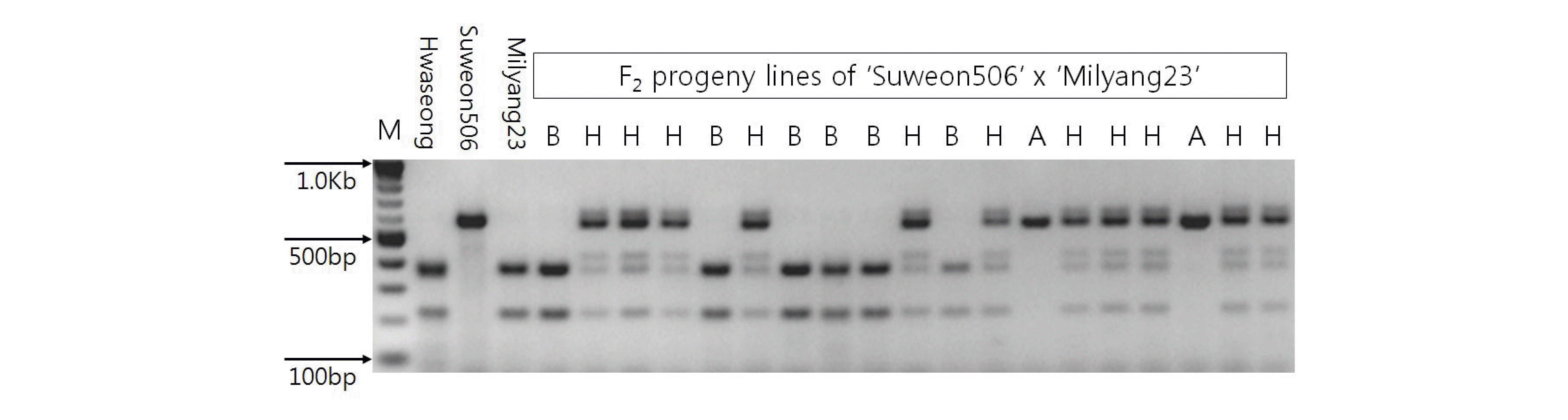
최초 51개의 SSR 마커들에 대해 F2 식물체들의 유전자형 을 조사하여 연관지도 초안(linkage map skeleton)을 작성하 였다. 차후 각 개체의 유전자형과 도열병 저항성(표현형)간의 연관성분석(association analysis)을 통해 확인된 목표유전자 위에 대한 분자마커의 밀도를 올리기 위해 염색체 12번에 대 응하는 3개 SSR (RM3747, RM3472, RM1337) 마커와 1개 STS 마커(S10704; Forward: 5’-cctccgtgatggcgtc-3’, Reverse: 5’-acgataacaaactgggaaca-3’)를 추가로 분석하였다(Table 3, Fig. 3). 각 마커들에 대하여 F2 식물체들로부터 조사된 유전 자형의 분리비가 기대치에 부합하는지 평가하기 위하여 적합 성검정(χ2 test)을 실시하였다.
Table 3
Summary of association analysis between the SSR marker genotypes of F2 progenies and rice blast resistance level of F2:3 seedlings derived from ‘Suwon506’ × ‘Milyang 23’
Table 3
Locusz Mirror-mapy Individuals used for association analysisx
Single-locus ANOVAw Genetic effectv
No. of genotypes Resistance mean
(F2) (F2:3)


Marker Ap Ch cM cM(%) A H B A H B SSM SSE F R2 Add Dom DeD

RM3524 1 4 68.3 64.3 27 66 32 1.28 1.54 2.26 16.3 177.1 5.6** 0.084 0.49 -0.23 -0.47

RM6818 1 6 65.8 53.1 19 73 33 2.37 1.68 1.25 15.3 178.1 5.2** 0.079 -0.56 -0.13 0.24
RM3628 1 6 85.4 76 19 81 25 2.07 1.73 1.16 9.9 183.5 3.3* 0.051 -0.46 0.12 -0.25

RM3747 2 12 19.1 17.5 11 53 61 0.72 1.51 1.98 17.1 176.3 5.9** 0.088 0.63 0.16 0.26
RM6296 1 12 26.7 24.5 12 71 41 0.63 1.58 2.16 23.1 168.1 8.3*** 0.121 0.76 0.19 0.25
RM3472 2 12 27.1 24.8 11 55 59 0.45 1.56 2.00 23.8 169.6 8.5*** 0.123 0.78 0.33 0.43
RM101 1 12 48.2 44.1 20 58 47 0.55 1.38 2.51 63.2 130.2 29.6*** 0.327 0.98 -0.15 -0.16
S10704 2 12 49.3 45.1 18 61 46 0.57 1.41 2.45 53.7 139.3 23.5*** 0.278 0.94 -0.10 -0.10
RM1337 2 12 50.5 47.2 20 59 46 0.53 1.38 2.54 66.0 127.4 31.6*** 0.341 1.01 -0.16 -0.16
RM277 1 12 63.3 58.0 15 62 48 0.70 1.44 2.26 34.3 159.1 13.1*** 0.177 0.78 -0.04 -0.05

zDNA markers were tested on 140 F2 progenies of ‘Suewon506’ × ‘Milyang 23’. After the first round of association analyses with well defined 51 anchor markers (application: Ap=1), additional 4 markers were applied to narrow down the putative location of rice blast resistance gene on chromosome 12 (Ap=2). Markers with significant F value were presented on rice chromosomes 4, 6, and 12

yBoth cM positions and percentage-expressed (cM%) are indicated (see Table 2)

xAssociation analysis was conducted on 125 fertile F2 individuals. By using the corresponding F2:3 seedlings, mean resistance level, against the blast isolate, ‘93-072’, for each genotype categories revealed by DNA markers. A and B are homozygous for ‘Suweon506’ and ‘Milyang 23’ allele types, respectively, and H indicates heterozygous progenies at the tested locus

wThe significance levels corresponding to each F-value are indicated with asterisk; ***P<0.0001, **P<0.01, and *P<0.05

vAdditive effect (Add), and degree of dominance (DeD) were then estimated at the declared loci: Add=(Bmean-Amean)/2 and DeD=Do/Add, where A and B are homozygous F2 individuals for ‘Suweon506’ and ‘Milyang 23’, H is heterozygous individuals at the tested locus, and Do(dominant effect) = Hmean-(Bmean+Amean)/2
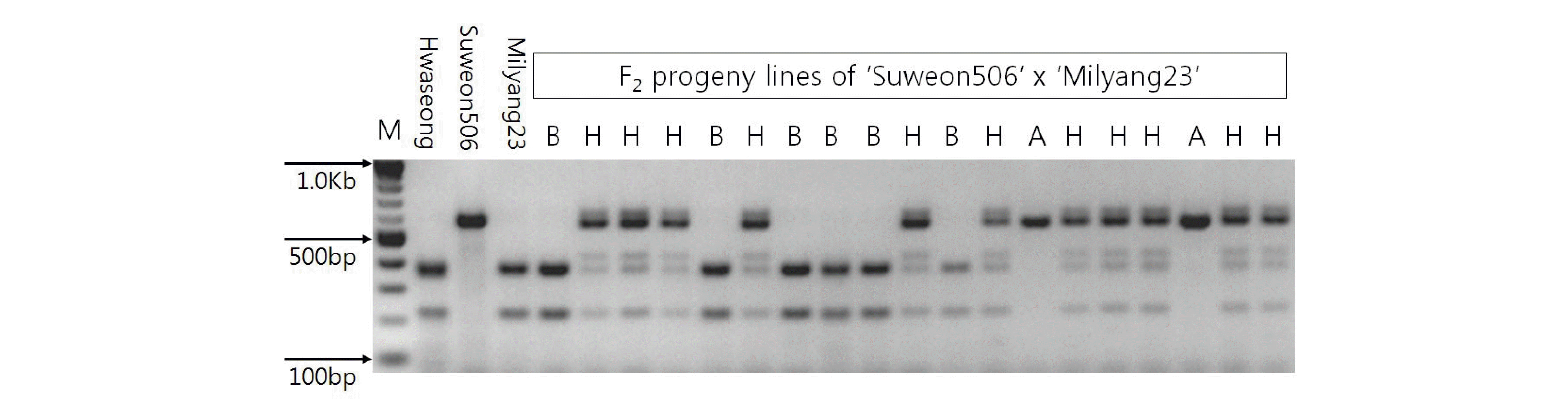

Fig. 3.
Partial gel image showing segregation pattern of a STS marker, S10704 within F2 progeny lines derived from the cross between ‘Suweon506’ and ‘Milyang23’. The PCR products were cleaved by an endonuclease, Hinf I (G^ANTC) to detect latent polymorphism, where the paternal allele type, ‘Milyang23’ cleaved into two fragments. Among F2 progeny lines, A and B are homozygous for ‘Suweon506’ and ‘Milyang 23’ allele types, respectively, H is for heterozygous progenies at the locus tagged by S10704. M indicates a DNA size ladder, 2-Log(New England Biolabs, USA). Note that the different allele type between ‘Hwaseong’ and ‘Suweon506’ is also strongly suggests the introgression event of the O. minuta’s DNA segment nearby the S10704 locus of ‘Hwaseong’.
KJBS-46-17_F3.gif
PCR은 10 ng의 DNA와 5 pmol의 forward 및 reverse 프 라이머, 0.2 mM dNTP mix, 1X PCR buffer[50 mM KCl, 10 mM Tris-HCl (pH 9.0), 0.1% Triton X-100, 1.5 mM MgCl2] 및 1 unit의 Taq polymerase (Nurotics, Korea)를 이 용하여 총 부피 20 ul로 실시하였다. PTC-100® thermocycler (Waltham, USA)를 사용하여, 95°C에서 3분간 초기 변성 후 95°C에서 20초, 55°C에서 30초, 72°C에서 60초로 총 35회 반 복하고, 72°C에서 5분간 반응하였다. PCR 산물은 Sequencing gel[5% polyacrylamide (19:1, acrylamide:bis- acrylamide), 6 M Urea, 1X TBE, 80 W]을 이용하여 전기영동 한 후 Silver Sequence™ (Promega, USA)로 염색하여 유전자형을 판정하였다. 단, STS 마커 S10704의 경우, PCR 산물을 제한 효소 Hinf I (New England Biolabs, USA)로 절단한 후 Agarose gel (1% Agarose, 1X TBE, 200 V)로 전기영동 하 고 ethidium bromide로 염색하였다.
도열병 저항성 유전자위 표지를 위한 유전통계분석
야생벼에서 유래한 도열병 저항성 관련 유전자위의 벼 염 색체상 위치를 파악하기 위해 ‘수원506호’와 ‘밀양23호’의 F2 개체들로부터 확보된 마커 유전자형과 도열병 균주 ‘93-072’ 에 대한 F2:3 계통들의 저항성 간의 연관성을 평가하였다 (association analysis). SAS 프로그램(SAS Institute 2000)의 PROC MEANS를 이용하여 기술통계량을 산출하였고, PROC GLM을 이용하여 각 SSR 마커들에 의해 표지되는 유전자좌 가 도열병 저항성에 관여되는 정도를 판정하였다. 각 유전자 좌에 대한 F 분석 결과 P값이 0.05보다 작으면 유의하다고 판정하고, F2분리집단에서 관찰된 전체 도열병저항성 분산에 대한 해당 유전자좌의 기여도(R2 value; %)와 유전적 작용가 (additive effect) 및 기작양상(degree of dominance) 등을 추 정하였다(Jeung et al. 2007).
수원506호의 도열병 저항성평가 및 검정 균주선정
‘수원509호’ 등 6개 품종에 대해 6개 도열병 균주를 접종 하여 이병반응을 검정한 결과는 Table 1 및 Fig. 1과 같다. ‘화성’과 ‘일품’은 접종된 6개 균주 모두에 이병성 반응을 보 였고, 그 외 4개 품종들은 서로 다른 이병성 반응을 보였다. 특히 공시된 6개 균주 모두에 감수성인 ‘화성’에 비해 ‘수원 506호’는 3개 균주(93-072, 93-456, 03-177)에 저항성을 발 현하므로 야생벼 O. minuta의 도열병 저항성 유전인자가 ‘화 성’에 이전되었음을 재차 확인할 수 있었다. 도열병 저항성 유전자 연관분석(Jeung et al. 2007) 및 벼 품종 육성계보도 추정연구(Cho et al. 2007) 등의 선행연구를 통해 ‘화성’은 Pia, ‘진부’는 Piz, Pita, PikPi9(t), ‘일품’은 PibPii, ‘주남’은 Pib, ‘밀양23호’는 Pib, PitaPik-p 등의 도열병 저항성 유전자를 보유하는 것으로 밝혀진 바 있다. 이상의 결 과로 미루어 볼 때 ‘수원506호’는 비교 품종들이 보유하고 있 는 저항성 유전자들과는 다른 유전자의 작용에 의해 도열병 저항성이 발현되는 것으로 판단되어 이에 대한 유전분석을 수행하고자 하였다.
Fig. 1.
Reaction patterns of the ‘Suweon506’ to virulent Korean rice blast isolates, which are highly compatible to the recurrent parent, ‘Hwaseung’, and a good quality japonica rice cultivar, ‘Ilpum’.
KJBS-46-17_F1.gif
‘수원506호’는 불임, 탈립성 등 종간교잡 후대에서 흔히 관 찰되는 열악한 형질 발현(Brar & Khush 1997)을 극복하기 위해 여교잡으로 육성된 ‘화성’의 근동질 계통이다(Kang et al. 2007, Jeung et al. 2011b). 그러므로 자포니카 벼 품종에 대해 분자마커의 다형성(polymorphism) 확보가 용이한 ‘밀 양23호(통일계)’를 F2 유전분석 집단의 부본으로 선정하였다. ‘수원506호’의 도열병 저항성이 분리하는 교잡후대에서 변별 력 높은 표현형결과(도열병 저항성)를 확보하기 위해 ‘수원 506호’는 침해하지 못하면서 반복친인 ‘화성’과 부본인 ‘밀양 23호’에 동시에 친화성인 도열병 균주 ‘93-072’를 유전분석 에 이용하였다.
‘수원506호’ x ‘밀양23호’ 후대 F2 집단을 이용한 연관지도 작성
‘수원506호’ × ‘밀양23호’의 교배립에서 유래한 F1 식물체 의 자가수정을 통해 F2 종자를 확보하고 총 140개의 F2 식물 체로 구성된 유전분석 집단을 구축하였다. 각 F2 개체에서 DNA를 추출하여 분자마커를 이용한 연관지도를 작성하였다 (Table 2). 연관지도 작성에서는 처음부터 전 염색체에 고밀 도의 분자마커를 배치하는 대신, 각 염색체 마다 최소한의 개 수의 SSR 마커를 균등하게 배치하여 ‘연관지도 초안(linkage map skeleton)’을 작성하였다. 일차적으로 연관지도 초안에 포함된 각 분자마커의 유전자형과 표현형(도열병 저항성) 간 의 연관성분석을 수행하여, 유의성이 높은 염색체 부위에만 선택적으로 분자마커의 배치밀도를 높여주는 전략을 취하였 다(Jeung et al. 2011a, 2011b; Table 3). 염색체별 분자마커 배치에는 Jeung et al. (2007)이 제사한 ‘e-Landing’ 기법을 활용하여 각 분자마커에 대응하는 벼 유전체정보를 파악하고 ‘mirror-map’을 구축함으로써 연관지도 작성에 요구되는 부 가적인 유전통계분석 절차를 생략하였다(Table 2).
‘수원506호’와 ‘밀양23호’ 간에 다형성을 보이며, 각 염색 체상에 균등하게 위치한 총 51개의 SSR 마커를 이용하여 연 관지도 초안을 작성하였다(Table 2). 유전자형의 분리비를 검 정한 결과, 염색체 3번과 6번의 상단부위와 염색체 12번 전반 에서 분리비 이상(segregation distortion)이 매우 유의하게 관 찰되었다(Table 2). 염색체 12번에서는 ‘수원506호’의 유전 자형에 비해 ‘밀양23호’의 유전자형의 빈도가 매우 높게 관찰 되었는데, 이러한 분리비 이상은 RM3747, RM3472, S10704 및 RM1337 등 4개 마커의 추가분석에서도 동일한 경향이었 다(Table 2, Table 3).
‘수원506호’ x ‘밀양23호’ 후대 F2:3 계통을 이용한 도열병 저항성 평가
‘수원506호’ × ‘밀양23호’ F2 집단에서 도열병 저항성 유 전자의 분리양상을 평가하기 위하여 각 F2 개체들로부터 수 확된 F2:3 종자를 이용하였다. 불임이 심하였던 15개 개체를 제외한 125개 F2 개체들로부터 종자가 수확되었다. 각 F2:3 계 통 당 20~30개 개체들을 도열병 균주 ‘93-072’로 접종한 후, 개체 별로 평가된 저항성 정도의 평균값을 취하여 각 F2:3 계 통에 대응하는 F2 개체의 도열병 저항성 표현형으로 사용하 였다.
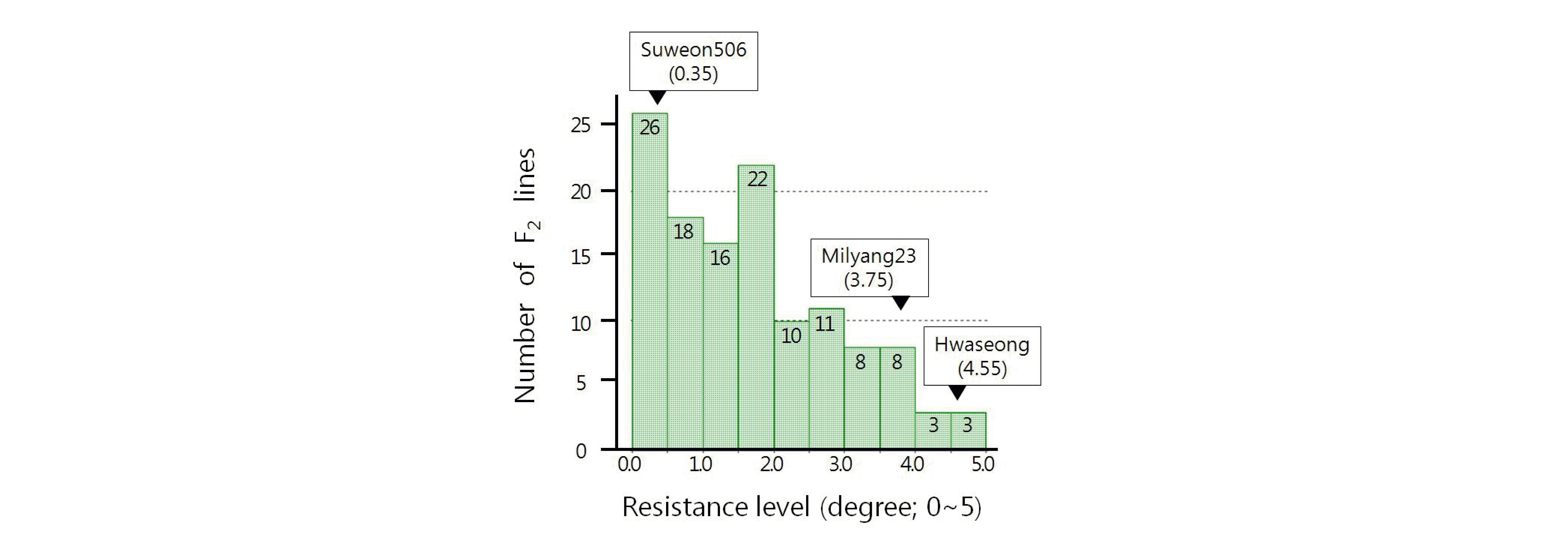
양친인 ‘수원506호’ 및 ‘밀양23호’의 저항성 수준은 각각 0.35와 3.75로 평가되었으며, ‘수원506호’의 반복친 ‘화성’은 4.55로 평가되었다. 이러한 결과로 미루어 도열병 균주 ‘93-072’ 의 특이성(specificity)이 F2:3 계통평가 과정에서도 잘 발현되 었음을 알 수 있었다(Table 1). 125개 F2 개체들의 저항성 수 준의 분포는 평균 1.67을 중심으로 왼편(저항성)으로 크게 편 향된 양상을 보여(skewness=0.63), F2 집단에서 도열병 균주 ‘93-072’에 대한 저항성이 소수의 주동유전자에 의해 지배되 고 있음을 강하게 시사하였다(Fig. 2).
Fig. 2.
Histograms of mean resistance level of F2:3 seedlings derived from the 125 fertile F2 individuals of ‘Suweon506’ × ‘Milyang 23’. The descriptive statistics on the performance of 125 F2:3 lines, over-all mean, standard deviation, skewness, and kurtosis are 1.67, 1.25, 0.63, and -0.45, respectively. The resistance levels of the parental lines, ‘Suweon506’ and ‘Milyang23’, and the recurrent parent, ‘Hwaseong’, were also evaluated along with the F2:3 lines. The mean resistance levels, based on 20 times observations, of those three lines, are presented in parenthesis.
KJBS-46-17_F2.gif
연관성평가에 의한 도열병 저항성 유전자위 표지
연관지도 초안에 배치된 51개 SSR 마커에 대응하는 F2 개 체들의 유전자형과 F2:3 계통검정을 통해 확보된 표현형간의 연관성 평가를 실시하였다(Table 3). 각 SSR 마커에 대해 125개 F2 개체들을 3개의 유전자형 군집으로 나눈 후(No. of genotypes), 각 군집의 평균(Resistance mean)에 대해 분산분 석을 실시하였다(Single-locus ANOVA). 분산분석 결과 F 값이 유의한 경우 해당 유전자좌 근접부위에 표현형 변이에 영향을 끼치는 유전자가 존재하는 것으로 판단하고 R2 값(전 체 표현형 분산이 유전자형에 의해 설명되는 비율)을 제시하 고 유전적 작용력(Genetic effect)을 추정하였다.
연관지도 초안에 배치된 총 51개의 SSR 마커들 중 통계적 으로 유의한 F 값을 지니는 마커는 6개로 4번, 6번 및 12번 염색체에서 각각 1개, 2개 및 3개가 확인되었다(Table 3, Ap=1). 분산분석 결과가 유의한 6개 SSR 마커에 대해 추정된 F 값과 R2 값에 미루어 도열병 균주 ‘93-072’에 저항성을 발 현하는 후보 유전자위들은 4번 염색체 중단 부위(RM3524), 6번 염색체 중단 부위(RM6818) 및 12번 염색체 중단 부위 (RM101) 등에서 1차적으로 표지 되었다. 이들 유전자좌들에 서 추정된 상가적 효과(additive effect)는 ‘수원506호’의 대 립인자에 의해 4번 및 12번 염색체에서 각각 0.49 및 0.98씩 저항성이 증가되고, 6번 염색체에서는 ‘밀양23호’의 대립인 자에 의해 저항성이 0.56 증가 되었다.
‘수원506호’가 발현하는 도열병 저항성에 관여하는 주동유 전자위가 12번 중단부위에 위치하는 것으로 판단하고 해당부 위의 연관지도 밀도를 높이기 위해 RM3747, RM3472, S10704 및 RM1337 등의 분자마커들에 대한 연관성 평가를 추가로 실시하였다(Table 3, Ap=2). 분산분석 결과의 F 값 및 R2 값 에 의거하여 ‘수원506호’의 도열병 저항성 관련 유전자는 RM101-S10704-RM1337 분자마커들에 대응하는 2.3 cM 영 역 내에 위치하는 것으로 추정되었다. 상기 3개 분자마커들에 대응하는 ‘화성(반복친)’의 유전자형을 ‘수원506호’와 비교한 결과 RM101과 RM1337에서는 동일한 유전자형이(자료 미제 시), S10704에서는 이질적인 유전자형이 확인되었다(Fig. 3). 이는 S10704에서 추정된 고도로 유의한 통계량(F = 23.5, R2 = 0.278)과 함께, 도열병 저항성 유전자를 포함하는 야생벼 O. minuta의 염색체 절편이 ‘화성’으로 이입되어 ‘수원506호’ 가 육성되었다는 객관적인 증거로 생각된다. 그러나 S10704의 상, 하위에 배치된 RM101(F = 29.6, R2 = 0.327)과 RM1337 (F = 31.6, R2 = 0.341)에서 추정된 더욱 유의한 통계량들은 S10704를 도열병 저항성 유전자가 위치하는 ‘최근접 부위’라 는 결론과 상충되었다. 이와 같이 S10704에서 추정된 통계량 이 약간 낮아진 것은 ‘RM101-S10704’ 및 ‘S10704-RM1337’ 등 두 영역에서 교차(cross over)에 의해 저항성인 ‘수원506 호’의 유전자형 빈도가 약간 감소했기 때문으로 여겨진다 (Table 3). 반면에 상기 3개 분자마커들에서 각각 추정된 상 가적 효과들은 0.94~1.01 로 실용적인 차이가 거의 없었다 (Table 3). ‘목표유전자위’에 대한 보다 면밀한 분자생물학적 분석을 위해서는 상기 3개 유전자위가 모두 헤테로인 F2 개체 들이 세대 진전된 규모 있는 ‘추가분리집단’에 대한 유전분석 이 필요할 것으로 판단되었다. 현재 6개 F2:3 계통군에서 임의 선정된 1,000 여 개체들에 대한 유전자형 판정과 각 개체에서 수확된 F2:4 종자를 이용한 표현형 평가작업이 진행 중이다.
e-Landing을 이용한 목표유전자위에 대응하는 벼 유전전 체 탐색
연관지도에 포함된 각 분자마커에 대해 e-Landing을 수행한 결과(Table 2, Physical information), 12번 염색체의 RM101-S10704-RM1337에 대응하는 벼 유전체 정보는 8.8~11.9 Mbp 사이로 제한되었다(Fig. 4). 해당 영역은 약 3.1 Mbp 크 기로 31개의 BAC 혹은 PAC 클론들로 이루어져 있었다. 12 번 염색체 중단에는 Pi-6(t), Pi12(t), Pi-21(t), Pi31(t), Pi-32(t), Pi-41, Pi-157, Pita, Pi-ta2Pi-tq6 등 적어도 9 개의 저항성 유전자들이 위치하는 것으로 보고 되었으나 (Sallaud et al. 2003, Yang et al. 2009), 야생벼 O. minuta 에서 유래한 도열병 저항성 유전자는 보고된 바 없다. 앞으로 추가분리집단에 대한 유전분석을 통하여 ‘수원506호’의 도열 병 저항성 유전자위를 보다 정밀하게 탐색하고 해당부위를 포함하는 BAC 혹은 PAC 클론의 전사부위(open reading frame; ORF) 정보를 활용하여 기존에 보고된 도열병 저항성 유전자들과의 유전적 관련성에 대한 판정이 필요하다.
Fig. 4.
High density linkage map for the target region on rice chromosome 12, harboring the blast resistant gene originated from a wild relative, O. minuta. A. Linkage map skeleton of the chromosome 12. Ten DNA markers (9 SSRs and 1 STS) were used to narrow down the putative location. Markers were applied based on F-statistics from single-locus ANOVA results (see Table 3). B. High resolution map for the target region surrounded by DNA markers was determined through e-Landings. Based on the primer sequence information of SSR markers, the corresponding 3.1 Mbp virtual contig composed of BAC or PAC clones was determined.
KJBS-46-17_F4.gif
본 연구에서 재배벼(AA)인 ‘화성’의 12번 염색체 중단 부 분에 이입된 야생벼 O. minuta (BBCC)의 염색체 단편은 ‘수 원506호’에서 확인된 STS 마커 S10704의 이질적 유전자형 으로 인해 증명되었다(Fig. 3). 반면에 도열병 저항성 주동유 전자위에 대한 연관지도 밀도를 높여주기 위해서 검토되었던 30여 개의 분자마커들과 더불어(자료 미제시), S10704에 근 접하는 RM101 및 RM1337 등에서 확인된 ‘수원506호’와 ‘화성’간 동일한 유전자형들은 이입된 O. minuta의 염색체 절편과 ‘화성’의 대응영역 간 상당한 수준의 ‘상동성’(highly conserved micro-colinearity)이 유지됨을 강하게 시사하였다. Wang et al. (2005)은 종간교잡을 통해 재배벼로 이입된 야 생벼의 염색체 단편의 물리적 위치가 재배벼의 게놈구조에 의해 크게 지배된다고 제시한 바 있다. 이러한 현상은 O. australiensis (EE 게놈)로부터 유래한 벼멸구 저항성 유전자 Bph18 (Jena et al. 2006) 및 도열병 저항성 유전자 Pi40 (Jeung et al. 2007)과 O. minuta에서 유래한 도열병 저항성 유전자 Pi9 (Liu et al. 2002) 등에서도 확인된 바 있다.
야생벼는 재배벼의 병해충 저항성과 불량환경 적응성 등을 제고할 수 있는 유용한 유전자원으로 평가되고 있다. 농촌진 흥청 국립식량과학원에서 국내육성 자포니카 벼 품종인 ‘화 성’과 야생벼 O. minuta (BBCC 게놈; Acc.=101141)간의 종 간교잡을 통하여 흰잎마름병과 도열병에 저항성인 ‘수원506 호’를 육성하였으며, 본 계통에 대한 야생벼 유래 도열병 저 항성 유전자의 유전양상 구명 및 유전자위 표지에 대한 연구 결과는 다음과 같다.
  1. 반복친인 ‘화성’에 높은 친화성을 발현하는 6개 도열병 균 주 검정에서 ‘수원506호’는 반복친 ‘화성’과 5개 비교품종 들과 다른 저항성 반응을 보여 이들과 다른 야생벼 유래 도열병 저항성 유전자를 보유하는 것으로 판단되었다.

  2. 분자마커의 유전자형과 도열병 저항성 간의 연관성평가를 수행한 결과, ‘수원506호’의 도열병 저항성에 관여하는 주 동유전자위는 12번염색체 중단의 RM101-S10704-RM1337 좌위에 위치하는 것으로 추정되었다.

  3. STS 마커 S10704에서 확인된 ‘화성’과 ‘수원506호’의 이 질적인 유전자형은 해당부위에 야생벼 O. minuta의 염색 체 단편이 이입되었다는 것을 증명하였다.

  4. 이 좌위는 적어도 9개의 도열병 저항성 유전자들이 위치하 는 것으로 보고된 바 있는데, 추후 정밀분석을 통해 ‘수원 506호’의 도열병 저항성 유전자위와 기 보고된 유전자들 과의 관계를 분석할 계획이다.

본 연구는 농촌진흥청 바이오그린21사업(과제번호 PJ00816) 의 지원으로 수행된 결과이며, 이에 감사 드립니다.
  • 1. Bonman JM, Wang GL, Mackill DJ, McCouch SR, Champoux MC, Nelson RJ. RFLP mapping of genes conferring complete and partial resistance to blast in a durably resistant rice cultivar. Genetics 1994. 4: 1421-1434.
  • 2. Brar DS, Khush GS. Alien introgression in rice. Plant Mol. Biol 1997. 35: 35-47.
  • 3. Cho YC, Kwon SW, Choi IS, Lee SK, Jeon JS, Oh MK, Roh JH, Hwang HG, Yang SJ, Kim YG. Identification of major blast resistance genes in Korean rice varieties (Oryza sativa L.) using molecular markers. J. Crop Sci. Biotech 2007. 10: 265-276.
  • 4. Huang CL, Hwang SY, Chiang YC, Lin TP. Molecular evolution of the Pi-ta gene resistant to rice blast in wild rice (Oryza rufipogon). Genetics 2008. 179: 1527-1538.
  • 5. Jena KK, Jeung JU, Lee JH, Choi HC, Brar DS. High-resolution mapping of a new brown planthopper (BPH) resistance genegene, Bph18(t), and marker-assisted selection for BPH resistance in rice (Oryza sativa L.). Theor. Appl. Genet 2006. 112: 288-297.
  • 6. Jeung JU, Hwang HG, Moon HP, Jena KK. Fingerprinting template japonica and tropical indica rice genotypes by comparative analysis of DNA markers. Euphytica 2005. 146: 239-251.
  • 7. Jeung JU, Heu SG, Shin MS, Vera Cruz CM, Jena KK. Dynamics of Xanthomonas oryzae pv. oryzae populations in Korea and their relationship to known bacterial blight resistance genes. Phytopathology 2006. 96: 867-875.
  • 8. Jeung JU, Kim BR, Cho YC, Han SS, Moo HP, Lee YT, Jena KK. A novel gene, Pi40(t), linked to the DNA markers derived from NBS-LRR motifs confers broad spectrum of blast resistance in rice. Theor. Appl. Genet 2007. 115: 1163-1177.
  • 9. Jeung JU, Roh TH, Kang KH, Jeong JM, Kim MK, Kim YG. Genetic analysis on the bacterial blight resistance of Suweon497, a rice breeding line developed through wide hybridization. Korean J. Breed. Sci 2011a. 43: 81-91.
  • 10. Jeung JU, Roh H, Kang KH, Shin YS, Kim YG. Genetic analysis on the bacterial blight resistance gene from a wild relative, Oryza minuta. Korean J. Crop Sci 2011b. 56: 124-133.
  • 11. Kang KH, Seo JP, Jeon YH, Jeung JU, Lee YT. Development of elite lines with disease and insect resistance through wide hybridization in rice. Treat Crop Res 2007. 8: 89-104.
  • 12. Kim BR, Roh JH, Choi SH, Ahn SW, Han SS. Durability of rice cultivars to blast in Korea by sequential planting method. Korean J. Breed. Sci 2004. 36: 350-356.
  • 13. Kim CK. Blast management in high input, high yield potential, temperature rice ecosystems, rice blast disease 1994. walling ford, UK, IRRI and CAB international. 451-463.
  • 14. Kim DM, Ju HG, Yang P, Han SS, Roh JH, Ahn SN. Mapping and race specific reaction of the resistance gene Pi45(t) in rice. Korean J. Breed. Sci 2011a. 43: 42-49.
  • 15. Kim DM, Ju HG, Kang JW, Han SS, Ahn SN. A new rice variety ‘Hwaweon 4’ with durable resistance to rice blast. Korean J. Breed. Sci 2011b. 43: 620-624.
  • 16. Liu G, Lu G, Zeng L, Wang GL. Two broad- spectrum blast resistance genes, Pi9(t) and Pi2(t), are physically linked on rice chromosome 6. Mol. Genet. Genomics 2002. 267: 472-480.
  • 17. McCouch SR, Teytelman L, Xu Y, Lobos KB, Clare K, Walton M, Fu B, Maghirang R, Li Z, Xing Y, Zhang Q, Kono I, Yano M, Fjellstrom R, DeClerck G, Schneider D, Cartinhour S, Ware D, Stein L. Development and Mapping of 2240 New SSR Markers for Rice (Oryza sativa L.). DNA Res 2002. 9: 257-279.
  • 18. Murray M, Thompson W. Rapid isolation of high molecular weight plant DNA. Nucl Acid Res 1980. 8: 4321.
  • 19. Noh TH, Lee DK, Kang MH, Shin MS, Na SY. Identification of new race of Xanthomonas oryzae pv. Oryzae in Korea. Phytopathology 2003. 93: S66.
  • 20. Rahman ML, Chu SH, Choi MS, Qiao YL, Jiang W, Piao R, Khanam S, Cho YI, Jeung JU, Jena KK, Koh HJ. Identification of QTLs for some agronomic traits in rice using an introgression line from Oryza minuta. Mol. Cells 2007. 24: 16-26.
  • 21. Sallaud C, Lorieux M, Roumen E, Tharreau D, Berruyer R, Svestasrani P, Garsmeur O, Ghesquiere A, Notteghem J-L. Identification of five new blast resistance genes in the highly blast-resistant rice variety IR64 using a QTL mapping strategy. Theor. Appl. Genet 2003. 106: 794-803.
  • 22. SAS InstituteSAS Language and Procedure: Usage, Release & 01 2000. Cary, NC, USA, SAS Institute.
  • 23. Shim HS, Hong SJ, Yeh WH, Han SS, Sung JM. Damage analysis of rice panicle blast on disease occurrence time and severity. Plant Pathol. J 2005. 21: 87-92.
  • 24. Yang Q, Lin F, Wang L, Pan Q. Identification and mapping of Pi41, a major gene conferring resistance to rice blast in the Oryza sativa subsp. indica reference cultivar, 93-11. Theor. Appl. Genet 2009. 118: 1027-1034.
  • 25. Wang YM, Dong ZY, Zhang ZJ, Lin XY, Shen Y, Zhou D, Liu B. Extensive de novo genomic variation in rice induced by introgression from wild rice (Zizamia latifola Griseb.). Genetics 2005. 170: 1945-1956.

Download Citation

Download a citation file in RIS format that can be imported by all major citation management software, including EndNote, ProCite, RefWorks, and Reference Manager.

Format:

Include:

Genetic Analysis on the Blast Resistance Gene of ‘Suweon506’ Derived from a Wild Relative, Oryza minuta
Korean. J. Breed. Sci.. ;46(1):17-27.   Published online March 31, 2014
Download Citation

Download a citation file in RIS format that can be imported by all major citation management software, including EndNote, ProCite, RefWorks, and Reference Manager.

Format:
Include:
Genetic Analysis on the Blast Resistance Gene of ‘Suweon506’ Derived from a Wild Relative, Oryza minuta
Korean. J. Breed. Sci.. ;46(1):17-27.   Published online March 31, 2014
Close

Figure

  • 0
  • 1
  • 2
  • 3
Genetic Analysis on the Blast Resistance Gene of ‘Suweon506’ Derived from a Wild Relative, Oryza minuta
Image Image Image Image
Fig. 3. Partial gel image showing segregation pattern of a STS marker, S10704 within F2 progeny lines derived from the cross between ‘Suweon506’ and ‘Milyang23’. The PCR products were cleaved by an endonuclease, Hinf I (G^ANTC) to detect latent polymorphism, where the paternal allele type, ‘Milyang23’ cleaved into two fragments. Among F2 progeny lines, A and B are homozygous for ‘Suweon506’ and ‘Milyang 23’ allele types, respectively, H is for heterozygous progenies at the locus tagged by S10704. M indicates a DNA size ladder, 2-Log(New England Biolabs, USA). Note that the different allele type between ‘Hwaseong’ and ‘Suweon506’ is also strongly suggests the introgression event of the O. minuta’s DNA segment nearby the S10704 locus of ‘Hwaseong’.
Fig. 1. Reaction patterns of the ‘Suweon506’ to virulent Korean rice blast isolates, which are highly compatible to the recurrent parent, ‘Hwaseung’, and a good quality japonica rice cultivar, ‘Ilpum’.
Fig. 2. Histograms of mean resistance level of F2:3 seedlings derived from the 125 fertile F2 individuals of ‘Suweon506’ × ‘Milyang 23’. The descriptive statistics on the performance of 125 F2:3 lines, over-all mean, standard deviation, skewness, and kurtosis are 1.67, 1.25, 0.63, and -0.45, respectively. The resistance levels of the parental lines, ‘Suweon506’ and ‘Milyang23’, and the recurrent parent, ‘Hwaseong’, were also evaluated along with the F2:3 lines. The mean resistance levels, based on 20 times observations, of those three lines, are presented in parenthesis.
Fig. 4. High density linkage map for the target region on rice chromosome 12, harboring the blast resistant gene originated from a wild relative, O. minuta. A. Linkage map skeleton of the chromosome 12. Ten DNA markers (9 SSRs and 1 STS) were used to narrow down the putative location. Markers were applied based on F-statistics from single-locus ANOVA results (see Table 3). B. High resolution map for the target region surrounded by DNA markers was determined through e-Landings. Based on the primer sequence information of SSR markers, the corresponding 3.1 Mbp virtual contig composed of BAC or PAC clones was determined.
Genetic Analysis on the Blast Resistance Gene of ‘Suweon506’ Derived from a Wild Relative, Oryza minuta

Reactions of rice lines to selected Korean virulent blast isolates

Linesz Rice blast isolate (race)y
90-008 93-072 93-093 93-456 02-319 03-177
(KI1113) (KJ103) (KI197) (KI409) (KJ105) (KJ105)

‘Suweon506’ 4 0 3 0 5 0
‘Hwaseong’ 5 5 5 5 5 5
‘Jinbu’ 2 5 4 0 0 4
‘Namil’ 4 4 4 1 5 5
‘Ilpum’ 5 5 5 4 5 5
‘Junam’ 5 0 5 1 5 5
‘Milyang23’ 3 4 3 2 3 2

‘Suweon506’ is an introgression line of a wild rice O. minuta (BBCC genome, Acc. 101141) into a Korean Japonica rice cultivar, ‘Hwaseong’

Rice blast isolates were collected from Korean farmers’ fields, and tested on rice lines due to their high compatibility to ‘Hwaseong’, the recurrent parent of ‘Suweon506’

List of DNA markers, their e-Landing mediated physical positions on rice Pseudomolecule6, corresponding BCA/PAC clones with their determined cM positions, and the segregation test (χ2 test) results on the F2 progenies derived from the cross between ‘Suweon506’ and ‘Milyang23’

Markerz Physical informationy
Mirror mapx
Segregation testw
Ch Start Stop e-PCR e % BAC/PAC cM cM% A H B M χ2

RM3252 1 299,681 299,852 172 0.7 AP002818 0.3 0.7 34 66 40 0 0.76
RM600 1 9,461,346 9,461,566 221 21.7 AP001081 49.6 21.7 36 56 48 0 7.08*
RM449 1 15,305,619 15,305,758 140 35.1 AP008247 72.8 35.1 35 61 44 0 3.10
RM1349 1 25,398,082 25,398,300 219 58.3 AP002744 103.1 57.9 30 59 51 0 9.02*
RM1003 1 33,803,800 33,803,927 128 77.5 AP003345 136.6 77.5 29 75 36 0 1.16
RM6321 1 43,251,019 43,251,186 168 99.2 AP003277 181.8 99.2 37 72 31 0 0.45

RM7 3 9,808,540 9,808,710 171 27.0 AC134232 44.4 27.0 15 59 66 0 39.02***
RM1164 3 14,840,558 14,840,757 200 40.8 AC084766 68.7 40.8 19 77 44 0 9.53**
RM1350 3 28,632,514 28,632,682 169 78.8 AC087181 126.8 78.8 28 74 38 0 1.56
RM3585 3 36,080,616 36,080,784 169 99.3 AC128647 161.7 99.3 21 82 37 0 7.16*

RM551 4 168,620 168,811 192 0.5 AL606442 3.1 0.5 38 73 29 0 1.13
RM5633 4 13,059,370 13,059,580 211 37.1 AL731595 19.9 37.1 34 73 33 0 0.16
RM3524 4 22,674,720 22,674,847 128 64.3 AL606636 68.3 64.3 30 73 37 0 0.73
RM349 4 32,465,508 32,465,652 145 92.1 AL606455 111.3 92.1 24 70 44 2 5.25
RM559 4 35,117,645 35,117,804 160 99.6 AL606637 129.6 99.6 32 76 32 0 0.79

RM5693 5 441,872 442,071 200 1.5 AC129716 4.6 1.5 37 67 36 0 0.16
RM5558 5 21,168,727 21,168,899 173 70.9 AC105769 86.0 70.9 46 64 30 0 4.16
RM1054 5 29,144,035 29,144,184 150 97.6 AC098598 122.0 97.6 31 77 32 0 1.13

RM3353 6 435,582 435,697 116 1.4 AP001129 1.4 1.4 21 77 42 0 7.02*
RM276 6 6,230,046 6,230,169 124 19.9 AP003488 33.5 19.9 17 83 40 0 11.56***
RM6818 6 16,581,413 16,581,542 130 53.1 AP004012 65.8 53.1 30 76 34 0 1.02
RM3628 6 23,737,032 23,737,157 126 76.0 AP003612 85.4 76.0 25 88 27 0 8.56*
RM5753 6 30,966,850 30,967,050 201 99.1 AP004685 124.4 99.1 34 78 28 0 2.02

RM1093 7 668,161 668,310 150 2.0 AP003746 2.5 2.3 36 72 32 0 0.22
RM1377 7 12,782,829 12,783,009 181 43.1 AP004305 49.7 43.1 35 71 34 0 0.02
RM3743 7 19,342,334 19,342,513 180 65.2 AP003815 67.0 65.2 37 74 29 0 1.10
RM172 7 29,560,592 29,560,750 159 99.6 AP005199 118.6 99.6 45 70 25 0 5.16

RM408 8 119,935 120,063 129 0.4 AP005406 0.5 0.4 33 64 43 0 2.10
RM547 8 5,586,058 5,586,291 234 19.7 AP004746 40.2 19.7 37 73 25 5 2.61
RM3262 8 22,248,334 22,248,500 167 78.6 AP005483 86.7 78.6 34 76 29 1 1.31
RM5545 8 28,141,927 28,142,083 157 99.4 AP004623 121.2 99.4 35 68 37 0 0.10

RM316 9 1,074,933 1,075,126 194 4.7 AP005860 0.8 4.5 44 58 38 0 4.13
RM219 9 7,887,585 NA 34.3 AP005912 20.7 34.5 44 60 36 0 3.36
RM566 9 14,704,798 14,705,036 239 63.9 AP005397 50.7 63.9 35 78 27 0 2.42
RM205 9 22,720,646 22,720,801 156 98.7 AP005546 93.5 98.7 29 76 35 0 1.30

RM1375 10 16,386,764 16,386,943 180 71.6 AC025905 42.7 71.6 39 74 27 0 2.13
RM590 10 22,784,993 22,785,130 138 99.6 AC018727 83.8 99.6 35 68 37 0 0.10

RM332 11 2,840,211 2,840,381 171 10.0 AC133217 10.3 10.0 26 77 37 0 2.73
RM536 11 8,968,470 8,968,712 243 31.5 AC138197 49.1 31.5 32 63 45 0 3.36
RM5961 11 19,425,385 19,425,513 129 68.2 AC108223 79.9 68.2 30 75 35 0 0.88
RM144 11 28,246,930 28,247,154 225 99.2 AC134045 116.2 99.2 38 64 38 0 0.79

RM8215 12 1,585,781 1,586,001 221 5.8 BX000498 10.8 9.9 8 65 66 1 47.27***
RM3747 12 2,304,368 2,304,510 143 8.4 AL954364 19.1 17.5 11 61 68 0 46.99***
RM6296 12 3,200,576 3,200,730 155 11.6 AL713906 26.7 24.5 13 79 47 1 18.13***
RM3472 12 3,520,117 3,520,331 215 12.8 AL713902 27.1 24.8 11 63 66 0 42.96***
RM101 12 8,826,829 NA 32.1 AL928776 48.2 44.1 22 65 53 0 13.50***
S10704 12 10,081,374 NA AL731739 49.3 45.1 23 65 52 0 13.82***
RM1337 12 11,933,319 11,933,500 182 43.4 BX000556 50.5 47.2 22 66 52 0 12.42***
RM277 12 18,290,458 NA 66.5 AL831799 63.3 58.0 15 70 54 1 20.78***
RM1300 12 25,965,369 25,965,533 165 94.4 AL713940 100.2 93.4 10 66 64 0 40.53***
RM17 12 26,954,668 26,954,835 168 98.0 AC027133 107.4 98.4 13 63 64 0 37.02***

A total of 55 DNA markers are listed, in which 51 SSR anchor markers were used to construct ‘linkage map skeleton’, and 4 DNA markers (underlined; RM3747, RM3472, S10704, and RM1337) were included, after conducting initial association analysis, to increase marker density nearby the chromosomal region harboring the blast resistance gene on chromosome 12

The primer sequences were used as queries to localize on the ‘Rice Pseudomolecules Release 6’ (http://rice. plantbiology. msu.edu/analyses_search_blast.shtml). When both primer sequences were successfully recognized for their physical locations to be annealed, the expected PCR product size (e-PCR: ‘Stop’-‘Start’+1bp, NA=not available) was used to judge PCR products. If any primer failed for e-Landing, the other primer's location was used to estimate the corresponding point. The determined physical regions followed by e-Landing were used to match corresponding BAC/PAC clones according to the ‘Rice Pseudomolecule Information and Gene Search’(http://rice.plantbiology.msu.edu/)

The determined cM position for each BAC/PAC clones was directly adopted from the ‘IRGSP Build5 Pseudomolecules’ (http://rgp.dna.affrc.go.jp/E/IRGSP/Build5/build5.html). To compare the cM positions from various mapping populations with different total lengths, the percentage relative genetic positions, ‘cM%’, was also calculated

A and B are homozygous for ‘Suweon506’ and ‘Milyang 23’ allele types, respectively, H is for heterozygous progenies at the tested locus, and M indicates the number of plants with missing genotype. Segregation distorted loci are indicated with asterisk; ***P<0.0001, **P<0.01, and *P<0.05

Summary of association analysis between the SSR marker genotypes of F2 progenies and rice blast resistance level of F2:3 seedlings derived from ‘Suwon506’ × ‘Milyang 23’

Locusz Mirror-mapy Individuals used for association analysisx
Single-locus ANOVAw Genetic effectv
No. of genotypes Resistance mean
(F2) (F2:3)


Marker Ap Ch cM cM(%) A H B A H B SSM SSE F R2 Add Dom DeD

RM3524 1 4 68.3 64.3 27 66 32 1.28 1.54 2.26 16.3 177.1 5.6** 0.084 0.49 -0.23 -0.47

RM6818 1 6 65.8 53.1 19 73 33 2.37 1.68 1.25 15.3 178.1 5.2** 0.079 -0.56 -0.13 0.24
RM3628 1 6 85.4 76 19 81 25 2.07 1.73 1.16 9.9 183.5 3.3* 0.051 -0.46 0.12 -0.25

RM3747 2 12 19.1 17.5 11 53 61 0.72 1.51 1.98 17.1 176.3 5.9** 0.088 0.63 0.16 0.26
RM6296 1 12 26.7 24.5 12 71 41 0.63 1.58 2.16 23.1 168.1 8.3*** 0.121 0.76 0.19 0.25
RM3472 2 12 27.1 24.8 11 55 59 0.45 1.56 2.00 23.8 169.6 8.5*** 0.123 0.78 0.33 0.43
RM101 1 12 48.2 44.1 20 58 47 0.55 1.38 2.51 63.2 130.2 29.6*** 0.327 0.98 -0.15 -0.16
S10704 2 12 49.3 45.1 18 61 46 0.57 1.41 2.45 53.7 139.3 23.5*** 0.278 0.94 -0.10 -0.10
RM1337 2 12 50.5 47.2 20 59 46 0.53 1.38 2.54 66.0 127.4 31.6*** 0.341 1.01 -0.16 -0.16
RM277 1 12 63.3 58.0 15 62 48 0.70 1.44 2.26 34.3 159.1 13.1*** 0.177 0.78 -0.04 -0.05

DNA markers were tested on 140 F2 progenies of ‘Suewon506’ × ‘Milyang 23’. After the first round of association analyses with well defined 51 anchor markers (application: Ap=1), additional 4 markers were applied to narrow down the putative location of rice blast resistance gene on chromosome 12 (Ap=2). Markers with significant F value were presented on rice chromosomes 4, 6, and 12

Both cM positions and percentage-expressed (cM%) are indicated (see Table 2)

Association analysis was conducted on 125 fertile F2 individuals. By using the corresponding F2:3 seedlings, mean resistance level, against the blast isolate, ‘93-072’, for each genotype categories revealed by DNA markers. A and B are homozygous for ‘Suweon506’ and ‘Milyang 23’ allele types, respectively, and H indicates heterozygous progenies at the tested locus

The significance levels corresponding to each F-value are indicated with asterisk; ***P<0.0001, **P<0.01, and *P<0.05

Additive effect (Add), and degree of dominance (DeD) were then estimated at the declared loci: Add=(Bmean-Amean)/2 and DeD=Do/Add, where A and B are homozygous F2 individuals for ‘Suweon506’ and ‘Milyang 23’, H is heterozygous individuals at the tested locus, and Do(dominant effect) = Hmean-(Bmean+Amean)/2
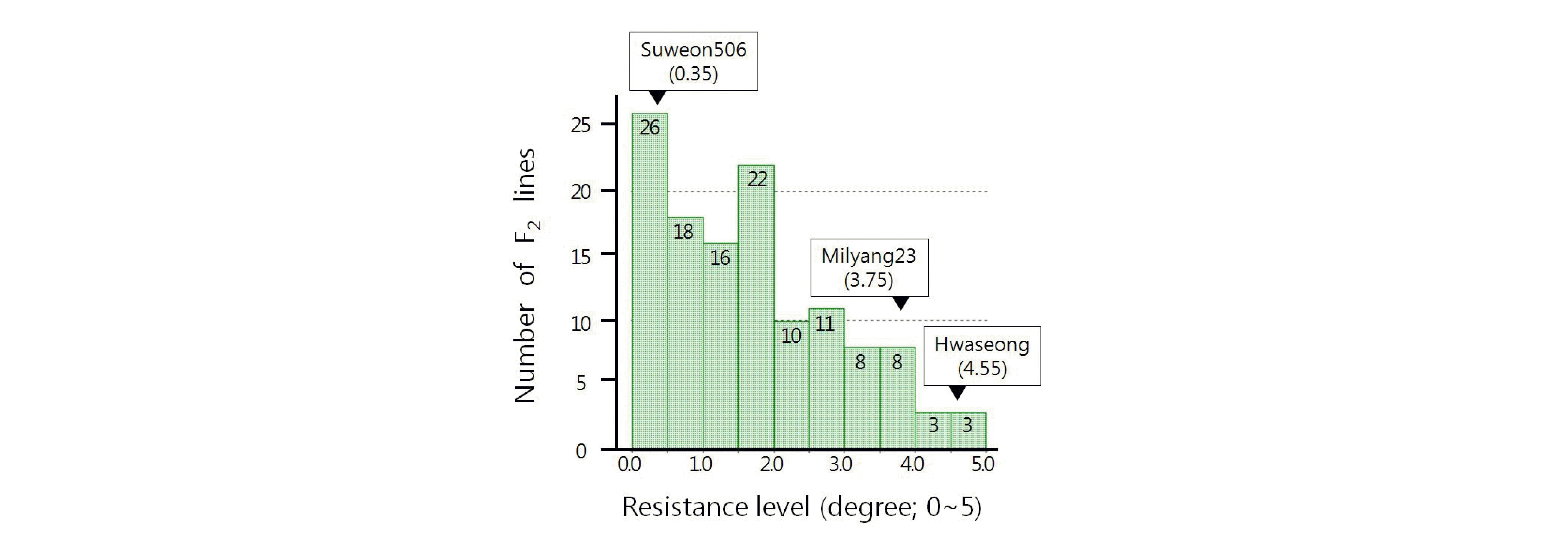
Table 1 Reactions of rice lines to selected Korean virulent blast isolates

‘Suweon506’ is an introgression line of a wild rice O. minuta (BBCC genome, Acc. 101141) into a Korean Japonica rice cultivar, ‘Hwaseong’

Rice blast isolates were collected from Korean farmers’ fields, and tested on rice lines due to their high compatibility to ‘Hwaseong’, the recurrent parent of ‘Suweon506’

Table 2 List of DNA markers, their e-Landing mediated physical positions on rice Pseudomolecule6, corresponding BCA/PAC clones with their determined cM positions, and the segregation test (χ2 test) results on the F2 progenies derived from the cross between ‘Suweon506’ and ‘Milyang23’

A total of 55 DNA markers are listed, in which 51 SSR anchor markers were used to construct ‘linkage map skeleton’, and 4 DNA markers (underlined; RM3747, RM3472, S10704, and RM1337) were included, after conducting initial association analysis, to increase marker density nearby the chromosomal region harboring the blast resistance gene on chromosome 12

The primer sequences were used as queries to localize on the ‘Rice Pseudomolecules Release 6’ (http://rice. plantbiology. msu.edu/analyses_search_blast.shtml). When both primer sequences were successfully recognized for their physical locations to be annealed, the expected PCR product size (e-PCR: ‘Stop’-‘Start’+1bp, NA=not available) was used to judge PCR products. If any primer failed for e-Landing, the other primer's location was used to estimate the corresponding point. The determined physical regions followed by e-Landing were used to match corresponding BAC/PAC clones according to the ‘Rice Pseudomolecule Information and Gene Search’(http://rice.plantbiology.msu.edu/)

The determined cM position for each BAC/PAC clones was directly adopted from the ‘IRGSP Build5 Pseudomolecules’ (http://rgp.dna.affrc.go.jp/E/IRGSP/Build5/build5.html). To compare the cM positions from various mapping populations with different total lengths, the percentage relative genetic positions, ‘cM%’, was also calculated

A and B are homozygous for ‘Suweon506’ and ‘Milyang 23’ allele types, respectively, H is for heterozygous progenies at the tested locus, and M indicates the number of plants with missing genotype. Segregation distorted loci are indicated with asterisk; ***P<0.0001, **P<0.01, and *P<0.05

Table 3 Summary of association analysis between the SSR marker genotypes of F2 progenies and rice blast resistance level of F2:3 seedlings derived from ‘Suwon506’ × ‘Milyang 23’

DNA markers were tested on 140 F2 progenies of ‘Suewon506’ × ‘Milyang 23’. After the first round of association analyses with well defined 51 anchor markers (application: Ap=1), additional 4 markers were applied to narrow down the putative location of rice blast resistance gene on chromosome 12 (Ap=2). Markers with significant F value were presented on rice chromosomes 4, 6, and 12

Both cM positions and percentage-expressed (cM%) are indicated (see Table 2)

Association analysis was conducted on 125 fertile F2 individuals. By using the corresponding F2:3 seedlings, mean resistance level, against the blast isolate, ‘93-072’, for each genotype categories revealed by DNA markers. A and B are homozygous for ‘Suweon506’ and ‘Milyang 23’ allele types, respectively, and H indicates heterozygous progenies at the tested locus

The significance levels corresponding to each F-value are indicated with asterisk; ***P<0.0001, **P<0.01, and *P<0.05

Additive effect (Add), and degree of dominance (DeD) were then estimated at the declared loci: Add=(Bmean-Amean)/2 and DeD=Do/Add, where A and B are homozygous F2 individuals for ‘Suweon506’ and ‘Milyang 23’, H is heterozygous individuals at the tested locus, and Do(dominant effect) = Hmean-(Bmean+Amean)/2