적요
유채는 국내 노지 재배 여건에서 연간 1세대 전개가 일반적이며, 계통 고정에 6-7년이 소요된다. 본 연구는 스피드 브리딩(SB)과 스피드 버널리제이션(SV)을 조합하여 유채 작형별 세대 단축 조건을 확립하고 국내 육성 품종 및 계통에 대한 적용 가능성을 평가하였다. SB (22h 명/2h 암) 조건에서 봄형과 반겨울형은 각각 파종 후 33일, 43일에 개화하였으나, 겨울형은 추대가 유도되지 않았다. 반면, 10℃에서 2주간 춘화처리(22h 명/2h 암) 후 SB로 처리(SV(2)-SB)를 한 결과, 겨울형에서도 개화하였다. 세 작형 모두, 개화 45일 후에 수확되었으며, 발아율은 95% 이상으로 나타났다. 따라서, 봄형과 반겨울형은 SB 조건에서 연간 4세대, 겨울형은 SV(2)-SB 조건에서 연간 3세대를 전개할 수 있음을 확인하였다. 확립된 조건을 이용해 국내 육성 품종 및 계통에 적용한 결과, 모든 자원들은 SB 조건에서 개화하였고, 대부분 자원에서 종자 발아율이 90% 이상 나타나 연간 4세대 전개가 가능함을 확인하였다. 다만, 일부 품종(‘유려’)에서는 결실 저하가 관찰되어, 세대 단축 조건에서 안정적 결실 확보를 위한 추가 검토가 필요하다. 본 연구는 국내 유채 육종에서 작형별 생리적 춘화 요구도를 반영한 세대 단축 조건을 확립하였고, 흰 꽃 형질 및 개화 반응과 같은 선발 지표의 활용 가능성을 제안함으로써 유채 품종 개발 기간 단축을 위한 기반을 마련하였다.
Abstract
Rapeseed (Brassica napus L.) is typically grown under field conditions in Korea, with one generation per year, and requires 6-7 years to develop homozygous lines. This study established generation-acceleration protocols for different rapeseed growth types by combining speed breeding (SB) and speed vernalization (SV) and evaluated their applicability to Korean-bred cultivars and lines. Under SB (22 h light/2 h dark), the spring and semi-winter types flowered at 33 and 43 days after sowing, respectively, whereas bolting was not observed in the winter-type. In contrast, the winter-type flowered after SV at 10℃ for 2 weeks under an extended photoperiod (22 h light/2 h dark), followed by transfer to SB conditions (SV(2)-SB). For all three types, pods were harvested 45 days after flowering, and seed germination exceeded 95%. Accordingly, the spring and semi-winter types achieved four generations per year under SB, whereas the winter type achieved three generations per year under SV(2). When applied to Korean-bred cultivars and lines, SB induced flowering in all accessions and most seeds germinated (>90%), enabling four generations per year. However, no seed set was obtained in one cultivar (‘Yuryeo’), indicating that further optimization is needed to ensure reliable seed production under generationacceleration conditions. Overall, these protocols account for growth-type-dependent vernalization requirements and provide a foundation for shortening the rapeseed breeding cycle, with the flowering response and white-flower phenotype as practical selection indicators.
-
Key words: rapeseed, speed breeding, speed vernalization, generation acceleration
서언
유채(
Brassica napus L.)는 국내에서 식용유와 나물 등 다양한 용도로 활용되는 작물이다(
An et al. 2024,
Yu et al. 2024). 최근 소비자 기호의 다양화와 산업적 수요 확대에 따라 품질 특성 및 용도 적합성이 우수한 신품종을 신속하게 개발할 필요성이 커지고 있다. 그러나 유채는 부분타가수정작물로, 계통육종법을 통해 안정적인 동형접합 계통을 확보하기 위해서는 여러 세대에 걸친 자가수분과 계통 고정 과정이 필수적이다. 또한 국내 재배는 겨울재배(10월-6월)와 봄재배(2월-7월) 체계가 일반적이며, 노지 조건에서는 연간 1세대 전개가 보편적이다. 이로 인해 고정 계통 확보에 평균 6-7년이 소요되고, 반복적인 자가수분 작업이 요구되어 시간과 노동 투입이 크다. 더불어 기존 계통육종 기반의 품종 육성에는 통상 13년 이상이 필요하므로, 시장과 산업의 수요 변화에 신속히 대응하는 데 한계가 있다. 따라서 전체 육성 기간의 상당 부분을 차지하는 계통 육성 단계(6-7년)를 단축하는 것은 국내 유채 육종에서 중요한 과제로 판단된다.
배가반수체(double haploid, DH) 기술, 특히 유채에서 소포자 배양을 이용한 반수체 육종은 100% 동형접합계통을 확보할 수 있는 장점이 있다. 그러나 소포자 배양은 유전형 의존성이 매우 크고, 배양 환경이나 배지 조건에 따라 배발생(embroygenesis) 효율이 크게 변동한다. 따라서, 반응성이 높은 유전형과 낮은 유전형 간에 서로 다른 소포자 배양 프로토콜의 최적화가 필요하며, 배양 환경 요인이 배발생 효율을 결정하는 핵심 요인으로 작용한다(
Ferrie &, Möllers 2011). 국내 육성 품종을 대상으로 한 연구에서도 반수체 배 생산성은 유전형에 의해 크게 좌우되었고, 일부 품종에서는 배 생산 및 세포분열이 전혀 일어나지 않았다(
Park et al. 2006). 이러한 문제를 해결하기 위해 꽃봉오리 크기, 열처리 조건, 배양 밀도 등 배양 조건을 체계적으로 규명하고 최적화하려는 연구가 진행되었다. 배발생 효율이 낮은 품종이나 F1 잡종을 대상으로 효율적인 소포자 배 생산 조건을 확립하려는 시도가 보고되었으나 비배발생(non-embryogenesis) 을 거쳐 캘러스가 형성되거나, 순화된 재분화 식물체의 배수성이 유채(4n)와 불일치(2n 또는 8n) 하는 등의 문제가 발생하였다(
Kim et al. 2012,
Lee et al. 2022). 따라서, 소포자 배양을 통한 DH 생산은 대량 계통 확보 효율성 측면에서 여전히 제약이 존재하며, 육종 현장에서 요구되는 계통수를 충분히 확보하기 위해서는 효율적인 세대 단축 전략이 필요하다.
최근, 장일 조건을 기반으로 생육 및 발달을 가속화하는 스피드 브리딩(speed breeding, SB)이 제시되었다.
Watson et al.(2018)은 22시간 명/2시간 암의 장일 광주기를 적용하여 밀과 보리에서 연간 6세대, 유채는 4세대 전개가 가능함을 보고하였다. 다만
Watson et al.(2018)의 결과는 봄형(spring type) 장일성 작물을 대상으로 하였으며, 겨울형(winter type) 작물에는 적용에 한계가 있었다.
Song et al.(2022)은 겨울형 장일 식물의 세대 단축을 위해 장일 처리는 유지하되 명 상태에는 4.5℃, 암 상태에서는 9℃의 저온을 주어 춘화(vernalization)를 유도하는 comprehensive speed breeding (CSB)를 제안하였다. 또한, 춘화 처리에도 추대하지 않는 겨울형 유채에는 원적외광을 추가하여 개화를 유도하였다. 이를 통해 봄형, 반겨울형(semi-winter type), 겨울형 유채에서 각각 연간 5.5세대, 4.5세대, 3세대를 전개할 수 있다고 보고하였다. 국내에서도 장일 처리를 통해 밀과 트리티케일의 세대 단축 효과를 확인하였다(
Cha et al. 2020,
Cha et al. 2021). 밀의 경우, 봄밀은 단순 장일처리만으로 개화 하였지만, 겨울밀의 경우 출수기 단축이 어려웠다. 겨울밀의 세대 단축을 위해,
Cha et al.(2022)는 일반적인 춘화 조건(4℃)보다 높은 온도(10℃)에서 춘화를 유도하는 방법을 제시하였고 이를 Speed vernalization (SV)로 명명하였다. 상대적으로 높은 온도에서도 탈춘화(devernalization) 현상이 일어나지 않았으며, 겨울형 밀과 보리의 세대를 연간 5세대 전개가 가능하다고 보고하였다. 한편, 장일식물 뿐만 아니라, 단일식물인 콩에서도 광원, 광량(PPFD), 재식밀도 등 요인 실험을 통해 세대 전개를 단축시키는 조건이 보고되었다(
Lee et al. 2023). 작물별 여러 요인을 기반으로 하는 이러한 접근들은 소포자 배양을 통한 반수체 육종법보다 더 많은 계통을 확보할 수 있으며, 높은 기술력을 요구하지 않고, 생육 관찰을 통해 집단들을 직접 다룰 수 있다는 점에서 육종 현장에서의 적용성이 높다. 특히, 장일 처리와 춘화 처리를 조합한 세대 단축 방법은 유채 작형(봄형, 반겨울형, 겨울형)간 생리적 요구도의 차이를 반영하여 운용할 수 있으며, 유전형 의존성이 큰 소포자 배양 접근법을 보완할 수 있는 대안이 된다.
본 연구는 지금까지 보고된 장일 처리 및 춘화 처리 기반 세대 단축 조건을 토대로, 봄형, 반겨울형, 겨울형 유채에 적용 가능한 세대 단축 조건을 확립하였다. 그 후, 확립된 조건으로 국내 품종 및 계통을 적용하여 세대 단축 효과를 검증하고 활용 전략을 수립하는 것을 목표로 하였다. 이를 통해 국내 유채 육종에서 품종 개발을 가속화할 수 있는 육성 기반을 마련하고자 한다.
재료 및 방법
식물 재료 및 재배 조건
본 연구는 국립식량과학원 소득식량작물연구소 온실에서 수행하였다. 유채는 일반적으로 춘화 요구도와 개화 반응에 따라 봄형, 반겨울형, 겨울형으로 구분된다. 봄형은 춘화 없이 개화하며 주로 캐나다와 호주에서 재배되고, 겨울형은 정상적인 개화를 위해 장기간의 저온 처리(춘화)가 필요하여 주로 유럽에서 재배되며, 반겨울형은 중간 수준의 춘화 요구도를 보이며 주로 중국에서 재배된다(
Wang et al. 2011,
Zhou et al. 2017). 따라서, 유채 작형별로 장일 및 춘화 처리에 따른 세대 단축 효과를 평가하기 위해 봄형 ‘Brio’ (IT119627), 반겨울형 ‘Gan you No.5’ (IT134597), 겨울형 ‘Falcon’ (IT267749) 자원들을 유전자원센터(
http://genebanck.rda.go.kr/)에서 분양받았다(
Table 1). 설정된 세대 단축 조건의 효과 검증을 위해 국내 육성 품종 및 계통인 ‘유려’, ‘중모7001’, ‘중모 7002’, ‘중모7003’, ‘금별’, ‘백운’, ‘다건’, ‘탐미’, ‘영산’, ‘목포 151호’를 공시재료로 선정하였다. 모든 자원은 자원당 5개체(n=5)씩 시험하였으며, 종자는 50공 트레이에 각 공당 3립씩 파종하였다. 토양은 원예용 상토(Hungnong, Korea)를 사용하였으며, 관수는 관주방식으로 실시하였다. 발아 후 5일경 떡잎이 전개되는 시기에 솎아주기를 통해 공당 1개체로 유지하였으며, 각 자원별로 개화 45일 후에 성숙된 꼬투리를 수확하였다.
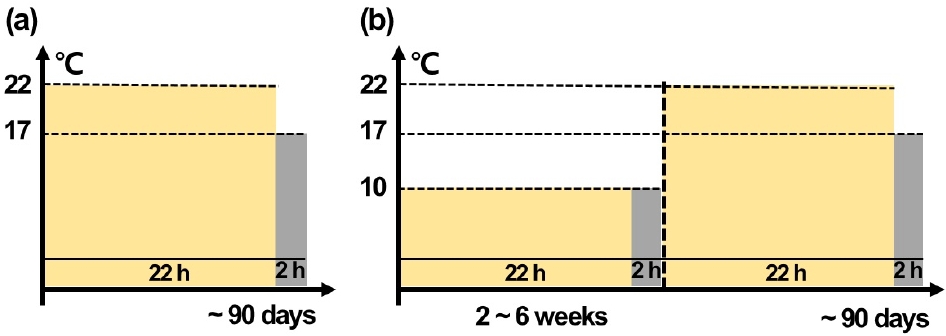
⋅SB: 22 h light (22℃)/2 h dark (17℃)
⋅SV (2-6)-SB: 22 h light (10℃)/2 h dark (10℃) (2-6 weeks) - SB
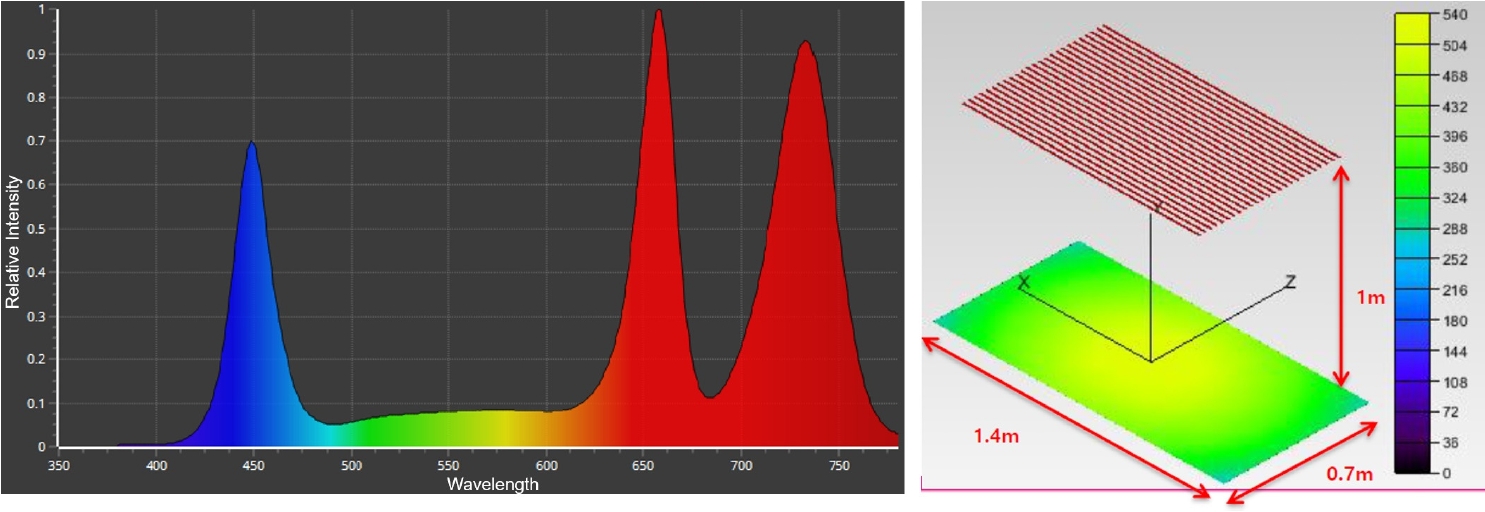
광원은 발광 다이오드(LED)를 사용하였으며, 겨울형 유채의 추대 및 개화 유도를 고려하여 원적외선을 포함하여 제작하였다. 재배대 하단부터 LED까지의 광도는 444-520 μmol m
-2s
-1이었다(
Fig. 2).
개화소요일수는 추대 이후 형성된 꽃봉오리 중 20%가 개화하였을 때를 기준으로 계산하였다. 생육 특성 조사는 수확 시점에 수행하였으며, 초장(plant height), 분지수(branch number per plant), 개체당 꼬투리수(silique number per plant), 꼬투리당 종자수(seed number per silique), 꼬투리 길이(silique length)를 측정하였다. 꼬투리에서 탈립된 수확 종자는 페트리디시에 치상하여 발아율을 조사하였다. 발아된 종자는 치상 7일 후 유근과 떡잎이 모두 전개된 것을 기준으로 하였다.
통계 분석
통계 분석은 Rstudio (verson 4.4.1; Rstudio, PBC, Boston, MA, USA)를 사용하여 수행하였다. 모든 결과는 5반복의 평균 또는 평균±표준편차로 제시하였다. 처리 효과 검정을 위해 이원분산분석(Two-way ANOVA)을 수행하였고, 처리 평균 간 비교를 Duncan’s multiple range test (DMRT)로 실시하였다(p<0.05).
결과 및 고찰
유채 작형별 SB와 SV 조건에서의 세대 단축
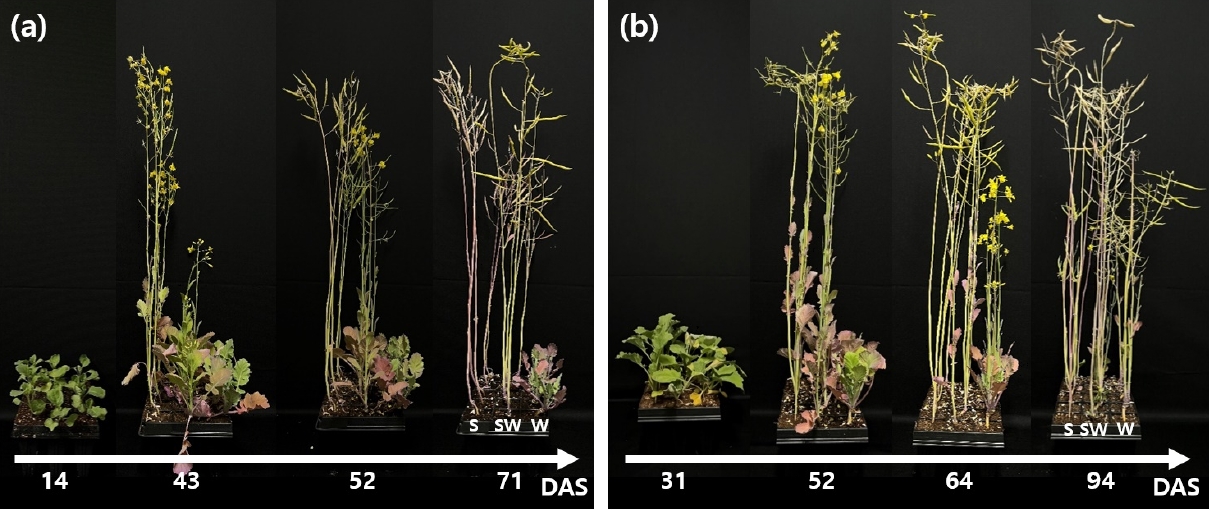
SB 조건에서 봄형 ‘Brio’는 파종 후 33.6일, 반겨울형 ‘Ganyou No.5’는 파종 43.4일 후에 개화한 반면, 겨울형 ‘Falcon’은 파종 후 120일이 지났음에도 추대가 진행되지 않았다(
Table 2). SB 조건에서 봄형의 개화는 기존에 보고된 결과와 일치하였으나, 반겨울형의 경우 상반된 결과가 나타났다.
Song et al.(2022)은 반겨울형 ‘ZS11’이 춘화 조건 없이 작은 꽃봉오리만 형성하여 정상적인 개화가 일어나지 않았고, 4℃의 춘화 조건을 통해서만 개화하였다고 보고하였다. 본 결과에서는 반겨울형의 개화에 춘화조건이 요구되지 않았으며, 이는 반겨울형 품종 간의 춘화 요구도 정도, 재배 조건 등이 달라 나타난 결과로 사료된다. 이를 통해, 춘화 요구도가 낮은 봄형과 반겨울형은 장일 조건만으로도 개화가 이루어지며, 춘화 요구도가 높은 겨울형은 저온처리가 없으면 생식생장으로 전환이 되지 않는 것을 확인하였다. SV 2주 처리 후 SB 조건으로 전환한 조건(SV(2)-SB)에서 ‘Falcon’은 파종 후 60일에 개화하였다(
Fig. 3). 이는 겨울형 유채 개화를 위해서는 춘화가 필요하다는 것을 나타낸다. 또한,
Song et al.(2022)는 일반적인 춘화 온도(4℃)에서 처리하여 겨울형의 개화를 유도하였지만, 본 결과에서는 일반적인 춘화온도보다 높은 온도인 10℃에서 2주만 처리하여도 가능하다는 것을 확인하였다. 봄형과 반겨울형은 SV 조건에서도 정상적으로 개화하였으나, SB 조건보다 개화 소요일수가 단축되지 않았으며, 단순히 SV 처리 기간이 추가됨에 따라 연장된 것으로 나타났다. 이러한 결과는, 작형별로 적합한 세대 단축 조건을 적용하는 것이 효율적이며, 봄형과 반겨울형은 SB 조건, 겨울형에는 2주의 SV 조건 후 SB 전환이 효과적인 것으로 나타났다.
처리 조건에 따른 생육 특성 조사 결과, 초장, 분지수, 개체당 꼬투리수, 꼬투리당 종자수, 꼬투리 길이에서 대부분 통계적 유의성이 나타나지 않았으며, 유의성이 나타난 조사 항목에서도 경향성이 나타나지 않았다(
Table 2). 작형별로 개화 45일 후에 성숙한 꼬투리를 수확하였으며 별도의 건조 과정을 거치지 않았고, 수확한 종자의 발아율은 모두 96% 이상 높게 나타났다(
Table 3). 따라서 봄형과 반겨울형은 연간 4세대, 겨울형은 연간 3세대를 전개할 수 있음을 확인하였다. 스피드 브리딩 적용시 미성숙 종자 조기 수확과 건조를 통해 세대 전개 기간을 단축할 수 있다고 제시하였다(
Watson et al. 2018). 본 실험에서는 단기간의 생육 조건에서도 종자들이 완전히 성숙하여 높은 발아율을 보였기 때문에, 세대 전개 과정에서 추가적인 건조 과정은 필요하지 않았다.
앞서 설정된 SB와 SV(2)-SB 조건을 적용해 육성 품종 및 계통 10자원에 대한 세대 단축 효과를 평가하였다. 그 결과, 모든 자원들이 SB 조건에서 파종 후 35일 이내에 개화하였으며, 이는 반겨울형인 ‘Gan you No.5’ (43일) 보다 개화소요일수가 짧았고, 일부 자원은 봄형인 ‘Brio’(33일)보다도 더 빠른 개화를 나타냈다(
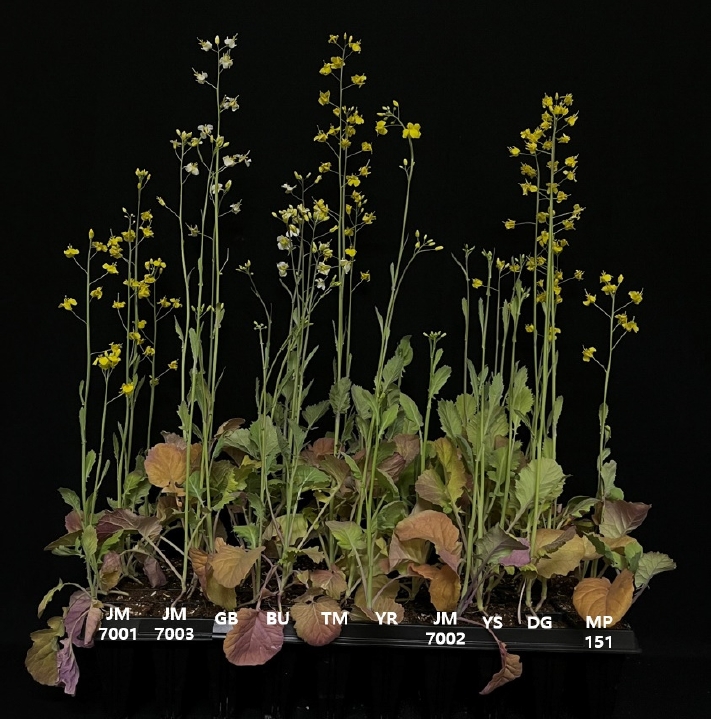
Table 4). 이러한 결과는 국내 육성 자원들은 남부 지역에서 월동이 가능한 반겨울형 특성을 가지면서, 동시에 춘화 요구도가 낮아 봄파종 환경에서도 개화가 가능한 특성을 함께 보유했기 때문으로 사료된다. 즉, 국내 기후에 적합한 육성 자원들은 SB 조건만으로 생식생장 전환이 유도되었다(
Fig. 4). SV(2)-SB 조건에서 모든 자원들이 개화하였으나, 봄형과 반겨울형 자원의 결과와 마찬가지로 SV 처리 기간이 추가됨에 따라 연장된 것으로 나타났다. 농업적 형질은 SB 조건에서의 분지수와 SV(2)-SB 조건에서 분지수와 꼬투리당 종자수를 제외하고 자원 간 유의한 차이가 관찰되었다(
Table 4).
한편, ‘유려’는 정상적으로 개화하고 꼬투리를 형성하였으나, 꼬투리 내부에서 종자 결실이 이루어지지 않는 현상이 관찰되었다. 유채에서 개화와 꼬투리 형성은 정상적으로 이루어지나, 종자 결실이 저하되는 현상이 종종 보고되며, 주요 원인으로 미량원소 결핍, 광⋅온도 스트레스 등이 제시되고 있다. 특히, 붕소 결핍은 화분 발달과 화분관 생장 저해를 통해 결실률 및 꼬투리 종자수 감소로 이어질 수 있다(
Jiang et al. 2025,
Yang et al. 2009). 게다가, LED광을 사용한 온실조건에서 높이에 따른 열 스트레스에 의해 화분 및 수정 후 화분관 발달이 영향을 받을 수 있다(
Chaturvedi et al. 2021,
Sheibani et al. 2023). 따라서 단기간 생육하여 종자를 형성하는 세대 단축 조건에서 높은 결실률을 위해서는 미량원소의 불균형, 실내 환경 스트레스에 따른 수분 저하 등 여러 가능성에 대한 고려가 필요하다. ‘유려’를 제외한 자원들은 개화 후 45일 후에 수확하였고, 발아율은 일부 품종을 제외하고 90% 이상을 나타내었으며 연간 4세대 전개가 가능함을 확인하였다(
Table 5).
본 연구결과를 종합하면, 국내 유채 육종 현장에서 세대 단축 기술을 적용할 때 국내 기후에 적합한 봄형과 반겨울형에는 연간 4세대를 전개할 수 있는 SB 조건을 적용하는 것이 가장 효율적인 것으로 판단된다. 겨울형은 SV(2)-SB 조건에서 3세대 전개가 가능하며, 교배친 활용시에 SV 처리를 통해 개화시기를 조절하여 활용할 수 있을 것으로 사료된다.
국내 유채 재배지에서는 야생갓(
Brassica juncea) 및 들갓(
Sinapis arvensis)의 혼입 가능성 문제가 있으며, 이는 에루스산(erucic acid, C22:1) 함량 관리와 밀접하게 연관되어 있다. 채종유(유채유/카놀라유)는 제조⋅가공 기준에서 에루스산 함량을 2% 이하로 관리해야 한다(MFDS 2023). 국내 주요 보급종인 ‘중모 7001’과 ‘유려’는 에루스산이 함유되지 않도록 육성되었다(
Jeong et al. 2024,
Kim et al. 2014). 반면, 야생갓과 들갓은 에루스산이 40~50% 수준을 나타내어, 무(無)에루스산 유채 종자에 소량만 혼입되어도 유채유의 에루스산 함량을 증가시킬 수 있다. 따라서, 재배⋅수확 단계에서 구별 및 제거가 필요하나 유채와 갓은 배추과(Brassicaceae) 작물로 꽃색(노란색), 종피색(검은색) 등 표현형이 비슷하여 전문가가 아닌 이상 구별이 힘들다. 따라서, 이를 구별하기 위해서는 필지에서 구별할 수 있는 흰 꽃과 수확 후 판별이 용이한 노랑종피와 같은 표현형 형질을 활용하는 것이 실질적인 관리 대안이 될 수 있다. 다만, 국내에서 유일하게 흰 꽃 형질을 가지는 품종인 ‘중모 7003’은 수량이 적으며(
Kim et al. 2016), 최근에는 기후변화로 인해 재배 안정성이 떨어지는 단점이 있다. 본 연구에서 육성 품종 및 계통을 대상으로 시험한 결과, 흰 꽃 형질을 가지는 ‘중모7003’ 및 ‘백운’은 개화기에서 꽃 색이 명확히 구별되어, 스피드 브리딩 연계 표현형에 기반한 선발 지표로 활용할 수 있음을 확인하였다(
Fig. 4).
세대 단축 조건에서 관찰되는 형질이 노지 조건에서도 동일한 경향을 나타낸다면, 세대 단축시에 선발지표로 활용할 수 있다. 밀에서는 온실과 연계한 세대 단축 조건에서 출수 소요 일수와 간장(Culm)의 길이가 유의한 상관을 보였다고 보고하였다(
Cha et al. 2023). 유채에서도 SB 조건에서 개화 반응 또는 개화소요일수를 통해 국내 재배환경에 적합한 봄형과 반겨울형 자원을 선발하는 전략으로 확장할 수 있다. 또한, SB와 SV 조건에서 자원별로 초장, 꼬투리수, 꼬투리길이는 유의한 차이가 나타났다(
Table 4). 따라서 SB 조건과 노지 조건에서의 형질 값을 자원별로 조사하여 상관관계를 분석하고, SB 조건에서 활용 가능한 선발 지표를 확립할 필요가 있다. 또한, 본 연구에서는 제한된 수의 자원을 대상으로 수행되었기 때문에, 모든 자원의 유전적 배경을 대상으로 하기엔 한계가 있다. 반겨울형 및 겨울형 내에서도 춘화 요구도와 개화 반응은 유전형간 변이가 존재할 수 있기 때문에, 재배환경 요인에 따라 세대 단축 효율이 달라질 가능성이 있다. 따라서, 향후에는 다양한 국내외 유전자원 및 교배 유전집단을 대상으로 적용 범위를 검증하는 추가 연구가 필요하다.
스피드 브리딩은 단순한 세대 진전 뿐만 아니라 표현형 선발(phenotypic selection), 유전자 집적(pyramiding), 여교배(backcross), 마커 보조 선발(marker-assisted selection)과 연계해 육종 효율을 향상 시킬 수 있다(
Cha et al. 2024,
Wanga et al. 2021). 향후에는 유채 세대 단축 조건 선발 지표가 노지 조건에서의 농업적 형질을 얼마나 예측하는지 정량화하고, 중요 농업적 형질을 중심으로 마커 보조 선발을 통해 우수한 유전자를 집적하고자 한다.
Notes
-
사사
본 연구는 농촌진흥청 국립식량과학원 연구사업(과제명:유채 자원순환 활성화를 위한 품종 육성 및 활용도 제고 기술 개발(1세부), 과제번호: PJ017594012025)의 지원으로 수행되었습니다.
Fig. 1.The schematic illustration of environmental conditions, (a) Speed breeding (SB), (b) SB combined with speed vernalization for 2-6 weeks (SV(2-6)-SB).
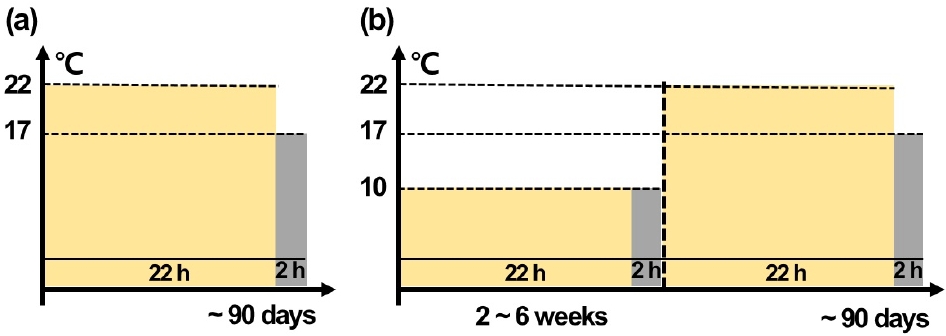
Fig. 2.Light spectrum (left) and intensity (right) at the cultivation bench under SB and SV conditions.
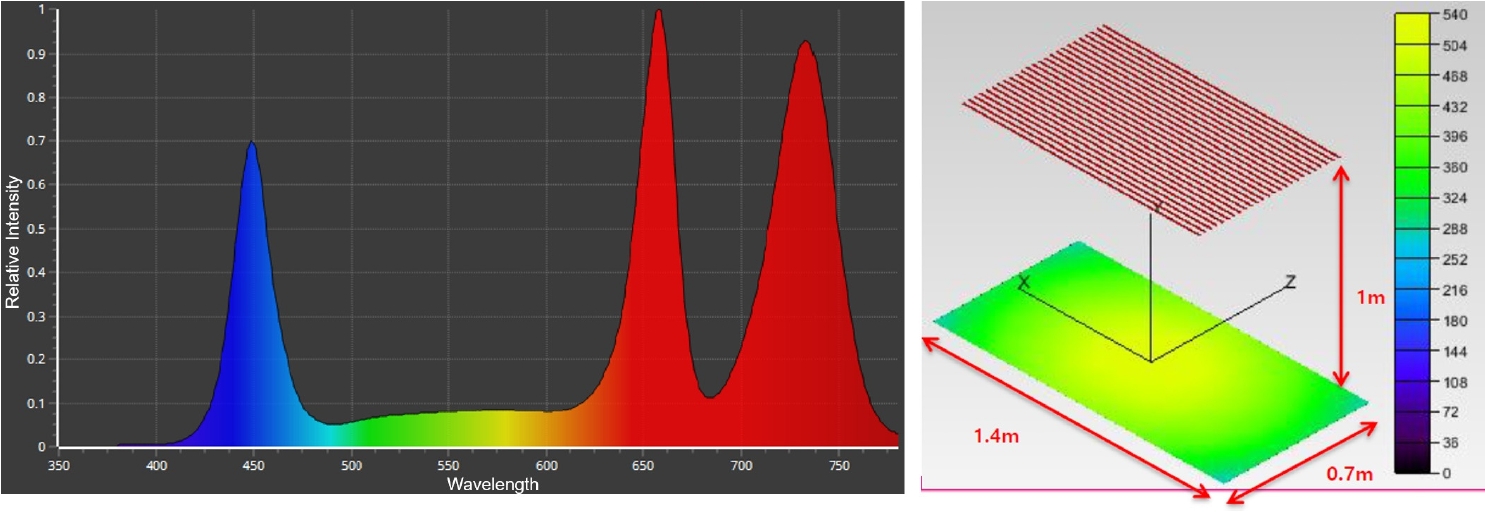
Fig. 3.Under (a) SB and (b) SV(2)-SB conditions in three rapeseed cultivars (left to right within each row: Brio, spring type (S); Ganyou No.5, semi-winter type (SW); Falcon, winter type (W)). (a) Under SB, Brio and Ganyou No.5 flowered at 33 and 43 days after sowing (DAS), respectively, whereas Falcon not flowered, (b) Under SV(2)-SB, all three cultivars flowered; notably, Falcon flowered at 60 DAS.
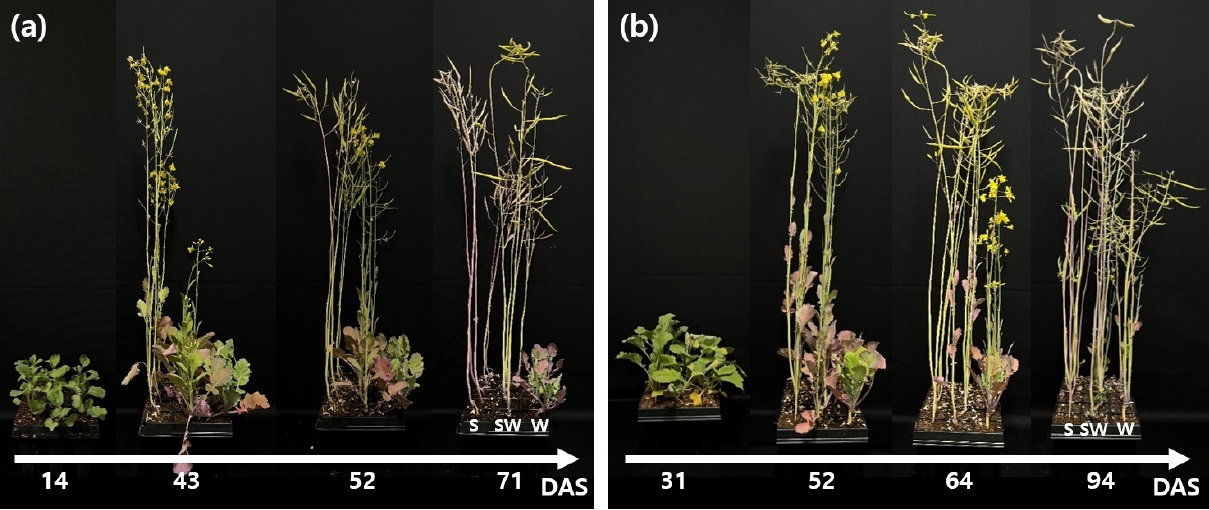
Fig. 4.Under SB condition in ten rapeseed cultivars at 36 days after sowing (DAS); left to right in row: Jungmo 7001 (JM 7001), Jungmo 7003 (JM 7003), Geumbyeol (GB), Baegun (BU), Tammi (TM), Yuryeo (YR), Jungmo 7002 (JM 7002), Yeongsan (YS), Dageon (DG), and Mokpo 151 (MP 151).
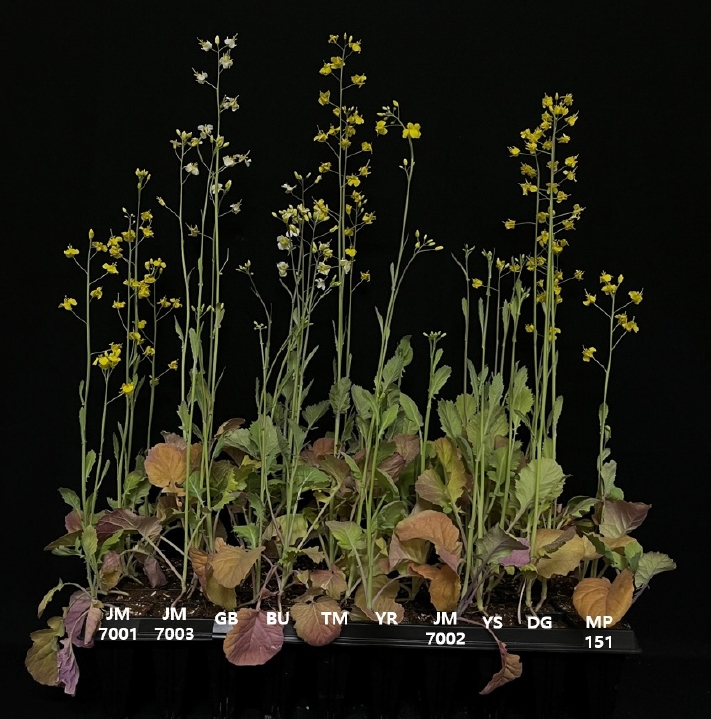
Table 1.Classification and origin of rapeseed cultivars used in this study.
Table 1.
|
Type |
IT No. |
Cultivar |
Origin |
Reference |
|
Spring |
119627 |
Brio |
France |
Wu et al. 2019 |
|
Semi-winter |
134597 |
Ganyou No.5 |
China |
Wang et al. 2007 |
|
Winter |
267749 |
Falcon |
France |
Wu et al. 2019 |
Table 2.Days to flowering and agronomic traits of rapeseed types under SB and SV(2-6)-SB conditions.
Table 2.
|
Cultivar |
Treatment |
Days to flowering |
Plant height (cm) |
Branch number per plant |
Silique number per plant |
Seed number per Silique |
Silique length (mm) |
|
Brio |
SB |
33.6±0.9b
|
62.4±9.0ns
|
1.2±0.4ns
|
9.8±1.1ns
|
13.1±7.2a
|
42.4±9.4a
|
|
SV(2)-SB |
43.2±0.4b
|
73.4±2.6 |
1.6±0.9 |
3.8±4.0 |
11.7±7.7ab
|
38.5±10.9ab
|
|
SV(3)-SB |
47.2±0.4b
|
74.9±3.4 |
1.2±0.4 |
5.2±4.6 |
10.1±6.8b
|
35.9±10.7b
|
|
SV(4)-SB |
53.2±0.4b
|
62.3±13.1 |
1.0±0.0 |
7.4±5.2 |
10.1±6.1b
|
37.6±9.1ab
|
|
SV(5)-SB |
58.4±0.5b
|
65.7±7.5 |
1.0±0.0 |
8.6±3.9 |
12.1±6.1ab
|
37.6±9.4ab
|
|
SV(6)-SB |
63.2±0.4b
|
62.2±15.0 |
1.0±0.0 |
10.6±4.8 |
10.9±5.0ab
|
38.4±8.3ab
|
|
Gan you No. 5 |
SB |
43.4±0.9a
|
67.6±9.0a
|
1.6±0.9b
|
10.4±5.5a
|
6.6±6.0ns
|
31.4±13.6b
|
|
SV(2)-SB |
45.2±0.4b
|
65.3±6.9a
|
1.4±0.5b
|
2.2±1.3b
|
4.3±3.1 |
50.2±15.6a
|
|
SV(3)-SB |
48.0±0.7b
|
69.2±6.5a
|
2.8±0.8a
|
1.8±1.3b
|
2.4±1.7 |
42.3±11.4a
|
|
SV(4)-SB |
53.4±0.5b
|
54.2±15.3b
|
2.0±0.7ab
|
1.6±1.8b
|
6.1±3.6 |
51.9±9.1a
|
|
SV(5)-SB |
58.6±0.5b
|
60.4±14.8a
|
1.8±0.4b
|
1.4±0.5b
|
5.3±4.6 |
39.7±5.8ab
|
|
SV(6)-SB |
63.6±0.5b
|
40.8±5.5b
|
1.6±0.5b
|
2.2±1.3b
|
2.6±1.9 |
44.6±9.5a
|
|
Falcon |
SB |
- |
- |
- |
- |
- |
- |
|
SV(2)-SB |
60.8±2.7a
|
44.9±5.1b
|
2.4±0.9ns
|
5.2±3.6ns
|
3.0±2.0ns
|
36.4±8.2ns
|
|
SV(3)-SB |
69.2±1.3a
|
40.1±3.2b
|
2.3±0.5 |
4.5±3.1 |
4.1±2.7 |
35.6±9.9 |
|
SV(4)-SB |
73.0±0.7a
|
43.3±6.7b
|
2.4±0.5 |
3.8±2.5 |
3.5±3.3 |
35.1±9.3 |
|
SV(5)-SB |
79.4±0.5a
|
53.2±10.8a
|
1.8±0.8 |
2.0±1.7 |
2.4±1.5 |
36.9±11.3 |
|
SV(6)-SB |
83.6±0.9a
|
53.2±7.6a
|
1.6±0.5 |
2.0±1.2 |
2.3±1.6 |
34.8±13.4 |
|
Analysis of variance |
Cultivar (C) |
5075.54***
|
29.67***
|
17.47***
|
17.86***
|
83.13***
|
2.83ns
|
|
Treatment (T) |
1338.30***
|
3.09*
|
2.28ns
|
6.04***
|
2.04ns
|
1.74ns
|
|
C × T |
28.97***
|
3.88***
|
1.82ns
|
2.53*
|
0.59ns
|
6.88***
|
Table 3.Germination rate of rapeseed types under SB and SV(2)-SB conditions.
Table 3.
|
Treatment |
Cultivar |
Germination rate (%) |
|
SB |
Brio |
96.3 |
|
Ganyou No.5 |
100.0 |
|
Falcon |
- |
|
SV(2)-SB |
Brio |
99.5 |
|
Ganyou No.5 |
100.0 |
|
Falcon |
97.4 |
Table 4.Days to flowering and agronomic traits of rapeseed cultivars and varieties under SB and SV(2)-SB conditions.
Table 4.
|
Treatment |
Cultivar |
Days to flowering |
Plant height (cm) |
Branch number per plant |
Silique number per plant |
Seed number per Silique |
Silique length (mm) |
|
SB |
Jungmo 7001 |
26.4±0.5ef
|
52.2±14.9c
|
1.0±0.0ns
|
6.2±2.6a
|
5.1±4.1ab
|
28.6±8.5c
|
|
Jungmo 7003 |
25.8±1.9ef
|
62.0±4.8abc
|
1.0±0.0 |
3.8±4.1abc
|
4.4±3.6ab
|
32.0±9.4bc
|
|
Geumbyeol |
30.0±0.7bc
|
59.0±5.2bc
|
1.0±0.0 |
4.2±2.5abc
|
8.7±6.8a
|
39.3±13.2ab
|
|
Baegun |
27.6±0.9de
|
60.8±5.6bc
|
1.2±0.4 |
6.2±1.6a
|
4.6±4.1ab
|
37.3±10.5abc
|
|
Tammi |
26.6±0.9ef
|
62.4±7.5ab
|
1.2±0.4 |
4.8±3.0ab
|
8.2±6.3a
|
35.4±10.3abc
|
|
Yuryeo |
31.6±1.1b
|
55.9±6.7bc
|
1.0±0.0 |
– |
– |
– |
|
Jungmo 7002 |
34.4±1.7a
|
70.8±2.0a
|
1.0±0.0 |
1.2±1.1c
|
6.5±4.9ab
|
44.6±6.7a
|
|
Yeoungsan |
31.0±0.0bc
|
70.7±0.7a
|
1.0±0.0 |
1.4±0.5c
|
2.3±2.5ab
|
35.4±8.7abc
|
|
Dageon |
25.4±0.5f
|
54.7±5.3bc
|
1.0±0.0 |
2.2±1.1bc
|
2.5±2.2ab
|
34.3±4.8bc
|
|
Mokpo 151 |
29.4±3.3cd
|
37.2±6.0d
|
1.0±0.0 |
1.6±0.9c
|
6.8±4.8ab
|
33.7±8.4bc
|
|
SV(2)-SB |
Jungmo 7001 |
37±1.0c
|
64.5±9.8a
|
1.0±0.0ns
|
1.6±0.5ab
|
1.3±0.5ns
|
20.5±2.8bc
|
|
Jungmo 7003 |
36.8±1.1c
|
61.8±5.7ab
|
1.0±0.0 |
1.2±1.3b
|
3.0±1.1 |
44.5±8.3a
|
|
Geumbyeol |
37.2±1.1c
|
46.2±9.2bc
|
1.2±0.4 |
3.6±3.1a
|
3.5±3.0 |
24.7±9.1bc
|
|
Baegun |
36.4±0.9cd
|
59.3±5.7ab
|
1.0±0.0 |
1.4±0.5ab
|
3.0±0.0 |
34.0±5.9ab
|
|
Tammi |
36.8±1.1c
|
50.5±11.9abc
|
1.0±0.0 |
1.2±1.1b
|
4.5±5.3 |
30.2±13.5abc
|
|
Yuryeo |
41.0±0.7a
|
54.8±5.7ab
|
1.0±0.0 |
– |
– |
– |
|
Jungmo 7002 |
40.0±1.7ab
|
50.7±19.9abc
|
1.0±0.0 |
1.4±0.5ab
|
4.5±3.6 |
44.6±6.7a
|
|
Yeoungsan |
39.4±0.5b
|
57.7±11.9ab
|
1.0±0.0 |
1.6±0.5ab
|
1.5±0.7 |
16.6±6.9c
|
|
Dageon |
35.4±0.5d
|
54.4±6.7ab
|
1.0±0.0 |
2.4±2.3ab
|
3.8±2.5 |
30.8±9.8abc
|
|
Mokpo 151 |
36.2±0.4cd
|
36.5±11.1c
|
1.0±0.0 |
2.0±1.6ab
|
3.7±2.9 |
30.4±17.4abc
|
|
Analysis of variance |
Cultivar (C) |
33.92***
|
7.31***
|
0.78ns
|
4.99***
|
2.67**
|
4.08***
|
|
Treatment (T) |
1249.03***
|
7.62**
|
0.33ns
|
17.32***
|
13.32***
|
9.97**
|
|
C × T |
5.16***
|
2.75**
|
1.07ns
|
3.45**
|
1.10ns
|
3.16**
|
Table 5.Germination rate of rapeseed cultivars and varieties under SB conditions.
Table 5.
|
Treatment |
Cultivar |
Germination rate (%) |
|
SB |
Jungmo 7001 |
92.7 |
|
Jungmo 7003 |
98.8 |
|
Geumbyeol |
94.3 |
|
Baegun |
99.3 |
|
Tammi |
95.5 |
|
Yuryeo |
- |
|
Jungmo 7002 |
43.5 |
|
Yeoungsan |
78.9 |
|
Dageon |
82.1 |
|
Mokpo 151 |
100.0 |
References
- 1. An DH, Yu GD, Jeong JH, Choi JB, Cho HM, Kim DS, Cha YL. 2024. Quality characteristics of cold-pressed oils according to different varieties in Reupublic of Korea. Korean J Food Nutr 37: 171-179.
- 2. Cha JK, Lee JH, Lee SM, Ko JM, Shin D. 2020. Heading date and grwoth character of Korean wheat cultivars by controlling photoperiod for rapid generation adavancement. Korea J Breed Sci 52: 20-24.
- 3. Cha JK, Park MR, Shin D, Kwon Y, Lee SM, Ko JM, Kim KM, Lee JH. 2021. Growth characteristics of triticale under long-day photoperiod for rapid generation advancement. Korean J Breed Sci 53: 200-205.
- 4. Cha JK, O’Connor K, Alahmad S, Lee JH, Dinglasan E, Park H, Lee SM, Hirsz D, Kwon SW, Kwon Y, Kim KM, Ko JM, Hickey LT, Shin D, Dixon LE. 2022. Speed vernalization to accelerate generation advance in winter cereal crops. Mol Plant 15: 1300-1309.
- 5. Cha JK, Park H, Choi C, Kwon Y, Lee SM, Oh KW, Ko JM, Kwon SW, Lee JH. 2023. Acceleration of wheat breeding: enhancing efficiency and practical application of the speed breeding system. Plant Methods 19: 118.
- 6. Cha JK, Park H, Kwon Y, Lee SM, Jang SG, Kwon SW, Lee JH. 2024. Synergizing breeding strategies via combining speed breeding, phenotypic selection, and marker-assisted backcrossing for the introgression of Glu-B1i in wheat. Front Plant Sci 15: 1402709.
- 7. Chaturvedi P, Wiese AJ, Ghatak A, Záveská Drábková L, Weckwerth W, Honys D. 2021. Heat stress response mechanisms in pollen development. New Phytologist 231: 571-585.
- 8. Ferrie AMR, Möllers C. 2011. Haploids and doubled haploids in Brassica spp. for genetic and genomic research. Plant Cell Tissue and Organ Culture 104: 375-386.
- 9. Jeong JH, An DH, Cha YL, Choi JB, Kim SY, Kim KS. 2024. ‘Yuryeo’: A rapeseed with high oleic acid, resistant to sclerotinia stem rot and lodging. Korea J Breed Sci 56: 53-61.
- 10. Jiang Z, Liu L, Wang S, Ye X, Liu Z, Xu F. 2025. Transcriptional analysis reveals the differences in response of floral buds to boron deficiency between two contrasting Brassica napus varieties. Plants 14: 859.
- 11. Kim KS, Lee YH, Cho HJ, Jang YS, Park KG. 2012. Effects of culture condition on embroyogenesis in microspore culture of Brassica napus L. Domestic cultivar ‘Tammiyuchae’. Korean J Crop Sci 57: 317-323.
- 12. Kim KS, Jang YS, Lee YH, Kim CW, Choi KH, Kang DS, Kim ST, Choi IH. 2014. A rapeseed intermediate parent ‘Jungmo 7001’ with wide adaptable and large flower. Korean J Crop Sci 46: 302-306.
- 13. Kim KS, Jang YS, Lee YH, Ko S, Choi KH, Shin JH, Lee KB. 2016. A new rapeseed variety ‘Jungmo 7003’ with white flower, early flowering and disease resistance. Korean J Breed Sci 48: 339-343.
- 14. Lee D, Han K, Kim JH, Jun T-H, Lee JS. 2023. Development of speed-breeding system for Korean soybean varieties [Glycine max (L.) merr] using LED light source. Plant Breed Biotech 11: 49-55.
- 15. Lee JE, Park JH, Kim KS, An DH, Cha YL. 2022. Prouduction of doubled haploid population derived from the microspore culture of rapeseed (Brassica napus L.) F1 generation and anaylysis of fatty acid composition. J Plant Biotechnol 49: 74-81.
- 16. Ministry of Food and Drug Safety (MFDS). 2023. Food code (Notification No. 2023-56). Cheongju, Republic of Korea.
- 17. Park YJ, Kim KS, Jang YS, Kim CW, Bang JK. 2006. Comparison of frequency embryogenesis through microspore culture of domestic cultivars in Brassica napus L. Korean J Crop Sci 51(S):237-241.
- 18. Song Y, Duan X, Wang P, Li X, Yuan X, Wang Z, Wan L, Yang G, Hong D. 2022. Comprehensive speed breeding: a high-throughput and rapid generation system for long-day crops. Plant Biotechnol J 20: 13-15.
- 19. Sheibani F, Bourget M, Morrow RC, Mitchell CA. 2023. Close-canopy lighting, an effective energy-saving strategy for overhead sole-source LED lighting in indoor farming. Front Plant Sci 14: 1215919.
- 20. Wang HZ, Guan CY, Zhang CL. 2007. Studies on rapeseed production and cultivation science and technology in China. In The 12th International Rapeseed Congress Proceeding Science, edited by Fu, T.D., and Guan, C.Y., 2-7. Wuhan, China: Press USA Inc.
- 20. Wang HZ, Guan CY, Zhang CL. 2007. Studies on rapeseed production and cultivation science and technology in China. pp. 2-7. In: Fu TD, Guan CY. (Eds). The 12th International Rapeseed Congress Proceeding Science. Wuhan, China: Press USA Inc.
- 21. Wang N, Qian W, Suppanz I, Wei L, Mao B, Long Y, Meng J, Müller AE, Jung C. 2011. Flowering time variation in oilseed rape (Brassica napus L.) is associated with allelic variation in the FRIGIDA homologue BnaA.FRI.a. J Exp Bot 62: 5641-5658.
- 22. Wanga MA, Shimelis H, Mashilo J, Laing MD. 2021. Opportunities and challenges of speed breeding: A review. Plant Breed 140: 185-194.
- 23. Watson A, Ghosh S, Williams MJ, Cuddy WS, Simmonds J, Rey MD, Asyraf Md Hatta M, Hinchliffe A, Steed A, Reynolds D, Adamski NM, Breakspear A, Korolev A, Rayner T, Dixon LE, Riaz A, Martin W, Ryan M, Edwards D, Batley J, Raman H, Carter J, Rogers C, Domoney C, Moore G, Harwood W, Nicholson P, Dieters MJ, DeLacy IH, Zhou J, Uauy C, Boden SA, Park RF, Wulff BBH, Hickey LT. 2018. Speed breeding is a powerful tool to accelerate crop research and breeding. Nature Plants 4: 23-29.
- 24. Wu D, Liang Z, Yan T, Xu Y, Xuan L, Tang J, Zhou G, Lohwasser U, Hua S, Wang H, Chen X, Wang Q, Zhu L, Maodzeka A, Hussain N, Li Z, Li X, Shamsi IH, Jilani G, Wu L, Zheng H, Zhang G, Chalhoub B, Shen L, Yu H, Jiang L. 2019. Whole-genome resequencing of a worldwide collection of rapeseed accessions reveals the genetic basis of ecotype divergence. Mol Plant 12: 30-43.
- 25. Yang M, Shi L, Xu FS, Lu JW, Wang YH. 2009. Effects of B, Mo, Zn, and their interactions on seed yield of rapeseed (Brassica napus L.). Pedosphere 19: 53-59.
- 26. Yu GD, Hwang EJ, Park YJ, Jeong JH, An DH, Kim HJ, Song YS, Woo KS. 2024. Antioxidant compounds and antioxidant activities of rapeseed plants according to cultivar and growth stage. Korean J Food Nutr 37: 244-254.
- 27. Zhou Q, Zhou C, Zheng W, Mason AS, Fan S, Wu C, Fu D, Huang Y. 2017. Genome-wide snp markers based on SLAF-seq uncover breeding traces in rapeseed (Brassica napus L.). Front Plant Sci 8: 648.