적요
‘Daname’ is a foxtail millet(Setaria italica Beauv.) variety developed and registered by Department of Southern Area Crop Science, NICS, RDA in 2014. This variety which collected from IT252182 was developed through pure line selection. ‘Daname’ is a early-maturing variety having 100 days of growth period from seeding to harvesting in Milyang of Korea. The culm length is about 97 cm which is 20cm shorter culm length than standard variety ‘Hwanggeumjo’, and it showed tolerant to lodging in field. The panicle shape is a cylindrical and the length is about 19cm. According to the grain, seed color and dehusked grain colors are orange and yellow and endosperm characteristic is non-glutinous. The yield performance of this variety was about 3.81 t ha-1 in local adaptability test from 2013 to 2014 and it showed similar with standard variety ‘Hwanggeumjo’. As the addition amount of ‘Daname’ in rice increased from 0% to 30% and 100%, the antioxidant ability of ‘Daname’ added rice and hardness/stickiness balances were increased. But we could not find out the difference of hardness/stickiness balances between 0%and 10% addition. So, 10% addition amount was concluded to increase antioxidant ability regardless eating quality of cooked rice. (Variety registration No. 6243)
서 언
조(Foxtail millet,
Setaria italica Beauv.)는 우리 민족이 오래 전부터 쌀의 대용식으로 먹어왔던 토종 잡곡의 하나이다. 메조는 속(粟), 차조는 출(秫)이라 하고, 재배종의 식물학적 원형은 강아 지풀(
Setaria viridis Beauv.)로 추정되고 있다(
Joe 1990). 조의 원산지는 중앙아시아에서 인도지역에 걸쳐있고 신석기 시대부 터 유라시아와 중국 북부지역, 한반도 등에서 재배되었다. 따라 서 우리나라에서의 재배역사는 오래되어 역사적 기록에 의하면 3세기
「위지동이전
」 고구려조 기록과
「삼국사기
」 신라본기 문 무왕 8년에 농공행상에 조를 준 기록 등으로 조가 삼국시대 이전부터 재배되었음을 알 수 있다. 재배면적은 1945년 이전 남북한 전체 70만 ha, 1960년대까지 15만 ha를 유지하였으나 점차 감소하여 근년에는 2,000 ha 수준으로 급감하였다(
Park et al. 2015).
그 동안 주식인 쌀의 수량과 맛에 밀려 식량생산 분야에서 소외되어 왔던 조는 최근 웰빙 소비 트랜드에 따라 조가 가진 건강기능성이 부각되면서 관심이 증가하고 있다. 조는 쌀, 밀, 옥수수 등 다른 화본과 곡물에 비하여 알맹이가 작아 동일한 무게와 양을 기준으로 하였을 때 영양, 기능성 높은 성분이 많이 함유되어 있는 배아 및 호분층의 비율이 쌀 3%, 소맥 2%에 비하여 17%로 다른 곡류에 비하여 월등히 높다는 특징이 있다. 조의 영양성분은 단백질함량 9~12%, 조섬유 6.7%, 칼슘 14~30 mg/100 g, 철분 2.8~5.3 mg/100 g, 비타민 B1 0.59 mg/100 g 등으로 주식으로 섭취되는 쌀에 비하여 식이섬유 3~10배, 칼슘 3~5배, 철분 3배 더 높은 영양학적 특징을 지니고 있다 (FAO 1995). 아미노산 중에는 티로신이 7.0%로 높은 수치를 나타내었는데, 티로신은 기억력을 향상시키고 노인성 치매에 효과가 있는 것으로 알려져 있다(
Kwon 1988). 그 외에도 폴리페 놀 및 피트산 등 항산화물질이 많아 콜레스테롤 저하, 당뇨 예방 등 성인병에 대한 광범위한 예방 효과가 있음이 알려지고 있다 (
Amadou 2013,
Woo et al. 2012,
Ko et al. 2011). 동의보감에서 는 조는 비위의 열을 내리고, 소갈을 치료한다고 하고, 중국 송대의 양노봉친서에는 조가 신기를 보하고 비위 열을 없애주므 로 노인의 위장을 편안하게 한다고 기재되어 있다(
Park 2016).
조에 대한 관심 증가에 따라 우리나라 재배환경에 적합한 우량 품종의 개발 및 보급이 필요하나 조를 비롯한 잡곡의 경우 아직 개발된 품종의 수가 많지 않고, 수량위주의 품종개발에 치우치다 보니 도복저항성과 같은 재배안정성은 높지 않은 편이 다. 현재 개발되어 등록된 조 품종으로는 지역재래종 순계분리 육성된 ‘경관1호’(
Lee et al. 2012a), ‘경관2호’(
Lee et al. 2012b), 삼다메(
Lee et al. 2013), 삼다찰(
Lee et al. 2014)등 7종이 있으나 모두 키가 1m가 넘기 때문에, 앞으로 태풍 등 기후변화에 따른 이상기후 증가가 예상되는 환경에서 피해가 우려된다. 또한 조의 단간화 및 도복저항성의 확보는 콤바인 수확 용이 등 조의 기계화재배 확대를 위해서도 우선적으로 요구되는 특성이기도 하다.
따라서 도복에 강하여 기계화재배 적응성 높은 조 품종의 육성 및 보급을 위하여 국립식량과학원에서는 지역별로 우수한 재래종을 순계 분리하여 혼반용으로 적합하고 수량이 높은 품종 육성에 노력을 기울여 왔다. 그 결과 2014년 조 ‘단아메’를 개발 하여 농촌진흥청의 직무육성 신품종 선정위원회의 심의를 거쳐 전국 1모작 및 남부 맥후작 재배지역에 보급하게 되었기에 그 육성경위와 주요 특성을 보고하고자 한다.
재료 및 방법
본 시험은 2013~2014년 밀양을 비롯한 수원, 청원, 익산, 나주 5개 지역에서 ‘황금조’를 표준품종으로 보통기 표준재배 지역적응시험을 수행하였다. 각 지역에서 시험에 공시한 품종은 6월 5일에 파종하여 6월 20일에 포장에 정식하였다. 재식거리는 60×10㎝로 주당 2본으로 하였고, 시비량 및 질소분시방법은 N - P2O5 - K2O 를 9 - 7 - 8 kg/10a 시용하였고, 전량 기비로 시용하였다. 생육특성으로 간장, 수장, 출수일수, 생육기간 및 현곡 천립중을 조사하였으며, 기타 형태적 특성 중 지엽의 안토시 아닌 유무, 엽색, 이삭의 자세, 이삭의 모양 등을 조사하였다. 출수일수는 파종에서부터 출수가 50% 되었을 때의 기간을 출수 소요일로 하였으며, 생육일수는 파종부터 이삭의 색이 50% 이상 황색으로 변하는 시기까지를 생육일수로 하였다. 그 외의 조사는 농촌진흥청 식물 유전자원 평가기준(The Korea Seed & Variety Service, Ministry for Food, Agricultural, Forestry and Fisheries. 2008)에 준하여 실시하였다. 수확 후 도정은 고무 롤러식 현미기(쌍용정밀기계, model SY88-TH)를 이용하여 제 현과정을 거친 후 연삭식 정미기(쌍용정밀기계, model SY09-MMCHT, 한국)로 1분간 정미하여 과피 부분을 제거하여 좁쌀로 만들고, 제현율, 도정수율, 완전미율을 조사하였다.
‘단아메’의 배유특성을 알고자 요오드 분석법을 통하여 메찰 검정을 실시하고(
Pederson et al. 2004), 아밀로스 함량을 조사하 였다. 영양성분 및 기능성을 조사하고자 단백질, 무기성분함량 및 폴리페놀을 조사하였다. 일정량의 시료를 취하여 습식 분해한 후 100 mL로 정용하여 분석용 시료로 사용하였다. 조단백질 함량은 Kjeldahl 분석기(2300 Kjeltec Analyzer Unit, FOSS Tecator, Hoeganaes, Sweden)를 이용하여 정량하였고, 칼슘 함량은 550°C에서 회화한 후 0.5 N 질산을 가하여 가온해서 녹이고 GF/C 여과지로 여과한 다음 정용하여 ICP(inductively coupled plasma, Optima-3300DV, Perkin- Elmer, Norwalk, CT, USA)로 분석하였다. 아밀로스 함량은 아밀로스가 나선구 조 속에 요오드 분자를 결합시켜 안정된 청자색 혼합물을 형성시 키는 특성을 이용하여 아밀로스-요오드 혼합물의 청색을 가장 많이 흡수하는 적색파장에서의 흡광도를 비색계(Multiskan Spectrum, Thermo Fisher Scientific, Vantaa, Finland)를 이용 하여 620 nm에서 측정하였으며, 표준품으로 pure potato amylose(Sigma-Aldrich, St. Louis, MO, USA)를 이용하여 정량하였다(
Jeong et al. 2006). 항산화성분은 동결 건조하여 분쇄된 시료를 80% 에탄올로 진탕 추출하여 얻은 추출물을 얻어 총 폴리페놀을 분석하였으며 측정방법은
Choi et al.(2006) 의 방법을 변형하여 측정하였다. 통계처리는 SAS 9.1 프로그램 을 이용하였다.
조 ‘단아메’의 주된 이용방법인 혼반용으로 사용하였을 경우 혼반비율에 따른 경점도비 및 항산화활성을 조사하였다. 일품벼 100%를 대조구로 하여 ‘단아메’ 10%, 20%, 30% 혼합의 4처리 를 실시하였다. 경점도 측정을 위하여 시료 30g을 30초간 흐르는 물에 세척 후 135% 가수 및 30분 침지 후 취반하였다. 20분 식힌 후 식미검정기(STAKE, RHS1A, Japan)를 이용하여 경도 와 점도를 6반복 측정 후 평균값을 이용하여 자료를 얻었고, 경도와 점도의 측정단위는 kgf를 사용하였다. 항산활성은 ABTS(2,2'-Azino-bis-3- ethylbenzo- thiazoline-6-sulfonic acid, Sigma-Aldrich) radical의 소거활성 분석을 이용하였고 그 분석방법은
Choi 등(2006)의 방법을 변형하여 측정하였다. ABTS radical의 소거활성 표준물질로는 Trolox를 이용하였고 mg TE(Trolox equivalent antioxidant capacity)/g(dry basis)으 로 표현하였다.
결과 및 고찰
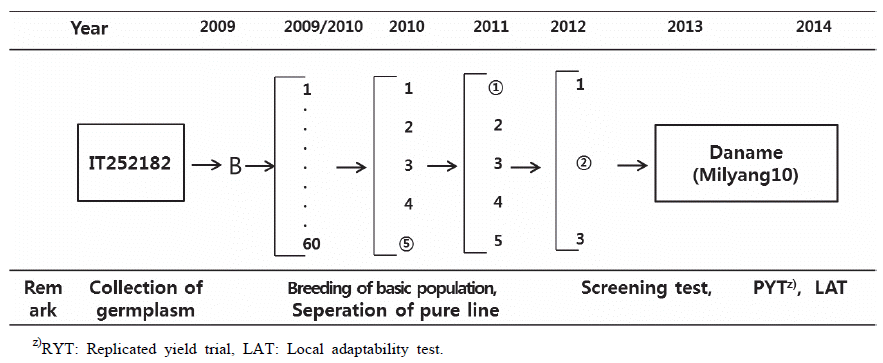
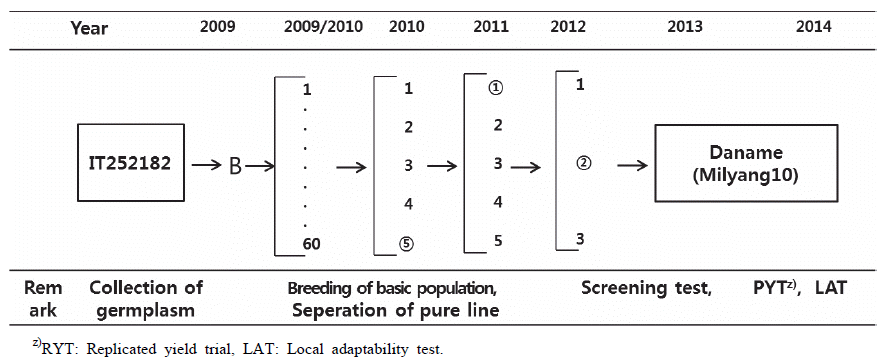
‘단아메’는 키가 작아 쓰러짐에 강하고 숙기가 빨라 이모작 재배에 이용하기 좋은 조를 육성하고자 2009년 국립유전자원센 터로부터 분양 받은 유전자원 중에서 배유의 특성이 메성이고 초형이 양호한 IT252182을 기본집단으로 하여 순계분리육종법 을 통하여 육성하였다. '09~'12년 4년간 분리육종법을 통해 순계 분리 후 '13~'14년에 생산력 검정 시험과 기후생태가 다른 3개 지역에서 실시한 지역적응시험을 동시에 수행하면서 ‘밀양10호’ 로 계통명을 부여 받으면서, 특성을 검정한 결과 신품종 보호출원 요건에 합당함이 인정되어 2014년 농촌진흥청의 농작물직무육 성 신품종선정위원회에서 보호출원 품종으로 선정되었다. ‘단아 메’의 육성과정은 Fig.
1과 같다.
Fig. 1Pedigree diagram of ‘Daname’.
주요 특성
출수기 및 생육기간
‘단아메’는 Table
1과 같이 영남평야지(밀양)에서 보통기 재 배(6월5일 파종)시 평균 출수기 7월 30일로 대비품종 ‘황금조’ 7월25일에 비하여 5일 늦다, 따라서, 기본영양생장기간이 ‘황금 조’ 49일, ‘단아메’ 53일로 조생종인 ‘황금조’와 4일 차이 나지만, 중만생종인 ‘삼다찰’ (
Lee et al. 2014)이 ‘황금조’와 기본영양생 장기간이 20일 차이 나는 것을 고려하였을 때 조생종에 속한다.
Table 1Heading date, growth period and characteristics of basic vegetation period of ‘Daname’ and ‘Hwanggeumjo’ (NICS in Milyang, '13~'14)
Table 1
|
Variety |
Seeding date (mm.dd) |
Heading date (mm.dd) |
Growth period z) (days) |
|
|
Daname |
6.5 |
7.30 |
100 |
|
Hwanggeumjo |
6.5 |
7.25 |
95 |
잎, 줄기와 뿌리
‘단아메’의 엽색은 녹색이고, 지엽의 안토시아닌 색소 발현은 없으며 지엽의 자세는 ‘황금조’가 수평인데 반하여 직립형이다. 줄기의 길이는 ‘황금조’ 117cm에 비해 97cm 로 ‘단아메’가 20cm 더 짧고, 줄기두께는 ‘황금조’에 비하여 굵으면서 줄기의 분얼개도는 ‘황금조’에 비하여 직립이다. 뿌리는 ‘황금조’에 비 하여 넓고 깊게 분포되어 있다.(Table
2)
Table 2Leaf and culm characteristics of ‘Daname’ and ‘Hwanggeumjo’ (NICS in Milyang, '13~'14)
Table 2
|
Variety |
Leaf Color |
Anthocyanin in flag leaf |
Growth habit |
Culm |
Root distribution |
|
|
Length (cm) |
Width (mm) |
|
|
Daname |
Green |
No |
Erect |
97±4.1z) a y)
|
9.3±2.5 a
|
Wide |
|
Hwanggeumjo |
Green |
Yes |
Semi-erect |
117±6.5 b
|
8.5±3.1 a
|
Shallow |
Lim et al.(1992)은 벼에서 도복과 관련 있는 형질을 분석한 결과, 포장도복과 관련 정도가 높은 형질은 간장, 하중비(지상건 물중/임계도복하중), 휨모멘트(지상부건물중Ⅹ간장), 단위간휨 모멘트(휨모멘트/줄기두께)와 고도로 유의한 정의 상관을 나타 낸다고 하였으며, 이러한 요인들을 경로계수분석을 통하여, 직접 간접적으로 분석한 결과 줄기두께는 두껍고, 길이는 짧은 단간품 종이 도복억제효과가 있다고 보고하였다. 조도 벼와 같은 화본과 작물로서 이와 유사한 경향을 보일 것으로 예상하였을 경우 단간, 강한 줄기와 같은 ‘단아메’의 형태적 특징은 ‘단아메’가 ‘황금조’에 비하여 도복 저항성이 높을 수 있는 형태적 특징요소 라 할 수 있다.
이삭과 낟알
‘단아메’의 이삭 형태는 원통형이고 이삭의 길이는 18.7cm 정도로 ‘황금조’ 15.9cm 보다 조금 길다. 이삭의 자세는 ‘황금조’ 에 비하여 아래로 처지는 정도가 낮다. 종실색은 주황색이며, 낟알색은 노란색, 배유전분의 특성은 메성으로 ‘황금조’와 종실 색의 차이가 있으나 낟알 및 배유특성은 동일하다(Table
3).
Table 3Panicle and grain characteristics of ‘Daname’ and ‘Hwanggeumjo’ (NICS in Milyang, '13~'14)
Table 3
|
Variety |
Panicle |
Seed color |
Dehusked grain color |
Endosperm |
|
|
Length(cm) |
Shape |
Type |
|
|
Daname |
18.7±1.7z) a y)
|
Cylindrical |
Droopy |
Orange |
Yellow |
Non-waxy |
|
Hwanggeumjo |
15.9±2.1 a
|
Spindle |
Droopy |
Yellow |
Tellow |
Non-Waxy |
도복, 생리장애 저항성 및 병해충 저항성
‘단아메’는 포장상태에서 ‘황금조’에 비하여 도복에 강하였으 며. 이는 ‘단아메’의 줄기길이 및 강도, 뿌리 분포와 같은 농업적 특징(Table
2)이 ‘황금조’에 비하여 유리하였기 때문으로 생각 된다. ‘단아메’는 조도열병에 있어 ‘황금조’에 비하여 저항성을 나타내었으며, 노균병, 줄무늬잎마름병 및 내충성은 ‘황금조’과 비슷한 저항성을 나타내었다(Table
4).
Table 4Reaction to physiological stress, lodging tolerance, and major diseases and insect of ‘Daname’ and ‘Hwanggeumjo’ (NICS in Milyang, '13~'14)
Table 4
|
Variety |
Field lodging (0-9) |
Damage index by diseases and insect y)
|
|
|
Blast |
Downy mildew |
Bacterial stripe |
Pest resistance |
|
|
Daname |
1z)
|
1 |
0 |
0 |
3 |
|
Hwanggeumjo |
5 |
3 |
0 |
0 |
3 |
수량구성요소
‘단아메’의 주당수수와 수당이삭무게, 등숙비율은 황금조와 비슷하고, 조곡 천립중은 2.95g로 황금조에 비해 무거운 편이었 으며, 현곡 천립중은 황금조와 비슷하였다(Table
5).
Table 5Yield components of ‘Daname’ and ‘Hwanggeumjo’ (NICS in Milyang, '13~'14)
Table 5
|
Variety |
Spikelet (No. panicle-1) |
Panicle weight per hill-1 |
Ripened grain ratio (%) |
Weight of 1,000 seeds(g) |
|
|
Unpolished grain |
Polished grain |
|
|
Daname |
1.8±0.49z)a y)
|
10.9±1.2 a
|
68.3±4.5 a
|
2.95±0.07 a
|
2.38±0.05 a
|
|
Hwanggeumjo |
2.0±0.71 a
|
11.9±2.5 a
|
67.6±6.1 a
|
2.86±0.05 b
|
2.33±0.04 a
|
도정 및 성분특성
‘단아메’의 도정 특성은 제현율 78.5%, 도정수율 73.2%로서 대조품종인 ‘황금조’와 비슷하였으며, 완전미 도정수율도 황금 조와 유사하였다. 곡실 중 영양성분은 단백질 함량이 8.0%로 황금조보다 낮았으며, 항산화성분인 폴리페놀 함량은 ‘황금조’ 보다 높은 수준이었다. ‘단아메’의 아밀로스 함량은 21.6%로 황금조와 비슷하였다(Table
6). 벼에서 식미는 아밀로스 함량과 단백질함량이 낮은 것이 취반시 식미가 더 우수하다고 알려져 있다(
Juliano 1985,
Park 2016). 벼에서 단백질 함량은 취반 시 전분입자 주위에 단백질 층을 형성함으로써 점성과 탄성을 저하시켜 취반 후 식감과 부의 상관관계를 가지는데(
Juliano 1985), 조 역시 벼와 같은 탄수화물 곡류이고, 혼반용으로 주로 이용되므로 단백질 함량이 높을 시 식감에 좋지 않은 영향을 미칠 수 있다. 단아메는 식미치에 영향을 미치는 아밀로스 함량은 비슷하면서 단백질 함량은 황금조보다 낮으므로 대조품종인 황금조에 비하여 식미가 더 우수할 것으로 예상된다.
Table 6Milling property and functional component of ‘Daname’ and ‘Hwanggeumjo’ (NICS in Milyang, '14)
Table 6
|
Variety |
Variety Brown/rough grian ratio(%) |
Milled grain recovery (%) |
Head grain milling yield (%) |
Protein Contents (%) |
Polyphenol content (㎍/g) |
Amylose content (%) |
|
|
Daname |
78.5 az)
|
73.2 a
|
69.9 a
|
8.0 a
|
837 a
|
21.6 a
|
|
Hwanggeumgjo |
78.7 a
|
72.8 a
|
69.3 a
|
9.8 b
|
725 b
|
21.4 a
|
수량성
2013~2014년에 밀양, 수원, 청원, 익산, 나주 5개 지역에서 수행된 지역적응 시험결과 단아메는 평균 3.81 t/ha로서 대비품 종인 ‘황금조’에 비해 4% 증수하였으나 통계적인 유의성은 없었 다(Table
7). 지역별로 단아메는 남부평야지(밀양, 익산, 나주)에 서는 약 10% 증수되는 반면 중부지역(수원, 청원)에서는 약 6.5% 감수되는 경향이었다.
Table 7Yield performance of ‘Daname’ and ‘Hwanggeumjo’ at local adaptability test(LAT) (Unpolished grains, t ha-1, '13~'14)
Table 7
|
Variety |
Milyang |
Suwon |
Cheongwon |
Iksan |
Naju |
Mean |
Index |
|
|
Daname |
4.58 |
3.48 |
4.01 |
3.55 |
3.43 |
3.81 a z)
|
1.04 |
|
Hwanggeumjo |
4.18 |
3.87 |
4.15 |
2.98 |
3.38 |
3.71 a
|
1 |
단아메 혼반 비율에 따른 경점도비 및 항산화활성
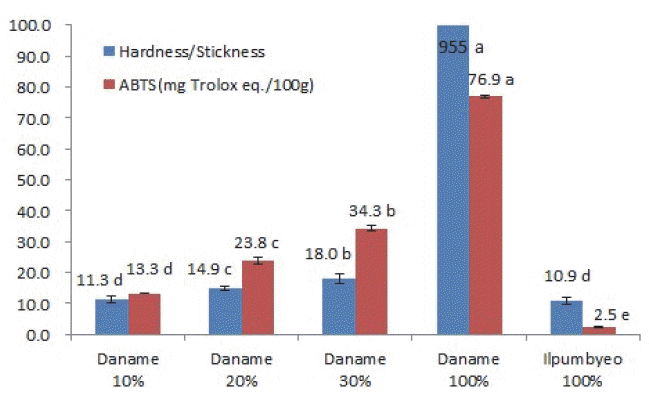
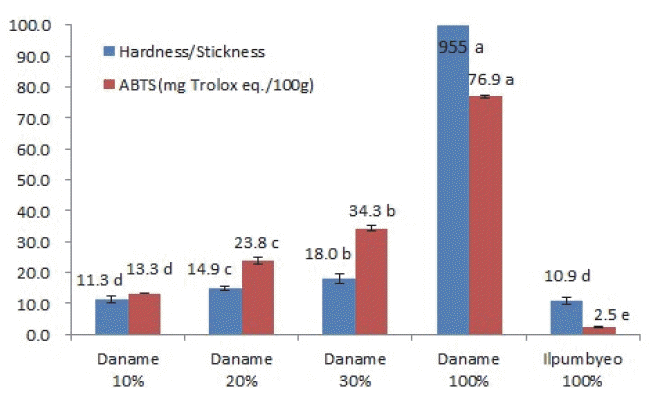
조 ‘단아메’의 적정 혼반비율 구명을 위하여 ‘단아메’ 첨가량 을 10%, 20%, 30% 첨가 및 ‘단아메’ 100%, 일품벼 100%로 취반한 밥의 경점도비 및 항산화활성을 측정한 결과(Fig.
2), ‘단아메’ 첨가량이 증가할수록 ABTS라디컬 소거 항산활성은 뚜렷이 증가하였고, 10% 첨가시에도 무첨가의 2.5mg Trolox eq./100g에 비하여 8.8배 증가하였다. 경점도비는 10% 첨가시 까지는 무첨가와 통계적 차이를 나타내지 않았으며, 20% 첨가시 부터 경도의 증가에 따라 증가하는 경향을 나타내었다. 경점도비 는 식미와 관계 있는 인자로서 경도는 낮고, 점도는 높을 때 밥의 식감이 우수하다고 한다(
Kim et al. 2012,
Park et al. 2016). ‘단아메’는 아밀로스 함량이 21.6%로서 일품벼 18.9%에 비하여 아밀로스 함량이 높아 첨가량이 증가할 때 밥맛의 저하가 일어날 수 있는데, ‘단아메’를 10% 첨가시 까지는 무첨가시와 경점도비의 차이가 없으면서 항산화활성은 현저히 증가하였으 므로 10% 첨가는 식미치에 영향을 주지 않으면서 기능성을 증진시킬 수 있는 첨가비율로 생각되었다.
Fig. 2Hardness/stickiness balance and ABTS radical ability in addition to ‘Daname’ in cooked rice.
적응지역 및 재배상 유의점
‘단아메’는 전국 1모작 및 2모작지에 추천되는 중생종 메조 품종이다. 또한 도복 등 재해에는 비교적 강하지만 습해에는 약하므로 배수가 불량한 밭이나 논토양에서 재배하고자 할 때에 는 배수시설을 설치하는 것이 좋다. 조명나방에 대한 저항성이 없으므로 적기방제를 꼭 실시하여야 한다. 또한 조는 전용약제가 등록되어 있지 않아 제초제 처리는 피해야 한다.
적 요
조 ‘단아메’는 유전자원센터에서 분양 받은 IT252182을 기본 집단으로 하여 분리육종법을 통해 국립식량과학원에서 2014년 육성된 신품종으로 주요특성과 수량성을 요약하면 다음과 같다. 출수기는 표준품종인 ‘황금조’보다 보통기 재배에서는 5일 정도 늦으나 중만생종 ‘삼다찰’에 비하면 15일 이상 출수차이가 나므 로 조생종에 속하고 생육일수는 100일 정도이다. 간장은 97cm 로 ‘황금조’에 비해 20cm정도 짧은 단간형 품종으로, 도복에 강한 특성을 나타낸다. 이삭은 원통형이며 아래로 처지는 형태를 지니고 있다. 종실색은 주황색이고, 낟알은 노란색이며, 조곡 천립중 2.95g, 현곡 천립중 2.86g으로 ‘황금조’에 비하여 약간 무거운 편이다. 배유의 아밀로스 함량은 21.6%로 메조에 해당하 며, 날알의 단백질함량이 8.0%로 황금조에 비해 낮은 특성을 가지고 있다. 수량은 지역적응시험 보통기 재배 평균 3.81 t ha-1로 서 표준품종 황금조와 비슷한 수준이었다. 조 ‘단아메’의 적정 혼반비율 구명을 위하여 ‘단아메’ 첨가량을 10%, 20%, 30% 첨가 및 ‘단아메’ 100%, ‘일품벼’ 100%로 취반한 밥의 경점도비 및 항산화활성을 측정한 결과, 항산화활성은 현저히 증가하고, 경점도비의 차이는 ‘일품벼’ 100% 취반 시와 차이가 없었던 ‘단아메’ 10% 첨가시로 판단되었다.
사 사
본 논문 및 품종은 농촌진흥청 연구사업(과제번호: PJ011365022017)의 지원에 의해 이루어진 것이며, 본 품종을 육성함에 있어 협력하여 주신 농촌진흥청 국립농업과학원 농업 유전자원센터 관계관께 깊은 감사를 드립니다.
References
- 1. Amadou I., Gounga M., Le G.W.. Millets : Nutritional composition, some health benefits and processing- A review. Emir. J.Fod AGRIC. 2013. 25(7):501-508.
- 2. Choi Y., Lee S.M., Chun J., Lee H.B., Lee J.. Influence of heat treatment on the antioxidant activities and polyphenolic compounds of Shiitake (Lentinus edodes) mushroom. Food Chem. 2006. 99: 381-387.
- 3. Jeong E.G., Kim K.J., Cheon A.R., Lee C.K., Kim S.L., Brar D.S., Son J.R.. Characterization of grain quality under lodging time and grade at ripening. Hangug Jagmul Haghoeji 2006. 37: 440-444.
- 4. Joe J.Y.. Upland crop.. Hwangmoonsa, 1990. pp. 539.
- 5. Juliano B.O.. Polysaccharide, proteins, and lipids in rice chemistry and technology.. MN, USA: AACC, 1985.
- 6. Kim C.E., Kang M.Y., Kim M.H.. Comparison of properties affecting the palatability of 33 commercial brands of rice. Hangug Jagmul Haghoeji 2012. 57(3):301-309.
- 7. Ko J.Y., Song S.B., Lee J.S., Kang J.R., Seo M.C., Oh B.G., Kwak D.Y., Nam M.H., Jeong H.S., Woo K.S.. Changes in Chemical Components of Foxtail Millet, Proso Millet, and Sorghum with Germination. Korean J. Food Sci. Technol. 2011. 40(8):1128-1135.
- 8. Kwon Y.C.. Old references related to agriculture in Korea-II. Kinds and varieties of cereal crops. Yugjong Haghoeji 1988. 20: 341-365.
- 9. Lee JS, Ko JY, Kim KY, Song SB, Woo KS, Kim JI, Kwak DY, Jeong TW, Seo MC, Oh IS. A medium maturing non-glutinous lodging tolerance foxtail millet (Setaris italic Beauv.) variety ‘Samdame’. Korean J. Breed. Sci. 2013. 45(4):382-387.
- 10. Lee J.S., Ko J.Y., Woo K.S., Song S.B., Jeong T.W., Yun Y.H., Seo M.C., Oh B.G., Lee M.G.. A Medium Maturing, Glutinous Foxtail Millet (Setaria italic Beauv.) Variety ‘Samdachal’. Korean J. Breeding. 2014. 46(4):439-444.
- 11. Lee JS, Oh BG, Song SB, Ko JY, Woo KS, Nam MH, Park ST, Kim JI, Seo MC., Kwak DY, Jeong TW.. A medium maturing non-glutinous lodging tolerance foxtail millet (Setaris italic Beauv.) variety ‘Samdame’. Korean J. Breeding. 2012. 44(3):369-372. a.
- 12. Lee J.S., Song S.B., Ko J.Y., Woo K.S., Nam M.H., Park C.Y., Park S.T., Kim J.I., Seo M.C., Oh B.G., Kwak D.Y., Jeong T.W.. New Cultivar Developed : A New Medium Maturing, Yellowish Grain and Glutinous Foxtail Millet (Setaria italica Beauv.) Variety ?oKeongkwan2 ??. Korean J. Breeding. 2012. b. 44(4):648-652.
- 13. Lim T.L., Lee H.J., Cho K.S., Song D.S.. Analysis of Lodging Related Characteristics in Rice Plants. Hangug Jagmul Haghoeji 1992. 37(1):78-85.
- 14. Park C.H., Kim H.J., Park K.G., Park S.E., Woo S.H., Lee G.Y., Jang G.J., Choi M., Choi Y.S.. Miscellaneous cereal is functional cereal.. Jinyool, 2015. pp. 219.
- 15. Park H.Y., Shin D.S., Woo K.S., Sim E.Y., Kim H.J., Lee S.K., Won Y.J., Lee S.B., Oh S.K.. Mechanical Quality evaluation of rice cultivars that could potentially be used to produce processed cooked rice. Hangug Jagmul Haghoeji 2016. 61(3):145-152.
- 16. Park S.A.. application and literary investigation of food therapy and traditional food using foxtail millet (Setaria italica L. Beaur) – Korean literature 10 1300’s~1900’s-... Daegue Hanny University, 2016.
- 17. Pedersen J.F., Bean S.R., Funnell D.L., Graybosch R.A.. Rapid iodine staining techniques for identifying the waxy phenotype in Sorghum grain waxy genotype in sorghum pollen. Crop Sci. 2004. 44: 764-767.
- 18. Woo K.S., Lee J.S., Ko J.Y., Song S.B., Seo H.I., Seo M.C., Oh B.G., Kwak D.Y., Nam M.H., Oh I.S., Jeong H.S.. Antioxidant compounds and antioxidant activities of different varieties of foxtail millet and proso millet according to cultivation time. J Korean Soc. Food Sci. Nutr. 2012. 41(3):302-309.