적요
신품종 ‘올찬메’는 충북 제천 재래 조를 수집하여 순계분리육종법을 통해 2022년 육성된 신품종으로 주요 특성은 이삭은 원통형으로 아래로 처지는 형태이고, 출수기는 표준품종인 ‘삼다메’에 비해 11일 정도 빠른 조생종 품종이다. 간장은 141 cm로 ‘삼다메’와 비슷하며 기계수확이 가능한 품종이다. 종실과 낟알은 황색이고, 조곡 천립중은 2.9 g이며 수량성은 평균 3.26 MT ha-1로 나타났다. 재배 및 병해충 저항성에서는 도열병과 깜부기병 발생이 없었으며, 노균병은 낮은 수준으로 나타났다. 노린재 피해는 3 수준으로 신품종과 표준품종 간 차이가 없었다. 이화학적 성분으로는 조단백질 10.5%, 아밀로스 18.6%로 메조에 해당하고, 칼륨 및 마그네슘 함량이 ‘삼다메’보다 높게 나타났으며, 라디컬 소거능은 표준품종과 유사한 수준이었다. 종합해보면, ‘삼다메’에 비해 낟알 충실도가 높은 특성을 가진 신품종 ‘올찬메’는 제주 지역을 제외한 국내 전역에 걸쳐 광지역 적응성을 나타낼 것으로 전망된다.
Abstract
‘Olchanme’ is a new foxtail millet variety developed by Chungcheongbukdo Agricultural Research & Extension Service from 2011 to 2021. This variety was collected in Jecheon and developed through pure-line selection. The culm length of ‘Olchanme’ is similar to that of the standard variety ‘Samdame,’ but its panicle length is longer. The panicle shape differs between ‘Olchanme’ and ‘Samdame,’ but other inherent characteristics (panicle type, grain color, dehusked grain color, and endosperm) are similar. The grain and dehusked grain colors were yellow, and the endosperm was non-glutinous. The heading period is 11 days earlier than that of ‘Samdame,’ indicating that ‘Olchanme’ is an early-maturing cultivar. In local adaptability tests, conducted from 2018 to 2021, excluding 2020, the average grain yield of ‘Olchanme’ is 3.26 MT ha-1. In terms of physicochemical composition, the crude protein content was 10.5% and amylose content was 18.6%, classifying it as a non-glutinous type. Its potassium and magnesium contents were higher than those of ‘Samdame,’ while radical scavenging activity was similar to that of the standard variety. Overall, the new variety ‘Olchanme,’ characterized by higher grain filling than ‘Samdame,’ is expected to demonstrate wide regional adaptability across the entire country, excluding Jeju Island.
-
Key words: foxtail millet, ‘Olchanme’, non-glutinous, variety
서언
조(Foxtail millet,
Setaria italica Beauv.)는 벼목 화본과에 속하는 외떡잎식물 한해살이 작물로, 아시아를 중심으로 오랫동안 재배되어 온 작물이다. 조는 아밀로스 함량으로 메조와 차조로 구별되며, 메조는 전분이 28% 내외이며, 차조는 전분이 8% 내외로 알려져 있다. 천립중은 조곡으로 2.5~3 g으로 매우 가벼우며, 껍질색은 황색, 적색, 흑색 등으로 다양한 색을 가지고 있다(
Lee et al. 2013).
국내에서는 예로부터 주로 혼반용이나 떡, 엿, 죽, 소주 등의 가공식품의 원료로 이용되어 왔으며(Ha &, Lee 2001), 해외에서는 빵, 발효음료, 죽, 영양바 등 다양한 가공식품에 활용되고 있다(
Maji et al. 2024). 최근 웰빙 소비 트렌드와 건강기능성 식품에 대한 관심 증가에 따라 조의 영양학적⋅기능적 가치가 주목받고 있다. 조는 다른 화본과 곡물에 비하여 종실 크기가 작아 동일한 무게를 기준으로 하였을 때, 배아 및 호분층의 비율이 쌀 3%, 소맥 2%에 비하여 17%로 높아, 영양 및 기능성 성분이 많이 함유되어 있다. 특히 식이섬유는 주식인 백미에 비해 3~10배 함유되어 있어 배변에 용이하고 대장암을 예방하는 효과가 있다고 알려져 있으며(Ha &, Lee 2001), 칼슘과 철분 함량 등 무기질 함량이 높아 영양학적으로 우수한 특성을 가진다. 이 외에도 기능성 성분으로 항산화, 혈당 조절, 항염 효과 등 다양한 생리활성을 나타내는 기능성 성분을 함유하는 것으로 보고되었다(
Kalsi and Bhasin 2023).
국내 조 품종 육성은 주로 높은 수량성을 중심으로 진행되어 있으나, 최근 이상기후 증가에 따른 피해를 경감하기 위해서는 도복저항성 등 재배안정성이 높은 품종이 필요하다(
Ko et al. 2017). 특히, 지역별 재배 환경에 적합한 품종 개발은 조의 안정적 생산과 산업적 활용 확대를 위해 중요한 과제로 인식되고 있다(
Park et al. 2023). 이에 충청북도농업기술원에서는 도복에 강하며, 다수성의 기계수확에 적합한 광지역 적응성이 우수한 조 품종 개발을 목표로 ‘올찬메’ 품종을 육성하였다. 본 연구에서는 ‘올찬메’ 품종의 육종 경위와 주요 특성을 기술하고자 한다.
재료 및 방법
본 시험은 2020년을 제외한 2018년부터 2021년까지 3년간 3개의 지역(충북 청주, 대구, 경기 평택)에서 수행하였고, 표준품종인 ‘삼다메’와 농업적 특성을 비교하고 검토하였다. 각 시험에서 공시한 품종들은 6월 4일 파종하여, 난괴법 3반복으로 재식하였다. 재식거리는 60 × 10 cm로 주당 2본으로 하였고, 시비량은 N-P
2O
5-K
2O=9-7-8 kg/10a 로 전량 기비로 시용하였다. 주요 생육 특성으로는 간장, 수장, 줄기직경, 분지수, 뿌리 분포를 조사하였으며 반복 당 20개체씩 조사하였다, 수량 특성으로는 주당 수수, 이삭당 종실무게, 조곡 천립중을 조사하였다. 병충해 저항성으로는 도열병, 노균병, 깜부기, 조명나방, 노린재류를 조사하였다. 조사기준은 농촌진흥청 연구조사분석기준(RDA 2012)을 참고하였다. 배유특성은
Pedersen et al. (2004)의 요오드 분석법을 통하여 메찰 검정을 실시하였다. ‘올찬메’의 조단백 함량은
AOAC 방법(2005)에 따라 Micro-Kjeldahl법을 분석하였고, 회분은 550℃ 직접회화법을 사용하였다. 무기성분 중 K, Ca 및 Mg의 함량은
Osborne & Voogt (1981) 의 방법에 따라 마이크로웨이브 분해기(Ultrawave, Milestone, Italy)로 시료를 분해하고, ICP-OES (Agilent 720-ES, Australia)로 분석하여 무기성분의 함량을 구하였다. 아밀로스 함량은 비색계(Multiskan Spectrum, Thermo Fisher Scientific, Vantaa, Finland)를 이용하여 620 nm에서 측정하였으며, 표준품으로 pure potato amylose (Sigma-Aldrich, St. Louis, MO, USA)를 이용하여 정량하였다(
Jeong et al. 2006). 항산화 활성은 동결 건조하여 분쇄한 시료를 에탄올 80%로 진탕 추출하여 얻은 추출물을 분석하였다. ABTS 및 DPPH radical 소거활성 표준물질로는 Trolox를 이용하였고, mg/TE (Trolox equivalent antioxidant capacity)/g (dry basis)로 표현하였다(
Choi et al. 2006). 통계분석은 R프로그램(ver.4.2.2.)을 이용하여 분산분석(ANOVA)를 실시하였으며, 처리 간 평균 비교는 Duncan의 다중범위검증으로 유의성을 검정하였다(
p<0.05).
결과 및 고찰
육성경위
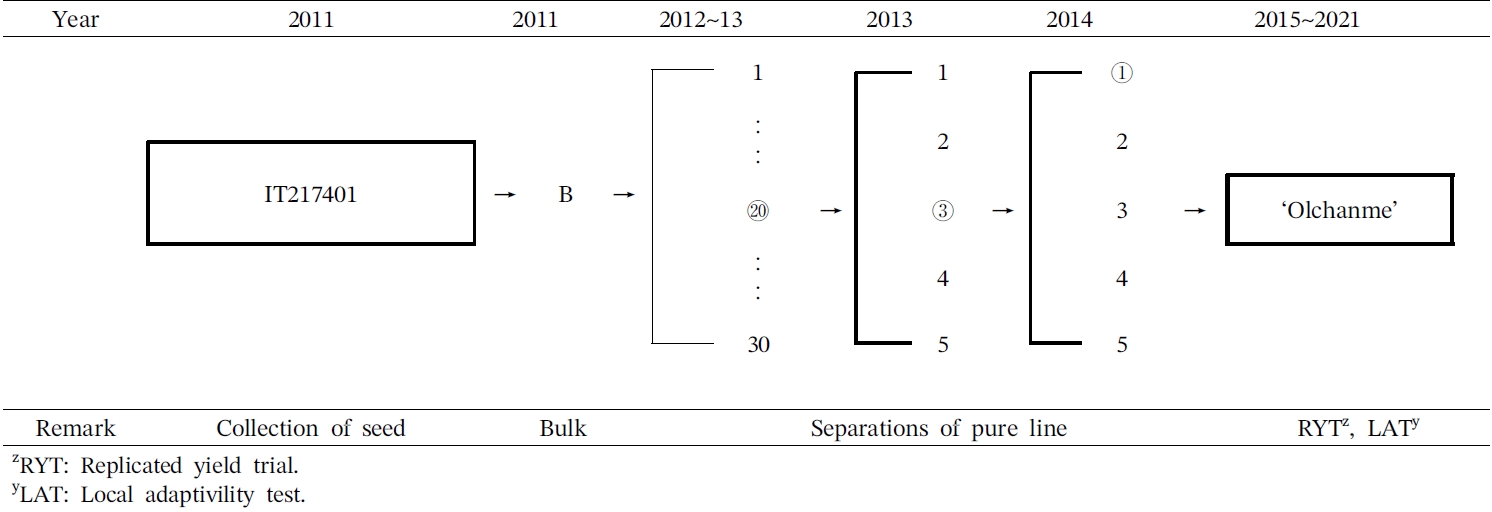
2011년 충북 제천에서 재래조를 수집하여 순계분리한 ‘올찬메’는 이모작이 가능하고, 도복에 강하며, 다수성으로 기계수확이 가능한 메성의 특성을 가진 조이다. 2012~2014년 3년간 개체선발을 통한 순계분리 후 2015~2017년 3년간 생산력 검정시험과 2020년을 제외한 2018~2021년 3년간 충북18호로 3개의 지역에서 지역적응시험을 수행하였다. 2022년 농촌진흥청 농작물직무육성 신품종 선정위원회에서 보호 출원 품종으로 선정 후, 2022년 국립종자원에 품종보호 출원하여 표준 품종과의 구별성, 균일성, 안정성, 신규성 등 2년간의 재배심사에 걸쳐 최종적으로 2025년 품종보호 등록되었으며, 품종 육성 과정은
Fig. 1과 같다.
1. 고유특성
‘올찬메’의 이삭은 원통형으로 표준품종인 ‘삼다메’의 방추형과 뚜렷한 차이를 나타내었으며, 이는 두 품종 간 유전적 차이를 반영하는 주요 형태적 지표로 활용될 수 있을 것으로 판단된다. 그 외의 고유 특성들은 표준품종인 ‘삼다메’와 같았다. ‘올찬메’의 이삭은 아래로 처진 형태이며, 종실과 낟알색은 황색이었으며 배유는 메성을 나타내었다(
Table 1). 잎의 색은 녹색이며 지엽의 안토시아닌은 없었으며, 반직립 형태로 뿌리는 넓게 분포하였다. 선행연구(
Ko et al. 2017)에서 보면 ‘단아메’ 품종과 비교하였을 때 종실색만 주황색으로 달랐고 나머지는 유사한 주요 특성을 나타내었다. 또한, 동일한 논문에서 사용된 비교품종인 ‘황금조’는 본 연구에서 사용된 ‘삼다메’와 거의 유사한 특성을 나타냈었다. 찰성을 나타내는 ‘경관2호’는 이삭의 모양은 원뿔형으로 품종에 따라 다른 특성을 보였다(
Lee et al. 2012). ‘올찬메’의 간장은 141 cm로 ‘삼다메’와 같았으며, 수장은 23.6 cm로 ‘삼다메’의 22.0 cm보다 길었으나 유의적인 차이는 없었다. 또한 ‘올찬메’의 줄기직경은 8.9 mm로, ‘삼다메’의 9.0 mm와 비교하였을 때 유의적인 차이는 없었다(
Table 2).
2. 출수기 및 일반특성
‘올찬메’와 표준품종 ‘삼다메’의 출수기는 각각 8월 1일과 8월 12일로, ‘올찬메’가 ‘삼다메’보다 출수 일수가 11일 빨랐다(
Table 3). 작부체계 상, 출수일수가 65일 미만일 시, 조생종으로 보고된 바(
RDA 2020), ‘올찬메’는 기본영양 생장기간이 58일이 소요되어 조생종에 속한다고 볼 수 있다. 우리나라 중북부 지역에서 국내 조 몇 가지 품종의 출수기를 비교한 연구결과를 보면(
Park et al. 2023), 조생종인 ‘미리메조’와 손가락조 품종인 ‘손가락조 1호’를 5월 중순에 파종할 경우 출수기까지 약 80일, 6월 하순에 파종할 경우는 65일이 소요되었으며, 중만생종인 ‘황미차조’와 ‘삼다차조’도 동일한 파종시기 조건에서 각각 100일과 85일로 나타났다. 이는 늦은 파종으로 인해 출수기간 중 일평균 기온이 높아짐에 따라 출수 소요일수가 15~20일로 단축된 것으로 판단된다(
Park et al. 2023).
Huang et al. (2023)의 연구에서는 주변의 온도(13℃~30℃ 범위)가 높을수록 생장 속도가 빨라지고 출수시기가 촉진된다고 보고하였다.
3. 수량 구성 요소와 수량성
수량 구성 요소 분석 결과, ‘올찬메’의 주당 이삭수는 1.8개로 ‘삼다메’의 1.5개보다 많았으나, 유의적인 차이는 없었다. 이삭당 종실 무게는 각각 17.0 g, 14.8 g으로 ‘올찬메’가 더 높은 무게를 보였으나 통계적으로 유의적인 차이가 없었다. 하지만, 조곡 천립중은 각각 2.9 g, 2.6 g으로 무게가 무거워 유의적인 차이가 있었으며, 올찬메’가 낟알 충실도가 우수한 것으로 나타났다(
Table 3). 선행 연구를 살펴보면, ‘단아메’와 ‘황금조’의 경우 조곡 천립중이 각각 2.95 g와 2.86 g으로 본 연구와 거의 유사한 값을 나타냈었다(
Ko et al. 2017). 2016~2017년까지 생산력 검증 결과, ‘올찬메’는 3.79 MT/ha로 ‘삼다메’ 3.06 MT/ha에 비해 수량성이 24% 증가하였다(
Table 4). 2009년에 추진한 ‘경관2호’와 ‘황금조’의 경우 두 품종간 3% 차이가 있었고(
Lee et al. 2012), 2010~2011년에 수행된 ‘삼다찰’과 ‘황금조’의 경우 10% 증수효과가 있다고 보고하였다(
Lee et al. 2014). 2018년~2021년까지 수행한 지역별 수량성 평가에서 ‘올찬메’는 청주, 대구, 평택 3개 지역 평균 수량이 3.26 MT/ha였고, 표준품종인 ‘삼다메’가 3.12 MT/ha로 나타나, 표준품종에 대비 4% 수량이 증가하였으나 통계적으로 유의성은 없었다(
Table 5).
4. 재해 및 병해충 저항성
재해 및 병해충 저항성에
Table 6의 결과와 같이, 도복저항성은 ‘올찬메’가 2로 평가되어 ‘삼다메’보다 약한 편이었으나, 두 품종 모두 실용적 재배 수준에서 도복 피해가 크지 않은 것으로 판단된다. 불임내성은 두 품종 모두 약한 편으로, 저온 또는 고온 등 불량 환경 조건에서 불임 발생 가능성에 대한 재배 관리가 필요할 것으로 보인다. 병해 저항성 측면에서는 도열병과 깜부기병이 두 품종 모두 발생하지 않았으며, 노균병이 두 품종 모두 1로 낮은 수준의 발생에 그쳐 전반적으로 병해에 대한 저항성이 양호한 것으로 나타났다. 충해의 경우에도 두 품종 모두 조명나방의 피해는 발생하지 않았으며, 노린재류에 의한 피해가 두 품종 모두 3으로 동일하게 나타나, 재배 시 노린재 방제에 대한 주의가 요구된다.
5. 이화학적 및 라디컬 소거능 분석
몇 가지 이화학적 분석 결과, ‘올찬메’의 조단백질 함량은 10.5%로 ‘삼다메’의 10%와 유사한 수준이었으며, 조회분 함량 또한 두 품종 모두 1.3%로 동일하게 나타났다(
Table 7). 무기물 함량에서는 칼륨이 100 g 당 348.6 mg로 ‘삼다메’의 236.3 mg에 비해 현저히 높았으며, 마그네슘 함량도 236.7 mg으로 ‘삼다메’의 191.3 mg보다 높게 측정되었다. 반면 칼슘 함량은 12.1 mg으로 ‘삼다메’의 13.9 mg에 비해 다소 낮게 나타났다. 농촌진흥청 국가표준식품성분표를 보면 메조와 백미의 영양성분을 비교하였을 때, 단백질 함량은 백미에 비해 2~3배가량 높고, 마그네슘 등의 무기질의 함량도 조가 훨씬 높게 나타난다고 보고하였다(
RDA 2016). 아밀로스 함량의 경우 ‘올찬메’가 ‘삼다메’보다 약 2.4%가 낮은 18.6%로 나타났으며, 선행 연구에서 보면(
Ko et al. 2017,
Lee et al. 2014), ‘황금조’가 23.1%, ‘단아메’가 21.6%로 보고하고 있어, 신품종 ‘올찬메’는 아밀로스 함량이 다소 낮은 품종으로 보인다. DPPH 및 ABTS 라디컬 소거능은 ‘올찬메’와 표준품종인 ‘삼다메’가 거의 유사한 것으로 나타났다.
6. 적응지역 및 재배상 유의점
‘올찬메’는 전국 재배 적응성을 갖춘 조생종 메조 품종이다. 질소비료의 과다 시용은 도복이 우려되므로 적정 시비하여야 하며, 습해에는 약하므로 배수가 불량한 밭이나 논에서는 배수를 철저히 해야 한다. 활착 후 유묘기 시 조명나방의 방제가 필요하며, 생육 후기에서는 노린재 예찰 및 방제에 유의하여야 한다. 또한 성숙기 조류 피해와 개화기 강우로 인한 불임이 발생할 수 있어 적기 파종하는 것이 중요하다. 제초제의 경우, 전용 약제가 등록되어 있지 않아 제초제 처리는 금하여야 한다.
Fig. 1.Pedigree diagram of new foxtail millet variety ‘Olchanme’.
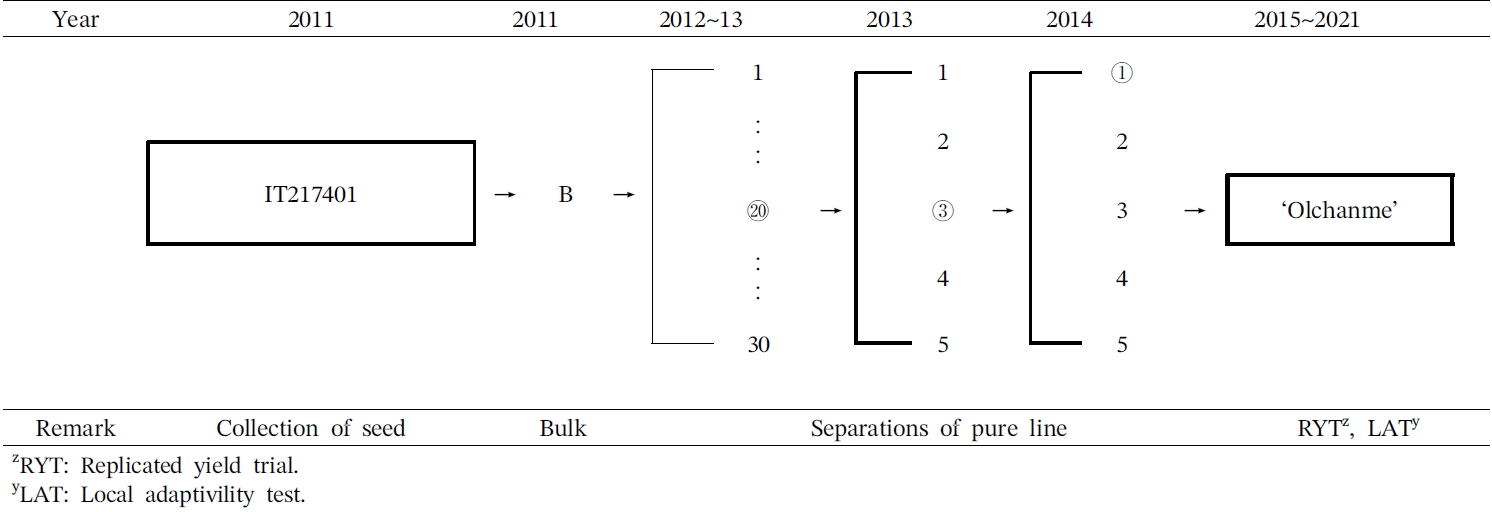
Table 1.Panicle and grain characteristics of ‘Olchanme’ and ‘Samdame’.
Table 1.
|
Variety |
Panicle
|
Grain color |
Dehusked grain color |
Endosperm |
|
Shape |
Type |
|
Olchanme |
Cylindrical |
Droopy |
Yellow |
Yellow |
non-waxy |
|
Samdame |
Spindle |
Droopy |
Yellow |
Yellow |
non-waxy |
Table 2.Leaf and culm characteristics of ‘Olchanme’ and ‘Samdame’.
Table 2.
|
Variety |
Leaf color |
Anthocyanin in flag leaf |
Growth habit |
Panicle length (cm) |
Culm
|
Root distribution |
|
Length (cm) |
Width (mm) |
|
Olchanme |
Green |
No |
Semi-erect |
23.6az
|
141a |
8.9a |
Wide |
|
Samdame |
Green |
No |
Semi-erect |
22.0a |
141a |
9.0a |
Wide |
Table 3.Heading date and yield component analysis of growth period of ‘Olchanme’ and ‘Samdame’.
Table 3.
|
Variety |
Heading date (mm.dd) |
Heading period (days) |
No. of panicle/Plant |
Weight of grain/panicle (g) |
1000-grain weight (g) |
|
Olchanme |
8.1 |
58bz
|
1.8a |
17.0a |
2.9a |
|
Samdame |
8.12 |
69a |
1.5a |
14.8a |
2.6b |
Table 4.Grain yield of ‘Olchanme’ at replicated yield trial (RYT).
Table 4.
|
Region |
Grain yield (MT/ha)
|
Indexz
|
|
2016 |
2017 |
Mean (MT/ha) |
|
Olchanme |
2.13 |
4.85 |
3.79ay
|
124 |
|
Samdame |
2.81 |
3.31 |
3.06b |
100 |
Table 5.Grain yield of ‘Olchanme’ and ‘Samdame’.
Table 5.
|
Region |
Olchanme
|
Indexz
|
Samdame
|
|
2018 |
2019 |
2021 |
Mean (MT/ha) |
2018 |
2019 |
2021 |
Mean (MT/ha) |
|
Cheongju |
3.70 |
2.99 |
4.06 |
3.58 |
102 |
4.55 |
2.48 |
3.51 |
3.51 |
|
Daegu |
3.82 |
3.40 |
1.88 |
3.03 |
110 |
4.21 |
2.23 |
1.81 |
2.75 |
|
Pyeongtaek |
2.87 |
3.35 |
- |
3.11 |
101 |
2.83 |
3.33 |
- |
3.08 |
|
Average |
3.46 |
3.25 |
2.97 |
3.26ay
|
104 |
3.86 |
2.68 |
2.66 |
3.12a |
Table 6.Characteristics of lodging tolerance, major disease and insect pests of ‘Olchanme’ and ‘Samdame’.
Table 6.
|
Variety |
Lodging resistant (0-9) |
Sterility tolerance |
Disease (0-9)z
|
Insect pests (0-9)z
|
|
Blast |
Downy mildew |
Covered smut |
Corn borer |
Stink bug |
|
Olchanme |
2 |
Weak |
0 |
1 |
0 |
0 |
3 |
|
Samdame |
1 |
Weak |
0 |
1 |
0 |
0 |
3 |
Table 7.Chemical characteristics and antioxidants properties of ‘Olchanme’ and ‘Samdame’.
Table 7.
|
Variety |
Crude protein (%) |
Crude ash (%) |
Inorganic contents (mg/100g)
|
Amylose contents (%) |
Radical Scavenging activity (mg TE/100g)
|
|
K |
Ca |
Mg |
DPPH |
ABTS |
|
Olchanme |
10.5 |
1.3 |
348.6 |
12.1 |
236.7 |
18.6 |
30.6 |
57.2 |
|
Samdame |
10.0 |
1.3 |
236.3 |
13.9 |
191.3 |
21.0 |
33.8 |
59.6 |
References
- 1. AOAC. 2005. Official methods of analysis. 18th ed. Association of official analytical chemists, Washington, DC, USA.
- 2. Choi Y, Lee SM, Chun J, Lee HB, Lee J. 2006. Influence of heat treatment on the antioxidant activities and polyphenolic compounds of shiitake (Lentinus edodes) mushroom. Food Chem 99: 381-387.
- 3. Ha YD, Lee SP. 2001. Characteristics of proteins in italian millet, sorghum and common millet. Korean J Food Preserv 8: 187-192.
- 4. Huang YC, Wang YT, Choong YC, Huang HY, Chen YR, Hsieh TF, Lin YR. 2023. How ambient temperature affects the heading date of foxtail millet (Setaria italica). Front Plant Sci 14: 1147756.
- 5. Jeong EG, Kim KJ, Cheon AR, Lee CK, Kim SL, Brar DS, Son JR. 2006. Characterization of grain quality under lodging time and grade at ripening. Korean J Crop Sci 51: 440-444.
- 6. Kalsi R, Bhasin JK. 2023. Nutritional exploration of foxtail millet (Setaria italica) in addressing food security and its utilization trends in food system. eFood 4: e111.
- 7. Ko JY, Song SB, Choe ME, Kwak DY, Kim JI, Park CH, Choi JM, Woo KS, Jung TW. 2017. Short culm, lodging tolerance, non-glutinous foxtail millet (Setaria italica Beauv.) variety ‘Daname’. Korean J Breed Sci 49: 396-402.
- 8. Lee JS, Ko JY, Woo KS, Song SB, Jung TW, Yun YH, Seo MC, Oh BG, Lee MG. 2014. A medium maturing, glutinous foxtail millet (Setaria italica Beauv.) variety ‘Samdachal’. Korean J Breed Sci 46: 439-444.
- 9. Lee JS, Oh BG, Go JY, Song SB, Kim JI, Kim GY, Jeong TW, Kwak DY, Oh IS, Woo GS. 2013. Taxonomical classification of the domestic foxtail millet (Setaria italica Beauvios) cultivars by heading ecotypes. J Agr Sci Chungbuk nat’l Univ 29: 33-39.
- 10. Lee JS, Song SB, Ko JY, Woo KS, Nam MH, Park CY, Park ST, Kim JI, Seo MC, Kwak DY, Jung TW, Oh IS, Oh BG, Kim KY. 2012. A new medium maturing, yellowish grain and glutinous foxtail millet (Setaria italica Beauv.) variety ‘Keongkwan2’. 2012. Korean J Breed Sci 44: 648-652.
- 11. Maji P, Umesha C, Joharika C, Maindar SS. 2024. Effect of spacing and nitrogen on growth and yield of foxtail millet (Setaria italica L.). Int J Res Agron 7(SP-6):41-44.
- 12. Osborne DR, Voogt P. 1981. The analysis of nutrients in foods. London Academic Press. pp. 130-134.
- 13. Park SJ, Kim BH, Jun HW, Kim YK. 2023. Ecological characteristics of spike heading time of korean foxtail millet cultivars in the north-central region of the Korean Peninsula. Korean J Crop Sci 68: 431-437.
- 14. Pedersen JF, Bean SR, Funnell DL, Graybosch RA. 2004. Rapid iodine staining techniques for identifying the waxy phenotype in Sorghum grain waxy genotype in sorghum pollen. Crop Sci 44: 764-767.
- 15. Rural Development Administration. 2012. Agricultural science and technology research, survey and analysis standards. 5th ed. Rural Development Administration, Suwon, Korea.
- 16. Rural Development Administration. 2016. Korean Food Composition Table. 9th ed. II pp. 1-593.
- 17. Rural Development Administration. 2020. Foxtail millet and proso millet. Rural Development Administration, Jeonju, Korea.
Citations
Citations to this article as recorded by