적요
‘Geumsilchal’ is a Proso millet (Panicum miliaceum L.) variety developed and registered by the Department of Southern Area Crop Science, NICS, RDA, in 2014. This variety was developed through pure line selection from K131247. ‘Geumsilchal’ was an erect type medium-maturing variety. Its growing period was 104 days when it was seeded on May 15, and 94 days when it was seeded on July 15 in Milyang, Korea. The culm length of ‘Geumsilchal’ was about 123 cm, which was 13 cm longer than that of the standard variety ‘Hwanggeumgijang’. ‘Geumsilchal’ was tolerant to lodging in the field because of its wide column width and erect plant type. The panicle type was droopy and its length was about 23 cm. Seed grain and dehusked grains were yellow, and the endosperm characteristic was glutinous. The yield potential of ‘Geumsilchal’ was about 2.41 ton ha-1 in regional yield trials from 2013 to 2014 and was 27% higher than that of the standard variety ‘Hwanggeumgijang’ (Variety registration No. 6247).
서언
기장(Proso millet,
Panicum miliaceum L.) 은 신석기시대부터 중앙아시아, 중동지역, 중국 등 유라시아 대륙 전역에서 재배되어 온 작물로 농업의 기원과 연관된 오래된 작물이다(
Oelke et al. 1990,
Graybosh & Baltensperger 2009,
Kim et al. 2013). 지금도 유럽 및 세계 전역에 널리 재배되고 있으나 식량작물로서 주요 재배지는 중국 등 동아시아지역에 해당된다(
Salini et al. 2010). 기장은 천립중 4~6 g으로서 조와 더불어 대표적인 소립 화본과 곡물인 밀렛(millet)에 속한다. 밀렛은 벼, 옥수수 등의 다른 화본과 작물에 비하여 알갱이가 작기 때문에 배아 및 호분층의 비율이 상대적으로 높고 다른 곡류에 비하여 지방, 단백질, 미네랄, 식이섬유, 비타민 A 등의 함량이 높은 영양학적 특징을 가지고 있다(
Oelke et al. 1990,
Ha & Lee 2001,
Amadou et al. 2013). 또한, 생리활성 효과가 우수한 것으로 보고되고 있는데,
Park et al.(2011)에 의하면 기장은 지방억제 능력이 우수하고 대식세포에 열수추출물과 lipopolysaccharide 자극을 같이 처리한 결과 pro-inflammatory cytokine인 TNF-α와 IL-6의 mRNA 발현량이 효과적으로 감소함으로서 항염증 효과가 우수한 것으로 나타났다. 또한,
Kalinova(2007)는 만성 위장장애가 있는 환자의 식사에 기장을 이용하면 효과적이라는 사실을 구명하였다. 그 외 기장, 메밀, 율무, 수수의 에탄올 추출물을 이용하여
S.Typhimurium TA98과 TA100에서의 항돌연변이 효과를 검정한 결과 기장 추출물 투여시 돌연변이 발생을 억제하는 효과가 가장 우수한 것으로 나타났다(
Kwak et al. 2004).
기장은 배유특성에 따라 찰기장과 메기장으로 나뉘며, 재배시기에 따라 4월말에 파종하여 7월중 수확하는 조기재배용 기장과 5월에서 7월사이 파종하여 10월에 수확하는 기장으로 나눌 수 있다. 일찍 파종하면 생산성은 증가하나 도복에 의한 수량감소가 발생할 우려가 크고, 늦게 파종하면 이삭크기가 줄어들면서 수량 감소가 일어나게 된다(
Park et al. 2015).
기장은 다른 작목에 비하여 요수량이 낮고 재배기간이 짧으면서 척박지에 견디는 힘이 강하여 예로부터 구황작목 혹은 대체작물로 많이 재배되어 왔으며, 최근에는 재배기간이 짧고 봄, 여름 모두 재배가 가능한 다양한 생태형 등의 특성으로 인하여 작부체계 활용이 증가하여 재배면적이 늘어나고 있다(
Jeju. 2014). 우리나라의 기장품종은 주로 지역재래종을 중심으로 재배되어 왔으나 재래종은 종자의 혼입도가 높고 수량성이 높지 않으므로 안정적인 기장 생산에 장애요소가 되고 있다. 따라서 재래종의 순계분리 및 교잡육종을 통하여 생산성이 높고 쌀에 부족 되기 쉬운 칼슘과 같은 미네랄 등의 기능성 물질을 다량 함유하고 있는 우수한 기장 품종의 육성이 필요하다. 현재까지 기장 품종육성은 국내 생산 및 재배면적이 넓지 않은 이유로 활발하게 이루어지지 않았으며, 개발된 품종으로는 강원도농업기술원에서 지역재래종을 순계분리한 ‘황금기장’과 국립식량과학원에서 개발된 지역재래종 순계분리종 ‘다강기장’, 그리고 이모작 재배에 적합한 흰색 찰기장 ‘이백찰’과 황색 찰기장 ‘황실찰’이 있다. 이에 국립식량과학원에서는 지역별로 우수한 재래종을 순계 분리하여 혼반용으로 적합하고 재배기간이 길지 않아 작부체계에 적용하기 좋으면서 수량성이 높은 품종육성에 노력을 기울여 왔던 바 직립 초형의 중생종 기장 ‘금실찰’을 개발하였으며 2014년 농촌진흥청 직무육성 신품종 선정위원회의 심의를 거쳐 전국 1모작 및 남부 맥후작 재배지역에 보급하게 되었기에 육성경위와 주요 특성을 보고하고자 한다.
재료 및 방법
기장 ‘금실찰’의 농업적 특성을 검정하기 위하여 2012~2013년 국립식량과학원 남부작물부(밀양)에서 생산력검정시험, 2013 ~ 2014년 밀양을 비롯한 수원, 청원, 익산, 나주 5개 지역에서 ‘황금기장’을 표준품종으로 수행된 지역적응시험을 수행하였다. 생산력검정시험은 밀양에서 보통기 5월 15일, 만기 6월 15일 파종하였고, 지역적응시험은 6월 5일에 파종하여 6월 20일에 포장에 정식하였다. 재식거리는 60×15 cm로 주당 2본으로 하였고, 시비량 및 질소분시방법은 N - P2O5 - K2O를 9 - 7 - 8 kg/10a 시용하였고, 전량 기비로 시용하였다. 생육특성으로 간장, 수장, 출수일수, 생육기간 및 현곡 천립중을 조사하였으며, 기타 형태적 특성 중 지엽의 안토시아닌 유무, 엽색, 이삭의 자세, 이삭의 모양 등을 조사하였다. 출수일수는 파종에서부터 출수가 50% 되었을 때의 기간을 출수일로 하였으며, 생육일수는 파종부터 이삭의 색이 50% 이상 황색으로 변하는 시기까지를 생육일수로 하였다. 그 외의 조사는 농촌진흥청 식물 유전자원 평가기준(The Korea Seed & Variety Service, Ministry for Food, Agricultural, Forestry & Fisheries 2008)에 준하여 실시하였다. 수확 후 도정은 고무 롤러식 현미기(쌍용정밀기계, model SY88-TH)를 이용하여 제현과정을 거친 후 연삭식 정미기(쌍용정밀기계, model SY09-MMCHT, 한국)로 1분간 정미하여 과피 부분을 제거하여 기장쌀로 만들고, 제현율, 도정수율, 완전미율을 조사하였다.
‘금실찰’의 배유특성을 알고자 요오드 분석법을 통하여 메찰 검정을 실시하고(Pederson et al. 2004), 아밀로즈 함량을 분석하였다. 영양성분 및 기능성을 조사하고자 단백질 및 폴리페놀을 분석하였다. 일정량의 시료를 취하여 습식 분해한 후 100 mL로 정용하여 분석용 시료로 사용하였다. 조단백질 함량은 Kjeldahl 분석기(2300 Kjeltec Analyzer Unit, FOSS Tecator, Hoeganaes, Sweden)를 이용하여 정량하였다. 아밀로스 함량은 아밀로스가 나선구조 속에 요오드 분자를 결합시켜 안정된 청자색 혼합물을 형성시키는 특성을 이용하여 아밀로스-요오드 혼합물의 청색을 가장 많이 흡수하는 적색파장에서의 흡광도를 비색계(Multiskan Spectrum, Thermo Fisher Scientific, Vantaa, Finland)를 이용하여 620 nm에서 측정하였으며, 표준품으로 pure potato amylose (Sigma-Aldrich, St. Louis, MO, USA)를 이용하여 정량하였다(Jeong et al. 2006). 폴리페놀은 동결 건조하여 분쇄된 시료를 80% 에탄올로 진탕 추출하여 얻은 추출물을 얻어 분석하였으며 측정방법은
Choi et al.(2006)의 방법을 변형하여 측정하였다. 통계처리는 SAS 9.1 프로그램을 이용하였다.
결과 및 고찰
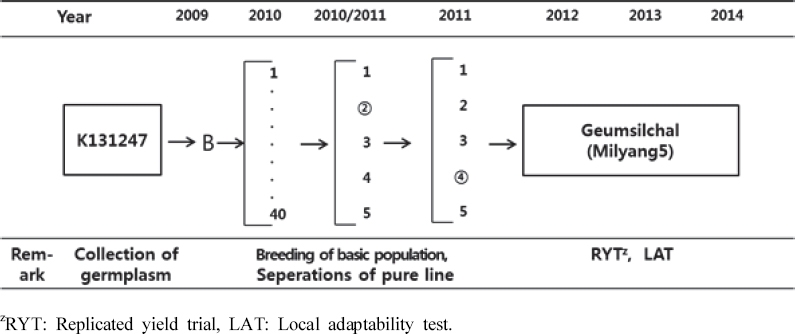
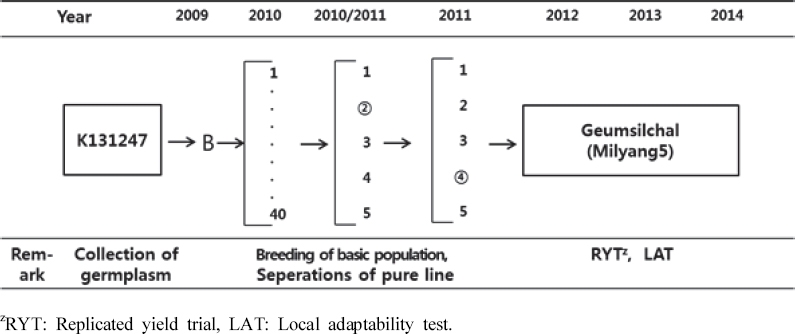
‘금실찰’은 만식재배 적성이 우수하면서 숙기가 빨라 이모작 재배에 적합한 기장을 육성하고자 2009년 국립농업과학원 유전자원센터로부터 분양받은 유전자원 중에서 배유의 특성이 찰성이고 초형이 양호한 K131247을 기본집단으로 하여 순계분리육종법을 통하여 육성하였다. 2009 ~ 2011년 3년간 분리육종법을 통해 순계분리 후 2012 ~ 2014년에 생산력 검정 시험 및 2013 ~ 2014년 사이 기후생태가 다른 5개 지역에서 실시한 지역적응시험을 동시에 수행하면서 ‘밀양5호’로 계통명을 부여하였다. 그 결과 신품종 보호출원 요건에 합당함이 인정되어 2014년 농촌진흥청의 농작물직무육성 신품종선정위원회에서 보호출원 품종으로 선정되다. ‘금실찰’의 육성과정은
Fig. 1과 같다.
Fig. 1Pedigree diagram of ‘Geumsilchal’.
주요 특성
1. 출수기 및 생육기간
영남평야지(밀양)에서 ‘금실찰’과 대조품종 ‘황금기장’의 출수기를 살펴보면, 기장은 감광성이 큰 작물로서 만기재배시 ‘황금기장’, ‘금실찰’ 모두 영양생장기간이 9~10일 정도 현저히 줄어듦을 알 수 있다(
Table 1). 품종별로는 보통기 재배(5월 15일 파종)시 ‘금실찰’ 평균 출수기 7월 13일, 대비품종 ‘황금기장’ 7월 4일이고, 만기재배(6월 15일 파종)시 ‘금실찰’ 8월 3일, ‘황금기장’ 7월 26일로 나타났다. 따라서, 보통기 재배시 재배기간이 ‘황금기장’ 95일, ‘금실찰’ 104일로 조생종인 ‘황금기장’에 비하여 9일의 차이가 나고, 만기재배시 ‘황금기장’ 86일, ‘금실찰’ 94일로 8일 늦어서 ‘금실찰’은 중생종에 해당된다.
Table 1Seeding date, heading date and growth period of ‘Geumsilchal’ and ‘Hwanggeumgijang’ in normal and late season
Table 1
|
Variety |
Normal season |
Late season |
|
|
|
Seeding date (mm.dd) |
Heading date (mm.dd) |
Growth periodz (days) |
Seeding date (mm.dd) |
Heading date (mm.dd) |
Growth period (days) |
|
Geumsilchal |
5.15 |
7.13 |
104 |
6.15 |
8.3 |
94 |
|
Hwanggeumgijang |
5.15 |
7.4 |
95 |
6.15 |
7.26 |
86 |
2. 잎, 줄기와 뿌리
‘금실찰’의 엽색은 녹색이고, 지엽의 안토시아닌 색소 발현은 대조품종인 ‘황금기장’에 비하여 약하다(
Table 2). 줄기의 길이는 ‘황금기장’ 110 cm보다 큰 123 cm이고, 줄기두께는 ‘황금기장’에 비하여 약간 두껍다. 분얼경의 생장형은 황금기장이 반직립형임에 비하여 직립형을 이루고 있었다.
Table 2Leaf, culm and root characteristics of ‘Geumsilchal’ and ‘Hwanggeumgijang’
Table 2
|
Variety |
Leaf Color |
Anthocyanin in flag leaf |
Growth habit |
Culm |
|
|
Length (cm) |
Width (mm) |
|
Geumsilchal |
Green |
No |
Erect |
123±4.1z,a,y
|
5.0±0.6 |
|
Hwanggeumgijang |
Green |
Yes |
Semi-erect |
110±6.5b
|
4.3±0.5 |
3. 이삭과 낟알
‘금실찰’의 이삭자세는 ‘황금기장’과 같은 하수형이고 이삭의 길이는 28.0 cm 정도로 ‘황금기장’ 32.3 cm 보다 조금 짧지만 조밀한 형태를 이루고 있다. 종실색은 황색이며, 낟알색은 노란색, 배유전분의 특성은 찰성으로 ‘황금기장’과 종실색에서 뚜렷한 차이가 있으며, 낟알 및 배유특성은 동일하다(
Table 3).
Table 3Panicle and grain characteristics of ‘Geumsilchal’ and ‘Hwanggeumgijang’
Table 3
|
Variety |
Panicle |
Seed color |
Dehusked grain color |
Endosperm |
|
|
Length(cm) |
Type |
|
Geumsilchal |
28.0±1.5z,a,y
|
Droopy |
Yellow |
Yellow |
Glutinous |
|
Hwanggeumgijang |
32.3±2.8b
|
Droopy |
Brown with white dot |
Yellow |
Glutinous |
4. 도복, 생리장애 저항성 및 병해충 저항성
‘금실찰’은 포장상태에서 ‘황금기장’에 비하여 도복에 강하였으며. 이는 ‘금실찰’의 줄기 두께 및 직립형의 초형과 같은 농업적 특성(
Table 2)이 ‘황금기장’에 비하여 유리하였기 때문으로 생각된다. ‘금실찰’은 세균줄무늬병, 잎짚무늬마름병, 줄무늬잎마름병 등 병 저항성에 대해 ‘황금기장’과 비슷한 정도를 나타내었으며, 조명나방 및 노린재 등에 대한 내충성도 ‘황금기장’과 비슷한 강도를 나타내었다(
Table 4).
Table 4Reaction to lodging tolerance, and major diseases and insect of ‘Geumsilchal’ and ‘Hwanggeumgijang’
Table 4
|
Variety |
Field lodging (0-9) |
Damage index by diseases and insecty
|
|
|
Blast |
Sheath blight |
Bacterial stripe |
Pest resistance |
|
Geumsilchal |
1z
|
3 |
3 |
1 |
1 |
|
Hwanggeumgijang |
3 |
3 |
3 |
1 |
1 |
5. 수량구성요소
기장도 화본과에 속하므로 벼의 수량구성요소 조사에 따라 조사해본 결과는 다음과 같다(
Table 5). ‘금실찰’의 조곡 및 현곡 천립중은 황금기장보다 가벼웠으나, 단위면적당 이삭수와 주당 이삭중이 ‘황금기장’ 에 비하여 많은 편이었다. 따라서 ‘금실찰’은 낟알 무게는 작으나 낟알 숫자가 많아서 수량성을 확보하고 있는 것으로 판단되었다.
Table 5Yield components of ‘Geumsilchal’ and ‘Hwanggeumgijang’
Table 5
|
Variety |
Panicle number per m-2
|
Panicle weight per hill-1
|
Ripened grain ratio (%) |
Weight of 1,000 seeds(g) |
|
|
Unpolished grain |
Polished grain |
|
Geumsilchal |
39.9±5.11z,a,y
|
5.8±1.1a
|
71.2±2.5a
|
4.68±0.08a
|
3.79±0.03a
|
|
Hwanggeumgijang |
35.6±2.43a
|
5.3±1.9a
|
72.3±3.1a
|
5.36±0.12b
|
4.19±0.05b
|
6. 도정 및 성분특성
‘금실찰’의 도정 특성은 제현율 81.8%, 도정수율 76.2%로서 대조품종인 ‘황금기장’과 비슷하였으며, 완전미 도정수율도 ‘황금기장’과 유사하였다. 곡실 중 영양성분은 단백질 함량이 11.2%로 ‘황금기장’ 8.7%보다 높았으며, 항산화성분인 폴리페놀 함량은 ‘황금기장’ 보다 조금 높은 수준이었으나 통계적으로 차이는 없었다. 아밀로스 함량은 8.7%로서 ‘황금기장’과 동일하게 찰기장에 속하였다(
Table 6).
Table 6Milling property and functional component of ‘Geumsilchal’ and ‘Hwanggeumgijang’
Table 6
|
Variety |
Variety Brown/rough grian ratio (%) |
Milled grain recovery (%) |
Head grain milling yield (%) |
Protein Contents (%) |
Polyphenol content (μg/g) |
Amylose content (%) |
|
Geumsilchal |
81.8a,z
|
76.2a
|
71.2a
|
11.2a
|
694a
|
8.7a
|
|
Hwanggeumgijang |
82.6a
|
76.8a
|
72.3a
|
8.7b
|
617a
|
7.7a
|
7. 수량성
2012~2014년간 수행한 생산력검정시험결과, 5월 15일 파종한 보통기 재배시 ‘금실찰’은 200 kg/10a로 ‘황금기장’에 비하여 32% 증수하였으며, 6월 15일 파종한 이모작기 파종시 ‘황금기장’에 비하여 10% 증수하여 수량성이 우수하였다(
Table 7). ‘금실찰’이 ‘황금기장’에 비하여 수량성이 증가한 것은
Table 5에서 나타난 바와 같이 ‘금실찰’이 천립중은 작지만 주당수수와 수당이삭무게가 높았기 때문으로 생각된다. 또한, 이모작기 재배에서 보통기 재배에 비하여 수량의 증가 정도가 감소하였던 것은 기장은 파종기가 늦어질수록 감광성의 영향으로 영양생장일수가 짧아지고, 그 결과 주당수수가 줄어드는데, 그 정도는 품종 및 자원에 따라 상이하다는
Yoon et al.(2016)의 연구결과를 고려하였을 경우, 금실찰은 황금기장에 비하여 감광성이 더 큰 것으로 판단되었다.
Table 7Yield performance of ‘Geumsilchal’ and ‘Hwanggeumgijang’ at advanced yield trial(AYT)
Table 7
|
Variety |
Normal season |
Late season |
|
|
|
Yield (Ton/ha) |
Index |
Yield (Ton/ha) |
Index |
|
Geumsilchal |
2.00 |
132 |
2.07 |
110 |
|
Hwanggeumgijang |
1.51 |
100 |
1.89 |
100 |
2013~2014년에 밀양, 수원, 청원, 익산, 나주 5개 지역에서 수행된 6월 5일 파종한 지역적응 시험결과 ‘금실찰’은 평균 2.41 t/ha로서 대비품종인 ‘황금기장’에 비해 평균 27% 증수하여 생산력검정시험과 유사한 결과를 나타내었다(
Table 8).
Table 8Yield performance of ‘Geumsilchal’ and ‘Hwanggeumgijang’ at local adaptability test(LAT)
Table 8
|
Variety |
Milyang |
Suwon |
Cheongwon |
Iksan |
Naju |
Mean |
Index |
|
----------- Unpolished grains, t ha-1 ------- |
|
Geumsilchal |
2.69 |
1.82 |
2.99 |
1.74 |
2.78 |
2.41a,z
|
1.27 |
|
Hwanggeumgijang |
1.67 |
1.28 |
2.20 |
1.81 |
2.54 |
1.90a
|
1.00 |
8. 적응지역 및 재배상 유의점
‘금실찰’은 전국 1모작 및 2모작지에 추천되는 중생종 찰기장 품종이다. 도복 등 재해에는 비교적 강하지만 습해에는 약하므로 배수가 불량한 밭이나 논토양에서 재배하고자 할 때에는 배수시설을 설치하는 것이 좋다. 조명나방에 대한 저항성이 없으므로 적기에 방제를 꼭 실시하여야 한다. 또한 기장은 전용약제가 등록되어 있지 않아 제초제 처리는 피해야 한다.
적요
기장 ‘금실찰’은 국립농업과학원 유전자원센터에서 분양 받은 K131247을 기본집단으로 하여 분리육종법을 통해 국립식량과학원에서 2014년 육성된 신품종으로 주요특성과 수량성을 요약하면 다음과 같다. 출수기는 표준품종인 ‘황금기장’ 보다 보통기 재배에서 9일, 만기재배에서 8일 늦은 중생종으로 생육일수는 보통기재배시(5월 15일 파종) 104일, 만기재배시(6월 15일 파종) 94일 정도이다. 간장은 123 cm로 ‘황금기장’에 비해 13 cm 정도 길지만 분얼경 생장형이 직립형이고, 줄기 직경이 넓어 도복에 강한 특성을 나타낸다. 이삭은 하수형이며. 종실색은 황색이고, 낟알은 노란색이며, 조곡 천립중 4.68 g, 현곡 천립중 3.79 g으로 ‘황금기장’에 비하여 약간 가벼운 편이나 주당 이삭수는 황금기장에 비하여 많다. 배유의 아밀로스 함량은 8.7%로 찰기장에 해당하며, 낱알의 단백질함량이 11.2%로 황금기장에 비해 높은 특성을 가지고 있다. 수량은 지역적응시험 보통기 재배 평균 2.41 t ha-1로서 표준품종 황금기장에 비하여 27% 증가하였다.
사사
본 논문 및 품종은 농촌진흥청 연구사업(과제번호: PJ01136502)의 지원에 의해 이루어진 것이며, 본 품종을 육성함에 있어 협력하여 주신 농촌진흥청 국립농업과학원 농업유전자원센터 관계관과 지역적응시험 담당자께 깊은 감사를 드립니다.
References
- 1. Amadou I, Gounga M, Le GW. 2013. Millets:Nutritional composition, some health benefits and processing- A review. Emir. J Fod AGRIC 25: 501-508.
- 2. Choi Y, Lee SM, Chun J, Lee HB, Lee J. 2006. Influence of heat treatment on the antioxidant activities and polyphenolic compounds of Shiitake (Lentinus edodes) mushroom. Food Chem 99: 381-387.
- 3. Graybosh RA, Baltensperger DD. 2009. Evaluation of the waxy endosperm trait in proso millet(Panicum miliaceum). Plant breeding 128: 70-73.
- 4. Ha YD, Lee SP. 2001. Characteristics of proteins in italian millet, sorghum and common millet. Korean J Postharvest Sci Technol 8: 187-192.
- 5. Jeju agricultural research & extension services. 150 main crop cultivation technology 2014. 1583.
- 6. Kalinova J. 2007. Nutritionally important components of proso millet(Panicum miliaceum). Food 1: 91-100.
- 7. Kim JK, Park SY, Yeo Y, Cho HS, Kim YB, Bae H, Park CH, Lee JH, Park SU. 2013. Metabolic profiling millet (Panicum miliaceumL.) using gas chromatography-time–of-flight mass spectrometry (GC-TOFMS) for quality assessment. Plant omics journal 6: 73-78.
- 8. Kwak CS, Lim SJ, Kim SA, Park SC, Lee MS. 2004. Antioxidative and antimutagenic effects of Korea Buckwheat, Sorghum, Millet and Job's tear. J Korean Soc Food Sci Nutr 33: 921-929.
- 9. Oelke EA, Oplinge ES, Putnam DH, Durgan BR, Doll JD, Undersander DJ. 1990. Millets in Alternative field crop manual. University of Wisconsin-extension, University of Minnesota, Center for alternative plant & animal products and the Minnesota extension service. http://hort.Purdue.edu/newcrop/afcm/millet.html
- 10. Park CH, Kim HJ, Park GG, Park SU, Woo SH, Lee GY, Jang GJ, Choi M, Choi YS. 2015. Miscellaneous cereal is functional cereal. Jinsol. P. 219.
- 11. Park MY, Kim JH, Park DS. 2011. Anti- inflammatory activites of Hog millet(Panicum miliaceum L)in murine marcrophages through IRAK-4 signaling. Korea J Food & Nutr 24: 268-272.
- 12. Pedersen JF, Bean SR, Funnell DL, Graybosch RA. 2004. Rapid iodine staining techniques for identifying the waxy phenotype in Sorghum grain waxy genotype in sorghum pollen. Crop Sci 44: 764-767.
- 13. Salini K, Nirmalakumari A, Muthiah AR, Senthil N. 2010. Evaluation of proso millet(Panicum miliaceumL.) germplasm collections. Electronic journal of plant breeding 1: 489-499.
- 14. Yoon ST, Han TG, Jeong IH, Kim YJ, Yul JB, Yang J, Ye MH, Han KS, Baek SW, Kim SI, Lee MC, Kim GW. 2016. Effect of planting density and seeding date on the tiller aspect and growth characteristics of proso millet (Panicum miliaceumL.). Korean J Plant Res 29: 511-518.