적요
Oats are known for their abundance of quality proteins and lipids compared to those of other grain crops; they especially contain a large amount of good quality fibers, including β-glucan. The Korean domestic consumption of oats is rapidly increasing due to their high nutritional value. However, the research for functional food breeding material has been insufficient because oats have been focused on as feed. Therefore, this study aimed to evaluate the agronomic traits and important nutritional ingredients, including β-glucan, protein, lipid, fiber, and dietary fiber, of 142 oat germplasms from Korea, China, and Japan, which are maintained in the National Agrobiodiversity Center. In addition, the diversity by origin of the germplasms was analyzed based on their agronomic traits. For the agronomic characteristics, Korean oat germplasms were on average headed and matured earlier than the Chinese and Japanese ones. Seven accessions, including IT151107, were matured before mid-June, which makes double cropping possible in the Southern region of Korea. In the diversity analysis by origin based on quantitative agronomic traits, Korean oat germplasms were in the distinguished group compared to Chinese and Japanese germplasms. Oat germplasm had a wider range of main ingredients compared to that of Korean domestic oat cultivars. However, Chinese germplasms had a significantly higher β-glucan content, while Korean germplasms had significantly higher crude protein, crude lipid, and crude fiber contents, than did other germplasms from other origins. Dietary fiber contents showed no significant differences between origins. IT129802 (China), IT166594 (Korea), IT166584 (Korea), IT151108 (Korea), and IT129798 (China) showed the highest β-glucan, protein, lipid, fiber, and dietary fiber contents, respectively. These selected oat germplasms can be superior breeding materials for various functional and agronomic purposes.
서 언
귀리(
Avena sativa L.)는 벼과에 속하는 두해살이 풀로 연맥이라 불리며, 세계적으로 밀, 옥수수, 벼, 보리, 수수에 이어 6번째로 높은 생산량을 보이는 주요 작물이다(
Hackett 2018,
USDA 2017). 예로부터 단백질, 섬유질, 비타민과 무기질이 풍부하여 건강식품으로 인식되어 왔으며, 근래 혈중 콜레스테롤 강하 등 생리활성이 알려지면서 기능성 식품소재로서의 관심도 높다. 식용으로의 귀리의 영양적 이점은 비교적 다양하게 연구되었는데, 귀리는 조성이 훌륭한 질 높은 단백질, 탄수화물, 식이섬유, 지방, 무기질 공급원이면서, 동시에 플라보노이드와 항산화물질, 베타글루칸과 수용성 식이섬유 등도 풍부하게 함유되어 있다고 알려져 있다(
Premkumar et al. 2017,
Rasane et al. 2013).
귀리의 단백질은 타 곡물에 비해 필수 아미노산 조성을 기준으로 그 양과 질이 특히 사람과 비반추동물에게 우수한 것으로 알려져 있다(
Chu 2014,
FAO 2004,
Gorash et al. 2017). 곡물의 종자 저장 단백질은 크게 두 종류로 염과 물에 녹는 글로블린과 알코올에 녹는 프롤라민으로 나눠지는데(
Anderson 2014), 필수 아미노산 중에는 특히 단백질의 생합성에 중요한 역할을 하는 라이신이 중요한데, 라이신은 포유류가 스스로 합성할 수 없고 반드시 외부로부터 섭취해야만 하는 영양소이다(
Tome & Bos 2007,
Yu & Tian 2018). 곡류는 이러한 필수아미노산의 우선 공급원으로, 특히 귀리에 함유된 단백질은 프롤라민 단백질 함량이 높은 다른 곡류에 비해, 라이신이 풍부하고, 글로블린 단백질의 비율이 높아 영양적으로 우수하다고 알려져 있다(
Carpita 1996,
Fincher 2009,
Gell et al. 2017,
Giuberti et al. 2011).
귀리는 보통 지방함량이 3~11%에 이르고 특정품종의 경우 지방의 함량이 18%에 이른다는 보고가 있기도 할 만큼 지방함량이 높고, 불포화 지방산 구성이 뛰어나 영양적으로 훌륭하다고 평가받는 작물이다. 또한 배나 배반의 지방함량이 높은 타 곡물에 비해 귀리의 지방은 대부분이 배유에 저장되어 있다(
Banas et al. 2007,
Rasane et al. 2013). 귀리의 지방산은 불포화지방산인 올레산(18:1), 리놀레산(18:2), 리놀렌산(18:3)과 포화지방산인 미리스트산(14:0), 팔미트산(16:0), 스테아르산(18:0)으로 구성되어 있고, 이 중 올레산, 리놀레산, 팔미트산의 함량이 높다. 올레산, 리놀레산은 영양적으로 필수적인 불포화 지방산이고, 팔미트산은 지방의 과산화를 방지하는데, 지방의 과산화는 독성을 유발하고 곡류의 식미를 떨어뜨린다. 이처럼 귀리의 지방함량 및 지방산 구성은 대체로 영양적으로 우수하다고 평가 받아왔다(
Saastamoinen et al. 1989). 그러나, 곡실의 용도에 따라 지방의 함량은 좀더 면밀히 평가될 필요가 있다. 사료용으로는 지방의 에너지가치(37 kJg
-1)가 단백질이나 탄수화물(16~17 kJg
-1)에 비해 월등히 높아 가축에게 훌륭한 에너지 공급원이 되기 때문에 지방함량이 높은 것이 대체로 선호되는 반면, 식용으로는 식미가 떨어지고, 조리시 과도한 갈변을 일으키는 원인이 되기도 하기 때문에 지방 함량이 지나치게 높은 것은 선호되지 않기도 한다(
Leonova 2013,
Rasane et al. 2013).
귀리의 건강기능성은 1998년 FAO에서 귀리추출물을 함유한 식품에 건강기능효과 라벨을 붙일 수 있도록 허가함으로써 세계적으로 큰 관심을 끈 바 있다. 또한 세계 10대 슈퍼푸드 중 하나로 알려져, 건강에 대한 소비자의 관심이 증대됨에 따라 우수한 건강기능성 식품으로 그 소비가 최근 늘고 있다(
Gorash et al. 2017,
Rasane et al. 2013). 귀리는 중요한 기능성 성분으로 식이섬유와 베타글루칸의 함량이 특히 높은데, 귀리의 베타글루칸은 주로 선형 다당류인(1→3), (1→4)-베타-디-글루칸으로 이뤄져 있으며 흔히 이를 줄여서 베타글루칸이라고 한다. 맥류에 함유된 베타글루칸의 건강상 이점은 비교적 많이 알려져 있는데, 귀리의 베타글루칸은 용해성, 교화성(gelation), 상대적인 분자량 등에 있어 밀⋅보리와 차이점을 보인다고 알려져 있다(
Hu et al. 2015,
Wang & Ellis 2014). 귀리에서 베타글루칸은 배유 및 호분층 세포벽에 다량 함유되어 있으며, 특히 고혈압과 당뇨에 효과가 있다고 잘 알려져 있다. 구체적으로는 식후 혈당을 희석시켜 인슐린의 혈증 반응을 감소시킬 뿐 아니라 혈액내 저밀도지질단백질 콜레스테롤을 줄이고, 고밀도지질단백질 콜레스테롤은 높여 정상 혈중지질농도 및 정상 체중 유지에 도움을 준다. 이 외에도 백혈구/매크로파지(면역담당세포)를 활성화하고, 면역 글로블린, NK세포, 킬러 T세포 등의 늘려 면역기능을 촉진시키는데, 이는 암 및 감염, 기생충에 의한 질병에 대한 저항성을 높여준다고 알려져 있다(
Daou et al. 2012). 이러한 베타글루칸의 건강상 이점 때문에 베타글루칸 함량을 높이는 것은 귀리 기능성 육종의 중요한 목표 중 하나로 인식되고 있다(Ahmad et al. 2014, Newell 2011).
재배적으로는 타 곡물과 비교하여 양분이 부족한 척박한 환경에서도 잘 자라고, 춥고 습한 기후에서의 재배가 가능하며, 화학비료 요구도가 낮으며, 병해충도 적은 편으로 화학적 방제의 필요성 또한 적어 친환경적 재배가 가능한 장점이 있다(Buerstmayr et al. 2007, Sunilkumar et al. 2017). 전세계 귀리 곡실 생산량의 70%는 동물 사료용으로, 30% 정도는 식용으로 소비되는데, 이처럼 귀리는 식용과 사료용으로 모두 이용이 가능한 다목적 작물이자 영양적 구성이 뛰어나 양분 공급원으로서 중요한 위치를 차지한다(FAO 2013, Kaur et al. 2018, Sang & Chu 2017).
그러나 재배자 입장에서는 귀리보다 수량이 높고 수익이 많이 나는 밀, 벼, 보리가 훨씬 더 선호되었고, 전세계적으로 지난 몇 십 년간 귀리의 생산량은 꾸준히 감소해왔다. 따라서 세계적으로 밀, 보리, 벼와 달리 귀리에 대한 농업적 연구는 부족한 편인데, 귀리 육종가들의 연구는 수량과 관계 있는 표현형 선발과 병저항성에 주로 집중되었고, 유전학적 연구와 기타 필요형질에 대한 연구는 타 작물에 비해 진전속도가 느린 편이었다. 하지만, 최근 영양학적으로 긍정적인 효과와 건강상 이점들이 주목을 받고, 주요 곡물로서의 위치가 점차 확고해지면서 그 소비나 연구가 차츰 늘어나고 있다(
Leonova 2013,
Premkumar et al. 2017,
Winkler et al. 2016). 국내의 귀리 연구 사정 또한 다르지 않아 그 동안 주로 재배나 사료작물로서 품질평가가 주가 되어 왔으며, 식용 품종보다 조사료용 품종 개발이 다수를 차지하고 있었다. 기능성 성분인 베타글루칸 추출이나 생리활성 연구가 종종 이뤄졌으나, 식용이나 가공제품용 품종 개발은 더딘 진전을 보였다. 특히 영양기능성 개선을 위한 육종과 육종재료로서 유전자원에 대한 연구는 매우 제한적이었다. 그러나 귀리의 건강기능성에 대한 대중의 인식으로 국내에서도 귀리의 소비가 급증하고 있으며, 향후에도 이러한 영양 기능 개선이 소비촉진에 긍정적 영향을 줄 수 있다고 보여진다. 그러므로 향후 연구는 수량뿐 아니라, 베타글루칸 함량이 높은 품종을 육성하는 등 영양적 가치를 향상시키는 방향으로도 활발히 진행되어야 할 것이다.
본 연구에서는 농촌진흥청 농업유전자원센터에 보존된 한국, 중국, 일본 원산 142점의 귀리 유전자원에 대해 농업형태적 특성을 조사하고 베타 글루칸을 비롯한 주요 영양기능성 성분에 대한 분석을 실시하였다. 이를 통해 원산지별 다양성을 분석하여 유전자원의 활용도를 높이고, 우수한 자원을 선발하여 육종재료로 제공함으로써 기능성 귀리 품종 육종 효율을 향상시키며, 나아가 국내 귀리 소비촉진에 기여하고자 한다.
재료 및 방법
시험재료 및 재배특성조사
국립농업과학원 농업유전자원센터에서 보존하고 있는 귀리 자원 중 한국원산 36자원, 중국원산 69자원, 일본원산 37자원 등 총 142자원을 공시재료로 하였고, 여기에 삼한, 스완, 조양, 조풍, 하이스피드 등 국내외 귀리 5품종을 표준품종으로 공시하였다. 원산지 및 자원 정보는
Table 1과 같다. 일본 자원의 경우 자원구분이 미상인 자원이 많았으나 자원명과 기타 정보로 보아 육종계통이 다수를 차지하는 것으로 보였다. 공시 자원은 2017년 3월 10일 전주시 중동에 위치한 유전자원센터 노지포장에서 재식거리 50 × 100 cm로 관행파 줄뿌림으로 파종하여 재배하였다(
Table 2). 출수기, 성숙기 등 필수 재배특성은 표준영농교본과 유전자원특성조사 및 관리요령(
RDA 2005,
RDA NAS 2006)에 준하여 조사하였다. 수확한 자원은 대부분 겉귀리로 이는 간이도정기(FC2K, Yamamoto, Japan)를 이용하여 도정한 후 분쇄하였고, 쌀귀리는 도정과정 없이 분쇄하였다(BL123, Tefal, Korea). 도정된 시료는 분쇄 후 0.5 mm 체에 걸러 준비하였다.
Table 1Information of the analyzed oat germplasms in this study.
Table 1
|
Korea |
China |
Japan |
Total |
|
Landrace |
34 |
16 |
|
50 |
|
Cultivar |
1 |
6 |
6 |
13 |
|
Breeding line |
|
28 |
|
28 |
|
Unknown |
1 |
19 |
31 |
51 |
|
|
Total |
36 |
69 |
37 |
142 |
Table 2Cultivation overview of the materials in this study.
Table 2
|
Seeding date |
Seeding place |
Seeding Method |
Planting distance |
Standard cultivar |
|
2017.3.10 |
Jeonju, South Korea |
Drill Planting |
0.5 X 1 m |
Samhan (Hulled oat)
Joyang (Naked oat) |
베타글루칸 분석
귀리의 총 베타글루칸 함량은 Oat β-glucan kit (Megazyme Pty. Ltd., Deltagen, Australia)를 이용하여 효소추출법을 사용하여 측정하였다. 분쇄가루 0.1 g에 50% EtOH 1 ml와 Sodium phosphate buffer 4 ml을 추가한 후 100°C 항온수조에서 2분간 반응시킨 후 50°C 항온수조에서 다시 5분간 냉각시켰다. Lichenase 0.2 ml를 넣고 섞은 뒤 1시간 동안 반응시킨 후 원심분리하여 상장액 0.1 ml에 β-Glucosidase 0.1 ml을 넣고 50°C에서 10분간 반응시켰다. 마지막으로 Glucose oxidase / peroxidase (GOPOD) reagent 3 ml를 첨가하고 510nm에서 흡광도를 측정하였다. Blank는 Sodium acetate buffer를 사용하였다.
조단백⋅조지방 분석
조단백 함량은 micro-Kjeldahl법(
NICS 2009)으로 분쇄시료 0.2 g을 단백질 분해관에 넣고 황산 12 ml과 촉매제를 첨가한 후, Kjeltec™ 8400 auto unit (Foss Tecator, Hillerod, Denmark)를 이용하여 420°C에서 40분간 분해하고 30분간 상온에서 냉각시킨 후 질소함량을 측정하였다. 이 질소함량에 귀리의 질소계수(5.83)을 곱하여 조단백 함량을 정량하였다.
조지방 함량은 용매추출법으로(
NICS 2009), 지방추출장치 ST 243 Sotex™ (Foss Sotex™, Hillerod, Denmark)을 이용하여 분석하였다. 분쇄 시료 1 g을 비등석을 넣은 extraction thimble에 담고 hexane 50 ml를 첨가 후 130°C에서 30분간 가열 후 추출은 60분, 회수는 15분간 실시하였다. 용출된 조지방을 담고 있는 수기를 103°C에서 45분간 건조 후 상온에서 20분간 방냉한 후 무게를 측정하여 조지방 함량을 정량하였다.
조섬유 함량은 Fibertec 2010 auto analyzer (Foss Tecator, Hillerod, Denmark)를 이용하여 분석하였다(
NICS 2009). 분쇄시료 1 g을 추출용기에 넣고 무게 측정 후 미리 가열된 1.25% H
2SO
4를 이용하여 30분간 끓인 후 증류수로 세척하고 1.25% NaOH를 이용하여 위 과정을 반복하였다. 산, 염기가 처리된 시료를 포함한 추출용기를 105°C 건조기에서 1시간 건조한 후 데시케이터에 옮겨 2시간 동안 방냉한 후 무게를 측정하였다. 이를 다시 전기회화로 DS-84E (Dasol scientific Co.,Ltd., Hwaseong, Korea)를 이용하여 500°C에서 3시간 동안 회화시킨 후 2시간 동안 방냉 후 무게를 측정하여 조섬유 함량을 측정하였다.
식이섬유 함량은 Fibertec 1023 system E (Foss, Denmark)를 이용하여 분석하였다. 시료 1 g에 50 ml phosphate buffer (pH 6.0)를 넣고 0.1 ml α-amylase solution으로 가수분해하였다. 여기에 NaOH를 넣어 pH를 조정하고 다시 protease를 넣어 가수분해한다. 다시 HCl을 넣어 pH를 조정하고 amylogluco sidase을 넣어 가수분해한다. 이 가수 분해물에 95% ethanol을 넣어 실온에서 1일 방치한 후 ethanol로 세척, 건조시킨 후 무게를 측정하여 정량하였다.
재배특성 및 주요성분에 대한 원산지별 통계 분석
조사된 재배특성 및 주요성분에 대한 분석결과는 원산지별 유의미한 차이에 대한 분산분석(ANOVA)과 주성분분석(PCA: Principal Component Analysis), 그리고 군집분석(Cluster analysis)을 실시하였다. 분산분석은 농업재배형질 및 주요성분 항목에 대해 실시하였고, Statistix 8.1 패키지(
McGraw-Hill C 2008)를 이용하였다. 주성분 분석은 주요재배특성인 출수기, 성숙기, 간장, 수장, 백립중에 대해 실시하였고,
Kassambara & Mundt (2017)의 방법에 따라 RStudio (
2015) 프로그램을 이용하였다. 또한 이 특성들은
Nei (1973)의 방법에 따라 각 자원별로 유전적 거리를 계산하고, Past3 Software (
Hammer et al. 2001)를 이용하여 UPGMA (Unweighted Pair Group Method using Arithmetic algorithm) tree를 작성하였다.
결과 및 고찰
귀리유전자원의 주요 재배특성
귀리는 맥류 작물 중 내한성이 가장 약해 발아가능온도는 2°C 이상으로 기온이 6~8°C이상이면 생장하기 시작하나 생육적온은 18~25°C로 서늘하고 습윤한 기후에서 잘 생육한다. 귀리의 국내 안전재배지역은 전남, 경남 및 제주를 포함한 1월 최저평균기온 -4°C 이상인 지역으로 한정되어 중북부지역이라면 춘파가 적합하다. 그러나 춘파는 추파에 비해 곡실의 품질, 수량, 조숙성에 있어 불리하고 작부체계상 답리작 재배가 선호되므로 국내에서는 내한성이 강한 품종을 선택하여 추파로 재배하는 것을 더 선호한다(
Han et al. 2014,
RDA NICS 2013). 본 실험에서는 안전 월동을 위해 춘파로 재배하였고, 그 결과 대조품종의 평균 출수기는 5월 하순, 평균 성숙기는 6월 하순이었으며, 81% 이상의 귀리 유전자원이 7월 상순 이후에 성숙하는 것으로 조사되었다. 따라서 춘파의 경우에는 논에서 동계작물로 재배되어 장마 이전에 수확하기가 어려울 것으로 예상된다. 한국원산 자원은 중국과 일본원산 자원에 비해 출수와 성숙이 빠른 경향을 보였다(
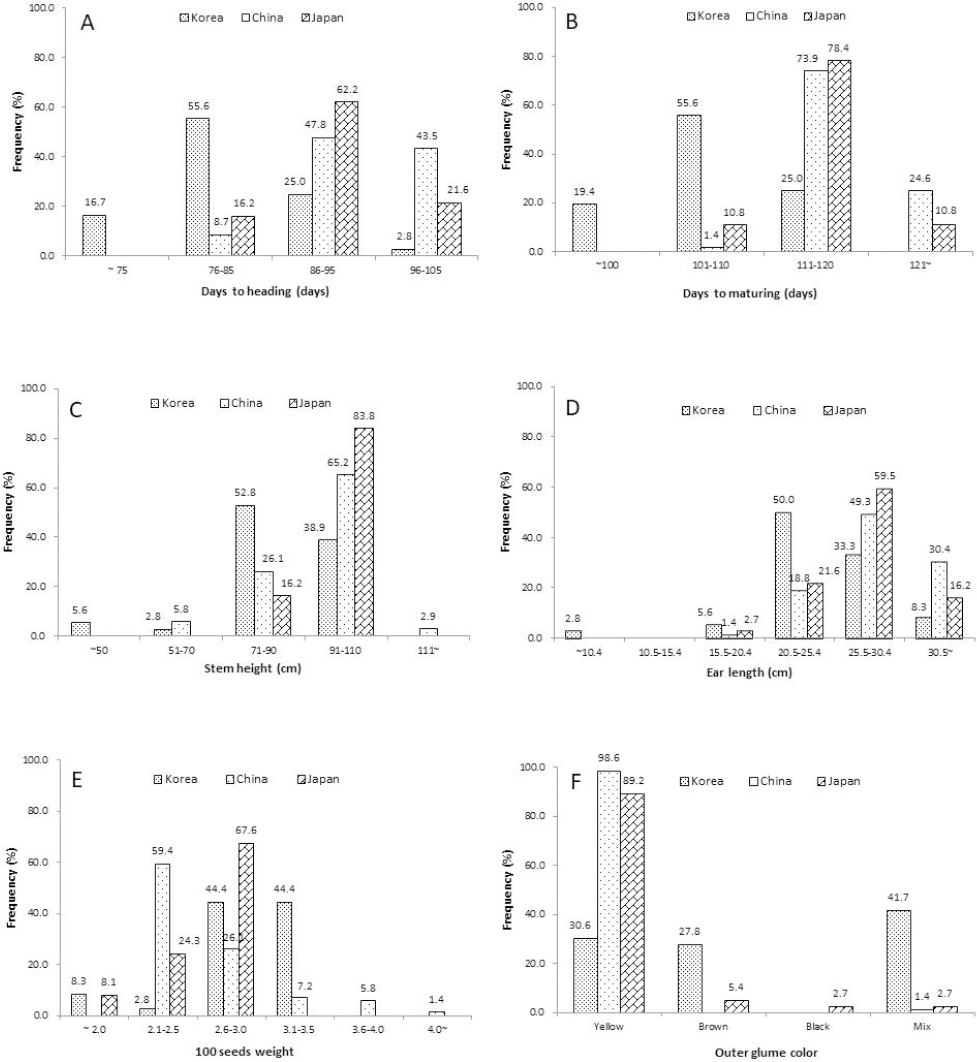
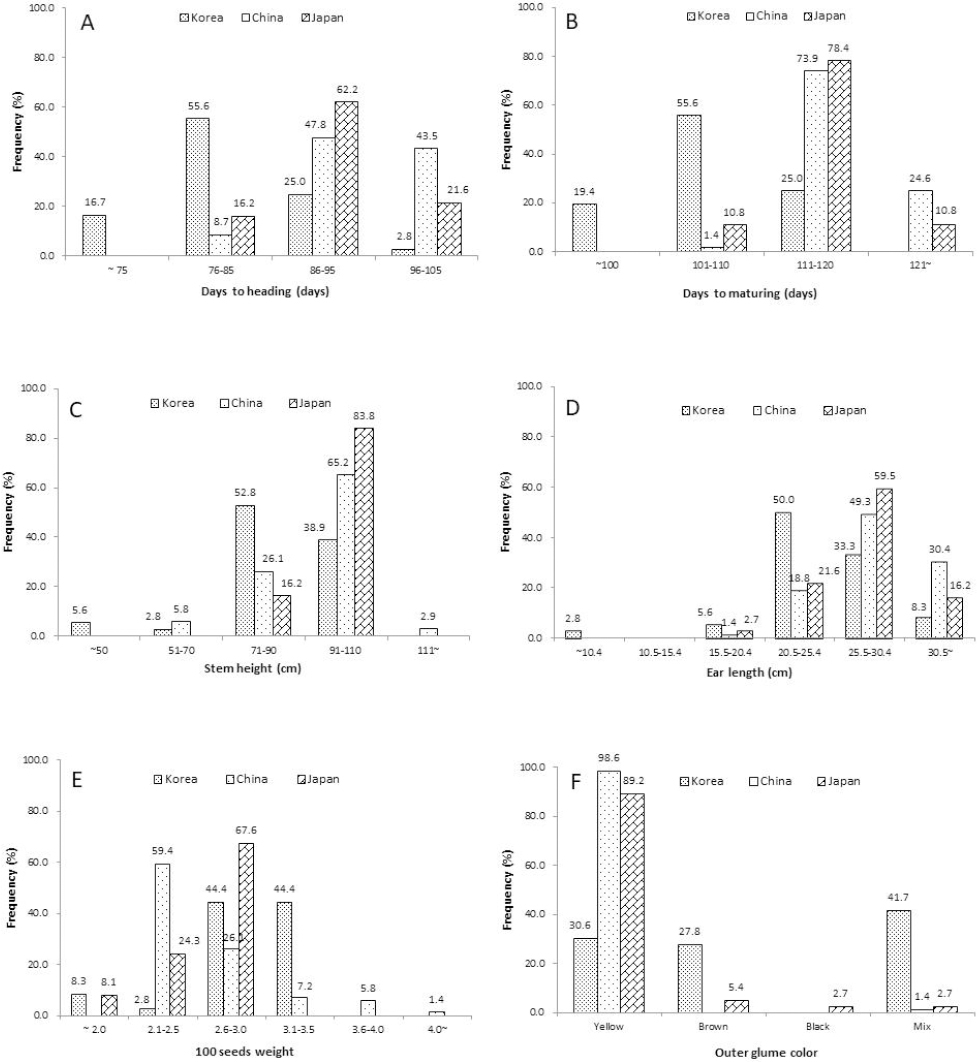
Table 3). 한국원산 자원의 경우 파종일로부터 평균 82일 후 출수하였고, 이는 중국원산 자원(92일)이나 일본원산 자원(94일)보다 10~12일 가량 빨랐다. 성숙기의 경우도 한국원산 자원은 파종일로부터 평균 107일이 소요되었고, 이는 중국원산 자원(119일)과 일본원산 자원(118일)에 비해 11~12일 빨랐다. 이번에 조사된 한국원산 자원들은 중국이나 일본원산 자원에 비해 출수⋅성숙기가 모두 평균 10일 이상 유의적으로 빨라 조숙성을 보였다. 국내 답리작 재배에 유리한 6월 10일 이전에 수확이 가능하도록 파종 후 92일 이내에 성숙하는 자원은 없었으나, 100일이내에 성숙하는 자원은 IT1551107을 포함한 7자원으로 모두 한국원산 자원이며, 전체 한국원산 자원 중 20%에 육박하였다. 이들 자원은 국내 대조품종 중 가장 성숙기가 빨랐던 조양(성숙기 2017.6.21, 성숙소요일수 103일)보다 빨리 성숙한 것으로 춘파의 경우에도 남부지방에서는 이앙 전 재배가 가능할 정도로 성숙기가 빠른 편이다. 구간별 성숙기 분포를 보더라도(
Fig. 1) 한국원산 자원의 경우 75%의 자원이 파종으로부터 110일 이전에 성숙하고, 121일이상 소요되는 자원이 없었으나, 일본원산 자원의 경우 89%의 자원이 성숙에 111일 이상이 소요되고, 중국원산 자원은 99%에 이르는 자원들이 성숙에 111일 이상 소요되었다. 중국원산 자원의 경우 성숙에 121일이상 소요되는 자원도 25%에 이르렀다. 본 연구에서 사용된 대조품종들은 스완을 제외하고는 모두 한국육성품종들로 평균 성숙기는 6월 25일로 파종으로부터 107일이 소요되었다. 이들 대조품종보다 빠른 성숙기를 보인 자원은 총 39자원이었으며, 대체로 대조품종으로 사용된 한국 품종들이 조숙성을 중요하게 생각하여 육성된 것을 감안할 때, 한국품종보다 빨리 성숙되는 자원들은 국내 작부체계에 적응이 용이할 것으로 생각된다. 이 39자원들은 일본 원산 1자원을 제외하고는 모두 한국원산 재래종 자원이었다. 한국원산 자원의 간장(85.7±1.9 cm)은 평균적으로 중국(92.3± 12.1 cm)이나 일본(91.7±5.5 cm)원산 자원에 비해 짧았다. 수장도 한국원산 자원(24.4±4.3 cm)이 중국(28.6±3.5 cm) 이나 일본(27.7±3.2 cm)원산 자원에 비해 짧은 편이었다. 특히 한국원산의 IT166576자원의 경우 가장 짧은 간장(41.6 cm)과 수장(7.8 cm)을 동시에 가진 자원으로 조사되었다. 이는 수집재래종으로 야생형에 가까운 초형과 수형을 가지고 있기 때문인 것으로 생각된다. 반면 백립중은 일본원산 자원이 한국과 중국원산 자원에 비해 약간 무거운 편이었으나 유의적 차이는 없었다. 단, 중국원산 자원의 백립중은 1.8 g (IT166575)에서 4.2 g (IT128790)까지 타 원산지 자원에 비해 비교적 넓은 범위에 분포되어 있었다(
Table 3). 황색은 전체 자원 중 78.8%가 해당하는 가장 흔한 종피색 이었으며, 갈색이 그 다음이었다(8.5%). 흑색 자원도 1자원 있었으며, 이 자원(IT162928)은 일본원산 자원이었다. 갈색, 회색, 흑색 등의 유색자원의 경우 기능성 육종소재로서 선호도가 높은데, 전체 한국 자원 중 27.8%의 자원이 갈색자원으로 타 원산지 자원에 비해 특히 유색자원의 비율이 높았다. 특히 한국원산 자원의 경우 94%의 자원이 재래종이고, 재래종 특성상 균일하지 않은 자원이 많은데 이들 자원까지 포함하면 유색자원은 전체의 69.4%에 이르러 기능성 육종 소재로서 활용할 수 있는 자원이 많을 것으로 생각된다.
Table 3Mean values and ranges of five quantitative agronomic traits of the oat germplasms by origins in this study.
Table 3
|
Origin |
Days to heading (days) |
Stem height (cm) |
Days to maturity (days) |
Ear length (cm) |
100 seeds weight (g) |
|
Korea |
Range |
74~97 |
41.6~109.1 |
100~120 |
7.8~33.2 |
1.8~3.6 |
|
Average |
82.0±0.9c
z
|
85.7±1.9b |
106.8±0.7c |
24.4±0.6b |
2.6±0.1 |
|
|
China |
Range |
79~104 |
56.4~120.4 |
109~126 |
18.52~35.18 |
1.8~4.2 |
|
Average |
94.3±0.7a |
92.3±1.4a |
119.2±0.5a |
28.6±0.4a |
2.6±0.1 |
|
|
Japan |
Range |
77~100 |
82.1~109.1 |
106~122 |
20.2~35.3 |
2.0~3.9 |
|
Average |
91.7±0.9b |
95.4±1.9a |
117.5±0.7b |
27.7±0.6a |
2.8±0.1 |
|
|
Total |
Range |
74~104 |
41.6~120.4 |
100~126 |
7.8~35.3 |
1.8~4.2 |
|
Average |
90.5±7.5 |
91.4±12.0 |
115.6±6.6 |
27.3±4.0 |
2.7±0.4 |
Fig. 1Distribution of agro-morphological traits of oat germplasm by origins. Days from sewing to heading (A), days from sewing to maturity (B), stem height (C), ear length (D), 100-seed weight (E), and outer glume color (F).
귀리유전자원의 재배특성 원산지별 다양성 비교
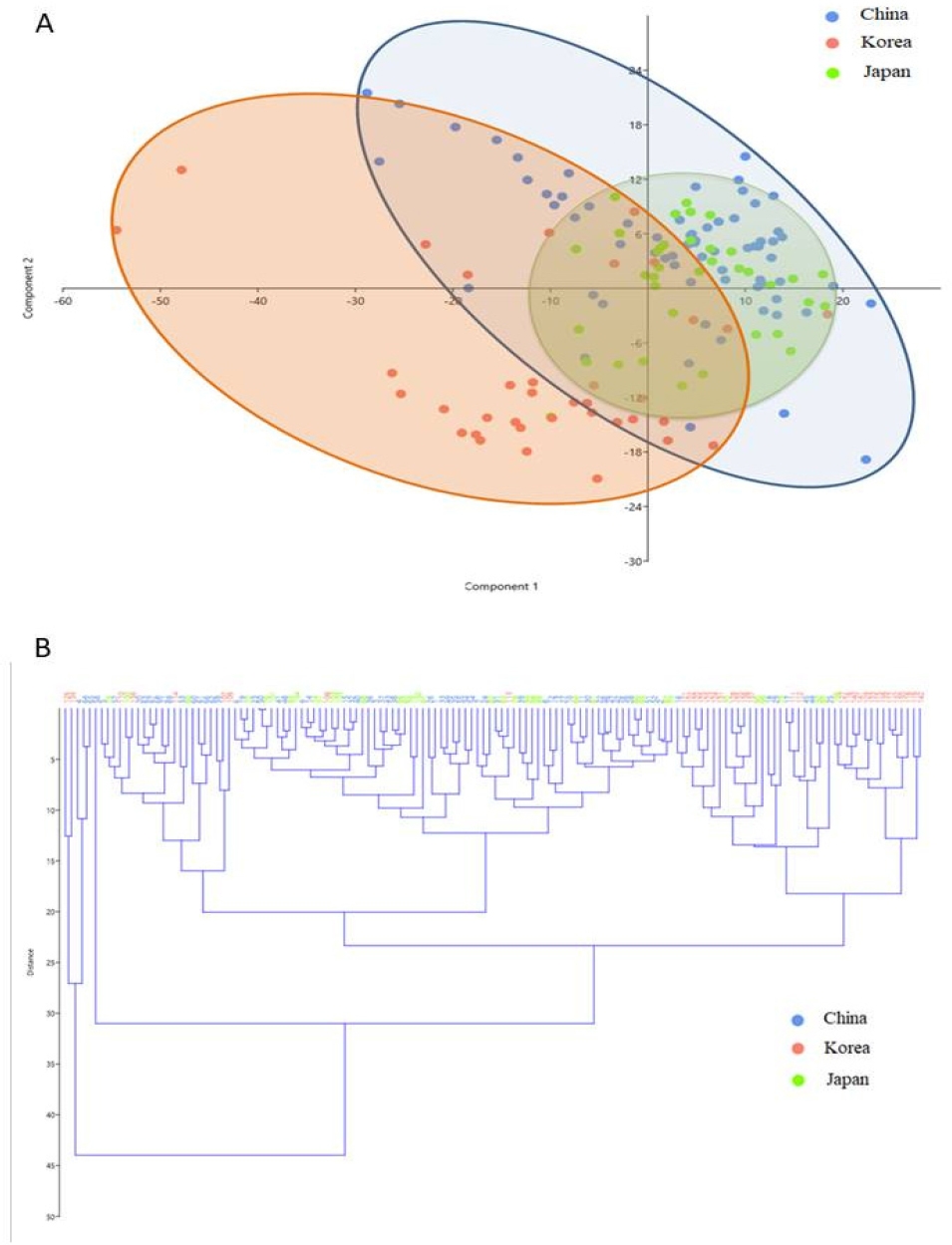
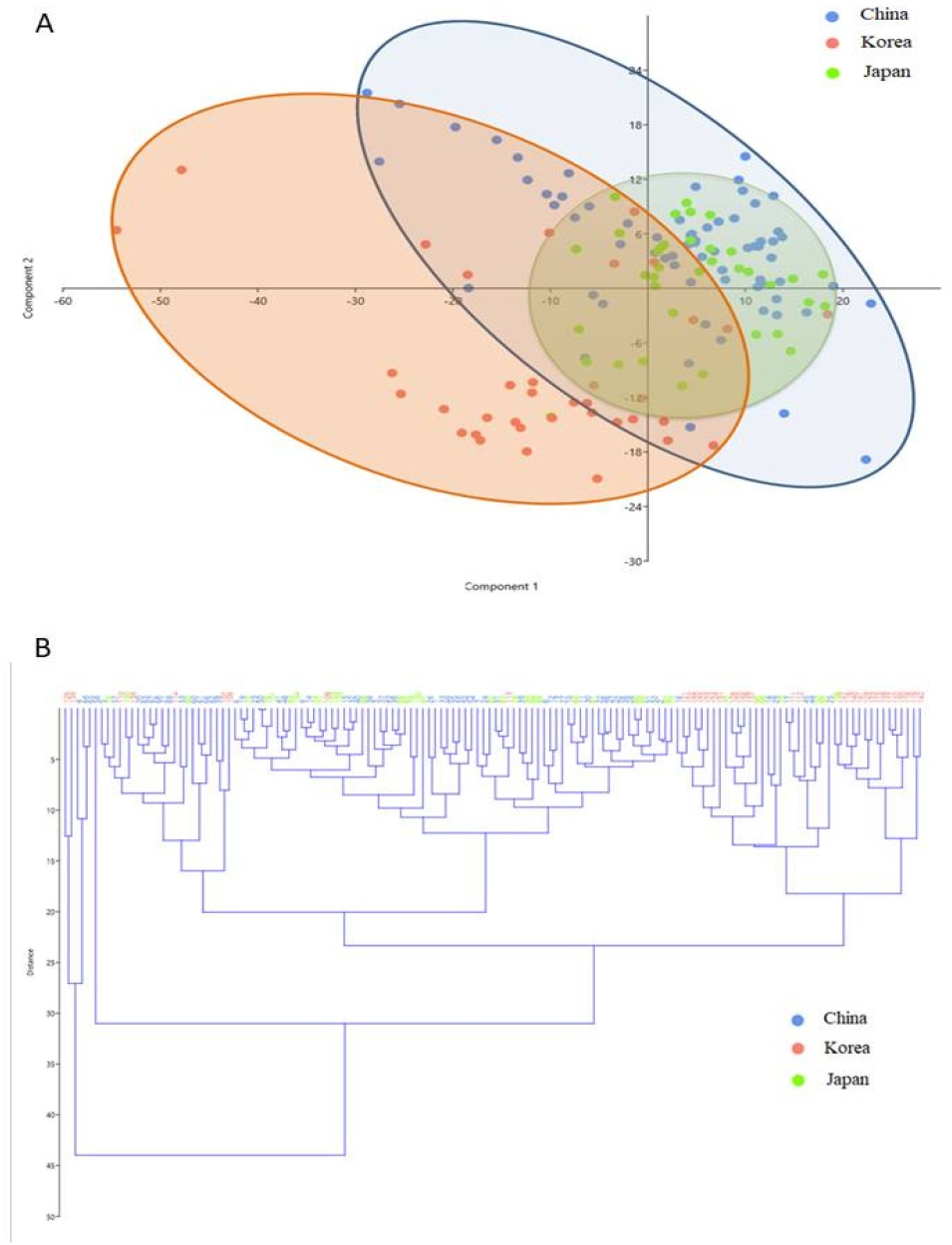
재배적 주요형질 중 양적 형질(출수기, 성숙기, 간장, 수장, 백립중)을 이용한 주성분 분석 결과, 한국원산 자원과 중국원산 자원간 분산의 차이가 크고, 일본원산 자원은 중간적 성격으로 변이의 폭이 넓지 않고, 중국원산 자원과 중복되는 경향을 보였다. 한국원산 자원은 중국⋅일본원산 자원에 비해 출수기와 성숙기가 10일 이상 빠르고, 간장과 수장이 특히 짧아 구분되는 특성을 보였는데, 이러한 특성상 두 원산지 자원과 겹치지 않는 부분이 많은 것으로 생각된다. 군집분석 결과도 주성분 분석 결과와 비슷한데, 한국원산 자원은 UPGMA tree상 같은 그룹에 속하는 자원이 많고, 중국과 일본 자원은 섞여 있는 경향을 보였다(
Fig. 2). 이는 중국과 일본원산 자원의 경우 품종이나 육성계통의 비율이 높아 근거리간 일반적으로 요구되는 평균적인 형질을 보이는 자원이 많은 반면, 한국원산 자원의 경우 현지 수집된 자원이 많아 서로 구분되는 형질이 많을 것으로 판단된다.
Fig. 2Result of PCA (A) and cluster (B) analysis by origins using major agronomic traits including heading date, maturing date, stem height, ear length, and 100 seed weight.
주요 유용성분 평가
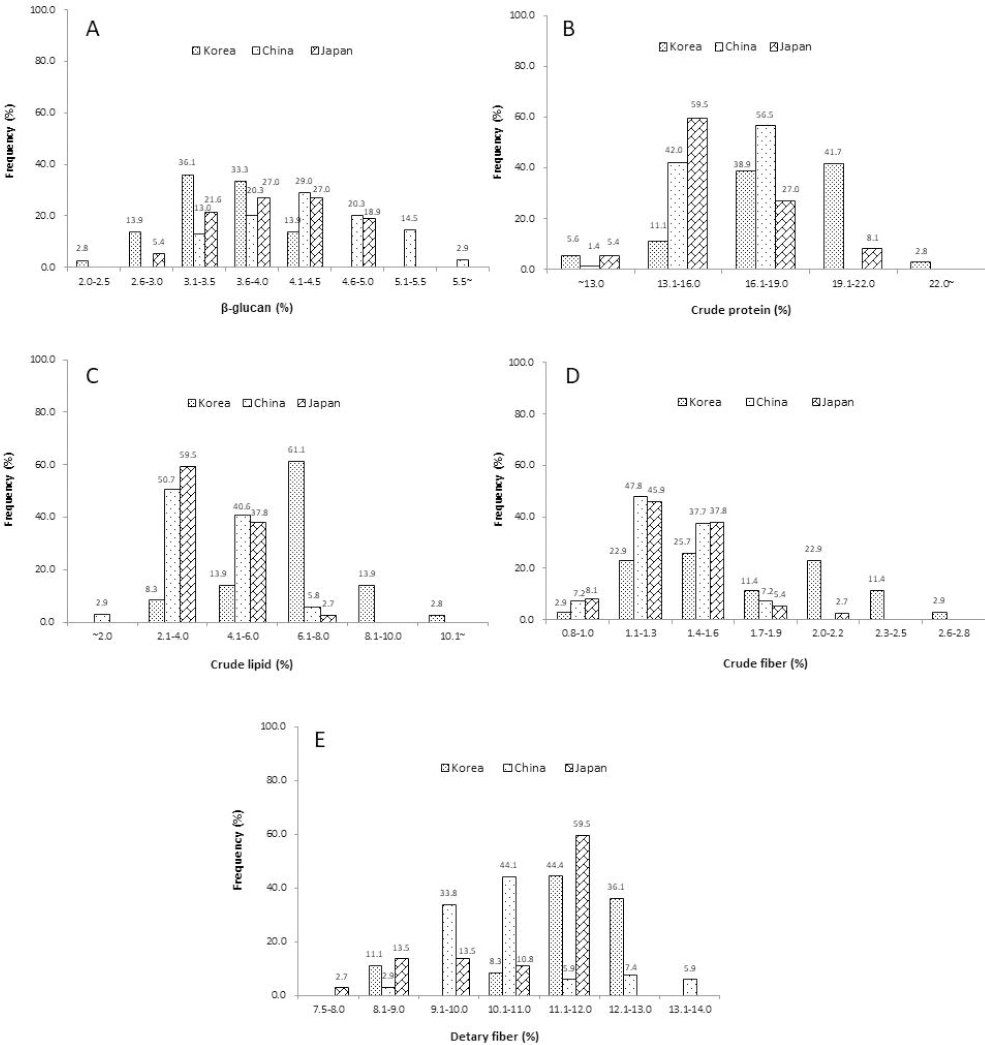
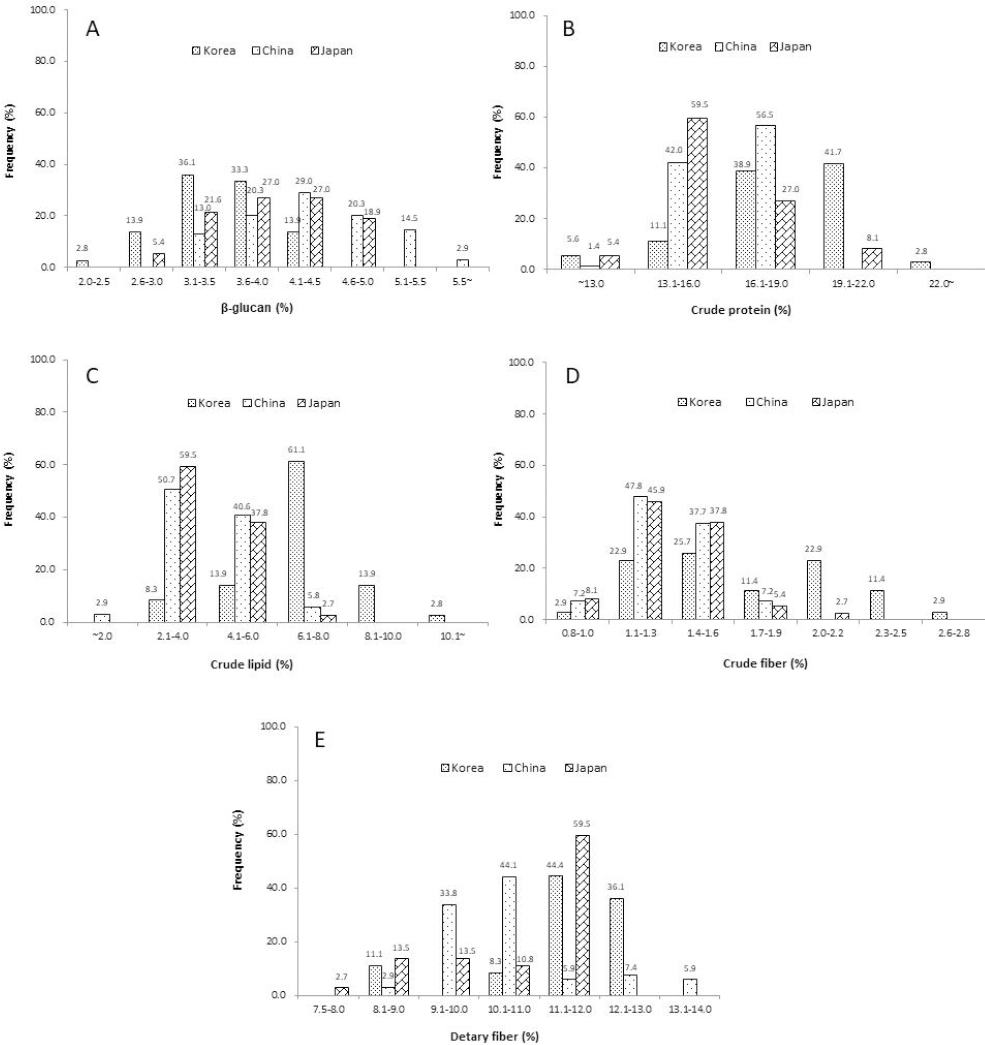
본 연구에서 전체 한⋅중⋅일 귀리 자원의 베타글루칸 분포는 최저 2.3%부터 최고 5.7%까지였다. 중국원산 자원(4.3±0.6%)은 한국원산 자원(3.5±2.3%)과 일본원산 자원(4.0±0.6%)에 비해 유의미하게 높은 경향을 보였으나 한국과 일본원산 자원간 유의미한 차이는 없었다. 단백질 함량의 경우 11.6%에서 22.9%의 분포를 보였고, 한국(18.6±2.8%), 중국(16.1±1.4%), 일본(15.6± 1.7%) 순으로 한국원산 자원이 중국과 일본원산 자원에 비해 높은 경향을 보였다. 조지방 함량은 1.4%에서 12.0%의 분포를 보였다. 조지방 평균함량 역시 한국(6.8±0.2%), 중국(4.1±0.2%), 일본(4.0±0.1%)원산 자원 순으로, 한국원산 자원이 중국과 일본원산 자원에 비해 높은 함량을 보였다. 조섬유 함량은 0.8%에서 2.7%까지의 분포를 보였다. 한국원산 자원(1.8±0.05%)의 조섬유 함량이 중국(1.3±0.03%)이나 일본(1.3±0.05%)원산 자원보다 유의적으로 높았다. 식이섬유는 최저7.9%에서 최고 13.9%까지 분포하였으며, 중국(10.9±1.2%)과 일본(10.9±1.5%)원산 자원이 한국(10.6±1.0%)원산 자원보다 약간 높은 경향을 보였으나 유의적인 차이는 나지 않았다(
Table 4). 본 연구에서는 한국원산 자원이 조단백, 조지방, 조섬유 함량이 중국, 일본원산 자원에 비해 유의적으로 높은 경향을 보였고, 중국 원산 자원은 베타글루칸이 높은 경향을 보였다(
Fig. 3).
Table 4Mean values and ranges of five main ingredients of the oat germplasms by origins in this study.
Table 4
|
Origin |
β-glucan (%) |
Crude protein (%) |
Crude lipid (%) |
Crude fiber (%) |
Dietary fiber (%) |
|
Korea |
Range |
2.3~4.2 |
11.6~22.9 |
2.9~12.0 |
1.0~2.7 |
8.4~12.6 |
|
Average |
3.5±0.1b
z
|
18.6±0.3a |
6.8±0.2a |
1.8±0.05a |
10.5±0.2 |
|
|
China |
Range |
3.2~5.7 |
12.5~19.0 |
1.4~6.5 |
0.8~1.8 |
7.9~13.9 |
|
Average |
4.3±0.1a |
16.1±0.2b |
4.1±0.2b |
1.3±0.03b |
10.9±0.2 |
|
|
Japan |
Range |
2.7~4.9 |
12.4~19.4 |
2.6~6.2 |
1.0~2.0 |
8.1~13.7 |
|
Average |
4.0±0.1b |
15.6±0.3b |
4.0±0.1b |
1.3±0.05b |
10.9±0.2 |
|
|
Total |
Range |
2.3~5.7 |
11.6~22.9 |
1.4~12.0 |
0.8~2.7 |
7.9~13.9 |
|
Average |
4.0±0.7 |
16.6±2.2 |
4.7±1.7 |
1.4±0.3 |
10.8±1.3 |
Fig. 3Distribution of bio-chemical ingredients of oat germplasms by origins. β-glucan (A), crude protein (B), crude lipid (C), crude fiber (D), and dietary fiber (E).
본 연구에서는 지리환경적으로 비교적 근접하여 유사성이 높을 것으로 추정되는 한⋅중⋅일 원산의 유전자원이라도, 삼한 등 국내 주요 귀리 육성품종들의 주요 성분 함량 분포에 비해서는(
Lee et al. 2016), 대체로 훨씬 넓은 범위를 보였다(
Table 5). 베타글루칸이나 조숙성 등 주요형질은 재배요인보다 품종간 유전적 차이에 기인하는 바가 크다고 알려져 있는 등(
Lee et al. 2016), 유전적 차이는 육종에 있어 매우 중요하다. 따라서 귀리 기능성 육종에 있어 품종에 비해 다양한 형질을 지니는 유전 자원을 평가 선발하여, 다양한 육종소재를 발굴하고 활용하는 것이 필수적일 것이다.
Table 5Comparison of ranges and mean value of main ingredients between Korean oat cultivars and the genetic resources.
Table 5
|
Ingredients |
Korean cultivar (Lee et al. 2016) |
Standard cultivars in this study |
Oat germplasms in this study |
|
|
Samhan |
Joyang |
|
β-glucan (%) |
3.4~4.1 |
3.8 |
3.5 |
2.3~5.7 (average 4.0) |
|
Crude protein (%) |
11.6~16.9 |
15.7 |
12.9 |
11.6~22.9 (average 16.6) |
|
Crude lipid (%) |
5.5~10.0 |
4.5 |
7.1 |
1.4~12.0 (average 4.8) |
|
Crude fiber (%) |
1.2~1.5 |
1.1 |
0.8 |
0.8~2.7 (average 1.4) |
|
Dietary fiber (%) |
13.2~20.7 |
8.9 |
8.1 |
7.9~13.9 (average 10.6) |
유용자원 선발
농업적 형질의 경우 국내작부체계 특성상 조숙이 선호되는 바, 파종부터 성숙까지 100일이하로 소요되는 조숙성 자원으로 IT1551107 등 7자원을 선발하였다. 이는 본 연구에서 대조구로 사용된 국내육종품종보다 짧은 성숙기간을 가지는 것으로 국내작부체계상 선호될 것으로 기대된다. 그 외 다양한 육종목적에 따라 농업적 재배특성에 대해 간장이 짧거나(50 cm 이하) 긴(110 cm 이상) 자원, 수장이 짧거나(10 cm 이하) 긴(35 cm 이상) 자원을 선발하였고, 유색자원 중 특히 안토시아닌 함량이 높을 것으로 기대되는 흑색자원을 선발하였다(
Table 6).
Table 6Selected oat germplasm with useful characteristics in this study.
Table 6
|
Traits |
Characteristics |
Selected accession number |
|
Early maturity |
Early matured (below 100 days) |
IT1551104, IT151106, IT151107, IT151108, IT166581, IT166582, IT166583 |
|
Stem height |
Shortest (below 50 cm) |
IT166576, IT166586 |
|
Longest (over 110 cm) |
IT128791, IT166568 |
|
Ear length |
Shortest (below 10 cm) |
IT166576 |
|
Longest (over 35 cm) |
IT127402, IT129992 |
|
Outer glum color |
Black |
IT162928 |
|
β-glucan |
High contents (over 5.5%) |
IT129798, IT129802 |
|
Crude protein |
High contents (over 22.0%) |
IT166597, IT166594 |
|
Crude lipid |
High contents (over 7.0%) |
IT166581, IT166584 |
|
Crude fiber |
High contents (over 2.5%) |
IT151108, IT166574 |
|
Dietary fiber |
High contents (over 13.0%) |
IT129798, IT128232, IT133645, IT128108 |
각 함량별로 가장 높은 자원의 경우, 베타글루칸 함량이 가장 높은 자원은 중국원산의 IT129802(5.7%), 조단백⋅조지방 함량이 가장 높은 자원은 각각 한국원산의 IT166594(22.9%)와 한국원산의 IT166584(12.0%), 조섬유⋅식이섬유 함량이 가장 높은 자원은 각각 한국원산의 IT151108(2.7%)과 중국원산의 IT129798 (13.9%)이었다. 이들 최고함량 자원들 외에도 성분별로 일정함량 이상 되는 유용한 자원들을 2-4점씩 각각 선발하였다(
Table 6). 이처럼 특이형질이나 각 주요성분별로 높은 함량을 가진 자원의 경우 귀리를 활용한 식품기능성 육종 소재로 제공하여 유전자원 활용도를 높이고, 육종효율을 향상시키는데 유용할 것이다. 향후 본 연구에서 분석된 한⋅중⋅일 원산 자원뿐 아니라 기타 다양한 원산지 자원을 대량 분석하여 뛰어난 형질을 지닌 자원에 대한 지속적인 선발을 실시하여 여러 목적의 기능성 소재로 유용하게 활용할 필요가 있을 것이다.
적 요
본 연구는 농촌진흥청 농업유전자원센터가 보유하고 있는 귀리 유전자원 중 한⋅중⋅일 원산 142자원을 대상으로 농업형태적 특성을 조사하고, 베타글루칸을 비롯한 주요 영양⋅기능성 성분에 대한 분석을 실시하였다. 이를 바탕으로 원산지별로 비교분석하고, 기능성 귀리품종 육성재료로 우수한 자원을 선발하였다. 결과는 다음과 같다. 한⋅중⋅일 자원의 주요농업특성 중 출수기⋅성숙기의 경우, 본 연구에서는 안전월동을 위해 3월 10일 춘파를 실시하였는데, 대부분 한국품종인 대조품종의 경우 5월 하순 출수, 6월 하순 성숙하였으나, 유전자원의 경우는 성숙이 늦어 81% 이상의 자원이 7월 상순 이후 성숙하였다. 따라서 춘파시 중북부 지역에서는 장마 이전 수확이 불가능하고 답리작 재배도 어려울 것으로 예상된다. 원산지별로는 한국원산 자원(출수 소요일수: 82일, 성숙 소요일수: 107일)이 중국(92일, 119일)이나 일본(94일, 117일)원산 자원에 비해 출수와 성숙에서 평균 10일 이상 빠른 경향을 보였다. IT1551107 등 파종에서 성숙까지 100일 이내로 소요되는 극조숙자원 7점 또한 모두 한국원산 자원으로 이들은 대조품종보다 오히려 성숙이 빨라 작부체계상 이점이 있을 것으로 기대되었다. 그 외 주요 재배특성에 있어서도 한국원산 자원은 중국 및 일본원산 자원과 구분되는 경향을 보이는데, 한국원산 자원의 간장⋅수장은 중국이나 일본원산 자원에 비해 짧은 편이었고, 종피색에 있어서도 전체 자원의 79%가 황색을 가진 반면, 한국원산 자원은 갈색 자원이 28%에 이르러 유색자원이 많았다. 백립중의 경우 중국원산 자원의 분포범위가 넓고(1.8~ 4.2 g), 평균적으로 일본원산 자원(2.8 g)이 한국(2.6 g)과 중국원산 자원(2.6 g)에 비해 약간 무거운 경향을 보였으나 큰 차이는 나지 않았다. 출수기, 성숙기, 간장, 수장, 백립중, 종피색 등 주요 재배형질 조사결과를 이용하여 주성분 분석을 실시한 결과, 한국원산 자원과 중국원산 자원간 차이가 크고, 일본원산 자원은 중간적 성격으로 변이 폭이 넓지 않고, 다수의 자원이 중국원산 자원과 중복되는 경향을 보였다. 군집분석 결과도 이와 비슷한 경향을 보였는데, 한국원산 자원은 중국과 일본 원산의 주요 그룹과는 구분되는 특성을 보였다. 이는 중국과 일본원산 자원이 품종과 육성계통이 많아 일반적으로 요구되는 평균적 형질을 보이는 자원이 많은 반면, 한국원산 자원은 94%의 자원이 수집된 재래종 자원으로 그 형질이 구분될 것으로 판단되었다. 한⋅중⋅일 자원의 주요성분특성의 경우, 베타 글루칸은 중국원산 자원(4.3%)이 한국(3.5%)이나 일본원산 자원(4.0%)에 비해 유의적으로 높은 평균함량을 보였으나, 그 외 조단백, 조지방, 조섬유 함량은 모두 한국원산 자원(조단백18.6%, 조지방6.8%, 조섬유1.8%)이 중국(16.1%, 4.1%, 1.3%)이나 일본원산 자원(15.6%, 4.0%, 1.3%)에 비해 높은 경향을 보였다. 식이섬유의 경우 중국(10.9%)과 일본원산 자원(10.9%)이 한국원산 자원(10.5%)보다 약간 높은 경향을 보였으나 유의미한 차이는 없었다. 또한 이들 유전자원은 대체로 기존 주요 한국품종이 가지는 주요성분의 분포범위보다 넓은 분포를 보여 다양성이 높았다. 귀리의 주요 기능성 성분인 베타 글루칸은 특히 재배요인보다 유전적 요인이 크다고 알려져 있어, 다양성이 높은 유전자원을 육종에 활용하는 것이 효율적일 것으로 생각된다. 이러한 농업재배특성과 주요성분 분석결과를 활용하여 유용한 자원을 선발하였는데, 농업재배특성에 있어서는 성숙소요일수가 100일 이하의 조숙자원(IT151107 등)과 간장⋅수장이 특히 길거나 짧은 자원(IT166576 등), 그리고 유색자원 중 특히 안토시아닌 함량이 높을 것으로 기대되는 흑색자원(IT162928)등 15점을 선발하였다. 또한 주요성분에 있어서는 베타글루칸이 가장 높은 IT129802, 조단백 함량이 가장 높은 IT166594, 조지방함량이 가장 높은 IT166584, 조섬유 함량이 가장 높은 IT151108과 식이섬유 함량이 가장 높은 IT129798 등을 비롯하여 고함량 자원 총 12점을 선발하였다. 이러한 특이형질을 지닌 유용자원들은 향후 다양한 목적의 기능성 육종소재로서 활용가능성이 높을 것으로 기대된다.
사 사
본 연구는 농촌진흥청 농업과학기술연구 개발사업(과제번호: PJ012478)의 지원에 의해 이루어졌습니다.
References
- 1. Anderson OD. 2014. The spectrum of major seed storage genes and proteins in oats (Avena sativa). PLoS ONE 9: e83569
- 2. Banaś A, Debski H, Banaś W, Heneen WK, Dahlqvist A, Bafor M, Gummeson P-O, Marttila S, Ekman Å, Carlsson AS, Stymne S. 2007. Lipids in grain tissues of oat (Avena sativa): differences in content, time of deposition, and fatty acid composition. J Exp Bot 58: 2463-2470.
- 3. Carpita NC. 1996. Structure and biogenesis of the cell walls of grasses. Annu Rev Plant Physiol Plant Mol Biol 47: 445-476.
- 4. Chu YF. 2014. Oats Nutrition and Technology. Wiley Blackwell, Oxford, UK.
- 5. Daou C, Zhang H. 2012. Oat beta-glucan: its role in health promotion and prevention of diseases. Compr Rev Food Sci Food Saf 11: 355-365.
- 6. FAO.2004. World food and agriculture. Statistical Yearbook 2004. UNFAO, Rome, Italy.
- 7. Fincher GB. 2009. Revolutionary times in our understanding of cell wall biosynthesis and remodeling in the grasses. Plant Physiol 149: 27-37.
- 8. Gell G, Kovács K, Veres G, Korponay-Szabó IR, Juhász A. 2017. Characterization of globulin storage proteins of a low prolamin cereal species in relation to celiac disease. Sci Rep 7: 1-10.
- 9. Giuberti G, Gallo A, Masoero F. 2011. A comparison of methods to quantify prolamin contents in cereals. Ital J Anim Sci 10: 7-13.
- 10. Gorash A, Armonienė R, Mitchell-Fetch J, Liatukas Z, Danytė V. 2017. Aspects in oat breeding: nutrition quality, nakedness and disease resistance, challenges and perspectives. Ann Appl Biol 171: 281-302.
- 11. Hackett R. 2018. A comparison of husked and naked oats under Irish conditions. Irish J Agr Food Res 57: 1-8.
- 12. Hammer Ø, Harper DAT, Ryan PD. 2001. Past: paleontological statistics software package for education and data analysis. Palaeontol Electron 4: 1-9.
- 13. Han OK, Park TI, Park HH, Park KH, Oh YJ, Kim KJ, Song TH, Jang YJ, Kim DH, Hwang JJ, Kwon YU. 2014. “Suynag”A new naked oat cultivar with early-heading and high yielding. Korean J Breed Sci 46: 323-327.
- 14. Hu X, Zhao J, Zhao Q, Zheng J. 2015. Structure and characteristic of β-glucan in cereal: a review. J Food Process Preserv 39: 3145-3153.
- 15. Kassambara A, Mundt F. 2017. Package ‘factoextra’: Extract and visualize the results of multivariate data analyses.
https://cran.r-project.org/web/packages/factoextra/factoextra.pdf
- 16. Lee YY, Ham H, Park HH, Kim YK, Lee Mj, Han OK, Kim YH, Park HM, Lee B, Park JY, Sim EY, Lee C, Kim WH. 2016. The physicochemical properties and dietary fiber contents in naked and hulled Korean out cultivars. Korean J Breed Sci 48: 37-47.
- 17. Leonova S. 2013. Lipids in seeds of oat (Avena spp.), a potential oil cropDoctoral Thesis. Swedish University of Agricultural Sciences.
- 18. McGraw-Hill C. 2008. Statistix ver. 8.1 (Analytical Software, Tallahassee, Florida). Maurice/Thomas text.
- 19. Nei M. 1973. Analysis of gene diversity in subdivided populations. Proc Natl Acad Sci 70: 3321-3323.
- 20. NICS (National Institute of Crop Science)2009. Manual of quality analysis for crop. National Institute of Crop Science.
- 21. Premkumar R, Nirmalakumari A, Anandakumar CR. 2017. Germplasm characterization for biochemical parameters in oats (Avena sativa L.). Int J Pure App Biosci 5: 68-72.
- 22. Rasane P, Jha A, Sabikhi L, Kumar A, Unnikrishnan VS. 2013. Nutritional advantages of oats and opportunities for its processing as value added foods - a review. J Food Sci Technol 52: 662-675.
- 23. RStudio Team. 2015. RStudio: Integrated development for R. RStudio, Inc, Boston, MA, URL http://www.rstudio.com
- 24. Saastamoinen M, Kumpulainen J, Nummela S. 1989. Genetic and environmental variation in oil content and fatty acid composition of oats. Cereal Chem 66: 296-300.
- 25. Tomé D, Bos C. 2007. Lysine requirement through the human life cycle. J Nutr 137: 1642S-1645S.
- 26. USDA. 2017. World agricultural production. Online available at http://usda.mannlib.cornell.edu/usda/fas/worldag-production/2010s/2017/worldag-production-09-12-2017.pdf
- 27. Wang Q, Ellis PR. 2014. Oat β-glucan: Physico-chemical characteristics in relation to its blood-glucose and cholesterol- lowering properties. British J Nutr 112: S4-S13.
- 28. Winkler LR, Michael-Bonman J, Chao S, Admassu-Yimer B, Bockelman H, Esvelt K. 2016. Population structure and genotype–phenotype associations in a collection of oat landraces and historic cultivars. Front Plant Sci 7: 1-15.
- 29. Yu S, Tian L. 2018. Breeding major cereal grains through the lens of nutrition sensitivity. Mol Plant 11: 23-30.
- 30. RDA2005. Textbook of standard farming.
- 31. RDA NICS (National Institute of Crop Science). 2013. The cultivation manual of edible oat
- 32. RDA NAS (National Institute of Agricultural Science)2006. Manual on investigation of characteristics and management of genetic resources: wheat.