적요
‘Shingil’ was developed as a processing rice for specialization as a rice flour by means of mutation breeding from ‘Hanareum’ MNU (N-methyl N-nitrosourea) treatment. The bulk population was displayed from M1 to M6, followed by pedigree methods from M7, where line selection was carried out based on the amylose content, with opacity in the endosperm. The result was that ‘Milyang317’, which has a somewhat high amylose content as well as a high ratio of starch opacity, was selected and named as ‘Shingil’ in 2017. ‘Shingil’ is a mid-maturing ecotype with a heading date of August 10, showing resistance to both leaf/panicle blast and rice stripe virus (RSV), but susceptibility to Bph. ‘Shingil’ showed a low viviparous germination rate of 5.2%. The yield capacity of ‘Shingil’ was 745kg/10a over two years based on a regional yield test. The amylose content of ‘Shingil’ is 23.4% with the grain showing opacity in most parts of the endosperm, which is caused by the round particle shape, unlike the polygonal shape of ordinary grains. Thus, ‘Shingil’ could be used as a rice flour source in various processing field and dry milling industries where milling costs could be saved (Registration No. 8019).
서 언
최근 인구구조와 식습관 변화로 쌀 소비 패러다임이 밥쌀에서 가공용으로 급격히 전환되고있다. 그 중 도시락 등 가공밥류 중심으로 시장규모가 급성장하고 있으나(
KOSTAT 2020) 가공 용도별 적합 품종 개발은 아밀로스 함량 조절(
Cho et al. 2018,
2019) 이나, 쌀가루 전용 품종 개발(
Mo et al. 2013,
Won et al. 2019,
2020) 등에 한정되어 있고, 가공 원료곡 원가절감을 위한 초다수성 품종을 이용한 가공특성 연구(
Kim 2020,
Lee & Ha 2015,
Sim et al. 2019) 등이 일부 제한적으로 보고되고 있다. 현재 국내에서 소비되는 가공용쌀의 70%가 쌀가루 형태로 이용되고 있으나 대부분 반습식 분쇄형태의 자가제분으로 소비되고 있어(
Foodnews 2017) 쌀 가공산업 활성화를 위한 쌀가루 품종개발 및 제분산업에 대한 기반 구축이 필요하다. 쌀가루 관련 연구는 다양한 제분기(
Kum et al. 1993,
Park et al. 1988), 습식 및 건식 제분방법(
Jitranut & Jirarat 2016,
Jun et al. 2008,
Lee & Lee 2006,
Park et al. 2017) 등에 따른 쌀가루의 이화학적 및 물리화학적 특성이나 쌀빵 등 가공품의 특성을 분석한 연구들이 보고 되었다. 일반적으로 건식제분에 비하여 습식분쇄 시 전분의 크기 및 손상 전분이 적으며 수분 흡수력 및 부품성 등 가공 적성이 우수한 것으로 보고되고 있다. 그러나 습식분쇄는 분쇄 과정이 복잡하고 비용이 많이 소요되어(
Kim & Song 2017) 일반화 되지 못하고, 따라서 소규모 쌀 가공업체에서는 반습식 분쇄를 이용한 자가 분쇄를 이용하는 것이 일반적이다. 반면, 건식분쇄의 경우 단백질이나 회분 등의 함량이 습식 분쇄에 비해 높은 경향이며(
Jitranut & Jirarat 2016,
Chen et al. 1999), 따라서 이러한 특성은 고 영양식 식품에 이용될 경우 장점으로 활용될 수 있다.
국내에서도 쌀가루를 이용한 다양한 가공 특성이 연구되었는데 쌀가루 입자가 미세 할수록 쌀빵의 품질 및 관능평가에서 우수한 결과를 보였다(
Park et al. 2008). 또한 품종별 쌀가루의 입자 크기에 따른 품질특성에서 쌀가루 입자가 작을수록 수분 흡수력 등이 우수하였으며(
Shin et al. 2017), 막걸리 함량에 따른 건식쌀가루의 막편 품질 특성(
Jo & Yoon 2016) 등이 보고되었다. 특히 증편의 경우 습식분쇄 시 일반적인 특성은 양호하였으나 적당한 수분을 첨가할 경우 건식(pin-mill) 제분에서도 우수한 품질의 증편을 만들 수 있다고 보고하여(
Kim et al. 1995), 건식분쇄 쌀가루를 최적의 가공기술과 접목할 경우 쌀가루 분쇄 비용을 크게 절감하면서 고품질의 쌀가공품 제조가 가능한 것으로 판단된다. 한편 아밀로스 함량이 높은 쌀가루는 쌀국수 가공에 적합한 것으로 보고되었으며(
Baek & Koh 2014,
Seo et al. 2011), 효소처리 쌀가루를 이용한 쌀 쿠키 품질 특성 등이 연구된 바 있다.
따라서 다양한 가공식품의 소재인 원료곡의 원가절감 및 분쇄 가공비를 함께 절감할 수 있는 초다수성 건식제분 전용품종의 개발과 함께 최적의 가공 용도에 적합한 가공기술 개발이 시급한 실정이다. 본 연구에서는 아밀로스 함량이 밥쌀용 보다 높으며 분상질 비율이 높아 건식제분이 가능한 쌀가루 전용품종 ‘신길’을 개발한 결과를 보고하고자 한다.
재료 및 방법
시험재료, 재배방법 및 주요 농업 형질 조사
쌀가루 전용품종 ‘신길’ 육성을 위해 중생이며 초다수성 통일형벼 ‘한아름’벼에 MNU (N-methyl N-nitrosourea) 돌연변이를 유기하여 분상질 비율이 높고 아밀로스 함량이 높은 우량 계통을 선발하였다. 생산력검정시험은 2014년부터 2015년까지 국립식량과학원 남부작물부 시험포장(밀양)에서 초다수성 벼 표준 재배법에 따라 수행하였다. 지역적응시험은 2016년부터 2017년까지 2개년 동안 국립식량과학원 전주 및 밀양 등 영호남평야지 3개소에서 수행하였고, 표준품종 으로는 ‘다산’을 공시하였다. 각 시험지별 재배방법은 4월 30일 파종하여 30일간 육묘한 후 5월 30일에 30×12 cm의 재식 거리로 주당 5본씩 이앙하고, 시비량은 N-P
2O
5-K
2O=18-9-11 kg/10a로 재배하였다. 그 밖의 재배관리와 품종 육성을 위한 주요 농업적 특성, 수량특성, 생리장해 및 병해충 저항성, 그리고 품질관련 분석 조사는 농촌진흥청 신품종개발공동연구사업 과제수행계획서(
RDA 2017a,
2017b) 조사기준에 준하여 실시하였다. 주요 농업적 형질에 대한 평균을 기술 통계법으로 구하였고, PROC
t-test를 이용 표준 품종과 비교하였다.
내냉성 검정은 국립식량과학원 춘천출장소 내냉성 검정 시험포장에서 실시하였다. 이앙 후 20일부터 등숙기까지 수온 17℃, 수심 5 cm로 냉수를 처리한 후 적고, 출수 지연일 및 임실률 등을 조사하였다. 유묘 내냉성 검정은 3엽기부터 수온 13℃로 10일간 처리하여 1~9의 등급(1: 엽색 농록, 3: 엽 선단부 담록, 5: 1/3 엽색황변, 7: 2/3 엽색 갈변, 9: 고사)으로 구분하였다. 수발아 검정을 위하여 출수 후 40일에 주간에서 3이삭을 채취하여 25℃ 포화습도에서 7일간 치상 후 발아율을 조사하여 측정하였다.
주요 병해충 저항성 검정
잎도열병 저항성 검정은 국립식량과학원, 도농업기술원 등 전국 12개 지역에서 질소다비(N-P2O5-K2O=240-80-120 kg/ha) 조건의 밭못자리 상태로 6월 하순에서 7월 상순에 늦게 파종하는 밭못자리 검정법을 이용하였다. 발병 최성기인 파종 후 30일 이후에 병반의 크기에 따라 0~9 단계로 구분하였다. 이삭도열병 포장저항성 검정은 익산, 밀양, 이천, 및 진주 포장에서 잎도열병 검정에서와 같이 질소다비 조건으로 이앙재배하여 출수 후 30~35일 경에 건전 이삭과 이병 이삭의 비율로 발병 정도를 측정하였다. 벼줄무늬잎마름병, 오갈병 및 검은줄오갈병 등 바이러스 저항성검정은 보독충이 충분히 유지된 망실에 검정 계통을 파종 후 이병성 품종인 ‘추청’이 병징을 나타낼 때 저항성과 감수성으로 판정하였다. 벼멸구 및 애멸구 저항성 검정은 파종 후 본엽 2~3엽기에 벼멸구와 애멸구를 접종하여 감수성 대비 품종인 ‘추청’이 고사한 후에 검정 계통을 저항성과 감수성으로 판정하였다.
쌀알의 품질 및 이화학적 특성 검정
정조 및 현미 장폭비는 현미 20립을 이용 캘리퍼스(Caliper CD-15CP, Mitutoyo Corp. Japan)를 이용하여 너비에 대한 길이의 비율로 계산하였다. 투명도는 백미 20립을 1~9 등급(1: 쌀이 유리알 같이 맑은 것, 5: 중간, 9: 불투명)으로 구분 하였다. 알칼리붕괴도는 백미 6립을 1.4% KOH 용액에 침지 후 30℃ 항온기에서 23시간 정치 후 1~7 등급으로 구분하였다.
단백질 함량은
AOAC (2000) 방법에 의하여 Micro-Kjeldahl법으로 자동단백질 분석기(2300 Kjeltec Analyzer, Foss, australia)를 이용하여 측정하였고, 아밀로스함량은
Juliano (1985)의 비색정량법에 따랐다. 시료 100 mg에 95% 에탄올과 1N sodium hydroxide를 가한 후 호화시킨 전분 호화액에 1N acetic acid와 2% I
2-KI 용액을 첨가하여 요오드 정색반응 후 분광광도계를 이용하여 620 nm의 파장에서 흡광도를 측정하였다.
건식 쌀가루를 이용한 쌀라면(컵라면) 제조 및 품질 특성 분석을 위하여 쌀가루 전용품종인 ‘한가루’ 및 ‘신길’ 품종을 이용 쌀가루 입도가 120 mesh 이하로 건식분쇄를 하였다(신안상사). 쌀라면 제조는 쌀가루 함량이 30%가 되도록 하였으며 감자전분, 글루텐, 변성전분, 소금, 팜유, 기타 첨가제를 첨가하였고, 증숙 온도는 100℃, 튀김의 유탕 온도는 155℃로 하였다(㈜ 새롬식품). 컵라면의 요리 전 특성은 건 면발의 경도, 아밀로그램(RVA) 및 아밀로스 함량을 조사하였으며, 끓는 물에 4분 요리 후 특성으로는 면의 굵기, 물성 및 색도를 분석 하였고, 관능검정(22명)을 통하여 면의 모양, 퍼짐성 및 질감 등 5항목을 조사하였다.
결과 및 고찰
육성경위
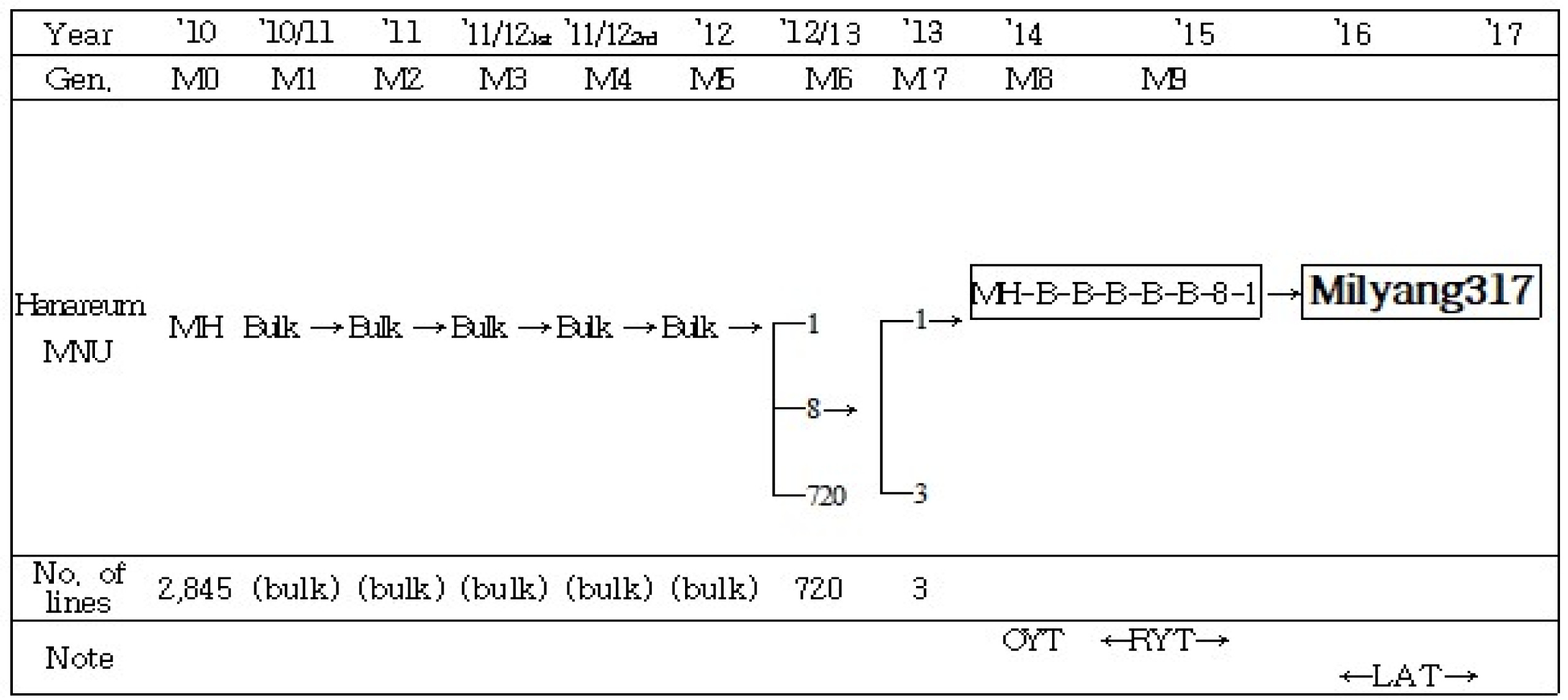
쌀가루 전용품종 ‘신길’은 가공용 원료곡의 원가절감 및 제분 비용절감을 위하여 초다수성 벼 ‘한아름’벼를 이용 돌연변이 처리를 하여 육성한 품종이다. 2010년 MNU 처리 하루 전 개화기에 있는 ‘한아름’ 벼 식물체를 포트에 옮긴 후 처리 전일 까지 개화한 모든 영을 제거한 다음 처리 당일 개화한 영만 남기고 나머지 모든 영화를 제거하였다. 암실에서 1.0 mM 농도의 MNU 용액에 벼의 이삭 부위를 1시간정도 침지 한 후 흐르는 수돗물에 24시간 동안 씻은 후(
Choi 2006) 온실에서 M
0 종자 2,845립을 확보하였다. 2010년 동계온실에서 M
0 종자를 파종한 후 2012년 M
5까지 집단으로 계통을 전개한 이후 초형이 양호하고 수량성을 확보한 개체 중 분상질률이 높은 변이개체들을 중심으로 M
7까지 계통육종법에 준하여 계통 선발한 다음, 최종적으로 아밀로스 함량이 높으며 배유의 70~80%가 opaque 처럼 불투명한 ‘밀양317호’를 선발하였다(
Figs. 1,
2). 2016~2017년 2년간 지역적응성 시험 보통기 다비재배에서 아밀로스 함량이 높으며 분상질률이 높아 건식제분이 용이한 가공 전용품종으로 인정되어 2017년 12월 농촌진흥청 농작물직무육성 신품종선정심의회에서 ‘신길’(
Fig. 3) 신품종으로 결정되었다.
‘신길’의 출수기는 영⋅호남 평야지 3개소 보통기 다비재배에서 8월 10일로 대비 품종인 ‘다산’ 보다 4일 정도 늦은 중생종의 출수 형태를 보였다. 간장은 81 cm로 ‘다산’ 보다 4 cm 정도 크고, 주당 수수는 15개로 ‘다산’ 보다 3개정도 많았다. 수당립수는 126개로 ‘다산’ 보다 13개 정도 많았으나 유의성은 인정되지 않았다. 등숙율은 84.3%로 ‘다산’의 80.2%보다 높았으며, 현미 천립중은 22.1 g으로 ‘다산’의 24.7 g에 비해 약 89.5% 정도로 낮았는데 이는 배유가 분상질이 높고 전분 조직이 느슨한 특성에 따른 것으로 판단되었다(
Table 1).
쌀가루 전용품종의 경우 배유 전분의 특성상 공극이 많은 형태로 인하여 수분 흡수율이 높기 때문에 쌀가루의 품질에 크게 영향을 끼치는 수발아가 크게 문제시 되는데,
Table 2에서와 같이 ‘신길’의 수발아율은 5.2%로 현재까지 육성된 일반계(
japonica) 계열의 쌀가루 전용품종 ‘한가루’(
Won et al. 2019) 나 ‘미시루’(
Won et al. 2020) 보다 수발아 저항성이 높아 고품질의 쌀가루 원료곡으로 적합한 품종임이 판단되었다. 내냉성 검정결과 성숙기 출수지연 일수는 대비 품종 ‘다산’ 보다 2일 정도 적었으나 등숙기 임실율은 28.5%로 ‘다산’ 보다 약한 편이었으며, 유묘기 및 성숙기 적고는 ‘다산’보다 약간 약한 반응을 보였다(
Table 2).
전국 12개소에서 실시한 잎도열병 밭못자리검정에서 ‘신길’은 평균 저항성정도가 1.0으로 강한 저항성을 보였으며, 목도열병 또한 포장검정에서 발생하지 않았다(
Table 3). 병해충 검정에서 ‘신길’은 흰잎마름병 K1 균주에 저항성을 보였고 그외 균주에는 감수성이었다. 바이러스병의 경우 줄무늬잎마름병에는 저항성이었으나 오갈병 및 검은줄오갈병에는 감수성이었으며, 해충 저항성 검정에서 애멸구에는 저항성이나 벼멸구에는 감수성 이었다(
Table 4).
쌀알 모양에서 ‘신길’의 현미 길이와 폭 및 두께는 ‘다산’ 보다 약간 적은 편이었으나 장폭비는 2.19로 ‘다산’과 같았으며, 일반계 쌀알에 비해 쌀알의 길이가 약간 긴 형태를 보였다(
Table 5). 이화학적 특성분석에서 ‘신길’의 단백질 함량은 7.3%로 ‘다산’ 보다 약간 높은 편이었으며, 알카리붕괴도는 6.8로 ‘다산’ 보다 호화가 잘 되는 편이었다. ‘신길’의 아밀로스 함량은 일반 밥쌀 보다는 높으나 제면 전용품종인 ‘새미면’(
Cho et al. 2018) 보다는 낮은 23.4%로 기존의 국내 육성 품종에서는 찾아볼 수 없는 아밀로스 함량을 보였다(
Table 6). 일반적으로 아밀로스 함량이 높은 계통들은 저항전분 등 기능성이 일부 보고되었는데(
Choi et al. 2006,
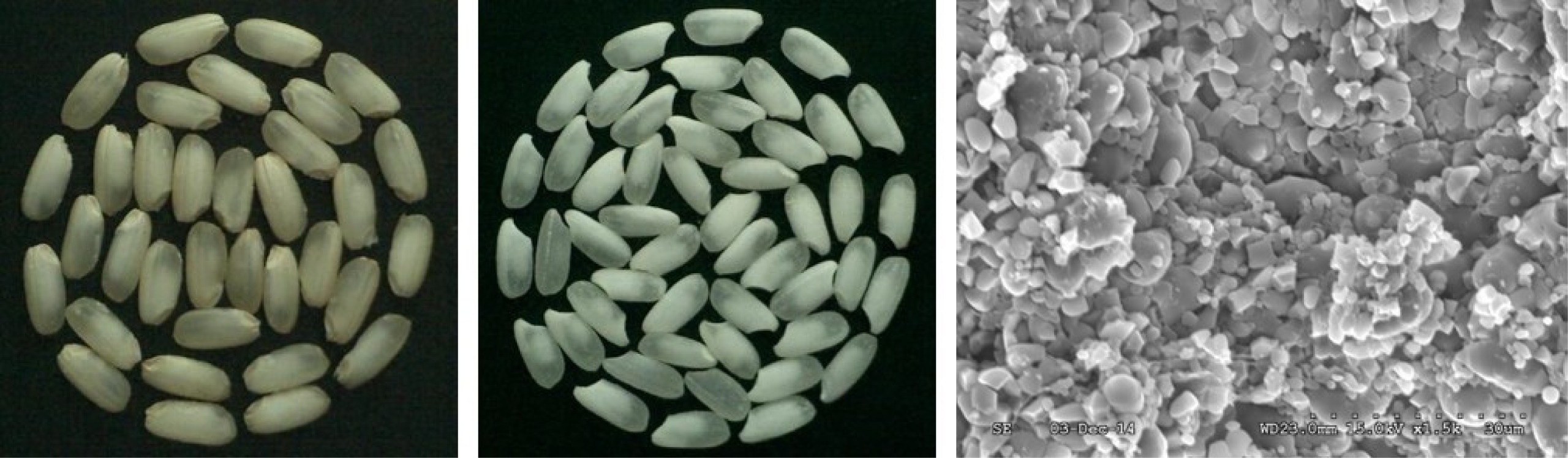
Hu et al. 2004), 본 연구의 ‘신길’ 품종은 저항전분 함량이 0.39%로 일반 메벼 계통들과 차이가 없었다(data not shown). ‘신길’의 쌀 외관은 일부 가장자리 부분을 제외하면 전체적으로 불투명한 외관을 보이며, 일반적인 메벼의 경우 다각형(polygonal)의 전분입자를 보인 반면 ‘신길’은 둥근 입자 형태의 모양을 보였다(
Fig 3). 또한 ‘신길’의 아밀로스 함량과 관련하여 다양한 온도변화 프로파일을 이용한 호화특성의 차이 유무를 관찰하고자 하였으나 특별한 변화를 관찰할 수 없었는데(data not shown) 이러한 특성은 쌀가루를 이용한 다양한 가공품 제조 시 품질에 크게 영향을 미칠 수 있는 부분으로 더 많은 시험 연구가 진행되어야 할 것으로 보였다.
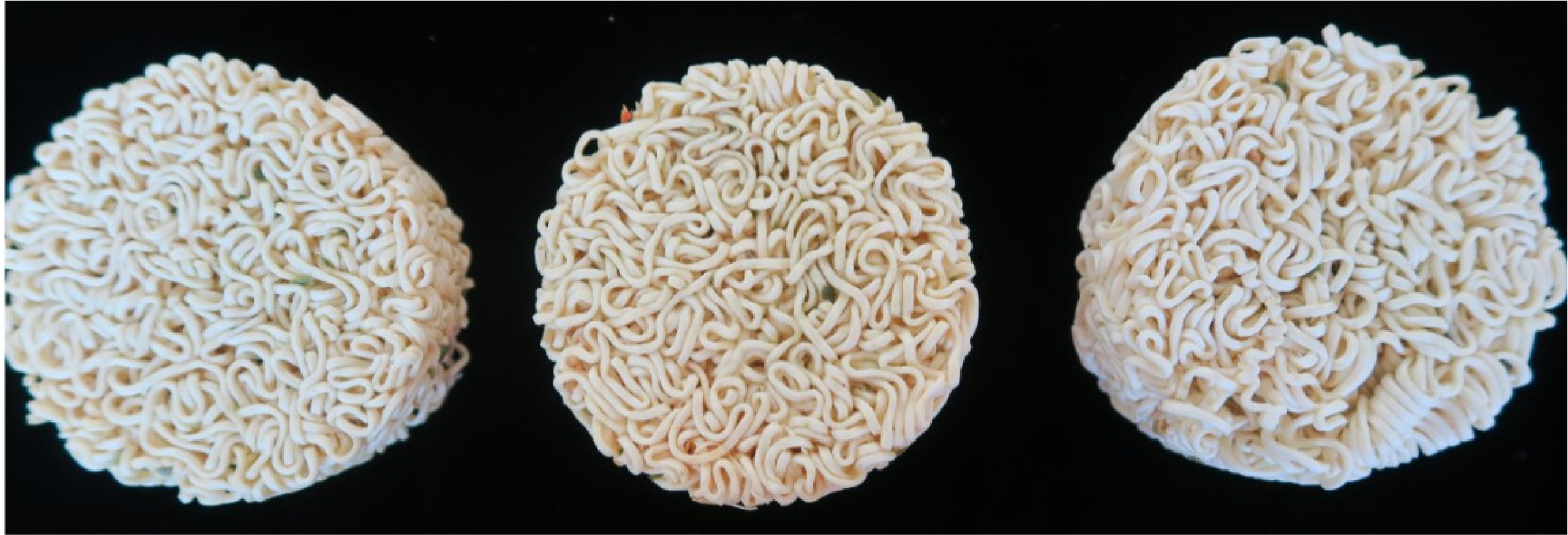
요리 전 건면의 품질분석에서 쌀라면은 밀가루 라면에 비해 경도가 좀더 높은 경향을 보였으며, ‘신길’이 ‘한가루’에 비해 상대적으로 경도가 높았는데 이는 ‘신길’의 아밀로스 함량이 상대적으로 높은 결과로 분석되었다. 색도의 경우 쌀라면이 밀가루 라면에 비해 조금 어두운 경향이었으며, ‘한가루’의 경우 ‘신길’에 비해 노란색의 정도가 높았다(
Table 7,
Fig. 4). 아밀로스 함량에서는 ‘신길’과 ‘한가루’ 쌀라면이 각각 20.8%와 18.7%로 밀가루 라면의 22.1% 보다 낮았다. 아밀로그램(RVA) 특성에서는 품종간 일정한 경향을 보이지 않았는데, 이는 사용한 쌀가루 함량이 30%정도로 낮은 반면 감자 및 변성전분, 기타 첨가물에 의한 영향이 큰 것으로 추정되었다(
Table 8). 요리 후 컵라면의 품질분석에서는 면발이 불어나는 정도인 퍼짐성(면발의 굵기)은 ‘신길’이 ‘한가루’에 비해 큰 경향이었고 쌀라면의 색도는 밀가루라면과 비슷한 경향을 보였다. 반면, 요리된 면의 강도는 밀가루 제품이 쌀 제품에 비해 강한 편이었으며 ‘신길’이 ‘한가루’에 비해 상대적으로 강한 편이었다(
Table 9). 관능검정에서 쌀라면은 모양 및 찰기 등 5개의 모든 항목에서 밀가루 라면에 비해 선호성이 높은 것으로 나타났으며, ‘신길’의 경우 면의 퍼짐성에서 ‘한가루’ 보다 양호한 것을 제외하면 ‘한가루’가 찰기, 질감 및 총평에서 ‘신길’보다 선호성이 높았다(
Table 10). 일반적으로 아밀로스 함량이 높을 경우 제면 특성이 양호한 것으로 보고되었는데(
Baek & Koh 2014), ‘신길’의 경우 관능검정에서 오히려 아밀로스 함량이 상대적으로 낮은 ‘한가루’보다 선호성이 낮은 결과로 볼 때, 쌀쿠키 및 쌀어묵 등 제조 특성이 높은 기타 다양한 쌀가루 가공품(data not shown)에 대한 검토가 필요해 보였다.
‘신길’의 수량성은 2016년 및 2017년 2개년간 영⋅호남 평야지 3개소에서 실시한 보통기 다비 재배시험에서 평균 쌀수량이 745 kg/10a로 ‘다산’ 보다 11% 증수된 수량성을 보였다. 쌀수량의 지역 및 년차 간 변이를 살펴볼 때 밀양 지역에서 변이가 크고 호남평야지 보다 영남 평야지에서 상대적으로 수량성이 높은 것으로 나타났다(
Table 11). 따라서 ‘신길’은 쌀가루 원료곡의 가격 경쟁력 확보를 위한 높은 수량성 확보를 위하여 시비량 등 재배 환경에 대한 더 많은 연구가 필요한 것으로 보였다.
적 요
‘신길’은 쌀가루 전용품종을 육성하기 위하여 재배 안정성 및 수량성이 높은 통일형 ‘한아름’벼를 이용한 MNU (N-methyl N-nitrosurea) 돌연변이 계통이다. M5세대 이후 계통 육종법에 준하여 초형이 양호하고, 수량성을 확보한 계통 중 배유의 70~80%가 opaque처럼 불투명 하면서 아밀로스 함량이 높은 ‘밀양317호’를 선발하였다. 2016~2017년 2년간 지역적응성 시험에서 수발아 저항성이며 분상질률이 높고 쌀 수량성이 높은 통일형 쌀가루 품종으로 인정되어 2017년 신품종으로 결정되었다. ‘신길’은 쌀가루 전용품종으로서 출수기가 8월10일로 중생종이며, 아밀로스 함량이 23.4%로 높은 편이고 쌀알은 전체적으로 불투명한 외관을 보이며 쌀 수량성은 745 kg/10a이다. (품종보호권 등록번호: 제8019호; 2020년 03월 03일).
사 사
본 논문은 농촌진흥청 연구사업(과제번호: PJ012890 건식 쌀가루 전용품종 육성 및 육종소재 다양화 연구, PJ01289002 쌀가루 가공적성 다양화 초다수성 품종 육성)의 지원에 의해 이루어진 것으로 품종을 육성함에 있어 협력하여 주신 농촌진흥청 국립식량과학원, 연구정책국, 농촌지원국 및 각도 농업기술원 관계관께 깊은 감사를 드립니다.
Fig. 1Pedigree diagram of ‘Shingil’. OYT: Observation of yield trial, RYT: Replicated yield trial, LAT: Local adaptability test.
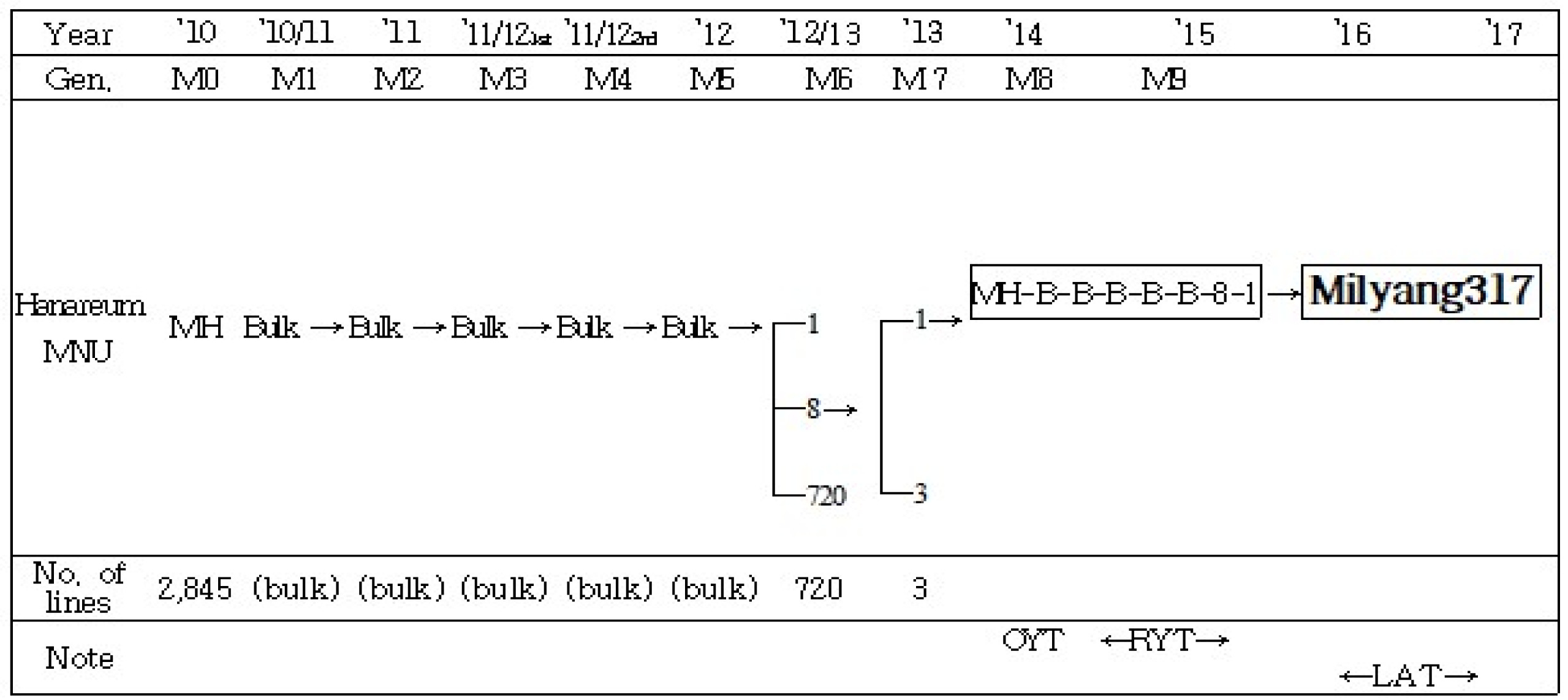
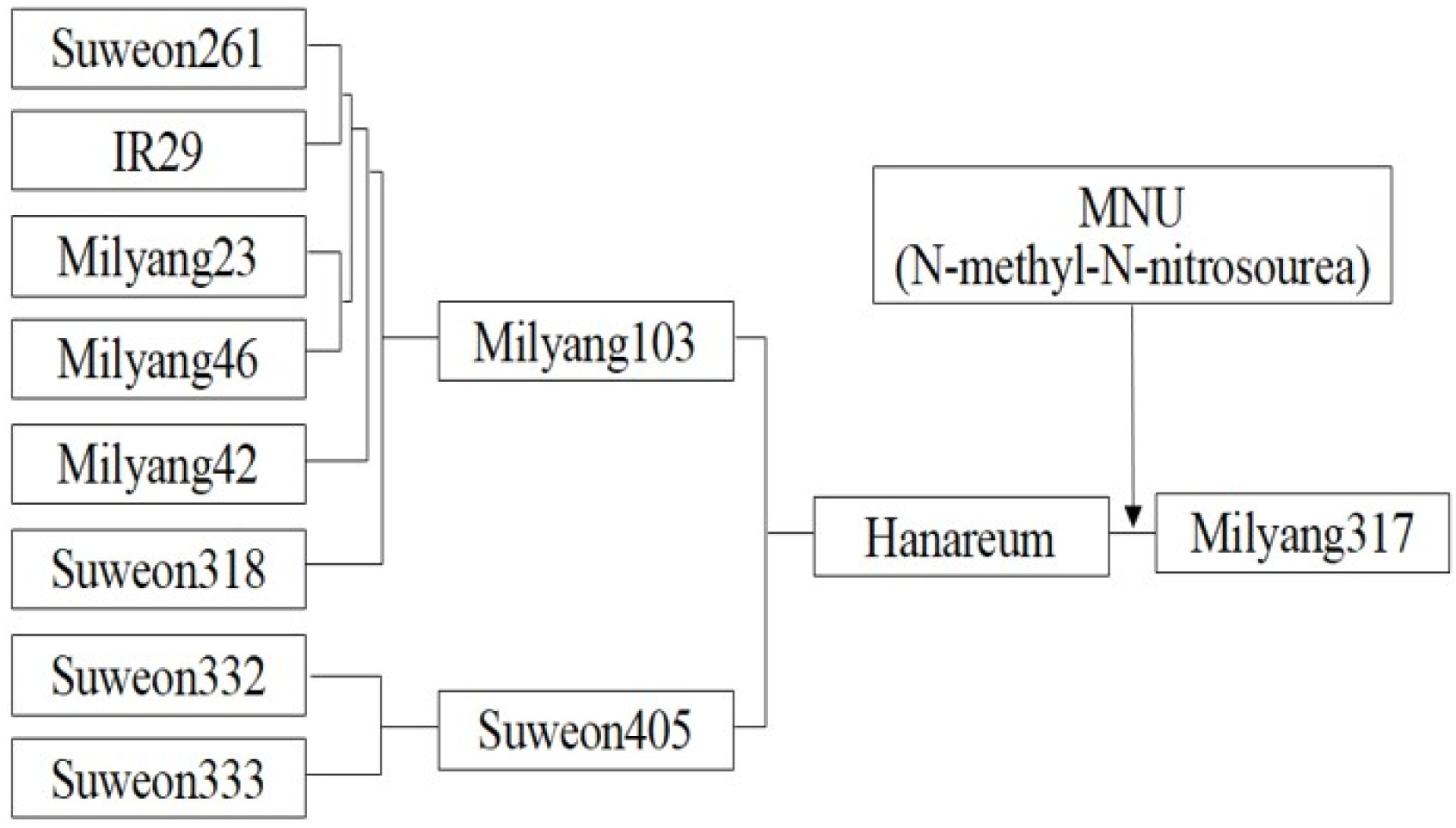
Fig. 2Genealogical diagram of ‘Shingil’.
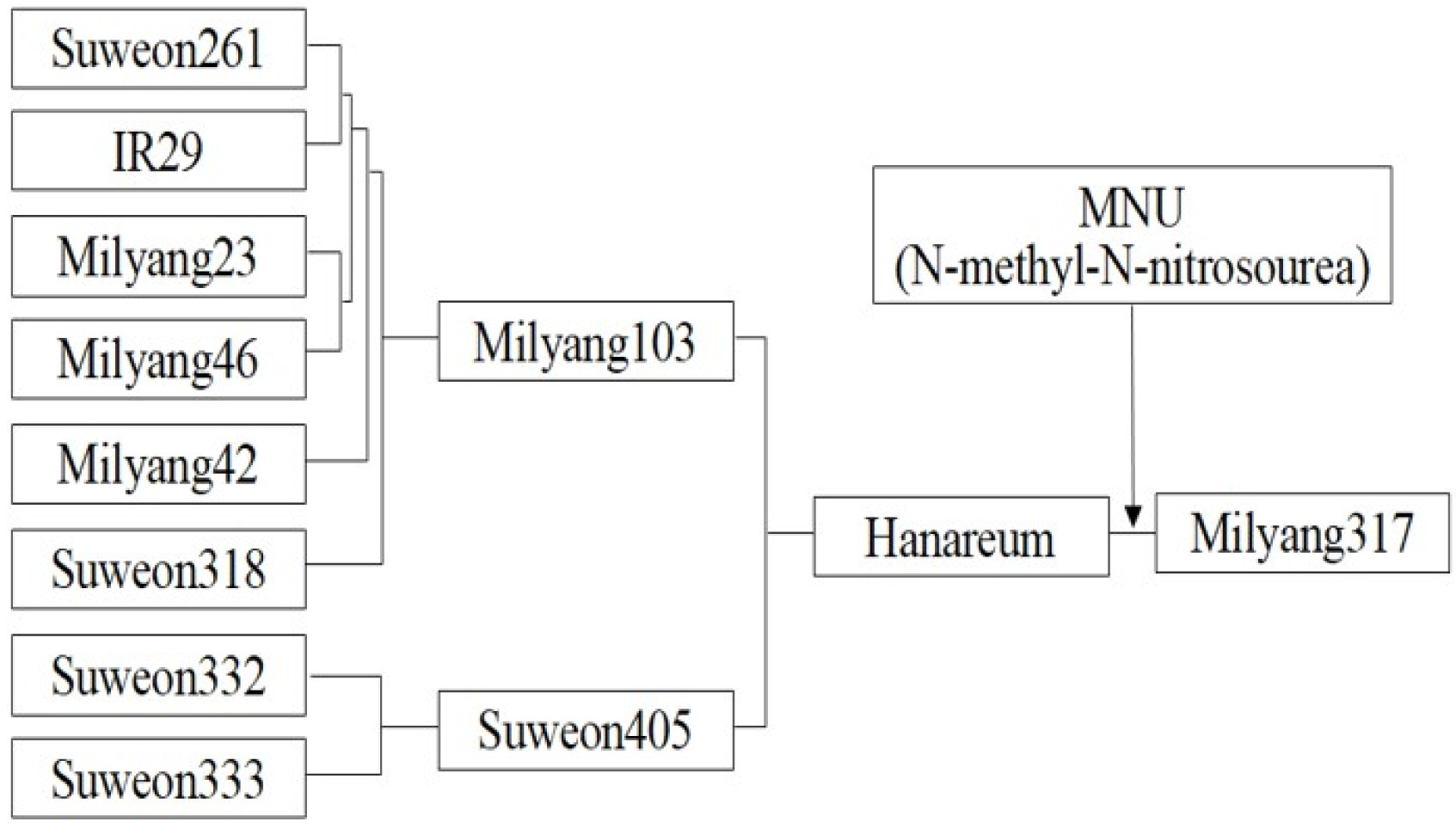
Fig. 3Grain appearance (brown and milled rice) and starch granule (SEM, 1.5K) of ‘Shingil’.
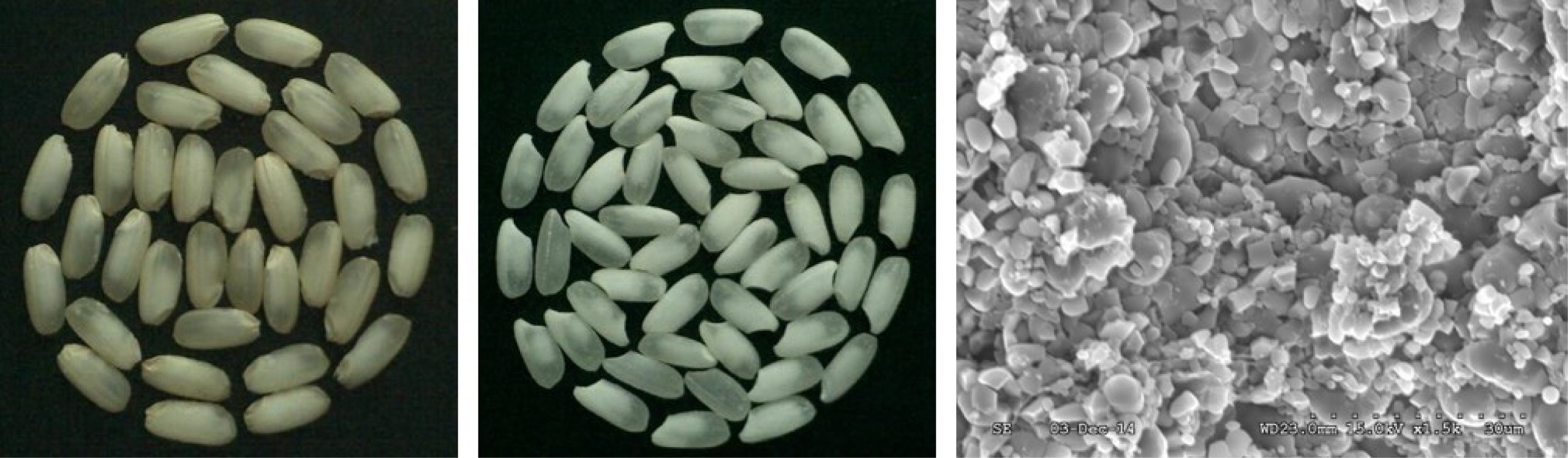
Fig. 4Rice noodles (left ‘Shingil’, middle ‘Hangaru’, right Wheat).
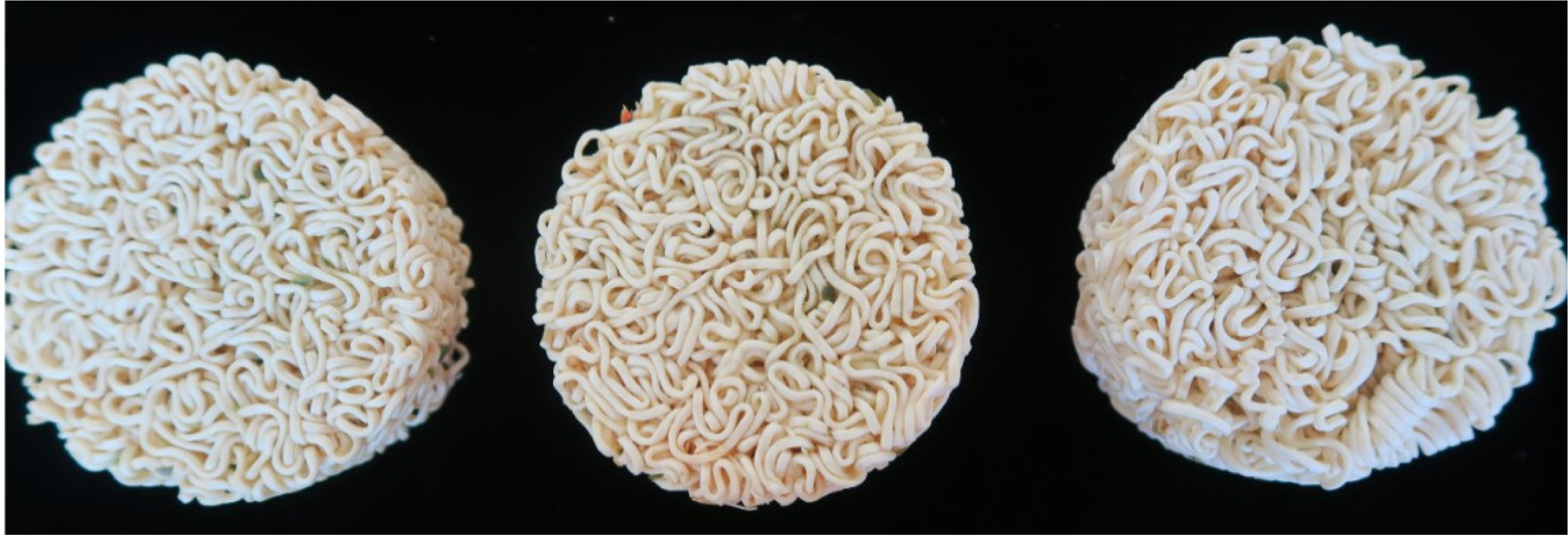
Table 1Major agronomic traits and yield components of ‘Shingil’. (LAT: '16~'17)
Table 1
|
Variety |
Heading date
(m.d) |
Culm
length
(cm) |
Panicle
length
(cm) |
No. of
panicles per
hill |
No. of
Spikelets per panicle |
Ratio of
ripened
grain (%) |
Brown rice
1000 grains
weight (g) |
|
Shingil |
8.10**
|
81ns
|
24ns
|
15**
|
126ns
|
84.3ns
|
22.1*
|
|
Dasan |
8.06 |
77 |
25 |
12 |
113 |
80.2 |
24.7 |
Table 2Abiotic stress response of ‘Shingil’. (LAT: '16~'17)
Table 2
|
Variety |
VVGz
(25℃ at 40 DAF) |
Cold tolerancey
|
|
Heading delay
(days) |
Grain fertility
(%) |
PAx at maturing stage
(1-9) |
PA at seedling stage
(1-9) |
|
Shingil |
5.2ns
|
16ns
|
28.5ns
|
6ns
|
7ns
|
|
Dasan |
9.7 |
18 |
37.0 |
5 |
6 |
Table 3Reaction to leaf and neck blast disease of ‘Shingil’. (LAT: '16~'17)
Table 3
|
Variety |
Leaf blast diseasez
|
|
Neck blast disease |
|
|
|
No. of tested sites |
Ave. |
Rate of diseased panicle (%) |
|
|
|
R (0~3) |
M (4~6) |
S (7~9) |
Iksan |
Milyang |
Icheon |
Jinju |
|
Shingil |
12 |
0 |
0 |
1.0 |
|
0.0 |
0.0 |
0.1 |
0.0 |
|
Dasan |
12 |
0 |
0 |
1.1 |
|
0.5 |
0.0 |
0.0 |
0.0 |
Table 4Reaction to bacterial blight, virus diseases and insect pests of ‘Shingil’. (LAT: '16~'17)
Table 4
|
Variety |
Bacterial blight |
|
Virus diseasez
|
|
Insect pestsy
|
|
|
|
|
K1 |
K2 |
K3 |
K3a |
RSV |
RDV |
RBSDV |
BPH |
SBPH |
|
Shingil |
Rx
|
S |
S |
S |
|
R |
S |
S |
|
S |
R |
|
Dasan |
R |
S |
S |
S |
|
R |
R |
S |
|
S |
R |
Table 5Grain shape of rough and brown rice of ‘Shingil’. (LAT: '16~'17)
Table 5
|
Variety |
Rough rice |
|
Brown rice |
|
|
|
Length (L) |
Width (W) |
Thickness (T) |
Ratio of L/W |
Length |
Width |
Thickness |
Ratio of L/W |
|
Shingil |
8.70ns
|
2.93**
|
2.12*
|
2.97ns
|
|
5.70**
|
2.60*
|
1.91ns
|
2.19ns
|
|
Dasan |
9.02 |
3.17 |
2.16 |
2.85 |
|
5.91 |
2.71 |
1.97 |
2.19 |
Table 6Physiochemical properties of ‘Shingil’. (LAT: '16~'17)
Table 6
|
Variety |
Trans-lucency
(1-9) |
Amylose
(%) |
Protein
(%) |
1.4% KOH
Alkali digestion value
(1-7) |
Endosperm
Core/belly
(0-9) |
|
Shingil |
7 |
23.4*
|
7.3ns
|
6.8*
|
7/7 |
|
Dasan |
3 |
18.0 |
6.9 |
6.2 |
3/3 |
Table 7Hardness and color properties of rice noodles before cooking.
Table 7
|
Variety |
Hardnessz
(g) |
Colory
|
|
|
L*(D65) |
a*(D65) |
b*(D65) |
|
Hangaru |
186.5±61.8b,x
|
58.0b
|
5.0a
|
33.8a
|
|
Shingil |
221.3±84.1a
|
54.2c
|
2.9b
|
29.3b
|
|
CK (Wheat) |
110.6±8.5c
|
73.4a
|
0.5c
|
30.1b
|
Table 8Physiochemical properties of rice noodles before cooking.
Table 8
|
Variety |
Amylose
(%) |
Amylogram (RVA)z
|
|
Peak
1 |
Trough 1 |
Break-
down |
Final
Visc |
Set-
back |
Peak
Time |
|
Hangaru |
18.7c,y
|
50.4a
|
50.9a
|
-0.5a
|
84.3a
|
33.9a
|
7.0a
|
|
Shingil |
20.8b
|
35.3c
|
35.6c
|
-0.3a
|
61.9c
|
26.6b
|
7.0a
|
|
CK (Wheat) |
22.1a
|
44.8b
|
45.1b
|
-0.3a
|
78.7b
|
33.9a
|
7.0a
|
Table 9Physiochemical properties of rice noodles after cooking (cook for 4 minutes in boiling water).
Table 9
|
Variety |
Thickness
(mm) |
Texturez
|
|
Colory
|
|
|
Hardness
(g) |
Length
(mm) |
L*(D65) |
a*(D65) |
b*(D65) |
|
Hangaru |
0.68±0.29b,x
|
22.7±8.9b
|
8.5±2.2a
|
|
69.5a
|
3.2a
|
29.8a
|
|
Shingil |
1.07±0.20a
|
25.5±4.3a
|
9.9±3.1a
|
|
68.5a
|
3.7a
|
30.9a
|
|
CK (Wheat) |
0.82±0.27b
|
27.4±4.5a
|
9.6±1.9a
|
|
69.1a
|
1.5 |
29.8a
|
Table 10Panel test of rice noodles after 4 min. cook in boiling water.
Table 10
|
Variety |
Appearance |
Stickiness |
Texture |
Taste |
Swelling |
Overall |
|
Shingil |
0.59 |
0.45 |
0.45 |
0.45 |
0.45 |
0.36 |
|
Hangaru |
0.64 |
0.82 |
0.68 |
0.64 |
0.32 |
0.73 |
Table 11Yield of milled rice at local adaptability test of ‘Shingil’. (LAT: '16~'17)
Table 11
|
Cultivation season |
Region |
No. of
test site |
Yield of milled rice (kg/10a) |
|
Dasan
(B) |
Shingil
(A) |
Index
(A/B*100) |
Range
(Shingil) |
|
Ordinary planting |
Honam plain (II-1) |
1 |
645 |
690 |
108 |
666-713 |
|
Yeongnam plain Milyang (II-2) |
1 |
712 |
805 |
113 |
743-867 |
|
Yeongnam plain Daegu (II-2) |
1 |
660 |
741 |
113 |
733-749 |
|
|
Average |
3 |
672 |
745 |
111 |
|
References
- AOAC.2000. Official methods for analysis. 17th ed. Association of official analytical chemists, Washington DC. USA.
- Baek JE, Koh BK. 2014. Bread and Noodle Making Potential of Commercial Rice Flour. Journal of Living Science Research 40: 25-34.
- Chen JJ, Lu S, Lii CY. 1999. Effects of milling on the physicochemical characteristics of waxy rice in Taiwan. Cereal Chem 76: 796-799.
- Cho JH, Lee JH, Park NB, Son YB, Oh SH, Han SI, Song YC, Seo WD, Park DS, Nam MH, Lee JY. 2018. 'Saemimyeon', a Tongil-Type Medium-Late Maturing Rice Variety with High Amylose Content Used for Rice Noodle Preparation. Korean J Breed Sci 50: 522-528.
- Cho JH, Song YC, Lee JH, Lee JY, Son YB, Oh SH, Han SI, Kim CS, Chung KH, Park DS, Lee JS, Yeo US, Kwak DY. 2019. 'Dodamssal (Milyang261)', Functional rice as a resistant starch with a high amylose content. Korean J Breed Sci 51: 515-522.
- Choi HC. 2006. A Guide to Rice Breeding. pp. 110-111.
- Choi ID, Son JR, Hong HC, Lee JH, Kim KJ. 2006. Indigestible carbohydrate contents and physical properties of Goami2 harvested at the maximized milling quality. Food Sci Biotechnol 15: 254-259.
- Foodnews. 2017. Creating a new value of rice using dry rice flour. http://www.foodnews.co.kr/news/articleView.html?idxno=62357
- Hu P, Zhaoa H, Duan Z, Linlin Z, Dianxing Wu D. 2004. Starch digestibility and the estimated glycemic score of different types of rice differing in amylose contents. Journal of Cereal Science 40: 231-237.
- Jitranut L, Jirarat A. 2016. Effects of Dry-Milling and Wet-Milling on Chemical, Physical and Gelatinization Properties of Rice Flour. Rice Science 23: 274-281.
- Jo YJ, Yoon HY. 2016. A Study on the Quality Characteristics of Makpyeon Prepared with Dry Milled Rice Powder. J Korean Soc Food Cult 31: 235-242.
- Juliano BO. 1985. Polysaccharide, proteins, and lipids of rice. In rice chemistry and technology. The American association of cereal chemists, St Paul MN. USA: pp. 59-120.
- Jun HI, Yang EJ, Kim YS, Song GS. 2008. Effect of Dry and Wet Millings on Physicochemical Properties of Black Rice Flours. J Korean Soc Food Sci Nutr 37: 900-907.
- Kim YI, Kum JS, Kim KS. 1995. Effect of different milling methods of rice flour on quality characteristics of jeungpyun. Korean J Soc Food Sci 11: 213-219.
- Kim KM, Song YH. 2017. A Study on the Processed Rice Products Int'l Marketing Strategy on the Rice Flour by the Dry Milling Method. Food Distribution Research 34: 161-181.
- Kim WS. 2020. Physicochemical Properties of High Yield Tongil Type Geumgang Rice Flours and Starch. Korean J Food Cook Sci 36: 119-125.
- KOSTAT. 2020. KOSIS (Korean statistical information service). http://kostat.go.kr/portal/korea/index.action
- Kum JS, Lee SH, Lee HY, Kim KH, Kim YI. 1993. Effect of different milling methods on distribution of particle size of rice flours. Korean J Food Sci Technol 25: 541-545.
- Lee MH, Lee YT. 2006. Bread⁃making Properties of Rice Flours Produced by Dry, Wet and Semi⁃wet Milling. J Korean Soc Food Sci Nutr 35: 886-890.
- Lee N, Ha KY. 2015. Quality characteristics of frozen cookie dough using rice flour of super yield Korean rice varieties. Korean J Food Preserv 22: 63-69.
- Mo YJ, Jeung JU, Shin YS, Park CS, Kang KH, Kim BK. 2013. Agronomic and genetic analysis of Suweon 542, a rice floury mutant line suitable for dry milling. Rice 6: 37
- Park YK, Seog HM, Nam YJ, Shin DH. 1988. Physicochemical properties of various milled rice flours. Korean J Food Sci Technol 20: 504-510.
- Park MK, Lee KS, Lee KH. 2008. Effects of Rice Powder Particle Size in Baked Rice Breads. J East Asian Soc Dietary Life 18: 397-404.
- Park JY, Lee SK, Park HY, Choi HS, Cho DH, Lee KH, Han SI, Cho JH, Oh SK. 2017. physicochemical Properties of Rice Flour of Different Cultivars using Wet and Dry Milling Processes. Korean Journal of Crop Science 62: 184-192.
- Rural Development Administration (RDA)2017a. Project Plan for Collaborative Research Program to Develop New Variety of Summer Crop.
- Rural Development Administration (RDA)2017b. Standard of analysis and survey for agricultural research.
- Seo HI, Ryu BM, Kim CS. 2011. Effect of Heat-Moisture Treatment of Domestic Rice Flours Containing Different Amylose Contents on Rice Noodle Quality. Korean Soc Food Sci Nutr 40: 1597-1603.
- Shin DS, Lee EC, Choi JY, Oh SK, Park HY. 2017. Comparative Analysis of Quality Properties by the Particle Size of Rice Flours according to Cultivars. Korean J Food Nutr 30: 635-643.
- Sim EY, Park HY, Lee JY, Kwak JE, Lee JY, Jeon YH, Lee CK, Hong HC, Choi ID. 2019. Quality characteristics of soft morning roll bread with different ratios of high yield tongil-type rice flours. Korean J Food Preserv 26: 650-658.
- Won YJ, Ahn EK, Jeong EG, Chang JK, Lee JH, Jung KH, Hyun UJ, Cho YC, Oh SK, Yoon MR, Kim BK, Kim BJ. 2019. An Opaque Endosperm Rice Cultivar, 'Hangaru', Suitable for Exclusive Dry-Milling Rice Flour Production. Korean J Breed Sci 51: 134-139.
- Won YJ, Ahn EK, Jung KH, Hong HC, Hyun UJ, Park HM, Yoon MR, Lee JH, Seo JP, Jeong EG, Chang JK, Kwak JE, Oh SK. 2020. Agricultural Characteristics of 'Misiru' with Improved Dry-Milling Rice Flour Trait. Korean J Breed Sci 52: 151-157.