적요
Wheat, in conjunction with rice and maize, constitutes one of the three most significant staple crops worldwide, sustaining over 40% of the global population. In Korea, the annual per capita wheat consumption exceeds 30 kg, totaling approximately 4 million tons nationwide. However, more than 95% of this demand is met through imports, resulting in a meager self-sufficiency rate of approximately 0.7%, raising concerns regarding supply stability and price fluctuations. Enhancing wheat self-sufficiency in Korea requires addressing yield reductions caused by abiotic stressors, including elevated temperatures, drought, cold damage and pre-harvest sprouting induced by climate change, as well as biotic stressors such as Fusarium head blight. The development of high-quality wheat varieties with superior processing characteristics that satisfy consumer demands is crucial. This study provides critical insights for future research on the development of novel wheat cultivars in Korea. It reviews the current state of wheat cultivation and production, environmental and biological factors affecting growth, compositional elements influencing quality, domestic cultivars developed through conventional crossbreeding currently in commercial distribution, and contemporary breeding trends, with particular emphasis on novel breeding technologies, such as biotechnology.
서언
밀(wheat,
Triticum aestivum L.)은 쌀, 옥수수와 함께 세계 3대 식량작물로, 전세계 인구 40% 이상이 주식량으로 사용하고 있다. 세계 인구가 소비하는 칼로리의 약 20%와 단백질 섭취량의 약 25%를 제공하며 다양한 식품으로 가공될 수 있고 단백질, 식이섬유(diatery fiber), 비타민(vitamines), 무기질(minerals), 생리활성 물질(phytochemicals)를 많이 함유하고 있다(
Ahn 2002,
Yang et al. 2021). 밀은 주로 서양의 주식으로서 사용되고 있으며 최근 서구화된 식생활로의 변화로 인해 우리나라에서 쌀 다음으로 제 2의 기본식량으로 가장 많이 소비되고 있다(
Kim 2016a,
Son et al. 2013). 국내에서 1년에 국민 1인당 약 30 kg이상, 국가적으로는 약 400만톤 정도가 소비되나 대부분 소비량의 95%이상을 수입에 의존하고 있다(
Ahn 2002,
Yang 2017). 따라서 국산 밀 자급률이 0.7%로 매우 낮아 효율적 자원 배분이 불가능하며 수급 및 가격 불안정 문제가 제기되고 있다. 밀 자급률을 높이기 위해서는 가공적성이 우수한 기능성 밀 품종을 개발하여 국산밀 선호도를 증가시키고 국내 재배면적 확대와 지리적으로 협소한 재배면적 내에서 생산량을 높이는 기술을 개발할 필요가 있다(
Bae & Park 2020,
Kang et al. 2016). 최근 기후변화로 인한 이상 기후 현상으로 식물에 대한 비생물학적 스트레스는 세계농업에 큰 영향을 주고 있으며, 밀 육종과 생산에도 극복해야할 중요한 문제이다. 대표적인 피해 요인으로는 잦은 강우로 인한 수발아와 고온, 가뭄 등이 있으며 주요 밀 식물병인 붉은 곰팡이병, 녹병, 흰가루 병 등의 발생 빈도와 심각성 역시 증가되고 있다. 이로 인해 밀의 수량 감소, 품질이 저하되는 피해가 크며 국산 밀의 안정적 공급을 위해서는 재해저항성, 병저항성 증진에 대한 활발한 연구가 필요하다(
Park et al. 2022). 기존의 전통육종 방법으로는 품종개선에 한계가 있기 때문에 생명공학기술을 이용하거나 빅데이터와 AI 딥러닝 기술이 융복합된 디지털 육종 기술을 이용한 밀 육종연구들이 전세계적으로 각광받고 적극적으로 추진되고 있다(
Rasheed & Xia 2019,
Roth et al. 2023). 본 논문은 앞으로 개발해 나갈 우리나라 밀 신품종 육성 연구를 위한 정보를 제공하고자 국내 밀의 재배 및 생산 현황과 밀의 생육에 미치는 환경 및 생물학적 요인, 밀 품질에 영향을 끼치는 성분적 요인, 전통 인공교배 육종법을 통해 육성된 현재 보급 및 상업적 판매가 되고 있는 국내 밀 품종, 생명공학 기술을 활용한 최근 밀 육종 연구동향을 분석하였다.
본론
국내 밀 재배 및 생산 현황
세계적으로 재배되고 있는 밀 종류 중 실용적, 상업적으로 가치 있는 밀은
Triticum속인
T. monococcum (2배체, 1립계),
T. turgidum (4배체, 2립계),
T. timopHeevi (4배체),
T. aestivum (6배체, 보통계) 4종이다. 이 중에 국수용으로 쓰이는 밀은
T. turgidum L. var.
durum으로 전세계 밀 곡물 생산량에서 약 6%를 차지하며, 제빵용으로 쓰이는 밀은
T. aestivum (보통밀)으로 전세계 밀 생산량 중 90%로 가장 많이 생산되고 있다. 국내 재배 밀은 모두
T. aestivum종에 속한다(
Alemu 2017,
Jo et al. 2013,
Park et al. 2020).
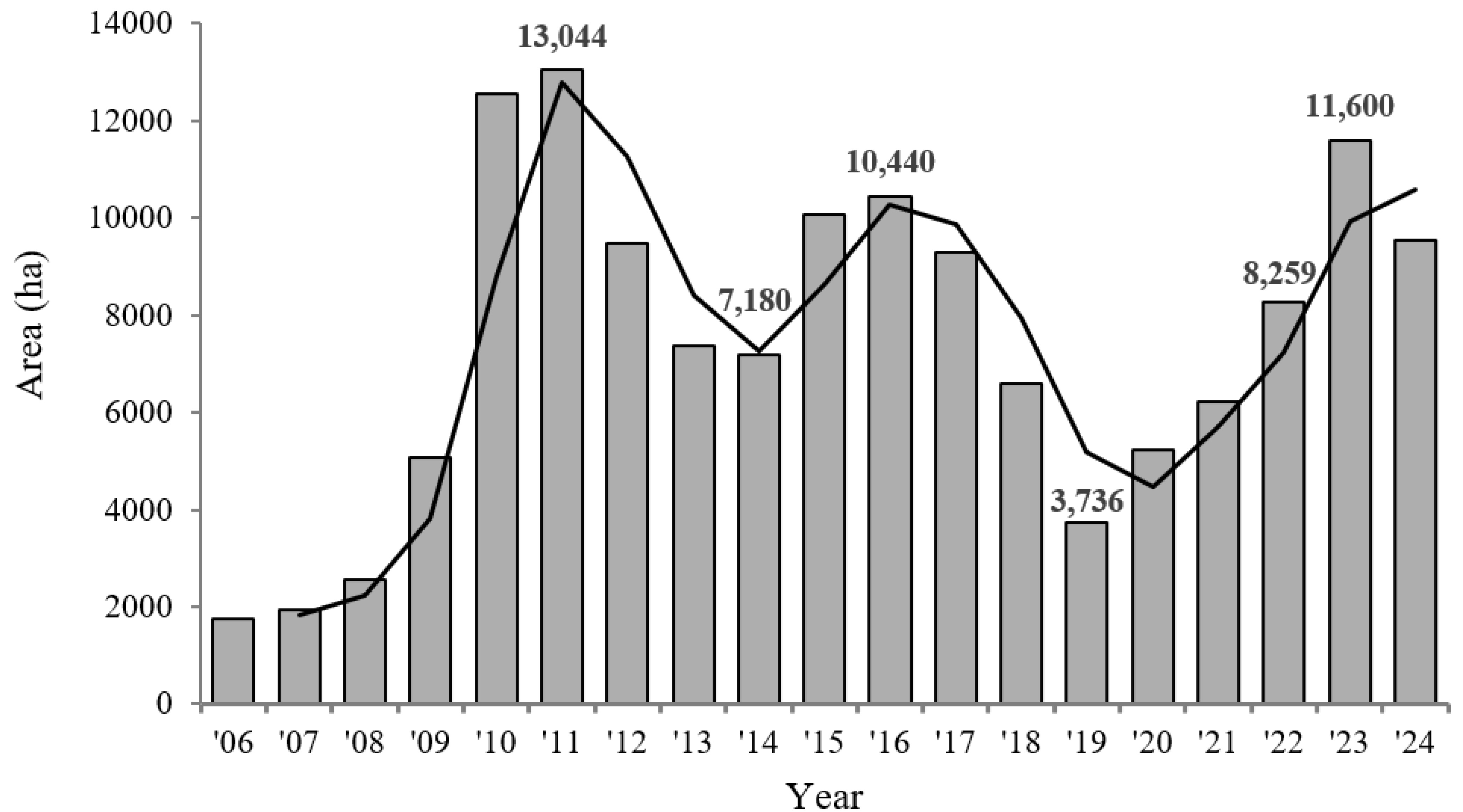
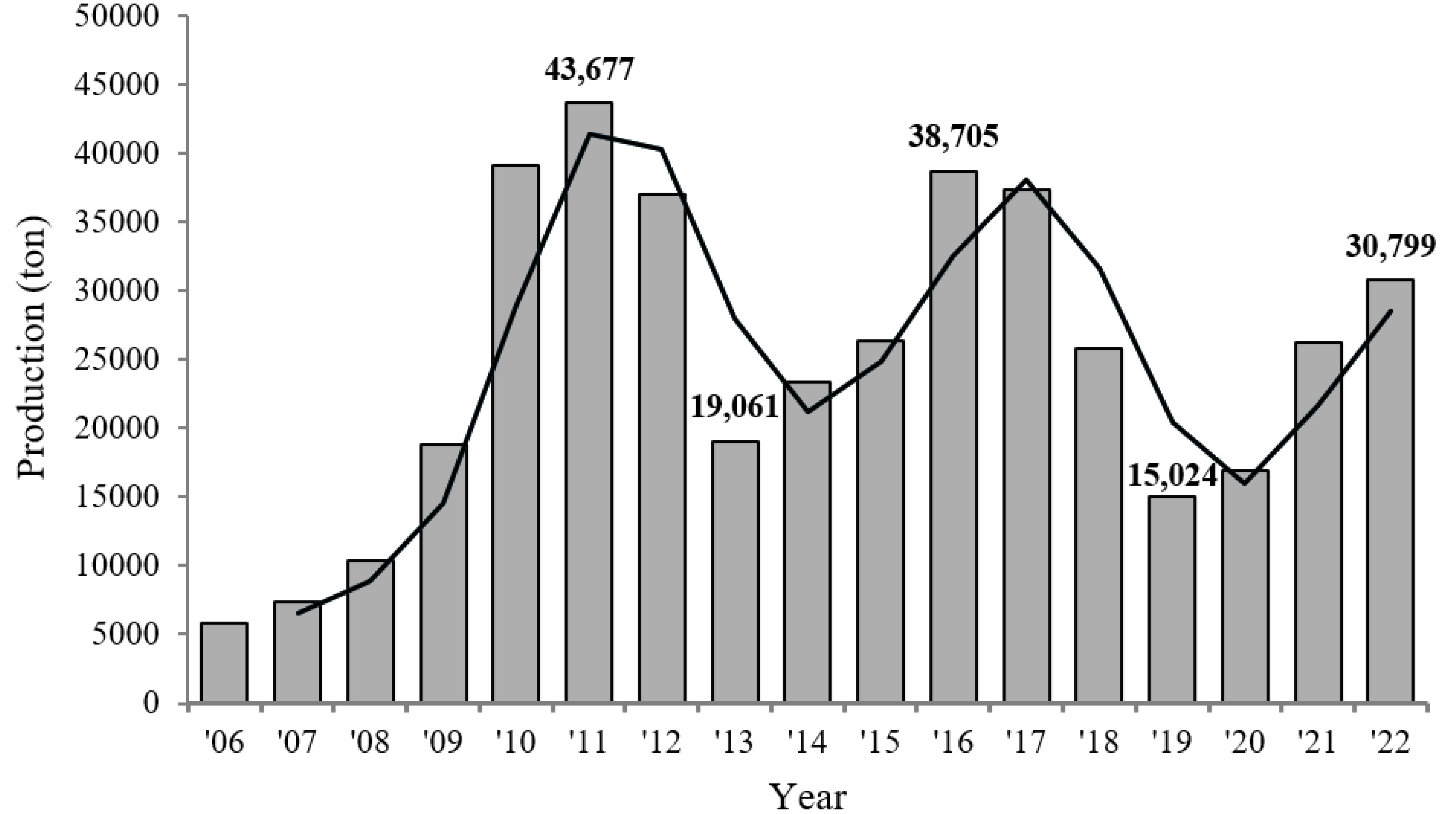
국내 밀 재배면적 및 생산량의 통계보고에 따르면(
Figs. 1,
2), 2008년 농식품부의 제2의 녹색혁명 추진의 영향으로 2011년 재배면적이 13,044 ha까지 급격히 증가하였고, 생산량 또한 2011년 4만 3677톤까지 증가하게 되었다. 그러나 밀의 과잉생산은 수요업체에 재고 부담을 주어 농가에 대금지급이 지연되는 문제가 발생했다. 결과적으로 생산이 위축되어 2014년 7,180 ha까지 재배면적이 감소되고 생산량 또한 2013년 1만 9061톤으로 감소되었다. 2015년 농림축산식품부의 답리작 활성화 대책방안으로 다시 2016년 밀 재배면적이 10,440 ha로 증가하고 2016년 국산 밀 생산량이 3만 8705톤으로 증가하였다. 그러나 국내 생산 밀 수요가 저조해 다시 재고량이 누적되어 2019년 밀 재배면적이 3736 ha로 축소되었다. 또한, 냉해로 인해 작황이 저조하여 2019년 밀 생산량이 1만 5024톤으로 매우 낮게 나타났다. 지금까지의 국산 밀 재배면적, 생산량 감소의 원인은 기후 변화, 소비부족으로 인한 국산밀 재고량 급증이라고 할 수 있다(
Jung et al. 2020). 최근 2022년 우리나라 밀 재배면적은 8,259 ha로 전년 대비 32.7%가 증가, 2023년은 11,600 ha로 22년 대비 40.5%가 증가하였다. 생산량 또한 2019년 1만 5024톤에서 22년 3만 799톤까지 상승했다. 이는 농식품부에서 국내 생산 밀 산업육성을 위한 2020년 ‘제1차 밀 산업 육성 기본계획’ 추진한 것과 2023년부터 시행한 식량자급률 제고와 ‘전략작물직불제’의 영향이다. USDA에 따르면 2023-24년 한국 밀 생산량은 4만 6천톤, 수입량은 약 450만톤일 것으로 보고하고 있다(
USDA 2023). 국내 밀 생산과 보급을 증가시키기 위해 정부에서는 다양한 정책을 지원하였음에도 불구하고, 소비자들과 기업체는 여전히 가공적성이 좋은 수입밀을 선호하고 있어 소비의 대부분을 수입에 의존하고 있다. 밀 국내 자급률은 20년 0.8%에 불과했지만 21년 1.1%, 22년 1.3%로 꾸준히 상승했으며 23년 기준 밀 자급률은 2.0% 수준인 것으로 농식품부는 보고하였다. 정부는 2025년까지 자급률 5% 달성을 목표로 하고 있으며, 이를 위해 밀 재배 면적 확대, 공공 비축 물량 증가 등 다양한 정책을 추진하고 있다(
MAFRA 2023,
2024b). 앞으로 국내 밀 자급률을 향상시키기 위해서는 국내 재배환경에 적합하고 가공적성이 우수한 밀 품종을 개발하기 위한 육종방법을 연구할 필요가 있다.
우리나라 밀 재배는 논에선 벼+맥류(밀/보리)로 밭에서는 콩+맥류(밀/보리)의 이모작 작부 체계로 재배되고 있다. 가을 파종보다 수량성이 낮은 봄밀은 거의 재배되고 있지 않고 주로 가을밀을 재배하고 있으며, 10월 20-30일 가을에 파종해 월동기를 거쳐 6월 20일 경에 수확한다(
Park et al. 2020).
밀 품질을 저하시키는 가장 큰 원인은 월동기 동안의 저온과 수확기때 높은 강우량과 같은 비생물학적 스트레스 환경문제이다. 국내 밀 품종은 주로 가을에 파종하여 다음해 6월경에 수확하기 때문에, 이 기간 중 저온에 의한 손상은 밀의 성장에 영향을 미쳐 생산량 감소로 이어지게 된다. 월동작물 밀의 동해 피해는 12월 상순부터 3월 상순까지 나타나며, 겨울 동안 한파 피해 뿐만 아니라 월동 시기를 지나 초봄에 동상해를 입어 고사하는 경우도 많다. 밀은 저온스트레스로 인해 잎이 탈색되고 시들며 생장억제가 발생하여 최종적으로 고사된다. 동해로 인한 밀의 피해 정도는 겨울철 토양온도에 의해 가장 큰 영향을 받는데, 이는 밀의 잎이나 정단분열조직보다 뿌리의 저온 내성이 약하여 뿌리 생장율이 크게 감소돼 수분, 영양소 흡수가 억제되기 때문이다. 밀의 내동성은 겨울기간동안 추위에 견딜 수 있도록 가을에서 겨울에 걸쳐 온도가 점진적으로 차가워지며 증대된다. 하지만 3-5월 봄철기간 동안 밀의 성장이 진행될수록 내동성이 소실돼 저온에 취약해지기 때문에 봄철에 저온이 나타날 경우 냉해로 인한 급격한 생산량 감소가 일어난다(
Hassan et al. 2021,
Lee 2018). 또한 국내 밀 성숙기가 장마시기와 겹쳐 수발아 및 붉은 곰팡이병 발병 등이 품질 저하의 원인이 되기도 한다. 이러한 환경문제에 대한 생산 안전성을 확보하기 위해서 수발아 저항성이 있는 품종 개발이 중요하다. 수발아는 수확을 앞둔 등숙기간에 잦은 강우와 낮은온도로 발아억제물질이 분해돼 종자의 휴면이 타파되어 이삭이 수확이전에 비정상적인 발아를 하는 현상이다. 수발아가 되면 배유의 α-amylase 활성증가로 인해 전분이 분해돼 밀종실의 품질을 떨어뜨리고 밀가루, 가공제품 적성이 저하된다(
Park et al. 2022).
밀에 피해를 주는 또 다른 환경문제로는 고온과 가뭄이 있다. 고온 스트레스와 가뭄은 생장기에 밀의 생육을 크게 방해하여 품질뿐만 아니라 수량에도 영향을 미친다. 미국의 대표적인 밀 생산지인 캔자스주에서는 2022-23년 연속 극심한 가뭄과 고온이 발생하여 수확량이 큰 폭으로 줄어든 것으로 보고되었다(
Najmabadi 2023). 밀은 개화 후 10일에서 성숙 단계 동안 고온피해를 입으면 수량 78%, 종자수 63%, 종자무게 29% 정도가 감소된다. 또한 고온 스트레스는 밀의 발아를 저해하고 초기 생육에 부정적 영향을 끼쳐 수확량을 감소시킨다(
Maity & Shrivastav 2024,
Son et al. 2015).
다음의 피해 원인으로는 생물학적 스트레스요인으로서 주요 밀 식물병에는 붉은 곰팡이병, 녹병, 흰가루병과 같은 식물병이 있다(
Azimi et al. 2020,
Kim et al. 2020a,
2020b,
2020c,
Lee et al. 2023a) (
Table 1). 이중에서 한국에서 가장 문제가 되는 병은 붉은 곰팡이병으로 이로인해 2021년에는 지역에 따라 밀에서 최대 26%의 병든 이삭률 피해가 보고되었다(
RDA 2022a). 밀 붉은 곰팡이병(Fusarium head blight, FHP)은 밀 이삭에 발생하기 때문에 수확량, 품질에 큰 영향을 미치며, FHB감염 곡물에서 생산되는 트리코테신(Trichothecene)에 속하는 독소는 인축에게 중독증 피해를 일으킨다. 우리나라에서는 전국에서 발병하지만 주로 온난다습한 이모작 지대에서 많이 발생한다. 4월 하순과 5월 상순의 밀 출수기, 유숙기의 잦은 강우로 습도가 높아져 FHB 병원균
Fusarium graminearum에 감염되면 이삭이 갈변하고 성숙시에 붉은색의 분생포자층이 생기며 출수지연, 기형이삭 발생, 종실이 제대로 채워지지 않고 붉은색이나 검은색으로 변한다(
Park et al. 2022). 이러한 병해를 예방하기 위해 농촌진흥청과 정부는 스트레스 저항성 품종 개발, 정밀 농업 적용, 그리고 병해 예측 시스템 구축에 주력하고 있다(
RDA 2024,
Byeon et al. 2012).
밀 곡물은 2~3%의 배아, 13~17%의 겨, 80~85%의 배유로 크게 구조되어 있다. 최외각층 겨는 여러 층으로 구성되어 밀곡물 내부를 보호한다. 비타민B와 미네랄이 풍부하며 겨의 53%는 섬유질성분으로 구성되어 있다. 이 밀 겨의 섬유질은 단백질에 결합된 자일로스와 아라비노스 중합체인 셀룰로스와 펜토산을 포함한다. 겨의 총건조량의 16%는 단백질과 탄수화물로 이뤄져 있으며 7.2%의 미네랄 함량을 가지고 있다. 외배유(호분층)은 발아과정에서 중요역할을 하는 단백질, 효소가 풍부하다. 내배유는 에너지를 생성하는 전분이 풍부하며 1.5% 지방, 13% 단백질을 포함한다. 특히 글루텐을 형성하는 단백질인 글루테닌, 글리아딘을 가지고 있다. 미네랄(회분)과 식이섬유는 각각 0.5%, 1.5%로 함량이 낮다. 배아는 25%의 단백질, 8~13%의 지질이 풍부하며 높은 4.5%의 미네랄 함량을 가지고 있다(
Šramková et al. 2009). 이와 같이 밀 종실 부위에 따라 영양소는 다르게 분포되어 있다(
Table 2).
밀(
T. aestivum)은 높은 비율의 글루텐(gluten)단백질을 함유하고 있다. 밀 종실에서 저장 단백질은 전체의 약 8~15%를 구성하며 글루텐은 저장단백질의 80-85%를 차지한다. 그 중 30%는 글리아딘(gliadin)으로, 50%는 글루테닌(glutenin)으로 구성되어 있다. 글루텐은 밀반죽의 제빵특성과 품질에 관여하는 수분 흡수 능력, 응집성, 탄성, 신축성 등을 결정하는 가장 중요한 요소이다. 글루텐은 4그룹의 α / β -, γ-, ω5-, ω1,2- 글리아딘과 고분자량-, 저분자량- 글루테닌 서브유닛 [high-molecular-weight glutenin subunit (HMW-GS), low- molecular-weight glutenin subunit (LMW-GS)]으로 구성되며 글루테닌은 탄성, 글리아딘은 점성과 신축성과 관련이 깊다. 글루텐의 함량조성에 따라 밀가루 이용 특성이 구분 지어지게 된다. 밀가루는 보통 제빵용, 제과용, 제면용 등의 용도별로 구분하며 밀가루의 단백질 함량에 따라 강력분, 중력분, 박력분으로 나뉜다. 건조된 글루텐의 양이 13% 이상이면 강력분이라 하고, 제빵용으로 이용되며, 중력분은 10-13%로 제빵용과 제면용으로 사용되고 있다. 박력분은 10% 이하로 제과용이나 튀김용으로 이용된다(
Park et al. 2020). 또한 글루텐 단백질은 알레르기를 유발하는 주요 알레르겐(항원)으로 작용하기도 한다. 글루텐에 의해 발병되는 밀 알레르기로는 셀리악병(Celiac disease, CD), 밀 의존성 운동 유발성 과민증(Wheat-dependent exercise-induced anaphylaxis, WDEIA), 소맥분천식(Baker’s asthma) 등이 있다(
Jang et al. 2018,
Lee et al. 2011,
Park et al. 2022,
Sánchez-León et al. 2024,
Son et al. 2017a).
국내 밀 품종 개발은 주로 농촌진흥청을 중심으로 진행되었으며, 2000년까지는 주로 농가 소득 증가를 위한 수량성 증대 및 벼 후작 재배가 가능하도록 수확시기를 단축하는 것에 목표를 두었으나 2000년 이후 부터는 용도별 품종 다양화에 초점을 맞추어 개발이 진행되고 있다(
Bae & Park 2020).
국내 밀 품종 육성은 1970년 이후 농림72호, 농림12호를 인공교배해 올밀 품종을 개발함으로 시작됐다(
Kang et al. 2015). 현재 정부 밀 보급종인 금강, 백강, 새금강, 황금알 외에도 68개의 밀 품종이 국립종자원 한국종자품종서비스(KSVS)에 등록되어 있다. 정부 보급종 밀 품종의 특성으로, 금강과 백강은 단백질 함량과 글루텐함량이 높아 제빵용으로 적합하다. 금강은 수확기에 수발아 및 붉은곰팡이병을 유의해야 하고 백강은 내한성에 약하다. 새금강은 국수용으로 적합하며 수발아와 붉은곰팡이병에 강하고 흰가루병 발생에 유의해야한다. 2024년 9월부터 신규 공급하는 황금알은 단백질(14.0%)과 글루텐(10.3%)함량이 높아 제빵적성이 높으며 수발아에 강하고 붉은 곰팡이병에 약한 특성이 있다(Korea Seed & Variety Service n.d.,
MAFRA 2024a,
RDA 2022b).
국립식량과학원이 개발한 총 57개 직무육성 품종이 국립식량과학원에 등록되어있다(
Table 3). 국립식량과학원에서 개발한 국내 최초 유색밀 ‘아리흑’은 안토시아닌 및 탄닌, 폴리페놀을 고함유하고 있으며 항산화 능력도 약 10배 높다. 아리흑의 기능성을 더 강화한 ‘아리진흑’, 통밀밥으로 사용할 수 있게 찰성을 보유한 ‘아리흑찰’도 있다(
Lee 2021,
RDA 2021a). 이외에도 알레르기 저감 밀인 ‘오프리’가 있다. 오프리는 세계 최초로 유전자 조작이 아닌 인공교배를 통해 알레르기 유발 물질이 제거된 밀이다. 오프리의 유전적 특성을 분석한 결과 밀 의존성 운동 유발성 과민증(wheat dependent exercise-induced anaphylaxis; WDEIA)의 원인인 ω 5- 글리아딘 유전자가 결실되었음이 확인되었다. 또한 셀리악병의 원인인 ‘저분자 글루테닌(LMW-GS)’, ‘γ-글리아딘’과 제빵사 천식의 중심 항원인 ‘α-amylase inhibitor’가 없는 것으로 분석됐다. 미국, 중국에 국제특허가 등록됐으며 2022년 국내 밀 알레르기 환자를 대상으로 임상시험이 실시되었다(
Journal 2018,
Kang et al. 2019,
RDA 2022b). 국내 최초 주정 및 양조용 밀인 ‘우주’는 금강밀 대비 주정생산수율이 5%높고 당화력 또한 13%향상돼 높은 당화효소활성으로 주정생산에 최적화된 품종이다(
RDA 2021b). 또한 추위와 도복에 강하고 수발아저항성으로 생산안전성이 우수하며 과자용 밀인 ‘고소’와 수발아저항성과 다수성을 가진 국내 최초 케이크용으로 개발된 ‘조아밀’ 등이 있다(
Kang et al. 2015,
Kim 2016b). 점점 다양해지는 소비자 기호도를 충족시키고 밀 자급률을 향상시키기 위해서는 이와같이 재해저항성을 가지며 고품질인 국산밀 품종 용도 다양화를 해 나가야 한다.
밀의 수확량과 품질을 개선하기 위해 전통적인 육종법이 많은 성과를 거두었지만, 이 과정은 긴 시간이 필요하며 생물학적 한계가 존재한다. 이를 극복하기 위해 생명공학 기술이 접목되어 전통적인 육종법을 보완하고 있다. 유전자 마커를 활용한 선발, 유전자 가위기술을 이용한 육종 그리고 인공지능과 빅데이터를 통한 분석은 육종 주기를 단축하고 목표 형질을 신속히 개선하는 데 기여한다. 또한 스피드브리딩 기술 접목을 통해 품종개발기간을 단축하여 밀 육종을 가속화 하였다.
마커를 이용한 밀 분자육종
분자마커는 두 개체 간 특정 형질을 조절하는 유전적 특성을 구별해 낼 수 있는 마커 시스템이다. 현재는 주로 DNA 마커들이 쓰이며, DNA염기서열 차이를 기반으로 하기 때문에 대용량 분석이 가능할 뿐 아니라 작물 생육 변화 및 환경적 요인에 크게 영향을 받지 않는다. 특히 SNP (Single Nucleotide Polymorphism)와 SSR (simple sequence repeats)마커는 높은 정확성과 효율성을 가진 덕분에 유전체 연구에서 주로 활용된다. 이러한 분자 마커를 이용하여 양적형질을 조절하는 유전자좌(quantitative trait loci, QTLs) 맵핑 및 계통 유연 관계 분석 등이 이뤄지고 있다. 또한 QTL을 통한 정보를 바탕으로한 분자 마커 이용 선발법(maker Assisted Selection, MAS)은 수량, 내병성, 내충성, 품질 등 농업적으로 중요한 형질과 연관된 분자마커를 간접적인 선발마커로 사용하여 우량 개체를 선발하는 방법으로, 육종연한과 비용을 효율적으로 감소시킬 수 있다. 밀 개량에서 분자마커는 병 저항성, 수확량 증대, 기후 적응, 품질 개선 등의 다양한 형질개량에 적용되고 있다(
Cha et al. 2020,
Huh 2015,
Hwang et al. 2012,
Lee et al. 2018,
Son et al. 2017b,
Song et al. 2023). 농진청은 수발아 감수성인 백색립 금강 품종과 수발아 저항성인 연적색립 올그루 품종의 교배종에서 수발아, 종자휴면과 관련된 QTL분석과 발아지수를 통한 표현형형질평가를 하여 수발아저항성과 연관된 마커로서 염색체 3A, 3D에서 Xbarc12, Xgwm3가 있음을 확인했다(
Kim et al. 2014). 붉은곰팡이병(Fusarium head blight, FHB) 저항성 선발 마커로
Fhb (
Fhb1-Fhb7)유전자를 가장 많이 활용하고 있으며 다양한 유전 집단에서 많은 QTL mapping을 기반으로 우리나라 재래품종 조광에서도 3BS, 4BL, 5DL에서 FHB저항성에 관련된 QTL이 위치함이 보고됐다(
Lee et al. 2023b). 국내에서는 기존 밀 고온스트레스와 연관된 14개의 microsatellite (Simple sequence repeat, SSR)마커를 이용해 국내 7개 품종과 터키에서 분양받은 고온 및 가뭄 스트레스 저항성을 가진 내고온성 유망 23계통, Chinese spring 1개를 평가하였다. 전체 86개의 대립유전자(평균 6.14개)가 확인되었으며, 터키 내고온성특성을 가진 밀과 비교해 국내 밀은 크게 세 그룹으로 형성됐고 국내 밀의 내고온성은 파성과 밀접히 연관되어 있는 것으로 추측됐다(
Son et al. 2015).
유전자 변형 작물, GMO (Genetically Modified Organism)는 특정형질의 외래 유전자를 다른 생물체의 염색체에 삽입하여 획득형질을 갖게 만든 생물체이다(
Cho et al. 2012). 2019년 아르헨티나에서는 세계 최초로 환경 스트레스 신호에 반응하는 해바라기 유전자 Hahb4 (Helianthus annuus homeobox4)를 형질전환시켜 가뭄내성을 가지는 GM밀(HB4밀)을 개발하였으며, 가뭄조건에서 밀 수확량을 약 20%증가시키는 것을 확인하였다. 2020년부터 HB4밀은 10개국에서 식품 및 사료로 소비되는 것이 승인되었으며 아르헨티나와 브라질은 상업적재배를 허가하였다. 또한 2023년 아르헨티나의 Bioceres-Indear회사는 25개공장에서 GM밀(HB4밀)과 일반 밀을 혼합해 식품이 생산, 판매되고 있음을 밝혔다. 이는 처음으로 유전자변형 밀이 대량소비식품에 적용된 사례이다(
González et al. 2019). 몬산토 기업에서는 제초제 내성을 가지는 GM밀인 Roundup Ready 밀을 개발하였다. 제초제 활성성분인 Glyphosate는 작물 생존에 중요 역할을 하는 EPSP (Enzyme 5-enolpyruvylshikimate 3-phosphate)합성효소를 표적으로 억제하여 제초 기능을 한다. Glyphosate에 반응하지 않는 EPSP효소를 생성하는 유전자가 도입된 Roundup Ready 밀은 제초제 내성을 나타내게 된다. 미국과 캐나다의 GM규제 기관에서 이 제초제 내성 GM밀 허가를 검토 중이었지만 2004년, 몬산토 기업은 Roundup Ready 밀의 상용화 계획을 중단하였고 미국, 캐나다 또한 제초제 저항 GM밀 허가 검토를 중단하였다. 이는 유럽연합과 일본이 GM밀 상용화를 허가할 경우 미국 밀 구매를 하지 않을 것이란 의견을 드러냈기 때문으로 보았다(
Funke et al. 2006, Stoksatd 2004).
유전자가위 기술이라고 알려진 기술은 Meganuclease, Zinc Finger Nuclease (ZFN), Transcription Activator-Like effect (TALEN), Clustered Regularly Interspaced Short Palindromic Repeats (CRISPR/Cas9) 등이 있다. 이러한 위치 특이적 핵산분해효소 시스템을 이용하여 표적 DNA 서열의 특정 부위를 선택적으로 절단(DSBs, double strand breaks)하고, 이후 절단된 부위는 생물체 자체 기작으로 복구되며, 이 과정에서 염기 중 일부가 소실되거나(deletion), 단편이 삽입되거나(insertion), 또는 다른 염기로 치환되어(substitution) 변이가 일어난다(
Park et al. 2019a). 유전자가위작물(GEO, genetically edited organism)은 이러한 유전자가위기술로 유전체에서 특정 염기서열을 제거하거나 교체해 원하는 형질을 나타내게 한 작물이다. 기존의 1세대 ZFN, 2세대 TALEN 유전자가위 기술보다 높은 정확도를 가지며 짧은 시간안에 효율성이 높고 저렴한 3세대 기술인 CRISPR/Cas9 (Clustered Regularly Interspaced Short Palindromic Repeats-CRISPR associated protein 9)이 보편적으로 사용되고 있다. CRISPR/Cas9은 목표 DNA 서열을 인식하여 결합하는 20 bp single-guide RNA (sgRNA)서열과 표적서열을 절단하는 분해효소인 Cas9 단백질로 이루어져 있다. sgRNA와 Cas9단백질이 결합된 Cas9/sgRNA 복합체가 표적서열의 3' 끝에 있는 protospacer adjacent motif (PAM) 서열(5'-NGG-3') 및 목표 DNA를 인식하여 유전자 교정을 하게 된다. CRISPR/Cas9로 절단된 염기서열은 double strand break (DSB)가 일어난 후, 크게 비상동성 재조합 기작(non-homologous end joining, NHEJ) 또는 상동재조합기작(homology-directed recombination, HDR) 두 가지 형태의 수선 기작이 일어난다. NHEJ는 절단된 염기서열이 복구되는 과정에서 염기의 결손이나 삽입이 일어나 특정 유전자 기능을 완전히 없애는 현상(knock-out)으로 인해 목표 유전자 기능을 상실하는 것이며, HDR은 공여 DNA를 함께 도입하여 새로운 유전자 염기서열을 추가하거나 교체하는 교정기작이다. CRISPR-Cas9 기술은 외래 DNA 단편(transgene)이 최종 유전자교정 산물에 남아 있지 않아 transgene-free한 작물의 개발이 가능하다. 따라서 GEO는 자연적발생 돌연변이 식물과 구분할 수 없으며, 기존의 GMO표시제 등을 포함한 법을 집행하는 과정에서 필요한 검출과 모니터링이 적절하게 수행될 수 없다(
Jiwan & Seong-Yeob 2023,
Jung 2020,
Kim et al. 2022,
Lee et al. 2021,
Lee 2019,
Park et al. 2019b). 이러한 과학적 사실에 근거하여 미국과 남미국가인 아르헨티나, 브라질은 GE작물을 non-GMO로 보며 일부 GE작물의 재배를 허용한다. 또한 엄격히 GE작물에 GMO 규제를 적용했던 영국과 유럽연합은 2023년 규제 완화를 추진하고 있다(
Kim & Lee 2023,
NARS 2024,
Sprink et al. 2022). CRISPR/Cas9 유전자 편집 기술을 활용해 γ-와 ω-글리아딘 유전자를 표적으로, 유전자 내 서열을 교정해 글루텐 함량을 96.7%에서 97.7%까지 감소시킨 저 글루텐 밀 품종을 개발했다. 이 저 글루텐 밀 품종 계통들 중, 특정 계통에서 α-글리아딘 함량 또한 크게 감소한 것이 확인되었으며, 글리아딘 감소와 함께 글루테닌 함량이 증가하는 현상이 관찰되었다. 이러한 현상으로 편집된 밀 품종이 저 글루텐 함량을 가짐에도 불구하고 반죽의 점탄성을 유지하며 제빵 산업에서 유용하게 활용될 수 있다는 것을 확인하였다(
Gupta 2023,
Sánchez-León et al. 2024,
Sheridan 2021). 최근, 더 발전된 형태인 4세대 유전자 가위 기술은 기존의 유전자 편집 기술의 한계를 극복하고, 더 정확하고 효율적인 유전자 교정을 가능하게 한다. 대표적으로 프라임 에디팅(Prime Editing), 베이스 에디팅(Base Editing)이 있다. 프라임 에디팅은 DNA절단없이 서열을 교체, 삽입, 삭제 시키며 베이스 에디팅은 DNA절단없이 하나의 단일 염기 교체만 가능한 기술이다(
Kantor et al. 2020).
디지털 육종은 BT (유전체, 표현체, 대사체) 오믹스 정보와 IT (생명정보, 컴퓨팅 툴 등)의 융합으로 기존육종방법에서는 개량이 어려운 품질, 수량성, 비생물학적스트레스 저항성 등의 양적형질을 개량할 수 있는 새로운 품종 개발 전략이다(
Oh et al. 2021).
기존의 유전정보를 활용한 유전체선발(genomic selection, GS)은 환경적 영향을 예측할 수 없고 많은 노동력이 필요한 과정으로 인한 어려움이 있었다. 이 문제를 해결하기 위해 인공지능(머신러닝, ML, machine learning)기술을 GS에 통합한 디지털육종방법을 사용하기 시작했다(
Mani et al. 2024). AI를 활용한 디지털 육종을 하기 위해서는 거대유전체 집단(training population), 그 집단의 유전체 또는 마커 정보와 목적으로 하는 표현형 정보가 필요하며, 이 모든 정보를 활용해 유전체 정보와 표현형 간 연관을 통계학적으로 판단하는 유전체선발(GS, genome selection)예측 모델이 필요하다(
Lee et al. 2022). 밀의 핵심집단 구축, 검정에 SSR(Simple sequence repeat)마커를 활용해 농촌진흥청에서 보유중인 해외 60개국 밀 유전자원과 국내 고세대 계통을 포함한 유전자원 1,967점을 유전체 분석, 농업특성평가를 하여 최종 614점의 국내 환경 적응 밀 핵심집단이 구축되었다. 이외에도 SNP마커 정보 및 다양한 농업형질 등의 표현형정보를 축적해 디지털 육종의 기반을 마련하고 있다(
Min et al. 2021).
멀리 떨어져 있는 대상물을 관측하는 기술인 원격탐사(Remote Sensing, RS)는 항공, 우주 상에서 다중 스펙트럼, 초분광, 열화상 등 다양한 센서를 통한 높은 해상도의 대용량 이미지 데이터로 작물 표현형을 수집하는 기술이다. RS는 대상 작물이 반사하는 빛 에너지의 파장 스펙트럼을 포착해 생성된 이미지 데이터를 수집한다. 다중 스펙트럼 센서는 가시광선과 근적외선 영역의 스펙트럼을 포함하며 대표적으로 적색, 녹색 및 청색 파장으로 구성되는 RGB 센서가 있다. 초분광 센서는 가시광선에서 근적외선, 단파, 적외선 범위에 이르기까지 수백 개의 파장대를 연속적으로 포착하여 더 높은 해상도의 이미지 데이터를 생성한다. 다중 스펙트럼 이미지는 작물의 물리적 외관 분석에 주로 이용되며, 초분광 이미지 분석은 식물의 광합성 활동, 수분 및 영양소 흡수와 관련된 생물학적 스트레스 감지에 유용하게 사용된다. 열화상 카메라는 적외선을 사용해 이미지를 생성하여 작물의 표면 온도를 모니터링하는 효과적인 근위 원격 감지 기술이다. 위성 원격감지 기술은 큰 규모의 작물 표현형 수집에 주로 사용되지만 해상도가 낮을 수 있고 대기 간섭, 비용 제약의 단점을 지니고 있다. 이 점을 보완할 수 있는 무인항공기(UAV) 원격감지 기술은 센티미터 수준의 높은 공간 해상도를 가지고 있어 대규모 재배 지역에서 빠르고 정확한 표현형 감지 및 실시간 모니터링이 가능하다(
Feng et al. 2024,
Gano et al. 2024).
Sharma 등(2024)은 수분이 제한된 환경에 강한 밀 품종 육종을 위해 553개의 관련 유전자형을 가지는 밀 유전자원을 대상으로 자연 강우량, 관개 조건에서 식물 높이, 생육단계, 수확량 등의 데이터를 수집하였다. 그 결과, 무인 항공기(UAV) 다중 스펙트럼 이미지를 통한 작물 높이 측정치는 높은 정확성을 보였으며 머신 러닝 모델을 함께 적용하여 생육패턴을 구별해 수확량 예측에 효과적임을 확인하였다. 밀 줄기썩음병은 줄기 밑 둥을 표적으로 하며 성장 중후반까지 무증상으로 나타나 발병 인식이 어렵다. 이에
Xie 등(2024)은 초분광 이미지 분석 기술을 이용해 줄기썩음병 감염30일 후, 육안으로는 명확한 증상을 관찰할 수 없는 시점에서 발병여부를 조기 진단할 수 있음을 확인하였다.
EI-Hendawy 등(2024)은 열화상, RGB 이미지와 인공신경망 분석 툴을 결합하여 염분 스트레스조건에서 재배된 밀 유전자원의 상대수분함량, 엽록소 a, 엽록소 b, 총 엽록소, 식물건중량을 측정해 밀의 염분 내성을 효과적으로 평가할 수 있음을 확인하였다. RGB카메라 광학센서와 소프트웨어 기반으로 포장에서 밀 냉해를 판별하는 디지털 표현형 분석이 보고됐다(
Fu et al. 2021). 2022년 농촌진흥청은 월동 시 밀 냉해 고엽율, 엽록소 함량을 정밀 분석하기 위해 RGB카메라를 사용한 이미지분석 방법으로 내한성 평가를 실시하였다. 그 결과, 기존의 육안 관찰에 의존했던 밀 냉해 평가 방법보다 정밀성을 높이고 평가자의 주관적 오류를 감소시킬 수 있었다(
Lee et al. 2022). 또한 농진청은 국산 밀 50개 품종의 화학적 외관 검사와 종실 특성 관련 분자 표지인자 및 영상 이미지 분석을 통해 국산 밀 품종 순도 관리에 필요한 기초 자료를 제공하였다(
Choi et al. 2022).
국내 개발 밀 품종은 대부분 계통육종법을 통해 육성되며, 17 Gb의 매우 큰 밀 염색체 크기 때문에 평균 약 12년의 육성기간을 가지고, 선발계통 고정에 최소 5~6년이 소요된다. 다양해진 소비자 요구에 따라 급변하는 소비 트렌드를 충족하기 위한 신품종 개발, 보급을 위해선 신품종 육성 연한을 단축시키는 것이 중요하다. 이를 위해, 2020년 국내에서 밀 스피드 육종 시스템(SB, Speed Breeding)으로 국립식량과학원이 밀의 일장조절을 이용한 세대단축방법 연구를 개시하였다. 이 밀 세대 촉진 방법은 온실의 22℃에서 22시간 명조건, 17℃에서 2시간 암조건의 장일 처리를 통해 봄밀의 출수기를 단축시키고 건조 및 저온 처리로 미성숙 종자의 휴면을 타파해 1년에 6세대까지 전개할 수 있는 방법이다. 이 같이, 봄밀에서 세대단축은 가능했지만 겨울밀에서는 세대단축이 어렵고 출수가 늦어진다는 결과를 얻었으며, 겨울밀은 세대단축을 위해 종자녹체춘화처리법(
Mukade et al. 1973)을 활용한 2년 5세대 세대단축법을 적용하여 후속 연구를 할 필요가 있다는 견해를 제시했다(
Cha et al. 2020). 이후 후속 연구로 2022년 국내에서 스피드 춘화처리(SV, Speed Vernalization)를 이용한 겨울밀 세대단축법이 개발되었다. 생식생장전환을 위해 겨울 밀은 최대 6~10주 저온춘화처리가 필요하기 때문에 스피드브리딩으로는 세대단축이 어려웠다. 이를 개선하기 위해 토양표면 위에서 종자를 4주간 스피드 춘화처리(10℃, 장일처리-22시간 명조건: 2시간 암조건)한 후 스피드브리딩 조건으로 전환하는 육종방법(SV+SB)을 적용하였다. 이를 통해 기존의 춘화처리 및 생장 조건에서는 연간 2세대 생육만 가능했던 전과 달리 연간 최대 5세대 전개가 가능하도록 발전시켰다. 이 방법으로 우리나라 겨울 밀 51개 품종들에 테스트하여 이중 45개 품종이 세대 단축에 성공하는 것을 확인하였으며, 일부 겨울 밀 품종은 봄 밀 품종과 유사한 세대단축시간에 도달하였다(
Cha et al. 2022). 2023년, 국립식량과학원은 앞서 개발된 SB조건을 수정해 육종가가 실제 현장에서 적용할 수 있고 에너지를 절약하는 세대단축시스템(modified speed breeding, mSB)을 연구해냈다. mSB조건은 10시간의 자연광과 12시간의 LED조명을 이용한 22시간 광주기와 겨울철 온도 제어를 최소화한 유리온실 시스템으로 기존의 SB보다 에너지사용량을 80%까지 감소시켰다. 또한 SV+mSB시스템을 사용해 봄밀과 겨울밀 품종간 다양한 교배조합을 포함한 인공교배 집단을 1년에 4세대까지 전개가 가능하도록 하여, 기존의 필드육종방법에 비해 F6까지 육종시간을 절반이상 단축시켰다. SV+mSB조건으로 필드육종법과 비교했을 때 출수일, 줄기길이와 같은 농업적 형질에 대해 효과적으로 시각적 표현형을 선발할 수 있음을 확인하였다. 하지만 SV+mSB조건에서 주요 수량 관련 형질을 평가해 선발하는 것은 여전히 수행할 수 없기 때문에 MAS (marker-assisted selection) 및 GS (genomic selection) 같은 최신 육종 기술을 사용해야할 필요가 있다(
Cha et al. 2023).
적요
본 논문은 앞으로 개발해 나갈 우리나라 밀 신품종 육성 연구를 위한 정보를 제공하고자 국내 밀의 재배 및 생산 현황과 밀의 생육에 미치는 환경 및 생물학적 요인, 밀 품질에 영향을 끼치는 성분적 요인, 전통 인공교배 육종법을 통해 육성된 현재 보급 및 상업적 판매가 되고 있는 국내 밀 품종, 생명공학 기술과 같은 새로운 육종 기술을 활용한 최근 밀 육종 연구동향을 분석하였다.
국산 밀 재배면적, 생산량 감소의 원인은 기후 변화, 소비부족으로 인한 재고량 급증이다. 소비자, 기업체는 가공적성이 좋은 수입밀을 선호해, 소비 대부분을 수입에 의존하고 있다.
밀 품질, 수량을 저하시키는 원인은 저온, 높은 강우량으로 인한 수발아와 고온, 가뭄과 같은 비생물학적 스트레스 요인이 있으며 생물학적 스트레스 요인으로 주요 밀 식물병인 붉은 곰팡이병, 녹병, 흰가루병과 같은 식물병이 있다.
밀 제빵특성, 품질에 영향을 주는 중요 성분인 글루텐 단백질은 밀반죽의 점탄성 등을 결정하는 가장 중요한 요소이지만 밀 알레르기를 유발하는 주요 항원으로도 작용한다.
현재 정부 밀 보급종인 금강, 백강, 새금강, 황금알 외에 68개의 밀 품종이 한국종자품종서비스(KSVS)에 등록되어 있다. 국내 밀 품종 개발은 기존에는 수량성 증대, 수확시기 단축에 목표를 두었으나 최근에는 용도별 품종 다양화에 초점을 맞추어 개발이 진행되고 있다.
밀 자급률 향상을 위해서는 병충해저항성을 가지며 가공적성이 우수한 고품질 국산 밀 품종을 육성해야 할 필요가 있다. 또한 급변하는 소비자 기호도를 충족시키기 위해 빠르게 국산 밀 품종 용도 다양화를 해 나가야 한다.
긴 시간이 필요하며 생물학적 한계가 존재하는 기존의 전통육종법의 문제를 보완하기 위해, 현재에는 유전자 마커를 활용한 선발, 새로운 육종 기술인 유전자 변형 기술, 유전자 가위 기술을 이용한 GMO, GEO 연구를 통한 육종과 스피드 브리딩이 이뤄지고 있으며 이로 인해 목표 형질을 신속히 개선하는 것이 가능해졌다. 앞으로는, 인공지능 기반 빅데이터를 활용한 디지털 육종과 이전의 유전자 가위 기술보다 더욱 정교하게 유전체를 교정할 수 있는 기술인 4세대 유전자 가위 기술, 대표적으로, 프라임 에디팅(Prime Editing)과 베이스 에디팅(Base Editing)을 통해 차세대 정밀농업 연구를 더욱더 추진해 나갈 것으로 여겨진다.
사사
본 논문은 농촌진흥청 국립농업과학원의(과제번호: PJ01745301) 지원으로 수행되었으며, 이에 감사드립니다.
Fig. 1
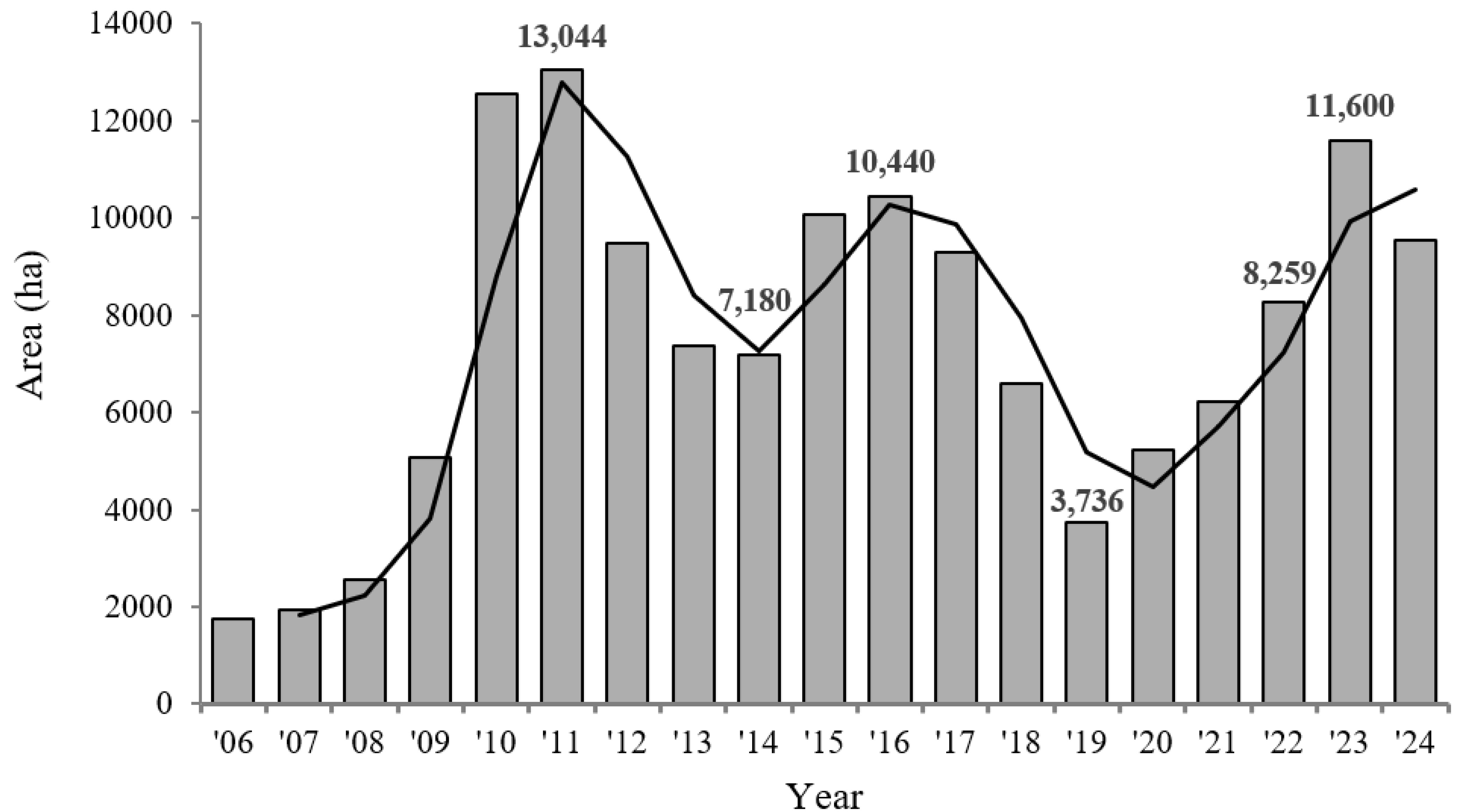
Fig. 2
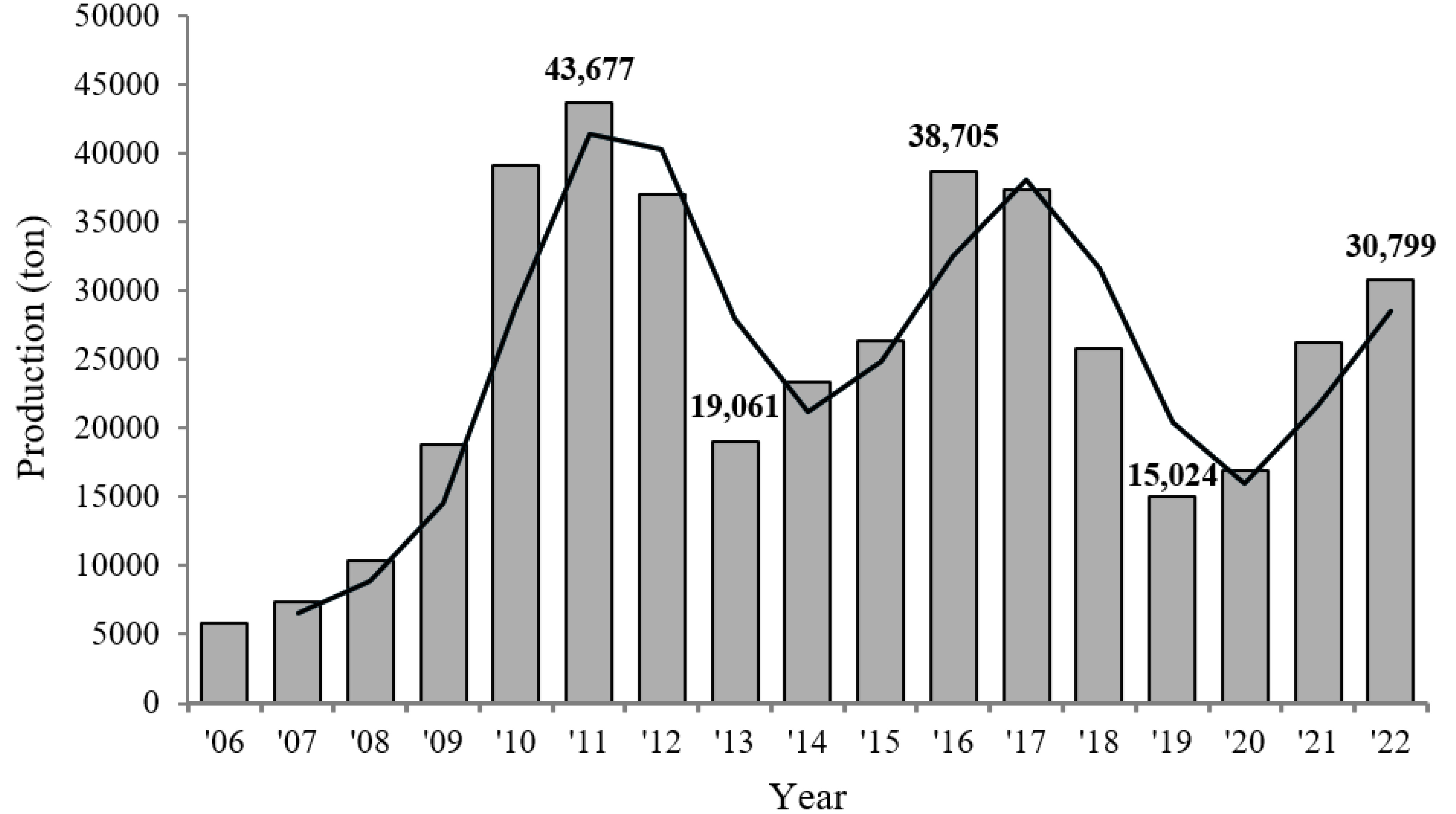
Table 1Characteristics, causal pathogens, and environmental conditions of major wheat diseases.
Table 1
|
Disease |
Causative agent / Virus |
Damage characteristics |
Condition for occurrence |
|
Fusarium Head Blight |
Fusarium graminearum
|
tde heads and grains turn red, resulting in yield reduction and tde production of trichotdecenes toxin. |
High temperature and humidity conditions. |
|
|
Leaf Rust |
Puccinia triticina
|
Orange spores appear on tde leaves. tde disease spreads to grains, reducing grain weight and tde number, leading to a decrease in yield. |
Low temperatures of 15-20°C and high humidity conditions. especially during tde grain-filling stage in May and tde harvest season in June. |
|
|
Stem Rust |
Puccinia graminis
f. sp. tirtici
|
Orange spores form on the stems, leading to reduced grain size and lodging, which results in yield loss. |
High temperature and humidity conditions. |
|
Stripe Rust
(or Yellow Rust) |
Puccinia striiformis
f. sp. Tritici
|
Orange spores appear in stripe patterns on the leaves, reducing the size and number of grains, which results in yield loss. |
Low temperatures of 4-7°C and high humidity conditions. |
|
|
Powdery mildrew |
Blumeria graminis
f. sp. tritici
|
White powdery lesions appear on the leaves and stems which results in yield loss. |
High temperature and humidity conditions. excessive nitrogen fertilization.
occurs especially during the rainy months of April and May, with symptoms worsening throughout the harvest season. |
Table 2Distribution of nutrients by wheat seed part.
Table 2
|
Seed part |
Function |
Ratio (%) |
Nutrients |
|
Seed coat |
Protection of the seed |
8 |
Dietary fiber, Potassium, Phosphorus, Magnesium, Calcium |
|
|
Aleurone layer |
Surrounds the entire endosperm except the part in contact with the scutellum |
7 |
Niacin, Minerals (Especially phosphorus), Phytic acid |
|
|
Endosperm |
Storage of seed material |
82 |
Starch, Protein, Pantothenic acid, Riboflavin, Minerals |
|
|
Embryo |
The state of being not yet divided into roots and stems |
1 |
Fat, Lipids, Sugar |
|
|
Scutellum |
The source of nutrition for the embryo, The passage connecting the embryo and the endosperm |
2 |
Vitamin B (especially Thiamine), Phosphorus |
Table 3Current status of major wheat cultivars developed domestically.
Table 3
|
Utilization by consumers |
Cultivar |
Year of release |
Major traits |
|
Noodle |
Keumkang |
1996 |
White grain, Cold resistance |
|
Joeun |
2000 |
Red grain |
|
Jopum |
2001 |
Red grain |
|
Anbaek |
2001 |
Lodging Tolerance |
|
Jonong |
2003 |
Red grain |
|
Younbeak |
2005 |
White grain, Lodging Tolerance |
|
Dabun |
2006 |
White grain |
|
Jeogjung |
2007 |
Fusarium head blight resistance |
|
Beakjoong |
2007 |
White grain, Pre-harvest sprouting tolerance, Fusarium head blight resistance |
|
Sugang |
2008 |
Red grain, Cold resistance, Pre-harvest sprouting tolerance, Lodging Tolerance |
|
Hanbaeg |
2008 |
Cold resistance |
|
Suan |
2009 |
Red grain, Cold resistance, Pre-harvest sprouting tolerance, Fusarium head blight resistance |
|
Dajung |
2010 |
Red grain, Cold resistance, Pre-harvest sprouting tolerance |
|
Hojoong |
2012 |
Red grain, Cold resistance, Pre-harvest sprouting tolerance, Lodging Tolerance |
|
Jojoong |
2014 |
Red grain, Pre-harvest sprouting tolerance, Lodging Tolerance |
|
Saekeumkang |
2015 |
Red grain, Pre-harvest sprouting tolerance, Fusarium head blight resistance |
|
Taejung |
2016 |
Red grain, Lodging Tolerance, Fusarium head blight resistance |
|
Johan |
2016 |
Red grain, Cold resistance, Lodging Tolerance |
|
|
Bread |
Jokhung |
2004 |
White grain |
|
Baeggang |
2015 |
White grain, Fusarium head blight resistance |
|
Hwanggeum |
2019 |
Red grain, Pre-harvest sprouting tolerance |
|
Neulchan |
2021 |
Red grain |
|
|
Cookie, Cake |
Goso |
2010 |
Red grain, Pre-harvest sprouting tolerance, Lodging Tolerance |
|
Joa |
2011 |
Red grain, Pre-harvest sprouting tolerance |
|
|
Cooking (mixed with rice) |
Shinmichal |
2006 |
Red grain |
|
Beakchal |
2012 |
White grain, Pre-harvest sprouting tolerance, Lodging Tolerance |
|
Brewing Wooju |
2020 |
White grain |
References
- 1. Ahn B. 2002. Market structure and import demand analysis on the food wheat in Korea. JRD 25: 1-15.
- 2. Alemu H. 2017. Review paper on breeding durum wheat (Triticum Turgidum L. var. Durum) for quality traits. Int J Adv Res Publ 1: 448-455.
- 3. Azimi N, Sofalian O, Davari M, Asghari A, Zara N. 2020. Statistical and machine learining-based FHB detection in durum wheat. Plant Breed Biotech 8: 265-280.
- 4. Bae G, Park R. 2020. A study on strategies for developing the wheat industry in Jeollabuk-do (Jeollabuk-do Mil San-eop Yukseong Bangan Yeongu). Jeonbuk Institute, from http://repository.jthink.kr/handle/2016.oak/605. Retrieved November 1, 2024
- 5. Byeon Y, Lee Y, Lee B, Sim G, Park H. 2012. Web GIS-based pest and disease monitoring, diagnosis, and prediction system for crops: National pest management system. In: 2024 Spring Confefence of KASE & ESK. Korean Society Of Applied Entomology, pp. 210.
- 6. Cha J, Lee J, Lee S, Ko J, Shin D. 2020. Heading date and growth character of Korean wheat cultivars by controlling photoperiod for rapid generation advancement. Korean J Breed Sci 52: 20-24.
- 7. Cha J, O'Connor K, Alahmad S, Lee J, Dinglasan E, Park H, Lee S, Hirsz D, Kwon S, Kwon Y. 2022. Speed vernalization to accelerate generation advance in winter cereal crops. Mol Plant 15: 1300-1309.
- 8. Cha J, Park H, Choi C, Kwon Y, Lee S, Oh K, Ko J, Kwon S, Lee J. 2023. Acceleration of wheat breeding: Enhancing efficiency and practical application of the speed breeding system. Plant Methods 19: 118
- 9. Cho S, Lee D, Yoon E, Kim G. 2012. Safe intake methods of cereals. J Food Hyg Saf 7: 3-8.
- 10. Choi R, Hong S, Yu J, Lee C, Baek J, Mo Y, Park CS. 2022. Analysis of grain appearance traits and images of Korean wheat cultivars. Korean J Breed Sci 54: 158-170.
- 11. EI-Hendawy S, Tahir MU, AI-Suhaibani N, Elsayed S, Elsherbiny O, Elsharawy H. 2024. Potential of thermal and RGB imaging combined with artificial neural networks for assessing salt tolerance of wheat genotypes grown in real-field conditions. Agronomy 14: 1390
- 12. Feng G, Gu Y, Wang C, Zhou Y, Huang S, Luo B. 2024. Wheat fusarium head blight automatic non-destructive detection based on multi-scale imaging: A technical perspective. Plants 13: 1722
- 13. Food Journal. 2018. [Research note] World's first allergen-reduced wheat 'OFree'. from https://www.foodnews.co.kr/news/articleView.html?idxno=68757. Retrieved October 26, 2024
- 14. Fu X, Bai Y, Zhou J, Zhang H, Xian J. 2021. A method for obtaining field wheat freezing injury phenotype based on RGB camera and software control. Plant Methods 17: 1-10.
- 15. Funke T, Han H, Healy-Fried ML, Fischer M, Schönbrunn E. 2006. Molecular basis for the herbicide resistance of roundup ready crops. Proc Natl Acad Sci USA 103: 13010-13015.
- 16. Gano B, Bhadra S, Vilbig JM, Ahmed N, Sagan V, Shakoor N. 2024. Drone-based imaging sensors, techniques, and applications in plant phenotyping for crop breeding: A comprehensive review. TPPJ 7: e20100.
- 17. González F, Capella M, Ribichich K, Curin F, Giacomelli J, Ayala F, Watson G, Otegui M, Chan R. 2019. Wheat transgenic plants expressing the sunflower gene HaHB4 significantly outyielded their controls in field trials. J Exp Bot 70: 1669-1681.
- 18. Gupta PK. 2023. Drought-tolerant transgenic wheat HB4®: A hope for the future. Trends Biotechnol 42: 807-809.
- 19. Hassan MA, Xiang C, Farooq M, Muhammad N, Yan Z, Hui X, Yuanyuan K, Bruno AK, Lele Z, Jincai L. 2021. Cold stress in wheat: plant acclimation responses and management strategies. Front Plant Sci 12: 676884.
- 20. Huh MK. 2015. An overview for molecular markers in plants. J Life Sci 25: 839-848.
- 21. Hwang J, Kim H, Chae Y, Choi H, Kim M, Park Y. 2012. Evaluation of germplasm and development of SSR markers for marker-assisted backcross in tomato. HST 30: 557-567.
- 22. Jang YR, Kang CS, Lim SH, Lee JY. 2018. Screening and identification of omega-5 gliadin mutants in wheat doubled-haploid lines. Korean J Breed Sci 50: 181-192.
- 23. Jiwan K, Seong-Yeob L. 2023. Legal issues of genetically edited organism and desirable direction of legislation. Korea Law Review 108: 331-376.
- 24. Jo S, Cho C, Ha K, Choi E, Kang Y, Kwon YI. 2013. The antioxidant and antimicrobial activities of extracts of selected barley and wheat inhabited in Korean peninsula. J Korean Soc Food Sci Nutr 42: 1003-1007.
- 25. Jung E, Lee D, Kim T, Park E, Song D. 2020. A study on establishing mid- to long-term development plans for the wheat industry. Korea Rural Economic Institute.
- 26. Jung T. 2020. Genetic enhancement and personal autonomy: Ethical implications of germline genome editing by CRISPR-CAS9 technology. Trans-Humanities 13: 29-61.
- 27. Kang C, Cheong Y, Kim B. 2016. Current situation and prospect of Korean wheat industry. Food Industry and Nutrition 21: 20-24.
- 28. Kang C, Cheong Y, Kim K, Kim H, Son J, Kim K, Park J, Kim D, Choi J, Bae J. 2015. A wheat variety,'Goso'with low protein, good cookie, red grain wheat and resistance to pre-harvest sprouting. Korean J Breed Sci 47: 330-338.
- 29. Kang C, Yun Y, Choi C, Son J, Lee J, Jeong H, Kim Y, Cheong Y, Park T. 2019. Gluten-intolerance and wheat-dependent exercise-induced anaphylaxis (WDEIA) reducing wheat 'OFree'. In: Proceedings of the Korean society of crop science conference. The Korean Society of Crop Science, pp. 215.
- 30. Kantor A, McClements ME, MacLaren RE. 2020. CRISPR-Cas9 DNA base-editing and prime-editing. Int J Mol Sci 21: 6240
- 31. Kim J, Lee S. 2023. Legal issues of genetically edited organism and desirable direction of legislation. Korea Law Review 108: 331-376.
- 32. Kim K, Cho S, Kang C, Kim K, Choi C, Son J, Park CS, Mo Y. 2020a. Research advances in wheat breeding and genetics for leaf rust resistance. Korean J Breed Sci 52: 213-224.
- 33. Kim K, Cho S, Kang C, Kim K, Choi C, Son J, Park CS, Mo Y. 2020b. Research advances in wheat breeding and genetics for stem rust resistance. Korean J Breed Sci 52: 225-234.
- 34. Kim K, Cho S, Kang C, Kim K, Choi C, Son J, Park CS, Mo Y. 2020c. Research advances in wheat breeding and genetics for stripe rust resistance. Korean J Breed Sci 52: 93-103.
- 35. Kim K, Jung J, Kang C, Shin S, Park J, Son J, Park CS. 2014. Mapping of QTL for pre-harvest sprouting resistance and seed dormancy in a doubled haploid population. Plant Breed Biotech 2: 247-256.
- 36. Kim MJ. 2016a. Immature wheat as functional ingredient of domestic wheat. Food Industry and Nutrition 21: 25-28.
- 37. Kim S. 2016b. Joa-Mil: Wheat for cakes with strong resistance to pre-harvest sprouting. National Institute of Crop Science. from https://www.nics.go.kr/bbs/view.do?m=100000126&bbsId=research&bbsSn=205958. Retrieved October 26, 2024
- 38. Kim Y, Choi S, Yoon IS, Kim SL, Mo Y. 2022. Research advances in improving disease resistance and abiotic stress tolerance using CRISPR/Cas9 gene editing in rice. Korean J Breed Sci 54: 331-344.
- 39. Korea Seed & Variety Service. n.d. Guide to government-distributed varieties, Geumgang. from https://www.seed.go.kr/seed/102/subview.do?enc=Zm5jdDF8QEB8JTJGdmFyaWV0eSUyRnNlZWQlMkY3MSUyRnZpZXcuZG8lM0Y%3D. Retrieved October 26, 2024
- 40. Korea Seed & Variety Service. n.d. Guide to government-distributed varieties, Hwanggeum-al. from https://www.seed.go.kr/seed/102/subview.do?enc=Zm5jdDF8QEB8JTJGdmFyaWV0eSUyRnNlZWQlMkYxMTYlMkZ2aWV3LmRvJTNG. Retrieved October 26, 2024
- 41. Korea Seed & Variety Service. n.d. Guide to government-distributed varieties, Sae Geumgang. from https://www.seed.go.kr/seed/102/subview.do?enc=Zm5jdDF8QEB8JTJGdmFyaWV0eSUyRnNlZWQlMkY5NCUyRnZpZXcuZG8lM0Y%3D. Retrieved October 26, 2024
- 42. Korea Seed & Variety Service. n.d. Guide to government-distributed varieties, Baekgang. from https://www.seed.go.kr/seed/102/subview.do?enc=Zm5jdDF8QEB8JTJGdmFyaWV0eSUyRnNlZWQlMkY5MyUyRnZpZXcuZG8lM0Y%3D. Retrieved October 26, 2024
- 43. Lee B. 2018. The impact of the 2018 abnormal cold weather conditions on wheat production damage: Trends in the global grain market. World Grain Market 7: 93-111.
- 44. Lee GH, Choi CH, Kim JY. 2021. Current status of precision breeding technology and plant transformation for development of what breeding material. Korean J Breed Sci 53: 250-265.
- 45. Lee H. 2021. The representative of Korean wheat to replace imports, Korea's first colored wheat, 'Ariheuk'. E-today. from https://www.etoday.co.kr/news/view/2083682. Retrieved October 26, 2024
- 46. Lee J, Kim Y, Kang C, Lim S, Ha S, Ahn S, Kim Y. 2011. High molecular weight glutenin subunit in common wheat (Triticum aestivum L.). Korean J Breed Sci 43: 479-489.
- 47. Lee JY, Seo MS, Won SY, Lim KA, Shin IS, Choi D, Kim JS. 2018. Construction of a genetic map using the SSR markers derived from "Wonwhang" of Pyrus pyrifolia. Korean J Breed Sci 50: 434-441.
- 48. Lee M, Hong S, Kim K, Kim Y, Kwak S, Kim K, Kang C, Park CS, Mo Y, Choi C. 2023a. Research advances in wheat breeding and genetics for powdery mildew resistance. Korean J Breed Sci 55: 218-243.
- 49. Lee M, Hong S, Kim K, Kwak S, Choi C, Kang C, Park CS, Mo Y, Kim K. 2023b. Research advances in wheat breeding and genetics for Fusarium head blight resistance. Korean J Breed Sci 55: 195-217.
- 50. Lee MH, Baek J, Kim K, Kim K, Kang C, Lee GE, Choi JY, Son J, Ko J, Choi C. 2022. Assessment of cold tolerance traits of Wheat cultivars using RGB images. Korean J Breed Sci 54: 171-176.
- 51. Lee SW. 2019. Current status on the modification of the scope for GMO regulation on the gene edited plants with no remnants of inserted foreign DNA fragments. J Plant Biotechnol 46: 137-142.
- 52. MAFRA. 2023. MAFRA prepares detailed action plan to enhance self-sufficiency rate of domestic wheat. from https://www.mafra.go.kr/bbs/home/792/566299/download.do. Retrieved October 25, 2024
- 53. MAFRA. 2024a. All wheat seeds used by farmers are genetically analyzable. from https://www.mafra.go.kr/home/5109/subview.do?enc=Zm5jdDF8QEB8JTJGYmJzJTJGaG9tZSUyRjc5MiUyRjU3MDk1NSUyRmFydGNsVmlldy5kbyUzRg%3D%3D. Retrieved October 25, 2024
- 54. MAFRA. 2024b. Announcement of the '2024 implementation plan' for the development of the domestic wheat industry, including support for commercialization of domestic wheat, introduction of new quality control standards. from https://www.mafra.go.kr/bbs/home/792/575798/download.do. Retrieved October 25, 2024
- 55. Maity S, Shrivastav SP. 2024. Understanding heat stress and tolerance mechanisms in wheat (Triticum aestivum L.): A comprehensive review. J Adv Biol Biotechnol 27: 1196-1211.
- 56. Mani V, Park S, Lee K, Kim JA, Ha K, Park S, Park S, Lee SI, Kwon S, Lee S. 2024. Metabolic perspective on soybean and its potential impacts on digital breeding: An updated pverview. J Plant Biol 67: 1-12.
- 57. Min KD, Kang Y N, Kim C S, Choi C H, Kim J Y. 2021. Genetic diversity and population structure of Korean common wheat (Triticum Aestivum). Korean J Breed Sci 53: 277-288.
- 58. Mukade K, Kamio M, Hosoda K. 1973. The acceleration of generation advancement in breeding rust-resistant wheat. In: Proceedings of the fourth international wheat genetics symposium pests. pp. 439-444.
- 59. Najmabadi S. 2023. Harvesting crews hustle to brings in wheat crop hit by drought, late rains. The Wall Street Journal. from https://www.wsj.com/articles/harvesting-crews-hustle-to-bring-in-wheat-crop-hit-by-drought-late-rains-2f000c8f?mod=Searchresults_pos14&page=1. Retrieved October 25, 2024
- 60. NARS. 2024. Trends and prospects in safety regulation changes related to gene-edited crops. from https://www.nars.go.kr/report/view.do?cmsCode=CM0018&brdSeq=44085. Retrieved November 1, 2024
- 61. Oh Y, Kim H, Joo J. 2021. 2020 preliminary feasibility study report development project of innovative technologies for the seed industry based on digital breeding. Korea Institute of S&T Evaluatio and Planning, pp. 42.
- 62. Park EJ, Sim J, Yang Y, Lee SB, Kim B, Kim S, Lee J. 2022. Agrobacterium-mediated transformation of wheat. Korean J Breed Sci 54: 358-368.
- 63. Park S, Joung Y, Kim K, Kim J, Koh H. 2019a. Gene-edited crops: Present status and their future. Korean J Breed Sci 51: 175-183.
- 64. Park S, Park J, Lim S, Lee J, Kim B. 2019b. Current status of new plant breeding technologies and crop development. Korean J Breed Sci 51: 161-174.
- 65. Park T, Son J, Kang C, Kim K, Choi C, Jung H, Kim K, Yang S, Kim S, Kim U, Yoon J, Kim D, Bae H, Jang H, Ahn S, Shin D, Seo D, Cha J, Park J. 2020. Wheat - Agricultural technology guide 044 (revised edition). Retrieved October 24, 2024, from https://www.nongsaro.go.kr/portal/search/nongsaroSearch.ps?categoryName=SCH01&menuId=PS00007&option=0&sortOrdr=01&searchWord=%EB%B0%80.
- 66. Rasheed A, Xia X. 2019. From markers to genome-based breeding in wheat. Theor Appl Genet 132: 767-784.
- 67. RDA. 2021a. Colored wheat: "Replacing imported wheat and increasing self-sufficiency". from https://nics.go.kr/bbs/view.do?m=100000020&bbsId=news&bbsSn=573706. Retrieved October 6, 2024
- 68. RDA. 2021b. Selection of lines for the development of early-maturing, high-yielding wheat varieties by usage. from https://www.nics.go.kr/bbs/view.do?m=100000126&bbsId=research&bbsSn=579785. Retrieved October 21, 2024
- 69. RDA. 2022a. Improving quality competitiveness and expanding double-cropping to increase wheat self-sufficiency. from https://www.nics.go.kr/bbs/view.do?m=100000020&bbsId=news&bbsSn=609032. Retrieved October 21, 2024
- 70. RDA. 2022b. Monitoring and control are essential for stable barley production in spring. from https://rda.go.kr/board/boardfarminfo.do?mode=view&prgId=day_farmprmninfoEntry&dataNo=100000778563&CONTENT1=#script. Retrieved October 25, 2024
- 71. RDA. 2024. Seeking solutions to overcome the climate crisis through agricultural research and development (R&D). from https://korea.kr/briefing/pressReleaseView.do?newsId=156612810. Retrieved October 26, 2024
- 72. Roth L, Fossati D, Krähenbühl P, Walter A, Hund A. 2023. Image-based phenomic prediction can provide valuable decision support in wheat breeding. Theor Appl Genet 136: 162
- 73. Sánchez-León S, Marín-Sanz M, Guzmán-López MH, Gavilán-Camacho M, Simón E, Barro F. 2024. CRISPR/Cas9-mediated multiplex gene editing of gamma and omega gliadins, paving the way for gliadin-free wheat. J Exp Bot erae 376:
- 74. Sharma V, Honkavaara E, Hayden M, Kant S. 2024. UAV remote sensing phenotyping of wheat collection for response to water stress and yield prediction using machine learning. Plant Stress 12: 100464.
- 75. Sheridan C. 2021. Argentina first to market with drought-resistant GM wheat. Nat Biotechnol 39: 652
- 76. Son J, Cheong Y, Park J, Kim K, Kim B, Kang C. 2017a. Current status of wheat allergy research. Korean J Breed Sci 49: 57-64.
- 77. Son J, Cheong Y, Park J, Kim Y, Park J, Kim K, Park T, Kim B, Kang C. 2017b. Assessment of genetic diversity and identification of Korean wheat varieties using RAPD markers. Korean J Breed Sci 49: 65-71.
- 78. Son J, Kim K, Cheong Y, Park J, Kim K, Kim Y, Oh Y, Song T, Kim B, Kang C. 2015. Evaluate of SSRs for heat tolerance using Korean major wheat cultivars and heat resistant Turkey resources. KJCS 60: 293-299.
- 79. Son J, Kim K, Shin S, Kim H, Kim N, Hyun J, Kang C. 2013. Current status and future prospects for Korean wheat research using molecular markers. Korean J Breed Sci 45: 189-200.
- 80. Song L, Wang R, Yang X, Zhang A, Liu D. 2023. Molecular markers and their applications in marker-assisted selection (MAS) in bread wheat (Triticum aestivum L.). Agriculture 13: 642
- 81. Sprink T, Wilhelm R, Hartung F. 2022. Genome editing around the globe: An update on policies and perceptions. Plant Physiol 190: 1579-1587.
- 82. Šramková Z, Gregová E, Šturdík E. 2009. Chemical composition and nutritional quality of wheat grain. Acta Chimica Slovaca 2: 115-138.
- 83. Stokstad E. 2004. Monsanto pulls the plug on genetically modified wheat. Science 304: 1088-1089.
- 84. USDA. 2023. Grain and feed update (KS2022-0031). from https://apps.fas.usda.gov/newgainapi/api/Report/DownloadReportByFileName?fileName=Grain%20and%20Feed%20Update_Seoul_Korea%20-%20Republic%20of_KS2022-0031.pdf. Retrieved October 21, 2024
- 85. Xie Y, Plett D, Evans M, Garrard T, Butt M, Clarke K, Liu H. 2024. Hyperspectral imaging detects biological stress of wheat for early diagnosis of crown rot disease. Comput Electron Agric 217: 108571.
- 86. Yang J, Park J, Son J, Kim K, Kim K, Jeong H, Kang C, Son J, Park T, Choi C. 2021. Protein and arabinoxylan contents of whole grains from wheat genetic resources cultivated in Korea. KJCS 66: 29-36.
- 87. Yang S. 2017. Core technology guidance (wheat). from https://agri.jeju.go.kr/agri/technology/crops.htm?qType=title&q=%EB%B0%80&button=%EA%B2%80%EC%83%89&page=1&act=download&seq=40027&no=1. Retrieved October 21, 2024