Skip to main navigation Skip to main content

Korean. J. Breed. Sci. : Korean Journal of Breeding Science

OPEN ACCESS
ABOUT
BROWSE ARTICLES
EDITORIAL POLICIES
FOR CONTRIBUTORS

Articles

ARTICLE

자색 찰성 겉보리 신품종 ‘보안찰’

Purple Covered Waxy Barley (Hordeum vulgare L.) Cultivar, ‘Boanchal’

Korean Journal of Breeding Science 2014;46(4):445-450.
Published online: November 30, 2014

1 국립식량과학원

1 National Institute of Crop Science(NICS), RDA, Suwon 441-100, Korea

2 충청북도농업기술원

2 Chungbuk Agricultural Research and Extension Service, Cheongwon 363-880, Korea

3 경상북도농업기술원

3 Gyeongbuk Agricultural Research and Extension Service, Daegu 702-320, Korea

*Corresponding Author : kim5yk@korea.kr, Tel: +82-63- 840-2242, Fax: +82-63-840-2116)
• Received: August 1, 2014   • Revised: August 3, 2014   • Accepted: September 29, 2014

© Tshe Korean Society of Breeding Science All rights reserved

This is an Open-Access article distributed under the terms of the Creative Commons Attribution Non-Commercial License (http://creativecommons.org/licenses/by-nc/3.0) which permits unrestricted non-commercial use, distribution, and reproduction in any medium, provided the original work is properly cited.
  • 2 Views
  • 0 Download
prev next
  • ‘Boanchal’, a new covered waxy barley cultivar derived from crossing the ‘Suwon232’ and ‘Masangwamaeg’ with early maturing and colored waxy endosperm cultivars, respectively was developed at the National Institute of Crop Science, RDA in 2009. ‘Boanchal’ is characterized as the growth habit of Ⅲ, green leaf, medium spike and long rough awns. The heading date was April 24 in upland and April 17 in paddy field which was 2 and 1 day, respectively earlier than check cultivar, ‘Seodunchal’. The culm length of ‘Boanchal’ was 79 cm, which was 11 cm shorter than that of check cultivar. It showed spike length of 3.5 cm, 854 spikes per m2, 43 grains per spike, and 28.0 g of 1,000-grain weight. Comparing to check cultivar, ‘Boanchal’showed stronger winter hardiness, but a similar resistance to barley yellow mosaic virus (BaYMV). It had purple grain and showed higher expansion rate than that of check cultivar, ‘Seodunchal’. Average yield of ‘Boanchal’ in the regional adaptation yield trial (RYT) was 2.96 MT/ha in upland and 3.91 MT/ha in paddy field. ‘Boanchal’ would be suitable for the area above -8°C of daily minimum temperature in January in Korean peninsula.
보리는 수매 중단 이후 재배면적이 극감하였으나 최근 보 리 가공산업 활성화와 1인당 소비량 1.3 kg(2012)을 유지로 재배면적이 30.5천ha로 회복되고 있다. 최근 웰빙시대에 부응 한 다양한 기능성 칼라 식품이 개발되어 소비자들의 관심이 높아짐에 따라 채소는 물론 곡류에 있어서도 유색 미, 유색 콩, 유색 옥수수 등과 같은 기능성이 가미된 곡류 섭취 증가 로 소비가 증가하고 있다(Song et al. 2005). Anthocyanin은 식물에 함유된 수용성 천연색소로 과채류와 곡류 등에 함유 되어 있고, pH에 따라 보라색, 적색, 주황색, 청색, 분홍색 등 다양한 색깔을 나타낸다(Henry 1996). 보리의 노랑, 청색 또 는 검정색의 보리종자에 delphinidin과 cyanidin이, 보라색 종자에는 pelargonidin이 함유되어 있다고 하였다(Jende- Strid 1978). Song et al. (2005)에 의하면 유색보리 계통이 전자공 여능, SOD-like 활성, lecithin 산화 저해활성능, hydrogen radical 소거능이 높았으며, 여러 가지 항산화 실험에서 항산 화능이 높게 측정되었다고 하였다. 현재 우리나라에서 재배 보급되고 있는 유색보리로는 자색종인 자수정찰, 보석찰, 흑 색종인 흑나래, 흑누리 그리고 청색종인 강호청 등 쌀보리가 개발되어 재배되고 있으며, 노란색 호분층을 가진 황금찰 겉 보리도 보급되고 있다(Choi et al. 2007, Lee et al. 2011a, 2012b, Kim et al. 2007). 그러나 특히 유색 쌀보리는 한해에 약한 편이어서 1월 최저평균기온이 -6°C 이상인 지역인 비교 적 따뜻한 남부지역에서 많이 재배되고 있는 실정이다. 따라 서 한해에 강한 특성을 지닌 겉보리 품종을 중북부지역 보급 하고자 겉보리 유색보리을 개발하게 되었다. ‘보안찰’은 자색 보리로 한해에 강하고 출수가 빠르면서 쓰러짐에 대한 저항 성이 강한 특성 등을 지닌 유색 겉보리 품종으로 그 육성경위 와 주요특성을 보고하는 바이다.
본 신품종의 생육 특성 및 수량검정 연구는 2007년부터 2009년까지 3년간 지역적응시험지역인 경기도 수원, 전북 익 산, 충북 청원, 경북 대구 등 4개 지역에서 표준품종인 서둔찰 보리와 비교 검토하였으며(RDA 2007, 2008, 2009), 지역별 표준재배로 수행하였다. 각각의 생육특성, 내재해성, 내병성, 수량구성요소 및 수량 등은 지역적응시험지역에서 3개년간 조사분석 하였다. 수량구성요소 중 천립중은 2.0 mm 종목체 를 통과한 종실 즉 설립을 제거한 종실에서 1,000립을 측정하 였으며, 수량은 설립을 제외한 ha 당 조곡수량에 67%의 비율 을 적용 수분 14%로 보정하여 환산하였다. 기타 조사는 농업 과학기술 연구조사 분석기준(RDA 2003)에 준하였다. 병해검 정 중 흰가루병은 수원, 익산지역에서 포장(비닐하우스)에서 Erysiphe graminis f.sp. hordei 병원균을 접종 2주 후 조사하 였으며, 발병심도를 0~9 및 괴사정도로 판정하였다. 보리호 위축병(Barley yellow mosaic virus, BaYMV) 검정은 지역 별 상습발병포장인 익산(strain Ⅲ형), 나주(strain Ⅰ형), 진주 (strain Ⅳ형)지역에서 자연 발생을 유도하였고 백동품종을 체크품종으로 하여 이병정도(0~9)를 3월 상순에서 4월 상순 사이에 조사하였다(Park et al. 2009). 내한성 검정은 경기도 연천 시험지에서 9월 하순에 파종하여 월동 후 고사주율(%) 을 조사하였다. 품질 분석은 조곡에서 단백질을, 정곡에서 베 타글루칸 등을 분석하였다. 시료는 Satake 시험도정기로 정맥 수율 67%로 정맥하였다. 조곡과 정곡을 0.5 mm체가 장착된 Retsch centrifugal mill (Model Dm/Zm 100)로 분쇄한 분말 시료를 사용하였다. 단백질분석은 Elementar Analyzer System (US/Vario)를 이용하여 분석한 총 질소함량에 켈달장치를 이 용하여 분석한 값과 비교하여 얻어진 conversion factor 5.17 를 곱하여서 구하였다. β-glucan 분석은 Mcclary 방법(Mccleary & Glennie-Holmes 1985)을 이용한 Megazyme kit를 이용하 여 510 nm에서 흡광도로 분석하였다. 백도는 Kett (Kett Electic Laboratory C-300-3)으로 3회 측정하였다. 취반에 따 른 정맥의 수분 흡수율, 퍼짐성은 Shinjiro et al. (1965)의 방 법을 사용하여 분석하였다. 보리쌀 5 g을 20 ml D.W (distilled water)가 들어있는 50 ml 메스실린더에 넣은 후 부피(a)를 읽 고, 이 시료를 평량한 알루미늄망(자체제작)에 넣어서 증류수 를 제거한 후 이 망을 100 ml 비이커에 넣고 충분히 끓는 물 80 ml를 부어 알루미늄 호일로 덮어 150°C 건조기에서 40분 간 취반하였다. 취반된 시료를 꺼내어 10회 정도 물기를 떨어 준 다음 비이커 60°C 정도 기울여 놓는다. 10분 후 무게(b)를 측정하고 이 시료를 20 ml 증류수가 들어 있는 50 ml 메스실 린더에 옮기고 부피(c)를 잰다. 100 ml 비이커에 남아 있는 물을 건조기에 넣고 75°C~80°C에서 16시간 정도 건조시킨 후 꺼내어 데시게이터에 넣고 30분 후 무게를 측정하고 다음 식으로 흡수율(%)=흡수 후 무게(b)-(시료+망무게)/시료무게 × 100, 퍼짐성(%)=취반 후 부피(c)/취반 전 시료부피(a) × 100으로 흡수율과 퍼짐성을 계산하였다. 안토시아닌 분석시 료는 완전히 성숙된 이삭을 탈곡한 종실을 이용하였다. 안토 시아닌은 5 ml 갈색병에 시료 0.2 g을 넣은 후 0.1N HCl- 80% MeOH 용액 2 ml을 가하여 4°C에서 24시간 추출하였 다. 추출액을 2.0 ml microtube에 옮긴 후 10,000 rpm에서 10분간 centrifuging 하였다. 원심분리한 상등액은 0.45 μg syring filter를 이용하여 여과한 후 HPLC분석 시험용액으로 사용하였다. 분석조건은 column (YMC-Pack, ODS- AM), detector (UV, 520 nm, Flow rate (0.9 ml/min), solvent (A: 5% formic acid, B: Acetonnitrile + formic acid), absorbance (520 nm), injection volume (20 μl) 하였다(Kim et al. 2007). 통계처리의 평균값의 비교는 α=5% 유의수준에서 Duncan`s Multiple Range test (DMRT)로 분석하였다.
육성경위
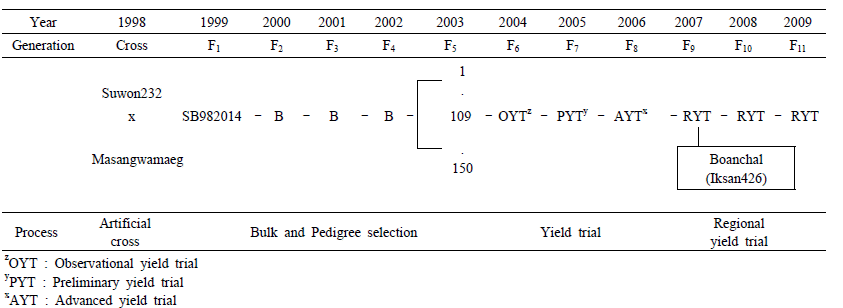
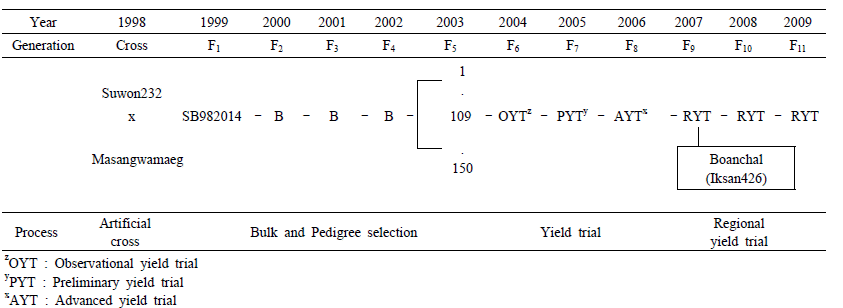
‘보안찰’은 1998년에 조숙계통인 ‘수원232호’모본으로, 찰 성, 자색, 쌀보리인 ‘마산과맥’를 부본으로 인공교배 하였다. 답리작 적응성이 뛰어나고 한해에 강한 특성과 단간이면서 도복에 강한 유색 겉보리를 육성하기 위해 1999년에 F1을 양 성한 후 이듬해 집단으로 F2를 전개하였고, 2001~2002년에 는 각각 F3, F4를 집단선발 하다. 2003년에는 F5 계통선발 하 였으며 2004년에는 OYT (Observational yield trial)를 공시 하여 우량시 되는 SB982014-B-B-B-109-B계통을 선발하였 다. 2005년부터 2개년간 생산력검정시험을 실시한 결과, 자 색이면서 키가 작은 단간으로 내도복성이 강한 우수 계통으 로 판명되어 ‘익산426호’로 계통명을 부여, 2007년부터 3개 년간 전작포장 재배시험을 수원, 청원 등 2개 지역, 답리작 재 배시험을 익산, 대구 등 2개 지역에서 지역적응시험을 실시하 였다(RDA 2007, 2008, 2009). 그 결과, 자색이면서 내도복 성이 강한 계통으로 입증되어 2009년 농작물 직무육성 신품 종선정심의회에서 선정됨과 동시에 ‘보안찰’로 명명하였다. 육성 계통도를 도식화하면 Fig. 1과 같다.
Fig. 1.
Pedigree diagram of a new barley variety,‘Boanchal’.
KJBS-46-445_F1.gif
주요특성
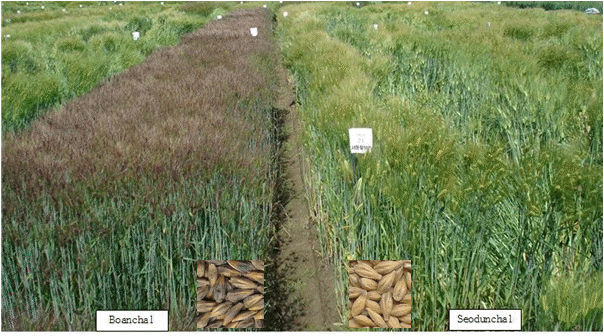
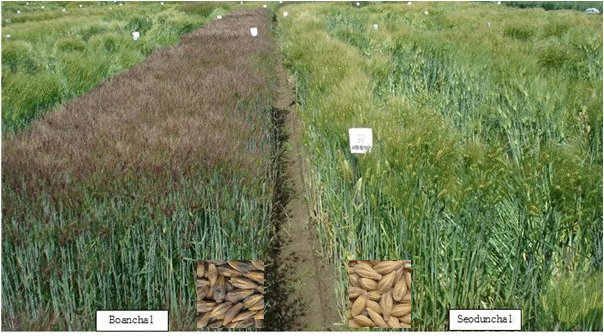
‘보안찰’은 Table 1에서 보는 바와 같이 이삭이 6조 밀수 형인 겉보리로서 파성이 Ⅲ이며, 줄기의 굵기는 가늘고 엽색 은 녹색, 폭은 중간형이다. 이삭의 색깔은 자색으로 출수 후 25일 전·후에서 색깔 발현이 시작되어 이삭이 성숙하면 끝이 난다. Song et al. (2011)에 의하면 보리에서 안토시아닌이 출 수 후 25일부터 검출되기 시작, 자색보리의 색깔 발현 시기가 육안으로 판단한 것과 유사하였다. 까락은 길며 탈망성이 양 호하다. 출수기는 4월 20일로 조숙종인 서둔찰보리보다 2일 빠르다. 성숙기는 5월 28일로 서둔찰보리보다 2일 정도 빠른 성숙을 보여 서둔찰보리와 같은 등숙일수를 보였다. 간장은 79 cm로 서둔찰보리보다 11 cm 작은 중간형으로 도복에 잘 견딘다. 수장은 3.5 cm로 서둔찰보리보다 작다. m2당 수수는 854개로 서둔찰보리보다 95개 많으나 1수립수는 43개로 9개 적은 품종으로 립수가 적은 단점이 보완되어야 할 부분이다.천립중은 28.0 g으로 서둔찰보리보다 적은 중소립종이며, 1L 중은 671 g으로 다소 가벼웠다(Table 2). 내한성은 경기도 연 천에서 검정한 결과(RDA 2007, 2008, 2009), 저휴(골) 재배 에서 6.1%, 고휴(두둑) 재배에서 14.7%로 서둔찰보리 25.0% 보다 10.3% 고사주율이 낮아 고휴재배에서 다소 강하였다. 도복(도복 발생지역 평균)정도는 1로 서둔찰보리 5 보다 강하 였다. 흰가루병은 유묘 접종 검정된 결과 감수성으로 서둔찰 보리와 같았다. 토양 전염병인 보리호위축병으로 상습발병지 에서 큰 피해를 주는 병으로(So et al. 1991) 남부 주재배지역 인 나주(strain Ⅰ형)와 진주(strain Ⅳ형)지역에서 저항성을 보였으며, Ⅲ형인 익산지역에서는 7정도로 약한 저항성을 나 타냈다(Table 3). 단백질 함량은 조곡(원맥)에서 11.7%, β -glucan 함량 6.7%, 정맥률은 67.3로 서둔찰보리와 비슷하였 으며, 보리쌀 색의 입백도는 35.6로 서둔찰보리 41.0 보다 낮 았다 이는 자색보리 특성상 도정 후에도 약간의 자색이 묻어 있어 백도가 낮아진 것으로 보인다(Table 4). 보안찰은 자색 의 영을 가진 겉보리로 안토시아닌 함량이 181.1 μg/g 서둔찰 보리 5.9 μg/g 보다 175.2 μg/g 높았다(Table 5). 자색보리 품 종이 일반보리 품종보다 안토시아닌 함량이 높다는 결과 (Choi et al. 2007)와 일치하였다.2
Fig. 2.
The photo of Boanchal (left) and Seodunchal (right) with its grain taken from the research field in Iksan.
KJBS-46-445_F2.gif
Table 1.
Growth habit and morphological characteristics of ‘Boanchal’.
Table 1.
Cultivar Growth habit Grain color Leaf Culm Spike Awn length


Color Width size Color Diameter Type Density

Boanchal III Purple Light Green Medium Purple Thin 6-rowed Compact Long type
Seodunchal III yellow Green Medium Light yellow Medium 6-rowed Compact Long type
Table 2.
Agronomic Characteristics of cultivar ‘Boanchal’ cultivated in Suwon, Cheongwon, Iksan and Daegu regions from 2007 to 2009.
Table 2.
Cultivar Heading date Maturing date Culm length (cm) Spike length (cm) No. of spike per m2 No. of grains per spike Test weight (g) 1000 grain weight (g)

Boanchal Apr.20 May 28 79bz 3.5b 854a 43b 671a 28.0b
Seodunchal Apr.22 May 30 90a 4.4a 759b 52a 678a 31.8a

zThe same letters are not significantly different among varieties at the 5% probability level by DMRT

Table 3.
Winter hardiness, lodging resistance and BaYMV of cultivar ‘Boanchal’ tested in Yeoncheon, Suwon, Cheongwon, Iksan, Daegu, Naju nand Jinju regions from 2007 to 2009.
Table 3.
Cultivar Winter withering ratez (%) Lodging (0~9) Powdery mildewy BaYMVx (0~9)


Normal High ridge Infection type Naju (I) Iksan (III) Jinju (IV)

Boanchal 6.1aw 14.7a 1b Susceptible 1a 7a 1a
Seodunchal 0.0a 25.0a 5a Susceptible 2a 4a 2a

zData tested at Yeoncheon

yMeans of Suwon, Iksan during RYT

xBarley Yellow Mosaic Virus. 0: Resistence, 9 : Susceptible

wThe same letters are not significantly different among varieties at the 5% probability level by DMRT

Table 4.
Pearling and cooking characteristics of ‘Boanchal’.
Table 4.
Cultivar Protein content (%) β-glucan content (%) Grain pearling Cooking quality


Rate (%) Whiteness Water absorption Rate (%) Expansion rate (%)

Boanchal 11.7az 6.7a 67.3a 35.6b 274.5a 444.5a
Seodunchal 10.5a 6.4a 70.4a 41.0a 270.0a 432.0a

zThe same letters are not significantly different among varieties at the 5% probability level by DMRT

Table 5.
Anthocyanin contents of ‘Boanchal’.
Table 5.
Cultivar Anthocyanin cont. (μg/g)z

Total Cya3g Del3g Pel3g Others

Boanchal 181.1 ay 30.1 a 1.4 a 3.9 a 145.8 a
Seodunchal 5.9 b ND b 1.3 a 2.6 b 1.9 b

zCya3g : Cyanidin-3-glucoside, Del3g : Delphinidin-3-glucoside, Pel3g : Pelargonidin-3-glucoside, ND : Not detected

yThe same letters are not significantly different among varieties at the 5% probability level by DMRT

수량성
‘보안찰’의 수량성은 2007년부터 2009년까지 3개년간 실 시한 지역적응시험(RDA 2007, 2008, 2009) 결과, 수량은 ha 당 3.44 MT으로 서둔찰보리에 비해 수량이 낮았다. 전작재 배 수원, 청원지역에서 답리작재배는 익산, 대구지역에서 연 차간 수량변이가 있어 통계적인 차이가 인정되지 않았다. 전 작재배에서 2.96 MT/ha, 답리작재배에서 3.91 MT/ha 이었 다(Table 6).
Table 6.
Yield potential of ‘Boanchal’ in the regional yield trials (RYT) tested in Suwon, Cheongwon, Iksan, and Daegu regions from 2007 to 2009.
Table 6.
Field Region Boanchal (MT/ha) Seodunchal (MT/ha) Index (A/B×100)


2007 2008 2009 Mean (A) 2007 2008 2009 Mean (B)

Upland Suwon 3.17 3.76 3.28 3.40 3.18 3.72 4.06 3.65 93
Cheongwon 2.65 2.02 2.89 2.52 3.87 2.59 4.37 3.61 70

Mean 2.91 2.89 3.09 2.96 3.53 3.16 4.22 3.63 82

Paddy Iksan 2.84 3.42 4.25 3.50 3.57 4.78 4.45 4.27 82
Daegu 4.18 3.98 4.79 4.32 4.41 4.86 4.06 4.44 97

Mean 3.51 3.70 4.52 3.91 3.99 4.82 4.26 4.36 90

Total mean 3.21 3.30 3.80 3.44bz 3.76 3.99 4.24 3.99a 86

zThe same letters are not significantly different among varieties at rhe 5% probability level by DMRT

‘보안찰’은 답리작 적응성이 높은 조숙 내한 내도복 유색 찰성 겉보리로 육성된 품종으로 파성은 Ⅲ이며, 이삭의 밀도 는 밀수형으로 까락 긴 장망형이다. 출수기와 성숙기는 각각 2일 빠른 조숙종이다. 흰가루병과 보리호위축병은 서둔찰보 리와 비슷하였다. 내한성과 내도복성은 서둔찰보리보다 다소 강하였다. 간장(79 cm)은 작고, 수장은 서둔찰보리보다 약간 작다. m2당 수수는 854개로 서둔찰보리보다 많고, 1수립수는 43개로 적다. 천립중은 서둔찰보리보다 작은 중소립종이며, 1 ℓ중은 다소 가벼웠다. 단백질 함량, β-glucan 함량과 정맥률 은 비슷하였고, 입백도는 낮았다. 취반특성 중 흡수율과 퍼짐 성은 비슷하였고, 안토시아닌 함량은 181.1 μg/g으로 높았다. 수량은 전작에서 2.96 MT/ha, 답리작에서 3.91 MT/ha 있었다.
본 논문은 농촌진흥청 시험연구사업(과제번호: PJ0064970 62014)의 지원에 의해 이루어졌으며, 품종 육성함에 있어 협 력하여 주신 농촌진흥청 국립식량과학원 및 농촌진흥청 연구 관리국, 각도 농업기술원 관계관께 깊은 감사를 드립니다.
  • 1. Choi JS, Suh JH, Min KS, Lee MJ, Park JC, Kim YK, Park TI, Hwang JJ, Kim HS, Baek SB, Ryu IM, Ju JI, Kang SJ, Kim DH, kim JG, Jung KY, Lee SH. A new colored naked barley cultivar “Zasoojeongchal” with waxy endosperm. Korean J. Breed. Sci 2007. 39: 244-245.
  • 2. HenryBS. Natural food colors. Hendry GAF, Houghton JD, editors. natural food colorans. Glasgo, Great Britain: Blackie and Son Ltd. 1996. 2nd ed. pp. 39-78.
  • 3. Jende-Strid B. Mutation affectiong flavonoid synthesis in barley. Carsberg Res. Commun 1978. 43: 265-273.
  • 4. Kim MJ, Hyun JN, Kim JA, Park JC, Kim MY, Kim JG, Lee SJ, Chun SC, Chung IM. Relationship between phenolic compounds, anthocyanins content and antioxidant activity in colored barley germplasm. J. Agric. Food Chem 2007. 55: 4802-4809.
  • 5. Kim YK, Baek SB, Kim JG, Lee MJ, Kim MJ, Kang Ms, Kim HS, Seo JH, Hwang JJ, Suh SJ, Hyun JN, Kim SJ, Ryu IM, Kim JC, Jung Ky, Lee SH. A new Sixrowed barley cultivar, “Hwangggeumchal” with waxy cover and yellow aleurone. Korean J. Breed. Sci 2007. 39: 335-336.
  • 6. Lee MJ, Seo JH, kim YK, Kim MJ, Park JC, Choi JS, Hyun JN, Kim JG, Kim TS, Lee KW, Kim KJ. Naked waxy barley cultivar “Boseokchal” with high anthocyanin content and purple lemma. Korean J. Breed. Sci 2011a. 43: -83.
  • 7. Lee MJ, Seo JH, kim YK, Park JC, Cho SK, Choi JS, Kim TS, Lee KW, Kim KJ. Six-rowed naked nonwaxy barley (Hordeum vulgare L.) cultivar “Ganghocheong” with high anthocyanin content and green aleurone. Korean J. Breed. Sci 2012b. 44: -89.
  • 8. McCleary BV, Glennie-Holmes M. Enzymic quantification of (1-3) (1-4)-β-D-glucan in barley and malt. J. of the Institute of Brewing 1985. 91: 285-295.
  • 9. Park JC, Noh TH, Park CS, Kang CS, Kang MH, Lee ES, Lee JH, Lee JJ, Kim TS. Responses of resistant genes to Barley Yellow Mosaic Virus (BaYMV) strains in Korea. Res. Plant Dis 2009. 15: 72-76.
  • 10. Rural Development Administration (RDA)Agriculture Experiment Investigation Standard 2003.
  • 11. Rural Development Administration (RDA)Report of Development New Variety of Winter Crops 2007.
  • 12. Rural Development Administration (RDA)Report of Development New Variety of Winter Crops 2008.
  • 13. Rural Development Administration (RDA)Report of Development New Variety of Winter Crops 2009.
  • 14. Shinjiro C, Endo I, Tani T. Qualities of rices by early seasonal cultivation or early sowing depend upon rice varieties and growing regions. Ⅱ. Cooking Qualities of Rice Grains. Report of the Food Research Institute 1965. Tokyo, Japan, 20: -13.
  • 15. Song ES, Park SJ, Woo NRA, Won MH, Choi JS, Kim JG, Kang MH. Antioxidant capacity of colored barley extracts by varities. J. Korean Soc. Food Sci. Nutr 2005. 34: 1491-1497.
  • 16. So IY, Cheong SS, Lee KJ, Oho YH. Vector of barley yellow mosaic virus (BaYMV) and consideration on its control. Res. Rept. RDA (Agri. Institutional Cooperation) 1991. 34: 75-83.
  • 17. Song TH, Han OK, Kim YK, Park TI, Park KH, Kim KJ. Effect of top dressing and harvest time on growth, feed value, and anthocyanin content of colored barley. Korean J. Crop Sci 2011. 56: 159-166.

Download Citation

Download a citation file in RIS format that can be imported by all major citation management software, including EndNote, ProCite, RefWorks, and Reference Manager.

Format:

Include:

Purple Covered Waxy Barley (Hordeum vulgare L.) Cultivar, ‘Boanchal’
Korean. J. Breed. Sci.. 2014;46(4):445-450.   Published online December 31, 2014
Download Citation

Download a citation file in RIS format that can be imported by all major citation management software, including EndNote, ProCite, RefWorks, and Reference Manager.

Format:
Include:
Purple Covered Waxy Barley (Hordeum vulgare L.) Cultivar, ‘Boanchal’
Korean. J. Breed. Sci.. 2014;46(4):445-450.   Published online December 31, 2014
Close

Figure

  • 0
  • 1
Purple Covered Waxy Barley (Hordeum vulgare L.) Cultivar, ‘Boanchal’
Image Image
Fig. 1. Pedigree diagram of a new barley variety,‘Boanchal’.
Fig. 2. The photo of Boanchal (left) and Seodunchal (right) with its grain taken from the research field in Iksan.
Purple Covered Waxy Barley (Hordeum vulgare L.) Cultivar, ‘Boanchal’

Growth habit and morphological characteristics of ‘Boanchal’.

Cultivar Growth habit Grain color Leaf Culm Spike Awn length


Color Width size Color Diameter Type Density

Boanchal III Purple Light Green Medium Purple Thin 6-rowed Compact Long type
Seodunchal III yellow Green Medium Light yellow Medium 6-rowed Compact Long type

Agronomic Characteristics of cultivar ‘Boanchal’ cultivated in Suwon, Cheongwon, Iksan and Daegu regions from 2007 to 2009.

Cultivar Heading date Maturing date Culm length (cm) Spike length (cm) No. of spike per m2 No. of grains per spike Test weight (g) 1000 grain weight (g)

Boanchal Apr.20 May 28 79bz 3.5b 854a 43b 671a 28.0b
Seodunchal Apr.22 May 30 90a 4.4a 759b 52a 678a 31.8a

zThe same letters are not significantly different among varieties at the 5% probability level by DMRT

Winter hardiness, lodging resistance and BaYMV of cultivar ‘Boanchal’ tested in Yeoncheon, Suwon, Cheongwon, Iksan, Daegu, Naju nand Jinju regions from 2007 to 2009.

Cultivar Winter withering ratez (%) Lodging (0~9) Powdery mildewy BaYMVx (0~9)


Normal High ridge Infection type Naju (I) Iksan (III) Jinju (IV)

Boanchal 6.1aw 14.7a 1b Susceptible 1a 7a 1a
Seodunchal 0.0a 25.0a 5a Susceptible 2a 4a 2a

zData tested at Yeoncheon

yMeans of Suwon, Iksan during RYT

xBarley Yellow Mosaic Virus. 0: Resistence, 9 : Susceptible

wThe same letters are not significantly different among varieties at the 5% probability level by DMRT

Pearling and cooking characteristics of ‘Boanchal’.

Cultivar Protein content (%) β-glucan content (%) Grain pearling Cooking quality


Rate (%) Whiteness Water absorption Rate (%) Expansion rate (%)

Boanchal 11.7az 6.7a 67.3a 35.6b 274.5a 444.5a
Seodunchal 10.5a 6.4a 70.4a 41.0a 270.0a 432.0a

zThe same letters are not significantly different among varieties at the 5% probability level by DMRT

Anthocyanin contents of ‘Boanchal’.

Cultivar Anthocyanin cont. (μg/g)z

Total Cya3g Del3g Pel3g Others

Boanchal 181.1 ay 30.1 a 1.4 a 3.9 a 145.8 a
Seodunchal 5.9 b ND b 1.3 a 2.6 b 1.9 b

zCya3g : Cyanidin-3-glucoside, Del3g : Delphinidin-3-glucoside, Pel3g : Pelargonidin-3-glucoside, ND : Not detected

yThe same letters are not significantly different among varieties at the 5% probability level by DMRT

Yield potential of ‘Boanchal’ in the regional yield trials (RYT) tested in Suwon, Cheongwon, Iksan, and Daegu regions from 2007 to 2009.

Field Region Boanchal (MT/ha) Seodunchal (MT/ha) Index (A/B×100)


2007 2008 2009 Mean (A) 2007 2008 2009 Mean (B)

Upland Suwon 3.17 3.76 3.28 3.40 3.18 3.72 4.06 3.65 93
Cheongwon 2.65 2.02 2.89 2.52 3.87 2.59 4.37 3.61 70

Mean 2.91 2.89 3.09 2.96 3.53 3.16 4.22 3.63 82

Paddy Iksan 2.84 3.42 4.25 3.50 3.57 4.78 4.45 4.27 82
Daegu 4.18 3.98 4.79 4.32 4.41 4.86 4.06 4.44 97

Mean 3.51 3.70 4.52 3.91 3.99 4.82 4.26 4.36 90

Total mean 3.21 3.30 3.80 3.44bz 3.76 3.99 4.24 3.99a 86

zThe same letters are not significantly different among varieties at rhe 5% probability level by DMRT

Table 1. Growth habit and morphological characteristics of ‘Boanchal’.
Table 2. Agronomic Characteristics of cultivar ‘Boanchal’ cultivated in Suwon, Cheongwon, Iksan and Daegu regions from 2007 to 2009.

The same letters are not significantly different among varieties at the 5% probability level by DMRT

Table 3. Winter hardiness, lodging resistance and BaYMV of cultivar ‘Boanchal’ tested in Yeoncheon, Suwon, Cheongwon, Iksan, Daegu, Naju nand Jinju regions from 2007 to 2009.

Data tested at Yeoncheon

Means of Suwon, Iksan during RYT

Barley Yellow Mosaic Virus. 0: Resistence, 9 : Susceptible

The same letters are not significantly different among varieties at the 5% probability level by DMRT

Table 4. Pearling and cooking characteristics of ‘Boanchal’.

The same letters are not significantly different among varieties at the 5% probability level by DMRT

Table 5. Anthocyanin contents of ‘Boanchal’.

Cya3g : Cyanidin-3-glucoside, Del3g : Delphinidin-3-glucoside, Pel3g : Pelargonidin-3-glucoside, ND : Not detected

The same letters are not significantly different among varieties at the 5% probability level by DMRT

Table 6. Yield potential of ‘Boanchal’ in the regional yield trials (RYT) tested in Suwon, Cheongwon, Iksan, and Daegu regions from 2007 to 2009.

The same letters are not significantly different among varieties at rhe 5% probability level by DMRT