Skip to main navigation Skip to main content

Korean. J. Breed. Sci. : Korean Journal of Breeding Science

OPEN ACCESS
ABOUT
BROWSE ARTICLES
EDITORIAL POLICIES
FOR CONTRIBUTORS

Articles

ARTICLE

당도가 높고 도복에 강한 노란 단옥수수 ‘고당옥’

A Yellow Sweet Corn Hybrid with High Sugar Content and Lodging Tolerance, ‘Godangok’

Korean Journal of Breeding Science 2014;46(4):476-480.
Published online: November 30, 2014

National Institute of Crop Science (NICS), RDA, Suwon 441-857, Korea

*Corresponding Author : z9813139@korea.kr, Tel: +82-31- 290-6759, Fax: +82-31-290-6759)
• Received: September 11, 2014   • Revised: September 12, 2014   • Accepted: November 21, 2014

© Tshe Korean Society of Breeding Science All rights reserved

This is an Open-Access article distributed under the terms of the Creative Commons Attribution Non-Commercial License (http://creativecommons.org/licenses/by-nc/3.0) which permits unrestricted non-commercial use, distribution, and reproduction in any medium, provided the original work is properly cited.

  • 1 Views
  • 0 Download
prev next
  • A single cross hybrid, ‘Godangok’, is a yellow sweet corn developed by the maize breeding team at the National Institute of Crop Science (NICS), Rural Development Administration (RDA) in 2011. This hybrid was produced by crossing between KSE5 and KSE19. KSE5 is a seed parent and KSE19 is a pollen parent of Godangok. Days to silking of Godangok was 3 days later than Danok 3, a check hybrid. Ear length and diameter of Godangok were 17.6 cm and 4.4 cm, respectively. The ratio of kernel set length to ear length was 87.1%. These characteristics of ear were similar to those of the check hybrid. However, the Degree Brix was 24.3 °Bx, higher than the check hybrid, 14.1 °Bx. Lodging tolerance of Godangok was better than the check hybrid. The number and weight of fresh ear of Godangok were similar to those of the check hybrid in regional yield trials (RYT) from 2009 to 2011. Seed production of this hybrid is good due to good match between the seed and pollen parent. It is adaptable to the whole country. Plant variety protection right of ‘Godangok’ was registered in July 2014, and its grant number is 5094.
옥수수는 세계3대 작물의 하나로 식용에서부터 사료용까 지 다양한 분야에서 이용되고 있으며 최근에는 바이오에탄올 등 바이오에너지 산업의 중요한 작물로 인식되고 있다(Rural Development Administration 2011). 옥수수는 일반옥수수, 찰옥수수, 단옥수수, 튀김옥수수 등 다양하게 분류되고 있으 며 우리나라에서는 대부분 찰옥수수를 재배하여 간식용, 가공 용 등으로 이용하고 있다(Hallauer 2001). 단옥수수는 남부지 방에서 소득작물로 많이 재배되었지만 종자 수급이 원활하지 않아 찰옥수수 재배로 많이 전환되고 있다(Lee et al. 2013). 하지만 식생활 습관이 서구화되면서 간식용, 가공용, 급식용 등 국산 단옥수수에 대한 국민적 관심이 증가함에 따라 전남 여수, 경북 고령, 경기 평택 등지에서 단옥수수류의 재배가 증 가하고 있으며 이에 따라 재배안정성이 뛰어나고 품질이 우 수한 단옥수수 품종 개발과 원활한 종자 보급 체계 구축이 필 요할 것으로 생각된다.
단옥수수는 찰옥수수 보다 재배기간이 짧아 찰옥수수와 같 이 2기작 재배가 가능하며 한지형 마늘, 양파, 콩, 벼 등 다양 한 작물과 작부체계 형성이 용이하여 농가 수익성을 향상시 킬 수 있다(Jung et al. 2012, Park et al. 1991, Shin et al. 2014). 또한 중부지방에서 4월 중순에 파종하였을 경우 7월 중순에 수확이 가능함으로 본격적으로 풋옥수수가 수확되는 7월 하순보다 시장 가격이 높게 형성되며 비닐하우스 재배 등 조기재배 시 더 높은 소득을 기대할 수 있다(SEOUL AGROFISHERIES & FOOD CORPORATION 2013).
우리나라의 단옥수수 품종은 2000년대 초반까지 단옥1호 (Park et al. 1984), 단옥2호(Park et al. 1991), 금단옥, 단옥3 호(Jung et al. 2002)가 개발되었지만 이들 품종은 수량성과 재배안정성이 낮고 sugary (su) 유전인자를 가지고 있어 당도 가 낮다. 초당옥1호, 감미옥 등과 같은 초당옥수수는 단옥수 수보다 당도는 높지만 발아율이 낮기 때문에 재배에 어려움 이 있다(Hallauer 2001). 2009년 농촌진흥청 국립식량과학원 에서는 sugary enhancer (se) 인자를 도입하여 su인자를 가진 단옥수수보다 당함량이 높고 내도복 등 재배안정성이 높으며 초당옥수수보다 발아율이 높은 ‘구슬옥’을 육성하였다. ‘구슬 옥’은 옥수수립의 색이 노란색과 흰색의 두 가지 색을 띠며 당도는 20.5 °Bx이다(Lee et al. 2013). 이후 농촌진흥청 국 립식량과학원에서는 당도가 높은 단옥수수 개발에 꾸준히 노 력하여 ‘구슬옥’ 보다 당도가 높은 ‘고당옥’을 개발하였고 그 육성경위와 주요특성 및 수량성을 보고하고자 한다.
본 시험은 2009~2011년까지 3년간 수원, 청원, 홍천, 대 구, 진주 5개 지역에서 수행하였다. 시비량은 N-P2O5-K20 = 15-3-6 kg/10a으로 주었으며 질소의 반량은 기비로, 나머지 반량은 7~8엽기에 추비로 분시하였다. 시험구는 난괴법4반 복으로 반복 내에는 완전임의배치하였으며, 재식밀도는 60 × 25 cm(6,600본/10a)로 하였다. 파종은 4월 중순~하순에 수 원 등 5개 지역에서 각각 하였으며, 2립씩 심어 3∼4엽기에 1주에 1개체만 남기고 솎아 주었다. 깨씨무늬병(Bipolaris maydis), 그을음무늬병(Exserohilum turcicum), 조명나방 (Ostrina furnacalis) 등은 자연발생조건에서 조사하였으며 생육특성, 도복 및 수량성 조사는 농촌진흥청 농업과학기술 연구조사분석기준에 따라 실시하였다(Rural Development Administration 2012). 채종시험은 2010년 영월지역에서 수 행하였고 5월 13일에 2립씩 파종하여 3~4엽기에 1주에 1개 체만 남기고 솎아 주었으며 식용옥수수 표준재배방법으로 재 배하였다. 시험구는 모·부본 재식비율 2:1과 3:1로 각 처리마 다 3반복으로 배치하였고, 재식밀도는 60 × 25 cm(6,600본 /10a)로 하였으며 제웅작업은 모본이 출웅할 때 수작업으로 수 행하였다. 생육특성, 개화기, 채종량은 농촌진흥청 농업과학기 술 연구조사분석기준에 따라 실시하였다(Rural Development Administration 2012). 통계분석은 SAS ver. 9.2 (SAS Institute inc.)로 수행하였다.
육성경위
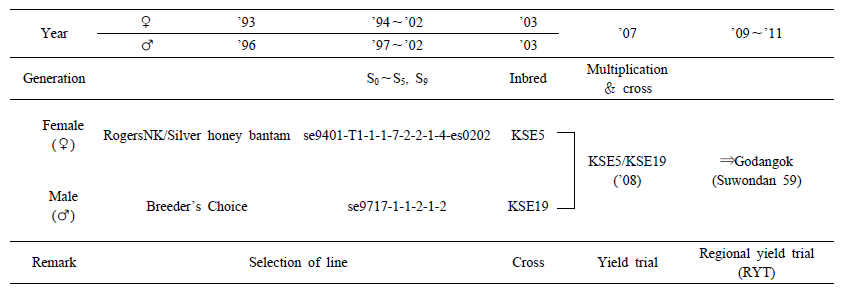
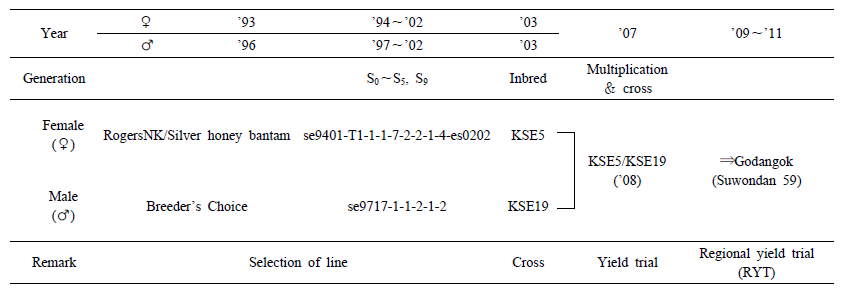
고당옥(수원단59호)은 2003년에 육성된 자식계통 KSE5를 종자친(모본)으로 하고 같은 해에 육성된 자식계통 KSE19를 화분친(부본)으로 하여 2007년에 교잡된 se인자를 보유한 단 옥수수 단교잡종이다. 고당옥은 2008년 생산력검정시험을 거 쳐, 2009~2011년 3년 동안 전국 5개 지역에서 지역적응시 험을 실시한 결과 그 우수성이 인정되어 2011년 농작물 직무 육성 신품종으로 결정되었으며 품종명을 ‘고당옥’으로 명명 하였다(Fig. 1).
Fig. 1.
Breeding procedure of Godangok.
KJBS-46-476_F1.gif
주요 생육 및 품질관련 특성
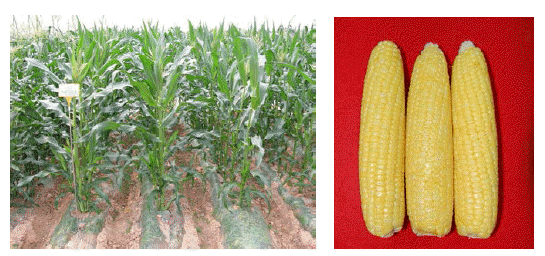
고당옥은 옥수수립의 색이 노란색이고, 이삭은 원통형과 원뿔형의 중간형을 띠고 있으며 출사일수는 66일로 표준품종 인 단옥3호(63일)에 비해 3일 정도 늦다. 간장은 161 cm로 단옥3호(153 cm)보다 크지만 착수고는 비슷하였다. 이삭길이 와 이삭직경은 각각 17.6 cm, 4.4 cm로 단옥3호와 비슷하였으 며 착립장률도 87.1%로 비슷한 수준이었다(Table 1, Fig. 2).
Fig. 2.
Plants and ears of Godangok (left: plants, right: ears).
KJBS-46-476_F2.gif
Table 1.
Agronomic characteristics of Godangok. (’09~’11, RYT)
Table 1.
Hybrid Days to silking Plant Height (cm) Ear Height (cm) Ear

Length (cm) Diameter (cm) Rksl/elz (%)

Godangok 66 ± 4 161 ± 23 49 ± 8 17.6 ± 1.9 4.4 ± 0.3 87.1 ± 6.2
Danok 3 63 ± 4 153 ± 26 53 ± 20 17.2 ± 1.5 4.4 ± 0.4 86.6 ± 6.5

zRksl/el : ratio of kernel set length / ear length

품질특성에 있어서 se인자를 보유한 고당옥의 경우 당도 가 24.3 Bx°로 단옥3호(14.1 Bx°)보다 높았고 옥수수립의 크 기는 비슷하였으며 전체적인 기호도는 단옥3호보다 우수하였 다(Table 2).
Table 2.
Kernel quality and sensory evaluation of Godangok. (’09~’11, RYT)
Table 2.
Hybrid °Brix 100-kernel weight (g) Grain Hardness (g/3.14 mm2) Sensory evaluation (1~9)z

Length (mm) Width (mm)

Godangok 24.3 23.1 8.4 7.2 156 5.9
Danok 3 14.1 25.2 8.2 7.8 120 4.7
LSD 0.05 y 0.7 ns ns ns 38.7 0.2

zSensory evaluation (1 : poor, 9 : excellent)

yMeans in a column followed by a different letter are significantly different according to least significant difference (α=0.05)

병충해 및 내재해성
병충해 및 내재해성은 ’09~’11년 3년간 수원과 홍천에서 검정한 결과, 깨씨무늬병, 그을음무늬병, 조명나방 등에 대한 저항성에서는 단옥3호와 비슷한 수준이었으나 내도복성은 단 옥3호보다 강하였다(Table 3).
Table 3.
Resistance to disease, insect and lodging of Godangok. (’09~’11, RYT)
Table 3.
Hybrid Disease resistance (0~9)z Corn borer (0~9)z Lodging (1~9)z

Bipolaris maydis Exserohilum turcicum

Godangok 2 3 2 1
Danok 3 3 3 2 4

z0, 1 : Resistance or excellent, 9 : Susceptible or poor

수량성
2009~2011년, 3년간 5개 지역에서 실시한 지역적응시험 결과, 고당옥의 평균 이삭수는 5,840개/10a, 이삭중은 1,028 kg /10a로 단옥3호의 수량성과 유의한 차이가 없었다(Table 4, 5).
Table 4.
The yield of Godangok in number of fresh ears in regional yield trials for three years. (’09~’11, RYT)
Table 4.
Location Godangok (ears/10a) Danok 3 (ears/10a)

’09 ’10 ’11 Mean Index ’09 ’10 ’11 Mean Index

Suwon 4,931 6,030 5,412 5,458 97 5,764 5,697 5,447 5,636 100
Hongcheon 6,666 6,333 5,999 6,333 98 6,583 6,500 6,333 6,472 100
Cheongwon 6,030 6,340 5,834 6,068 100 5,883 6,536 5,834 6,084 100
Daegu 4,274 6,094 5,952 5,440 124 3,261 4,857 5,000 4,373 100
Jinju - 6,556 5,667 6,111 106 - 6,000 5,500 5,750 100

Mean 5,475 6,271 5,773 5,840az 104 5,373 5,918 5,623 5,638a 100

zMeans in a row followed by the same letter is not significantly different according to least significant difference (α=0.05)

Table 5.
The yield of Godangok in fresh ear weight in regional yield trials for three years. (’09~’11, RYT)
Table 5.
Location Godangok (ears/10a) Danok 3 (ears/10a)

’09 ’10 ’11 Mean Index ’09 ’10 ’11 Mean Index

Suwon 924 958 572 818 89 1,042 1,034 696 924 100
Hongcheon 914 1,093 626 878 98 994 858 831 894 100
Cheongwon 1,558 1,430 1,288 1,425 109 1,288 1,430 1,206 1,308 100
Daegu 821 1,274 798 964 160 453 909 449 604 100
Jinju - 1,119 987 1,053 105 - 1,038 964 1,001 100

Mean 1,054 1,175 854 1,028az 109 944 1,054 829 942a 100

zMeans in a row followed by the same letter is not significantly different according to least significant difference (α=0.05)

채종시험
옥수수는 보급종(F1)을 채종할 때 채종 지역의 기상, 토양 등에 따라 지역간에 모본과 부본의 개화기 차이가 나타나므 로 옥수수 채종을 많이하는 영월지역에서 2010년 모·부본 재 식비율 2:1, 3:1로 모·부본 동시 파종하여 채종안정성을 시험 한 결과, 고당옥의 모본의 출사기와 부본의 화분 비산기간이 잘 일치하였으며 채종량은 모·부본 2:1 파종이 142 kg/10a으 로 3:1 파종(115 kg/10a)보다 채종량이 많았다(Table 6).
Table 6.
Seed production trial of Godangok in Yeongwol(2010).
Table 6.
Planting pattern Inbred Planting date Silking date Pollen dispersal period Plant height (cm) Ear height (cm) F1 seed production (kg/10a)

2 : 1 KSE5 (♀) May 13 July 12 - 142 36 142 ± 11.6
KSE19 (♂) May 13 - July 10 to July 16 148 - -
3 : 1 KSE5 (♀) May 13 July 12 - 142 36 115 ± 10.6
KSE19 (♂) May 13 - July 10 to July 16 148 - -
적응지역 및 재배상 유의점
고당옥은 전국에서 재배가 가능하며 1대 교잡종이므로 매 년 갱신된 종자를 이용해야 한다. 조명나방에는 감수성이어서 적기에 방제를 하여야 하고 초당옥수수를 비롯한 다른 종류 의 옥수수와 200 m이상 격리재배가 반드시 필요하다. 밀식재 배 시 이삭이 작아지고 끝달림이 불량하여 상품수량이 저하 될 수 있으므로 60 × 25 cm 이상의 재식밀도를 권장하며 강 풍을 동반한 우기 시 밭 배수관리에 유의하여야 한다.
고당옥은 2011년에 농촌진흥청 국립식량과학원에서 개발 한 단교잡종 단옥수수로 이삭의 색깔은 노란색이며 자식계통 KSE5를 종자친으로 하고 KSE19를 화분친으로 한다. 고당옥 의 출사일수는 표준품종(단옥3호)보다 3일 정도 늦었고 고당 옥의 이삭길이는 17.6 cm, 이삭직경은 4.4 cm였으며 착립장률 은 87.1%로 표준품종과 유사하였다. 그러나 당도는 24.3 °Bx 로 표준품종 14.1 °Bx보다 높았고 내도복성도 표준품종보다 우수하였다. 2009년부터 2011년까지 지역적응시험에서 고당 옥의 단위면적당 이삭수와 이삭중은 표준품종과 유사하였으 며 채종시험결과 종자친과 화분친간 개화기가 잘 일치하였다.
본 논문은 농촌진흥청 연구사업(세부과제명: 식용 풋옥수 수 계통육성시험, 세부과제번호: PJ00874702)의 지원에 의해 이루어진 것이며 본 품종을 육성하는데 협력하여 주신 농촌 진흥청 연구정책국, 강원도 옥수수연구소, 충북농업기술원, 경북농업기술원, 경남농업기술원 및 내병충성 검정을 담당한 국립식량과학원 작물환경과 등 관계관님들께 감사 드립니다.
  • Hallauer AR. Specialty Corns. 2001. CRC Press. pp. 155-197.
  • Jung GH, Lee JE, Seo JH, Kim SL, Kim DW, Kim JT, Hwang TY, Kwon YU. Effects of seeding dates on harvesting time of double cropped waxy corn. Korean J. Crop Sci 2012. 57: 195-201.
  • Jung TW, Cha SW, Moon HG, Son BY, Park NK, Kim SK, Ryu YH, Min HK, Huh CS, Lee JW. A new single cross sweet corn hybrid for early planting “Danok3”. Treat. of Crop Res 2002. 3: 124-129.
  • Lee JS, Jung TW, Son BY, Kim JT, Jung GH, Shin SH, Kim SK, Seo JH, Lee JE, Baek SB, Kim SL, Kim CK, Kim WH, Kwon YU. A new sweet corn hybrid with good eating quality and high sugar content, ‘Guseulok’. Korean J. Breed. Sci 2013. 45: 416-419.
  • Park KY, Park SU, Moon HG, Kang YK, Ham YS, Jung SK. A new high yeilding sweet corn hybrid “Tanok1”. Res. Rept. ORD 1984. 26-1(C):118-121.
  • Park SU, Park KY, Cha SW, Park RK, Rho TH, Hong JK, Cha YH. An early maturing single cross sweet corn hybrid “Tanok2”. Res. Rept. RDA (U&I) 1991. 33: 29-32.
  • Rural Development AdministrationRDA INTERROBANG 20 - Maize 2011.
  • Rural Development AdministrationAgricultural science technology research analysis standard reference 2012.
  • SEOUL AGRO-FISHERIES & FOOD CORPORATIONAnalysis of the place of shipment in Garak Market 2013.
  • Shin SH, Jung GH, Kim MJ, Lee JS, Son BY, Kim JT, Bae HH, Kim SG, Kwon YU, Baek SB. Effect of planting dates on growth and yield of late-planted sweet corn (Zea mays L.) to sell fresh ears in the autumn. Korean J. Crop Sci 2014. 59: 299-306.

Download Citation

Download a citation file in RIS format that can be imported by all major citation management software, including EndNote, ProCite, RefWorks, and Reference Manager.

Format:

Include:

A Yellow Sweet Corn Hybrid with High Sugar Content and Lodging Tolerance, ‘Godangok’
Korean. J. Breed. Sci.. 2014;46(4):476-480.   Published online December 31, 2014
Download Citation

Download a citation file in RIS format that can be imported by all major citation management software, including EndNote, ProCite, RefWorks, and Reference Manager.

Format:
Include:
A Yellow Sweet Corn Hybrid with High Sugar Content and Lodging Tolerance, ‘Godangok’
Korean. J. Breed. Sci.. 2014;46(4):476-480.   Published online December 31, 2014
Close

Figure

  • 0
  • 1
A Yellow Sweet Corn Hybrid with High Sugar Content and Lodging Tolerance, ‘Godangok’
Image Image
Fig. 1. Breeding procedure of Godangok.
Fig. 2. Plants and ears of Godangok (left: plants, right: ears).
A Yellow Sweet Corn Hybrid with High Sugar Content and Lodging Tolerance, ‘Godangok’

Agronomic characteristics of Godangok. (’09~’11, RYT)

Hybrid Days to silking Plant Height (cm) Ear Height (cm) Ear

Length (cm) Diameter (cm) Rksl/elz (%)

Godangok 66 ± 4 161 ± 23 49 ± 8 17.6 ± 1.9 4.4 ± 0.3 87.1 ± 6.2
Danok 3 63 ± 4 153 ± 26 53 ± 20 17.2 ± 1.5 4.4 ± 0.4 86.6 ± 6.5

zRksl/el : ratio of kernel set length / ear length

Kernel quality and sensory evaluation of Godangok. (’09~’11, RYT)

Hybrid °Brix 100-kernel weight (g) Grain Hardness (g/3.14 mm2) Sensory evaluation (1~9)z

Length (mm) Width (mm)

Godangok 24.3 23.1 8.4 7.2 156 5.9
Danok 3 14.1 25.2 8.2 7.8 120 4.7
LSD 0.05 y 0.7 ns ns ns 38.7 0.2

zSensory evaluation (1 : poor, 9 : excellent)

yMeans in a column followed by a different letter are significantly different according to least significant difference (α=0.05)

Resistance to disease, insect and lodging of Godangok. (’09~’11, RYT)

Hybrid Disease resistance (0~9)z Corn borer (0~9)z Lodging (1~9)z

Bipolaris maydis Exserohilum turcicum

Godangok 2 3 2 1
Danok 3 3 3 2 4

z0, 1 : Resistance or excellent, 9 : Susceptible or poor

The yield of Godangok in number of fresh ears in regional yield trials for three years. (’09~’11, RYT)

Location Godangok (ears/10a) Danok 3 (ears/10a)

’09 ’10 ’11 Mean Index ’09 ’10 ’11 Mean Index

Suwon 4,931 6,030 5,412 5,458 97 5,764 5,697 5,447 5,636 100
Hongcheon 6,666 6,333 5,999 6,333 98 6,583 6,500 6,333 6,472 100
Cheongwon 6,030 6,340 5,834 6,068 100 5,883 6,536 5,834 6,084 100
Daegu 4,274 6,094 5,952 5,440 124 3,261 4,857 5,000 4,373 100
Jinju - 6,556 5,667 6,111 106 - 6,000 5,500 5,750 100

Mean 5,475 6,271 5,773 5,840az 104 5,373 5,918 5,623 5,638a 100

zMeans in a row followed by the same letter is not significantly different according to least significant difference (α=0.05)

The yield of Godangok in fresh ear weight in regional yield trials for three years. (’09~’11, RYT)

Location Godangok (ears/10a) Danok 3 (ears/10a)

’09 ’10 ’11 Mean Index ’09 ’10 ’11 Mean Index

Suwon 924 958 572 818 89 1,042 1,034 696 924 100
Hongcheon 914 1,093 626 878 98 994 858 831 894 100
Cheongwon 1,558 1,430 1,288 1,425 109 1,288 1,430 1,206 1,308 100
Daegu 821 1,274 798 964 160 453 909 449 604 100
Jinju - 1,119 987 1,053 105 - 1,038 964 1,001 100

Mean 1,054 1,175 854 1,028az 109 944 1,054 829 942a 100

zMeans in a row followed by the same letter is not significantly different according to least significant difference (α=0.05)
Seed production trial of Godangok in Yeongwol(2010).

Planting pattern Inbred Planting date Silking date Pollen dispersal period Plant height (cm) Ear height (cm) F1 seed production (kg/10a)

2 : 1 KSE5 (♀) May 13 July 12 - 142 36 142 ± 11.6
KSE19 (♂) May 13 - July 10 to July 16 148 - -
3 : 1 KSE5 (♀) May 13 July 12 - 142 36 115 ± 10.6
KSE19 (♂) May 13 - July 10 to July 16 148 - -
Table 1. Agronomic characteristics of Godangok. (’09~’11, RYT)

Rksl/el : ratio of kernel set length / ear length

Table 2. Kernel quality and sensory evaluation of Godangok. (’09~’11, RYT)

Sensory evaluation (1 : poor, 9 : excellent)

Means in a column followed by a different letter are significantly different according to least significant difference (α=0.05)

Table 3. Resistance to disease, insect and lodging of Godangok. (’09~’11, RYT)

0, 1 : Resistance or excellent, 9 : Susceptible or poor

Table 4. The yield of Godangok in number of fresh ears in regional yield trials for three years. (’09~’11, RYT)

Means in a row followed by the same letter is not significantly different according to least significant difference (α=0.05)
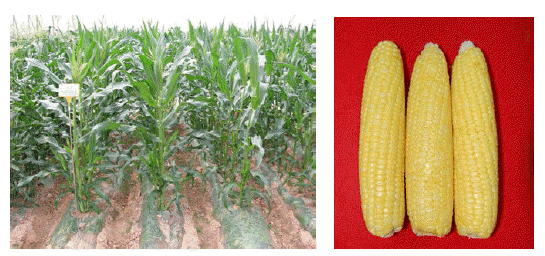
Table 5. The yield of Godangok in fresh ear weight in regional yield trials for three years. (’09~’11, RYT)

Means in a row followed by the same letter is not significantly different according to least significant difference (α=0.05)

Table 6. Seed production trial of Godangok in Yeongwol(2010).