Skip to main navigation Skip to main content

Korean. J. Breed. Sci. : Korean Journal of Breeding Science

OPEN ACCESS
ABOUT
BROWSE ARTICLES
EDITORIAL POLICIES
FOR CONTRIBUTORS

Articles

ARTICLE

중부지역 적응 조생 복합내병성 고품질 벼 ‘중모1023’

A Multiple Disease Resistant, Middle Plain Area Adaptable and Early Maturing Rice ‘Jungmo1023’

Korean Journal of Breeding Science 2015;47(3):281-287.
Published online: August 31, 2015

1 농촌진흥청 국립식량과학원

1 National Institute of Crop Science, RDA, Wanju 565-851, Republic of Korea

2 농촌진흥청

2 Rural Development Administration, Jeonju 560-500, Republic of Korea

3 전라북도농촌진흥원

3 Jeolabuk-do Agricultural Research & Extension Services, Iksan 570-704, Republic of Korea

*Corresponding author (lejehe@korea.kr, Tel: +82-31-695-4032, Fax: +82-31-695-4029)
• Received: May 7, 2015   • Revised: June 8, 2015   • Accepted: June 26, 2015

© Korean Society of Breeding Science All rights reserved

This is an Open-Access article distributed under the terms of the Creative Commons Attribution Non-Commercial License (http://creativecommons.org/licenses/by-nc/3.0) which permits unrestricted non-commercial use, distribution, and reproduction in any medium, provided the original work is properly cited.

  • 3 Views
  • 0 Download
prev next
  • The ‘Jungmo1023’ is the japonica rice variety developed from a cross between Yeongdeog34 and F1 of Iksan456 and SR21097-B-B-19-2-2 by the rice breeding team at NICS in 2012. The heading date of ‘Jungmo1023’ is August 3 in middle plain area and it is six days earlier than ‘Hwaseong’. ‘Jungmo1023’ has 80 cm of culm length which is 4 cm shorter than those of ‘Hwaseong’ and 107 spikelet per panicle. The premature heading rate of ‘Jungmo1023’ was 3.3%. It showed resistance to blast, bacterial blight (K1, K2, K3 race) and stripe virus, but susceptibility to K3a race of bacterial blight, dwarf and black streak dwarf viruses and planthoppers. The milled rice of this variety exhibits translucent and medium short grain shape. It has better palatability index of cooked rice (0.24) and lower amylose content (18.0%) than that of ‘Hwaseong’. The characteristics related to grain milling were better than those of ‘Hwaseong’, especially head rice milling recovery ratio and head rice ratio (96.2%). ‘Jungmo1023’ showed 4.56 MT/ha of milled rice productivity at 7 sites in ordinary cultivation. However, ‘Jungmo1023’ showed early cultivation culture adaptability because of 98% of its yield potential (4.99 MT/ha) compared to high yielding early-maturing variety ‘Jopyeong’. ‘Jungmo1023’ could be adaptable to the middle plain, mid-mountainous and north-east coastal area in Korea (Registration No. 5115).
2014년 우리나라 조생종 벼 재배면적은 96,175 ha로 전국 벼 재배면적 815,506 ha의 11.8%이다. 이 중 중부지역 경기, 강원, 충북, 충남은 40,407 ha로 42%를 점하고 있는데, 주로 재배되는 품종은 ‘오대’가 16,861 ha로 가장 많이 재배되고, 이어서 ‘조운(Won et al. 2010)’이 294 ha, ‘한설(Lee et al. 2010)’이 252 ha 재배되고 있다. 위의 품종 이외에 지역별로 강원도에서는 ‘오대’에 이어서 ‘오륜’이 2,948 ha, ‘설레미 (Kim et al. 2013)’가 254 ha재배되고, 충북은 ‘주남조생(Lee et al. 2009)’이 193 ha, 충남은 ‘조평(Nam et al. 2013)’이 534 ha재배되고 있다. 그러나 중부평야지에서 추석전 햅쌀 생산을 위한 조기재배에 적응하는 품종은 ‘조운’과 ‘한설’ 정 도로 다양성이 극히 부족하며, 각종 작부체계에 활용 가능하 고, 수확과 출하작업의 분산을 위한 조생종 벼 품종이 부족하 다. 더군다나 ‘조운’은 도열병과 수발아에 강하고, ‘한설’은 도열병과 내랭성이 강하지만 점차 북상하는 흰잎마름병과 줄 무늬잎마름병에 저항성이 없어 친환경 고품질 쌀 생산에 부 족하다. 또한 기후변화에 의한 대형 기상이변이 1980년대 12.7회에서 2000년대 24.5회로 증가하고, 흰잎마름병이나 벼 멸구 같은 돌발 병해충이 증가하여 재배안전성을 갖춘 조생 종 벼 품종 육성이 시급한 과제로 부각되고 있다. 본 연구는 재배안정성이 높은 조생종 벼 품종 개발로 농가 소득증대에 기여하고자 중부평야지 조기재배에 적응하고, 도열병, 흰잎마 름병 및 줄무늬잎마름병에 강한 복합내병성을 갖추면서 고품 질 품종인 ‘중모1023’ 을 육성하였기에 육성 경위 및 주요특 성을 보고하고자 한다.
‘수원534호’를 2010~2012년 3년간 중부평야지 4개소, 중 서부해안지, 중북부중산간지 그리고 동북부해안지 각 1개소 등 7개소에서 보통기 보비재배하여 대비품종 ‘화성’(Moon et al. 1986), ‘오대’와 비교 검토하였다(RDA 2010, 2011a, 2012a). 중부평야지에서는 4월 25일에 파종하여 5월 25일에 재식거 리 30 × 15 cm로 주당 3본씩, 중서부해안지에서는 4월 25일 에 파종하여 5월 25일에 재식거리 30 × 12 cm로 주당 5본씩, 중북부중산간지와 동북부해안지에서는 4월 20일에 파종하여 5월 20일에 재식거리 30 × 12 cm로 주당 5본씩 이앙하였다.
시비는 중부평야지에서는 질소, 인산, 가리를 성분량으로 각 각 9, 4.5, 5.7 kg/10a, 중서부해안지에서는 11, 5.1, 5.7 kg/ 10a, 중북부중산간지에서는 10, 6.4, 7.8 kg/10a, 동북부해안 지에서는 9, 6.4, 7.8 kg/10a을 시비하였다. 질소비료는 중부 평야지와 중서부해안지에서는 기비, 분얼비, 수비를 각각50%, 20%, 30%, 중북부중산간지와 동북부해안지에서는 50%, 25%, 25%의 비율로 분시하였다. 인산은 전량 기비로 시비하고, 칼 리는 기비와 수비를 70%, 30%로 분시하였다. 도복관련 형질 은 Kim et al. (2000)의 방법으로 초장과 중심고, 좌절중을 조사하였고, 도복지수는 농업과학기술 연구조사분석기준(RDA 2012c)의 방법으로 조사하였다. 기타 재배관리는 농촌진흥청 표준재배법에 준하여 재배관리를 하였고, 농업형질, 수량구성 요소 및 수량성, 생리장해 및 병해충 저항성, 도정특성 조사는 농촌진흥청 신품종개발 공동연구사업 과제수행계획서 조사기 준에 준하여 실시하였다(RDA 2010, 2011b, 2012b).
육성 경위
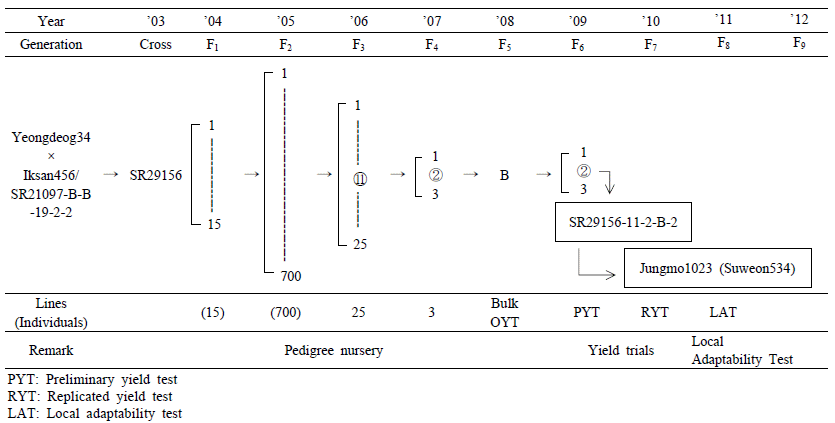
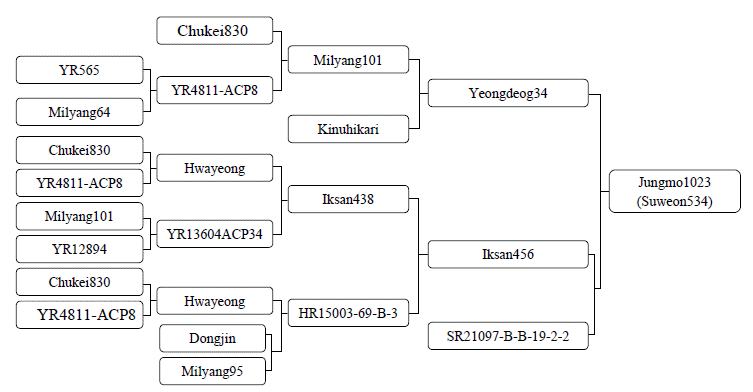
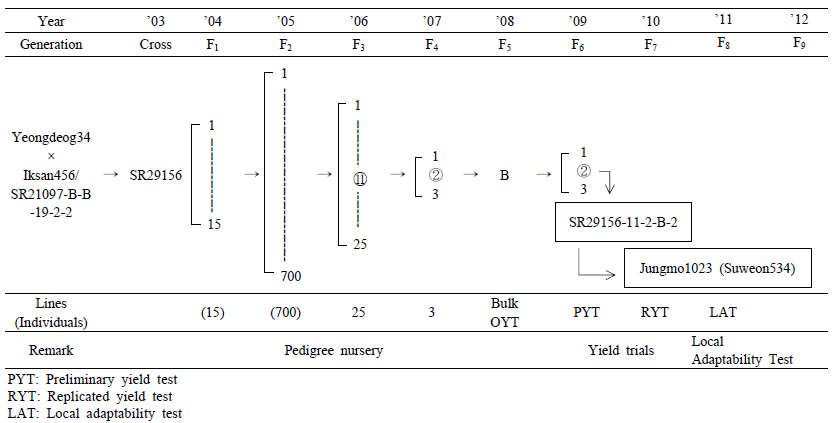
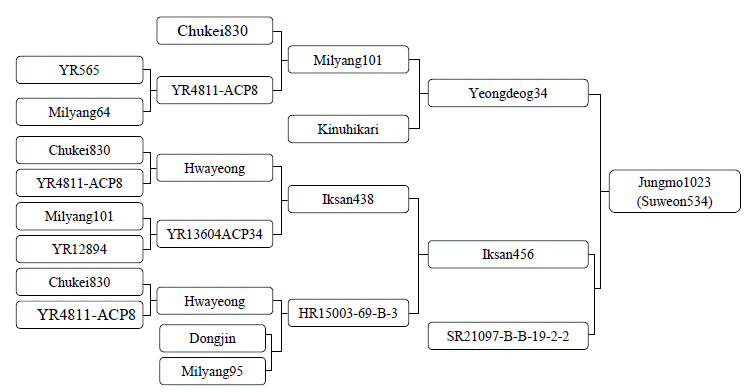
‘중모1023’은 중부지역 평야지 조기재배적응 고품질 품종 을 육성할 목적으로 2003년 하계에 중생이고 쌀의 외관 품위 가 좋으며 도정특성이 좋은 영덕34호를 모본으로, 중생이고 잎도열병, 흰잎마름병 및 줄무늬잎마름병에 강하고 직파재배 적응성이면서 현미천립중이 27.4 g으로 무거운 익산456호 (Kim et al. 2005)와 초형이 양호하고 고품질인 SR21097-BB- 19-2-2가 교배된 F1을 부본으로 교배하여 교배번호 SR29156 을 부여한 후, F1세대 15개체를 양성하였다. F2세대에서 700 개체를 시험하여 25개체를 선발 후 F3세대에서 F6세대까지 계통으로 전개하여 주요 병해충 및 미질 검정을 병행한 결과 유망한 SR29156-11-2-B-2계통을 선발하였다. 선발된 우량계 통에 대해 2009년에 생산력검정시험을 실시 한 결과 조생종 이고 도열병, 흰잎마름병, 줄무늬잎마름병에 저항성이면서 백 미완전립률이 높고 도정특성과 밥맛이 우수하여 수원534호로 계통명을 부여하고 2010년에는 생산력검정과 지역적응시험 을 병행하였다. 2010년부터 2012년까지 지역적응시험 3년을 실시한 결과 그 우수성이 인정되어 2012년 12월 농촌진흥청 직무육성 신품종선정위원회에서 중간모본으로 선정됨과 동시 에 ‘중모1023’으로 명명되었다. ‘중모1023’의 육성과정과 계 보도는 Fig. 1 및 Fig. 2와 같다.
Fig. 1.
Pedigree diagram of ‘Jungmo1023’.
KJBS-47-281_F1.gif
Fig. 2.
Genealogical diagram of ‘Jungmo1023’.
KJBS-47-281_F2.gif
주요특성
주요 농업적 특성
‘중모1023’은 중부평야지 및 중서부해안지 보통기 재배에 서 평균 출수기가 8월 3일로 ‘화성’보다 6일 빠르고, 중북부 중산간지와 동북부해안지 보통기 재배에서 8월 8일로 오대보 다 8일 늦은 조생종이다 (Table 1). 간장은 80 cm로 ‘화성’의 84 cm보다 4 cm작고, 이삭길이는 20 cm로 화성보다 1 cm 짧다. 주당 이삭수는 13개로 화성보다 1개 적으며 이삭당 입 수는 107개로 ‘화성’보다 14개 많았다. 등숙비율은 85.0%로 ‘화성’의 81.8%보다 높고, 현미 천립중이 21.8 g으로 ‘화성’ 과 비슷한 중소립종이다(Table 1).
Table 1.
Major agronomic traits and yield components.
Table 1.
Variety Heading date Culmz length (cm) Panicle length (cm) No. of panicles /hill No. of spikelets /panicle Ratio of ripened grain (%) 1000-grain weight of brown rice (g)

Jungmo1023 Aug. 3* 80ns 20ns 13ns 107** 85.0* 21.8ns
Hwaseong Aug. 9 84 21 14 93 81.8 22.4

zzlength from soil surface to panicle neck

*significant at 5% and 1% level, respectively

**significant at 5% and 1% level, respectively

nsnot significant

병해충 저항성
‘중모1023’은 전국 14개소에서 실시한 잎도열병 밭못자리 검정 결과 평균 2.9로 ‘화성’의 5.8보다 강한 저항성 반응을 보였고, 이삭도열병 포장검정에서도 ‘화성’보다 강한 반응을 보였다. 반면에 도열병 내구저항성 검정결과 내구성정도는 ‘화성’과 동일한 ‘7’이었지만, 접종한 30개 균주 중 8개 균주 가 친화성을 보여 안정적인 저항성을 나타냈다(Table 2). 흰 잎마름병에는 K1, K2, K3균계에 강한 반응을 보이고 K3a 균계에는 저항성이 없었다. 줄무늬잎마름병에도 이병율이 6.7%로 강한 반응을 보였으나 오갈병, 검은줄오갈병 및 벼멸 구에 대한 저항성은 없었다(Table 3). 중부평야지에 재배되고 있는 조생종 중 복합내병성을 갖춘 품종은 극조생종인 ‘조평’ 이 유일하였지만 ‘중모1023’의 육성으로 조생품종의 확대에 기여할 것이다.
Table 2.
Reaction to blast disease.
Table 2.
Variety Reaction to leaf blast at nursery test (0-9) Area ratio to leaf lesion of Magnaporthe grisea of sequential plantings (%) Reaction to neck blast (%)

No. of tested sites (14)


Rz M S Mean 1 2 3 4 5 6 7 Persistence (0-7) No. of susceptible race (30) Ichon Jecheon

Jungmo1023 9 5 0 2.9* 60 50 50 50 45 11 5 7 8 0.0 1.3
Hwaseong 0 12 2 5.8 58 58 48 50 50 38 32 7 18 4.9 8.7

zR: resistant (0~3); M: moderately resistant (4~6); S: susceptible (7~9)

N fertilizer: Blast nursery test = 240 kg/ha, Neck blast = 220 kg/ha

*significant at 5% level

Table 3.
Reaction to bacterial blight, virus disease and insect pests.
Table 3.
Variety Bacterial blight Virus diseases Resistance to insects


K1 K2 K3 K3a Stripe (%) Dwarf Black-streak dwarf BPHz SBPH

Jungmo1023 Ry R R S R(6.7) S S S S
Hwaseong S S S S R(14.1) S S S S

zzBPH: brown planthopper; SBPH: small brown planthopper

yR: resistance, S: susceptible

생리장해 저항성
‘중모1023’은 50일묘 늦심기에서 3.3%의 불시출수 현상을 보였지만 조생종으로서 낮은 수준이었고, 성숙기 하엽노화가 느리며 위조현상은 없었다. 춘천출장소에서 냉수처리 내랭성 검정 결과 출수지연이 10일로 ‘화성’대비 1일 짧았고, 냉수구 임실률은 47%로 ‘화성’보다 낮았으며, 적고는 ‘화성’과 같이 강한 반응을 보여 종합적인 내랭성은 ‘화성’과 비슷한 정도였 다. 수발아율은 2010년~2012년 3개년 평균 17.3%로 ‘화성’ 과 비슷한 반응을 보였다(Table 4). ‘중모1023’은 도복 특성 검정에서 ‘화성’과 벼키와 3절 간장이 비슷하였으나, 생체중 이 무겁고, 좌절중과 모멘트가 높아 도복지수가 ‘화성’과 같 은 179로 나타났고, 포장 도복에 강한 특성을 보였다(Table 5). 이 결과는 최근 우리나라에 영향을 주는 태풍의 회수가 증가하고, 등숙기간의 빈번한 집중호우에 노출되어도 ‘중모 1023’은 재배안정성이 높음을 의미한다.
Table 4.
Response to physiological and abiotic stresses.
Table 4.
Varietya Premature heading (%) Occurrence of wilting Leaf senescence at maturing Cold tolerancey Viviparousw germination (%)

Discoloration (1-9)z Heading delay (day) Grain fertility (%) PAx

Jungmo1023 3.3 Strong Late 1 10 47ns 6 17.3
Hwaseong 0.0 Strong Late 1 11 53 6 17.1

zEvaluation at maximum tillering stage (1: tolerance; 9: susceptible)

yCold tolerance was evaluated in Chuncheon cold-water (17°C) irrigated nursery

xPhenotypic Acceptability

wGermination rate at 7 days after incubation in 25°C chamber

nsnot significant

Table 5.
Some characteristics related with lodging
Table 5.
Variety Culmz length (cm) Third internode length (cm) Top fresh weight (g) Breaking strength (g) Moment (g.cm) Lodging index Lodging in the field (0~9)

Jungmo1023 84 13 15.1* 876* 1,571* 179 1
Hwaseong 84 12 10.7 623 1,115 179 1

zlength from upper part of root to panicle neck

*significant at 5% level

미질 및 도정특성
‘중모1023’의 입형은 현미 장폭비가 1.76으로 단원형이고, 백미외관은 심복백이 거의 없이 맑고 투명하여 ‘화성’보다 우 수하였으며, 알칼리 붕괴도는 6.2로 ‘화성’보다 낮았다. 단백 질함량은 6.9%로 같은 수준이었지만 아밀로스함량은 18.4% 로 ‘화성’의 20.6%보다 낮아 밥이 부드럽고 식미관능검정 결 과 0.24로 ‘화성’의 0.08보다 밥맛이 우수하였다(Table 6). 밥 맛은 연도가 다를 경우 생육환경이 달라 직접 비교하기는 어 렵지만, 극조생종인 ‘조평’과 조생종인 ‘오대’ 보다 식미관능 검정값이 높았다. 도정특성 검정에서 제현율은 ‘화성’보다 약 1.8% 낮은 81.4% 이었고, 현백률은 비슷하여 도정률도 ‘화 성’보다 1.9% 낮은 72.9% 이었다. 그러나 도정된 쌀의 완전 미율이 96.2%로 ‘화성’의 73.8%보다 22.4% 높아 완전미 도 정수율은 ‘화성’의 55.2% 보다 월등히 높은 70.1%로 도정특 성이 우수하였다(Table 7).
Table 6.
Characteristics related to grain shape and grain quality.
Table 6.
Variety Brown rice White core/velly Alkali digestive value (1~7) Protein content (%) Amylose content (%) Palatability of cooked rice (-3~3)

Length (mm) Width (mm) L/W ratio

Jungmo1023 4.88 2.77 1.76 0/0 6.2 6.9 18.4ns 0.24
Hwaseong 4.98 2.79 1.79 2/0 6.5 6.9 20.6 0.08

nsnot significant

Table 7.
Characteristics related to milling quality.
Table 7.
Variety Milling recovery ratio (%) Head rice milling recovery ratio (%)

Brown/rough Milled/brown Milled/rough Head rice

Jungmo1023 81.4** 89.5 72.9** 96.2** 70.1**
Hwaseong 83.2 89.9 74.8 73.8 55.2
수량성
백미수량은 2010년~2012년 3년 간 실시한 지역적응시험 결과 중부평야지 4개소 보통기 보비재배에서 평균 쌀수량은 4.68 MT/ha, 중서부해안지 1개소에서 4.34 MT/ha, 중북부중 산간지 1개소에서 4.45 MT/ha 그리고 동북부해안지 1개소에 서 4.44 MT/ha로 나타나 대비품종 ‘화성’의 88~97%, ‘오 대’의 89~90%, 7개소 전체평균은 4.56 MT/ha로 대비품종 대비 92%로 높지않은 수량성을 보였다(Table 8). ‘중모1023’ 은 절대적인 수량성이 낮았지만, 2010~2011년에 수량이 낮 았고, 2012년에는 ‘화성’과 비슷한 수준의 수량성을 보였다. 특히 조기재배 2년 평균 4.99 MT/ha로 극조생종이면서 수량 성이 높은 ‘조평’ 대비 98%의 수량성을 보여 ‘중모1023’은 조기재배에 적합한 품종으로 판단되었고, 수량성을 개선하면 평야지 조기재배 및 친환경 재배에 적합한 품종을 육성하는 데 중간모본으로 활용이 가능할 것으로 판단되었다.
Table 8.
Results of yield potential of ‘Jungmo1023’ on local adaptability test.
Table 8.
Culture Season Region Tested sites Average milled rice yield (MT/ha) Index(A/B)

Jungmo1023 Check variety

’10 ’11 ’12 Ave.(A) ’10 ’11 ’12 Ave.(A)

Ordinary planting culture Middle plain Suwon 4.89 3.90 5.01 4.60 4.77 4.59 4.90 4.75w 97
Hwaseong 3.59 3.97 5.53 4.36 4.37 4.39 5.32 4.69w 93
Yeoju 4.78 4.51 4.51 4.60 5.41 5.02 5.10 5.18w 89
Chuncheon 4.52 4.96 5.93 5.14 5.06 5.11 5.97 5.38w 96

Average 4.45 4.34 5.25 4.68ns 4.90 4.78 5.32 5.00 94

94 MWCz Namyang 4.37 3.28 5.36 4.34 518 393 571 4.94w 88

MMPy Cheolweon 4.15 4.74 4.47 4.45 4.69 5.03 5.23 4.98v 89

NECx Gangreung 4.51 4.23 4.59 4.44 4.67 5.31 4.80 4.93v 90

Average 4.40 4.23 5.06 4.56* 4.88 4.77 5.29 4.98 92

Early planting Middle plain Suwon - 5.14 4.83 4.99ns - 5.01 5.12 5.07u 98

zMWC: Mid-west coastal area

yMMP: Mid-northern middle plain area

xNEC: North-east coastal area

wHwaseong

vOdae

uJopyeong

nsnot significant

*significant at 5% level

재배상의 유의점
‘중모1023’은 질소질 비료 과용 시 미질저하, 등숙저하, 숙 색불량 및 병해충 발생이 우려되므로 적정 균형시비가 필요 하다. 특히 K3a균계에 대한 흰잎마름병, 오갈병, 검은줄오갈 병 및 멸구류에 저항성이 없으므로 적기 기본방제가 필요하 며, 고품질 쌀을 생산하기 위하여 적기 수확을 하여야 한다.
‘중모1023’은 중부지역 평야지 조기재배 적응 고품질 품종 을 육성할 목적으로 2003년 하계에 영덕34호를 모본으로, 익 산456호와 SR21097-B-B-19-2-2가 교배된 F1을 부본으로 교 배하였다. 후대에서 SR29156-11-2-B-2계통을 선발하여 ‘수 원534호’로 계통명을 부여하였고, 2012년 12월 농촌진흥청 직무육성 신품종선정위원회에서 ‘중모1023’으로 선정되었다.
‘중모1023’은 중부지역 보통기 재배에서 평균 출수기가 8 월 3일로 ‘화성’보다 6일 빠른 조생종이다. 간장은 80 cm로 ‘화성’보다 4 cm 작은 단간 내도복성이며, 이삭당 입수는 107개로 ‘화성’보다 14개가 많았다. 등숙비율은 85%로 ‘화 성’보다 높고, 현미 천립중이 21.8 g으로 ‘화성’과 비슷한 중 소립종이다. ‘중모1023’은 잎도열병에 강한 저항성 반응을 보 였고, 이삭도열병 포장검정에서도 ‘화성’보다 강한 반응을 보 였다. 흰잎마름병에는 K1, K2, K3균계에 강한 반응을 보이 고 K3a 균계에는 저항성이 없었다. 줄무늬잎마름병에도 강한 반응을 보였으나 오갈병, 검은줄오갈병 및 벼멸구에 대한 저 항성은 없었다. ‘중모1023’은 3.3%의 불시출수 현상을 보였 고, 종합적인 내랭성은 중정도, 수발아율 17.3% 그리고 도복 관련 특성은 ‘화성’과 비슷한 반응을 보였다. ‘중모1023’의 쌀 외관은 맑고 투명하였으며, 아밀로스함량은 18.4% 이었고, ‘화성’보다 밥맛이 우수하였다. 도정률은 ‘화성’보다 1.9% 낮 았지만, 완전미율이96.2%로 높아 완전미 도정수율은 ‘화성’ 의 55.2% 보다 높은 70.1%로 도정특성이 우수하였다. 쌀수 량은 2010~2012년 3개년 중부지역 7 개소에서 보통기 보비 재배 평균 4.56 MT/ha로 ‘화성’의 93% 수량성을 보였다. 그 러나 조기재배 2년 평균 4.99 MT/ha로 ‘조평’ 대비 98%의 수량성을 보여 평야지 조기재배 적응성을 보였다. ‘중모1023’ 의 재배적지는 중부・중북부 평야지 및 동북부해안지이다.
본 논문은 농촌진흥청 작물시험연구사업(세부과제명: 벼 조・중생종 고품질 품종개발, 세부과제번호: PJ00932501)의 지원으로 수행된 결과의 일부입니다. ‘중모1023’을 육성함에 있어 적극 협력하여주신 국립식량과학원 벼맥류부, 기능성작 물부 벼 육종 연구팀 및 각 도 농업기술원 지역적응시험 담당 자들과 농촌진흥청 연구정책국 관계관 여러분께 깊이 감사 드립니다.
  • 1. Kim BK, Ko JK, Nam JK, Shin MS, Ko JC, Ha KY, Choung JI, Kim KY, Lee JK, Choi DH, Oh MK, Kim YD, Choi YH, Kim YG, Lee KS, Kim HS, Shin WC, Lee YT, Kang HJ, Shin HT, Lee SH. A new mediumlate, multi-disease resistant, high quality rice cultivar, ‘Pyeongan’ adaptable to direct seeding. Korean J. Breed. Sci 2005. 37: 185-186.
  • 2. Kim JD, Chang JK, Sohn JK, Choi J. Inheritance of lodging tolerance in rice. Korean J. Breed. Sci 2000. 32: 194-198.
  • 3. Kim WJ, Park ST, Ko JK, Park HS, Nam MH, Kwak DY, Song YC, Park NB, Shin MS, Kim BK, Kang HJ, Ha KY, Nam JK, Baek MK, Kim KY, Ko JC, Baek SH, Shin WC, Mo YJ. A new early-maturing rice cultivar with high-quality, high-yielding, and good milling properties, ‘Seolemi’. Korean J. Breed. Sci 2013. 45: 298-302.
  • 4. Lee JH, Yeo US, Lee JS, Kang JR, Kwak DY, Park DS, Cho JH, Song YC, Park NB, Kim CS, Yi GH, Lim SJ, Oh BG, Shin MS. A new early maturing rice cultivar 'Junamjosaeng' with multiple disease resistance and high grain quality traits. Korean J. Breed. Sci 2009. 41: 149-153.
  • 5. Lee JH, Shin YS, Jeong OY, Kim MK, Kim YG, Kim HY, Lee JH, Lee JI, Cho YC, Jeon YH, Choi YH, Yang CI, hong HC, Won YJ, Shin JC, Kim HY, Seo DH, Hwang HG, Yea JD. A very early-maturing, cold tolerant and high quality japonica rice variety ‘Hanseol’. Korean J. Breed. Sci 2010. 42: 632-637.
  • 6. Moon HP, Cho SY, Son YH, Jun BT, Lim MS, Choi HC, Park NK, Park RK, Chung GS. An anther-derived new high quality and high yield rice variety 'Hwaseongbyeo'. Res. Rept. RDA(Crops) 1986. 28: 27-33.
  • 7. Nam JK, Ko JK, Kim KY, Kim BK, Kim WJ, Ha KY, Shin MS, Ko JC, Kang HJ, Park HS, Baek MK, Shin WC, Mo YJ, Choi IB, Kim YD, Yang HS, Kim JG. A new early-maturing rice with blast, bacterial blight, rice stripe virus resistant and high grain quality, ‘Jopyeong’. Korean J. Breed. Sci 2013. 45: 177-182.
  • 8. Rural Development Administration2010 Project plan for collaborative research program to develop new variety of summer crop 2010. 5-52.
  • 9. Rural Development Administration2010 Project report for collaborative research program to develop new variety of summer crop 2011a. 5-175.
  • 10. Rural Development Administration2011 Project plan for collaborative research program to develop new variety of summer crop 2011b. 5-44.
  • 11. Rural Development Administration2011 Project report for collaborative research program to develop new variety of summer crop 2012a. 5-186.
  • 12. Rural Development Administration2012 Project plan for collaborative research program to develop new variety of summer crop 2012b. 3-49.
  • 13. Rural Development Administration Agricultural science and technological research standard evaluation handbook 2012c. -321.
  • 14. Rural Development Administration2012 Project report for collaborative research program to develop new variety of summer crop 2013. 3-205.
  • 15. Won YJ, Ryu HY, Shin YS, Hong HC, Kim YG, Kim MK, Jung KH, Jeon YH, Cho YC, Ahn EK, Yoon KS, Lee JH, Kim JJ, Oh SK, Oh MK, Jeung JU, Chun AR, Park HM, Roh JH, Yoon YH. An extremely early-maturing, plain area adaptable, blast resistant and high grain quality rice cultivar ‘Joun’. Korean J. Breed. Sci 2010. 42: 313-317.

Download Citation

Download a citation file in RIS format that can be imported by all major citation management software, including EndNote, ProCite, RefWorks, and Reference Manager.

Format:

Include:

A Multiple Disease Resistant, Middle Plain Area Adaptable and Early Maturing Rice ‘Jungmo1023’
Korean. J. Breed. Sci.. 2015;47(3):281-287.   Published online September 30, 2015
Download Citation

Download a citation file in RIS format that can be imported by all major citation management software, including EndNote, ProCite, RefWorks, and Reference Manager.

Format:
Include:
A Multiple Disease Resistant, Middle Plain Area Adaptable and Early Maturing Rice ‘Jungmo1023’
Korean. J. Breed. Sci.. 2015;47(3):281-287.   Published online September 30, 2015
Close

Figure

  • 0
  • 1
A Multiple Disease Resistant, Middle Plain Area Adaptable and Early Maturing Rice ‘Jungmo1023’
Image Image
Fig. 1. Pedigree diagram of ‘Jungmo1023’.
Fig. 2. Genealogical diagram of ‘Jungmo1023’.
A Multiple Disease Resistant, Middle Plain Area Adaptable and Early Maturing Rice ‘Jungmo1023’

Major agronomic traits and yield components.

Variety Heading date Culmz length (cm) Panicle length (cm) No. of panicles /hill No. of spikelets /panicle Ratio of ripened grain (%) 1000-grain weight of brown rice (g)

Jungmo1023 Aug. 3* 80ns 20ns 13ns 107** 85.0* 21.8ns
Hwaseong Aug. 9 84 21 14 93 81.8 22.4

zzlength from soil surface to panicle neck

*significant at 5% and 1% level, respectively

**significant at 5% and 1% level, respectively

nsnot significant

Reaction to blast disease.

Variety Reaction to leaf blast at nursery test (0-9) Area ratio to leaf lesion of Magnaporthe grisea of sequential plantings (%) Reaction to neck blast (%)

No. of tested sites (14)


Rz M S Mean 1 2 3 4 5 6 7 Persistence (0-7) No. of susceptible race (30) Ichon Jecheon

Jungmo1023 9 5 0 2.9* 60 50 50 50 45 11 5 7 8 0.0 1.3
Hwaseong 0 12 2 5.8 58 58 48 50 50 38 32 7 18 4.9 8.7

zR: resistant (0~3); M: moderately resistant (4~6); S: susceptible (7~9)

N fertilizer: Blast nursery test = 240 kg/ha, Neck blast = 220 kg/ha

*significant at 5% level

Reaction to bacterial blight, virus disease and insect pests.

Variety Bacterial blight Virus diseases Resistance to insects


K1 K2 K3 K3a Stripe (%) Dwarf Black-streak dwarf BPHz SBPH

Jungmo1023 Ry R R S R(6.7) S S S S
Hwaseong S S S S R(14.1) S S S S

zzBPH: brown planthopper; SBPH: small brown planthopper

yR: resistance, S: susceptible

Response to physiological and abiotic stresses.

Varietya Premature heading (%) Occurrence of wilting Leaf senescence at maturing Cold tolerancey Viviparousw germination (%)

Discoloration (1-9)z Heading delay (day) Grain fertility (%) PAx

Jungmo1023 3.3 Strong Late 1 10 47ns 6 17.3
Hwaseong 0.0 Strong Late 1 11 53 6 17.1

zEvaluation at maximum tillering stage (1: tolerance; 9: susceptible)

yCold tolerance was evaluated in Chuncheon cold-water (17°C) irrigated nursery

xPhenotypic Acceptability

wGermination rate at 7 days after incubation in 25°C chamber

nsnot significant

Some characteristics related with lodging

Variety Culmz length (cm) Third internode length (cm) Top fresh weight (g) Breaking strength (g) Moment (g.cm) Lodging index Lodging in the field (0~9)

Jungmo1023 84 13 15.1* 876* 1,571* 179 1
Hwaseong 84 12 10.7 623 1,115 179 1

zlength from upper part of root to panicle neck

*significant at 5% level

Characteristics related to grain shape and grain quality.

Variety Brown rice White core/velly Alkali digestive value (1~7) Protein content (%) Amylose content (%) Palatability of cooked rice (-3~3)

Length (mm) Width (mm) L/W ratio

Jungmo1023 4.88 2.77 1.76 0/0 6.2 6.9 18.4ns 0.24
Hwaseong 4.98 2.79 1.79 2/0 6.5 6.9 20.6 0.08

nsnot significant

Characteristics related to milling quality.

Variety Milling recovery ratio (%) Head rice milling recovery ratio (%)

Brown/rough Milled/brown Milled/rough Head rice

Jungmo1023 81.4** 89.5 72.9** 96.2** 70.1**
Hwaseong 83.2 89.9 74.8 73.8 55.2

Results of yield potential of ‘Jungmo1023’ on local adaptability test.

Culture Season Region Tested sites Average milled rice yield (MT/ha) Index(A/B)

Jungmo1023 Check variety

’10 ’11 ’12 Ave.(A) ’10 ’11 ’12 Ave.(A)

Ordinary planting culture Middle plain Suwon 4.89 3.90 5.01 4.60 4.77 4.59 4.90 4.75w 97
Hwaseong 3.59 3.97 5.53 4.36 4.37 4.39 5.32 4.69w 93
Yeoju 4.78 4.51 4.51 4.60 5.41 5.02 5.10 5.18w 89
Chuncheon 4.52 4.96 5.93 5.14 5.06 5.11 5.97 5.38w 96

Average 4.45 4.34 5.25 4.68ns 4.90 4.78 5.32 5.00 94

94 MWCz Namyang 4.37 3.28 5.36 4.34 518 393 571 4.94w 88

MMPy Cheolweon 4.15 4.74 4.47 4.45 4.69 5.03 5.23 4.98v 89

NECx Gangreung 4.51 4.23 4.59 4.44 4.67 5.31 4.80 4.93v 90

Average 4.40 4.23 5.06 4.56* 4.88 4.77 5.29 4.98 92

Early planting Middle plain Suwon - 5.14 4.83 4.99ns - 5.01 5.12 5.07u 98

zMWC: Mid-west coastal area

yMMP: Mid-northern middle plain area

xNEC: North-east coastal area

wHwaseong

vOdae

uJopyeong

nsnot significant

*significant at 5% level

Table 1. Major agronomic traits and yield components.

zlength from soil surface to panicle neck

significant at 5% and 1% level, respectively

significant at 5% and 1% level, respectively

not significant

Table 2. Reaction to blast disease.

R: resistant (0~3); M: moderately resistant (4~6); S: susceptible (7~9)

N fertilizer: Blast nursery test = 240 kg/ha, Neck blast = 220 kg/ha

significant at 5% level

Table 3. Reaction to bacterial blight, virus disease and insect pests.

zBPH: brown planthopper; SBPH: small brown planthopper

R: resistance, S: susceptible

Table 4. Response to physiological and abiotic stresses.

Evaluation at maximum tillering stage (1: tolerance; 9: susceptible)

Cold tolerance was evaluated in Chuncheon cold-water (17°C) irrigated nursery

Phenotypic Acceptability

Germination rate at 7 days after incubation in 25°C chamber

not significant

Table 5. Some characteristics related with lodging

length from upper part of root to panicle neck

significant at 5% level

Table 6. Characteristics related to grain shape and grain quality.

not significant

Table 7. Characteristics related to milling quality.
Table 8. Results of yield potential of ‘Jungmo1023’ on local adaptability test.

MWC: Mid-west coastal area

MMP: Mid-northern middle plain area

NEC: North-east coastal area

Hwaseong

Odae

Jopyeong

not significant

significant at 5% level