적요
‘영웅’은 2014년 ‘건백’ 종자에 감마선 300 Gy를 조사하여 육성된 돌연변이 품종이다. 2020년 생산력검정시험을 거쳐 ‘밀양77호’로 계통명을 부여하였으며, 2021년부터 2023년까지 3년간 5개 지역에서 지역적응시험을 수행한 결과 우수성이 인정되어 2024년 신품종으로 선정되었다. ‘영웅’은 3과성 소분지 초형이며 종피색과 꽃색은 흰색이다. 개화기와 성숙기는 각각 6월 30일, 8월 16일이며, 경장은 167 cm, 주당삭수는 104개, 천립중은 2.9 g인 대립종이다. 특히 수확기에 낙엽성이 우수하여 수확 및 건조작업의 효율성을 높이는 특성을 지닌다. 내도복성은 ‘건백’과 비슷하며, 역병 병원균 인공접종 시 저항성 반응을 나타낸다. 특히 포장에서 시들음병 저항성은 ‘건백’ 대비 강하여 재배안정성을 유지한다. 수량성은 158 kg/10a로 ‘건백’ 대비 28% 증수하여 현재까지 개발된 국내 품종 중 최고 수준의 수량성을 보인다. 품질특성으로는 조지방 함량이 56.0%이며, 총 리그난 함량은 4.2 mg/g이다. 재배 시 유의점으로는 파종 전 종자 소독을 철저히 해야 하며, 잦은 강우 시 배수 관리와 적기 병해충 방제를 철저히 해야 한다.
Abstract
Sesame (Sesamum indicum L.) is a valuable oilseed crop; however, low yields and mechanical harvesting challenges limit its production. To address these issues, a high-yielding and disease-resistant sesame cultivar, ‘YoungWoong’, was developed via mutation breeding using ‘Geonbaek’ seeds irradiated with 300 Gy of γ-ray in 2014. ‘YoungWoong’ is characterized by a few branched plant types with three capsules per axil. The average height of the plants is 167 cm, with 104 capsules per plant and a 1,000-seed weight of 2.9 g. Notably, at maturity, the leaves and capsules turn yellow, which is accompanied by excellent leaf senescence. This effectively decreases plant volume and weight, thereby enhancing mechanical harvesting efficiency. Additionally, ‘YoungWoong’ exhibits enhanced field resistance to Phytophthora blight and Fusarium wilt, thereby ensuring stable production under high disease pressures. In regional adaptation trials, ‘YoungWoong’ achieved an average yield of 158 kg/10a, representing a 28% increase over that of ‘Geonbaek’ and the highest yield potential among previously developed cultivars. Thus, ‘YoungWoong’ has the potential to improve labor efficiency and sesame productivity (Registration No. 10784).
-
Key words: sesame, oilseed crop, cultivar
서언
참깨(
Sesamum indicum L.)는 종실의 약 50%가 조지방으로 구성된 대표적인 유지작물로, 참기름에는 올레산 등 불포화지방산과 세사민, 세사몰린 같은 리그난 계열 항산화물질이 풍부하여 식품학적 가치가 매우 높다(
Shyu & Hwang 2002). 최근 국산 참깨에 대한 소비자 선호도와 수요가 증가하고 있음에도 불구하고, 국내 참깨 평균 수량성은 10 a당 약 56 kg 수준에 머물러 있어 생산성 향상이 지속적으로 요구되고 있다(
KOSIS 2025). 또한 기후변화에 따른 생산 불안정성과 농촌 인력 부족으로 인해 재배면적과 자급률이 감소하고 있으며, 이에 따라 국내 참깨 생산 기반은 점차 위축되고 있다. 따라서 다양한 환경조건에서도 안정적인 생산이 가능하면서 높은 수량성을 확보할 수 있는 품종 개발의 필요성이 대두되고 있다.
이러한 생산성 및 재배 안정성 문제를 해결하기 위해 국내 참깨 육종은 주요 병해인 역병과 시들음병에 대한 저항성을 강화하는 동시에 수량성 증대에 중점을 두어 왔다. 그 결과 ‘건백’(
Kim et al. 2018)과 ‘강유’(
Kim et al. 2023)와 같은 내병성과 다수성을 겸비한 품종이 보급되어 기존 품종 대비 재배 안정성과 수량성이 크게 향상되었다. 그러나 최근 기후변화로 인한 국지성 호우와 고온 다습한 환경의 빈발은 병해 발생 양상을 복잡하게 만들고 있으며, 이는 기존 품종의 내병성 발현을 불안정하게 하여 수량 변동성을 증가시키는 요인으로 작용한다. 따라서 다양한 재배 환경조건에서도 기존 품종의 수량 한계를 극복할 수 있도록, 미래 환경에 대응하여 초다수성과 안정적인 복합 내병성을 동시에 실현하는 품종 육성 연구에 초점이 맞춰지고 있다(
Salse et al. 2024).
한편, 노동력 절감을 위한 기계화 재배 기술 도입이 확대됨에 따라 수확 관련 형질의 중요성이 더욱 부각되고 있다. 특히 수확기에 잎이 자연스럽게 탈락하는 낙엽성은 수확물의 부피를 감소시켜 인력이나 바인더 등을 이용한 수확 작업 시 발생하는 물리적 부하를 줄일 뿐만 아니라 예취 후 건조 효율을 향상하는 유용한 형질로 평가된다(
Langham 2007). 그러나 ‘건백’과 같이 기존 보급된 다수성 품종은 성숙기 이후에도 잎이 녹색으로 유지되고 쉽게 탈락하지 않는 특성이 있다. 이처럼 성숙기 이후 탈락하지 않고 남아있는 잎은 수확 및 건조 효율을 직접적으로 저해할 뿐만 아니라 수확물 내 이물질 함량을 높여 최종 수확물의 저장성과 품질을 떨어뜨리는 요인이 된다(
Grichar et al. 2020). 이에 우수한 수량성과 내병성을 유지하면서도, 이러한 수확 및 건조 가공 특성이 개선된 품종 개발의 필요성이 부각되고 있다.
이에 국립식량과학원에서는 역병과 시들음병 등 주요 병해에 강하면서 우수한 수량성과 낙엽성을 동시에 갖춘 참깨 품종 ‘영웅’을 개발하였으며, 육성 경위와 품종의 주요 농업적 형질을 보고하고자 한다.
재료 및 방법
생산력검정 및 지역적응시험
‘영웅’의 생육과 수량성 평가를 위해 2020년 생산력검정시험(AYT, Advanced Yield Trial)을 수행하였으며, 2021년부터 2023년까지 밀양, 수원, 청주, 안동, 나주 5개 지역에서 지역적응시험(RYT, Regional Yield Trial)을 수행하였다. 시험구 크기는 11 m2, 재식거리는 30×15 cm, 1주 1본으로 재배하였으며 난괴법 3반복으로 배치하였다. 농촌진흥청 농업과학기술 연구조사 분석기준에 따라 개화기, 성숙기, 경장, 착삭부위장, 주당삭수, 천립중 등 생육 특성과 수량성을 조사하였다.
내탈립⋅내도복성⋅내병성 검정
내탈립성 검정을 위해 포장에서 식물체 최하위 꼬투리 3개 이상 익었을 때 줄기를 손으로 흔들어 꼬투리 내 종자의 소리 유무와 종자의 떨어짐 정도를 평가하였다(
Langham 2007). 내도복성 검정은 성숙기에 45˚이상 기울어진 개체의 비율을 조사하여 지수로 평가(1: 5%이하, 3: 6~10%, 5: 11~50%, 7: 51~75%, 9: 76% 이상)하였다.
내병성 검정을 위해 역병과 시들음병은 수확 이전 병해가 가장 심할 때 발병주율을, 잎마름병은 병반면적율을 조사하여 0~9 지수로 평가하였다. 평가기준은 역병 발병주율 0: 무발병, 1: 5% 이하, 3: 5~15%, 5: 15~25%, 7: 25~50%, 9: 50% 이상, 시들음병 발병주율 0: 무발병, 1: 5% 이하, 3: 5~10%, 5: 10~20%, 7: 20~30%, 9: 30% 이상, 잎마름병은 병반면적율 0: 무발병, 1: 10% 이하, 3: 10~30%, 5: 30~50%, 7: 50~80%, 9: 80% 이상이다. 역병 저항성을 평가하기 위해 생물검정법을 수행하였으며(
Oh et al. 2018), 접종원으로는
Phytophthora nicotianae KACC48121 균주를 사용하였다. 참깨 제1본엽기에 지제부에 유주자 현탁액을 1×10
5 zoospore/mL 농도로 5 mL를 접종하였으며, 접종 10일 후 저항성 및 감수성으로 평가하였다.
지방 함량은 분쇄시료 2.0 g을 자동유지추출장치(Buchi B-811, Switzerland)를 사용하여 n-hexane으로 추출한 후 수분 보정 값으로 환산하였다. 지방산 조정은 추출된 지방을 메틸화한 후에 가스크로마토그래피(Agilent 7890A, USA)로 분석하였다. 리그난 함량은 분쇄시료 1.0 g을 메탄올 용매로 상온에서 24시간 교반 추출한 후 필터로 여과하여 고성능 액체크로마토그래피(Agilent 1100, USA)로 분석하였다. 단백질 함량은 질소분석기(US/RapidN111, Germany)를 이용하여 분석하였다.
통계 분석
통계 분석은 SAS program version 9.4 (SAS Institute, 2009)를 이용하여 분석하였다.
결과 및 고찰
육성경위
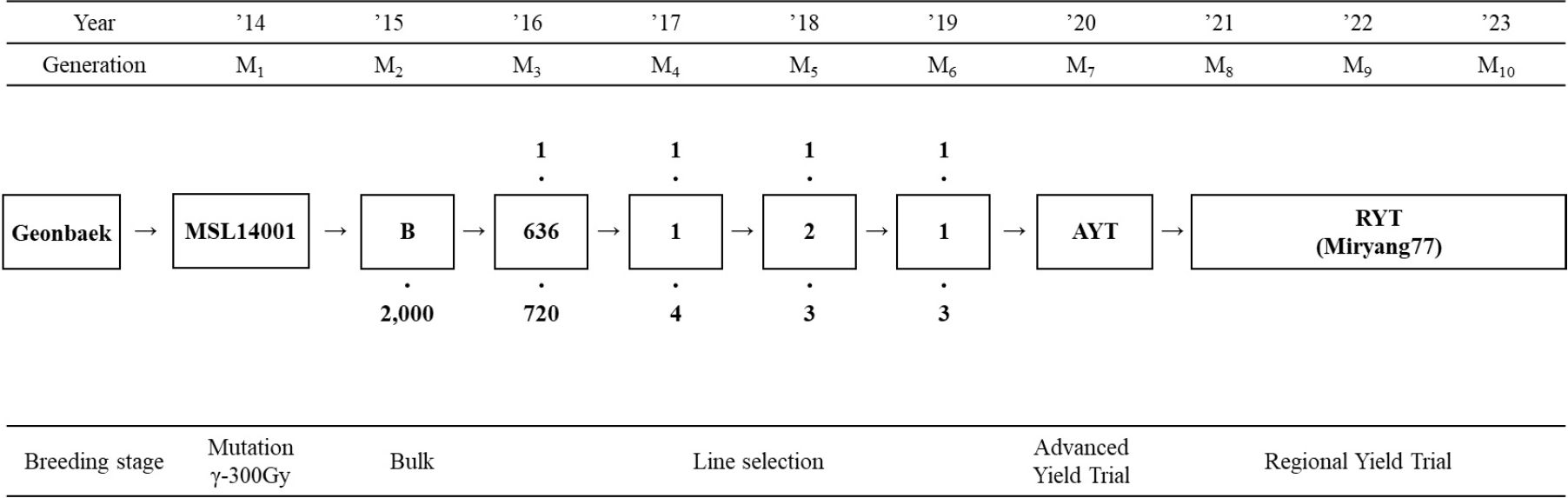
‘영웅’은 기존 우량품종인 ‘건백’을 모본으로 하여, 방사선 돌연변이 육종법을 통해 수량성과 내병성을 강화하고자 개발되었다. 2014년에 ‘건백’ 종자에 감마선(
γ-ray) 300 Gy를 조사한 후 M
1 세대를 양성하여 전량 채종하였다. 2015년 M
2 세대에서 2,000개체를 공시하여 우수한 개체를 선발하였으며, 이후 계통육종법에 따라 세대를 진전시키며 주요 농업적 형질과 생육 특성을 평가하였다. 2020년에는 생산력검정시험을 통해 수량성, 내병성 및 농업적 형질 등을 평가하여 유망계통을 선발하고 ‘밀양77호’로 명명하였다. 이후 2021년부터 2023년까지 3년간 밀양, 수원, 청주, 안동, 나주 5개 지역에서 지역적응시험을 수행하였다. 그 결과 기존 품종 대비 수량성이 월등히 높고, 재배 안정성이 우수할 뿐만 아니라 지방함량 및 착유율 또한 높은 것으로 확인되었다. 이에 2024년 농촌진흥청 직무육성 신품종선정위원회에서 신품종으로 선정되었으며, ‘영웅’으로 명명하였다(
Fig. 1).
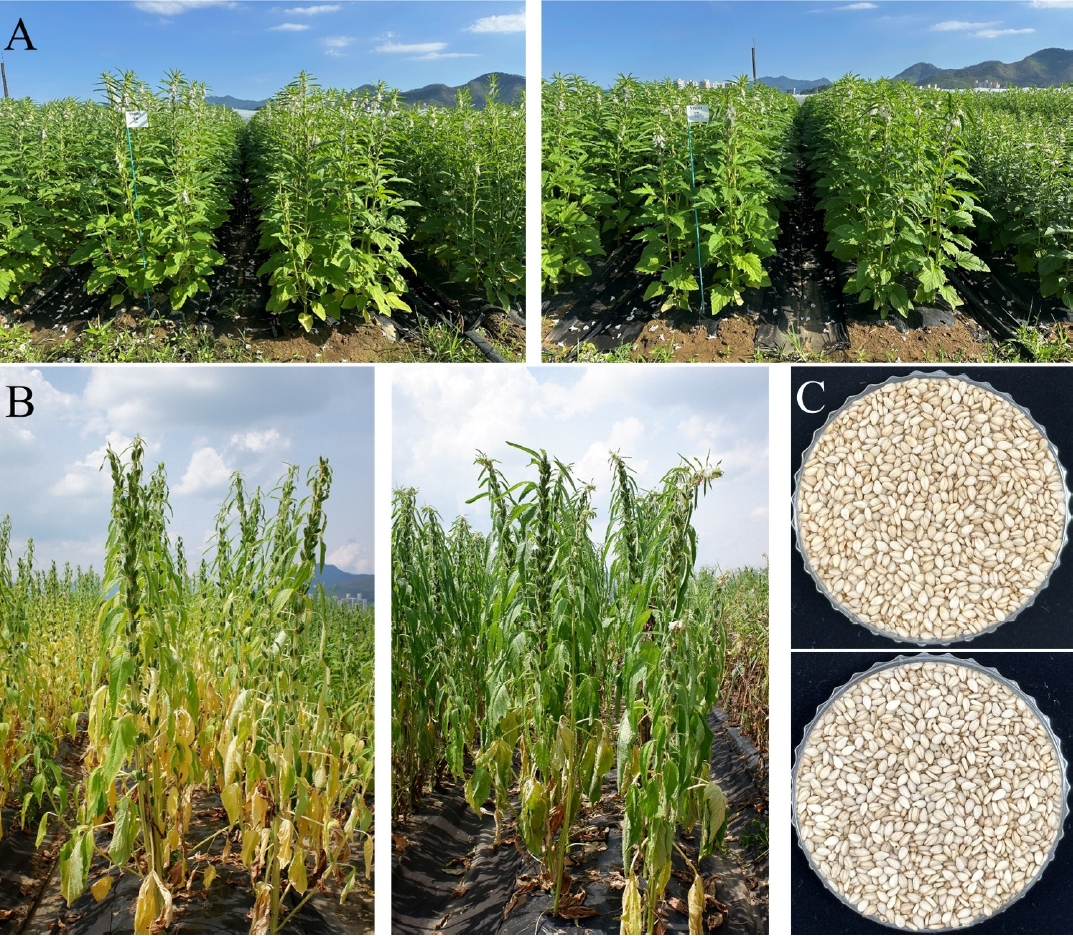
‘영웅’은 대조품종인 ‘건백’과 유사한 무한개화형 소분지 초형이며 꽃색과 종피색은 모두 흰색이다. 꼬투리의 착생은 마디 양쪽으로 3개씩 달리는 3과성이며, 꼬투리 형태는 2실 4방이다. 특히 성숙기에 줄기가 황색으로 변하며 하부 잎부터 탈락하는 낙엽성을 나타내어, 수확 작업 시 수확물의 부피를 줄여 예취 후 자연 건조 효율을 극대화하는 특성을 지닌다(
Table 1,
Fig. 2). ‘영웅’의 평균 개화기는 6월 30일로 대조품종인 ‘건백’ 대비 2일 빠르며, 성숙기는 8월 16일로 ‘건백’ 대비 1일 빠르다. 경장은 167 cm로 ‘건백’(164 cm)과 유사한 수준이나, 수량성과 직결된 착삭부위장은 119 cm로 ‘건백’보다 12 cm 길다. 이에 주당삭수는 104개로 ‘건백’ 대비 7개 많으며, 천립중은 2.9 g으로 대립종이다(
Table 2).
‘영웅’은 종자의 태좌부착성이 다소 약하여 꼬투리 개열 시 종자가 탈립되는 특성을 나타내며, 도복저항성은 대조품종 ‘건백’과 비슷한 수준으로 강한 특성을 보인다. 참깨 역병 병원균을 인공 접종하여 저항성을 검정한 결과, 저항성 반응을 보이며 포장 검정에서도 동일하게 우수한 역병 저항성을 유지한다. 세균점무늬병과 흰가루병은 저항성은 ‘건백’과 비슷하나, 생육 후기에 주로 발생하는 잎마름병에는 ‘건백’ 대비 강한 특성을 나타낸다(
Table 3). 특히 시들음병에 대한 포장 저항성은 대조품종 ‘건백’ 대비 우수하다. 3년간 5개 지역에서 평가한 결과, ‘영웅’의 시들음병 발병지수는 ‘건백’보다 낮거나 비슷한 수준이다. 특히 병 발생이 심한 환경에서도 연차간 낮은 발병률을 보인다(
Table 4).
‘영웅’의 품질분석 결과, 조단백질 함량은 24.0%, 조지방 함량은 56.0%이다. 지방산 조성 중 주요 불포화지방산인 올레산(Oleic acid, C18:1)이 40.9%, 리놀레산(Linoleic acid, C18:2)이 45.1%로 대조품종인 ‘건백’과 비교하여 통계적으로 유의적인 차이는 없다. 또한 착유율은 47%로 우수하다. 항산화물질인 세사민 함량은 2.3 mg/g, 세사몰린 함량은 1.9 mg/g으로 총 리그난 함량은 4.2 mg/g이다(
Table 5).
‘영웅’은 2020년 생산력검정시험 당시 잦은 강우로 참깨 재배환경이 매우 불량했음에도 불구하고 수량이 119 kg/10a로 대조품종 ‘건백’(91 kg/10a) 대비 수량성이 높을 뿐만 아니라 병에 강하여 지역적응시험 계통으로 공시하였다(
Table 6). 2021년부터 2023년까지 3년간 5개 지역에서 지역적응시험을 수행한 결과, ‘영웅’의 평균 수량은 158 kg/10a로 ‘건백’(123 kg/10a) 대비 28% 증수되어 현재 개발된 품종 중 최고 수준의 수량성을 나타낸다(
Table 7). 지역 및 연차 간 수량 변동은 각 재배지의 생육 환경과 기상 여건에 따른 품종 고유의 수량 잠재력이 발현 차이에 기인한 것으로 보인다. ‘영웅’은 전반적인 재배 환경조건에서 ‘건백’보다 높은 수량성을 안정적으로 유지하였으며, 특히 시들음병 발병 압력이 높았던 수원 등의 지역에서 안정적인 내병성과 다수성을 발휘하여(
Table 4), 대조품종 ‘건백’과 뚜렷한 수량 격차를 나타내며, 불리한 재배 환경에서도 뛰어난 생육 안정성을 나타내었다.
파종 전 잘록병 및 잎마름병 등 초기 병해 예방을 위해 종자 소독을 철저히 해야 한다. 육묘 시 저온 환경에서는 발아율이 낮아지고 초기 생육이 크게 저하되므로 가온을 통해 적정 온도를 유지해야 한다. 잦은 강우 시 배수 관리와 병 방제를 철저히 해야 하며, 연작지나 발병 상습지에서는 재배를 지양해야 한다.
Notes
-
사사
본 연구는 농촌진흥청 국립식량과학원의 연구개발사업(PJ01738702)의 지원으로 수행되었습니다.
Fig. 1.Pedigree diagram of ‘YoungWoong’.
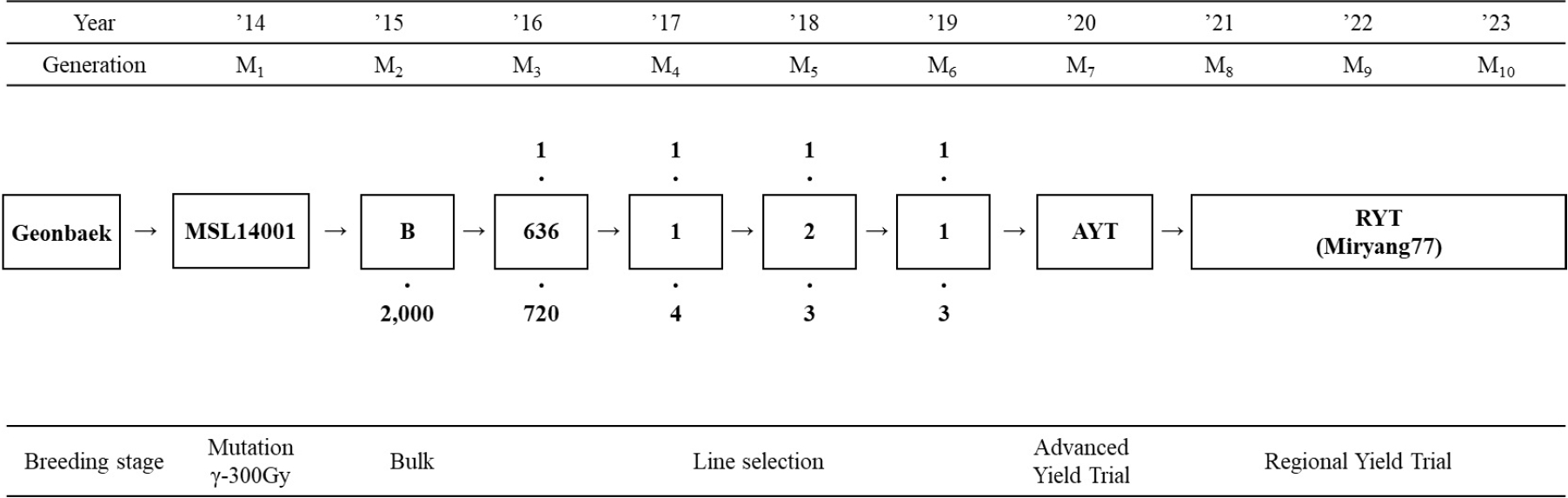
Fig. 2.Morphological characteristics. (A) Flowering stage, (B) Maturity stage (Left: ‘YoungWoong’, Right: ‘Geonbaek’), (C) Seeds (Upper: ‘YoungWoong’, Lower: ‘Geonbaek’).
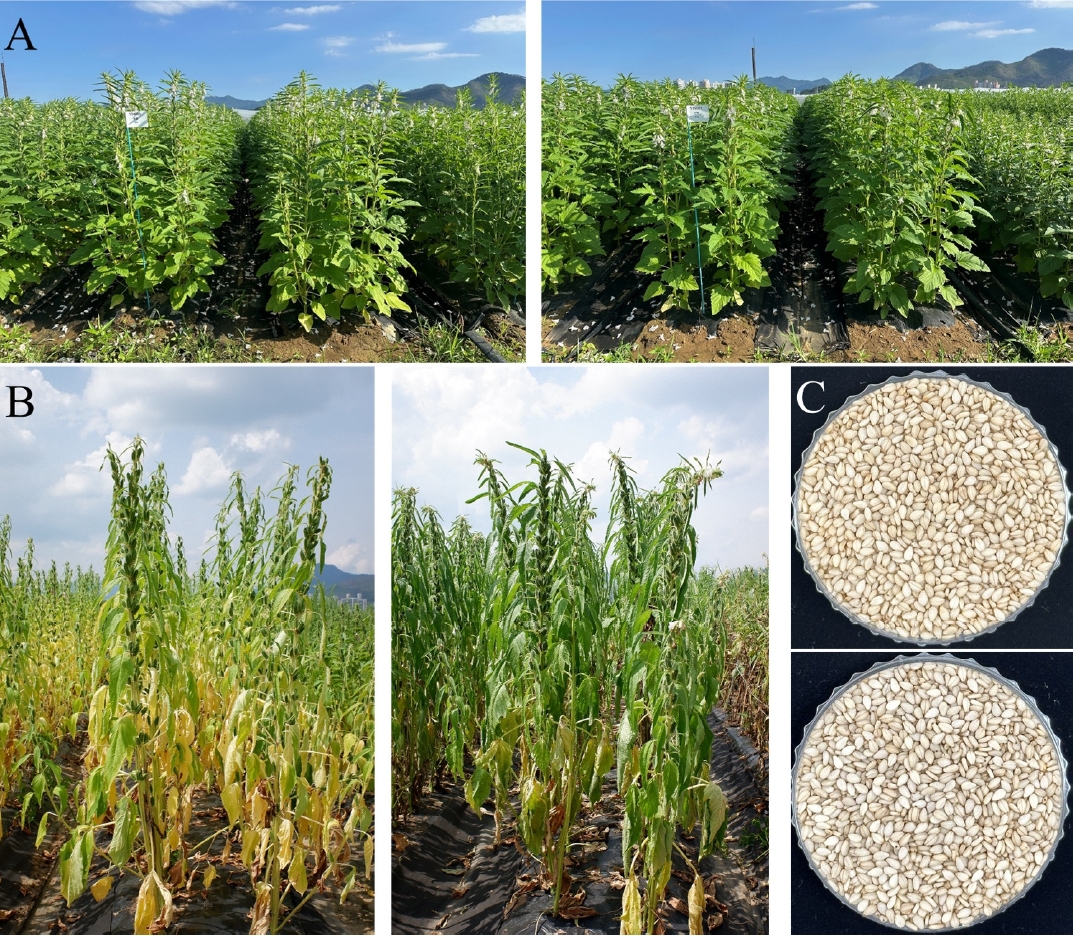
Table 1.Inherent characteristics of ‘YoungWoong’.
Table 1.
|
Variety |
Growth type |
Plant type |
Flower color |
Seed coat color |
Capsule bearing habit
|
|
Capsule |
Carpellate |
Loculus |
|
YoungWoong |
Indeterminate |
Few branched |
White |
White |
3 |
2 |
4 |
|
Geonbaek |
Indeterminate |
Few branched |
White |
White |
3 |
2 |
4 |
Table 2.Agronomic characteristics of ‘YoungWoong’ in the regional yield trial from 2021 to 2023.
Table 2.
|
Variety |
Flowering date |
Maturity date |
Height (cm) |
Capsule-bearing zone length (cm) |
No. of branches |
No. of Capsules per plant |
1,000-seed weight (g) |
|
YoungWoong |
6.30 |
8.16 |
167ns
|
119ns
|
1*
|
104ns
|
2.9ns
|
|
Geonbaek |
7.2 |
8.17 |
164 |
107 |
0 |
97 |
3.0 |
Table 3.Resistance characteristics of ‘YoungWoong’ evaluated from 2021 to 2023.
Table 3.
|
Variety |
Capsule shattering resistance (1-9)z
|
Lodging (1-9)y
|
Phytophtora blight inoculation (R, S)x
|
Disease severity in field (0-9)w
|
|
Phytophthora blight |
Fusarium wilt |
Powdery mildew |
Leaf blight |
|
YoungWoong |
9 |
1 |
R |
1 |
1 |
0 |
1 |
|
Geonbaek |
9 |
1 |
R |
1 |
3 |
0 |
1 |
Table 4.Comparison of Fusarium wilt resistance between ‘YoungWoong’ and ‘Geonbaek’ across five locations from 2021 to 2023.
Table 4.
|
Location |
YoungWoong
|
Geonbaek
|
|
2021 |
2022 |
2023 |
2021 |
2022 |
2023 |
|
Miryang |
0z
|
0 |
0 |
3 |
0 |
1 |
|
Suwon |
2 |
2 |
2 |
4 |
6 |
1 |
|
Cheongju |
1 |
0 |
1 |
2 |
3 |
3 |
|
Andong |
0 |
0 |
0 |
0 |
0 |
0 |
|
Naju |
0 |
0 |
0 |
0 |
0 |
0 |
Table 5.Seed quality characteristics of ‘YoungWoong’ in regional yield trial at Miryang from 2021 to 2023.
Table 5.
|
Variety |
Crude protein (%) |
Crude oil (%) |
Oil extraction yield (%) |
Fatty acid composition (%)z
|
Lignan (mg/g)
|
|
Ole. |
Lin. |
Sesamin |
Sesamolin |
Total |
|
YoungWoong |
24.0ns
|
56.0ns
|
47 |
40.9ns
|
45.1ns
|
2.3ns
|
1.9ns
|
4.2ns
|
|
Geonbaek |
26.0 |
53.0 |
45 |
42.7 |
44.9 |
2.5 |
2.2 |
4.7 |
Table 6.Yield of ‘YoungWoong’ in the advanced yield trials, 2020.
Table 6.
|
Variety |
Yield (kg/10a) |
Index |
|
YoungWoong |
119 |
131 |
|
Geonbaek |
91 |
100 |
Table 7.Yield of ‘YoungWoong’ in the regional yield trials at 5 locations.
Table 7.
|
Location |
YoungWoong (kg/10a, A)
|
Geonbaek (kg/10a, B)
|
Index (A/B) |
|
2021 |
2022 |
2023 |
Mean |
2021 |
2022 |
2023 |
Mean |
|
Miryang |
164 |
236 |
108 |
169 |
134 |
157 |
86 |
126 |
134 |
|
Suwon |
167 |
153 |
160 |
160 |
124 |
77 |
107 |
103 |
155 |
|
Cheongju |
139 |
172 |
75 |
129 |
133 |
135 |
89 |
119 |
108 |
|
Andong |
146 |
170 |
125 |
147 |
160 |
94 |
102 |
119 |
124 |
|
Naju |
132 |
248 |
173 |
184 |
115 |
204 |
131 |
150 |
123 |
|
Mean |
150 |
196 |
128 |
158* |
133 |
133 |
103 |
123 |
128 |
References
- 1. Grichar WJ, Dotray PA, Langham DR. 2020. Effects of harvest aids on sesame (Sesamum indicum L.) drydown and maturity. Pests, Weeds and Diseases in Agricultural Crop and Animal Husbandry Production. IntechOpen, pp. 1-15.
- 2. Kim SU, Lee JE, Oh EY, Kim JI, Kim MY, Kim SW, Lee ES, Cho KS, Lee MH. 2023. The white sesame variety ‘Kangyou’ with Phytophthora blight and Fusarium wilt disease resistance. Korean J Breed Sci 55: 367-372.
- 3. Kim SU, Lee MH, Pae SB, Oh EY, Kim JI, Ha TJ. 2018. A sesame variety “Goenbaek” with Phytophthora blight disease resistance and high yield. Korean J Breed Sci 50: 256-260.
- 4. KOSIS. 2025. National statistics portal. https://kosis.kr/index/index.do
- 5. Langham DR. 2007. Phenology of sesame. pp. 144-182. In: Janick J, Whipkey A. (Eds). Issues in new crops and new uses. ASHS Press, Alexandria, VA: pp. 144-182.
- 6. Oh E, Kim MY, Kim S, Lee J, Lee MH. 2018. An improved screening method for evaluation of resistance to Phytophthora blight in sesame cultivars and accessions. Plant Breed Biotechnol 6: 305-308.
- 7. Salse J, Barnard RL, Veneault-Fourrey C, Rouached H. 2024. Strategies for breeding crops for future environments. Trends Plant Sci 29: 303-318.
- 8. Shyu YS, Hwang LS. 2002. Antioxidative activity of the crude extract of lignan glycosides from unroasted Burma black sesame meal. Food Res Int 35: 357-365.
Citations
Citations to this article as recorded by