적요
간척농지 재배에 적합한 내염성 콩 품종 ‘세화’를 육성하고, 그 주요 농업적 형질을 조사하고 내염성 관련 형질을 평가하였다. ‘세화’는 Hutcheson × PI483463 조합에서 유래한 F1 개체와 국내 품종 ‘우람‘을 2012년 인공교배하여 육성되었다. 이후 계통육종법에 따라 세대를 진전시켰으며, 간척지 포장 검정 및 생산력 검정을 거쳐 내염성이 우수하고 형질이 고정된 최종 계통을 선발하였다. ‘세화’는 유한신육형의 직립형 초형으로 꽃색은 흰색, 모용색은 황갈색, 종피색은 황색이며 배꼽색은 진한 갈색을 나타낸다. 2020년 생산력 검정 결과, 개화기는 8월 3일로 대조품종인 ‘풍산나물’과 동일하였다. 평균 초장은 69.0 cm로 ‘풍산나물’(61.0 cm)에 비해 유의하게 컸으며, 마디 수(15.7개)와 개체당 협수(72.3개)는 유사한 수준을 나타냈다. 수량은 2.3 t/ha로, ‘풍산나물’(2.8 t/ha)과 유의한 차이가 없었다. 내염성 검정 결과, 100 mM NaCl 처리 시 ‘세화’의 엽 피해 지수(LSS)는 1.3으로 강한 염 저항성을 나타낸 반면, 염 민감성 품종인 ‘Hutcheson’은 심한 괴사 현상(LSS 3.7)을 보였다. ‘세화’는 100 mM NaCl 처리 조건에서 Na⁺ 함량이 대조구 대비 598% 증가하여, ‘Hutcheson’ (1,503%)에 비해 낮은 이온 축적률을 보였다. 또한 Na⁺/K⁺ 비율의 증가율 역시 529%로 나타나 ‘Hutcheson’ (1,365%)보다 현저히 낮아 ‘세화’가 상대적으로 Na⁺ 이온 흡수를 효과적으로 제어함을 확인하였다. 내염성 품종 ‘세화’는 향후 간척지 농지의 콩 재배 확대와 내염성 신품종 육성의 재료로 기여할 것으로 기대된다.
Abstract
The soybean [Glycine max (L.) Merr.] cultivar ‘Sehwa’ (Grant No. 10017) was developed at Kyungpook National University. It was derived from a cross between ‘Uram’ and an F1 plant from a cross between the salt-sensitive soybean ‘Hutcheson’ (G. max) and the salt-tolerant wild soybean ‘PI483463’ (G. soja). In salt tolerance bio-assays, ‘Sehwa’ demonstrated high tolerance, with a low leaf scorch score (LSS) of 1.3 under 100 mM NaCl treatment. Contrastingly, ‘Hutcheson’ exhibited severe chlorosis and necrosis (LSS 3.7). Under salt stress, ‘Sehwa’ accumulated markedly fewer toxic ions than did Hutcheson. Compared with that in the control, the Na⁺ content increased by 598% in ‘Sehwa’, which was significantly lower than that in ‘Hutcheson’ (1,503%). Notably, in ‘Sehwa’, the Na⁺/K⁺ ratio increased by 529%, whereas ‘Hutcheson’ revealed a 1,365% increase. In the 2020 yield trial, ‘Sehwa’ exhibited an erect growth habit with an average plant height of 69.0 cm, which was considerably taller than the check cultivar ‘Pungsannamul’ (61.0 cm). Despite being small-seeded cultivar (100-seed weight: 10.0 g) compared with ‘Pungsannamul’ (13.5 g), it shows a reasonable yield potential of 2.3 t/ha, comparable to the 2.8 t/ha of the ‘Pungsannamul’. Therefore, ‘Sehwa’ is a promising soybean cultivar for reclaimed land owing to its salt tolerance and favorable agronomic traits.
-
Key words: soybean, salt tolerance, reclaimed land
서언
우리나라는 1965년 이후 식량 증산과 농업 생산기반 확충을 목적으로 간척사업을 통해 농지를 지속적으로 조성해 왔다. 현재까지 약 105,000 ha의 간척농지가 준공되었으며, 추가로 9,000 ha가 공사중에 있다(
MAFRA 2026). 간척지는 지대가 낮고 지하수위가 높으며, 토양 내 염분 농도가 높은 특성을 지니고 있어 일반 밭작물의 생육을 저해하는 환경적 한계를 가진다(
Jeong et al. 2020,
Lee et al. 2003). 이러한 이유로 간척지는 오랫동안 벼 재배 중심으로 활용되어 왔다. 벼는 담수 재배 조건에서 생육기간 동안 토양 내 염류가 뿌리 하부로 용탈되어 염 스트레스의 영향을 상대적으로 덜 받는 특성이 있기 때문이다(
Lim et al. 2020).
최근 국내 쌀 소비량은 지속적으로 감소하고 있다. 1인당 연간 쌀 소비량은 2013년 67.2 kg에서 2023년 56.4 kg으로 감소하여 10년간 16.1% 줄어들었다. 반면 쌀 재고량은 2019년 890,000 t에서 2023년 1,440,000 t으로 증가하여 5년간 61.7% 늘어난 것으로 나타났다(
MAFRA 2026,
MODS 2026). 그러나 쌀을 제외한 콩, 옥수수 등 주요 곡물은 국내 생산 비중이 낮아 대부분 수입에 의존하고 있다. 이에 정부는 주요 곡물의 안정적인 공급이 가능하도록 식량 자급률 향상을 주요 정책 목표로 설정하였다. 2027년까지 전체 식량자급률을 55.5%로, 그 중 콩의 자급률을 43.5%로 높이는 것을 목표로 제시하였다(
MAFRA 2022). 이러한 정책적 배경 아래, 정부는 간척지의 벼 중심 재배 구조를 타작물 재배 확대 방향으로 전환하고 있으며, 간척지 내 타작물 재배 비율을 단계적으로 확대할 계획이다.
그러나 간척지는 토양의 전기전도도가 4.0 dS/m 이상의 고염조건을 나타내어 대부분의 밭작물 재배에 제약이 있어, 콩을 포함한 일반 밭작물은 염 스트레스에 직접적으로 노출된다. 콩은 포화토양 추출액의 전기전도도(ECe)가 5.0 dS/m를 내성 한계값으로 갖는 중간 수준의 염 감수성을 갖는 작물로 알려져 있어(
Maas 1985), 간척지 환경에서 안정적인 생산이 어렵다. 따라서 염 스트레스 조건에서도 수량 감소를 최소화할 수 있는 내염성 품종 개발이 선행되어야 한다.
세계적으로는 콩의 내염성과 관련하여 QTL 탐색, 유전자 기능 분석 및 마커 개발 등 다양한 기초 및 응용 연구가 수행되어 왔다(
Guan et al. 2014,
Li et al. 2024). 또한 400여 개의 콩 품종 및 유전자원을 대상으로 염 내성 평가 후 계통을 분류하는 연구가 수행되었으며(
Chen et al. 2024), 염류 집적 토양에 적응 가능한 계통을 선발하기 위한 연구가 활발히 진행되고 있다. 그러나 국내에서는 실제 재배 환경에 적용 가능한 내염성 품종 개발과 콩 내염성 연구가 제한적으로 이루어지고 있다. 특히 간척지 확대와 토양 염류 집적 문제가 지속적으로 제기되고 있는 상황에서 국내 환경 조건에 적합한 내염성 콩 품종 개발은 시급한 과제로 판단된다.
재배콩(
Glycine max)은 육종 과정에서 유전적 다양성이 낮아져 특정 환경 스트레스에 대한 대응 유전자가 제한적인 특성을 보이는 반면, 야생콩(
Glycine soja)은 높은 유전적 다양성과 다양한 환경에 대한 적응력을 고려할 때, 재배 콩을 개선할 수 있는 커다란 잠재력을 가지고 있다(
Kofsky et al. 2018). 이에 내염성 콩 품종 개발에 단일 우성 내염성 유전자를 보유한 것으로 보고된 야생콩 계통 PI483463 (
Lee et al. 2009)을 내염성 유전자원으로 활용하였다.
‘세화’는 국내 육성 품종 ‘우람’을 모본으로 하고, Hutcheson×PI483463 조합에서 육성된 F1과의 인공교배를 통해 개발된 품종으로, 생육 특성, 수량성 및 내염성 형질의 발현 여부를 평가하였고 그 결과를 보고하고자 한다.
재료 및 방법
육성과정
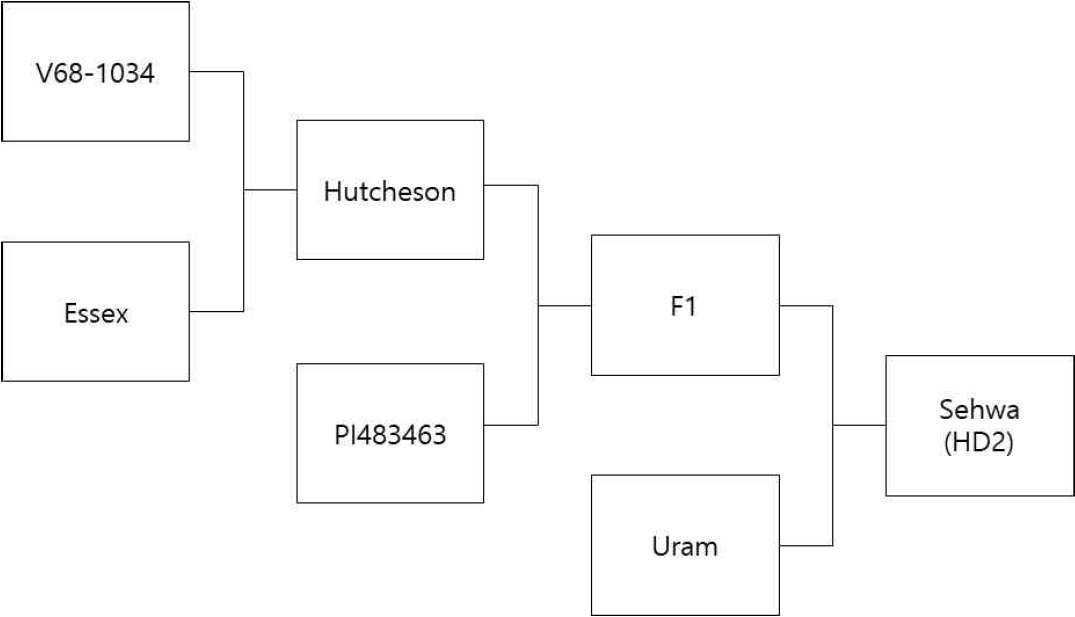
‘세화’는 국내 육성 콩 품종 ‘우람’(
Ko et al. 2016)과 Hutcheson×PI483463 조합에서 유래한 F
1 개체와 인공교배하여 개발된 품종이며, 육성기간 동안 ‘HD2’로 명명되었다(
Fig. 1).
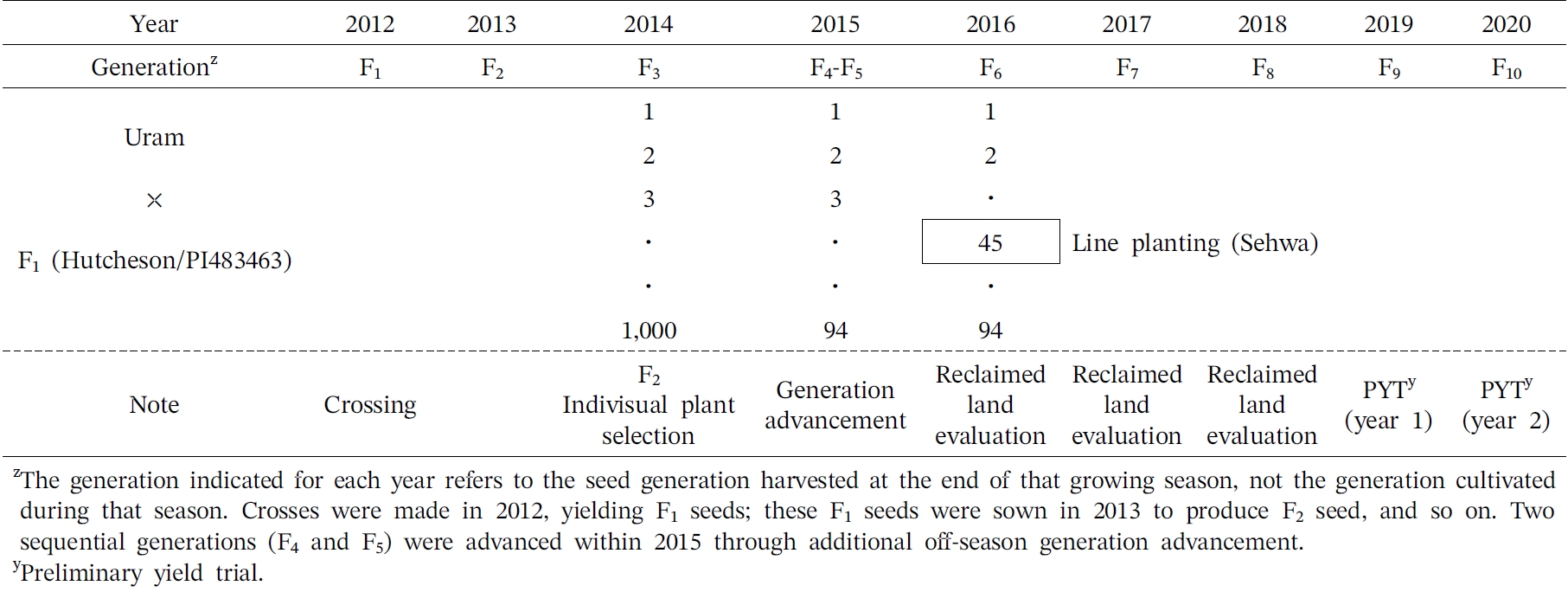
인공교배는 2012년 대구광역시 군위군 효령면에 위치한 경북대학교 농장(Daegu, 36°, 09′, 24.63″, N, 128°, 35′, 07.47″, E, Republic of Korea)에서 수행되었다. 인공교배에서 총 4개의 F1 종자를 확보하였으며, 2013년에 F1을 재배하여 F2 종자를 생산하였다. 2014년에 F2:3 계통을 육성하여, 포장 검정에서 덩굴성이 심하거나 탈립성이 높은 계통을 제외하고 세대를 진전시켜 2015년에 F5 세대를 확보하였다.
2016년에는 94개 계통을 현대서산농장의 간척지 포장에 재배하여 포장 조건에서 내염성을 검정하였으며, 동일한 계통을 경북대학교 포장에 재배하여 종자를 증식하는 동시에 주요 농업적 형질을 평가하였다. 이 중 덩굴성이 적고 내염성이 우수한 45번 계통을 선발하여 2017년부터 계통 재배를 통해 형질을 고정시켰다.
2017년부터 2018년까지 현대서산농장 간척지에서 적응성 검정을 수행한 결과, 대조 품종에 비해 내염성이 우수한 것으로 확인되었다. 이후 2019년부터 2020년까지 경북대학교 농장에서 생산력 검정을 수행하여 수량 및 주요 농업적 형질을 평가하였다(
Fig. 2).
2019년과 2020년에 생산력검정 시험을 대구광역시 군위군 효령면에 위치한 경북대학교 농장에서 수행하였다. ‘세화’와 대조 품종으로 ‘풍산나물’을 사용하였다.
시험구 면적은 4 m 4열(11.2 m2)로 하였으며, 재식거리는 70×15 cm, 1주 2본으로 재배하였다. 시험 설계는 난괴법으로 배치하였으며, 2019년에는 2반복, 2020년에는 3반복으로 수행하여 주요 생육 특성과 수량성을 평가하였다.
파종일은 2019년 6월 1일, 2020년 6월 5일로 하였다. 각 반복에서 무작위로 2019년에는 5개체, 2020년에는 10개체를 선정하여 초장, 분지수, 마디수, 개체당 협수 및 100립중을 조사하였다. 또한 신육형, 꽃색, 모용색, 종피색 및 배꼽색 등의 질적 형질을 생산력 검정 기간 동안 함께 평가하였다. 각 반복 내에서 조사된 개체값은 평균하여 해당 반복(구획)의 대푯값으로 사용하였으며, 통계분석은 이 반복별 평균값(2019년 n=2, 2020년 n=3)을 실험단위로 하여 수행하였다.
내염성 검정
내염성 검정을 위해 경북대학교 농장 온실(Daegu, 35°, 53′, N, 128°, 36′, E, Republic of Korea)에서 실험을 진행하였다. 염 스트레스 처리는 이전 연구(
Lee et al. 2008)에서 제시된 Plastic cone-tainer 방법을 변형하여 실시하였다. 콩은 50공 육묘 트레이(가로 53×세로 26×높이 11 cm)에 파종하여 제 1본엽기까지 재배하였다. 이후 처리구는 염 처리를 위해 100 mM NaCl 용액 5 L가 담긴 용기에 육묘 트레이를 하단부로부터 약 3 cm 가량 침지시켜 저면관수 방식으로 처리하였다. 대조구는 동일한 방법으로 수돗물을 공급하였다.
처리 후 21일째, ‘세화’와 ‘Hutcheson’ 두 품종에 대해 엽 피해 지수(Leaf scorch score, LSS)를 평가하였다. 엽 피해 정도는 1점(무피해)부터 5점(식물체 고사)까지의 5단계 척도로 평가하였으며(
Lee et al. 2008), 1점 = 황화 현상 없음; 2점 = 경미함(잎의 25%에서 황화가 보임); 3점 = 중간 수준(잎의 50%에서 황화와 일부 괴사가 보임); 4점 = 심한 황화(잎의 75%에서 황화와 심한 괴사가 보임); 5점 = 고사(잎 전체에서 심한 괴사가 보이며 시들음)으로 정의하였다. 엽 피해 지수(Leaf scorch score, LSS)를 기준으로 2.5 미만을 염 내성, 2.5 이상 3.5 미만을 중간 내성, 3.5 이상을 염 민감성으로 구분하였다(
Lee et al. 2018). 내염성 평가는 3반복으로 수행하였으며, 각 반복에서 품종당 5개체를 대상으로 조사하여 평균을 내어 반복의 값으로 사용하였다. 생육 조사를 위해 각 개체의 초장과 생체중을 측정하였으며, 지상부를 70℃ 드라이 오븐에서 24시간 동안 건조한 후 건물중을 산출하였다.
1. Cl⁻ 함량 분석
Cl⁻ 함량 분석은
Kim et al. (2026)의 방법을 일부 수정하여 실시하였다. 내염성 검정과 동일한 실험에서 채취한 시료를 사용하였으며, 3반복으로 수행하였고 각 반복은 품종당 5개체의 지상부 시료를 혼합하여 사용하였다. 콩의 지상부 시료를 70℃ 드라이 오븐에서 24시간 동안 완전 건조한 뒤 시료를 분말 형태로 분쇄하였다. 분석을 위해 분말 시료 0.05 g을 50 mL conical tube에 취하고 증류수 10 mL를 가하였다. 각 conical tube를 회전 교반기를 이용하여 60 rpm으로 1시간 동안 교반하였다. 추출액은 여과지를 통과시켜 분석용 시료로 사용하였다. 최종 용액 내 Cl⁻ 함량은 디지털 pH/mV 미터(Orion Star A214, Thermo Scientific, USA)와 복합 염화물 전극(Orion, Model 9617BNWP)을 사용하여 측정하였다. 최종 함량은 표준 검정 곡선(standard calibration curves)으로부터 도출된 농도에 희석 배수를 적용하여 계산하였으며, 시료의 건조 중량당 함량(mg g
-1dry weight)으로 환산하여 표기하였다.
2. K⁺ 및 Na⁺ 함량 분석
K⁺와 Na⁺ 함량 분석은
Kim et al. (2026)의 방법에 따라 진행하였다. K⁺ 및 Na⁺ 함량 분석은 내염성 검정과 동일한 실험에서 채취한 시료를 사용하였으며, 3반복으로 수행하였고 각 반복은 품종당 5개체의 지상부 시료를 혼합하여 사용하였다. 건조 후 분쇄된 분말 시료 0.15 g을 50 mL conical tube에 취한 후, 각 conical tube에 65% 질산(HNO
3) 2 mL를 첨가하고 80℃의 항온수조에서 4시간 동안 배양하였다. 실온으로 냉각한 후, 37% 과산화수소(H
2O
2) 0.2 mL를 첨가하고 반응이 완료되도록 30분간 방치하였다. 분해된 시료는 여과지로 여과한 후 증류수를 사용하여 최종 부피를 30 mL로 희석하였으며, 이 희석액을 K⁺ 및 Na⁺ 함량 분석에 사용하였다. 최종 용액 내 K⁺ 및 Na⁺ 함량은 이온 선택성 전극(ion-selective electrodes)과 디지털 pH/mV 미터를 사용하여 측정하였다. K⁺ 함량은 복합 칼륨 전극(Orion, Model 9719BNWP, Thermo Scientific, USA)을 사용하여 측정하였으며, Na⁺ 함량은 복합 나트륨 전극(Orion, Model 8611BNWP, Thermo Scientific, USA)을 사용하여 측정하였다. K⁺ 및 Na⁺ 최종 함량은 표준 검정 곡선(standard calibration curves)으로부터 도출된 농도에 희석 배수를 적용하여 계산하였으며, 시료의 건조 중량당 함량(mg g
-1dry weight)으로 환산하여 표기하였다.
생산력 검정 자료는 난괴법(RCBD)에 기반한 분산분석(ANOVA)을 실시하였으며, 내염성 검정 및 이온함량 분석 자료는 품종을 처리요인으로 하는 일원배치 분산분석(one-way ANOVA)을 실시하였다. 처리평균 간 차이는 Fisher의 최소유의차 검정(LSD, α=0.05)을 이용하여 비교하였다. 모든 통계분석은 SAS 9.4 (SAS Institute, Cary, NC, USA)의 PROC GLM을 이용하여 수행하였다. 본문 및 표에 제시된 값은 별도 언급이 없는 한 평균±표준편차(mean±SD)로 나타내었다.
결과
고유특성 및 생육특성
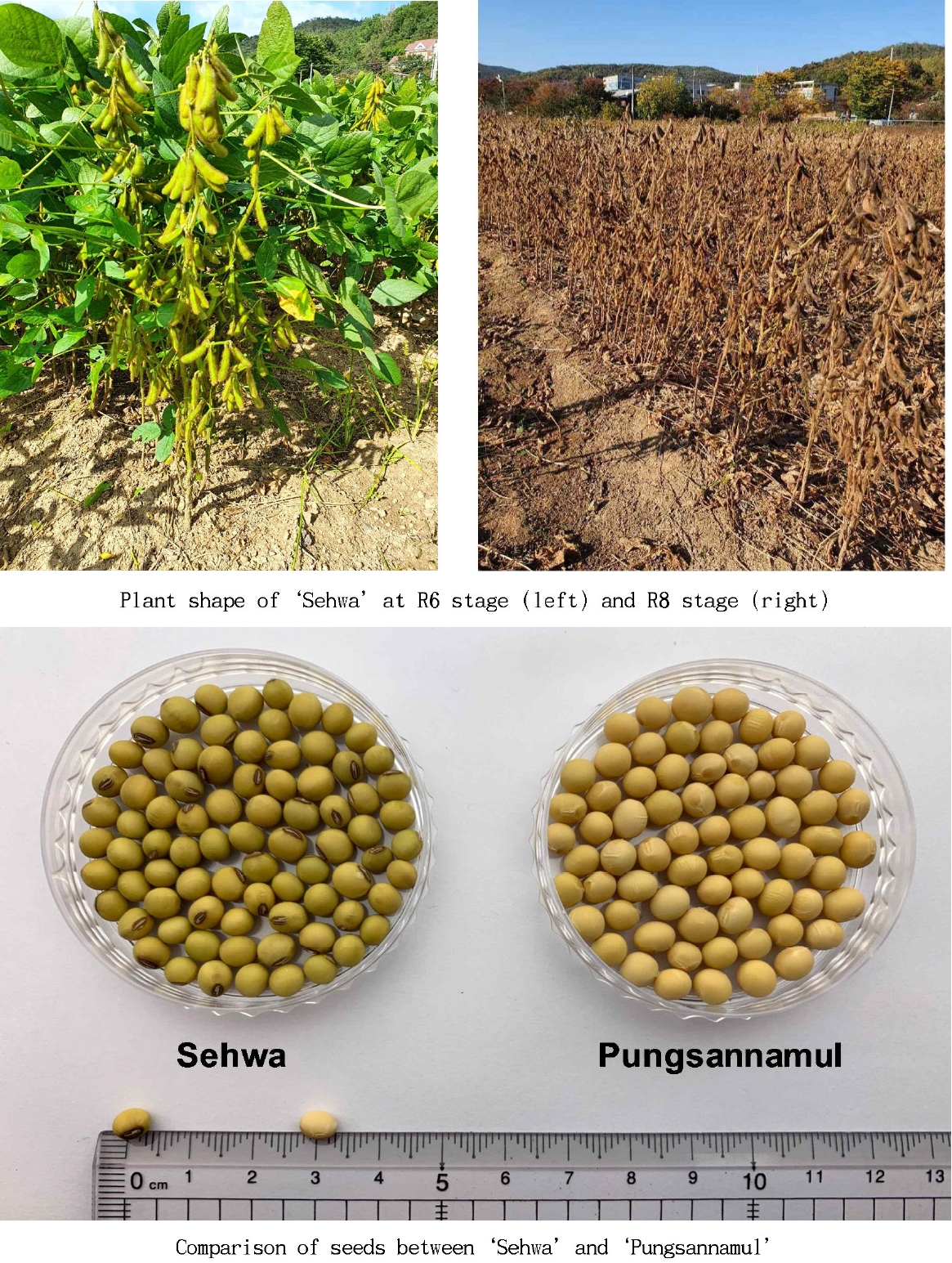
‘세화’는 직립형의 유한신육형이며 꽃색은 흰색, 모용색은 황갈색, 종피색은 황색, 배꼽색은 진한 갈색의 고유특성을 나타냈다(
Table 1). 엽형은 끝이 뾰족한 난형, 엽의 크기는 소형이었다. ‘세화’의 생육 최성기 초형, 잎의 형태적 특성, 줄기 정단부의 특징 및 종자의 형태는
Fig. 3에 제시하였다.
2019년 생산력검정에서 6월 1일 파종 시 ‘세화’의 성숙기는 10월 25일로 ‘풍산나물’보다 8일 느렸다. 평균 가지 수는 3.5개로, ‘풍산나물’(3.7개)과 유의한 차이가 없었다. 평균 마디 수는 14개로, ‘풍산나물’(14.5개)과 유의한 차이가 없었다. 평균 협수는 91.8개로, ‘풍산나물’(86.3개)과 유의한 차이가 없었다(
Table 2).
2020년 생산력검정에서 6월 5일 파종 시 ‘세화’의 개화기는 8월 3일로 ‘풍산나물’과 같았고, 성숙기는 10월 16일로 ‘풍산나물’보다 4일 느렸다. 평균 초장은 69.0 cm로, ‘풍산나물’(61.0 cm)보다 유의하게 컸다. 평균 가지 수는 4.7개로, ‘풍산나물’(4개)과 유의한 차이가 없었다. 평균 마디 수는 15.7개로, ‘풍산나물’(16.6개)과 유의한 차이가 없었다. 수량은 2.3 t/ha로, ‘풍산나물’(2.8 t/ha)과 유의한 차이가 없었다. 100립중은 10.0 g으로, ‘풍산나물’(13.5 g)보다 유의하게 작았다(
Table 3).
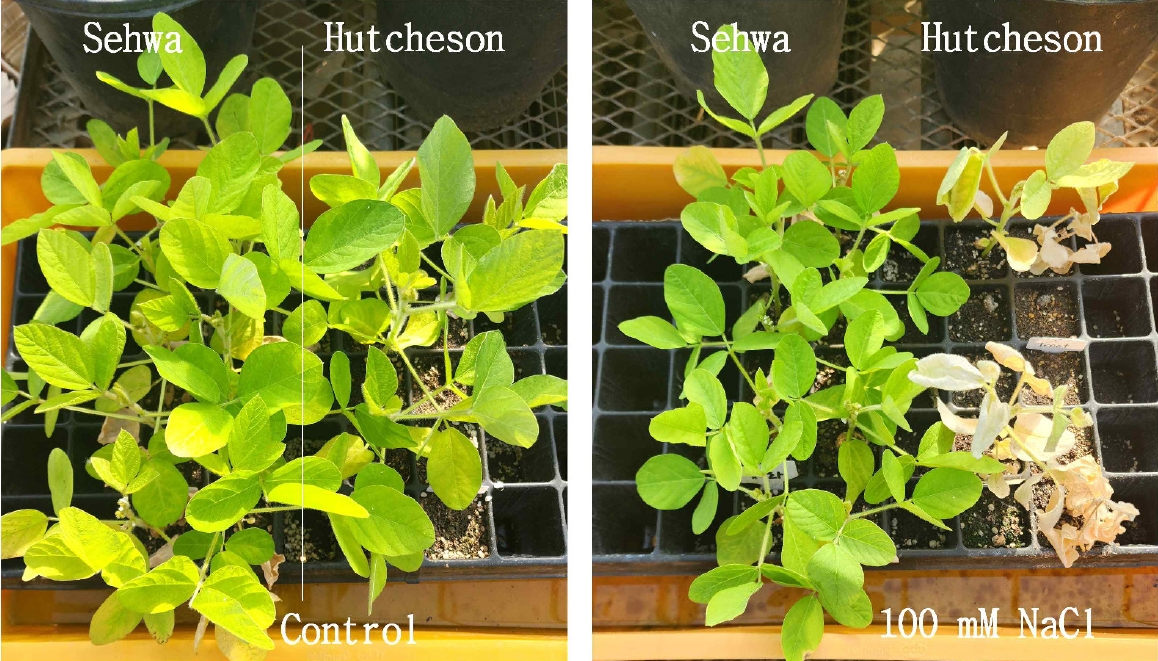
‘세화’의 염 저항성을 평가하기 위해 염 민감성 품종인 ‘Hutcheson’을 대조 품종으로 사용하여 염 처리 후 내염성 관련 지표를 분석하였다. 대조구에서는 ‘세화’와 ‘Hutcheson’ 모두 LSS가 1.0으로 나타나 품종 간 유의한 차이가 관찰되지 않았다. 반면 100 mM NaCl 처리 3주 후 처리구에서는 ‘세화’의 LSS가 1.3±0.4로 낮은 수준을 유지하여 염 저항성을 나타낸 반면, ‘Hutcheson’은 3.7±0.3으로 염 민감성을 나타냈다(
Fig. 4). 두 품종 간 LSS 값은 통계적으로 유의한 차이를 보였다(
Table 4).
NaCl 처리에 따른 두 콩 품종의 생육 반응을 비교하기 위해 생체중, 건물중, 초장을 조사하였다(
Table 5). 생체중의 경우, 대조구에서 ‘세화’는 5.40±0.40 g/plant, ‘Hutcheson’은 7.09±1.67 g/plant이었으며 두 품종 간 유의한 차이는 나타나지 않았다. 염 처리구에서의 생체중은 ‘세화’ 4.01±0.27 g/plant, ‘Hutcheson’ 3.69±0.42 g/plant로 대조구에 비해 모두 감소하였으나, 처리구 내에서의 품종 간 유의한 차이는 없었다. 100 mM NaCl 처리에 따른 대조구 대비 상대적 생체중은 ‘세화’ 74.4%, ‘Hutcheson’ 54.9%로 나타났다. 건물중은 대조구에서 ‘세화’ 3.23±0.72 g/plant, ‘Hutcheson’ 3.52±0.95 g/plant로 두 품종 간 유의한 차이는 없었다. 처리구에서의 건물중은 ‘세화’ 2.76±0.36 g/plant, ‘Hutcheson’ 2.86±0.50 g/plant로 확인되었으며, 이 역시 품종 간 유의한 차이가 나타나지 않았다. 대조구 대비 상대적 건물중은 ‘세화’ 88.9%, ‘Hutcheson’ 86.5%로 나타났다. 초장은 대조구에서 ‘세화’ 20.20±6.41 cm, ‘Hutcheson’ 21.27±2.31 cm로 품종 간 유의한 차이는 없었다. 처리구에서의 초장은 ‘세화’ 17.24±6.22 cm, ‘Hutcheson’ 16.14±1.68 cm로 두 품종 모두 대조구 대비 감소하는 경향을 보였다. 상대적 초장은 ‘세화’가 86.0%, ‘Hutcheson’이 76.0% 수준이었다(
Table 5).
NaCl 처리에 따른 두 콩 품종의 Cl⁻, Na⁺, K⁺ 함량 및 Na⁺/K⁺ 비율을 조사하였다(
Table 6).
Cl⁻ 함량의 경우, 대조구에서 ‘세화’는 2.07±0.19 mg g-1DW, ‘Hutcheson’은 4.27±0.83 mg g-1DW로 나타나 ‘Hutcheson’이 유의하게 높았다. 100 mM NaCl 처리 후 ‘세화’는 51.67±14.64 mg g-1DW, ‘Hutcheson’은 136.33±18.77 mg g-1DW로 증가하였다. 대조구 대비 증가율은 ‘세화’에서 2,563%, ‘Hutcheson’에서 3,351%이었다.
Na⁺ 함량은 대조구에서 ‘세화’는 1.43±0.14 mg g-1DW, ‘Hutcheson’은 1.60±0.07 mg g-1DW로 나타나 두 품종 간 유의한 차이가 없었다. 100 mM NaCl 처리 후 ‘세화’는 8.38±1.70 mg g-1DW, ‘Hutcheson’은 24.00±3.00 mg g-1DW로 나타나 ‘Hutcheson’에서 유의하게 높은 Na⁺ 축적이 확인되었다. 대조구 대비 증가율 또한 ‘세화’ 598%, ‘Hutcheson’ 1,503%로 나타나, ‘Hutcheson’이 ‘세화’에 비해 높은 증가율을 보였다.
K⁺ 함량은 대조구에서 ‘세화’는 36.49±9.16 mg g-1DW, ‘Hutcheson’은 44.83±13.12 mg g-1DW로 나타나 두 품종 간 유의한 차이가 없었다. 100 mM NaCl 처리 후 ‘세화’는 39.88±7.04 mg g-1DW, ‘Hutcheson’은 48.48±2.71 mg g-1DW로 나타나 처리구에서도 두 품종 간 유의한 차이는 확인되지 않았다. 대조구 대비 상대적 함량은 ‘세화’ 111%, ‘Hutcheson’ 118%로 나타나, 100 mM NaCl 처리에 따른 K⁺ 이온의 변화는 두 품종 모두 크지 않은 것으로 나타났다.
Na⁺/K⁺ 비율은 대조구에서 ‘세화’와 ‘Hutcheson’ 모두 0.04±0.01로 나타나 두 품종 간 유의한 차이가 없었다. 100 mM NaCl 처리 후 ‘세화’는 0.21±0.04, ‘Hutcheson’은 0.49±0.04로 나타나 ‘Hutcheson’에서 유의하게 높은 Na⁺/K⁺ 비율이 확인되었다. 대조구 대비 증가율 또한 ‘세화’ 529%, ‘Hutcheson’ 1,365%로 나타나, ‘Hutcheson’이 ‘세화’에 비해 높은 증가율을 보였다(
Table 6).
Notes
-
사사
본 연구는 농촌진흥청의 공동연구사업(RS-2023-00227533)의 지원으로 수행되었습니다.
Fig. 1.
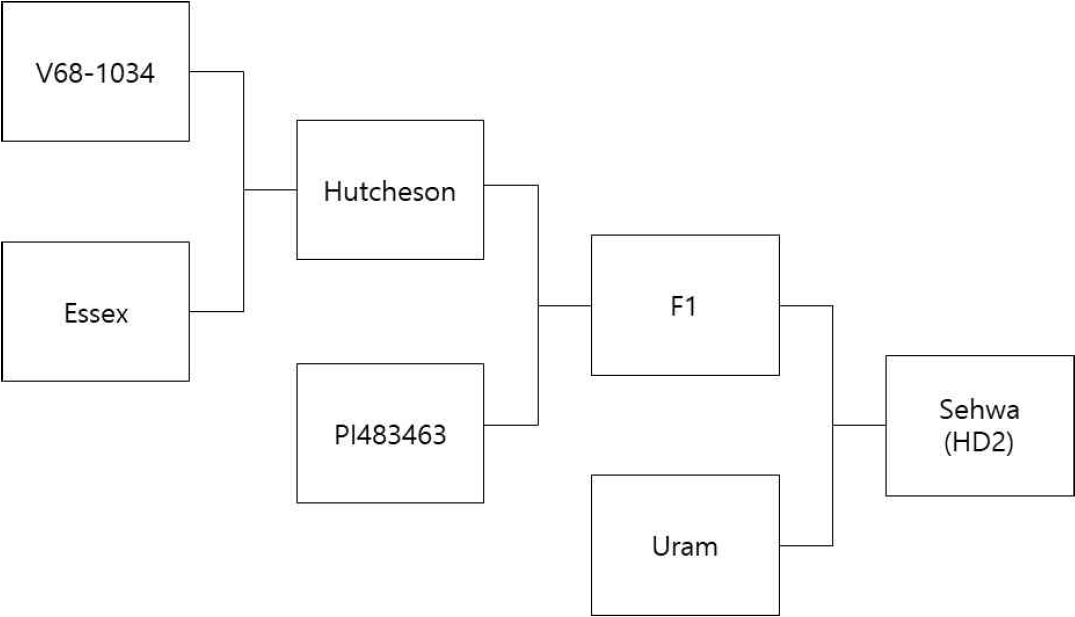
Fig. 2.Pedigree diagram of ‘Sehwa’.
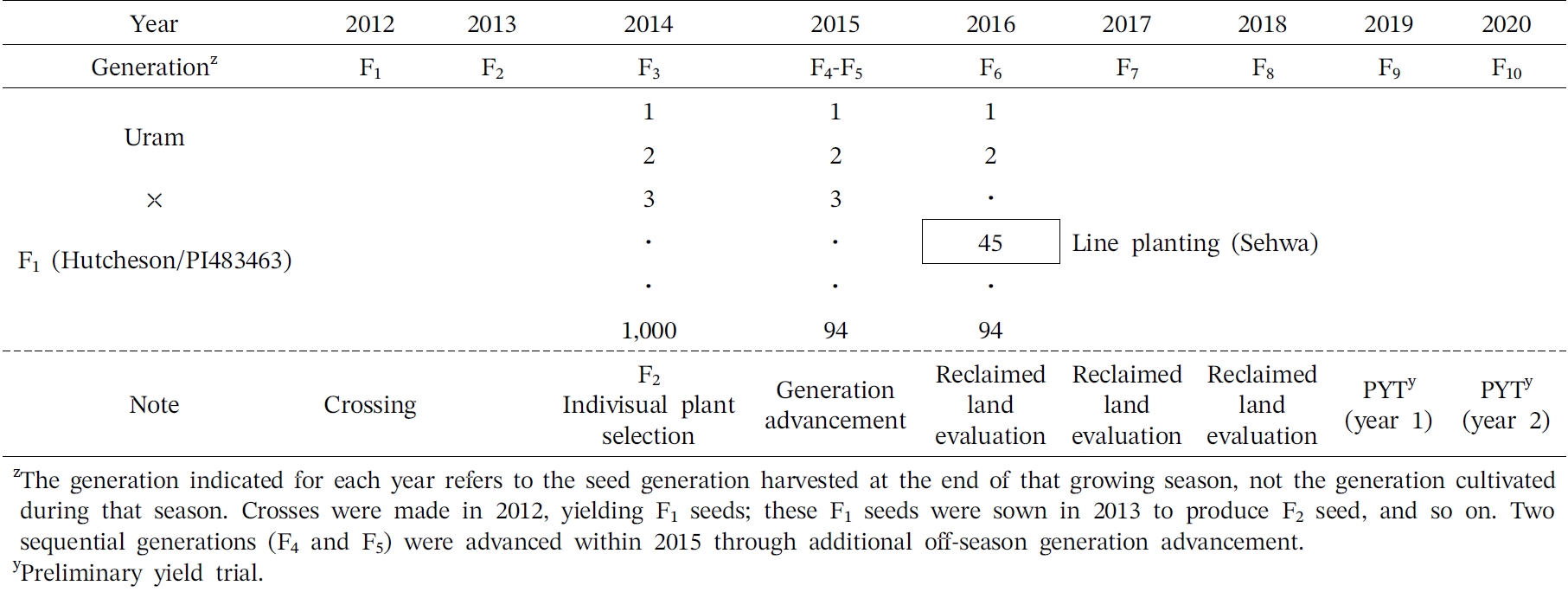
Fig. 3.Morphological characteristics and developmental stages of ‘Sehwa’.
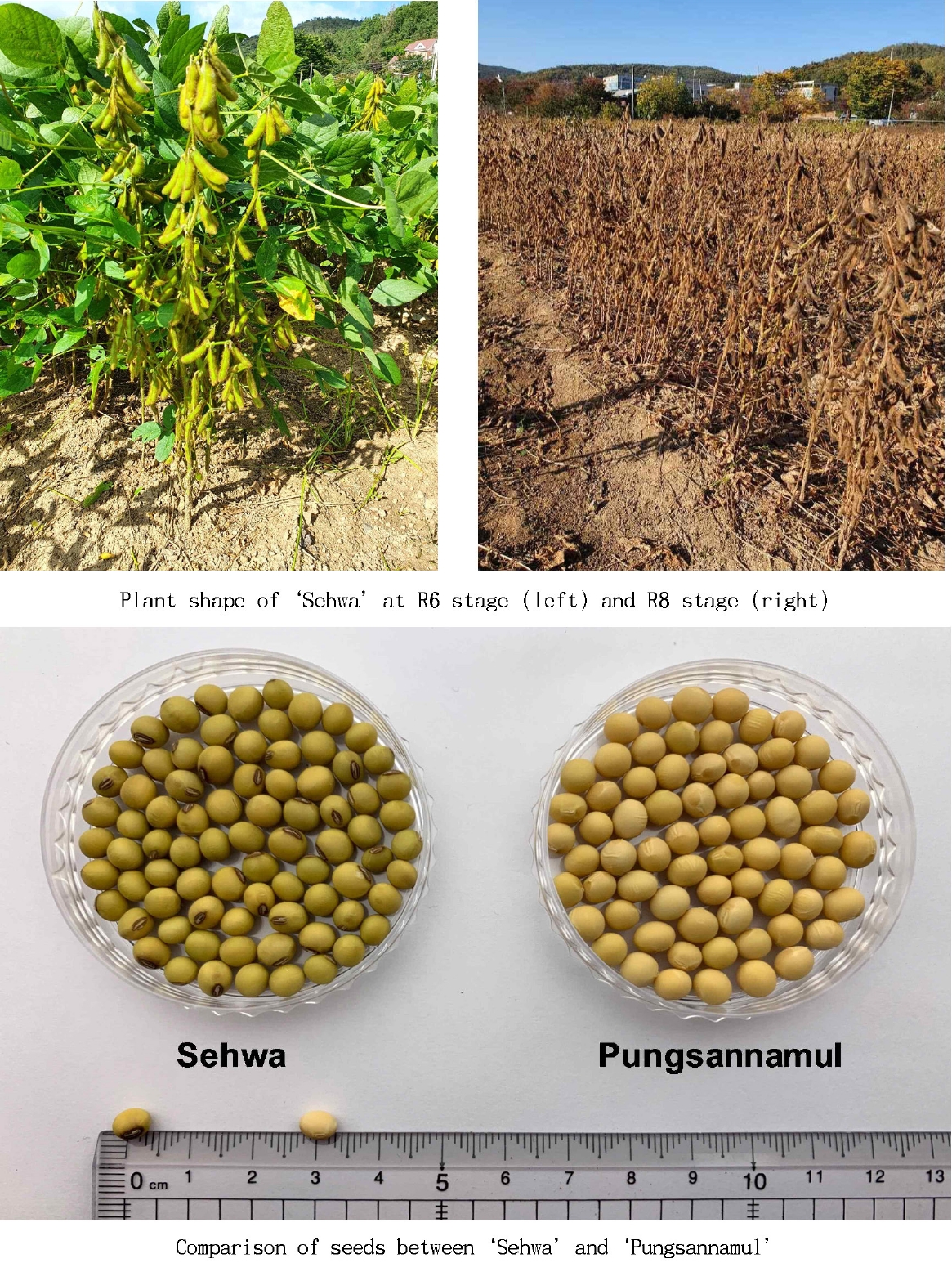
Fig. 4.Comparison of leaf scorch between ‘Sehwa’ and ‘Hutcheson’ 3 weeks after treatment with tap water (control) and 100 mM NaCl.
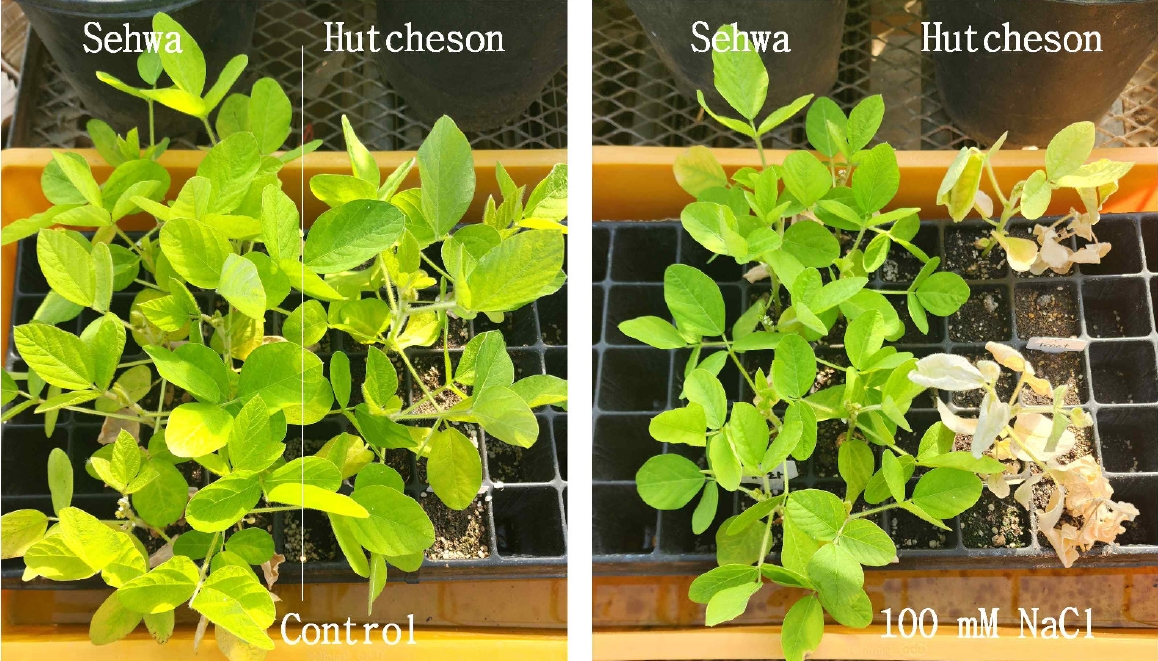
Table 1.Qualitative traits of cultivar ‘Sehwa’ compared with a check cultivar ‘Pungsannamul’.
Table 1.
|
Cultivar |
Growth habit |
Leaflet shape |
Flower color |
Pubescence color |
Pod color |
Seed coat color |
Hilum color |
Seed shape |
|
Sehwa |
Determinate |
Acute ovate |
White |
Tawny |
Dark brown |
Yellow |
Dark brown |
Spherical |
|
Pungsannamul |
Determinate |
Lanceolate |
Purple |
Gray |
Light brown |
Yellow |
Yellow |
Spherical |
Table 2.Agronomic characteristics of cultivar ‘Sehwa’ compared with a check cultivar ‘Pungsannamul’ at Gunwi, Korea in 2019.
Table 2.
|
Cultivar |
Maturity date (month.day) |
No. of branches/plant |
No. of nods/plant |
No. of pods/plant |
|
Sehwa |
10.25 |
3.5 |
14.0 |
91.8 |
|
Pungsannamul |
10.17 |
3.7 |
14.5 |
86.3 |
|
LSD (5%) |
- |
1.3 |
1.7 |
21.6 |
Table 3.Agronomic characteristics and seed yields of cultivar ‘Sehwa’ compared with a check cultivar ‘Pungsannamul’ at Gunwi, Korea in 2020.
Table 3.
|
Cultivar |
Flowering date (month.day) |
Maturity date (month.day) |
Plant height (cm) |
No. of branches/plant |
No. of nods/plant |
No. of pods/plant |
100-seed weight (g) |
Yield (t/ha) |
|
Sehwa |
8.3 |
10.16 |
69.0 |
4.7 |
15.7 |
72.3 |
10.0 |
2.3 |
|
Pungsannamul |
8.3 |
10.12 |
61.0 |
4.0 |
16.6 |
78.1 |
13.5 |
2.8 |
|
LSD (5%) |
- |
- |
6.2 |
0.7 |
1.0 |
9.5 |
1.2 |
1.6 |
Table 4.Leaf scorch score (LSS) of ‘Sehwa’ compared with a salt sensitive cultivar ‘Hutcheson’ under control and 100 mM NaCl treatment at 3 weeks after treatment.
Table 4.
|
Cultivar |
Leaf scorch scorez
|
Response |
|
Control |
100 mM NaCl |
|
Sehwa |
1.0±0.0a
|
1.3±0.4b
|
Tolerance |
|
Hutcheson |
1.0±0.0a
|
3.7±0.3a
|
Sensitive |
|
LSD (5%) |
0.0 |
0.8 |
|
Table 5.Comparison of fresh weight, dry weight, and plant height of ‘Sehwa’ and ‘Hutcheson’ under control and 100 mM NaCl treatment.
Table 5.
|
Cultivar |
Fresh weight (g) / plant
|
Dry weight (g) / plant
|
Plant height (cm)
|
|
Control |
100 mM NaCl |
Relative (%)z
|
Control |
100 mM NaCl |
Relative (%)z
|
Control |
100 mM NaCl |
Relative (%)z
|
|
Sehwa |
5.40±0.40a
|
4.01±0.27a
|
74.4a |
3.23±0.72a
|
2.76±0.36a
|
88.9a |
20.20±6.41a
|
17.24±6.22a
|
86.0a |
|
Hutcheson |
7.09±1.67a
|
3.69±0.42a
|
54.9a |
3.52±0.95a
|
2.86±0.50a
|
86.5a |
21.27±2.31a
|
16.14±1.68a
|
76.0a |
|
LSD (5%) |
2.75 |
0.80 |
31.0 |
1.91 |
0.98 |
66.5 |
10.92 |
10.33 |
43.3 |
Table 6.Comparison of Cl⁻, Na⁺, and K⁺ contents and Na⁺/K⁺ ratio in the shoot of ‘Sehwa’ and ‘Hutcheson’ under control and 100 mM NaCl treatment.
Table 6.
|
Cultivar |
Cl⁻ (mg g-1DW)
|
Na⁺ (mg g-1DW)
|
K⁺ (mg g-1DW)
|
Na⁺/K⁺ Ratio
|
|
Control |
100 mM NaCl |
Relative (%)z
|
Control |
100 mM NaCl |
Relative (%)z
|
Control |
100 mM NaCl |
Relative (%)z
|
Control |
100 mM NaCl |
Relative (%)z
|
|
Sehwa |
2.07±0.19b
|
51.67±14.64b
|
2563a
|
1.43±0.14a
|
8.38±1.70b
|
598b
|
36.49±9.16a
|
39.88±7.04a
|
111a
|
0.04±0.01a
|
0.21±0.04b
|
529b
|
|
Hutcheson |
4.27±0.83a
|
136.33±18.77a
|
3351a
|
1.60±0.07a
|
24.00±3.00a
|
1503a
|
44.83±13.12a
|
48.48±2.71a
|
118a
|
0.04±0.01a
|
0.49±0.04a
|
1365a
|
|
LSD (5%) |
2.00 |
38.16 |
2284 |
0.25 |
5.53 |
434 |
25.65 |
12.09 |
84 |
0.02 |
0.10 |
519 |
References
- 1. Chen L, Peng L, Ouyang W, Yao H, Ye Y, Shan Z, Cao D, Chen S, Yang Z, Huang Y, Han B, Sha A, Zhou X, Chen H. 2024. Screening and identification of salt tolerance soybean varieties and germplasms. Oil Crop Sci 9: 204-210.
- 2. Guan R, Qu Y, Guo Y, Yu L, Liu Y, Jiang J, Chen J, Ren Y, Liu G, Tian L, Jin LG, Liu Z, Hong H, Chang R, Gilliham M, Qiu L. 2014. Salinity tolerance in soybean is modulated by natural variation in GmSALT3. Plant J 80: 937-950.
- 3. Jeong YJ, Lim SS, Park HJ, Seo BS, Park SI, Ryu JH, Lee KS, Chung DY, Kim HY, Lee SH, Yang HI, Choi WJ. 2020. Evaluation of crop suitability for reclaimed tideland soils using soil and water salinity and soil texture. Korean J Soil Sci Fert 53: 70-81.
- 4. Kim KH, Kim TM, Lim HN, Kim UJ, Zhomartkyzy SN, Kim WC, Jo H, Song JT, Lee JD. 2026. Genome-wide identification of the gmcpa gene family and functional insights into the role of the plsc domain within Gmchx20b in salt tolerance in soybean. Environ Exp Bot doi:https://doi.org/10.1016/j.envexpbot.2026.106364
- 5. Ko JM, Han WY, Kim HT, Seo MJ, Kang BK, Choi MS, Lee BW, Shin SO, Baek IY. 2016. Soybean cultivar for soy-paste, ‘Uram’ with mechanization harvesting, large seed, disease resistance and high yield. Korean J Breed Sci 48: 301-306.
- 6. Kofsky J, Zhang H, Song BH. 2018. The untapped genetic reservoir: The past, current, and future applications of the wild soybean (Glycine soja). Front Plant Sci 9: 949.
- 7. Lee JD, Shannon JG, Vuong TD, Nguyen HT. 2009. Inheritance of salt tolerance in wild soybean (Glycine soja sieb. and zucc.) accession PI483463. J Hered 100: 798-801.
- 8. Lee JD, Smothers SL, Dunn D, Villagarcia M, Shumway CR, Carter TE, Shannon JG. 2008. Evaluation of a simple method to screen soybean genotypes for salt tolerance. Crop Sci 48: 2194-2200.
- 9. Lee S, Kim JH, Sundaramoorthy J, Park GT, Lee JD, Kim JH, Chung G, Seo HS, Song JT. 2018. Identification of GmSALT3 haplotypes and development of molecular markers based on their diversity associated with salt tolerance in soybean. Mol Breed 38: 86.
- 10. Lee SH, Hong BD, An Y, Ro HM. 2003. Relation between growth condition of six upland crops and soil salinity in reclaimed land. Korean J Soil Sci Fert 36: 66-71.
- 11. Li Y, Ye H, Vuong TD, Zhou L, Do TD, Chhapekar SS, Zhao W, Li B, Jin T, Gu J, Li C, Chen Y, Li Y, Wang ZY, Nguyen HT. 2024. A novel natural variation in the promoter of GmCHX1 regulates conditional gene expression to improve salt tolerance in soybean. J Exp Bot 75: 1051-1062.
- 12. Lim SS, Yang HI, Park HJ, Park SI, Seo BS, Lee KS, Lee SH, Lee SM, Kim HY, Ryu JH, Kwak JH, Choi WJ. 2020. Land-use management for sustainable rice production and carbon sequestration in reclaimed coastal tideland soils of South Korea: A review. Soil Sci Plant Nutr 66: 60-75.
- 13. Mass EV. 1985. Crop tolerance to saline sprinkling water. Plant Soil 89: 273-284.
- 14. Ministry of Agriculture, Food and Rural Affairs. 2022. Measures for strengthening mid- to long-term food security. Sejong, Korea: p. 4.
- 15. Ministry of Agriculture, Food and Rural Affairs (MAFRA). 2026. The 2nd comprehensive plan for the agricultural and fishery use of reclaimed land. Sejong, Korea: pp. 4-9.
- 16. Ministry of Data and Statistics (MODS). 2026. Annual grain consumption per capita. Daejeon, Korea.