적요
This study was carried out to investigate the variation of 12 isoflavone components among 172 Korean soybean varieties released from 1913 to 2013. Cluster analysis was performed to classify the varieties based on the variation of isoflavone contents. Total isoflavone contents ranged from 206.3 μg/g to 2666.2 μg/g with an average of 837.2 μg/g. By each component, malonylgenistin content ranged from 99.2 μg/g to 1149.1 μg/g with the highest average of 390.0 μg/g, and glycitein content ranged from 0.1 μg/g to 2.4 μg/g with the lowest average of 0.8 μg/g. Among composition groups, the aglycone group contents ranged from 2.2 μg/g to 33.1 μg/g with the lowest average of 10.0 μg/g, and glucoside group contents ranged from 36.9 μg/g to 801.8 μg/g with an average of 202.4 μg/g. The malonylglucoside group contents ranged from 143.6 μg/g to 1796.4 μg/g with the highest average of 599.1 μg/g and acetylglucoside group contents ranged from 3.7 μg/g to 103.9 μg/g with an average of 27.5 μg/g. Varieties with high total isoflavone content were Aga8(2666.2 μg/g), Aga4(2569.3 μg/g), and Aga9(2345.0 μg/g) in bean sprouts group. The low total isoflavone content were observed from Deawang(328.8 μg/g) in soy sauce and paste group, Hanol(599.3 μg/g) in vegetable and early maturity group and Gemjeong1(664.1 μg/g) in cooking with rice group. The first three principal component axises accounted for 89.14% of the total variation observed. Dendrogram constructed using average linkage cluster method revealed that 172 Korean soybean varieties were divided into seven groups with the average distance of 0.8 between groups. The group Ⅰ includes 57.6% of the total varieties, which was the largest group among seven groups, followed by the group Ⅱ that includes 35.5% of the total varieties. However, the other groups were small groups containing less than five varieties. In comparison among the total isoflavone contents according to groups, the highest isoflavone content was observed in group Ⅵ with an average of 2526.9 μg/g, followed by group Ⅳ(1546.6 μg/g) and group Ⅴ(1503.5 μg/g). The others were found to contain low isoflavone content.
서 언
우리나라의 콩[
Glycine max (L.) Merrill] 품종개발은 국내 재래종을 순계 분리하여 1913년에 최초로 ‘장단백목’이 육성되 었으며, 1960년대 이전에는 재래종과 도입품종에서 우량계통을 순계분리하여 품종을 육성, 보급하였고, 최초의 교잡품종으로 1969년에 모자이크 바이러스 저항성이며 다수성인 ‘광교’를 육성, 보급하였다. 1970년대는 다수확 품종이 육성되었고, 1980 년대에는 농촌의 노동력 감소에 따라 기계화 적응성품종이 육성 되었다. 1990년대에는 WTO(World Trade Organization)체제 가 출범하여 용도의 다양화 및 품질의 고급화를 육종 목표로 추진하였다. 2000년대 이후에는 육종의 목표가 기능성 고품질, 수요의 선호에 따른 용도별 다양성, 병충해 및 고부가가치성 등으로 다양화 되었으며, 2014년까지 다양한 기능 및 용도의 품종들이 육성되어 178품종이 개발되었다(
Lee at al. 2015a,
Lee et al. 2015b).
Isoflavone은 flavonoid의 종류로서 2개의 benzyl 고리를 기본 으로 하는 배당체로 식물체내에서 합성되고, 식물이 스트레스를 받을 때 생성되는 phytoallexin이라는 물질로 여러 가지 생물학적 인 역할을 하는 동시에 작물의 내병성 증진에 기여하는 물질이다 (
Liu 1997,
Erickson 1995). 콩에서 생성되는 isoflavone은 3개의 물질이 4가지의 화학적 구조로 이루어져 있는 12개의 이성질체로 비배당체인 aglycone(daidzein, glycitein, genistein)과 배당체인 glucoside(daidzin, glycitin, genistin), malonylglucoside 유도체 (6"-O-malonyldaidzin, 6"-O-malonylglycitin, 6"-O-malonylgenistin), acetylglucoside 유도체(6"-O-acetyldaidzin, 6"-O-acetylglycitin, 6"-O-acetylgenistin)의 형태로 존재한다(Lee & Lee 2009). 콩 isoflavone은 phytoestrogen이라고 불리며 혈중 콜레스테롤을 낮 추고 여성의 폐경 이후 심혈관질환, 골다공증 등을 완화하며 유방 암, 전립선암, 난소암, 대장암 등의 예방 효과를 보이는 등 생리적 활성이 높다고 알려져 있는데(
Barnes 1998),
Trock et al.(2006)은 콩 및 두류 가공 식품을 많이 섭취하는 아시아 국가 여성들의 유방암 발생 비율이 서양 국가 여성들의 유방암 발생 비율보다 낮다고 보고하였다.
콩에 함유된 isoflavone의 함량은 품종 및 재배환경에 따라 큰 차이를 보이고, 같은 품종이라도 재배장소, 품종 및 연차 간의 변화에도 함량의 변이가 크다고 하였다(
Wang & Murphy 1994,
Eldridge & Kwolet 1983). 국내 콩 품종의 isoflavone 함량은 714∼2248 μg/g(
Ok et al. 2008), 624.1∼2398.9 μg/g (
Ryoo et al. 2004), 309∼1610 μg/g(
Lee et al. 2002), 543∼ 1789 μg/g(
So et al. 2001) 및 371.9∼2398.9 μg/g(
Kim et al. 1999)의 범위로 품종 간에 isoflavone 함량의 변이가 큰 것으로 보고되었다.
Choung et al.(2006)도 콩의 isoflavone 함량은 품종 및 용도별 간에 변이가 크다고 하였고, Park et al.(2012)은 1913년부터 2006년까지 육성된 국내의 콩 품종은 isoflavone 함량의 평균은 1489 μg/g이었고 범위는 527.9∼ 3436.5 μg/g이었다고 하였다.
Tsukamoto et al.(1995)은 콩 isoflavone의 함량은 등숙기간의 평균기온이 낮은 지역에서 높 다고 하였고,
Kitamura et al.(1991)도 등숙기간(R5∼R7)이 저온 인 조건에서 함량이 높았다고 하였다. Lozovaya et al.(2005)은 대기온도와 토양의 수분상태에 따라 isoflavone의 함량이 달라 진다고 하였는데, 대기온도가 낮을수록, 수분함량이 높을수록 콩 종실에 isoflavone이 많이 축적된다고 하였다.
최근 국내외적으로 콩에서 가장 중요한 기능성 성분인 isoflavone 에 대한 연구가 활발히 진행되고 있지만 국내에서 육성된 콩 품종의 isofavone 함량에 대한 체계적인 분류는 매우 부족한 실정이다. 따라서 본 연구는 1913년부터 2013년까지 국내에서 육성된 콩 172품종에 대한 isoflavone 함량의 변이를 구명하고, 다변량 분석으로 품종군을 분류하여 콩 육종의 기초자료로 이용 코자 수행하였다.
재료 및 방법
시험품종은 1913년부터 2013년까지 국내에서 육성된 콩 172 품종이 사용되었다. 국내에서 1980년대 이전에 육성된 18품종, 1980년대에 육성된 17품종, 1990년대에 육성된 43품종 및 2000 년 이후(2000년~2013년)에 육성된 94품종이 이용되었다. 육성 기관별로는 농촌진흥청 국립식량과학원에서 139품종, 농업기 술원(경기도농업기술원, 강원도농업기술원)에서 12품종, 대학 (경북대학교, 경상대학교, 영남대학교, 서울대학교)에서 13품종, 연구소(한국원자력연구원)에서 3품종 및 회사(소이벤처)에서 5품종이 육성되었다(Table
1). 시험품종들은 농촌진흥청 농업유 전자원센터, 국립식량과학원 및 국립종자원으로부터 분양 받았 으며, 콩 품종의 재배는 2014년 5월 28일 충북대학교 농업생명환 경대학 전작포장에서 휴폭 70 cm, 주간 15 cm로 하여 1주당 3립씩 파종하였고, 초생엽이 전개되었을 때 1주당 2개체씩만 남기고 솎아주었다. 시비는 콩 복비 50 kg/10a(N : P
2O
5 : K
2O = 3 : 3 : 3.4 kg/10a)를 전량기비로 하였으며, 기타 재배관리는 농촌진흥청 콩 표준재배법에 준하였으며, 수확한 종실 시료는 건조 후 -20℃ 냉동고에서 보존하였다.
Table 1Number of soybean varieties classified by released year and breeding organization for this experiment.
Table 1
|
Released year |
Breeding Organization |
Total |
|
|
NICSz
|
ARESy
|
University |
Institute |
Company |
|
|
Before |
18 |
- |
- |
- |
- |
18 |
|
1980 |
|
1980s |
17 |
- |
- |
- |
- |
17 |
|
1990s |
40 |
3 |
- |
- |
- |
43 |
|
After 2000 |
64 |
9 |
13 |
3 |
5 |
94 |
|
(2000~2013) |
|
|
Total |
139 |
12 |
13 |
3 |
5 |
172 |
Isoflavone 함량은 Kim et al.(2012)의 방법을 변형하여 분석 하였다. 분석에 이용되는 methanol(100%)과 acetonitrile (100%) 및 증류수는 HPLC 등급으로 J. T. Baker로부터, HCl은 Daejung Chemical & Materials Co. Ltd.로부터 구입되었다. 표준물질은 daidzein, glycitein, genistein, daidzin, glycitin 및 genistin은 Sigma–Aldrich Co.로부터, 6"-O-Malonyldaidzin, 6"-O-Malonylgenistin, 6"-O-Malonylglycitin, 6"-O-Acetyldaidzin, 6"-O-Acetylgenistin 및 6"-O-Acetylglycitin은 Nacalai Co. Jp로부터 구입하여 사용 하였다. 콩 종실을 grinder(Cyclone sample mill, 0.5 mm screen)를 사용하여 곱게 마쇄한 후 시료 2 g을 칭량하여, 0.1N HCl 2 ml와 ACN(Acetonitrile) 10 ml을 가한 후 상온에서 2시간 교반하여 성분을 추출하였다. 추출물은 filter paper(No.42 Whatman)를 사용하여 여과한 후, 여액을 상온에서 완전히 감압농축하고, 농축물에 80% MeOH 2ml을 가하여 농축물을 완전히 용해시켜 0.2um syringe filter로 여과 후 HPLC분석에 사용하였다.
HPLC분석은 Waters 시스템(Waters 600 pump & controller, Waters 717 autosampler, Waters 486 tunable absorbance detector)를 사용하였고, 컬럼은 YMC-PACK ODS-AM column (5 ㎛, 4.6 X 250 mm)을 사용하였다. 이동상은 acetonitrile + 0.1% acetic acid와 0.1% acetic acid를 사용하였고, 펌프 프로그램을 통해 gradient를 설정하여 acetonitrile을 50분 동안 15%에서 35%까지 양을 증가 시켰다. 유속은 1.0ml/min로 조절하였고, 시료주입량은 20㎕이었으며, 검출파장은 254nm로 분석하였다 (Table
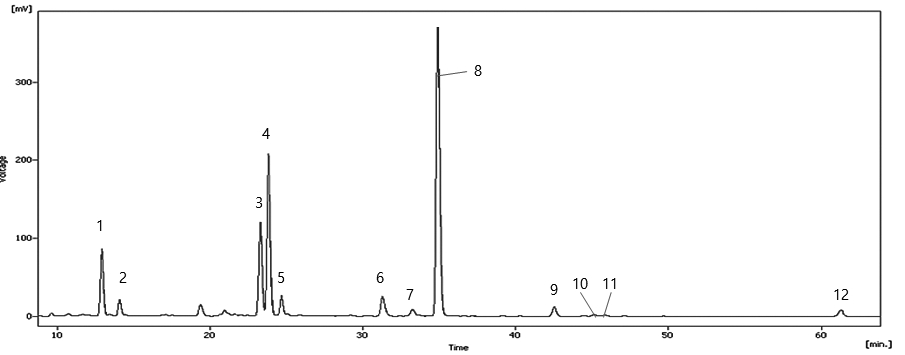
2). 시료당 3반복으로 분석하였고, 콩 종실의 isoflavone 정량분석을 위해 12개의 표준물질을 MeOH(Methanol)와 DMSO (Dimethysulfoxide)에 용해 후 농도구배에 따라 4개의 다른 농도 로 희석하여 20㎕씩을 HPLC에 주입해 얻어진 피크 면적의 실측 치와 표준용액의 농도간의 검량곡선식과 결정계수를 산출하여 정량하였다. Retention time에 따라 daidzin, glycitin, genistin, malonyldaidzin, malonylglycitin, acetyldaidzin, acetylglycitin, malonylgenistin, daidzein, glycitein, acetylgenistin, genistein 의 순서로 분리되었다(Fig.
1).
Fig. 1.
HPLC chromatogram patterns(UV 254nm) of seed isoflavones.
Peak: 1, daidzin; 2, glycitin; 3, genistin; 4, malonyldaidzin; 5, malonylglycitin; 6, acetyldaidzin; 7, acetylglycitin; 8, malonylgenistin; 9, daidzein; 10, glycitein; 11, acetylgenistin; 12, genistein.
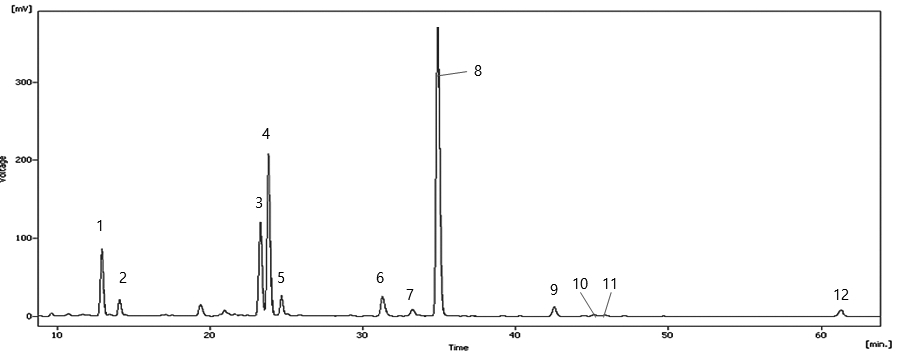
Table 2Analytical conditions of HPLC for isoflavone.
Table 2
|
Parameter |
Condition |
|
|
Instrument |
Waters 600 pump & controller, |
|
Waters 717 autosampler, |
|
Waters 486 tunable absorbance detector |
|
Wavelength |
254nm |
|
Mobile |
Acetonitrile + 0.1% acetic acid : 0.1% acetic acid |
|
phase |
Acetonitrile 15 → 35% / 50min (gradient) |
|
Flow rate |
1.0ml/min |
|
Injection |
20㎕ |
|
volume |
|
Column |
YMC-PACK ODS-AM column |
|
(5㎛, 4.6 X 250mm) |
본 연구의 통계처리는 SAS software(SAS Institute Inc., ver 9.1)를 이용하였으며, 품종군 분류는 주성분분석(Principal component analysis, PCA)을 수행한 후 주성분 점수를 이용해 Average Linkage Cluster 방법으로 군집분석을 수행하였다.
결과 및 고찰
육성품종의 isoflavone 함량의 변이
1913년부터 2013년까지 육성된 한국의 172개 품종의 종실 isoflavone 함량은 평균함량이 837.2 μg/g이었으며 206.3∼ 2666.2 μg/g의 범위에 있었다.
Wang & Murphy(1994)에 의하 면 콩의 품종간에 isoflavone 함량의 변이가 크다고 하였는데, 본 연구에서도 품종간 변이가 큰 것으로 나타났다.
Choung et al.(2006)도 콩의 isoflavone 함량은 품종 및 용도별 간에 변이가 크다고 하였고, Kim et al.(2012)도 미국 27품종, 중국 68품종 및 한국 109품종의 총 204품종의 isoflavone 함량의 분석에서 미국품종은 879.8∼3275.6 μg/g의 범위에, 중국품종은 683.3∼ 2441.4 μg/g의 범위에, 한국품종은 814.4∼4778.1 μg/g의 범위에 있었으며 품종간에 변이가 크고, 품종과 육성국가에 의하여 영향 받는다고 보고하였다.
Wang & Muppy(1994)도 isoflavone 함 량은 품종과 재배환경간에 상호작용이 있어 같은품종이라도 재배연도 및 재배지역에 따라 함량의 변이가 크다고 하였다. Malonylgenistin의 총 평균 함량이 390.0 μg/g으로 가장 높았으 며 99.2∼1149.1 μg/g의 범위에 있었고, glycitein의 총 평균 함량은 0.8 μg/g으로 가장 낮았으며 0.1∼2.4 μg/g의 범위이었 다. Group별 함량은 aglycone group이 평균 10.0 μg/g이었으며 2.1∼33.1 μg/g의 범위에 있었다. Glucoside group은 평균 202.4 μg/g이었고, 전체 평균함량의 24.2%를 차지하였으며 36.9∼801.8 μg/g의 범위에 있었다. Malonylglucoside group은 평균 599.1 μg/g이었고 전체 평균함량의 71.6%로 가장 많이 차지하였고, 143.6~1796.4 μg/g의 범위이었다. Acetylglucoside group은 평균 27.5 μg/g이었고 3.7∼103.9 μg/g의 범위이었다. Yan et al.(2011)은 중국재래종 56종에 대한 isoflavone 8개성분 의 분석에서 isoflavone 중에서 malonylglucoside group이 62% 로 가장 높았고, 다음으로 glucoside group이 34%로 높았으며, acetylglucoside group과 aglycone group은 각각 0%, 4%로서 함량이 매우 낮았다고 보고하여 본 연구와는 다소 상이하였다. 이러한 결과는 시험재료 및 재배환경의 차이에 기인한 것으로 생각된다. 변이계수는 acetylgenistin이 332.6%로 가장 높아 변이가 가장 컸고, malonylgenistin이 41.4%로 가장 낮아 변이가 가장 작았다. 각 성분 group 중에서 변이계수가 가장 큰 group은 glucoside group으로 58.1%이었으며, malonylglucoside group 이 43.9%로 가장 작았다(Table
3).
Table 3Maximum, minimum, mean and coefficient of variation(CV) values of isoflavone contents in 172 Korean soybean varieties.
Table 3
|
Statistics |
Aglycone |
Glucoside |
Malonylglucoside |
Acetylglucoside |
Total |
|
|
Daiz
|
Glyy
|
Genx
|
Total |
Daiw
|
Glycv
|
Geniu
|
Total |
Mdait
|
Mglys
|
Mgenr
|
Total |
Adaiq
|
Aglyp
|
Ageno
|
Total |
|
|
---------------------------------------------------------- μg/g--------------------------------------------------- |
|
Max. |
18.0 |
2.4 |
12.6 |
33.1 |
283.2 |
102.4 |
441.9 |
801.8 |
650.4 |
77.3 |
1149.1 |
1796.4 |
74.6 |
16.3 |
79.7 |
103.9 |
2666.2 |
|
Min. |
1.5 |
0.1 |
0.0 |
2.1 |
2.2 |
0.5 |
20.4 |
36.9 |
31.8 |
0.3 |
99.2 |
143.6 |
1.0 |
1.8 |
0.0 |
3.7 |
206.3 |
|
Mean |
5.8 |
0.8 |
3.4 |
10.0 |
67.7 |
27.5 |
107.2 |
202.4 |
181.1 |
28.0 |
390.0 |
599.1 |
19.8 |
5.7 |
2.1 |
27.5 |
837.2 |
|
±SD |
3.1 |
0.5 |
2.6 |
5.7 |
46.4 |
19.2 |
60.5 |
117.5 |
96.4 |
17.9 |
161.4 |
263.1 |
11.3 |
2.6 |
6.9 |
15.0 |
393.8 |
|
CV(%) |
53.2 |
63.4 |
75.4 |
57.3 |
68.6 |
69.8 |
56.4 |
58.1 |
53.2 |
64.1 |
41.4 |
43.9 |
57.1 |
45.9 |
332.6 |
54.6 |
47.0 |
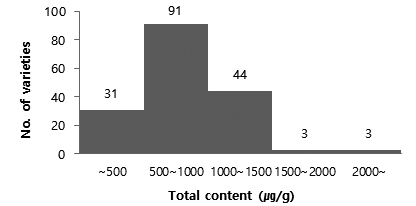
총 isoflavone 함량의 분포는 500∼1000 μg/g의 범위에서 91품종으로 가장 많았고 500 μg/g이하가 31품종, 2000 μg/g 이상이 3품종이었다(Fig.
2). 총 isoflavone 함량이 2000 μg/g 이상인 상위 3개의 품종은 아가8호(2666.2 μg/g), 아가4호 (2569.3 μg/g) 및 아가9호(2345.0 μg/g)이었고, 모두 소립종으로 서 isoflavone 고 함량 품종 육성을 위해 야생콩과 교잡된 품종들 이었다. Isoflavone 함량이 적은 하위 3개 품종은 모두 대립종으 로 장류용인 대왕(328.8 μg/g), 풋콩 및 올콩용인 한올(599.3 μg/g), 밥밑용인 검정콩 1호(664.1 μg/g) 이었다(Table
4).
Fig. 2.Frequency distributions of total isoflavone content in 172 Korean soybean varieties.
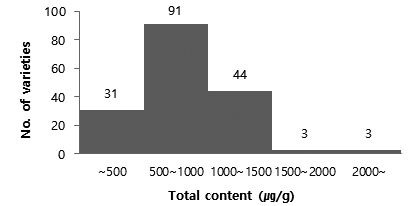
Table 4Varieties with high and low total isoflavone contents in 172 Korean soybean varieties.
Table 4
|
Isoflavone |
Variety |
Seed size |
Utilization type |
Isoflavone contents(μg/g) |
|
|
Aglycone |
Glucoside |
Malonylglucoside |
Acetylglucoside |
Total |
|
|
High |
Aga8 |
Sz
|
B.S.x
|
27.2 |
801.8 |
1744.6 |
91.7 |
2666.2 |
|
Aga4 |
Sz
|
B.S.x
|
33.1 |
653.0 |
1796.4 |
86.8 |
2569.3 |
|
Aga9 |
Sz
|
B.S.x
|
17.2 |
723.2 |
1536.0 |
68.5 |
2345.0 |
|
Low |
Daewang |
Ly
|
S.Pw
|
7.4 |
73.6 |
241.0 |
9.28 |
328.8 |
|
Hanol |
Ly
|
V.E.v
|
7.0 |
116.2 |
458.5 |
19.5 |
599.3 |
|
Geomjeong1 |
Ly
|
C.R.u
|
13.2 |
99.6 |
530.4 |
23.3 |
664.1 |
주성분분석
콩의 12개 isoflavone성분을 이용하여 주성분분석을 실시한 결과, 획득한 고유치(eigenvalue)와 각 주성분의 기여도는 Table
5와 같다. 전체에 대한 주성분의 기여도는 제 1주성분이 72.29% 로 누적기여도가 72.29%, 제 2주성분의 기여도는 9.18%이었고 누적기여도는 81.47%이었으며, 제 3주성분의 기여도는 7.67% 이고 누적기여도는 89.14%이었다. 제 11주성분부터는 누적기여 도가 100%로 나타났다. 12개의 주성분 중 자료의 변이를 많이 설명하는 주성분만을 선택해 군집분류를 실행하는데, 일반적으 로 고유값이 1 이상인 주성분의 수를 결정한다(
Janmohammadi et al. 2014). 따라서 본 연구에서도 고유값 1 이상을 기준으로 하여 상위 제 3주성분까지로 전체의 89.14%를 설명할 수 있기 때문에 1∼3주성분으로 한국 콩 육성 172품종의 isoflavone 함량 변이에 따른 군집분류가 가능한 것으로 나타났다. 제 1주성분은 acetylglycitin을 제외한 모든 성분들에 대하여 높은 정의 상관을 보였으며, 제 2주성분은 daidzein과 daidzin, malonyldaidzin에 대하여는 높은 부의 상관을 보였고, acetylglycitin과 acetylgenistin 에 대하여는 높은 정의 상관을 보였다. 또한 제 3주성분은 daidzein, daidzin, malonyldaidzin, acetylglycitin에 대해 높은 정의 상관 을 보였다(Table
6).
Table 5Eigenvalues and contribution obtained from principal component analysis in 172 Korean soybean varieties.
Table 5
|
Principal component |
Eigenvalue |
Contribution(%) |
Cumulative contribution(%) |
|
|
PC 1 |
12.289 |
72.29 |
72.29 |
|
PC 2 |
1.561 |
9.18 |
81.47 |
|
PC 3 |
1.304 |
7.67 |
89.14 |
|
PC 4 |
0.996 |
5.86 |
95.00 |
|
PC 5 |
0.36 |
2.12 |
97.12 |
|
PC 6 |
0.211 |
1.24 |
98.36 |
|
PC 7 |
0.121 |
0.71 |
99.07 |
|
PC 8 |
0.091 |
0.54 |
99.61 |
|
PC 9 |
0.026 |
0.16 |
99.76 |
|
PC 10 |
0.021 |
0.13 |
99.89 |
|
PC 11 |
0.014 |
0.08 |
100 |
|
PC 12 |
0.005 |
0 |
100 |
Table 6Correlation coefficients between isoflavone compositions and principal components in 172 Korean soybean varieties.
Table 6
|
Composition |
PC 1 |
PC 2 |
PC 3 |
|
|
Daidzein |
0.757**z
|
-0.344** |
0.413** |
|
Glycitein |
0.750** |
-0.021 |
-0.193 |
|
Genistein |
0.817** |
-0.059 |
-0.155 |
|
Daidzin |
0.805** |
-0.318** |
0.426** |
|
Glycitin |
0.947** |
0.047 |
-0.104 |
|
Genistin |
0.974** |
-0.021 |
-0.038 |
|
Malonyldaidzin |
0.734** |
-0.366** |
0.501** |
|
Malonylglycitin |
0.961** |
0.095 |
-0.064 |
|
malonylgenistin |
0.975** |
0.045 |
-0.043 |
|
Acetyldaidzin |
0.920** |
0.119 |
-0.127 |
|
Acetylglycitin |
-0.034 |
0.874** |
0.377** |
|
Acetylgenistin |
0.772** |
0.601** |
0.164 |
군집분석
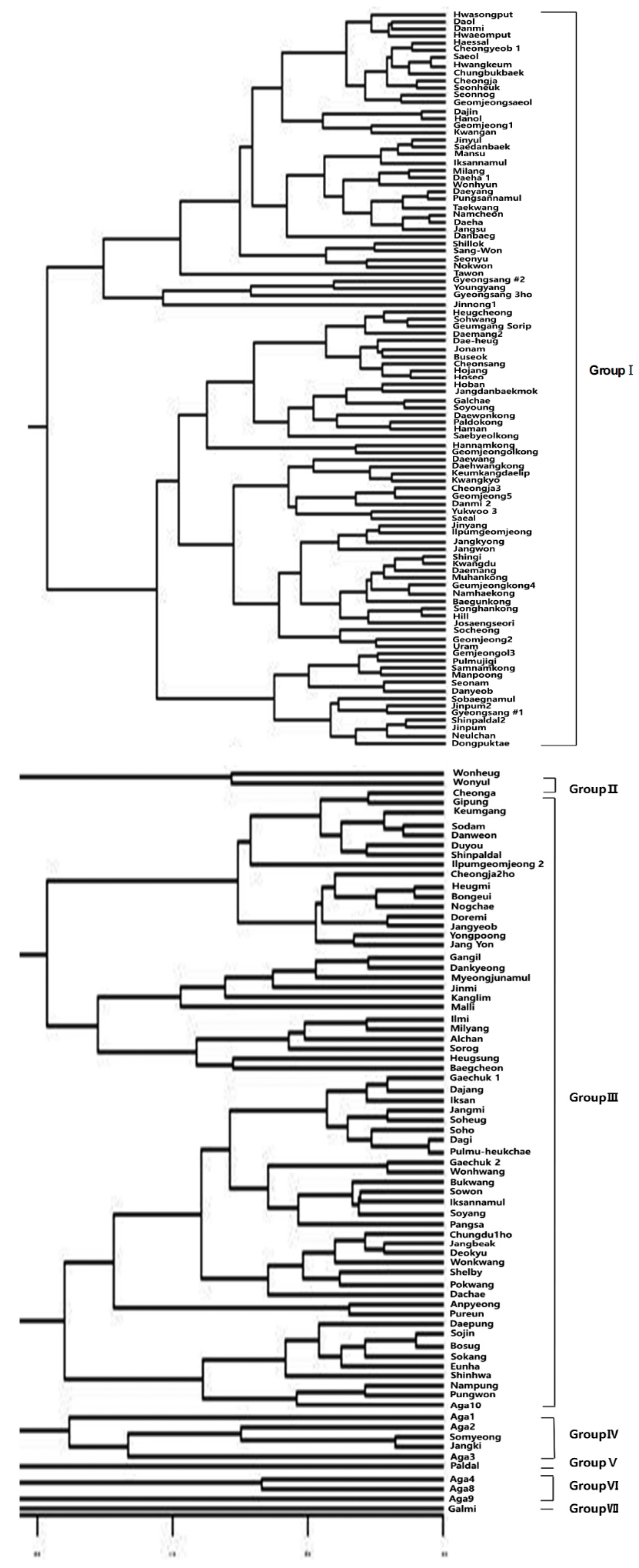
주성분분석을 수행한 후 제 1∼3주성분을 이용하여 평균군집 분석을 수행한 결과, 한국 콩 172개 품종들은 평균거리(average distance) 0.8을 기준으로 할 때 7개의 군집으로 구분되었다(Fig.
3). Ⅰ군집은 화성풋콩 등 99품종이, Ⅱ군집은 원흑 등 2품종이, Ⅲ군집은 청아 등 61품종이, Ⅳ군집은 아가1호 등 5개 품종이, Ⅴ군집은 팔달콩의 1개 품종, Ⅵ군집은 아가 4호 등 3품종이, Ⅶ군집은 갈미의 1개 품종이 포함되었다. Ⅰ군집은 전 품종의 57.6%를 차지하는 가장 큰 군집이었고, Ⅲ군집은 35.5%를 차지 하는 두 번째로 큰 군집이었다. Ⅳ군집은 2.9%를 차지하였으며 Ⅱ,Ⅴ,Ⅵ 및 Ⅶ군집은 전체의 2% 미만이 속하는 작은 군집이었다.
Fig. 3.Dendrogram classified by average linkage cluster based on principal component scores of isoflavone components in 172 Korean soybean varieties.
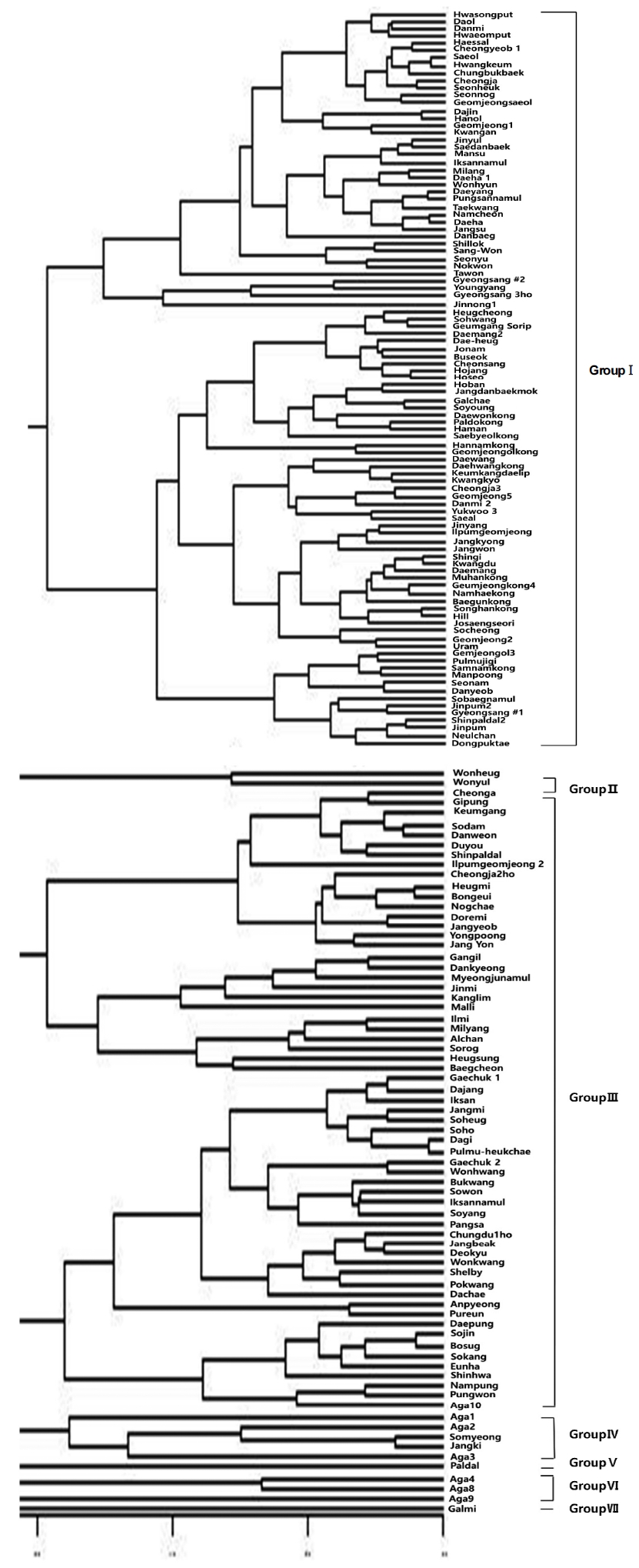
Table 7Mean values of isoflavone contents of each group classified in 172 Korean soybean varieties.
Table 7
|
Group |
Aglycone |
Glucoside |
Malonylglucoside |
Acetylglucoside |
Total |
|
|
Daiz
|
Glyy
|
Genx
|
Total |
Daidw
|
Glycv
|
Geniu
|
Total |
Mdait
|
Mglys
|
Mgenr
|
Total |
Adaiq
|
Aglyp
|
Ageno
|
Total |
|
|
------------------------------------------------------ μg/g------------------------------------------------------ |
|
I |
4.1 |
0.6 |
2.1 |
6.7 |
41.6 |
19.0 |
71.1 |
131.6 |
128.0 |
20.8 |
292.6 |
441.4 |
13.1 |
4.0 |
1.5 |
18.6 |
596.3 |
|
(n=99) |
|
II |
3.0 |
0.5 |
1.1 |
4.6 |
56.1 |
18.7 |
101.3 |
176.1 |
149.1 |
18.2 |
374.5 |
541.8 |
18.4 |
4.4 |
26.4 |
49.3 |
769.8 |
|
(n=2) |
|
III |
7.6 |
1.0 |
4.9 |
13.5 |
93.4 |
35.7 |
144.5 |
273.6 |
233.7 |
35.1 |
490.9 |
759.7 |
26.4 |
7.5 |
1.1 |
34.9 |
1080.3 |
|
(n=61) |
|
IV |
11.4 |
2.0 |
7.3 |
20.8 |
140.9 |
66.4 |
198.7 |
406.0 |
348.0 |
63.4 |
656.9 |
1068.3 |
40.4 |
9.8 |
1.8 |
51.9 |
1546.6 |
|
(n=5) |
|
V |
16.5 |
1.1 |
11.0 |
28.5 |
181.1 |
29.2 |
202.2 |
412.5 |
350.2 |
30.0 |
630.5 |
1010.8 |
39.1 |
12.2 |
2.0 |
53.3 |
1503.5 |
|
(n=1) |
|
VI |
14.0 |
2.0 |
9.8 |
25.8 |
265.5 |
87.7 |
372.8 |
726.0 |
572.4 |
71.7 |
1048.3 |
1692.4 |
66.7 |
14.6 |
1.0 |
82.3 |
2526.9 |
|
(n=3) |
|
VII |
5.3 |
0.4 |
3.6 |
9.3 |
33.1 |
11.7 |
75.3 |
120.0 |
119.0 |
10.9 |
361.6 |
491.5 |
17.9 |
6.4 |
79.7 |
103.9 |
722.6 |
|
(n=1) |
군집에 따른 총 isoflavone의 평균함량은 Ⅵ군집이 2526.9 μg/g으로 가장 높았으며, Ⅳ군집이 1546.6 μg/g, Ⅴ군집이 1503.5 μg/g, Ⅲ군집이 1080.3 μg/g, Ⅱ군집이 769.8 μg/g, Ⅶ군집이 722.6 μg/g 이었고 Ⅰ군집이 596.3 μg/g으로 가장 낮게 나타났 다. 각 군집의 성분별 평균함량은 품종이 가장 많이 속해있는 Ⅰ군집에서 malonylglucoside와 acetylglucoside의 함량이 각 각 441.4 μg/g, 18.6 μg/g으로 가장 낮았다. Ⅱ군집은 aglycone 의 함량이 4.6 μg/g으로 가장 낮았으며, Ⅴ군집은 aglycone함량 이 28.5 μg/g로 가장 높았다. Ⅵ군집은 glucoside 함량이 726.0 μg/g, malonylglucoside 함량이 1692.4 μg/g으로 가장 높았다. Ⅶ군집은 갈미 한 개의 품종만 속해 있었는데 glucoside함량이 120.0 μg/g으로 가장 낮았으며, acetylgenistin의 함량이 79.7 μg/g으로 다른 군집보다 함량이 현저히 높았기 때문에 따로 분류된 것으로 생각된다(Table
7). Yan et al.(20011)은 중국의 여러지역에서 수집된 재래종 56종에 대하여 isoflavone 8개성분 에 대한 분석과 함께 1∼3주성분으로 군집을 분류하여 5개 그룹 으로 분류한 바 있으며 각 그룹간에 isoflavone 구성성분의 차이 가 있다고 보고하였다.
본 연구에서 1913년 과거부터 2013년까지 한국에서 육성된 콩 172품종들에 대한 종실의 isoflavone 함량은 총 평균함량이 837.2 μg/g이었으며 206.3∼2666.2 μg/g의 범위로서 변이가 매우 큰 것으로 판단되었다. 이러한 결과는 육종과정에서 교배모 본의 유전적배경과 육성모지에서의 선발환경에 따른 차이일 것으로 생각된다. Park et al.(2012)은 1913년부터 2006년까지 한국에서 육성된 콩 106품종의 종실 isoflavone 함량은 육성년 대, 용도, 종실크기 및 육성모지에 따라서 유의적인 차이가 인정 된다고 보고한 바 있다. 또한 본 연구에서는 12개 isoflavone 함량에 근거하여 다변량분석으로 품종군을 분류하고 유연관계 를 도식화하였다. 작물육종에서 성공적인 요인은 보유하고 있는 유전집단의 변이와 유연관계를 평가하여 우수한 자원을 선발하 고 육종재료로 이용하는 것이다. 이러한 관점에서 품종이나 유전 집단의 체계적인 분류는 효율적인 육종을 위해서는 반드시 필요 한 과정이다(Lee et al. 2015b). 본 연구의 결과는 한국 콩 품종의 isoflavone 함량에 대한 육종계획에 효율적인 정보를 제공할 수 있을 것으로 생각된다.
적 요
1913년부터 2013년까지 국내에서 육성된 장류용, 나물용, 풋콩 및 올콩용, 밥밑용 품종을 포함한 172 품종에 대한 종실의 isoflavone 12개 성분의 함량에 대한 변이를 구명하고, 다변량분 석에 의한 품종군을 분류하였다. 종실의 총 isoflavone의 평균함 량은 837.2 μg/g이었고, 206.3∼2666.2 μg/g의 범위이었다. 성분별로는 malonylgenistin의 평균함량이 390.0 μg/g로서 가 장 높았고, 99.2∼1149.1 μg/g의 범위이었고, glycitein의 평균 함량이 0.8 μg/g로서 가장 낮았으며 0.1∼2.4 μg/g의 범위이었 다. 성분그룹별로 보면 malonylglucoside group의 평균함량은 599.1 μg/g로서 가장 높았고 143.6∼1796.4 μg/g의 범위이었으 며, glucoside group의 평균함량은 202.4 μg/g이었고 36.9∼ 801.8 μg/g의 범위이었다. acetylglucoside group의 평균함량은 27.5 μg/g이었고 3.7∼103.9 μg/g의 범위이었으며, aglycone group의 평균함량은 10.0 μg/g로서 가장 낮았고 2.1∼33.1 μg/g 의 범위이었다. 총 isoflavone함량이 높은 품종은 나물용 품종인 아가8호(2666.2 μg/g), 아가4호(2569.3 μg/g) 및 아가9호(2345.0 μg/g)이었고, 총 isoflavone 함량이 낮은 품종은 장류용 품종인 대왕(328.8 μg/g), 풋콩 및 올콩 품종인 한올(599.3 μg/g) 그리고 밥밑용 품종인 검정콩1호(664.1 μg/g)이었다. Isoflavone성분 에 대한 주성분분석을 실시한 결과, 제 1∼3주성분까지의 누적 기여도가 89.14%이었고, 제 3주성분만으로도 한국 콩 품종의 군집분류가 가능하였다. 군집분류에서 평균거리를 0.8로 하였을 때 7개의 군집으로 분류되었고, Ⅰ군집은 전체 품종의 57.6%가 속하는 가장 큰 군집이었고, 다음으로 Ⅲ군집이 35.5%가 속하는 큰 군집이었으며, 나머지 5개 군집은 5개 이하의 품종이 속하는 소군집이었다. 군집에 따른 총 isoflavone의 평균함량은 Ⅵ군집 이 2526.9 μg/g으로 가장 높았으며, 다음으로 Ⅳ군집이 1546.6 μg/g, Ⅴ군집이 1503.5 μg/g으로 높았으며, 그 외 군집은 낮았다.
사 사
본 연구는 2015년도 충북대학교 학술연구지원사업에 의하여 수행되었음
References
- 1. Barnes S.. Evolution of the health benefits of soy isoflavones. Proc. Soc. Exp. Biol. Med. 1998. 217: 386-392.
- 2. Cederroth C.R., Zimmermann C., Nef S.. Soy, phytoestrogens and their impact on reproductive health. Mol. Cell. Endocrinol. 2012. 355: 192-200.
- 3. Cho C.H., Seong Y.G., Kim S.M.. Classification of soybean genotypes based on seasonal response of flowering, and maturity by principle component analysis. Kor J Breed. 1994. 26: 405-413.
- 4. Choi G.B., Hyun K.H., Shin D.Y.. Mutivariate analysis on quantitative characteristics of Prunus mume. Kor J Plant Res. 2014. 27: 89-94.
- 5. Choi H.G.. Assessment of major physicochemical components on waxy corn hybrids(Zea mays L.). PhD thesis 2010. Department of Agronomy, Graduate School, Chungnam National University.
- 6. Choung M.G., Kang S.T., Han W.K., Back I.Y., Kim H.K., Shin D.C., Kang N.S., Hwang Y.S., An Y.N., Lim D., Kim K.S., Park S.H., Kim S.L.. Variation of isoflavone contents in Korean soybean germplasm. Kor J Crop Sci 2006. 512: 146-151.
- 7. Eldridge A.C., Kwol W.F.. Soybean isoflavone: Effect of environment and variety on composition. J. Agric. Food Chem. 1983. 31: 394-396.
- 8. Erickson D.. 1995. Practical Handbook of soybean processing and utilization.. USA: AOCS.
- 9. Garcia M.C., Torre M., Marina M.L.. Characterization of commercial soybean products by conventional and perfusion reversed-phase high-performance liquid chromatography and multivariate analysis. J. Chromatogr. A 2000. 881: 47-57.
- 10. Guh J.O., Lee Y.M., Shin D.Y.. Basic studies on the native colored-soybean cultivars II. Classification of collected soybean varieties by the multivariate analysis. Kor J Crop Sci. 1983. 28: 340-344.
- 11. Janmohammadi M., Movahedi Z., Sabaghnia N.. Multivariate statistical analysis of some traits of bread wheat for breeding under rainfed conditions. J. Agric. Sci. 2014. 59: 1-14.
- 12. Kim D.Y., Yoon M.K., Kwak J.H., Kim T.I., Kim J.H.. Classification of strawberry germplasms based on horticultural traits and principal component analysis. Kor J Hort Sci. Technol. 2009. 27: 636-643.
- 13. Kim E.H., Ro H.M., Kim S.L., Kim H.S., Chung I.M.. Analysis of isoflavone, phenolic, soyasapogenol, and tocopherol compounds in soybean [Glycine max (L.) Merrill] germplasms of different seed weights and origins. J. Agric. Food Chem. 2012. 60: 6045-6055.
- 14. Kim S.R., Hong H.D., Kim S.S.. Some properties and contents of isoflavone in soybean and soybean foods. Kor Soybean Digest 1999. 16: 35-46.
- 15. Kim S.R., Hong H.D., Kim S.S.. Some properties and contents of isoflavone in soybean and soybean foods. Kor Soybean Digest 1999. 16: 35-46.
- 16. Kim Y.J., Suh S.K., Kim H.S., Park H.K., Park M.S.. Classification of soybean accessions by morphological characteristics. Kor J Breed. 1999. 31: 132-137.
- 17. Kitamura K., Ijita K., Kikuchi A., Kudou S., Okubo K.. Low isoflavone content in some early maturing cultivars, so-called ?osummer-type soybeans ??(Glycine max (L.) merrill). Japan J Breed 1991. 41: 651-654.
- 18. Lee C.Y., Choi M.S., Kim H.T., Yun H.T., Lee B.W., Chung Y.S., Kim R.W., Choi H.K.. Soybean[Glycine max (L.) Merrill]: Importance as a crop and pedigree reconstruction of Korean varieties. Plant Breed. Biotechnol. 2015. a. 3: 179-196.
- 19. Lee G.Y., So Y.S., Kim H.S., Hong J.H., Jang E.K., Lee K.H., Yun G.S., Hwang S.G.. Variation of growth yield component characters and varietal classification by multivariate analysis in korean soybean varieties. Kor J Int Agric. 2015. b. 27: 348-357.
- 20. Lee MH, Park YH, Oh HS. Isoflavone content in soybean and its processed products. Korean J. Food Sci. Technol. 2002. 34: 365-369.
- 21. Lee S.W., Lee J.H.. Effects of oven-drying, roasting, and explosive puffing process on isoflavone distribution in soybeans. Food Chem. 2009. 112: 316-320.
- 22. Liu K.. Soybeans: chemistry, technology, and utilization.. New York: Chapman & Hall. XXVI, 1997. pp. 532.
- 23. Lozovaya V.V., Lygin A.V., Ulanov A.V., Nelson R.L., Dayde J., Widholm J.M.. Effect of temperature and soil moisture status during seed development on soybean seed isoflavone concentration and composition. Crop Sci. 2005. 45: 1934-1940.
- 24. Malik M.F.A.. Evaluation of genetic diversity in soybean(Glycine max (L.) genotypes based on agronomic and biochemical traits. PhD thesis 2011. Quaid-i-Azam University.
- 25. Murphy P., Farmakalidis E., Johnson L.. Isoflavone content of soya-based laboratory animal diets. Food Chem. Toxicol. 1982. 20: 315-317.
- 26. Nielsen J.P., Munck L.. Evaluation of malting barley quality using exploratory data analysis. I. Extraction of information from micromalting data of spring and winter. barley. J. Cereal Sci. 2003. 38: 173-180.
- 27. Ok H.C., Yoon Y.H., Jeong J.C., Hur O.S., Lee C.W., Kim C.G., Cho H.M.. Yields and isoflavone contents of soybean cultivars in highland area. Kor J Crop Sci. 2008. 53: 102-109.
- 28. Oliveira M.F., Nelson R.L., Geraldic I.O., Cruzd C.D., de Toledoa J.F.F.. Establishing a soybean germplasm core collection. Field Crops Res. 2010. 119: 277-289.
- 29. Omoni A.O., Aluko R.E.. Soybean foods and their benefits: potential mechanisms of action. Nutr. Rev. 2005. 63: 272-283.
- 30. Park J.Y., Sa K.J., Park K.J., Lee J.K.. Analysis of morphological characteristics for normal maize inbred lines. Kor J Crop Sci. 2014. 59: 312-318.
- 31. Park K.H., Piao X.M., Jang E.G., Yoo Y.E., Hwang T.Y., Kim S.L., Jong J.H., Shin H.M., Kim H.S.. Variation of isoflavone contents in Korean soybean cultivars released from 1913 to 2006. Kor J Breed Sci. 2012. 44: 149-159.
- 32. Ryoo S.H., Kim S.R., Kim K.T., Kim S.S.. Isoflavone, phytic acid and oligosaccharide contents of domestic and imported soybean cultivars in Korea. Kor J Food and Nutr 2004. 17: 229-235.
- 33. So E.H., Kuh J.H., Park K.Y., Lee Y.H.. Varietal difference of isoflavone content and antioxidant activity in soybean. Kor J Breed Sci. 2001. 33: 35-39.
- 34. Trock B.J., Hilakivi-Clarke L., Clarke C.. Meta analysis of soy intake and breast cancer risk. J. Natl. Cancer Inst. 2006. 98: 459-471.
- 35. Tsukamoto C., Shimada S., Ijta K., Kudou S., Kokubun M., Okubo K., Kitamura K.. Factors affecting isoflavone content in soybean seeds: Changes in isoflavones, saponins and composition of fatty acids at different temperatures during seed development. J. Agric. Food Chem. 1995. 43: 1184-1192.
- 36. Yan W., Maoying Y., Wenyu Y., Weiguo L., Taiwen Y.. Multivariate analysis on isoflavone content for soybean landraces in Sichuan Basin. J. Anim. Plant Sci. 2011. 11: 1380-1393.
- 37. Wang H., Murphy P.A.. Isoflavone composition of American and Japanese soybeans in Iowa: Effects of variety, crop year, and location. J. Agric. Food Chem. 1994. 42: 1674-1677.