적요
Stripe rust (or yellow rust) caused by Puccinia striiformis f. sp. tritici is the major wheat disease responsible for deteriorating global wheat yield and quality. Although stripe rust appears to be prevalent mainly in temperate areas, new races adapting to high temperature have recently appeared in warmer areas, such as Australia, the Middle East, and Africa, increasing the threat to global food security. Among the approximately 80 reported genes for stripe rust resistance, six (Yr5, Yr7, Yr15, Yr18, Yr36, Yr46) have been cloned. Stripe rust resistance genes are generally classified into race-specific (or all-stage) and non-race-specific (or high temperature adult plant) resistance genes. While resistance conferred by most race-specific genes are overcome by the appearance of new pathogen races within few years, non-race-specific genes, such as Yr18, Yr36, and Yr46, provide more durable resistance and are often stable for several decades. Yr18/Lr34/Sr57/Pm38 and Yr46/Lr67/Sr55/Pm46 are especially useful in breeding as they confer resistance to leaf rust, stem rust, and powdery mildew as well as stripe rust. Unlike the extensive global research efforts, few studies have been conducted in Korea regarding breeding and genetics for stripe rust resistance. To prevent damage by stripe rust in advance, it is important to monitor the changes in major pathogen races in Korea, evaluate major wheat breeding lines and landraces for stripe rust resistance by establishing an efficient screening system, and introduce new germplasm with various resistance genes. Reinforcing wheat molecular genetics and genomics capacity is also important to enable identification of new stripe rust resistance genes and efficient transfer of the novel genes into elite wheat cultivars using molecular markers.
서 언
녹병은 전세계적으로 밀의 수량과 품질을 위협하는 대표적인 질병으로 잎녹병(leaf rust), 줄기녹병(stem rust 또는 black rust), 줄녹병(stripe rust 또는 yellow rust)으로 구분된다(
Cummins & Hiratsuka 2004,
Duplessis et al. 2011,
Figueroa et al. 2018). 밀 줄녹병균인
Puccinia striiformis Westend. f. sp.
tritici (
Pst)는 서늘하고 습한 온대 지역에서 흔히 발생해서 지난 50년 동안 60개국 이상에서 보고되었지만, 2000년 이후에는 고온환경에 적응한 전염력이 강한
Pst 병원균 발생으로 점차 발생 지역과 빈도가 증가하는 추세이다(
Chen 2005,
Ali et al. 2014,
Beddow et al. 2015). 유럽, 호주 및 북미에서 발생하는
Pst는 대부분 다양성이 낮으나 중국 서부, 중앙아시아, 히말라야 근처에서 발병하는
Pst는 유전적 다양성이 상대적으로 높다고 보고되었다(
Hovmoller et al. 2011,
Ali et al. 2014,
Chen et al. 2014). 2011~2013년과 2015년에 히말라야 근처에서 기원하는
Pst 병원균의 변이체는 유럽 전역에 발병하여 큰 피해를 초래하였다(
Hovmoller et al. 2015,
Hubbard et al. 2015).
녹병균을 제어하는 방법은 화학적인 방법과 유전적인 방법이 있다. 병원균 매개체가 될 수 있는 녹색교량(green bridges)를 제거하는 경작적인 방법이 우선적인 방법이 될 수 있고, 다음으로는 살균제를 이용한 화학적 방법인데, 현재 승인된 녹병 살균제로는 quinone outside inhibitors (QoIs), 14α-demethylation inhibitors (DMIs), succinate dehydrogenase inhibitors (SDHI) 등이 이용되고 있다(
Oliver 2014). 그러나 많은 국가에서 적절한 살균제를 찾기가 쉽지 않고 부적절한 사용으로 인하여 인체와 환경에 심각한 피해가 발생하기도 하여 이로 인한 비용 증가가 문제점으로 대두되고 있다(
Kolmer et al. 2007,
Arduim et al. 2012,
Kumar et al. 2013,
Oliver 2014). 많은 지역에서는 녹병 방제를 위해서 초기 생육시기의 살균제를 통한 방제와 지속적인 포장 관리와 모니터링을 기본으로 하는 병해충 종합관리(integrated pest management, IPM)가 실질적인 방안으로 제시되고 있다(
Jorgensen et al. 2008).
본 론
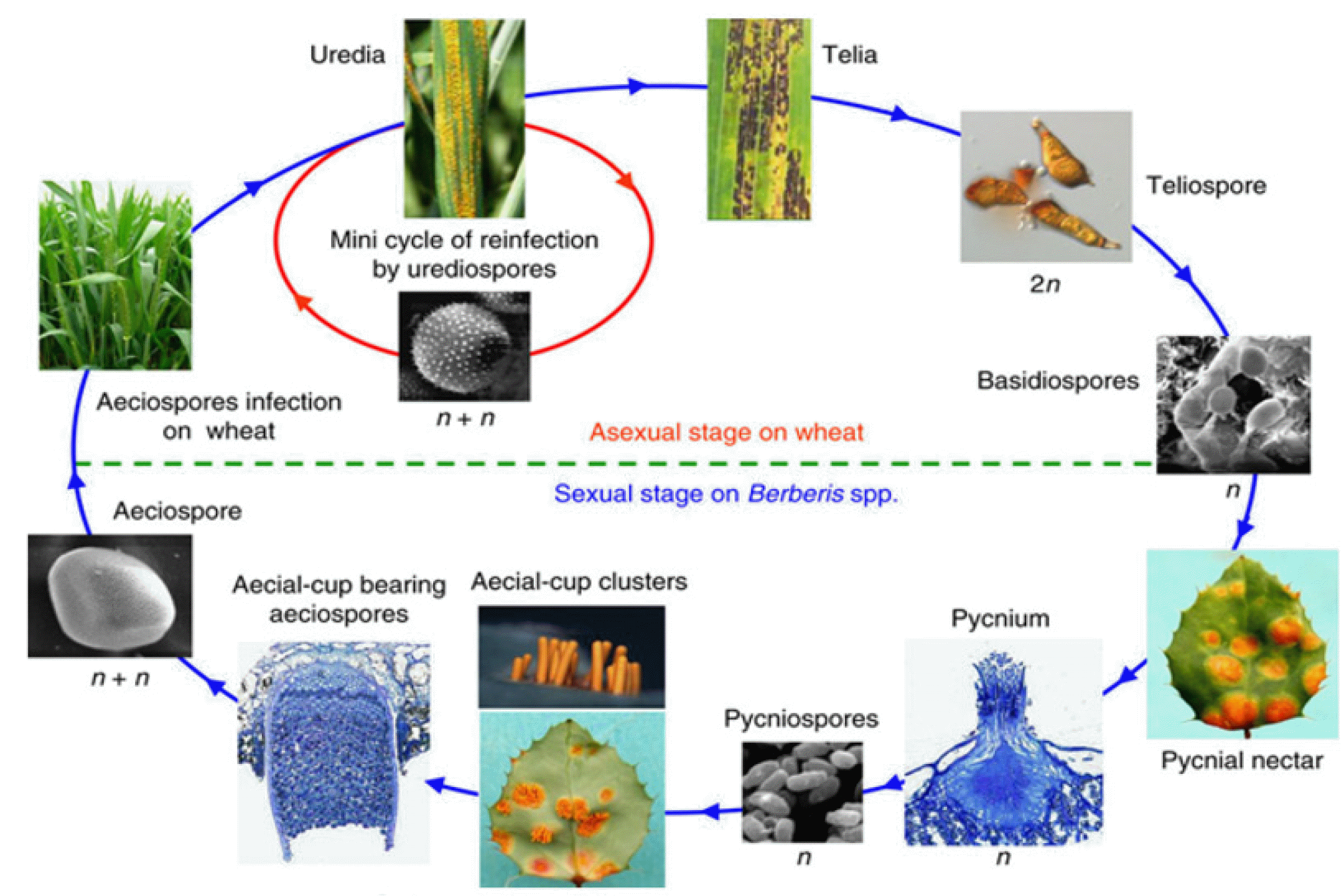
줄녹병 생활사
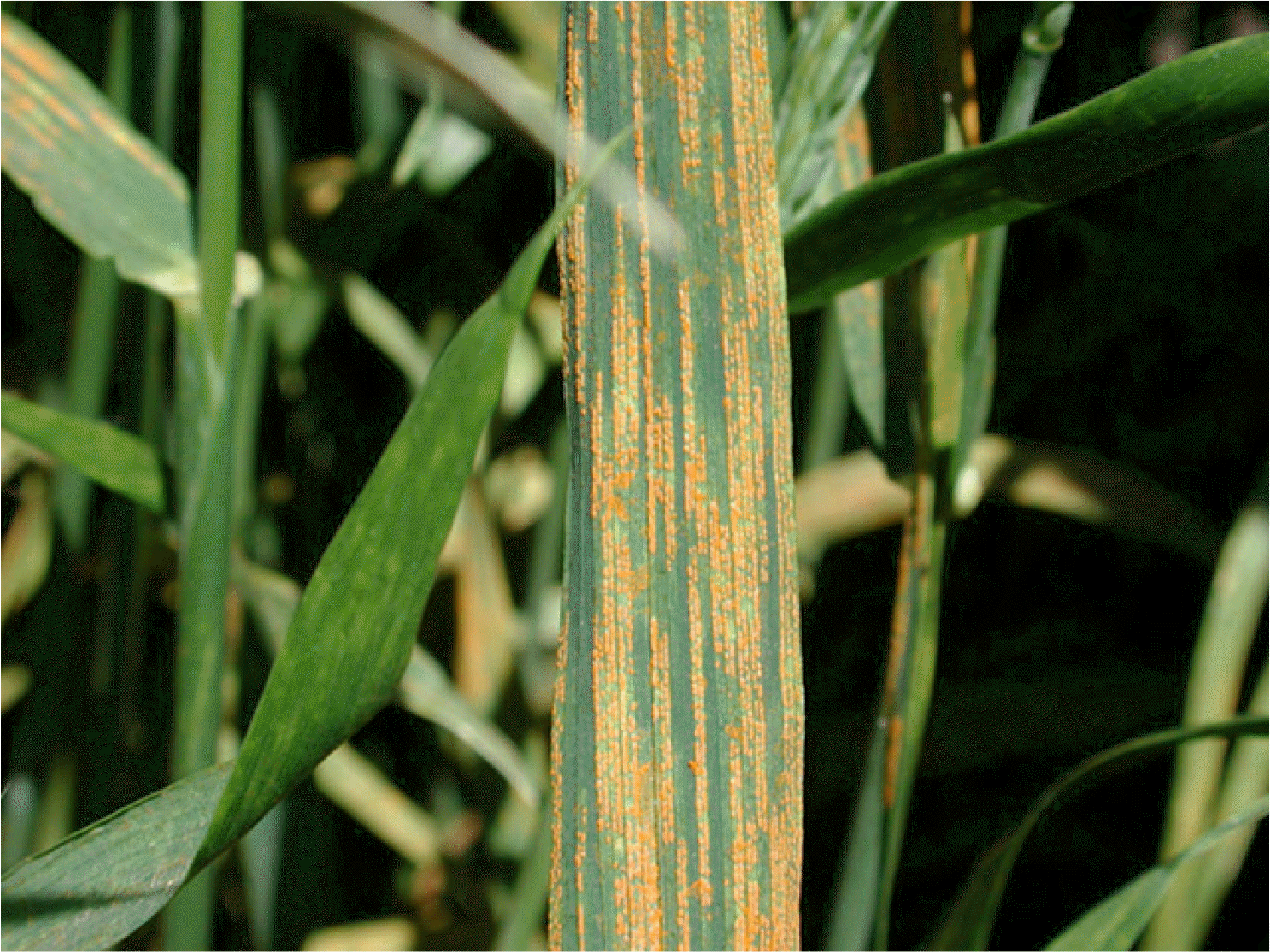
줄녹병의 감염은 4°C에서 시작되어 7°C가 적정온도이며 잎녹병이나 줄기녹병과 달리 밀에 침투하기 위한 부착기(appressoria)를 형성하지 않고, 생식관이 잎의 기공을 직접 관통하여 흡입 모세포(haustorial mother cells)를 형성한 후에 긴 균사(hyphae)가 잎의 길이 방향으로 자라게 되어 잎에 노랑색 내지 주황색의 포자(uredospore pustules)가 직선의 줄무늬 모양으로 나타나게 된다(
Moldenhauer et al. 2006,
Chen et al. 2014,
Fig. 2). 줄녹병 감염은 건물중, 뿌리 생장, 간장, 이삭 및 종실의 개수와 크기에 영향을 주며, 이러한 영향은 유묘기 감염이 가장 크지만 개화⋅수정기에 시작된 감염도 수량에 영향을 준다(
Wellings 2011).
줄녹병 저항성은 두 가지 형태가 존재한다. 첫번째 형태는 전단계 저항성(ASR, all-stage resistance)이라고 하는데, 이들은 잎녹병의 유묘기 저항성(SR, seedling resistance) 유전자처럼 생육 초기에 저항성을 나타내며, 같은 병원균에 대해서는 성체에서도 저항성을 유지하기 때문에 줄녹병에서는 ASR로 구분한다. 줄녹병의 ASR은 잎녹병의 유묘기 저항성과 마찬가지로 주동유전자(major gene)가 주로 관여한다(
Chen & Line 1995a,
1995b).
두번째 형태는 고온성체저항성(HTAP, high temperature adult plant resistance)으로 구분되는데, HTAP는 생육 후기의 온도가 21°C 이상이 되면서 병원균이 쉽게 퍼지는 시기에 저항성을 보인다(Qayoum & Line 1985). 줄녹병의 HTAP 저항성 유전자는 유묘기에는 감수성을 나타내지만, 잎녹병의 성체 저항성(APR, adult plant resistance)처럼 성체가 되면 줄녹병에 대한 저항성을 나타낸다(
Chen & Line 1995a,
1995b,
Line & Chen 1995). 이러한 형태의 저항성 유전자로 대표되는 것들은
Yr18,
Yr36과
Yr46이 있지만 이들의 정확한 저항성 기작에 대해서는 알려진 것이 적다(
Ellis et al. 2014). 유전자 동정을 통하여
Yr36이 WKS (Wheat Kinase-START) 단백질을 코딩하는 것이 밝혀졌고,
Yr18과
Yr46이 각각 ABC (ATP-binding cassette) transporter와 hexose transporter를 만든다는 정도만 밝혀졌다(
Krattinger et al. 2009,
Moore et al. 2015,
Dodds & Lagudah 2016).
줄녹병 저항성 유전자는
Yr로 표기하며 주요 저항성 유전자의 정보는
Table 1에 정리하였다. 줄녹병균인
Pst의 높은 다양성과 빠른 변이로 인하여 새로운 병원균이 지속적으로 발생하는데, 이로 인해 기존 유전자가 무력화 되는 경우가 많이 발생한다. 1990년대에
Yr2와
Yr9 유전자가 무력화 되었고,
Yr17과
Yr27이 각각 유럽과 인도에서 무력화 되면서 줄녹병이 대발생하였고, 2011년에도 유럽에서 병원성이 강한 새로운 균계의 발생으로 큰 피해가 초래되었다(
Bahri et al. 2011,
Hovmoller et al. 2015). 그러므로 균계 분화에 대응하기 위하여 종특이적 유전자와 종비특이적 유전자의 다양한 조합으로 줄녹병 저항성을 유지하는 것이 효과적이다(
Singh et al. 2000,
Herrera-Foessel et al. 2011). 예를 들어 종특이적 유전자인
Yr5이나
Yr15에 종비특이적 유전자인
Yr18,
Yr29과
Yr46를 조합하는 것이 줄녹병 저항성 증진에 효과적임이 보고된 바 있다(
Chen et al. 2014).
대부분의 줄녹병 저항성 유전자는 ASR에 속하며 주로 육배체 일반밀에서 유래하지만, 호밀(
Yr9), 야생밀(
Yr5,
Yr8,
Yr15,
Yr24,
Yr26,
Yr28,
Yr35,
Yr42)에서 유래하기도 한다(
Table 1). ASR의 경우 NBS-LRR 형태의 저항성 유전자에 의해 주로 조절될 것으로 추정되는 반면 HTAP 저항성은 보다 다양한 유전자나 환경인자에 영향을 받을 것으로 예측되고 있다(
Hulbert et al. 2007,
Chen 2013).
줄녹병의 HTAP 저항성 유전자는 대부분 다른 녹병이나 흰가루병 저항성과 연관이 되어있는데,
Yr17 (
Lr37/Sr38),
Yr18 (
Lr34/Sr57/Pm38),
Yr29 (
Lr46/Sr55/Pm46),
Yr30 (
Lr27/Sr2),
Yr46 (
Lr67/Sr55/Pm46)과
Yr47 (
Lr52)이 그 예로,
Yr18,
Yr29과
Yr36는 미국에서 HTAP 저항성 품종 육성에 많이 사용되고 있다(
Table 1). 특히 6BS 염색체에 위치한
Yr36은 종실 단백질 함량에 영향하는
Gpc-B1 유전자에 근접해 있어 빵 품질향상을 위한 분자표지와 병행하여 이용되고 있다(
Chen 2013). 위에서 언급한
Yr5,
Yr15,
Yr17,
Yr18,
Yr29,
Yr36,
Yr46를 비롯하여 주요 줄녹병 저항성 유전자의 도입을 위한 분자표지 관련 정보는 MAS Wheat 홈페이지(
https://maswheat.ucdavis.edu/)에 잘 정리되어 있으므로 육종사업에 유용하게 활용할 수 있다.
결 론
줄녹병은 온대지방에서 주로 발생하지만 최근 광범위한 기후에 적응하는 균계가 발생하면서 전세계적으로 밀의 생산성과 품질에 큰 위협이 되고 있다. 줄녹병 저항성 유전자는 약 80여개가 보고되었고 동정이 이루어진 것은 6개로
Yr5,
Yr7,
Yr15,
Yr18/
Lr34/
Sr57/
Pm38, Yr36,
Yr46/
Lr67/
Sr55/
Pm46이다(
Table 1). 새로운 줄녹병 저항성 유전자원을 발굴하고 다수의 저항성 유전자를 우수 품종에 집적시키기 위한 연구가 국제적으로 활발하게 이루어지고 있으나 우리나라의 줄녹병 저항성 유전육종 연구는 아직 초기단계이다. 국내 육성 밀 계통인 수원11호와 수원92호가 줄녹병 저항성 유전자인
YrSu,
YrSo를 각각 보유하였다는 외국의 보고 사례가 있었으나(
Wan et al. 2004,
Mamun et al. 2018) 이들 계통이 줄녹병 저항성 품종 개발을 위하여 국내에서 활용된 사례는 찾아보기 어렵다.
줄녹병은 저항성이 없는 품종에서 발병하는 경우 적게는 5~10%에서 많게는 80% 이상 밀 수량을 감소시키며 지속적인 균계 분화로 병원성 양상과 환경적응성이 빠르게 변화하므로 우리나라도 저항성 품종 육성을 통하여 발병피해를 선제적으로 예방해야 한다. 이를 위해서는 대량⋅정밀 검정체계를 구축하여 주요 줄녹병 균계에 대한 국내 밀 품종 및 육성계통, 재래종의 저항성을 판정해야 하며, 다양한 저항성 유전자를 보유한 유전자원을 적극적으로 도입하여 육종에 활용해야 한다.
보다 장기적으로는 밀 분자유전학 및 유전체 연구 강화를 통하여 국내에서도 새로운 녹병 저항성 유전자를 자체적으로 발굴해야 한다. 밀은 배수체이며 유전체의 크기가 벼의 40배 이상으로 매우 방대하여 유전연구가 까다로운 편이다. 그러나 최근 밀 표준유전체(IWGSC 2018)가 확립됨에 따라 전통적인 유전지도기반 유전자분리(map-based cloning) 이외에도 다양한 유전분석 기술이 활용되고 있다. 목표 염색체만 선별(flow cytometry)하여 차세대염기서열분석(NGS)을 진행하는 MutChromSeq (
Sanchez-Martin et al. 2016), 병 저항성 관련 부위만 선별하는 RenSeq (
Steuernagel et al. 2016), 유전자 부위를 선별하는 ExomeSeq (
Mo et al. 2018), 전유전체연관분석(GWAS)을 병 저항성 관련 부위에 집중하여 진행하는 AgRenSeq (
Arora et al. 2019) 등이 그 사례이다. 따라서 신규 유전자원 탐색과 함께 유전체 기반 기술을 활용한 유전분석을 병행한다면 국내 고유의 녹병 저항성 유전자 및 분자표지를 개발하고 이를 녹병 저항성 밀 육종에 활용하는 것도 가능해질 것으로 기대한다.
적 요
Puccinia striiformis f. sp. tritici에 의하여 발생하는 줄녹병은 잎녹병, 줄기녹병과 함께 밀의 생산성과 품질을 떨어뜨리는 주요 질병이다. 줄녹병은 과거에 온대지역에 주로 발생하여 잎녹병에 비하여 피해가 적은 것으로 인식되어 왔으나, 최근 균계 분화로 호주, 중동, 아프리카를 포함한 고온지역으로도 피해가 확대되면서 위협이 커지고 있다. 줄녹병 저항성 유전자는 현재까지 80여개가 보고되었고 그 중 6개(Yr5, Yr7, Yr15, Yr18, Yr36, Yr46)가 동정되었다. 줄녹병 저항성은 크게 종특이적 저항성(전단계저항성)과 종비특이적 저항성(고온성체저항성)으로 구분되는데, 종특이적 저항성 유전자는 균계 분화로 인하여 저항성이 수년 안에 쉽게 무너지는 반면 Yr18, Yr36, Yr46을 비롯한 종비특이적 저항성 유전자는 저항성이 수십년 이상 유지되기도 한다. 특히 Yr18/Lr34/Sr57/Pm38과 Yr46/Lr67/Sr55/Pm46 유전자는 줄녹병뿐아니라 잎녹병, 줄기녹병, 흰가루병에도 저항성을 나타내므로 육종적으로 매우 유용하다. 우리나라는 줄녹병 저항성 유전육종 연구가 아직 초기단계이므로 한반도 내 주요 균계의 분포와 변화, 저항성 검정체계 구축, 주요 밀 품종과 육성계통의 저항성 검정, 유망 유전자원 확보 및 활용 연구를 활성화하여 발병으로 인한 피해를 사전에 예방하는 것이 시급하다. 또한 장기적으로 분자유전학 및 유전체 분야의 연구를 강화하여 국내 고유의 줄녹병 저항성 유전자를 발굴하고 이를 밀 분자육종에 활용하기 위한 역량을 갖추어야 한다.
사 사
본 연구는 농촌진흥청 국립식량과학원 농업과학기술연구개발사업(과제명: 조기 육성 기술을 활용한 고품질 밀 우량 계통 육성 및 유전 분석, 과제번호: PJ014989032020)의 지원에 의해 이루어진 것으로 이에 감사드립니다.
Fig. 1
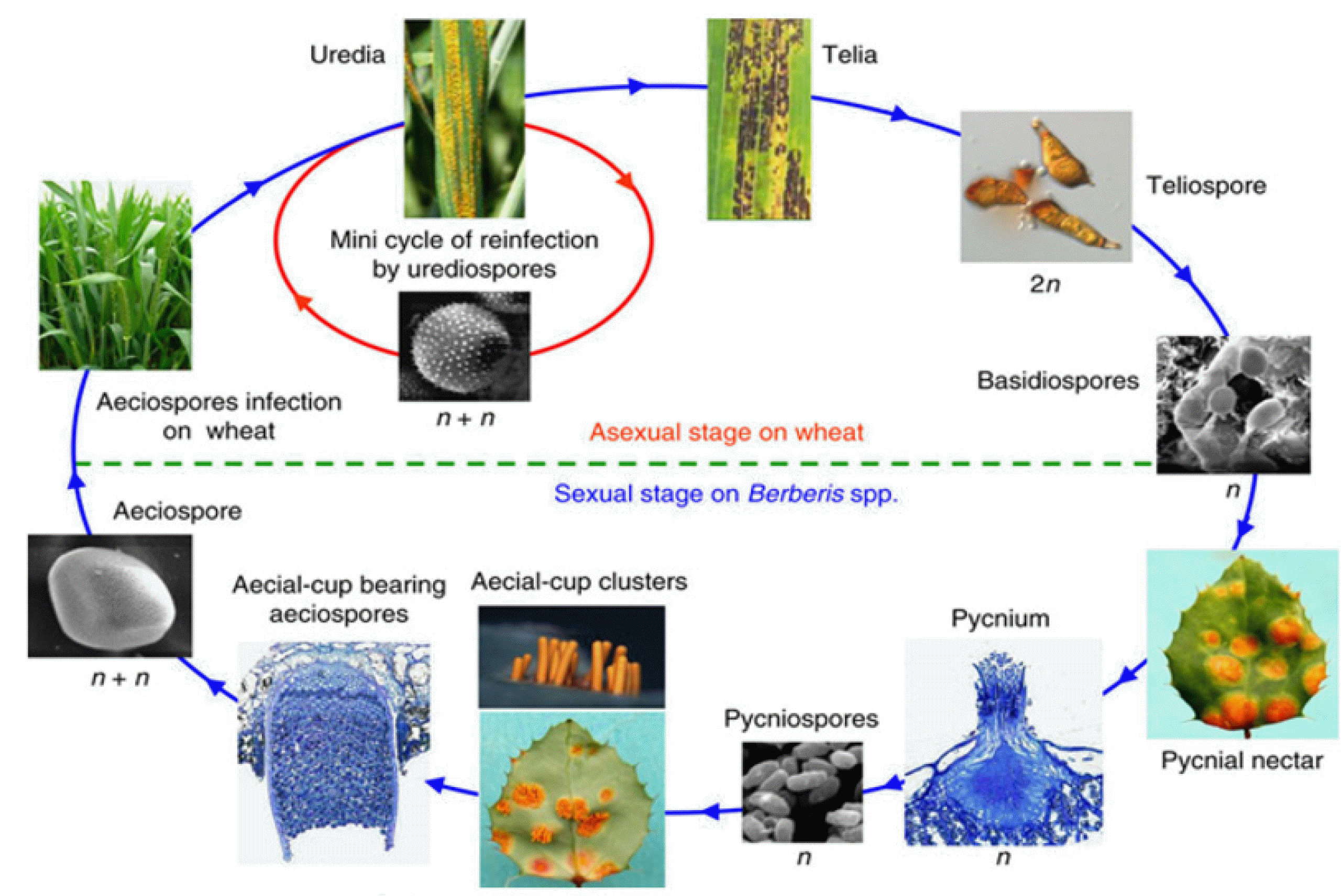
Fig. 2
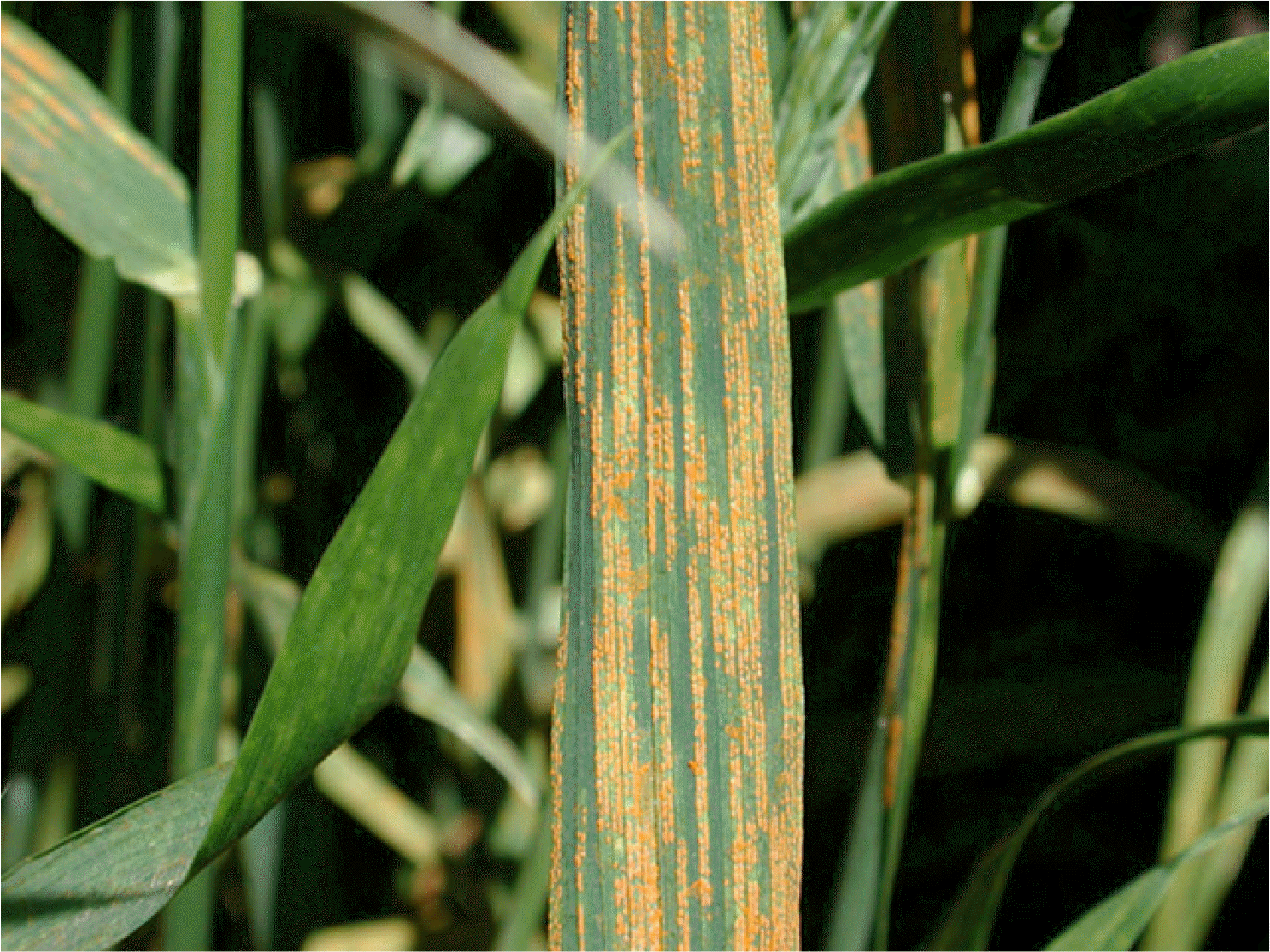
Table 1Summary of major stripe rust (Yr) resistance genes.
Table 1
|
Locus |
Acc.z
|
Source |
Chr.y
|
Typex
|
Referencesw
|
|
Yr1
|
- |
T. aestivum
|
2AL |
ASR |
Bansal et al. 2009, Hasancebi et al. 2014
|
|
Yr4
|
- |
T. aestivum
|
3BS |
ASR |
Bansal et al. 2010
|
|
Yr5 (YrSP) |
JN631792 |
T. spelta album
|
2BL |
ASR |
Chen et al. 2003, Yan et al. 2003, Smith et al. 2007, Murphy et al. 2009, Zhang et al. 2009, Naruoka et al. 2016, Marchal et al. 2018
|
|
Yr6
|
- |
T. aestivum
|
7B |
ASR |
Li & Niu 2007
|
|
Yr7
|
MN273771 |
T. aestivum
|
2B |
ASR |
Yao et al. 2006, Marchal et al. 2018
|
|
Yr8
|
- |
T. comosa
|
2D |
ASR |
Niu et al. 2004
|
|
Yr9
|
DQ167397 |
S. cereale
|
1BL |
ASR |
Mago et al. 2005
|
|
Yr10
|
AF149112 |
T. aestivum
|
1BS |
ASR |
Wang et al. 2002, Singh et al. 2009, Yuan et al. 2012, 2018, Liu et al. 2014
|
|
Yr11
|
- |
T. aestivum
|
2D |
HTAP |
McIntosh et al. 2003, Nazari & Wellings 2008
|
|
Yr12
|
- |
T. aestivum
|
2D |
HTAP |
McIntosh et al. 2003, Nazari & Wellings 2008
|
|
Yr13
|
- |
T. aestivum
|
2D |
HTAP |
McIntosh et al. 2003, Nazari & Wellings 2008
|
|
Yr14
|
- |
T. aestivum
|
2D |
HTAP |
McIntosh et al. 2003, Nazari & Wellings 2008
|
|
Yr15 (Wtk1) |
MG649384 |
T. dicoccoides G25
|
1BS |
ASR |
Peng et al. 2000, Murphy et al. 2009, Yaniv et al. 2015, Klymiuk et al. 2018
|
|
Yr16
|
- |
T. aestivum
|
2DL |
HTAP |
Agenbag et al. 2012
|
|
Yr17
|
GQ850586 |
T. ventricosa
|
2AS |
HTAP |
Helguera et al. 2003, Jia et al. 2011
|
|
Yr18/Lr34/Sr57
|
FJ436983 |
T. aestivum
|
7DS |
HTAP |
Lagudah et al. 2006, 2009, Krattinger et al. 2009
|
|
Yr24/Yr26
|
JX270677 |
D. villosum
|
1BS |
ASR |
Ma et al. 2001, Zhang et al. 2013, Zeng et al. 2014
|
|
Yr28
|
KX181569 |
T. tauschii W-219
|
4DS |
ASR |
Zhang et al. 2019
|
|
Yr29
|
- |
T. aestivum
|
1BL |
HTAP |
Rosewarne et al. 2006
|
|
Yr30
|
- |
T. aestivum
|
3BS |
HTAP |
Spielmeyer et al. 2003, Hayden et al. 2004
|
|
Yr33
|
- |
T. aestivum
|
7D |
- |
Zahravi et al. 2003
|
|
Yr34
|
- |
T. aestivum
|
5AL |
HTAP |
Qureshi et al. 2018
|
|
Yr35
|
- |
T. dicoccoides
|
6BS |
ASR |
Dadkhodaie et al. 2011
|
|
Yr36 (WKS1) |
EU835199 |
T. dicoccoides
|
6BS |
HTAP |
Fu et al. 2009
|
|
Yr37
|
|
A. kotschyi
|
2DL |
- |
Marais et al. 2005
|
|
Yr38
|
|
A. sharonensis
|
6AL |
- |
Marais et al. 2010
|
|
Yr39
|
- |
T. aestivum
|
1BS |
HTAP |
Lin & Chen 2007
|
|
Yr40
|
- |
A. geniculata
|
5DS |
- |
Kuraparthy et al. 2009
|
|
Yr41
|
- |
T. aestivum
|
2BS |
- |
Luo et al. 2008
|
|
Yr42
|
-
|
A. neglecta
|
6AS |
ASR |
Marais et al. 2009
|
|
Yr43/Yr44
|
- |
T. aestivum
|
2BL |
- |
Sui et al. 2009
|
|
Yr45
|
- |
T. aestivum
|
3DL |
ASR |
Li et al. 2011
|
|
Yr46/Lr67/Sr55
|
KR604818 |
T. aestivum
|
4DS |
HTAP |
Herrera-Foessel et al. 2011, Abdelbacki et al. 2014, Moore et al. 2015
|
|
Yr47
|
- |
T. aestivum
|
5BS |
HTAP |
Obert et al. 2005, Bansal et al. 2011, Qureshi et al. 2017
|
|
Yr48
|
- |
T. aestivum
|
5AL |
HTAP |
Lowe et al. 2011
|
|
Yr50
|
- |
T. intermedium
|
4BL |
HTAP |
Liu et al. 2013
|
|
Yr51
|
- |
T. aestivum
|
4AL |
ASR |
Randhawa et al. 2014
|
|
Yr52
|
- |
T. aestivum
|
7BL |
HTAP |
Ren et al. 2012
|
|
Yr53
|
- |
T. aestivum
|
2BL |
ASR |
Xu et al. 2013
|
|
Yr57
|
- |
T. aestivum
|
3BS |
ASR |
Randhawa et al. 2015
|
|
Yr58
|
- |
T. aestivum
|
3BS |
ASR |
Chhetri et al. 2016
|
|
Yr59
|
- |
T. aestivum
|
7BL |
HTAP |
Zhou et al. 2014a
|
|
Yr60
|
- |
T. aestivum
|
4AL |
ASR, HTAP |
Herrera-Foessel et al. 2015
|
|
Yr61
|
- |
T. aestivum
|
7AS |
ASR |
Zhou et al. 2014b
|
|
Yr62
|
- |
T. aestivum
|
4BL |
HTAP |
Lu et al. 2014
|
|
Yr64
|
- |
T. durum
|
1BS |
- |
Cheng et al. 2014, Qie et al. 2019
|
|
Yr65
|
- |
T. durum
|
1BS |
ASR |
Cheng et al. 2014
|
|
Yr67
|
- |
T. aestivum
|
7BL |
- |
Li et al. 2009
|
|
Yr69
|
- |
T. aestivum
|
2AS |
HTAP |
Hou et al. 2016
|
|
Yr71
|
- |
T. aestivum
|
3D |
HTAP |
Bariana et al. 2016
|
|
Yr76
|
- |
T. compactum
|
3AS |
- |
Xiang et al. 2016
|
|
Yr81
|
- |
T. aestivum
|
6A |
HTAP |
Gessese et al. 2019
|
References
- 1. Abdelbacki AMM, Omara RI, Najeeb MA, Soliman NEK. 2014. Identification of leaf rust resistant genes Lr9, Lr25, Lr28, Lr29 & Lr67 in ten Egyptian wheat cultivars using molecular markers. Int J Biotech Res 7: 89-96.
- 2. Agenbag GM, Pretorius ZA, Boyd LA, Bender CM, Prins R. 2012. Identification of adult plant resistance to stripe rust in the wheat cultivar Cappelle-Desprez. Theor Appl Genet 125: 109-120.
- 3. Ali S, Gladieux P, Leconte M, Gautier A, Justesen AF, Hovmøller MS, Enjalbert J, de Vallavieille-Pope C. 2014. Origin, migration routes and worldwide population genetic structure of the wheat yellow rust pathogen Puccinia striiformis f. sp. tritici. PLoS Pathog 10: e1003903.
- 4. Arduim GDS, Reis EM, Barcellos AL, Turra C. 2012. In vivo sensitivity reduction of Puccinia triticina races, causal agent of wheat leaf rust, to DMI and QoI fungicides. Sum Phytopathol 38: 306-311.
- 5. Arora S, Steuernagel B, Gaurav K, Chandramohan S, Long Y, Matny O, Hatta MAM. 2019. Resistance gene cloning from a wild crop relative by sequence capture and association genetics. Nat Biotechnol 37: 139-143.
- 6. Bahri B, Shah SJ, Hussain A, Leconte S, Enjalbert M, J. de Vallavieille-Pope C. 2011. Genetic diversity of wheat yellow rust population in Pakistan and its relationship with host resistance. Plant Pathol 60: 649-60.
- 7. Bansal UK, Hayden MJ, Keller B, Wellings CR, Park RF, Bariana HS. 2009. Relationship between wheat rust resistance genes Yr1 and Sr48 and a microsatellite marker. Plant Pathol 58: 1039-1043.
- 8. Bansal UK, Hayden MJ, Gill MB, Bariana HS. 2010. Chromosomal location of an uncharacterised stripe rust resistance gene in wheat. Euphytica 171: 121-127.
- 9. Bansal UK, Forrest KL, Hayden MJ, Miah H, Singh D, Bariana HS. 2011. Characterisation of a new stripe rust resistance gene Yr47 and its genetic association with the leaf rust resistance gene Lr52. Theor Appl Genet 122: 1461-1466.
- 10. Bariana H, Forrest K, Qureshi N, Miah H, Hayden M, Bansal U. 2016. Adult plant stripe rust resistance gene Yr71 maps close to Lr24 in chromosome 3D of common wheat. Mol Breeding 36: 98
- 11. Beddow JM, Pardey PG, Chai Y, Hurley TM, Kriticos DJ, Braun HJ, Park RF, Cuddy WS, Yonow T. 2015. Research investment implications of shifts in the global geography of wheat stripe rust. Nat Plants 1: 1-15.
- 12. Bolton MD, Kolmer JA, Garvin DF. 2008. Wheat leaf rust caused by Puccinia triticina. Mol Plant Pathol 9: 563-575.
- 13. Chen X, Soria MA, Yan G, Sun J, Dubcovsky J. 2003. Development of sequence tagged site and cleaved amplified polymorphic sequence markers for wheat stripe rust resistance gene Yr5. Crop Sci 43: 2058-2064.
- 14. Chen X. 2005. Epidemiology and control of stripe rust [Puccinia striiformis f. sp. tritici] on wheat. Can J Plant Pathol 27: 314-337.
- 15. Chen X. 2013. Review article: High-temperature adult-plant resistance, key for sustainable control of stripe rust. Am J Plant Sci 4: 608-627.
- 16. Chen XM, Line RF. 1995a. Gene action in wheat cultivars for durable high-temperature adult-plant resistance and interactions with race-specific, seedling resistance to stripe rust caused by puccinia striiformis. Phytopathology 85: 567-572.
- 17. Chen XM, Line RF. 1995b. Gene number and heritability of wheat cultivars with durable, high-temperature, adult-plant resistance and race-specific resistance to puccinia striiformis. Phytopathology 85: 573-578.
- 18. Chen W, Wellings C, Chen X, Kang Z, Liu T. 2014. Wheat stripe (yellow) rust caused by Puccinia striiformis f. sp. tritici. Mol Plant Pathol 15: 433-446.
- 19. Cheng P, Xu LS, Wang MN, See DR, Chen XM. 2014. Molecular mapping of genes Yr64 and Yr65 for stripe rust resistance in hexaploid derivatives of durum wheat accessions PI 331260 and PI 480016. Theor Appl Genet 127: 2267-2277.
- 20. Chhetri M, Bariana H, Kandiah P, Bansal U. 2016. Yr58: a new stripe rust resistance gene and its interaction with Yr46 for enhanced resistance. Phytopathology 106: 1530-1534.
- 21. Cummins GB, Hiratsuka Y. 2004. Illustrated genera of rust fungi. APS Press, St. Paul. MN.
- 22. Dadkhodaie NA, Karaoglou H, Wellings CR, Park RF. 2011. Mapping genes Lr53 and Yr35 on the short arm of chromosome 6B of common wheat with microsatellite markers and studies of their association with Lr36. Theor Appl Genet 122: 479-487.
- 23. Dakouri A, McCallum BD, Radovanovic N, Cloutier S. 2013. Molecular and phenotypic characterization of seedling and adult plant leaf rust resistance in a world wheat collection. Mol Breeding 32: 663-677.
- 24. Dodds PN, Lagudah ES. 2016. Starving the enemy. Science 354: 1377-1378.
- 25. Duplessis S, Cuomo CA, Lin YC, Aerts A, Tisserant E, Veneault-Fourrey C, Joly DL, Hacquard S, Amselem J, Cantarel BL, Chiu R, Coutinho PM, Feau N, Field M, Frey P, Gelhaye E, Goldberg J, Grabherr MG, Kodira CD, Kohler A, Kues U, Lindquist EA, Lucas SM, Mago R, Mauceli E, Morin E, Murat C, Pangilinan JL, Park R, Pearson M, Quesneville H, Rouhier N, Sakthikumar S, Salamov AA, Schmutz J, Selles B, Shapiro H, Tanguay P, Tuskan GA, Henrissat B, Van de Peer Y, Rouze P, Ellis JG, Dodds PN, Schein JE, Zhong S, Hamelin RC, Grigoriev IV, Szabo LJ, Martin F. 2011. Obligate biotrophy features unraveled by the genomic analysis of rust fungi. Proc Natl Acad Sci USA 108: 9166-9171.
- 26. Ellis EG, Lagudah ES, Spielmeyer W, Dodds PN. 2014. The past, present and future of breeding rust resistant wheat. Front Plant Sci 5: 641
- 27. Figueroa M, Hammond-Kosack KE, Solomon PS. 2018. A review of wheat diseases a field perspective. Mol Plant Pathol 6: 99-111.
- 28. Fu D, Uauy C, Distelfeld A, Blechl A, Epstein L, Chen X, Dubcovsky J. 2009. A kinase-START gene confers temperature-dependent resistance to wheat stripe rust. Science 323: 1357-1360.
- 29. Gessese M, Bariana H, Wong D, Hayden M, Bansal U. 2019. Molecular mapping of stripe rust resistance gene Yr81 in a common wheat landrace Aus27430. Plant Dis 103: 1166-1171.
- 30. Hasancebi S, Mert Z, Ertugrul F, Akan K, Aydin Y, Akfirat FS, Uncuoglu AA. 2014. An EST-SSR marker, bu099658, and its potential use in breeding for yellow rust resistance in wheat. Czech J Genet Plant 50: 11-18.
- 31. Hayden MJ, Kuchel H, Chalmers KJ. 2004. Sequence tagged microsatellites for the Xgwm533 locus provide new diagnostic markers to select for the presence of stem rust resistance gene Sr2 in bread wheat (Triticum aestivum L.). Theor Appl Genet 109: 1641-1647.
- 32. Helguera M, Khan IA, Kolmer J, Lijavetzky D, Zhong-Qi L, Dubcovsky J. 2003. PCR assays for the Lr37-Yr17-Sr38 cluster of rust resistance genes and their use to develop isogenic hard red spring wheat lines. Crop Sci 43: 1839-1847.
- 33. Herrera-Foessel SA, Lagudah ES, Huerta-Espino J, Hayden MJ, Bariana HS, Singh D, Singh RP. 2011. New slow-rusting leaf rust and stripe rust resistance genes Lr67 and Yr46 in wheat are pleiotropic or closely linked'. Theor Appl Genet 122: 239-249.
- 34. Herrera-Foessel SA, Singh RP, Lan CX, Huerta-Espino J, Calvo-Salazar V, Bansal UK, Lagudah ES. 2015. Yr60, a gene conferring moderate resistance to stripe rust in wheat. Plant Dis 99: 508-511.
- 35. Hou L, Jia J, Zhang X, Li X, Yang Z, Ma J, Chang Z. 2016. Molecular mapping of the stripe rust resistance gene Yr69 on wheat chromosome 2AS. Plant Dis 100: 1717-1724.
- 36. Hovmoller MS, Sorensen CK, Walter S, Justesen AF. 2011. Diversity of Puccinia striiformis on cereals and grasses. Annu Rev Phytopathol 49: 197-217.
- 37. Hovmoller MS, Walter S, Bayles RA, Hubbard A, Flath K, Sommerfeldt N, Leconte M, Czembor P, Rodriguez-Algaba J, Thach T, Hansen JG, Lassen P, Justesen AF, Ali S, De Vallavieille-Pope C. 2015. Replacement of the European wheat yellow rust population by new races from the centre of diversity in the near-Himalayan region. Plant Pathol 65: 402-411.
- 38. Hubbard A, Lewis CM, Yoshida K, Ramirez-Gonzalez RH, De VallavieillePope C, Thomas J, Kamoun S, Bayles R, Uauy C, Saunders DGO. 2015. Field pathogenomics reveals the emergence of a diverse wheat yellow rust population. Genome Biol 16: 23
- 39. Hulbert SH, Bai J, Fellers JP, Pacheco MG, Bowden RL. 2007. Gene expression patterns in near isogenic lines for wheat rust resistance gene Lr34/Yr18. Phytopathol 97: 1083-1093.
- 40. Jia J, Li G, Liu C, Lei M, Yang Z. 2011. Characterization of wheat yellow rust resistance gene Yr17 using EST-SSR and rice syntenic region. Cereal Res Commun 39: 88-99.
- 41. Jin Y, Szabo LJ, Carson M. 2010. Century-old mystery of Puccinia striiformis life history solved with the identification of berberis as an alternate host. Phytopathology 100: 432-435.
- 42. Jorgensen LN, Nielsen GC, Orum JE, Jensen JE, Pinnschmidt HO. 2008. Integrating disease control in winter wheat - optimizing fungicide input'. Outlooks on Pesticide Management 19: 206-213.
- 43. Klymiuk V, Yaniv E, Huang L, Raats D, Fatiukha A, Chen S, Chang W. 2018. Cloning of the wheat Yr15 resistance gene sheds light on the plant tandem kinase-pseudokinase family. Nat Commun 9: 1-12.
- 44. Kolmer J, Jin Y, Long D. 2007. Wheat leaf and stem rust in the United States. Crop Pasture Sci 58: 631-638.
- 45. Krattinger SG, Lagudah ES, Spielmeyer W, Singh RP, Huerta-Espino J, McFadden H, Bossolini E, Selter LL, Keller B. 2009. A putative ABC transporter confers durable resistance to multiple fungal pathogens in wheat. Science 323: 1360-1363.
- 46. Kumar A, Chhuneja P, Jain S, Kaur S, Balyan HS, Gupta PK. 2013. Mapping main effect QTL and epistatic interactions for leaf rust and yellow rust using high density ITMI linkage map. Aust J Crop Sci 7: 492-499.
- 47. Kuraparthy V, Sood S, Gill BS. 2009. Molecular genetic description of the cryptic wheat-Aegilops geniculata introgression carrying rust resistance genes Lr57 and Yr40 using wheat ESTs and synteny with rice. Genome 52: 1025-1036.
- 48. Lagudah ES, McFadden H, Singh RP, Huerta-Espino J, Bariana HS, Spielmeyer W. 2006. Molecular genetic characterization of the Lr34/Yr18 slow rusting resistance gene region in wheat. Theor Appl Genet 114: 21-30.
- 49. Lagudah ES, Krattinger SG, Herrera-Foessel S, Singh RP, Huerta-Espino J, Spielmeyer W, Brown-Guedira G, Selter LL, Keller B. 2009. Gene-specific markers for the wheat gene Lr34/Yr18/Pm38 which confers resistance to multiple fungal pathogens. Theor Appl Genet 119: 889-898.
- 50. Li Q, Chen XM, Wang MN, Jing JX. 2011. Yr45, a new wheat gene for stripe rust resistance on the long arm of chromosome 3D. Theor Appl Genet 122: 189-197.
- 51. Li Y, Niu Y. 2007. Identification of molecular markers for wheat stripe rust resistance gene Yr6. Europepmc 189-192.
- 52. Li Y, Niu YC, Chen XM. 2009. Mapping a stripe rust resistance gene YrC591 in wheat variety C591 with SSR and AFLP markers. Theor Appl Genet 118: 339-346.
- 53. Lin F, Chen XM. 2007. Genetics and molecular mapping of genes for race-specific all-stage resistance and non-race-specific high-temperature adult-plant resistance to stripe rust in spring wheat cultivar Alpowa. Theor Appl Genet 114: 1277-1287.
- 54. Line RF, Chen XM. 1995. Successes in breeding for and managing durable resistance to wheat rusts. Plant Dis 79: 1254-1255.
- 55. Liu J, Chang Z, Zhang X, Yang Z, Li X, Jia J, Wang J. 2013. Putative Thinopyrum intermedium-derived stripe rust resistance gene Yr50 maps on wheat chromosome arm 4BL. Theor Appl Genet 126: 265-274.
- 56. Liu W, Frick M, Huel R, Nykiforuk CL, Wang X, Gaudet DA, Kang Z. 2014. The stripe rust resistance gene Yr10 encodes an evolutionary-conserved and unique CC-NBS-LRR sequence in wheat. Mol Plant 7: 1740-1755.
- 57. Lowe I, Jankuloski L, Chao S, Chen X, See D, Dubcovsky J. 2011. Mapping and validation of QTL which confer partial resistance to broadly virulent post-2000 north american races of stripe rust in hexaploid wheat. Theor Appl Genet 123: 143-157.
- 58. Lu Y, Wang M, Chen X, See D, Chao S, Jing J. 2014. Mapping of Yr62 and a small-effect QTL for high-temperature adult-plant resistance to stripe rust in spring wheat PI 192252. Theor Appl Genet 127: 1449-1459.
- 59. Luo PG, Hu XY, Ren ZL, Zhang HY, Shu K, Yang ZJ. 2008. Allelic analysis of stripe rust resistance genes on wheat chromosome 2BS. Genome 51: 922-927.
- 60. Ma J, Zhou R, Dong Y, Wang L, Wang X, Jia J. 2001. Molecular mapping and detection of the yellow rust resistance gene Yr26 in wheat transferred from Triticum turgidum L. using microsatellite markers. Euphytica 120: 219-226.
- 61. Mago R, Miah H, Lawrence GJ, Wellings CR, Spielmeyer W, Bariana HS, Ellis JG. 2005. High-resolution mapping and mutation analysis separate the rust resistance genes Sr31, Lr26 and Yr9 on the short arm of rye chromosome 1. Theor Appl Genet 112: 41-50.
- 62. Mamun M, Tang C, Sun Y, Islam M, Liu P, Wang X, Kang Z. 2018. Wheat gene TaATG8j contributes to stripe rust resistance. Int J Mol Sci 19: 1666
- 63. Marais GF, McCallum B, Snyman JE, Pretorius ZA, Marais AS. 2005. Leaf rust and stripe rust resistance genes Lr54 and Yr37 transferred to wheat from Aegilops kotschyi. Plant Breeding 124: 538-541.
- 64. Marais GF, Marais A, McCallum B, Pretorius Z. 2009. Transfer of leaf rust and stripe rust resistance genes Lr62 and Yr42 from Aegilops neglecta Req. ex Bertol. to common wheat. Crop Sci 49: 871-879.
- 65. Marais GF, Badenhorst PE, Eksteen A, Pretorius ZA. 2010. Reduction of Aegilops sharonensis chromatin associated with resistance genes Lr56 and Yr38 in wheat. Euphytica 171: 15-22.
- 66. Marchal C, Zhang J, Zhang P, Fenwick P, Steuernagel B, Adamski NM, Lagudah E. 2018. BED-domain-containing immune receptors confer diverse resistance spectra to yellow rust. Nat Plants 4: 662-668.
- 67. McIntosh RA, Wellings CR, Park RF. 1995. Wheat Rusts: an atlas of resistance genes. Csiro Publishing
- 68. McIntosh RA, Yamazaki Y, Devos KM, Dubcovsky J, Rogers WJ, Appels R. 2003. Catalogue of gene symbols for wheat. Wheat Inform Service 97: 27-37.
- 69. McIntosh R. 2009. The history and status of the wheat rusts. NGRI Technical Workshop. pp. 11-24.
- 70. McIntosh RA, Dubcovsky J, Rogers WJ, Morris C, Appels R, Xia XC. 2014. Catalogue of gene symbols for wheat. 2013-2014 Supplement. Annual Wheat Newsletter. 58.
- 71. Mo Y, Howell T, Vasquez-Gross H, De Haro LA, Dubcovsky J, Pearce S. 2018. Mapping causal mutations by exome sequencing in a wheat TILLING population: a tall mutant case study. Mol Genet Genomics 293: 463-477.
- 72. Moldenhauer J, Moerschbacher BM, Westhuizen AJ. 2006. Histological investigation of stripe rust (Puccinia striiformis f. sp. tritici) development in resistant and susceptible wheat cultivars. Plant Pathol 55: 469-74.
- 73. Moore JW, Herrera-Foessel S, Lan C, Schnippenkoetter W, Ayliffe M, Huerta-Espino J, Lillemo M, Viccars L, Milne R, Periyannan S, Kong X, Spielmeyer W, Talbot M, Bariana H, Patrick JW, Dodds P, Singh R, Lagudah E. 2015. A recently evolved hexose transporter variant confers resistance to multiple pathogens in wheat. Nat Genet 47: 1494-1500.
- 74. Mundt CC. 2018. Pyramiding for Resistance Durability: Theory and Practice. Phytopathol 108: 792-802.
- 75. Murphy LR, Santra D, Kidwell K, Yan G, Chen X, Campbell KG. 2009. Linkage maps of wheat stripe rust resistance genes Yr5 and Yr15 for use in marker-assisted selection. Crop Sci 49: 1786-1790.
- 76. Murray GM, Brennan JP. 2009. Estimating disease losses to the Australian wheat industry. Australas. Plant Pathol 38: 558-570.
- 77. Naruoka Y, Ando K, Bulli P, Muleta KT, Rynearson S, Pumphrey MO. 2016. Identification and validation of SNP markers linked to the stripe rust resistance gene Yr5 in wheat. Crop Sci 56: 3055-3065.
- 78. Nazari K, Wellings CR. 2008. Genetic analysis of seedling stripe rust resistance in the Australian wheat cultivar 'Batavia'. In: The International Wheat Symposium proceedings; Sydney University Press. pp 1-3.
- 79. Niu YC, Li SM, Li WF, Wu LR, Xu SC. 2004. Molecular markers assisted selection for the stripe rust (Puccinia striiformis tritici) resistance genes Yr8 and Yr10 in wheat breeding. In: In Plant protection towards the 21st century-proceedings of the XVth Int Plant Protection Congress; Beijing, China. 21.
- 80. Obert DE, Fritz AK, Moran JL, Singh S, Rudd JC, Menz MA. 2005. Identification and molecular tagging of a gene from PI 289824 conferring resistance to leaf rust (Puccinia triticina) in wheat. Theor Appl Genet 110: 1439-1444.
- 81. Oliver RP. 2014. A reassessment of the risk of rust fungi developing resistance to fungicides. Pest Manag Sci 70: 1641-1645.
- 82. Peng JH, Fahima T, Röder MS, Huang QY, Dahan A, Li YC, Nevo E. 2000. High-density molecular map of chromosome region harboring stripe-rust resistance genes YrH52 and Yr15 derived from wild emmer wheat, Triticum dicoccoides. Genetica 109: 199-210.
- 83. Periyannan S, Milne RJ, Figueroa M, Lagudah ES, Dodds PN. 2017. An overview of genetic rust resistance: from broad to specific mechanisms. PLoS Pathog 13: e1006380.
- 84. Qayoum A, Line RF. 1985. High-temperature, adult-plant resistance to stripe rust of wheat. Phytopathology 75: 1121-1125.
- 85. Qie Y, Liu Y, Wang M, Li X, See DR, An D, Chen X. 2019. Development, validation, and re-selection of wheat lines with pyramided genes Yr64 and Yr15 linked on the short arm of chromosome 1B for resistance to stripe rust. Plant Dis 103: 51-58.
- 86. Qureshi N, Bariana H, Forrest K, Hayden M, Keller B, Wicker T, Bansal U. 2017. Fine mapping of the chromosome 5B region carrying closely linked rust resistance genes Yr47 and Lr52 in wheat. Theor Appl Genet 130: 495-504.
- 87. Qureshi N, Bariana HS, Zhang P, McIntosh R, Bansal UK, Wong D, Shankar M. 2018. Genetic relationship of stripe rust resistance genes Yr34 and Yr48 in wheat and identification of linked KASP markers. Plant Dis 102: 413-420.
- 88. Randhawa MS, Bansal U, Valárik M, Klocová B, Doležel J, Bariana H. 2014. Molecular mapping of stripe rust resistance gene Yr51 in chromosome 4AL of wheat. Theor Appl Genet 127: 317-324.
- 89. Randhawa MS, Bariana HS, Mago R, Bansal UK. 2015. Mapping of a new stripe rust resistance locus Yr57 on chromosome 3BS of wheat. Mol Breeding 35: 65
- 90. Ren RS, Wang MN, Chen XM, Zhang ZJ. 2012. Characterization and molecular mapping of Yr52 for high-temperature adult-plant resistance to stripe rust in spring wheat germplasm PI 183527. Theor Appl Genet 125: 847-857.
- 91. Rosewarne GM, Singh RP, Huerta-Espino J, William HM, Bouchet S, Cloutier S, Lagudah ES. 2006. Leaf tip necrosis, molecular markers and β1-proteasome subunits associated with the slow rusting resistance genes Lr46/Yr29. Theor Appl Genet 112: 500-508.
- 92. Sanchez-Martin J, Steuernagel B, Ghosh S, Herren G, Hurni S, Adamski N, Dolezel J. 2016. Rapid gene isolation in barley and wheat by mutant chromosome sequencing. Genome Biol 17: 221
- 93. Singh R, Datta D, Priyamvada Singh S, Tiwari R. 2009. A diagnostic PCR based assay for stripe rust resistance gene Yr10 in wheat. Acta Phytopa Thol Hun 44: 11-18.
- 94. Singh RP, Huerta-Espino J, Rajaram S. 2000. Achieving near-immunity to leaf and stripe rusts in wheat by combining slow rusting resistance genes. Acta Phytopa Thol Hun 35: 133-139.
- 95. Smith PH, Hadfield J, Hart NJ, Koebner RMD, Boyd LA. 2007. STS markers for the wheat yellow rust resistance gene Yr5 suggest a NBS-LRR-type resistance gene cluster. Genome 50: 259-265.
- 96. Spielmeyer W, Lagudah E. 2003. Homoeologous set of NBS-LRR genes located at leaf and stripe rust resistance loci on short arms of chromosome 1 of wheat. Funct Integr Genomic 3: 86-90.
- 97. Steuernagel B, Periyannan SK, Hernandez-Pinzon I, Witek K, Rouse MN, Yu G, Lagudah ES. 2016. Rapid cloning of disease-resistance genes in plants using mutagenesis and sequence capture. Nat Biotechnol 34: 652
- 98. Sui XX, Wang MN, Chen XM. 2009. Molecular mapping of a stripe rust resistance gene in spring wheat cultivar Zak. Phytopathology 99: 1209-1215.
- 99. Todorovska E, Christov N, Slavov S, Christova P, Vassilev D. 2009. Biotic stress resistance in wheat breeding and genomic selection implications. Biotechnol Biotec Eq 23: 417-1426.
- 100. Wan A, Zhao Z, Chen X, He Z, Jin S, Jia Q, Bi Y. 2004. Wheat stripe rust epidemic and virulence of Puccinia striiformis f. sp. tritici in China in 2002. Plant Dis 88: 896-904.
- 101. Wang L, Ma J, Zhou R, Wang X, Jia J. 2002. Molecular tagging of the yellow rust resistance gene Yr10 in common wheat, PI 178383 (Triticum aestivum L.). Euphytica 124: 71-73.
- 102. Wellings CR. 2011. Global status of stripe rust: a review of historical and current threats. Euphytica 179: 129-141.
- 103. Xiang C, Feng JY, Wang MN, Chen XM, See DR, Wan AM, Wang T. 2016. Molecular mapping of stripe rust resistance gene Yr76 in winter club wheat cultivar Tyee. Phytopathology 106: 1186-1193.
- 104. Xu LS, Wang MN, Cheng P, Kang ZS, Hulbert SH, Chen XM. 2013. Molecular mapping of Yr53, a new gene for stripe rust resistance in durum wheat accession PI 480148 and its transfer to common wheat. Theor Appl Genet 126: 523-533.
- 105. Yan G, Chen X, Line R, Wellings C. 2003. Resistance gene-analog polymorphism markers co-segregating with the Yr5 gene for resistance to wheat stripe rust. Theor Appl Genet 106: 636-643.
- 106. Yaniv E, Raats D, Ronin Y, Korol AB, Grama A, Bariana H, Dubcovsky J, Schulman AH. 2015. Evaluation of marker-assisted selection for the stripe rust resistance gene Yr15, introgressed from wild emmer wheat. Mol Breeding 35: 43
- 107. Yao ZJ, Lin RM, Xu SC, Li ZF, Wan AM, Ma ZY. 2006. The molecular tagging of the yellow rust resistance gene Yr7 in wheat transferred from differential host Lee using microsatellite markers. Scientia Agri Sinica 39: 1146-1152.
- 108. Yuan C, Jiang H, Wang H, Li K, Tang H, Li X, Fu D. 2012. Distribution, frequency and variation of stripe rust resistance loci Yr10, Lr34/Yr18 and Yr36 in Chinese wheat cultivars. J Genet Genomics 39: 587-592.
- 109. Yuan C, Wu J, Yan B, Hao Q, Zhang C, Lyu B, Fu D. 2018. Remapping of the stripe rust resistance gene Yr10 in common wheat. Theor Appl Genet 131: 1253-1262.
- 110. Zahravi M, Bariana HS, Shariflou MR, Balakrishna PV, Banks PM, Ghannadha MR, Pogna NE. 2003. Bulk segregant analysis of stripe rust resistance in wheat (Triticum aestivum) using microsatellite markers. In: In Proceedings 10th Int Wheat Genet Symposium; Instituto Sperimentale per Cerealcoltura. pp 861-863.
- 111. Zeng QD, Han DJ, Wang QL, Yuan FP, Wu JH, Zhang L, Kang ZS. 2014. Stripe rust resistance and genes in Chinese wheat cultivars and breeding lines. Euphytica 196: 271-284.
- 112. Zhang R, Singh RP, Lillemo M, He X, Randhawa MS, Huerta-Espino J, Lan C. 2019. Two main stripe rust resistance genes identified in synthetic-derived wheat line Soru# 1. Phytopathology 109: 120-126.
- 113. Zhang X, Han D, Zeng Q, Duan Y, Yuan F, Shi J, Wang Q, Wu J, Huang L, Kang Z. 2013. Fine mapping of wheat stripe rust resistance gene Yr26 based on collinearity of wheat with brachypodium distachyon and rice. PLoS ONE 8: e57885.
- 114. Zhang P, McIntosh RA, Hoxha S, Dong C. 2009. Wheat stripe rust resistance genes Yr5 and Yr7 are allelic. Theor Appl Genetics 120: 25-29.
- 115. Zheng W, Huang L, Huang J, Wang X, Chen X, Zhao J, Liu H. 2013. High genome heterozygosity and endemic genetic recombination in the wheat stripe rust fungus. Nat Commun 4: 1-11.
- 116. Zhou XL, Wang MN, Chen XM, Lu Y, Kang ZS, Jing JX. 2014a. Identification of Yr59 conferring high-temperature adult-plant resistance to stripe rust in wheat germplasm PI 178759. Theor Appl Genet 127: 935-945.
- 117. Zhou XL, Han DJ, Chen XM, Gou HL, Guo SJ, Rong L, Wang QL, Huang LL, Kang ZS. 2014b. Characterization and molecular mapping of stripe rust resistance gene Yr61 in winter wheat cultivar Pindong 34. Theor Appl Genet 127: 2349-2358.
Citations
Citations to this article as recorded by

- Durable resistance to stripe rust in wheat: integration of breeding tools and genomic technologies
Alaa Youssef, Wuletaw Tadesse, Neama H. Osman, Aladdin Hamwieh, Sawsan Tawkaz, Nourhan Fouad, Khaled H. Radwan, Mohamed El-soda
Cereal Research Communications.2026; 54(1): 39. CrossRef - Current Trends in Wheat Breeding Strategies for Developing Domestic Wheat Cultivars in Korea
Hajeong Kang, Hyoun-Min Park, San-Gu Lee, Eun-Ha Kim, Muhammad Imran, Hanyoung Choi, Myeong-Ji Kim, Seonwoo Oh
Korean Journal of Breeding Science.2024; 56(4): 491. CrossRef - Molecular identification of yellow rust resistance genes in some wheat and triticale cultivars and their resistance to Puccinia striiformis f.sp. tritici
Emad Mahmood Al-Maaroof, Sarkawt Hama Salih Ali
Czech Journal of Genetics and Plant Breeding.2024; 60(4): 223. CrossRef - Research Advances in Wheat Breeding and Genetics for Powdery Mildew Resistance
Myoung-Hui Lee, Sumin Hong, Kyeong-Min Kim, Yurim Kim, Sun-Hwa Kwak, Kyeong-Hoon Kim, Chon-Sik Kang, Chul Soo Park, Youngjun Mo, Changhyun Choi
Korean Journal of Breeding Science.2023; 55(3): 218. CrossRef - Unravelling consensus genomic regions conferring leaf rust resistance in wheat via meta‐QTL analysis
Aduragbemi Amo, Jose Miguel Soriano
The Plant Genome.2022;[Epub] CrossRef