적요
A new Adzuki bean cultivar, ‘Hongmiin’, was developed from the cross between K204656 (Toyomidainagon) and SA9905 in 2008. Hongmiin showed prominent agronomical characteristics, such as high grain quality, lodging resistance, and high yield in the regional adaptation yield trials (RYT) conducted for four years from 2017 to 2020. ‘Hongmiin’ is an early maturing variety, having a bright red seed coat, and the sediment ratio of this red bean was high because of the thin seed coat. The mean plant height of ‘Hongmiin’ was 58 cm, and its yield components were 7.4 pods per plant and a 100-seed-weight of 20.5 g of in the regional yield trials (RYT). This indicates that the Hongmiin has appropriate trait values for red bean production and processing. In the regional yield trial for the four years, the average yield potential of ‘Hongmine’ was 2.09 MT/ha, which is 8% higher than that of ‘Arari’ (Registration No. 9324).
서 언
팥(
Vigna angularis (Willd.) Ohwi & Ohashi)은 일년생 콩과작물(Fabaceae, Leguminosae) 로 우리나라를 비롯한 중국, 일본 등 동북아시아에서 많이 재배되고 있다(
Rho et al. 2003). 우리나라에서는 팥은 두류 중 콩 다음으로 많이 재배되고 있으며(
KOSIS 2020) 콩보다 수량성은 낮으나, 기후와 토양 적응성이 좋아 다양한 작부체계에 이용될 수 있다(
Rho et al. 2003). 2021년 현재 우리나라의 팥 생산량은 5,398톤, 재배면적은 4,318 ha 정도이다.
팥은 탄수화물 함량은 50% 정도로 높고 단백질과 지방질 함량이 각각 20%, 3% 정도 함유되어 있으며 탄수화물은 전분으로 대부분 이루어져 있다. 단백질의 대부분은 글리시닌이고 발린을 제외한 필수 아미노산이 풍부하고 쌀에 부족한 아미노산인 라이신 함량이 높아 혼식하면 단백질의 질을 향상시커주고(
Chang 1999), 각기병뿐만 아니라 피로회복에도 효과가 있다(
Choi et al. 2002). 팥의 유리아미노산은 glutamic acid 함량이 제일 많고 aspartic acid, arginine acid, serine 순이다(
Koh et al. 1997).
지금까지 팥 재배농가에서는 대부분 ‘충주팥’이나 재래종을 재배하고 있으나 이들은 잘 쓰러져 콤바인수확이 곤란하고 종자 크기가 중립이다. 소비자나 가공업체는 중립보다 가공수율이 높은 대립의 밝은 적색 팥에 대한을 선호도가 높다. 이러한 문제를 해결하고자 국립식량과학원에서는 도복에 강하고 종자가 대립인 품종 ‘홍미인’을 육성하게 되었다. 2020년 농촌진흥청의 직무육성신품종선정위원회의 심의를 거쳐 농가에 보급하고 있다. 본 연구에서는 ‘홍미인’ 품종의 육성경위와 주요 특성을 보고하고자 한다.
재료 및 방법
재배방법 및 특성조사
팥 신품종 ‘홍미인’(밀양38호)의 특성 및 수량검정시험은 2017년도부터 2020년도까지 4년간 청원, 익산, 춘천, 밀양 등 4개 지역에서 수행하였으며, 대비품종인 ‘아라리’와 수량성 등을 비교 검토하였다. 각 지역에서 시험에 사용한 품종은 중부지역은 6월 중순, 남부지역은 6월 하순에 재식거리는 60×15~20 cm로 파종하였고, 입모 후 주수는 1주 2본으로 조정하였다. 시험구는 매년 밀양은 난괴법 4반복, 나머지 3개소는 3반복으로 배치하였으며, 기타 재배법은 농촌진흥청 팥 표준재배법에 준하였다. 생육특성 및 수량성 조사는 농촌진흥청 시험연구 조사기준(
RDA 2012)에 준하여 실시하였다. 또한 내병충성은 팥모자익바이러스, 갈반병, 흰가루병에 대해 포장발병정도를 0-9로 조사하였다. 바이러스는 1~2본엽기, 갈반병과 흰가루병은 개화기~종화기에 조사하였다. 갈반병과 흰가루병의 발병정도는 병반면적율이 0은 무병반, 1은 1%이하, 3은 2~10%, 5는 11~20%, 7은 21~50, 9는 51%이상 되었을 경우로 하였다.
‘홍미인’ 종자의 조단백질, 무기성분 함량 및 총폴리페놀, 총플라보노이드, 항산화활성을비교하고자 2020년에 수확한 종자를 사용하여 3반복으로 측정하여 분석하였다. 단백질 함량과 무기성분 함량은 일정량의 시료를 습식분해한 후 100 ml로 정용하여 분석용 시료로 사용하였다. 조단백질 함량은 AOAC법(Association of Official Analytical Chemists)에 따라 Kjeldahl 방법을 이용하여 분석하였다(2300 Kjeltec Analyzer Unit, Foss Tecator, Hoeganaes, Sweden). 칼륨, 칼슘, 마그네슘, 나트륨 등의 무기성분함량은 분쇄한 시료(1.0 g)을 550℃에서 완전히 회화하여 0.25% 질산으로 녹여 건식분해하여 필터페이퍼로 여과한 후 25 ml 둥근 플라스크에 정량한 후 ICP(Inductively Coupled Plasma, Optima-3300DV, Perkin-Elmer, Norwalk, CT, USA)를 이용하여 무기성분을 분석하였다.
시료의 항산화 성분 분석은 시료의 일정량을 80% 에탄올로 상온에서 24시간 동안 3회 진탕추출(WiseCube WIS-RL010, Daihan Scientific Co., Ltd., Seoul, Korea)한 다음 여과하여 사용하였으며, 시료의 농도는 추출용매를 이용하여 100 μg/mL의 농도로 보정하여 사용하였다. 팥 추출물에 대한 항산화활성은 ABTS(2,2'-azino-bis-3-ethylbenzo-thiazoline-6-sulfonic acid, Sigma-Aldrich) 및 DPPH(1,1-diphenyl-2-picrylhydrazyl, Sigma-Aldrich) radical의 소거 활성을 측정하였다(
Choi et al. 2006). ABTS 및 DPPH radical의 소거 활성은 mg TE(Trolox equivalent antioxidant capacity)/g extract residue(ER)로 나타내었다. 총 폴리페놀 함량은 Folin-Ciocalteu phenol reagent가 추출물의 폴리페놀성 화합물에 의해 환원된 결과, 몰리브덴 청색으로 발색하는 것을 원리로 분석하였다(
Dewanto et al. 2002).
총 플라보노이드 함량은
Dewanto (2002) 등의 방법에 따라 추출물 250 μL에 증류수 1 mL와 5% NaNO₂ 75 μL 혼합하고, 5분 후 10% AlCl
3⋅6H
2O 150 μL 를 첨가하였다. 상온에서 6분 후 1 N NaOH 500 μL 를 혼합하여 11분간 반응 시킨 후, 반응액의 흡광도 값을 510 nm에서 측정하였다.
본 실험은 SAS 프로그램(Ver. 9.2)을 사용하여 통계분석을 실시하였고 각 시료간의 유의성 p<0.05 수준에서 t-test로 검증하였다.
결과 및 고찰
육성경위
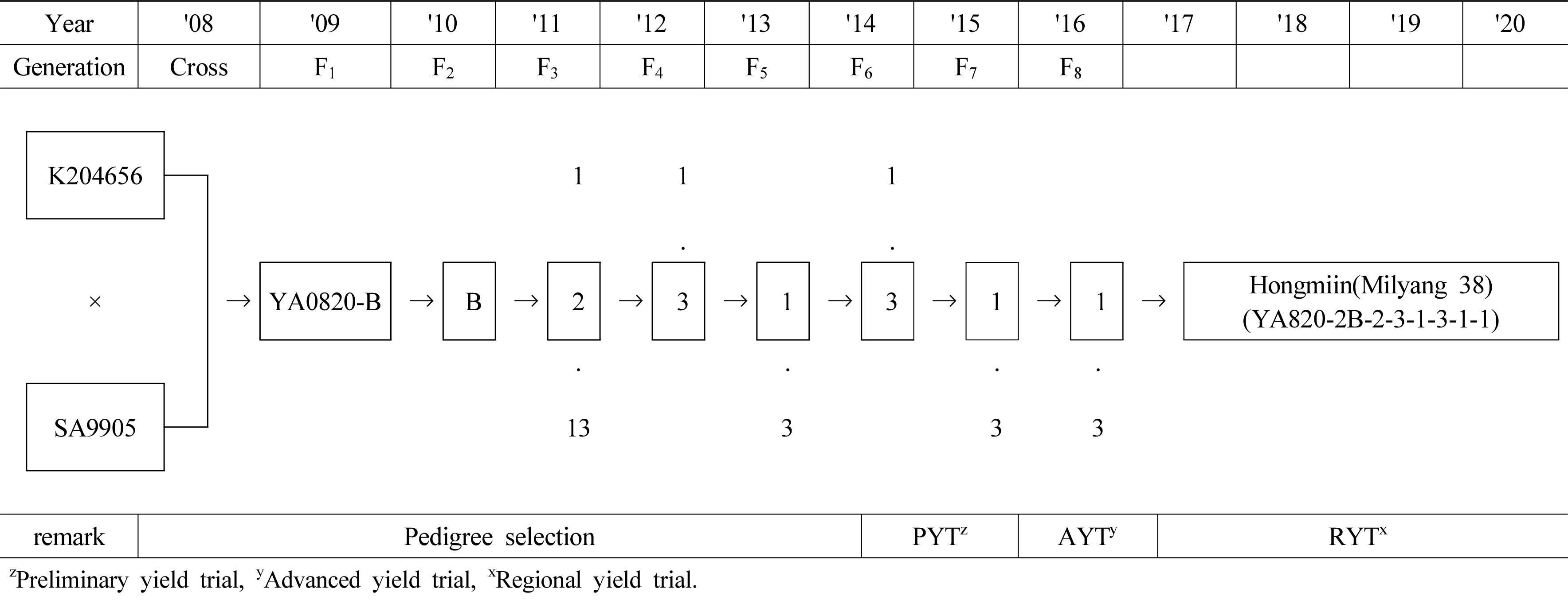
팥 신품종 ’홍미인’은 국립식량과학원에서 기계화적성이 우수하고 대립이면서 성숙기가 빠른 팥 품종을 육성하고자 담적색 대립인 K204656을 모본으로 하고 성숙기가 빠르고 쓰러짐에 강한 SA9905(SA9411/수원38호)를 부본으로 2008년에 인공교배하여 2009년 및 2010년에 F
1, F
2 세대 집단을 양성, 2011년에 F
3부터 계통육종법으로 선발한 ‘YA0820-2B-2-3-1-1’ 계통이다. 2015년과 2016년도에 실시한 생산력검정시험에서 쓰러짐에 강하고 수량성 등이 우수한 계통으로 판단되어 ‘밀양38호’의 계통명을 부여하였다. ‘밀양38호’는 2017년부터 2020년 까지 4년간 밀양 등 전국 4개 지역에서 적응성 검정을 실시한 결과, 그 우수성이 인정되어 2020년 12월 농작물 직무육성신품종선정위원회에서 신규등록 품종으로 결정하고 ‘홍미인’으로 명명 하였다(
RDA 2020). ‘홍미인’의 육성 과정은
Fig. 1과 같다.
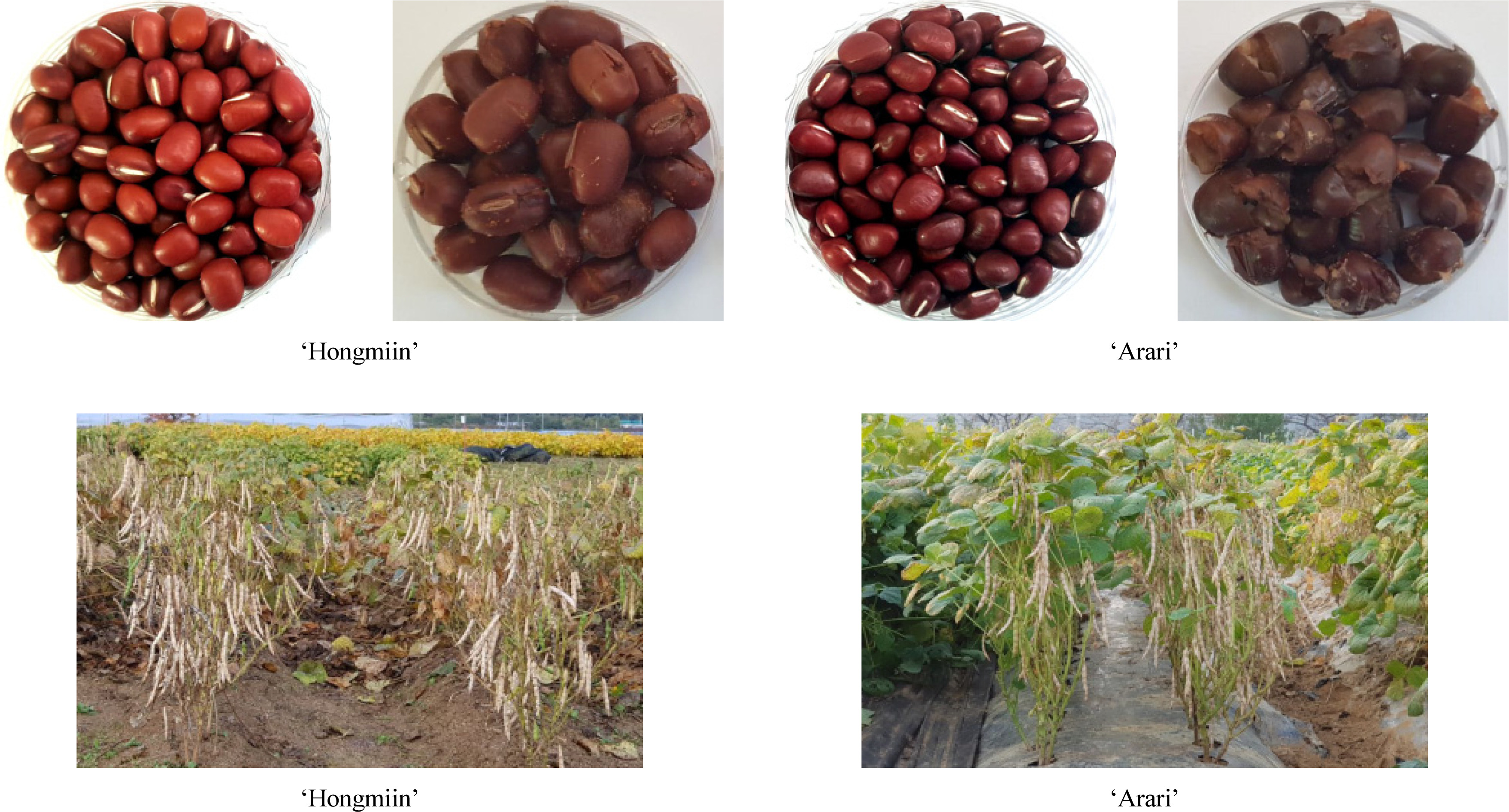
’홍미인’은 중간신육형으로 잎의 형태는 원형으로 크고 줄기는 녹색이다. 꽃은 황색이며 꼬투리는 황색이다. 종피색은 담적색 이며 배꼽색은 백색이다(
Table 1,
Fig. 2). ‘홍미인’의 생육특성을 ‘아라리’와 비교해 보면 개화기는 8월 8일이고, 성숙기는 10월 4일로 ‘아라리’에 비해 개화기는 13일 빠르나 성숙기는 비슷하였다. 100립중이 큰 품종들은 성숙기가 10월 중순 이후 이나 ‘홍미인’은 대립종 중에서는 성숙기가 빠른 품종에 속한다. 경장은 ‘아라리’와 비교시 4 cm 정도 크고, 100립중은 20.5 g으로 ‘아라리’ 보다 4.4 g 더 무거운 품종이다(
Table 2). ‘홍미인’은 개화기가 짧고 성숙기간이 길어 100립중이 커진 것으로 생각된다.
’홍미인’은 포장에서 도복성이 3으로 조사되어 ‘아라리’와 같이 도복에 강한 것으로 조사되었고, 수량과 품질에 영향을 크게 미치는 팥모자익바이러스, 흰가루병, 갈반병에 대한 저항성은 ‘아라리’와 비슷한 수준이었다(
Table 3). ‘홍미인’은 도복에 강한 품종이므로 콤바인 기계수확 작업이 가능할 것으로 여겨진다.
’홍미인’의 단백질 함량은 24.3%로서 ‘아라리’보다 많은 것으로 조사되었고, 곡실의 무기성분 중 칼륨, 칼슘, 마그네슘, 나트륨 함량은 각각 1109.6와 52.1, 168.0, 16.0 mg/100 g으로 조사되어 ‘아라리’와 비교시 칼륨, 칼슘, 마그네슘 함량은 각각 14%, 17%, 15% 낮았으며 나트륨 함량은 비슷한 것으로 조사되었다(
Table 4). 또한 ‘홍미인’의 총폴리페놀, 총플라보노이드의 함량은 각각 410.9 mg GAE/100 g, 267.5 mg CE/100 g으로 ‘아라리’ 보다 1.9, 2.3배 정도 더 높았다. Radical 소거 활성인 ABTS와 DPPH도 921.7와 754.5 mg TE/100 g으로 ‘아라리’ 대비 각각 1.7, 1.9배 정도 높은 것으로 조사되었다(
Table 5).
‘홍미인’은 2015년과 2016년, 2년간 실시한 생산력검정시험에서 평균수량은 ha 당 1.90 톤으로 표준품종인 ‘아라리’에 비하여 12% 증가되었고(
Table 6), 2017년 부터 2020년에 걸쳐 4년간 실시한 청원, 익산, 밀양, 춘천 등 4개소 지역적응시험에서 평균수량은 ha 당 2.09톤으로 ‘아라리’ 보다 8% 증수하였다(
Table 7).
‘홍미인’의 적정 파종기는 남부지역은 6월하순에서 7월상순이고 중부지역은 6월중순에서 6월하순이다. 산간고랭지 재배시에는 서리피해가 발생하지 않도록 주의하여야 하고, 수량성 확보를 위해서는 개화기와 착협기 시기에 충분한 관수가 필요하다.
적 요
’홍미인’은 국립식량과학원 남부작물부에서 2020년도에 육성한 담적색, 대립 팥품종으로 2008년에 ‘K204656(Toyomidainagon)’을 모본으로 하고 ‘SA9905’을 부본으로 인공 교배하여 계통육종법으로 선발한 계통으로 계통명은 ‘밀양 38호’이다. ‘홍미인’은 중간신육형으로 잎은 원형으로 크고 줄기는 녹색이며 협은 황색이다. ‘홍미인’의 개화기는 8월 8일로 ‘아라리’ 보다 13일 빠르고 성숙기는 10월4일로 ‘아라리’와 비슷하다. 경장은 58 cm로 ‘아라리’ 보다 4 cm 크고, 100립중은 20.5 g으로 4.4 g 더 큰 대립종이다. ha당 평균 수량은 2.09톤으로 ‘아라리’ 보다 8% 증수하였다.
사사
본 논문은 농촌진흥청 시험연구사업(과제번호 : PJ015031)의 지원에 의해 이루어진 것임
Fig. 1Pedigree diagram of a new adzuki bean(Vigna angularis) variety ‘Hongmiin’.
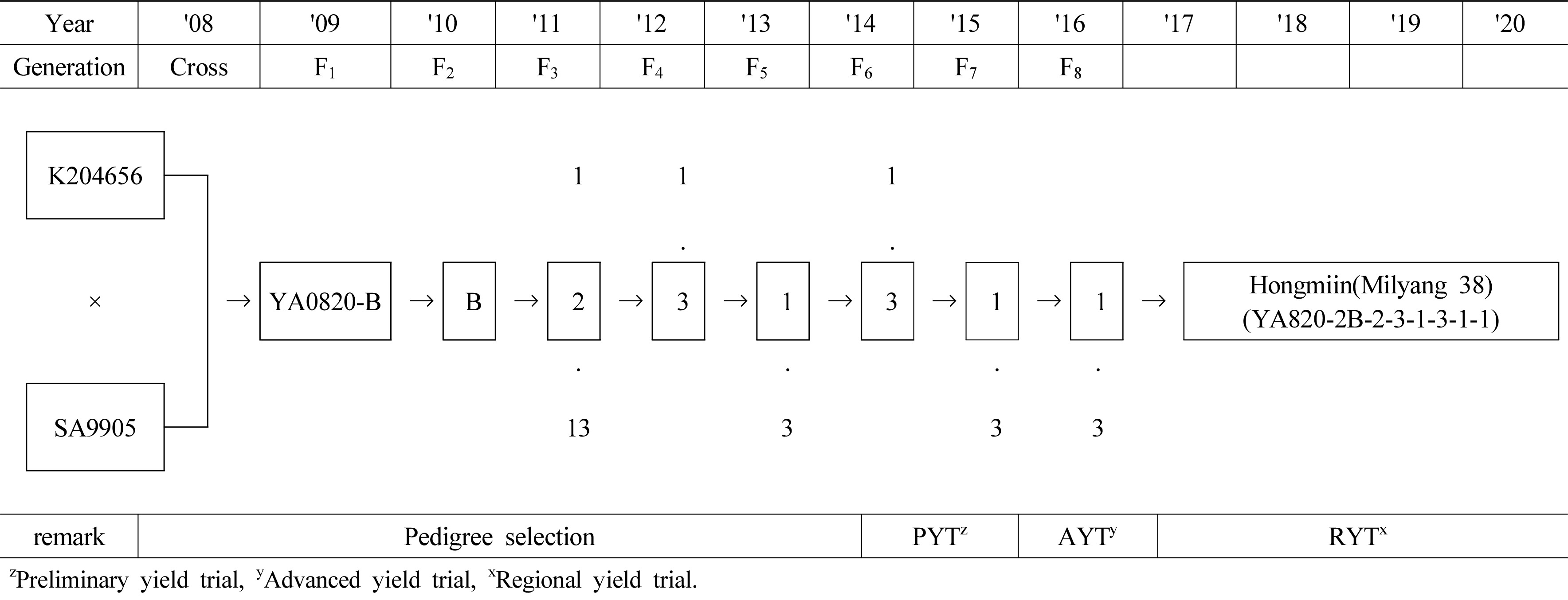
Fig. 2Plant type and seed appearance of ‘Hongmiin’ and ‘Arari’.
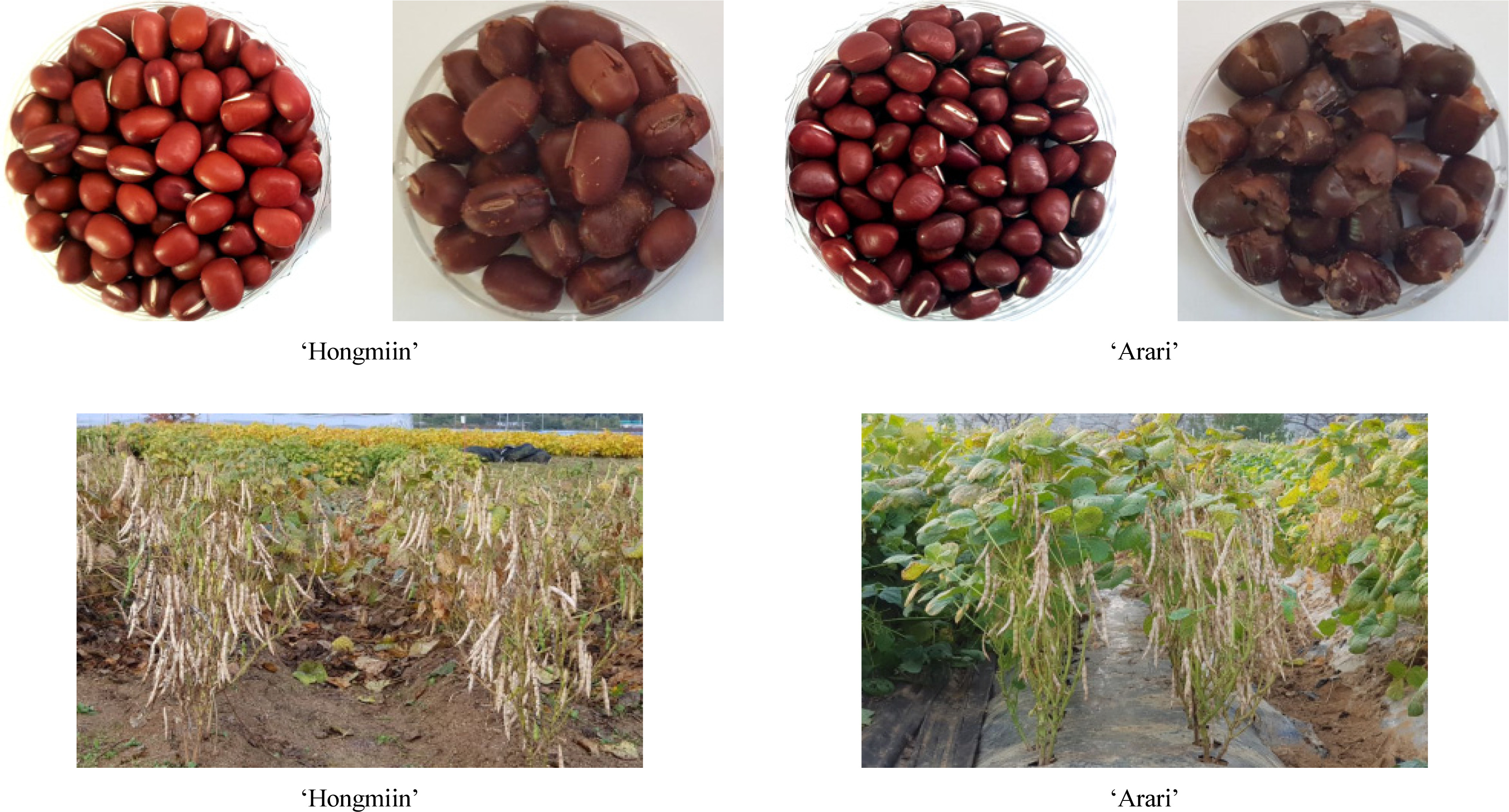
Table 1Inherent characteristics of ‘Hongmiin’ determined by the regional yield trial from 2017 to 2020.
Table 1
|
Variety |
Growth habit |
Embryonic color |
Stem color |
Flower color |
Leaf shape |
Pod color |
Seed coat color |
Hilum color |
|
Hongmiin |
Semi-determinate |
Green |
Green |
Yellow |
Orbicular |
Yellow |
Bright red |
White |
|
Arari |
Semi-determinate |
Green |
Green |
Yellow |
Orbicular |
Yellow |
Dark red |
White |
Table 2Agronomic characteristics of ‘Hongmiin’ determined by the regional yield trial from 2017 to 2020.
Table 2
|
Variety |
Flowering date |
Maturity date |
Stem height
(㎝) |
No. of pods/plant |
Seeds/pod |
100-seed weight
(g) |
|
Hongmiin |
Aug. 8 |
Oct 4 |
58ns
|
28ns
|
7.4ns
|
20.5 *
|
|
Arari |
Aug. 21 |
Oct 4 |
54 |
32 |
6.9 |
16.1 |
Table 3Resistance of ‘Hongmiin’ to lodging and major disease from 2017 to 2020.
Table 3
|
Variety |
Lodging
(1-9)y
|
Field resistance (0-9)z
|
|
Azukibean mosaic virus |
Powdery mildew |
Brown leaf spot |
|
Hongmiin |
3 |
0 |
1 |
3 |
|
Arari |
3 |
0 |
1 |
3 |
Table 4Protein and inorganic contents of ‘Hongmiin’ estimated in 2020.
Table 4
|
Variety |
Protein
(%) |
Inorganic content (mg/100 g) |
|
K |
Ca |
Mg |
Na |
|
Hongmiin |
24.3 |
1109.6*
|
52.1*
|
168.0*
|
16.0ns
|
|
Arar |
22.5 |
1295.7 |
62.9 |
198.3 |
18.3 |
Table 5Antioxidant compounds and radical-scavenging activity of ‘Hongmiin’ estimated in 2020.
Table 5
|
Variety |
Antioxidant compounds |
Radical-scavenging activity |
Total polyphenol
(mg GAE/100 g) |
Total flavonoid
(mg CE/100 g) |
ABTS
(mg TE/100 g) |
DPPH
(mg TE/100 g) |
|
Hongmiin |
410.0* (193)y
|
267.0* (230) |
921.7* (169) |
754.0* (190) |
|
Arari |
212.0 (100) |
116.0 (100) |
545.0 (100) |
396.0 (100) |
Table 6Results of yield trials of ‘Hongmiin’ at Milyang from 2015 to 2016.
Table 6
|
Variety |
Yield (MT/ha) |
|
PYT(2015)y
|
AYT(2016)X
|
Mean |
Indexw
|
|
Hongmiin |
1.75 |
2.05 |
1.90*
|
112*
|
|
Arari |
1.68 |
1.70 |
1.69 |
100 |
Table 7Yield of ‘Hongmiin’ on the regional yield trials carried out at 4 locations.
Table 7
|
Location |
Hongmiin (MT/ha, A) |
Arari(MT/ha, B) |
Index
(A/B)X
|
|
2017 |
2018 |
2019 |
2020 |
Mean |
2017 |
2018 |
2019 |
2020 |
Mean |
|
Cheongwon |
1.58 |
2.82 |
2.98 |
2.34 |
2.43 |
1.87 |
2.15 |
2.13 |
2.06 |
2.05 |
119 |
|
Chunchen |
1.64 |
1.52 |
2.54 |
1.99 |
1.92 |
1.80 |
1.77 |
1.94 |
1.81 |
1.83 |
105 |
|
Iksan |
1.91 |
1.80 |
2.19 |
1.84 |
1.94 |
1.90 |
1.90 |
2.09 |
1.86 |
1.94 |
100 |
|
Miryang |
1.81 |
2.05 |
- |
1.95 |
1.94 |
2.00 |
1.77 |
- |
1.86 |
1.87 |
104 |
|
Mean |
1.74 |
2.05 |
2.57 |
2.03 |
2.09ns
|
1.89 |
1.90 |
2.05 |
1.90 |
1.93 |
108 |
References
- 1. Ariga T, Koshiyama I, Fukushima D. 1988. Antioxidative properties of procyanidins B-1 and B-3 from azuki beans in aqueoussystems. Agr Biol Chem 52: 2717-2722.
- 2. Bae DG, Jung YS. 2010. Colorant extracting and its storage stability from red bean and black bean seed coat. Agric. Rex. Bull. Kyungpook National Univ 28: 31-38.
- 3. Chang HG. 1999. Information on food for the health of modern people. Shinkwang Publishing Co., Seoul, Korea: pp. 46-50.
- 4. Chen Y, Jinah Hwang JA, Chang YH. 2013. Quality characteristics of Makgeolli added with red bean department of food and nutrition, Myongji University. 29: 777-784.
- 5. Choi SY, Jeong YJ, Lee SJ, Chi OH, Chegal SA. 2002. Food and health for modern people. Dongmyungsa, Seoul, Korea: pp. 244-246.
- 6. Choi Y, Lee SM, Chun J, Lee HB, Lee J. 2006. Influence of heat treatment on the antioxidant activities and polyphenolic compounds of Shiitake(Lentinus edodes) mushroom. Food Chem 99: 381-387.
- 7. Dewanto V, Xianzhong W, Liu RH. 2002. Processed sweet corn has higher antioxidant activity. J Agr Food Chem 50: 4959-4964.
- 8. Hwang CS, Jeong DY, Kim YS, Na JM, Shin DH. 2005. Effects of enzyme treatment on physicochemical characteristics of small red bean percolate. Korean J food Sci Technol 37: 189-193.
- 9. Kang SJ, Han YS. 2012. Studies on the anti-oral microbial activity and selected functional component of small red bean extract. Korean J food Cookery Sci 28: 41-49.
- 10. Kim CG, Oh BH, Na JM, Sin DH. 2003. Comparison of physicochemical properties of Korean and Chinese red bean starches. Korean J Food Sci Technol 35: 551-555.
- 11. Koh KJ, Shin DB, Lee YC. 1997. Phsicochemical properties of aqueous extracts in small red bean, mung bean and black soybean. Korean Science of Food Science and Technology 29: 854-859.
- 12. Koide T, Hashimoto Y, Kamei H, Kojima T, Hasegawa M, Terabe K. 1997. Antitumor effect of anthocyanin fractions extracted from soybeans and red beans in vitro and in vivo. Cancer Biother Radiopharm 12: 277-280.
- 13. Korean Statistical Information Service (KOSIS). 2020. http://kosis.kr/statisticsList/statisticsListIndex.do?menuId=M_01_01&vwcd=MT_ZTITLE&parmTabId=M_01_01#SelectStatsBoxDiv. Accessed SEP. 24, 2020
- 14. Lee SY, Oh MJ, Yeom HY, Lee JY. 2022. A Study of whitening functional activity verification from red bean(Phaseolus angularis) Shell Extract. Korean Society for Applied Microbiology 50: 277-282.
- 15. Rho CW, Son SY, Hong ST, Lee KH, Ryu IM. 2003. Agronomic characters of Korean adzuki beans (Vigna angularis (Willd.) Ohwi & Ohashi). Korean J Plant Res 16: 147-154.
- 16. RDA(Rural Development Administration).2012. Agricultural science technology standards for investigation of research. RDA, Jeonju, Korea.
- 17. RDA(Rural Development Administration).2020. Research plan of development new variety of summer crops.
- 18. Song SB, Ko JY, Kim JI, Lee JS, Jung TW, Kim KY, Kwak DY, Oh IS, Woo KS. 2013. Changes in physicochemical characteristics and antioxidant activity of adzuki bean and adzuki bean tea dependingon the variety and roasting time. Korean J Food Sci Technol 45: 317-324.
- 19. Song SB, Ko JY, Woo KS, Choe ME, Kwak DY, Woo KS, Moon JK, Han SIk, Han WY, Choe ME, Ko JC, Oh IS. 2016. A new small redbean cultivar 'Arari' with lodging resistance and high-quality. Korean J Breed Sci 48: 374-377.
- 20. Song SB, Ko JY, Woo KS, Choe ME, Chu JH, Ha TJ, Han SI, Kwak DY. 2019. A small redbean cultivar 'Hongjin' with lodging tolerance and high yield. Korean J Breed Sci 51: 523-528.
- 21. Song SB, Ko JY, Woo KS, Choe ME, Chu JH, Kim JY, Sung JS, Han SI. 2020. A small redbean cultivar 'Haeorom' with Bright red seed cort color and high-yielding. Korean J Breed Sci 52: 489-494.
- 22. Song SB, Choe ME, Chu JH, Kim JY, Lee BW, Han SI. 2021. An Adzuki bean (Vigna Angularis) cultivar 'Honggyeong' with bright red seed-cort color and resistance to lodging stress. Korean J Breed Sci 53: 489-494.
- 23. Song SB, Choe ME, Chu JH, Kim JY, Lee BW, Han SI. 2022. The breeding and charactics of Adukibean(Vigna angularis) varieties 'Hinnarae' with yellowish white seed coat color. Korean J Breed Sci 54: 442-447.
- 24. Woo KS, Song SB, Ko JY, Kim MJ, Kim HJ, Sim EY, Lee CK, Jeon YH. Quality and antioxidant characteristics of fermented beverages from Adzuki beans (Vigna angularis var.nipponensis) derived from different breeding lines that had been fermented for varying lengths of time. Journal of Agricultural, Life and Environmental Sciences. 29: pp. 94-103.
- 25. Yoshida K, Sato Y, Okuno R, Kameda K, Isobe M, Kondo T. 1996. Structural analysis and measurement of anthocyanin from colored seed coats of Vigna, Phaseolus and Glycine Legumes. Biosci. Biotechnol. and Biochem 60: 589-593.
Citations
Citations to this article as recorded by

- Adzuki Bean (Vigna angularis var. angularis) Variety ‘Hongchan’ With Bright Red Seed Coat Color and a Large Seed Size
YoungKwang Ju, Sang-Ik Han, Joo-Sung Im, Ji-Ho Chu, Hyoseob Seo, Byung-Won Lee, SeokBo Song, Yeong Min Jo, Ji Ae Lee, Hyerim Moon
Korean Journal of Breeding Science.2025; 57(3): 329. CrossRef