적요
‘EePi No.1’, a new mid-ripening cultivar of chestnut (Castanea crenata Siebold & Zucc.) was developed in 2000 by cross-pollinating two cultivars, viz., ‘Riheiguri’ and ‘Ganne’ at Korea National Institute of Forest Science. Line selection among the seedlings of ‘Riheiguri’ and ‘Ganne’ was carried out in 2007, followed by comprehensive evaluations of fruit morphological traits and tree growth characteristics conducted during 2008-2015. The harvest time of ‘EePi No.1’ was the first week of October. It is characterized by excellent nut quality, suitable for both raw consumption and processing. The average fruit weight was 24.0 g, which is significantly higher than that of the cultivar ‘Daebo’ (20.0 g). Moreover, the soluble solids content was 14.26%, and pellicle removability was 93.5%. This cultivar produces large, firm fruits with high sugar content, making it ideal for consumption. It is also characterized by excellent nut quality, suitable for both raw consumption and processing. Moreover, the easily peelable inner skin makes it ideal for processing and roasting, thereby enhancing its commercial value. These qualities are expected to bolster the diversification of income derived from forest products in the future (Registration No. 337).
서언
밤나무는 참나무과(Fagaceae) 밤나무속(
Castanea)에 속하는 낙엽활엽교목으로, 아시아, 유럽, 북아메리카 등 3대륙에 걸쳐 10여종이 분포하며, 일본(한국)밤나무(
C. crenata), 중국밤나무(
C. mollissima), 미국밤나무(
C. dentata), 유럽밤나무(
C. sativa) 등이 과실 생산 목적으로 재배되고 있다(KFRI 2006a). 그 중 일본과 한국에서 재배하는 밤나무는 과실 크기가 큰 편이나 속껍질이 잘 벗겨지지 않는 특성을 가지고 있다(
Park & Kim 2015).
우리나라 밤나무 재배면적과 재배임가수는 각각 15,175 ha와 48,551임가(2020년 기준)로 임산물소득지원대상품목 중 수실류에서 재배면적이 가장 넓은 임산물이다. 그러나, 2023년 국내 밤 생산량은 39,797톤으로 2010년 68,630톤 이후 지속적으로 감소하는 추세이다(
KFS 2024a,
KFS 2024b). 특히, 밤 주산지 중 전라남도과 경상남도 권역은 밤나무의 노령화로 인해 과실품질, 수확량 등 생산성이 크게 낮아지고 있으며, 최근에는 국내에서 생산량이 가장 많은 충청남도 권역도 밤나무의 노령화가 진행되고 있다. 게다가 재배자의 고령화, 노동력 부족, 이상기후, 병해충 증가 등으로 인해 과실품질 및 생산량이 지속적으로 감소될 것으로 추정하고 있어(
KFS 2024a) 이에 대응하는 신품종 육성과 재배기술 개발이 요구되고 있다.
최근 국내의 밤 소비 패턴은 전통적인 제수용에서 간식용으로 변화하고 있는 추세이다. SNS 빅데이터를 통해 소비 의향을 분석한 결과, 소비자는 밤을 가을에 먹는 제철 간식으로 인식하고 있으며, 밤을 활용한 간식과 디저트에 대한 호감도가 높은 것으로 조사되었다. 특히, 밤은 영양적으로도 가치가 높다고 인식하고 있어, 생밤을 구매한 후 굽거나 삶아 간식 또는 아침 대용식으로도 소비가 늘어나고 있다. 밤과 관련하여 긍적적인 키워드에는 ‘맛있다’, ‘건강에 좋다’등이 있었고, 반면에 부정적인 키워드에는 ‘손질이 힘들다’가 가장 많았다(
Seok et al. 2019). 따라서, 밤의 속껍질이 잘 벗겨져 손질이 편해 소비자와 생산자의 선호도를 높일 수 있는 밤나무 신품종 개발이 시급한 과제라고 할 수 있다.
한편, 국내 밤 수입량은 2015년 6,001톤에서 2023년 14,760톤(생밤 기준)으로 점진적인 증가세를 나타내고 있다. 밤은 대부분 중국으로부터 수입되고 있으며, 속껍질이 매우 잘 까지는 특성이 있어 군밤용과 가공용에 주로 이용되고 있다(
KFS 2024a).
최근 인건비 상승, 노동력 부족, 밤나무 노령목 비율 증가 등으로 인한 국내 밤 생산량 감소와 밤 소비 패턴 변화, FTA 등 국내⋅외 정세 변화에 대응이 필요하다. 따라서, 기존에 개발된 대보, 미풍 등 대립⋅다수확성 품종 이외에 저장성이 높고 속껍질의 박피가 용이한 밤나무 품종 개발이 요구된다. 이에 소비자와 생산자 선호도가 높은 밤 품종 개발을 위해 수확량이 많고 속껍질이 잘 까지는 밤나무 품종 ‘이피1호’를 육성하였다.
재료 및 방법
과실품질이 우수하고, 수확량이 많으며, 속껍질이 잘 까지는 밤나무 신품종 육성을 위해 과실 외관(모양, 색깔 등)이 우수하고 대립종인 ‘이평’(♀)과 과실 품질(당도, 경도 등)이 우수한 ‘안근’(♂)을 2000년에 인공교배하였고, 얻어진 종자를 이듬해 파종하여 교잡종 차대묘를 양성하였다. 2002년에 교잡종 밤나무를 경기도 화성시 매송면 어천리 산3에 위치한 시험림 내에 식재하여 교잡종 검정림을 조성하였다.
2006년부터 2007년까지 교잡종 밤나무의 개체별 과실품질과 수확량 등을 조사하여 과실품질(크기, 당도, 내피박피율 등)이 우수하고, 수확량이 많은 12개체를 1차 선발하였다. 1차 선발된 우량개체는 검정기간 단축을 위해 접목증식(고접)을 하여 클론검정림을 조성하였다. 클론검정림은 과실 형질(모양, 색깔 등) 등 클론 고유의 특성이 잘 발현될 수 있도록 집약재배관리 수준의 저수고 수형조절(솎음전정, 절단전정 등), 시비(유박비료 10 kg/본) 및 병해충 방제 등을 실시하였다. 2008년부터 2011년까지 클론별 주요 과실 품질 특성을 조사하여(KFRI 2006b), 입중 18 g, 다배율 및 열과율이 5% 이하인 RG-13 등 4클론을 2차 선발하였다. 2차 선발한 4클론 중 RG-13의 품종보호권 출원을 위해 2012년부터 2015년까지 4년 간 내피박피성이 우수한 ‘대보’를 대조품종으로 선정하여 신품종 특성조사요령 ‘밤나무’(KSVS 2009)에 따라 조사항목(수세, 잎, 꽃, 결실, 과실 등 65항목) 특성을 조사하였다. 최종적으로 RG13을 ‘이피1호’로 명명하여 2015년 11월 품종보호권 출원하였으며, 2016년부터 2023년까지 출원품종 재배심사를 거쳐 2024년 1월에 품종보호권 등록이 완료되었다(품종등록번호 제337호) (
Table 1).
결과 및 고찰
주요 특성
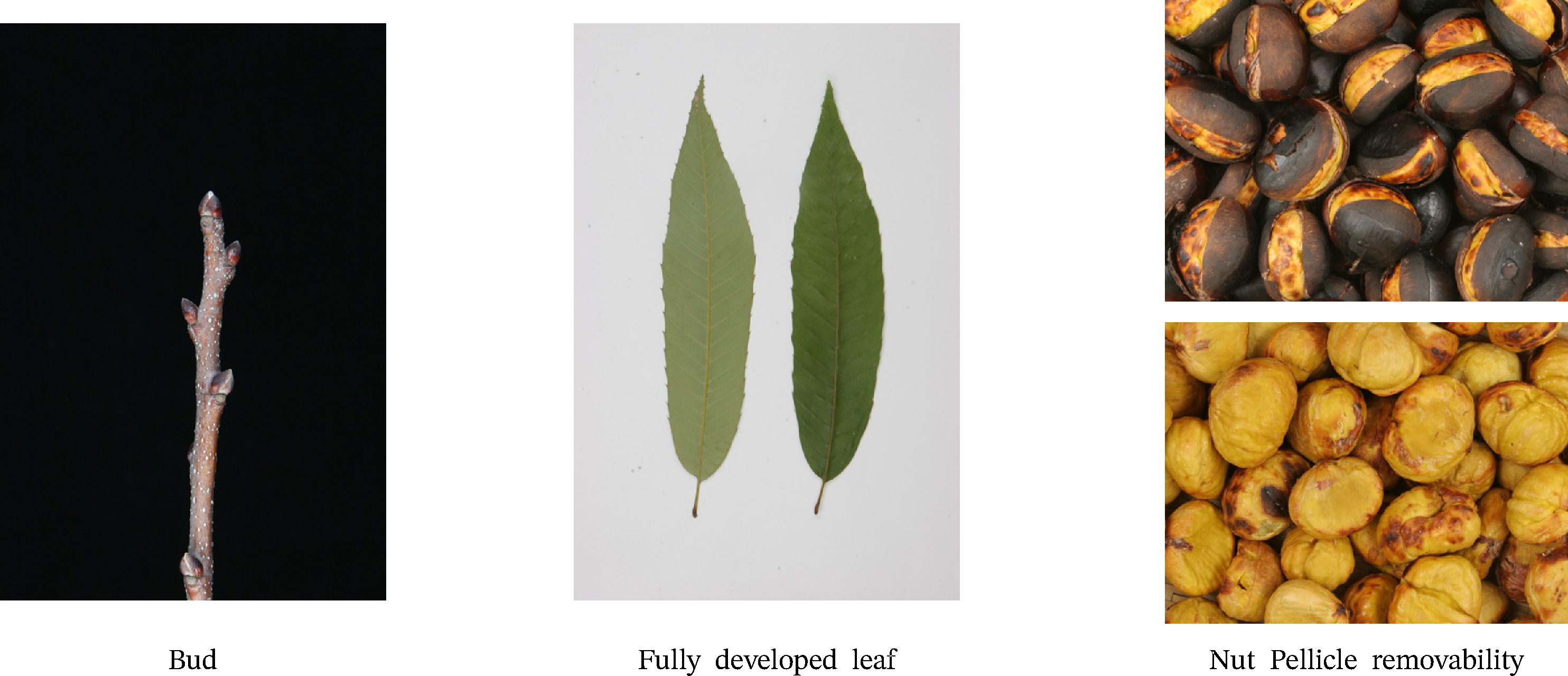
신품종 ‘이피1호’는 나무의 수세가 강하며, 수형은 반직립형이다. 일년생 가지의 색깔은 적갈색이고 털이 없으며, 피목 모양은 원형과 타원형이 혼재한다(
Table 2,
Fig. 1). 개엽시기는 5월 초로 대조품종 ‘대보’(4월 말)에 비해 느린 편이며, 개화시기는 암꽃과 수꽃이 각각 6월 14일, 6월 12일경으로 대조품종 ‘대보’(각각 6월 19일, 6월 14일) 보다 빠르게 시작한다(
Table 3). 잎 뒷면의 색깔은 연두색을 띄며, 잎의 가장자리 거치는 치아상이다. 잎몸의 길이는 평균 17.26 mm로 대조품종 ‘대보’(20.30 mm)에 비해 작지만, 잎몸 길이와 너비의 비율은 4.10으로 대조품종인 ‘대보’보다 작고 좁은 편이며, 잎맥 수가 21.40개로 더 많고 잎자루의 길이는 1.65 mm로 더 짧다(
Table 2,
Fig. 2).
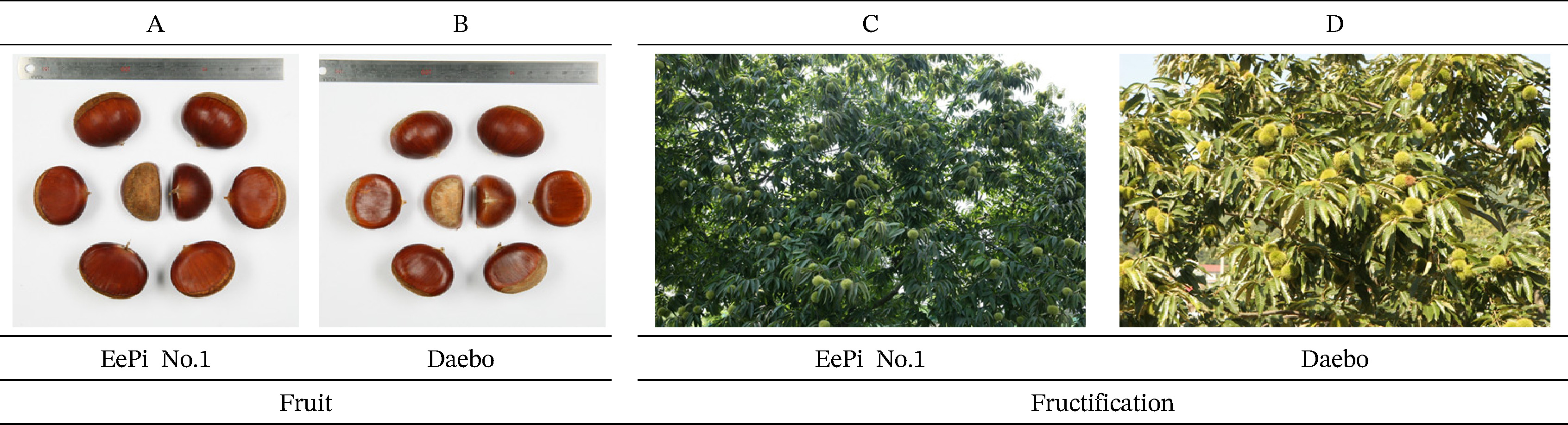
‘이피1호’는 10월 1일경부터 과실 수확이 시작되는 중만생종으로 밤송이 구육의 두께는 중간 정도이고, 가시의 길이가 짧으며, 대조품종과 달리 밤알이 밤송이와 같이 떨어진다. 과실의 형태는 대조품종과 마찬가지로 편원형이고, 과실색깔은 갈색이며, 과실표면의 광택이 매우 우수하다. 과실 정단부에는 털이 있고, 대조품종 보다 좌면의 크기가 넓다. 밤송이 내의 평균 함과수는 1.8개로 대조품종과 유사하다(
Tables 3,
4,
Fig. 1).
‘이피1호’의 평균 과실 무게는 24 g으로 대립종에 속하며, 수확 직후 과실의 당도와 경도는 각각 14.26%, 9.22 g/cm²로 높은 편이다. 다배과와 열과가 적어 과실품질이 뛰어나고 저장성이 우수하다. 특히, 내피의 두께가 얇고, 군밤 시 내피가 잘 벗겨지므로 군밤용으로 적합하다(
Table 4,
Fig. 2).
‘이피1호’는 척박지에서도 잘 적응하지만 수세가 강한 편으로 어릴 때부터 자람세가 왕성하여 수형관리가 요구된다. 이에 과도한 정지전정을 지양하고 적절한 시비를 통해 수세가 조기에 안정되도록 유도해야 한다. 밤나무 식재 후 7~8년이 경과하여 수세가 안정화되는 성목기에는 솎음전정 위주의 정지전정을 실시하여 수관면적 1 m²당 충실한 결과모지(기부직경 8 mm 이상)의 수가 5~6개 정도가 되도록 관리한다. 또한, ‘이피1호’는 다수확 품종이기 때문에 성목기에 과다하게 착과되면 과실이 작아 품질이 낮아지므로 철저한 정지전정과 비배관리가 필요하다. 밤 과실의 내피박피성은 수분수의 영향을 받을 수 있으므로 품종을 혼합하여 식재 할 때에는 주의가 필요하다. ‘이피1호’는 밤나무혹벌에 강하나 밤나무줄기마름병에는 다소 약한 편이다. 내한성은 보통으로 겨울철 동해 피해가 적은 중부 이남 지역이 재배에 적합하며, 배수가 불량한 장소는 식재를 피하는 것이 좋다.
유용성
‘이피1호’는 수확량이 많고 해거리 현상이 적어 저수고 집약재배에 적합한 품종이다. 또한, 쌍 밤과 열과가 적어 과실품질이 뛰어나고 저장성이 우수하며, 속껍질이 잘 벗겨지는 특성이 있어 군밤용으로도 활용이 가능하다. 과실이 크고 단맛이 많으며, 과육이 단단하면서 식미가 우수하므로 제수용, 생식용으로도 적합하다. ‘이피1호’는 기존 밤나무 신품종의 대립⋅다수확성 특성을 가지면서 내피박피성을 개선하여 개발한 신품종으로 임업인 소득 창출에 기여할 수 있을 것으로 기대한다.
적요
‘이피1호’는 국립산림과학원에서 2000년도에 밤나무 ‘이평’과 ‘안근’품종을 인공교배하여 얻은 교잡종으로부터 선발하여 육성한 중만생종 밤나무 신품종이다. 밤나무 교잡종검정림 조성 후 2007년도에 1차로 우수 개체를 선발하여 클론검정림을 조성하였다. 클론검정림에서 2008년부터 2011년까지 2차로 우수 클론을 선발하여, 2012년에서 2015년까지 우수 클론의 과실 특성에 대한 안정성 검정을 수행하였다. 2015년 11월에 ‘이피1호’를 품종보호권 출원하였고(출원번호 2015-24), 2024년 1월 3일에는 품종보호등록원부에 품종보호 제337호로 등록되었다. 밤나무 신품종 ‘이피1호’의 수확시기는 9월 말~10월 초이며, 과중 24.0 g, 당도 14.3%, 내피박피율 93.5%로 대조품종 ‘대보’보다 과실이 크고 속껍질이 잘 벗겨져 군밤 및 생식용으로 우수하다.
사사
본 연구는 국립산림과학원 연구과제 “건강증진 산림과수 품종 육성과 표준 재배기술 개발(FP0802-2022-01-2025)”의 지원으로 수행되었습니다.
Fig. 1Comparison of fructification and fruit from between ‘EePi No.1’ (A, C) and the control cultivar ‘Daebo’ (B, D).
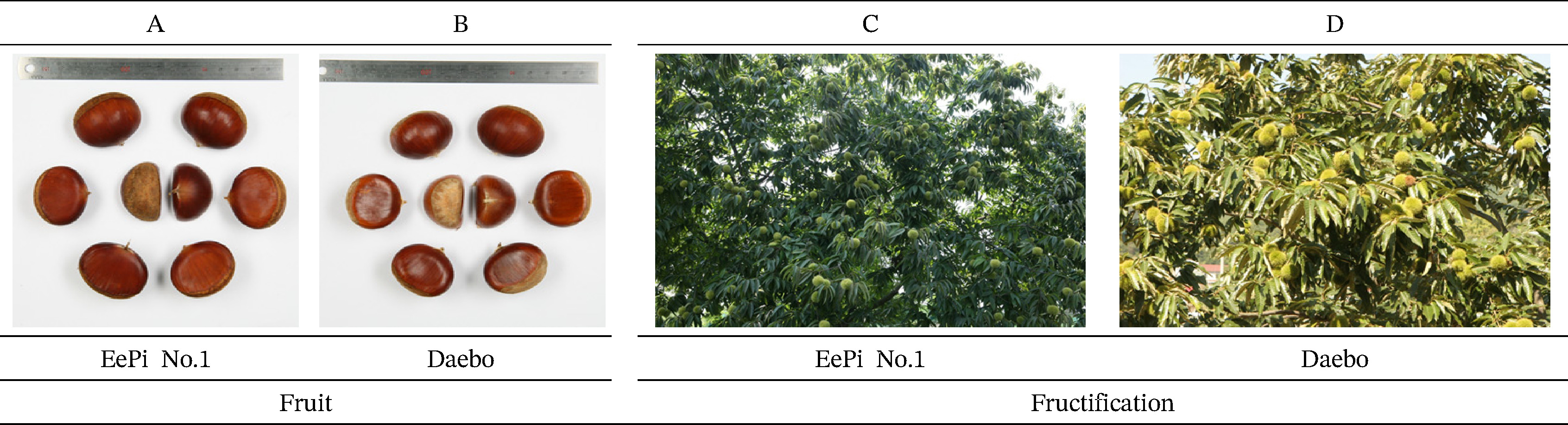
Fig. 2Appearance of Bud and leaf characteristics and fruit of ‘EePi No.1’.
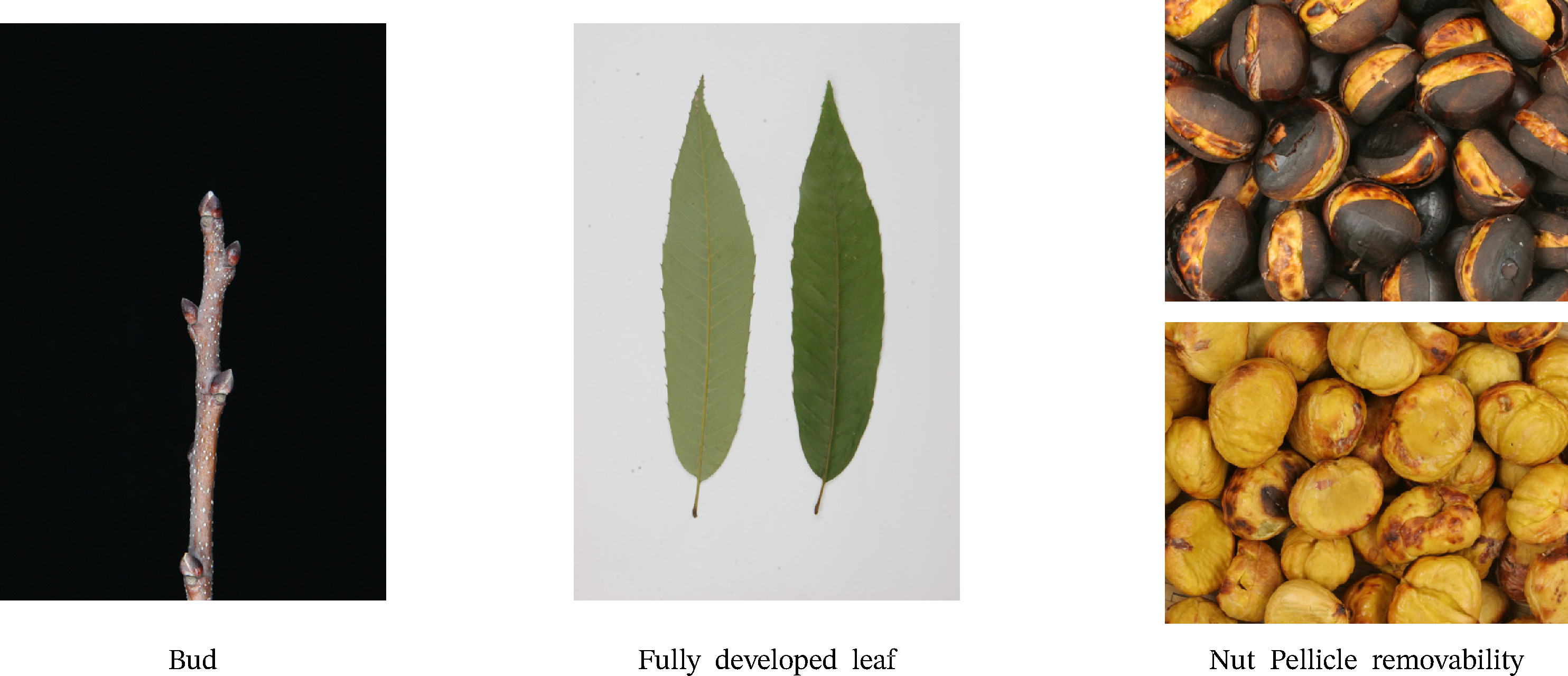
Table 1Breeding history of ‘EePi No.1’.
Table 1
|
year |
2000 |
2001~2006 |
2007 |
2008~2011 |
2012-2015 |
2015 |
|
Breeding stage |
Artificial crossing |
Seedling |
First selection |
Clone propagation
and traits stability test |
Second selection and propagation Characteristic trial |
Final selection |
|
Riheiguri×Ganne |
|
|
|
|
RG13 (EePi No.1) |
|
|
Number of lines |
|
26 |
12 |
4 |
1 |
Table 2Growth properties characteristics of ‘EePi No.1’.
Table 2
|
Cultivar |
Tree vigor |
Tree form |
One-year-old shoot |
Bud break |
|
|
Color |
Shape of lenticel |
Presence of trichome |
|
EePi No.1 |
Vigorous |
Semi-erect |
Red brown |
Orbicular and elliptical |
Absent |
May. 2 |
|
Daebo (control) |
Vigorous |
Semi-erect |
Gray brown |
Orbicular and oblate |
Present |
Apr. 28 |
|
|
Cultivar |
Fully developed leaf |
|
Color of
lower side |
Shape of margin |
Length of blade
(mm) |
No. of venation
(ea) |
Length/width ratio |
Length of petiole (mm) |
|
|
EePi No.1 |
Light green |
Acute |
17.26 |
21.40*
|
4.10*
|
1.65 |
|
Daebo (control) |
Whitish |
Flare shape |
20.30*
|
16.90 |
3.14 |
2.30*
|
Table 3Phenological and fructification characteristics of ‘EePi No.1’.
Table 3
|
Cultivar |
Time of beginning of male flowering |
Time of beginning of female flowering |
Time of maturity of consumption |
No. of bearing branch per bearing mother branch |
No. of total burr per bearing mother branch |
No. of burr per bearing branch |
Number of nuts per burr |
|
EePi No.1 |
Jun. 14 |
Jun. 12 |
Oct. 1 |
2.70 |
3.20 |
1.60 |
1.80 |
|
Daebo
(control) |
Jun. 19 |
Jun. 14 |
Sep. 25 |
2.85 |
4.61 |
1.73 |
1.88 |
Table 4Fruit characteristics of ‘EePi No.1’.
Table 4
|
Cultivar |
Bur thickness |
Bur pickles length |
Nut drop type |
Nut shape |
Nut skin color |
Pubescence position |
Size of hilum |
|
EePi No.1 |
Medium |
Short |
Bur |
Transeverse ellipsoid |
Brown |
Top |
Large |
Daebo
(control) |
Thick |
Long |
Nut |
Transeverse ellipsoid |
Light brown |
Middle |
Medium |
|
Cultivar |
Nut weight (g) |
Soluble solid content (%) |
Kernel hardness
(kg⋅cm²) |
Pericarp split rate (%) |
Occurrence of poly- embryonic nuts (%) |
Pellicle thickness |
Pellicle removability (%) |
|
EePi No.1 |
24.00*
|
14.26 |
9.22 |
3.90 |
5.00 |
thin |
93.50 |
Daebo
(control) |
20.50 |
14.56 |
10.76 |
5.10 |
0.20 |
medium |
86.40 |
References
- 1. KFRI (Korea Forest Research Institute).2006a. Chestnut cultivars in Korea. pp. 7-13.
- 2. KFRI (Korea Forest Research Institute).2006b. UPOV test guide for chestnut. pp. 2-5.
- 3. KFS (Korea Forest Service).2024a. Forest outlook 2024 Korea. pp. 374-456.
- 4. KFS (Korea Forest Service).2024b. Production of forest products. pp. 50-51.
- 5. KSVS (Korea Seed & Variety Service).2009. Guideline of characteristics for application and registration of new varieties in Castanea crenata Siebold & Zucc. pp. 1-24.
- 6. Park YM, Kim MJ. 2015. A rosted chestnut cultivar 'Jangwon' with high pellicle removability. Korean J Breed Sci 47: 409-413.
- 7. Seok HD, Choi JW, Byun SY, Min SH. 2019. Analysis on consumer's preference for non-timber forest product (Shiitake, Chestnut, Persimmon): social big-data analysis. For Sci 108: 97-108.
Citations
Citations to this article as recorded by

- Variation in Floral Nectar Traits of Four Chestnut (Castanea spp.) Cultivars: Implications for Pollinators and Apiculture
Ji-Min Park, Hyun-Jun Kim, Sang-Jae Won, Sung-Joon Na
Agriculture.2025; 15(22): 2358. CrossRef