적요
A new soybean [Glycine max (L.) Merr.] cultivar, ‘Dadrim,’ was developed by the National Institute of Crop and Food Science (NICS). ‘Dadrim’ is characterized by its superior suitability for tofu processing and high adaptability to mechanized cultivation. This cultivar ‘Milyang374’ was developed using the pedigree method from an artificial cross made in 2012 between ‘Milyang231’ and ‘Chamol.’ Its agronomic characteristics and production stability were verified through regional adaptation trials conducted over three years (2020- 2022). ‘Dadrim’ exhibits a determinate growth habit, white flowers, and spherical seeds with a yellow seed coat and yellow hilum. It is a large-seeded variety with a 100-seed weight of 30.9 g. As a late-maturing variety, it reaches maturity around October 22. Despite a relatively short plant height, it features a high first pod height of 16 cm, making it advantageous for mechanical harvesting. ‘Dadrim’ is resistant to bacterial pustule and soybean mosaic virus and possesses excellent lodging resistance. Notably, ‘Dadrim’ demonstrates a high tofu yield of 283%, which is 67% points higher than ‘Daewonkong’. The resulting tofu has a soft texture, making it suitable for soft and silken tofu. It also received high preference scores for taste and texture in sensory evaluations. ‘Dadrim’ yielded 3.37 tons/ha, an 8% increase compared to ‘Daewonkong.’ This new variety is expected to increase farm income and advance the domestic tofu industry (Registration No. 10461).
서언
콩(
Glycine max (L.) Merr.)은 약 40%의 단백질과 20%의 지방을 함유하여 전 세계적으로 중요한 식량 작물이자 단백질 공급원이며(
Medic et al. 2014), 우리나라에서는 두부, 장류, 콩나물 등 전통 식문화의 핵심 원료로 오랜 기간 이용되어 왔다(
Lee et al. 2015). 그러나 국내 식용 콩 자급률은 2023년 기준 34.3%로 정부가 제시한 목표인 43.5% 대비 낮은 수준으로, 자급률 향상을 위한 노력이 시급하다. 이에 정부는 쌀 수급 안정을 도모하고 콩 자급률을 높이고자 논에 벼 대신 콩을 재배하는 논콩 재배 면적 확대를 장려하고, 생산 단지 지원과 정부 수매 등 다양한 정책을 추진하고 있다(
MAFRA 2023).
최근 농촌 인구의 고령화와 노동력 부족 문제가 심화되면서, 농작업의 기계화는 지속 가능한 콩 생산을 위한 필수적인 요소가 되었다(
Kang et al. 2024). 따라서 콩 품종은 콤바인 수확 시 작업 효율을 높이고 손실률을 최소화할 수 있는 농업적 형질을 갖추어야 한다. 특히 쓰러짐에 강한 내도복성, 수확 과정에서 꼬투리가 터져 종실이 소실되는 것을 막는 내탈립성, 그리고 콤바인 예취부의 손실과 직접적인 관련이 있는 높은 첫 꼬투리 달림 높이(착협고)는 기계화 적응성을 결정하는 핵심 지표로 평가된다(
Kim et al. 2019,
Son & Heo 2002).
안정적인 콩 산업 발전을 위해서는 생산량 증대뿐만 아니라 식품 산업계와 소비자의 요구에 부응하는 고품질 원료를 생산하는 것이 중요하다. 2023년 국내 콩 소비는 ‘두부류’가 국산 기준 22만 3천톤(50.8%), 수입산이 포함된 전체 기준 15.9%를 차지하고 있어 가공 식품용으로 가장 많은 양이 사용되고 있다(
aTFIS 2024). 두부 가공적성은 수율, 조직감(경도, 탄력성), 색, 맛 등 최종 제품의 품질을 종합하는 지표로, 이는 원료콩의 단백질 함량 및 조성(11S/7S 비율), 지방산 조성, 입자 크기 등 복합적인 형질에 의해 결정된다(
Guan et al. 2021,
Wang et al. 2020). 소비자들은 고소한 풍미와 함께 부드러우면서도 탄력 있는 조직감을 선호하며, 이러한 고품질 두부에 대한 수요 증가는 전체 두부 시장의 성장을 견인하고 있다(
Sim et al. 2022). 따라서 가공 수율이 높을 뿐만 아니라 소비자의 기호를 충족시키는 맛과 조직감을 구현할 수 있는 원료콩 품종을 개발하는 것은 국내 콩과 두부 산업의 경쟁력을 높이고 시장을 확대하는 데 필수적이다(
Poysa & Woodrow 2002,
Sim et al. 2024).
농촌진흥청 국립식량과학원에서는 기계화 재배에 적합한 농업 형질을 갖추면서도, 두부 가공업체가 요구하는 높은 수율과 차별화된 품질을 동시에 만족시키는 콩 품종을 육성하고자 하였다. 그 결과, 내도복성과 높은 착협고 등 기계화 적응성을 나타내면서도, 대립이면서도 두부 수율이 높고 식감이 매우 부드러운 신품종 ‘다드림’(밀양374호)을 개발하였다. ‘다드림’의 육성 경위와 주요 농업적 특성, 병해 및 재해 저항성, 품질 특성 및 가공 적성 평가 결과를 보고하여, 본 품종이 국내 콩 산업의 경쟁력 강화에 기여할 수 있는 가치를 제시하고자 한다.
재료 및 방법
육성 과정
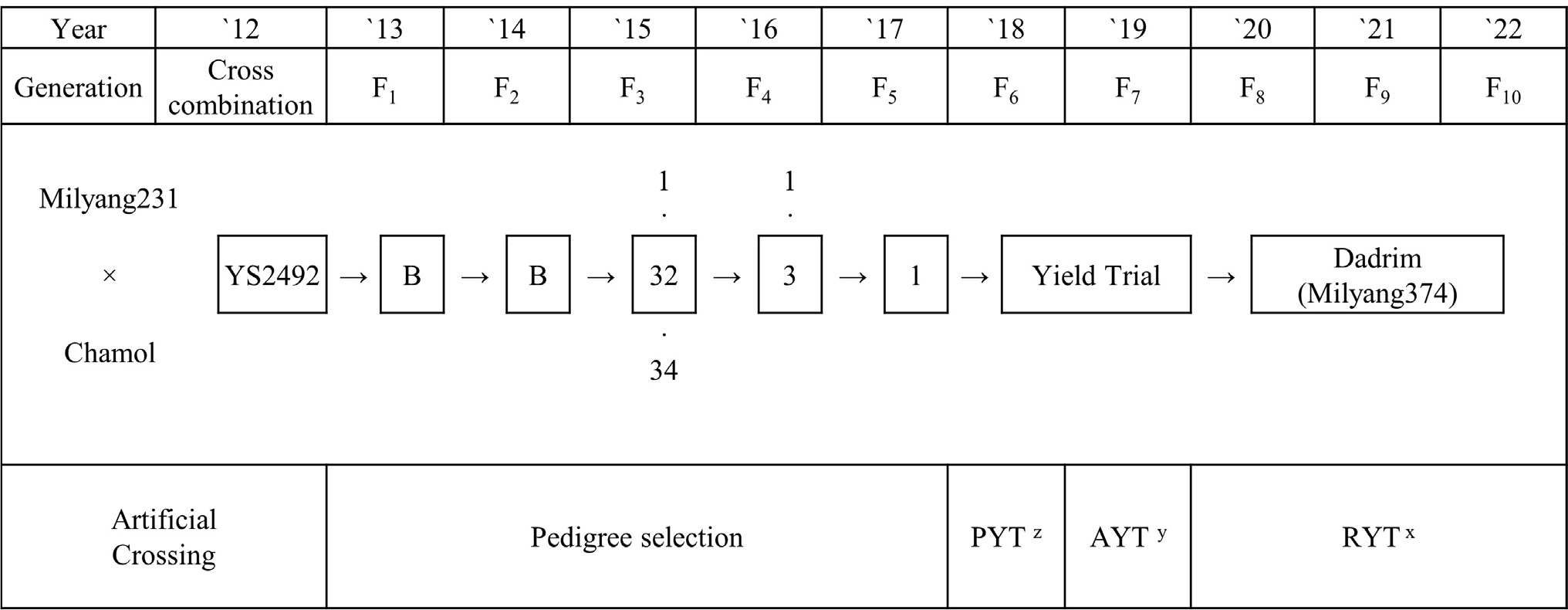
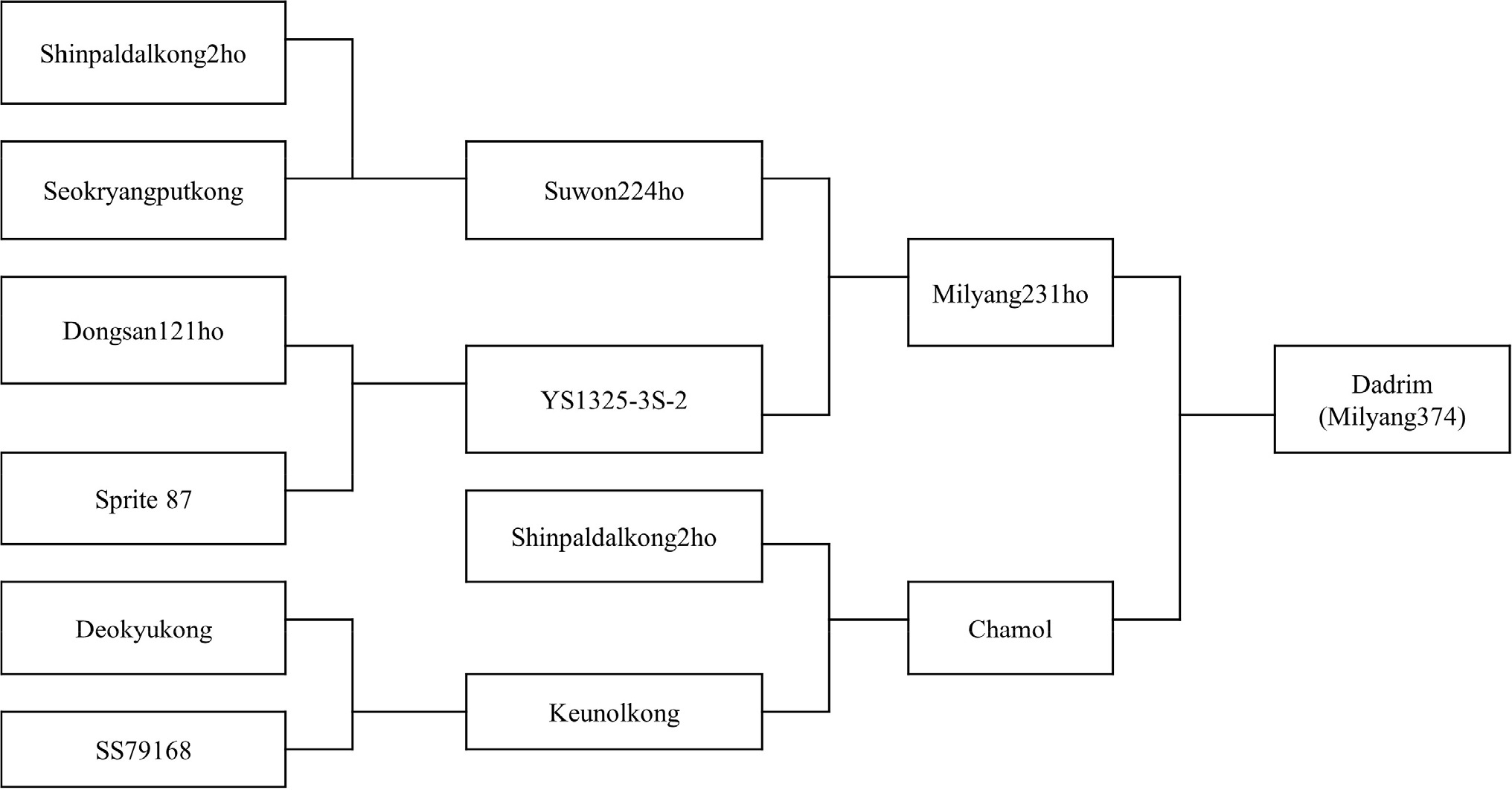
두부 가공용으로 적합하며 기계화 재배 안정성이 우수한 대립 다수성 콩 품종을 육성하기 위해 2012년 국립식량과학원에서 ‘밀양231호’(IT 263183)를 모본으로, ‘참올’(IT 237832)을 부본으로 인공교배하였다(
Fig. 1). 2013년 F
1 세대를 양성하고, 2014년부터 2017년까지 F
2~F
6 세대를 계통육종법(Pedigree Method)에 따라 전개하며 우량 계통을 선발하였다. 선발된 유망 계통들을 대상으로 2018년 생산력검정예비시험(Preliminary Yield Trial, PYT)과 2019년 생산력검정본시험(Advanced Yield Trial, AYT)을 수행하여 생산성과 주요 농업 형질을 평가하였다. 그 결과, 두부 가공적성과 기계화 적응성이 유망한 계통을 최종 선발하여 ‘밀양374호’라는 계통명을 부여하였다(
Fig. 2). ‘밀양374호’는 2020년부터 2022년까지 3년간 전국 11개소(수원, 연천, 춘천, 예산, 청원, 익산, 나주, 칠곡, 진주, 달성/밀양)에서 지역적응시험(Regional Yield Trial, RYT)을 수행하여 수량성, 재배 안정성 및 지역 적응성을 검증하였다. 모든 시험은 표준품종으로 ‘대원콩’을 사용하여 비교하였으며, 3년간의 시험 결과 그 우수성이 인정되어 2022년 농작물직무육성신품종선정위원회 심의를 거쳐 신규 품종으로 결정되었고, 두부 수율이 많다는 의미를 담아 ‘다드림’으로 명명되었다.
지역적응시험은 전국 11개소에서 3년간 수행되었으며, 시험구는 11.2 m
2 (휴장 4 m, 4열) 또는 16.8 m
2 (휴장 4 m, 6열), 난괴법 3반복으로 배치하였다. 파종은 6월 중순, 재식거리는 70×15 cm로 하여 1주 2본으로 재배하였다. 시비량은 질소, 인, 칼륨이 10 a당 각각 성분량 3 kg, 3 kg, 3.4 kg, 퇴비 1톤을 기비처리 하였다. 잡초, 병충해 방제 및 관수는 환경에 따라 조절하고 기본적으로 표준재배양식에 준하여 재배하였다. 생육 및 수량 관련 특성 조사는 농촌진흥청의 농업과학기술 연구조사분석 기준에 따라 실시하였다(
RDA 2012). 조사 항목은 개화기, 성숙기, 경장, 착협고, 마디수, 분지수, 개체당 협수, 협당 립수, 100립중으로 설정하였고, 수량성은 각 시험구에서 수확한 종실의 무게를 측정하여 10 a당 수량(kg/10a)으로 환산하였다.
내도복성은 성숙기에 식물체가 45° 이상 기울어진 정도를 기준으로 1 (없음)에서 9 (매우 심함) 등급으로 평가하였다. 등급은 ‘1’ 5% 이하, ‘3’ 6~10%, ‘5’ 11~50%, ‘7’ 51~75%, ‘9’ 76% 이상을 기준으로 조사되었다. 반복 및 연차간 등급을 평균하여 반올림 후 1-9로 최종등급을 표시하였다. 내탈립성은 포장에서 수확 적기 이후 꼬투리가 자연적으로 터지는 정도를 1 (안 터짐)에서 9 (잘 터짐) 등급으로 조사하는 포장 검정과, 성숙기 꼬투리를 채취하여 40℃ 건조기에서 48시간 처리 후 터진 꼬투리의 비율(%)을 조사하는 실내 검정을 병행하였다. 또한, 내탈립성 연관 SNP 기반 KASP 분자마커(
qPDH-KS)를 이용하여 유전형을 분석하고 저항성(R)과 감수성(S)을 판별하였다(
Lee et al. 2017).
내병성 검정은 지역적응시험 포장에서의 자연 발생 정도를 조사하는 포장 검정과 인위적으로 병원균을 접종하는 유묘 검정으로 나누어 실시하였다. 불마름병(
Xanthomonas axonopodis pv. glycines)은 포장 저항성과 유묘 접종 저항성을 모두 평가하였다. 불마름병 유묘 검정은 8ra를 증식하여 증류수에 희석하고 OD값 0.2-0.3으로 농도를 희석하여 제 2본엽기에 분무 접종 및 습식처리 후 10일 경과 후 잎에 나타난 병징을 조사하였다. 콩모자이크바이러스(Soybean Mosaic Virus, SMV)는 G6H 균계를 사용하여 유묘기에 접종한 후 접종엽과 상위엽의 병징을 관찰하였다(
Seo et al. 2009). 이병잎을 마쇄하여 2 M 농도의 인산 나트륨 버퍼에 녹인 후 즙액을 만들어 초생엽 전개 시 철가루(Carborundum)을 이용하여 잎 표면에 상처를 낸 후 접종하였다. 접종 및 2주 후 접종한 하위엽을 조사하고 10일 뒤 상위 엽을 조사하였다. 병반 없음(-), 갈색 병반(L), 엽맥 병반(V), 모자익 증상(M), 고사(N) 5가지 병징으로 판별하였다. 검은뿌리썩음병은 과습 조건의 포장에서 자연 발병률을 조사하였다. 자반병(Purple seed stain,
Cercospora kikuchii), 갈반병(Seed mottling), 미이라병(Phomopsis seed decay,
Phomopsis longicolla) 등 종자 이병립율은 수확 후 종실 100립을 무작위로 추출하여 3반복으로 조사하였다.
종실의 주요 성분 분석을 위해 수확한 종자를 시료로 사용하였다. 조단백질 함량은 질소 분석기를 이용하여 분석하였고, 조지방 함량은 자동유지추출장치(Soxhlet System)를 이용하여 n-hexane으로 추출한 후 측정하였다. 이소플라본 함량은 시료를 50% 메탄올 용액으로 추출한 후 액체크로마토그래피(HPLC)를 이용하여 분석하였으며, 배당체와 비배당체의 함량을 합산하여 총 함량으로 표시하였다.
두부 가공적성 평가는 원료콩 150 g을 상온에서 15시간 침지시킨 후, 가수량을 13배로 하여 두부제조기로 마쇄 및 가열하였다. 두유를 분리한 후 황산마그네슘(MgSO4)을 2% 수준으로 첨가하여 응고시키고, 성형틀에 넣어 압착하여 두부를 제조하였다. 두부 수율은(제조된 두부 무게 / 원료콩 무게)×100으로 계산하였다. 두부의 색차는 색차계(Minolta, JP/CM-3700D)를 이용하여 L (명도), a (녹색-적색), b (청색-황색) 값을 측정하였고, 물성은 Texture analyzer를 이용하여 경도(hardness), 탄력성(springiness), 응집성(cohesiveness), 검성(gumminess), 씹힘성(chewiness)을 측정하였다. 또한, 두부 가공업체((주)쿱양곡)와 협력하여 연두부를 생산하고, 21명을 대상으로 외관, 향, 맛, 식감, 총평에 대해 1 (매우 나쁨)에서 9 (아주 좋음) 척도로 블라인드 관능평가를 실시하였다.
발효적성 평가는 청국장을 제조하여 특성을 분석하였다. 원료콩을 증자한 후 청국장균(Bacillus subtilis)을 접종하여 45℃에서 24시간 발효시켰다. 발효물의 pH, 아미노태질소 함량, 수율, 끈적임 정도(1-5등급), 그리고 점질물인 감마-폴리글루탐산(gamma-PGA) 함량을 측정하였다.
통계 분석
생육특성과 수량성 데이터는 R (Ver. 4.4.2, RStudio 2025.09.0)을 이용하여 통계분석을 진행하였다. 품종 간 평균 비교는 t-검정(t-test)을 통해 5%, 1%, 0.1% 수준에서 유의성을 검정 하였다.
결과 및 고찰
고유특성 및 생육특성
‘다드림’의 주요 고유특성은
Table 1과 같다. 신육형은 유한신육형이며 엽형은 난형, 꽃색은 백색, 모용색은 회색이다. 협색은 연갈색이며, 종피색과 배꼽색은 모두 황색으로 가공용으로 선호도가 높은 특성을 지녔다. 종실 모양은 구형으로 외관 품질이 우수하다. 이러한 특성들은 표준품종인 ‘대원콩’과 유사하다. ‘다드림’의 주요 양적 생육특성은
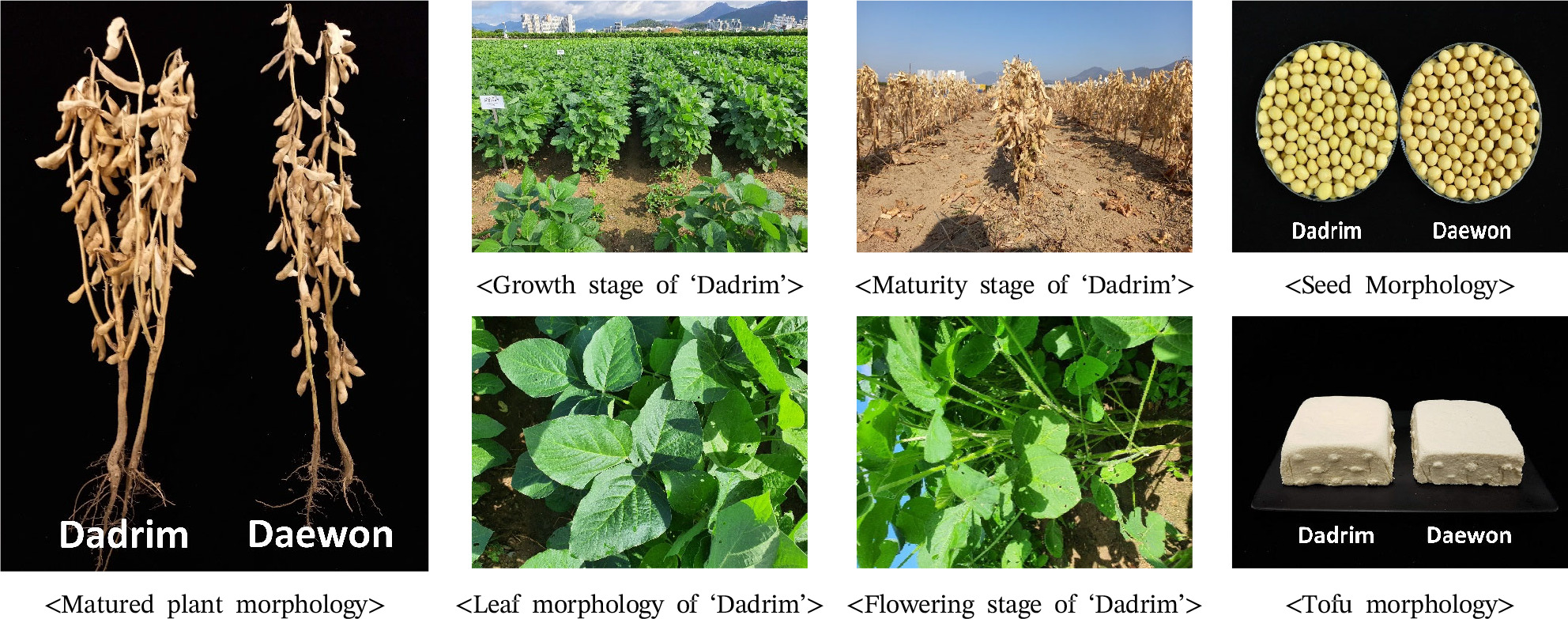
Table 2, 생육 모습과 종자 외관은
Fig. 3과 같다. 개화기는 8월 8일, 성숙기는 10월 22일로 ‘대원콩’에 비해 각각 9일, 4일 늦은 만생종 특성을 보인다. ‘다드림’의 기계화 적응성이 우수한 초형이다. 경장은 64 cm로 ‘대원콩’의 74 cm보다 약 10 cm 가량 짧아 도복의 위험을 줄이는 데 유리한 구조를 가지고 있다. 동시에, 첫 꼬투리가 달리는 높이인 착협고는 16 cm로 ‘대원콩’의 11 cm보다 유의하게 높아, 콤바인 수확 시 예취부에서 발생하는 종실 손실을 줄일 수 있다. 일반적으로 착협고는 경장과 정의 상관관계를 보이는 경향이 있으나, ‘다드림’은 짧은 경장에도 불구하고 높은 착협고를 확보한 기계화 적응형 초형을 나타내었다. 이는 재배 안정성과 수확 편의성을 동시에 높여 농가에 큰 이점을 제공할 수 있다. 수량구성요소를 살펴보면, 개체당 협수는 40개로 ‘대원콩’(51개)보다 적지만, 협당 립수가 2.2개로 더 많고 100립중이 30.9 g으로 ‘대원콩’(27.6 g)보다 무거운 대립종이다. 이러한 특성은 가공용 원료로서 매우 중요한데, 특히 7.1 mm 이상 크기의 대립 비율이 95.8%에 달해 균일하고 큰 입자를 선호하는 두부 가공 시장의 요구에 적합하다.
‘다드림’은 내도복성 등급이 ‘2’로 평가되어 ‘대원콩’(등급 3)보다 쓰러짐에 더 강한 특성을 나타냈다(
Table 2). 이는 앞서 언급한 짧은 경장과 더불어 재배 안정성을 높이는 중요한 요인이다. 내탈립 유전형(
qPDH-KS) 분석 결과, ‘다드림’은 저항성(R) 유전형을 가지고 있는 것으로 확인되었다. 이는 ‘다드림’이 유전적으로 탈립에 강한 잠재력을 지니고 있음을 의미한다. 그러나 40℃ 건조기에서 48시간 처리하는 가혹한 조건의 실내 검정에서는 5.0%의 협개열율을 보여, 0.0%의 협개열율을 보인 ‘대원콩’보다 다소 높은 수치를 나타냈다(
Table 2). 비록 유전적으로 저항성 인자를 보유하고 있더라도, 수확기가 늦어지거나 가을철 기상이 매우 건조할 경우 일부 꼬투리가 터질 가능성이 존재하는데, 이는 내탈립성이 주동유전자 뿐만아니라 미동유전자에 의해서도 조절되기 때문이다. 따라서 ‘다드림’의 유전적 잠재력을 최대한 활용하고 수량 손실을 방지하기 위해서는 적기 수확이 매우 중요하다.
안정적인 콩 생산을 위해서는 병해 및 환경 재해에 대한 저항성이 필수적이다. ‘다드림’의 병 저항성 검정 결과, 불마름병에 대해 포장 검정(등급 1)과 인공 접종(등급 2) 모두에서 ‘대원콩’보다 강한 저항성을 보였다. 검은뿌리썩음병은 0.0%로 저항성을 보였다. 콩모자이크바이러스(SMV) G6H 균계 유묘 접종 결과, 약한 모자이크 증상(MM/MM)을 보였으나 포장 저항성은 ‘대원콩’과 유사한 수준으로 강한 편이었다(
Table 3). 또한, 수확 후 종자 품질에 영향을 미치는 자주무늬병, 갈반병, 미이라병 등의 전체 이병립율은 0.3%로 매우 낮아 깨끗한 외관 품질을 유지하는 데 유리하였다.
‘다드림’ 종실의 주요 성분 분석 결과, 조단백질 함량은 41.6%, 불포화지방산 함량은 86.3%로 ‘대원콩’(조단백질 39.7%, 불포화지방산 87.4%) 대비 통계적으로 차이가 나타났다. 올레산(Oleic acid) 함량이 21.8%로 ‘대원콩’(24.9%) 대비 낮아 불포화 지방산의 차이가 나타나는 것으로 분석되었다. 조지방 함량은 18.9%로 ‘대원콩’과 통계적으로 유의한 차이가 없었다. 기능성 성분인 이소플라본 총 함량 역시 2,350 ug/g으로 ‘대원콩’ 대비 낮았으나 통계적 유의성은 없었다. 종자의 색택은 명도를 나타내는 L*값이 68.4로 ‘대원콩’(65.7)보다 높아 더 밝고 깨끗한 외관을 보였다(
Table 4).
‘다드림’의 가장 중요한 특성은 두부 가공적성이다(
Table 5). 두부 수율은 283%로 ‘대원콩’의 216%보다 67%p 높았다. 수량성을 감안할 때 10 a당 두부 생산량은 ‘다드림’이 954 kg으로 ‘대원콩’(676 kg) 대비 41% 더 많은 두부를 생산할 수 있다. 이러한 특성은 두부 제조업체의 생산성과 수익성을 개선할 수 있는 중요한 형질이다. 두부의 물성 분석 결과, 경도가 834 g으로 ‘대원콩’(1,753 g)의 절반 이하 수준으로 매우 낮았으며, 씹힘성과 검성 역시 유의하게 낮아 부드러운 식감을 나타냈다. 이러한 특성은 단단한 식감의 일반 두부보다는 부드러움이 품질을 좌우하는 연두부나 순두부 제품에 적합한 원료임을 시사한다. 실제 가공업체와 협력하여 연두부를 제작하고, 성별과 연령이 서로 다른 21명을 대상으로 블라인드 관능평가를 실시한 결과, ‘다드림’으로 만든 연두부는 맛, 식감, 총평 등 모든 항목에서 대조 품종보다 높은 점수(총평 7.1점)를 받았으며, 평가 참가자의 86%가 ‘다드림’ 연두부를 더 선호한다고 응답했다(
Table 6). ‘다드림’은 고품질의 프리미엄 연두부 시장을 공략할 수 있는 품종으로 고려할 수 있을 것이다.
청국장 발효적성 평가에서는 pH 6.6, 아미노태질소 함량 473 mg%, 수율 267%, 끈적임 정도 ‘4’, γ-PGA 함량 11.8 mg/g로 대부분의 지표에서 ‘대원콩’과 유사한 수준이었으며, 끈적임 정도가 ‘대원콩’(‘3’)보다 우수하게 평가되어 장류 가공에도 무난하게 사용될 수 있을 것으로 판단된다(
Table 7).
‘다드림’의 수량성은 2020년부터 2022년까지 3년간 전국 11개소에서 수행된 지역적응시험 결과를 통해 검증되었다(
Table 8). 전국 전체 평균 수량은 3.37톤/ha로, 표준품종 ‘대원콩’(3.13톤/ha) 대비 8% 증수된 결과를 보였다. 특히, 품종의 적응성을 보다 명확히 파악하기 위해 지역별 수량성을 분석한 결과, ‘다드림’은 경기 수원(3.82톤/ha, 9% 증수), 전남 나주(3.51톤/ha, 20% 증수), 전북 익산(3.57톤/ha, 21% 증수), 충남 예산(3.75톤/ha, 12% 증수) 지역에서 높은 수량 잠재력을 나타내는 것으로 나타났다. 반면, 경기 연천(3.14톤/ha, 5% 감수), 강원 춘천(3.12톤/ha, 1% 증수), 경남 진주(3.04톤/ha, 3% 증수)는 비교적 수량성이 낮아 표준재배 대비 추비 처리 등 시비관리 및 재배적 환경을 조절하여 생산성을 향상할 수 있도록 해야 할 것이다. ‘다드림’은 생육 기간이 비교적 긴 남부 지역의 기후 조건에 잘 적응하는 품종임을 보여준다.
‘다드림’은 재배 안정성이 높은 품종이지만, 그 특성을 최대한 발현시키기 위해서는 몇 가지 유의사항이 필요하다. 내탈립성 분자마커 검정 결과 저항성 유전형을 가지고 있음에도 불구하고, 가을철 기상이 건조할 경우 일부 꼬투리가 터질 가능성이 있다. 따라서 수확을 지연시키지 말고 성숙 후 적기에 수확하여 수량 손실을 예방해야 한다. 또한, 대립 다수성 품종이므로 충분한 등숙을 위해 생육 후기 비배 관리와 수분 관리에 유의하는 것이 높은 수량과 품질을 확보하는 데 도움이 된다.
적요
콩 신품종 ‘다드림’은 두부 가공적성과 기계화 재배 적응성 향상을 목표로 개발되었다. 2012년 ‘밀양231호’와 ‘참올’을 인공교배하여 계통육종법으로 육성하였으며, 2018-2019년 생산력검정시험과 2020-2022년 전국 11개소 지역적응시험을 거쳐 그 우수성이 입증되었다. ‘다드림’은 유한신육형 품종으로, 화색은 백색, 종피와 배꼽색이 황색인 구형의 대립종(30.9 g/100립)이다. 성숙기는 10월 22일경인 만생종이다. 경장이 64 cm로 짧고 착협고가 16 cm로 높아 내도복성이 강하고 기계수확에 유리한 초형을 가지고 있다. 불마름병과 콩모자이크바이러스에 강한 저항성을 보이며, 내탈립성 유전자를 보유하고 있어 재배 안정성이 높다. ‘다드림’의 가장 큰 특징은 두부 가공적성이다. 조단백질(41.6%)과 조지방(18.9%) 함량은 표준품종과 유사하나, 두부 수율이 283%로 ‘대원콩’ 대비 67%p 높아 가공 효율성이 뛰어나다. 또한, 두부의 경도가 매우 낮아(834 g) 식감이 부드러워 고품질 연두부 및 순두부 생산에 적합한 품종이다. 수량성은 전국 평균 337 kg/10a로 ‘대원콩’ 대비 8% 증수되었으며, 특히 적응 지역인 남부 이모작 지대에서는 11% 증수되어 높은 생산성을 보였다. 따라서 ‘다드림’은 기계화 재배를 통한 생산성 향상과 고품질 두부 생산을 통한 부가가치 창출을 동시에 가능하게 하여 국내 콩 농가와 식품 산업의 경쟁력을 높이는 데 크게 기여할 수 있는 품종이다.
사사
본 연구는 농촌진흥청 연구사업(과제명: 콩 재배안정성 및 기능성 향상 품종 개발, 과제번호: PJ01758901)의 지원에 의해 수행되었다.
Fig. 1Pedigree diagram of ‘Dadrim’, zPreliminary yield trial, yAdvanced yield trial, xRegional yield trial.
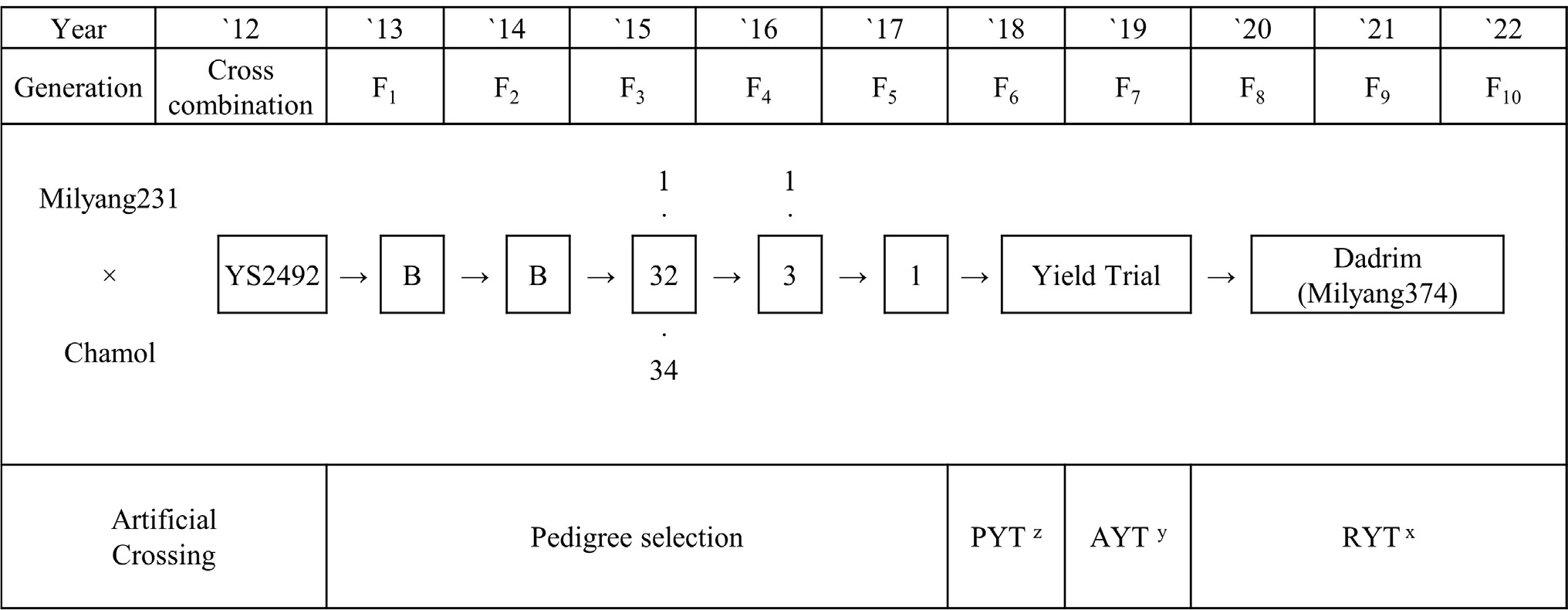
Fig. 2
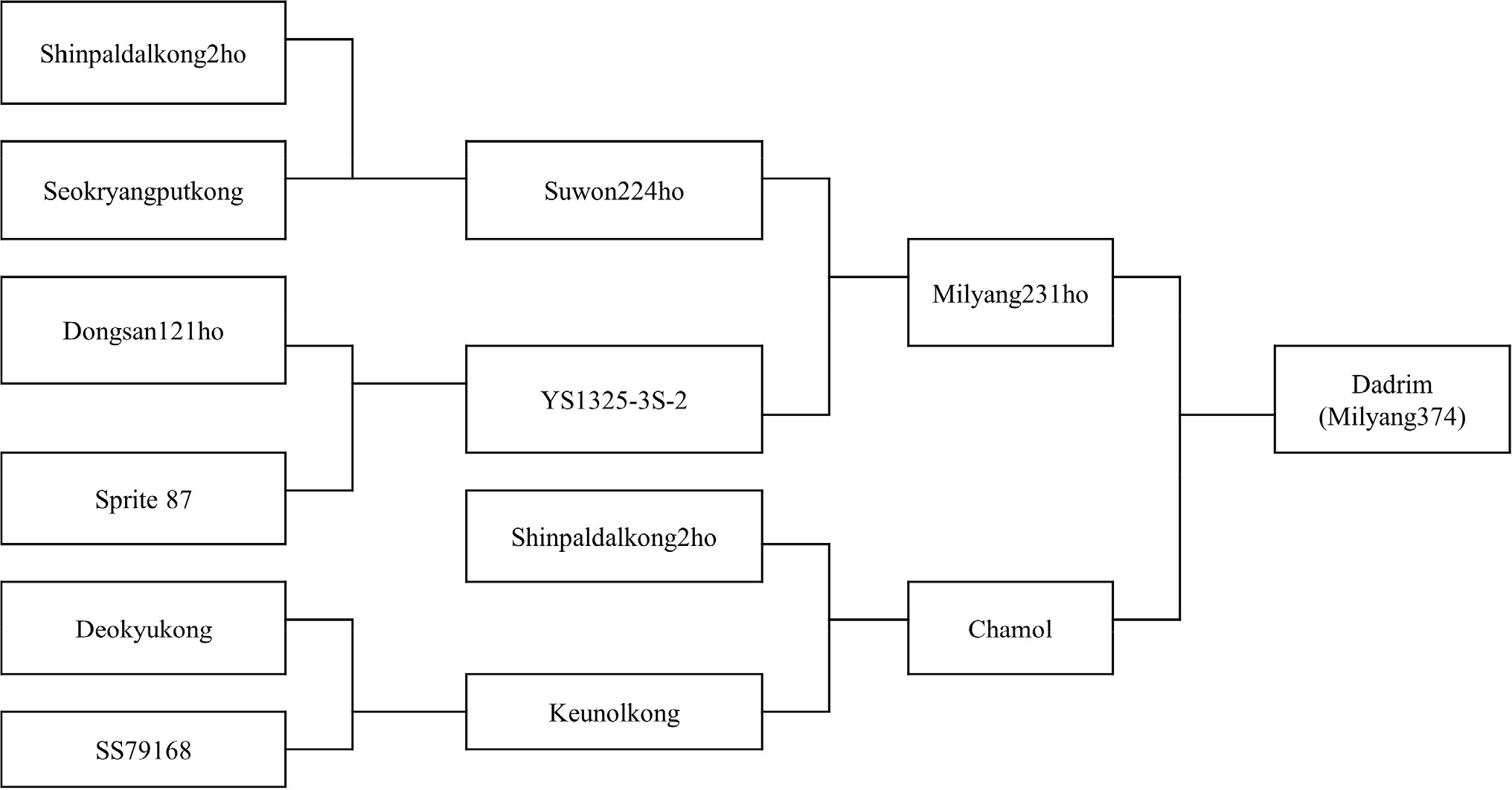
Fig. 3Morphological characteristics and developmental stages of ‘Dadrim’: A cultivar adaptable to mechanization and high tofu yield.
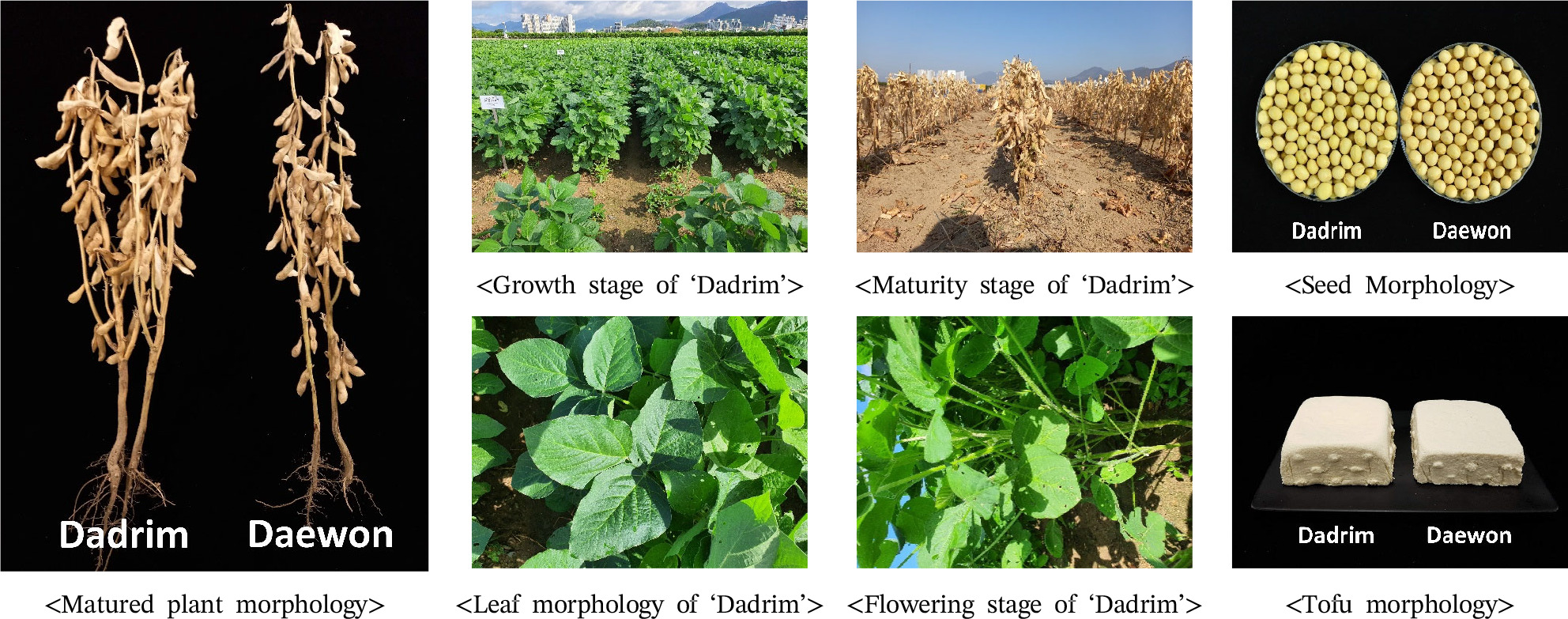
Table 1Qualitative characteristics of ‘Dadrim’.
Table 1
|
Cultivar |
Growth
type |
Leaflet
shape |
Flower
color |
Pubescence
color |
Pod
color |
Seed
coat
color |
Hilum
color |
Seed
shape |
|
Dadrim |
Determinate |
Oval |
White |
Grey |
Light brown |
Yellow |
Yellow |
Spherical |
|
Daewonkong |
Determinate |
Oval |
White |
Grey |
Light brown |
Yellow |
Yellow |
Spherical |
Table 2Quantitative characteristics of ‘Dadrim’ determined by regional yield trial (2020-2022).
Table 2
|
Cultivar |
Flowering
date
(Month. Day) |
Maturity
date
(Month. Day) |
Plant
height
(cm) |
First
pod
height
(cm) |
No. of
nods |
No. of
branches |
No. of
pod
s |
No. of
seeds per pod
|
100-seed weight
(g) |
Uniformity
(%, >7.1 mm) |
Lodging at field
(1-9)z
|
Shattering |
|
Field
(1-9)y
|
Ratio by Oven test (%) |
qPDH-KS
(R/S)x
|
|
Dadrim |
Aug. 8 |
Oct. 22 |
64 |
16 |
15 |
2.8 |
40 |
2.2 |
30.9 |
95.8 |
2 |
2 |
5.0 |
R |
|
Daewonkong |
Jul. 30 |
Oct. 18 |
74 |
11 |
15 |
3.4 |
51 |
1.9 |
27.6 |
84.6 |
3 |
1 |
0.0 |
R |
|
|
t-valuew
|
- |
- |
4.73*
|
-4.84*
|
-1.13ns
|
3.91*
|
3.83*
|
-2.56*
|
-3.93*
|
-3.93*
|
- |
- |
- |
- |
Table 3Resistance of ‘Dadrim’ to soybean diseases, estimated from 2020 to 2022.
Table 3
|
Cultivar |
Bacterial Pustule (0-9)z
|
Root
rot
(%)y
|
Soybean Mosaic Virusx
|
|
Percentages of damaged seed (%)y
|
|
|
|
Field
|
Inoculation |
Inoculation (G6H) |
Field
(0-9)z
|
Purple
seed stain |
Seed discoloration |
Phomopsis |
Total |
|
Dadrim |
1 |
2 |
0.0 |
MM / MM |
1 |
|
0.3 |
0.0 |
0.0 |
0.3 |
|
Daewonkong |
2 |
5 |
0.0 |
MM / MM |
2 |
|
0.3 |
0.0 |
0.0 |
0.3 |
Table 4Major component of seed in ‘Dadrim’ estimated from 2020 to 2022.
Table 4
|
Cultivar |
Seed color appearancesz
|
Crude protein
(%) |
Crude oil
(%) |
Fatty acids (%)y
|
|
Isoflavone (㎍/g) |
|
|
|
|
L*
|
a*
|
b*
|
ΔE
|
Unsaturated |
Ole. |
Lin. |
Lnl. |
Daidzein |
Glycitein |
Genistein |
Total |
|
Dadrim |
68.4 |
5.4 |
27.5 |
3.35 |
41.6 |
18.9 |
86.3 |
21.8 |
55.7 |
9.0 |
|
919 |
253 |
1,177 |
2,350 |
|
Daewonkong |
65.7 |
6.8 |
28.8 |
39.7 |
19.9 |
87.4 |
24.9 |
54.4 |
8.1 |
|
1,056 |
307 |
1,230 |
2,593 |
|
|
t-valuex
|
-3.89**
|
3.84*
|
1.93ns
|
- |
-2.90**
|
1.65ns
|
2.04*
|
2.41*
|
-0.44ns
|
-1.53ns
|
|
1.14ns
|
2.32*
|
0.49ns
|
1.01ns
|
Table 5Characteristics of tofu of ‘Dadrim’ estimated from 2020 to 2022.
Table 5
|
Cultivar |
Tofu yield
(%) |
Color valuez
|
|
Physical characteristics |
|
|
|
L |
a |
b |
ΔE |
Springiness |
Gumminess |
Cohesiveness |
Chewiness |
Hardness
(g/3.14mm2) |
|
Dadrim |
283 |
90 |
-1.94 |
18.9 |
0.99 |
|
0.87 |
730 |
0.75 |
668 |
834 |
|
Daewonkong |
216 |
90 |
-1.53 |
18.0 |
0.86 |
1485 |
0.69 |
1206 |
1753 |
|
|
t-valuey
|
-2.99**
|
- |
- |
- |
- |
|
-0.19ns
|
4.62***
|
-1.63ns
|
4.79***
|
4.97***
|
Table 6Tofu flavor test of ‘Dadrim’.
Table 6
|
Cultivars |
Appearancez
|
Flavor |
Taste |
Texture |
Total |
|
Dadrim |
7.1 |
7.4 |
7.5 |
7.5 |
7.1 |
|
Daewonkong |
6.3 |
5.0 |
5.3 |
5.2 |
5.6 |
Table 7Soybean fermentation characteristics of ‘Dadrim’.
Table 7
|
Cultivars |
pH |
Amino nitrogen (mg%)z
|
Yield (%) |
Degree of fermentation (1-5)z
|
γ-PGA (mg/g)y
|
|
Dadrim |
6.6 |
473 |
267 |
4 |
11.8 |
|
Daewonkong |
6.7 |
483 |
257 |
3 |
13.6 |
|
|
t-valuex
|
1.38ns
|
0.43ns
|
-0.41ns
|
-2.45*
|
2.91**
|
Table 8Yield of ‘Dadrim’ in regional yield trials across 11 locations. (ton/ha)
Table 8
|
Location |
Dadrim |
|
Daewonkong |
|
|
|
2020 |
2021 |
2022 |
Mean |
Indexz
|
2020 |
2021 |
2022 |
Mean |
|
Suwon |
3.81 |
4.17 |
3.48 |
3.82 |
109 |
|
3.43 |
3.97 |
3.17 |
3.52 |
|
Yeoncheon |
2.45 |
3.93 |
3.05 |
3.14 |
95 |
|
1.79 |
4.87 |
3.23 |
3.30 |
|
Chuncheon |
3.17 |
3.05 |
3.14 |
3.12 |
101 |
|
2.86 |
3.44 |
3.01 |
3.10 |
|
Naju |
3.22 |
3.74 |
3.58 |
3.51 |
120 |
|
3.05 |
2.62 |
3.12 |
2.93 |
|
Dalseong |
3.44 |
3.74 |
- |
3.59 |
105 |
|
3.25 |
3.61 |
- |
3.43 |
|
Miryang |
- |
- |
3.03 |
3.03 |
110 |
|
- |
- |
2.75 |
2.75 |
|
Yesan |
3.36 |
5.06 |
2.84 |
3.75 |
112 |
|
2.75 |
4.92 |
2.37 |
3.35 |
|
Iksan |
3.75 |
3.59 |
3.38 |
3.57 |
121 |
|
2.85 |
3.43 |
2.56 |
2.95 |
|
Jinju |
3.37 |
2.65 |
3.10 |
3.04 |
103 |
|
2.69 |
3.03 |
3.13 |
2.95 |
|
Cheongwon |
2.88 |
3.08 |
3.39 |
3.12 |
111 |
|
2.79 |
3.05 |
2.57 |
2.80 |
|
Chilgok |
2.96 |
3.35 |
3.44 |
3.25 |
103 |
|
3.20 |
3.19 |
3.11 |
3.17 |
|
|
Overall mean |
3.24 |
3.64 |
3.24 |
3.37ns
|
108 |
|
2.87 |
3.61 |
2.90 |
3.13 |
|
|
t-valuey
|
|
|
|
-2.56*
|
|
|
|
|
|
|
References
- 1. aT Food Information Statistics System (aTFIS).2024. Survey on the status of raw material consumption in the food industry.
- 2. Guan X, Zhong X, Lu Y, Du X, Jia R, Li H, Zhang M. 2021. Changes of soybean protein during tofu processing. Foods 10: 1594
- 3. Kang BK, Seo JH, Kim JH, Heo SV, Park GR, Han WY, Seo MC, Lee YH, Baek IY, Ko JY, Park JH, Sung JS, Kim HS, Jung CS, Choi HS, Jo YM, Go EB, Lee JA. 2024. Paddy field and mechanization-adaptable soybean cultivar, 'Jangpung', with fewer branches and higher first pod height. Korean Journal of Breeding Science 56: 547-558.
- 4. Kim HT, Han WY, Lee BW, Ko JM, Lee YH, Baek IY, Yun HT, Ha TJ, Choi MS, Kang BK, Kim HY, Seo JH, Kim HS, Shin SO, Oh JH, Kwak DY, Seo MJ, Song YH, Jang EK, Yun GS, Kang YS, Lee JY, Shin JH, Choi KH, Kim DK, Yang WS. 2019. A new soybean cultivar for soy-paste and tofu 'saegeum' with high first pod height, shattering resistance and adaptability for mechanized harvesting. Korean Journal of Breeding Science 51: 496-503.
- 5. Lee CY, Choi MS, Kim HT, Yun HT, Lee BW, Chung YS, Kim RW, Choi HK. 2015. Soybean [Glycine max (L.) Merrill]: Importance as a crop and pedigree reconstruction of Korean varieties. Plant Breeding and Biotechnology 3: 179-196.
- 6. Lee JS, Kim KR, Ha BK, Kang ST. 2017. Identification of SNPs tightly linked to the QTL for pod shattering in soybean. Mol Breeding 37: 54. doi:10.1007/s11032-017-0656-2.
- 7. Medic J, Atkinson C, Hurburgh CR. 2014. Current knowledge in soybean composition. Journal of the American Oil Chemists'. Society 91: 363-384.
- 8. Ministry of Agriculture.Food and Rural Affairs (MAFRA).2023. A food policy 2021-2023.
- 9. Poysa V, Woodrow L. 2002. Stability of soybean seed composition and its effect on soymilk and tofu yield and quality. Food Research International 35: 337-345.
- 10. Rural Development Administration (RDA).2012. Agricultural science technology research analysis standard 5ed. pp. 429-430.
- 11. Seo JK, Ohshima K, Lee HG, Son M, Choi HS, Lee SH, Sohn SH, Kim KH. 2009. Molecular variability and genetic structure of the population of soybean mosaic virus based on the analysis of complete genome sequence. Virology 393: 91-103.
- 12. Sim E, Choi HS, Park HY, Kim HS, Chun A. 2024. Comparison of quality characteristics of tofu made from three soybean cultivars grown in different regions of Korea. Food Science and Preservation 31: 1020-1032.
- 13. Sim EY, Kim HS, Kim M, Park HY, Choi HS. 2022. Evaluation of physico-chemical characteristics of commercial tofu products in Korea market. Korean Journal of Food and Nutrition 35: 521-530.
- 14. Sim EY, Kim HS, Park HY, Choi HS, Park J. 2020. Studies on quality characteristics of commercial silken tofu products. Korean Journal of Food and Nutrition 33: 576-583.
- 15. Son CK, Heo CS. 2002. Selection soybean cultivars for mechanized harvest. Research Report. Gyeongsangbuk-do Agricultural Research & Extension Services, pp. 108-116.
- 16. Wang F, Meng J, Sun L, Weng Z, Fang Y, Tang X, Zhao T, Shen X. 2020. Study on the tofu quality evaluation method and the establishment of a model for suitable soybean varieties for Chinese traditional tofu processing. LWT 117: 108441.