적요
‘조원’은 남부지역인 경남에서 조기재배 및 양파, 마늘 등 원예작물 후작지에 적용 가능한 고품질의 조생종으로 육성된 품종이다. 2015년 하계에 조생종 중에 출수가 빠르면서 수량성이 우수한 ‘조평’ 품종을 모본으로 하고, 밥맛이 우수하면서 도열병 및 줄무늬잎마름병에 강한 ‘해담쌀’을 부본으로 하여 인공교배하였다. 교배립은 동계온실에 이앙한 이후에 꽃가루 배양으로 계통을 고정하였다. 하계 시험포장에 전개하여 조생종이면서 잎도열병, 흰잎마름병 및 줄무늬잎마름병에 강하면서 반직립의 초형과 현미품위가 우수한 ‘KR15-ACP71’ line을 선발하였다. 생산력검정을 거쳐 ‘경남1호’ 로 계통명을 부여하였고, 3년간의 지역적응시험 결과 내도복성, 분상질립 및 싸라기 비율이 낮은 등의 우수한 특성으로 인하여 경상남도농업기술원 농작물 직무육성 신품종선정위원에서 ‘조원’으로 명명되었다. ‘조원’의 출수기가 7월 13일로 비교품종인 ‘조평’에 비하여 1일 빠르고, 벼 키는 64 cm로 ‘조평’보다 짧았다. 등숙비율은 84.5%로 ‘조평’에 비하여 높았고, 현미천립중의 차이는 없었다. 수발아검정에서 수발아 비율이 26.3%로 높아 적기에 수확이 필요하며, 도복지수가 낮아 ‘조평’보다 도복에 강한 특성을 보였다. 쌀 수량은 조기재배 시 516 kg/10a로 ‘조평’의 98% 수준이었고, 만기재배 시에는 485 kg/10a로 ‘금오’ 대비 107%의 수량성을 보였다. 쌀알에 심백 및 복백이 없고, 완전미비율이 87%로 높은 특성이 있어 남부지역 조기재배 및 만기재배 적응 고품질 품종으로 활용될 것으로 기대된다.
Abstract
‘Joweon’ is an early-maturing rice cultivar developed by the Gyeongsangnam-do Agricultural Research and Extension Services in 2020. It was developed from a cross made in the summer of 2015 between ‘Jopyeong,’ an early-maturing and high-yielding cultivar with early heading, and ‘Haedamssal,’ a cultivar with good eating quality and resistance to rice blast and rice stripe virus. Among the doubled haploid lines, ‘KR15-ACP71’ was selected for its early maturity, resistance to leaf blast, bacterial blight, and rice stripe virus, semi-erect plant type, and good brown rice appearance quality. Following preliminary and replicated yield trials, the line was designated as ‘Gyeongnam 1.’ Based on the results of three years of local adaptability tests, the line was named ‘Joweon’ by the Variety Selection Committee of Gyeongsangnam-do Agricultural Research and Extension Services. The culm length of ‘Joweon’ was 64 cm, which was shorter than that of ‘Jopyeong.’ The percentage of ripened grains was 84.5%, which was higher than that of ‘Jopyeong.’ Its lodging index was lower than that of ‘Jopyeong,’ indicating improved lodging resistance. The milled rice yield of ‘Joweon’ was 516 kg/10a under early cultivation and 485 kg/10a under late cultivation, corresponding to 98% of ‘Jopyeong’ and 107% of ‘Geumo,’ respectively. In addition, neither white nor white-belly kernels were observed and the head rice rate was as high as 87%. Therefore, ‘Joweon’ is a high-quality, early maturing rice cultivar suitable for early-season cultivation and cropping systems following winter open-field horticultural crops (Registration No. 10561, April 2, 2025).
-
Key words: early-season cultivation, rice, variety, winter open-field horticultural crops
서언
벼 품종 육성은 생산성 향상, 재배 안정성 확보, 품질 및 가공적성 개선 등 다양한 목표를 바탕으로 추진되고 있다. 이 중 밥쌀용 조생종 품종은 우리나라 벼 재배의 대부분을 차지하는 중만생종 품종과 이앙기 및 수확기가 달라 농작업 분산에 유리하며, 고랭지 및 산간지역 재배, 추석 전 햅쌀 생산을 위한 조기재배, 양파⋅마늘 등 원예작물 수확 후 후작을 위한 만기재배 등 다양한 작부체계에 활용될 수 있다. 특히 남부지역은 비교적 온화한 기후로 인해 이른 시기에 이앙이 가능하여 조기 햅쌀 생산에 유리하고, 이를 고가에 출하할 수 있어 농가 소득 향상에도 기여할 수 있다.
조기재배는 출수 후 등숙기간에 고온 조건에 노출될 가능성이 높아 수량성과 품질 향상에 불리하게 작용하고 있다.
Kobata & Uemuki (2004)는 광합성, 호흡, 전류 등 등숙 관련 생리과정이 온도의 영향을 크게 받으며, 종실의 발육 속도와 발육 기간이 온도와 밀접한 관련이 있다고 보고하였다. 또한
Inada & Sato (1976)는 등숙기 고온이 종실 전분 생성에 관여하는 효소의 활성을 저하시켜 종실 발육을 제한할 수 있다고 하였다.
Tashiro & Wardlaw (1989)는 등숙기 고온이 등숙 속도를 증가시켜 등숙기간을 단축시키고, 그 결과 입중과 등숙률을 저하시켜 수량 감소를 초래한다고 보고하였다. 아울러
Kwak & Choi (1998)와
Guh et al. (2003)은 등숙기 고온이 단백질 함량 증가와 전분의 열호화 특성 변화를 유도하여 밥의 끈기를 저하시키고 식미를 떨어뜨린다고 하였다. 이러한 결과를 고려할 때, 향후 고온화가 지속되는 벼 재배 환경에서는 조기재배에서 품질 저하 문제가 더욱 심화될 가능성이 있다.
양파⋅마늘 등 동계 노지 원예작물 수확 후 벼 재배 작부체계는 이앙기가 6월 하순~7월 상순 사이의 만기재배 조건으로, 생육 초기에는 고온에 노출되고 등숙기에는 저온 조건을 겪을 수 있다(
Lee et al. 2018). 이러한 기상 조건은 쌀 수량을 감소시키고 품질을 저하시킬 수 있다. 전 작물인 원예작물 재배 시 퇴비 및 비료량이 많아서 벼 재배 시 도복의 우려도 크기 때문에 내도복성도 중요한 항목이다.
따라서 조기재배 및 만기재배 환경에서 적응 가능한 품종은 짧은 생육기간에도 안정적인 수량과 품질을 확보할 수 있는 특성이 필요하다. 본 연구에서는 남부지역인 경남지역에 적합한 조생종 벼 품종인 ‘조원’을 육성한 경위와 주요 농업적 특성을 보고하고자 한다.
재료 및 방법
시험재료 및 재배방법
2020년에 육성된 ‘조원’ 품종은 2018년부터 2020년까지 지역적응시험을 수행하였으며, 조기재배는 4시험지(진주, 밀양, 전주, 나주)에서 대비품종으로 ‘조평’ 품종을 공시하였고, 만기재배는 3시험지(밀양, 전주, 수원)에서 ‘금오’ 품종을 대비품종으로 공시하였다. 조기재배 시험은 4월 10일에 파종하여 5월 10일에 재식본수 주당 3본, 재식거리 30 × 15 cm로 이앙하였고, 시비량은 N 9 kg/10a, P2O5 4.5 kg/10a, K2O 5.7 kg/10a을 시용하였다. 만기재배 시험은 수원에서 6월 10일에 파종하여 7월 1일에 이앙하였고, 전주 및 밀양에서는 6월 15일에 파종하여 7월 10일에 이앙하였다. 재식본수는 주당 5본, 재식거리 30 × 12 cm로 밀식하고, 시비량은 N 7 kg/10a, P2O5 3.2 kg/10a, K2O 4.2 kg/10a을 시용하여 재배하였다.
생육 및 주요특성 조사
육성 품종의 생육특성 조사는 농업과학기술 연구조사분석기준(
RDA 2012)과 농촌진흥청에서 발간한 신품종 개발공동연구사업 계획서(
RDA 2018,
2019,
2020)에 따라 조사하였다. 출수기 조사는 시험구 전체를 관찰하여 총 경수의 10%가 출수한 날을 출수시, 40%가 출수한 날은 출수기, 80%가 출수한 날을 출수전으로 하였고, 출수시에서 출수전까지를 수전일수로 하였다. 출수 이후 30일경에 시험구의 평균이 되는 20개체의 간장, 수장, 수수를 조사하였고, 수확기 때 3포기를 예취하여 수당립수, 등숙률 등을 조사하였다.
불시출수는 파종 후 50일간 육묘한 이후에 본답에 이앙하여 조사하였고, 국립식량과학원 춘천출장소 내냉성 검정 포장에서 이앙 후 30일부터 17℃ 냉수처리 후 출수지연일, 임실률, 성숙기 표현형 등을 조사하였다. 벼 수확전에 발생하는 수발아의 저항성 검정은 출수 40일에 주간이삭을 3반복 채취하여 25℃ 포화습도의 항온기에서 7일간 처리한 후 발아된 비율을 조사하였다. 도복 저항성 검정은 출수 후 20일 된 벼 포기를 채취한 후 간장, 수장, 총 생체중, 3절간장 및 인장강도시험기(DTG-5, Digitech Co. Ltd., Osaka, Japan)로 좌절중을 조사하였고, 도복지수는 모멘트[(주간 간장+수장) ×총생체중] / 좌절중(g) × 100의 식을 이용하여 구하였다. 포장도복은 출수 후 30경에 달관조사로 이삭줄기 경사 15% 미만일 때 1, 16~30%일 때 3, 31~45%일 때 5, 이삭의 일부가 지면에 닿을 때 7, 완전히 땅에 깔린 상태일 때 9의 등급으로 구분하여 조사하였다.
병해충 저항성 조사
병해충 저항성은 도열병, 흰잎마름병, 줄무늬잎마름병, 오갈병의 병해와 벼멸구 및 애멸구 충해의 저항성을 검정하였다. 도열병 저항성 검정은 잎도열병과 이삭도열병을 나누어서 수행하였다. 잎도열병은 밀양, 전주, 수원, 나주 등 12개 시험지에서 6월 중순에서 7월 초순 사이에 검정계통과 이병성 품종인 ‘낙동’ 및 ‘호평’을 동시에 파종하여 병발생을 유도한 이후 잎도열병 발병정도에 따라 0~9로 조사하였다(
IRRI 1988). 이삭도열병 검정은 진주, 밀양, 전주, 예산 시험지에서 6월 중순에서 7월 초순 사이에 밀식으로 이앙하고, 이병성 품종인 ‘낙동’과 ‘호평’을 주위에 배치하여 도열병 발생을 유도 후 출수 후 30~35일 경에 이병수율을 조사하였다.
벼 흰잎마름병의 저항성 검정은 수잉기에 잎을 가위로 잘라서 균주 HB1013 (K1 균계), HB1014 (K2 균계), HB1015 (K3 균계), HB1009 (K3a 균계)를 접종하여, 병반장이 1 cm 이하는 고도저항성(HR; highly resistance), 5 cm 미만은 저항성(R; resistance), 5~9 cm는 중도저항성(MR; moderately resistance), 10 cm 이상은 감수성(S; susceptible)으로 구분하여 조사하였다(
Shin et al. 2011). 바이러스병인 줄무늬잎마름병 및 오갈병 저항성 검정은 국립식량과학원 온실에서 유묘기(본엽 2~3엽기)에 바이러스 이병주를 흡즙한 매개충인 애멸구(줄무늬잎마름병)와 끝동매미충(오갈병)으로 흡즙시켜서 저항성 정도를 조사하였다.
벼멸구 및 애멸구 저항성 검정은 국립식량과학원 온실에서 종자 15~30립을 파종한 이후 유묘 2~3엽기에 벼멸구와 애멸구를 접종하여 감수성 품종인 ‘남평’이 완전히 고사한 이후에 개체당 1~2엽이 황화된 수준이면 저항성으로 판정하였다.
품질특성 조사
벼립형은 현미 상태에서 캘리퍼스로 길이, 너비, 두께를 조사하였고, 심백 및 복백은 백미를 달관조사하여 심복백 없을 때 0, 쌀알 면적의 5% 이하는 1, 6~10%일 때 3, 11~20%일 때 5, 21~40%일 때 7, 41% 이상은 9로 구분하였다. 단백질 함량은 자동 단백질 분석기(Kjeltec 2400 AUT, Foss Tecator, Mulgrave, Australia)를 이용하여 측정하였고, 아밀로스 함량은
Juliano (1985)의 비색정량법에 따라 분쇄한 쌀 100 mg에 99.9% 에탄올 1 ml와 1 N NaOH 9 ml를 첨가한 후에 100℃ 항온수조에서 10분간 호화한 후 1 N의 CH3COOH 1 ml와 iodine solution (2% KI solution + 0.2% iodine) 2 ml 첨가하여 요오드 정색 반응 후 분광광도계(UV-2700, Shimadzu Co., Japan)를 이용하여 620 nm의 파장에서 흡광도를 측정한 후 표준검량식에 대입하여 아밀로스 함량을 구하였다. 밥의 윤기치는 백미 33 g을 정량하여 식미검정기(MA-90B, Toyo Co., Tokyo, Japan)를 이용하여 측정하였다.
정조 1 kg을 현미 제조 후에 제현율을 구하고, 백미/정조 비율인 도정수율 등을 조사하였다. 쌀 품위특성은 도정된 백미를 외관품위기(RN300, Kett Co. Ltd., Yamagata, Japan)로 완전립(백미중 피해립, 동할립 및 분상질립 등 불완전립을 제외한 모양이 완전한 쌀과 깨어진 쌀 중 그 길이가 3/4이상인 쌀), 분상질립(쌀알 체적의 1/2 이상이 분상질 상태인 낟알), 싸라기(깨어진 낟알 중 완전한 낟알 평균길이의 3/4미만인 낟알), 피해립(병해립, 충해립, 반점립 등 손상된 낟알과 오염된 낟알)으로 구분하였다.
통계분석
통계분석은 XLSTAT 통계 및 데이터 분석 솔루션을 이용하였으며, 육성품종과 대비품종간의 비교는 t-test 또는 Duncan의 다중검정으로 유의성을 검정하였다.
결과 및 고찰
품종 육성 경위
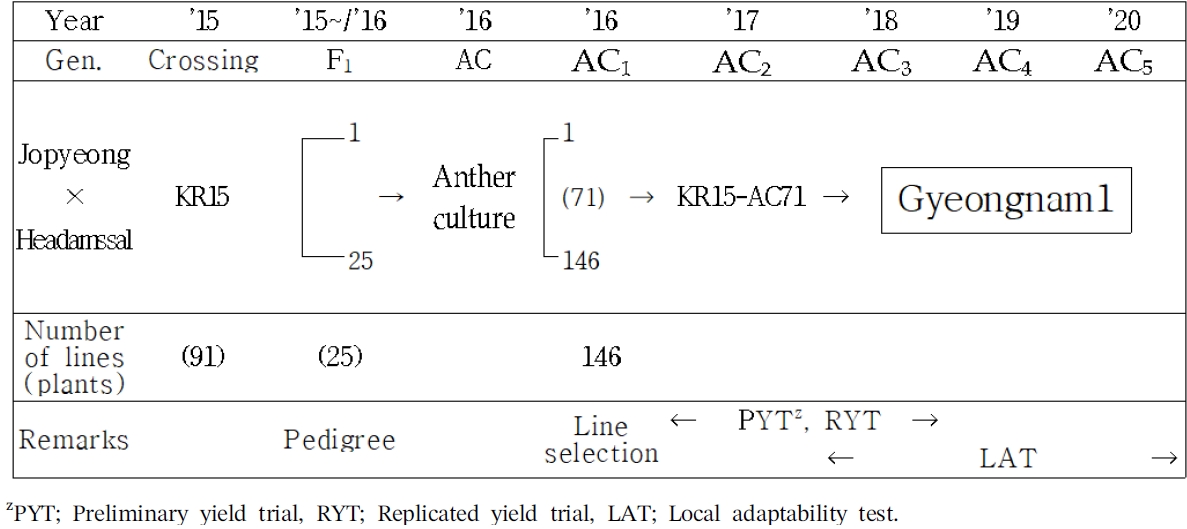
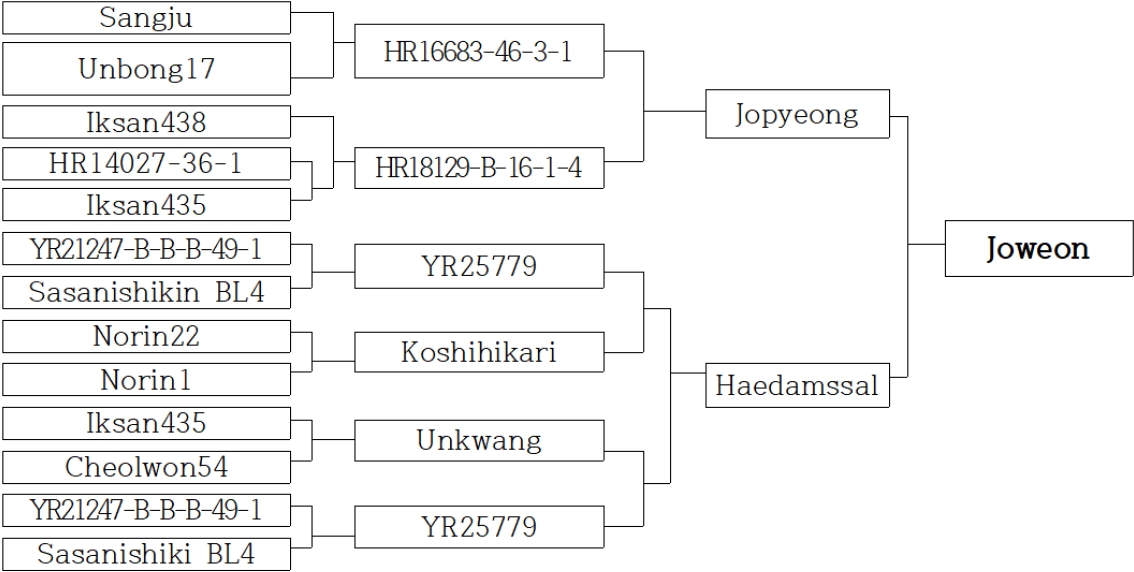
벼 신품종 ‘조원’은 남부지역인 경남에서 추석 전 햅쌀 생산과 양파, 마늘 등 원예작물 후작지에 적용 가능한 고품질의 조생종 품종을 육성하고자 조생종 중에 출수가 빠르면서 수량성이 우수한 ‘조평’ 품종을 모본으로 하고, 조생종 중에 밥맛이 우수하면서 도열병 및 줄무늬잎마름병에 강한 ‘해담쌀’을 부본으로 2015년 하계에 단교잡 인공교배하였다. 교배 이후 고정기간을 단축하기 위하여 동계온실에 이앙된 F
1 식물체를 이용하여 약배양하고, 재분화된 식물체 146개체에서 1이삭씩 수확하였다. 하계에 연구포장에서 일수일열법으로 이앙하여 포장선발과 실내선발을 거쳐 반직립의 초형과 이삭이 양호하면서 현미품위가 우수한 ‘KR15-ACP71’ line을 선발하였다. 1년간 생산력검정을 거쳐 ‘경남1호’라고 계통명을 부여하고, 차년도에는 생산력검정 2년차와 지역적응시험을 동시에 추진하였다. 3년간에 조기재배 4시험지(진주, 밀양, 전주, 나주), 만기재배 3시험지(밀양, 전주, 수원)에서 지역적응시험을 수행한 결과 출수기가 빠르면서, 내도복성, 분상질립 및 싸라기 비율이 낮은 등의 우수한 특성으로 인하여 경상남도농업기술원 농작물 직무육성 신품종선정위원에서 ‘조원’으로 명명되었다. 육성과정, 계보도는
Figs. 1,
2와 같다.
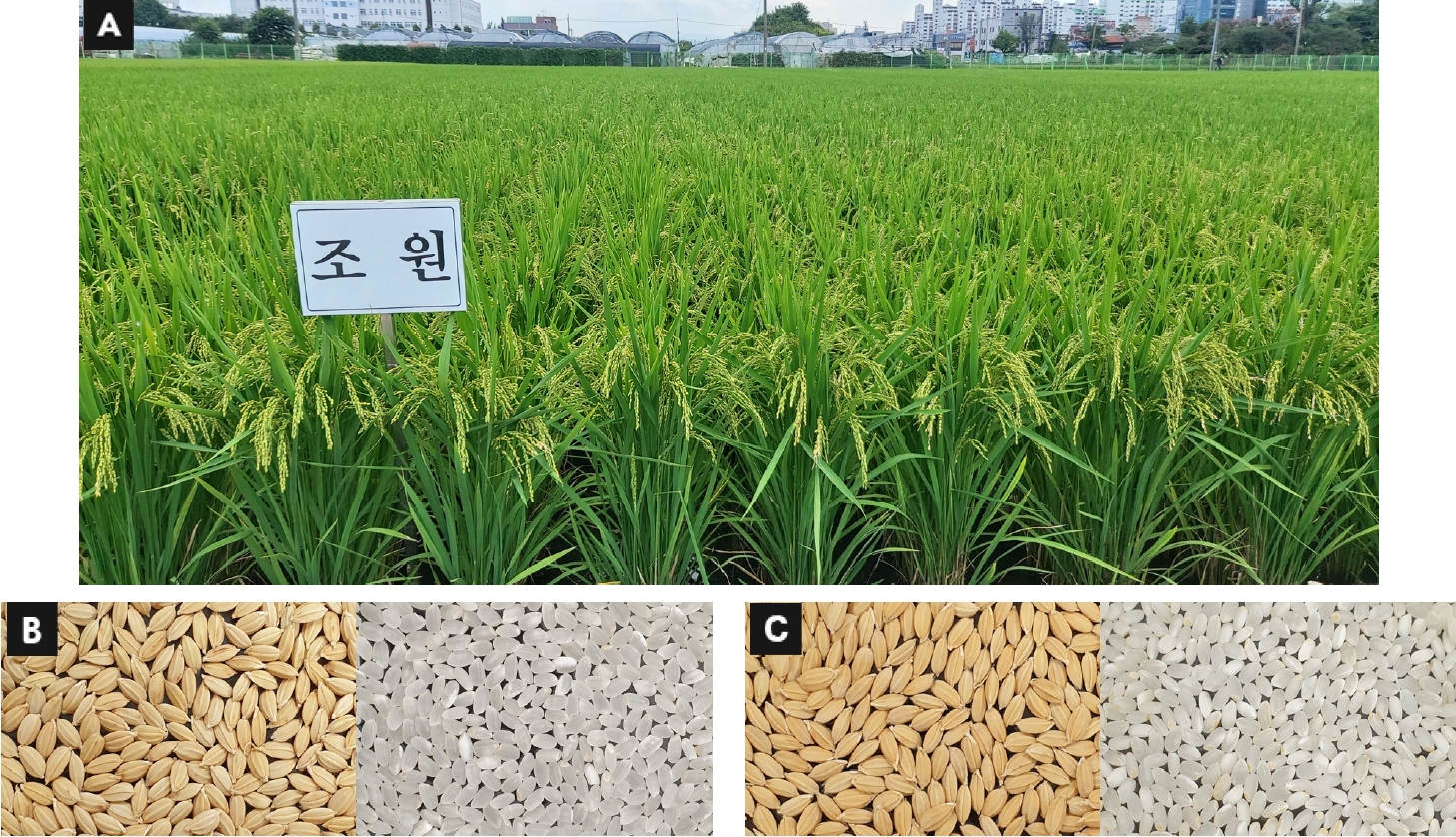
육성 품종인 ‘조원’을 조기재배 시 평균 출수기는 7월 13일로 비교품종 ‘조평’보다 1일 빠르고, 벼 키는 64 cm로 ‘조평’보다 짧은 경향이나 이삭의 길이는 비슷한 경향이었다. 수량 구성요소인 포기당 이삭수는 15개로 비교품종 ‘조평’보다 1개 적으나 이삭당 영화수는 110개로 비교품종 ‘조평’보다 10개 많았다. 등숙률은 ‘조원’이 84.5%로 비교품종 ‘조평’ 81.4%보다 높았으며 현미 천립중은 20.6 g으로 비교품종과의 큰 차이는 없었다(
Table 1,
Fig. 3).
‘조원’ 품종을 50일 묘에서 불시출수는 34.8%로 비교품종인 조평 22.5%, 금오 12.5%보다 높아 안정적인 재배를 위해서 적정한 육묘일수를 지켜서 재배하여야 할 것으로 판단되었다. 위조현상이 적고, 성숙기의 하위엽의 노화가 늦은 편이다. 벼 생육 중에 냉수처리 결과 출수지연일수가 16일로 비교품종인 ‘조평’ 19일 및 ‘금오’ 18일보다 적었고, 임실률은 23%로 ‘조평’보다 낮았다. 출수 이후 40일에 조사하는 수발아검정에서 수발아율이 26.3%로 ‘금오’ 품종에 비하여 수발아에 약한 것으로 조사되어(
Table 2) 수확기 비로 인한 수발아가 우려됨에 따라 적기에 수확하여야 한다.
도복저항성 검정 결과는
Table 3과 같다. ‘조원’의 벼 키는 71 cm로 비교품종 ‘조평’ 75 cm, ‘금오’ 77 cm보다 짧고, 3절간장도 14 cm로 ‘조평’ 및 ‘금오’ 17 cm보다 짧으며 좌절중이 무거운 경향이었다. 초장은 좌절중과 정의 상관, 좌절중은 도복지수와 부의 상관을 3절간장은 도복지수와 정의 상관을 보였다(
Chang et al. 1999,
Lim et al. 1992)는 결과를 볼 때 ‘조원’ 품종이 비교품종보다 도복에 강할 것으로 예측되나, 재배포장에서의 도복지수 차이는 보이지 않았다.
‘조원’ 품종을 전국 12개 잎도열병 밭못자리검정지에서 검정한 결과 11개소에서 강하고, 1개소에서 중간 정도의 저항성을 보여 평균 저항성정도가 2.8로 강한 것으로 조사되었다. 이삭도열병 발병 수율은 전주 지역에서 6.0%로 비교품종인 ‘조평’ 20.9% 비해 낮았으나, 예산 지역에서는 10.3%로 비교품종인 ‘조평’ 3.6%보다는 높아서 잎도열병보다는 이삭도열병 관리가 필요한 품종이다(
Table 4). 세균성 병해인 흰잎마름병의 K1, K2, K3 균계에 대해서는 저항성이며, K3a 균계에서 이병성이었다. 바이러스 병해 중에 줄무늬잎마름병 저항성이나, 오갈병에 저항성은 없었다. 해충 저항성 검정 결과 벼멸구 및 애멸구에 대한 저항성은 없었다(
Table 5).
‘조원’ 품종의 2018~2020년 3년간 쌀 수량은 조기재배에서 진주 527 kg/10a, 밀양 524 kg/10a, 전주 480 kg/10a, 나주 535 kg/10a 평균 516 kg/10a으로 비교품종 ‘조평’의 98% 수준이었다. 만기재배 시에는 밀양 498 kg/10a, 전주 464 kg/10a, 수원 492 kg/10a로 평균 485 kg/10a으로 비교품종 ‘금오’ 대비 107%의 수량성을 보였다(
Table 6).
‘조원’ 품종의 입형은 현미 장폭비가 1.71로 단원형에 속하고(KSVS 2005), 심백 및 복백이 없이 쌀알이 맑고 투명하다. 단백질 함량은 7.0%로 비교품종 7.6%보다 낮고, 아밀로스 함량은 18.5%로 메벼의 특성을 보였다. 취사 후에 윤기치를 측정하여 간접적으로 밥맛을 평가하는 Toyo 윤기치 값은 ‘조원’ 69.2로 ‘조평’과 비슷하였다(
Table 7). 현백률 및 도정률은 ‘조원’이 ‘조평’보다 조금 높은 경향이었고, 쌀 외관 품위 중에 완전미비율이 87%로 높고 특히 분상질립이 적었으며 싸라기 2.1%로 비교품종보다 우수한 특성을 보였다(
Table 8). 쌀의 외관이 우수한 특성으로 조기재배뿐만 아니라 만기재배 비율이 높은 남부지역에 적용 가능한 품종으로 판단된다.
Notes
-
사사
본 논문은 경상남도농업기술원 연구사업(과제명: 경남지역 맞춤형 벼 신품종 육성, 과제번호: LP005461)의 지원에 의해 이루어진 결과의 일부입니다. 품종 육성에 협력해주신 국립식량과학원 및 각도 농업기술원 관계자 여러분께 깊은 감사 드립니다.
Fig. 1.Pedigree diagram of ‘Joweon’.
Fig. 2.Genealogical diagram of ‘Joweon’.
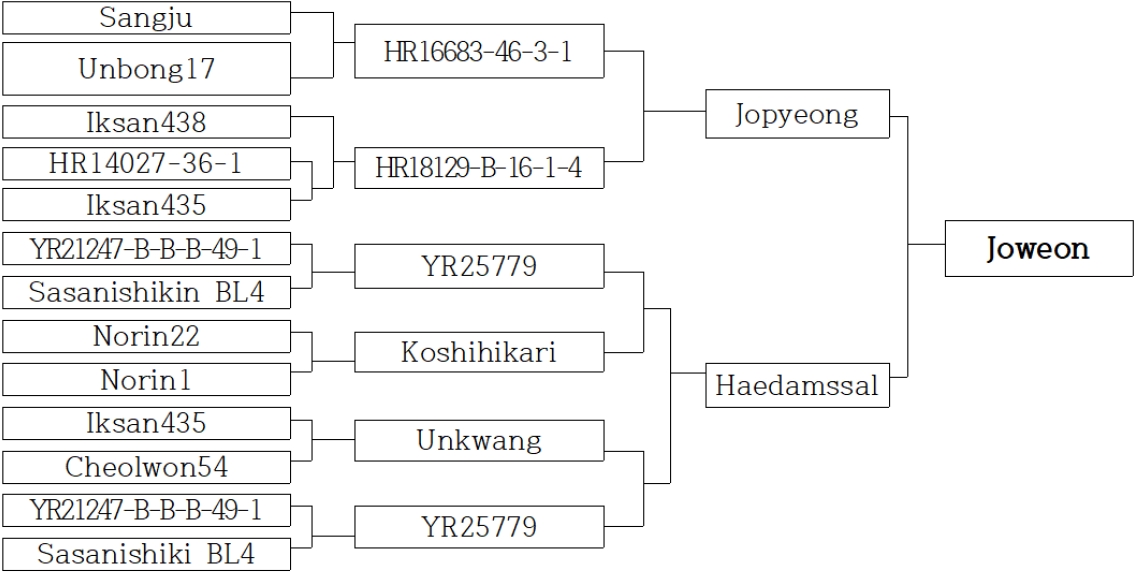
Fig. 3.Plant type of ‘Joweon’ at maturity (A). Grain shape of rough rice and milled rice in ‘Joweon’ (B). Grain shape of rough rice and milled rice in ‘Jopyeong’ (C).
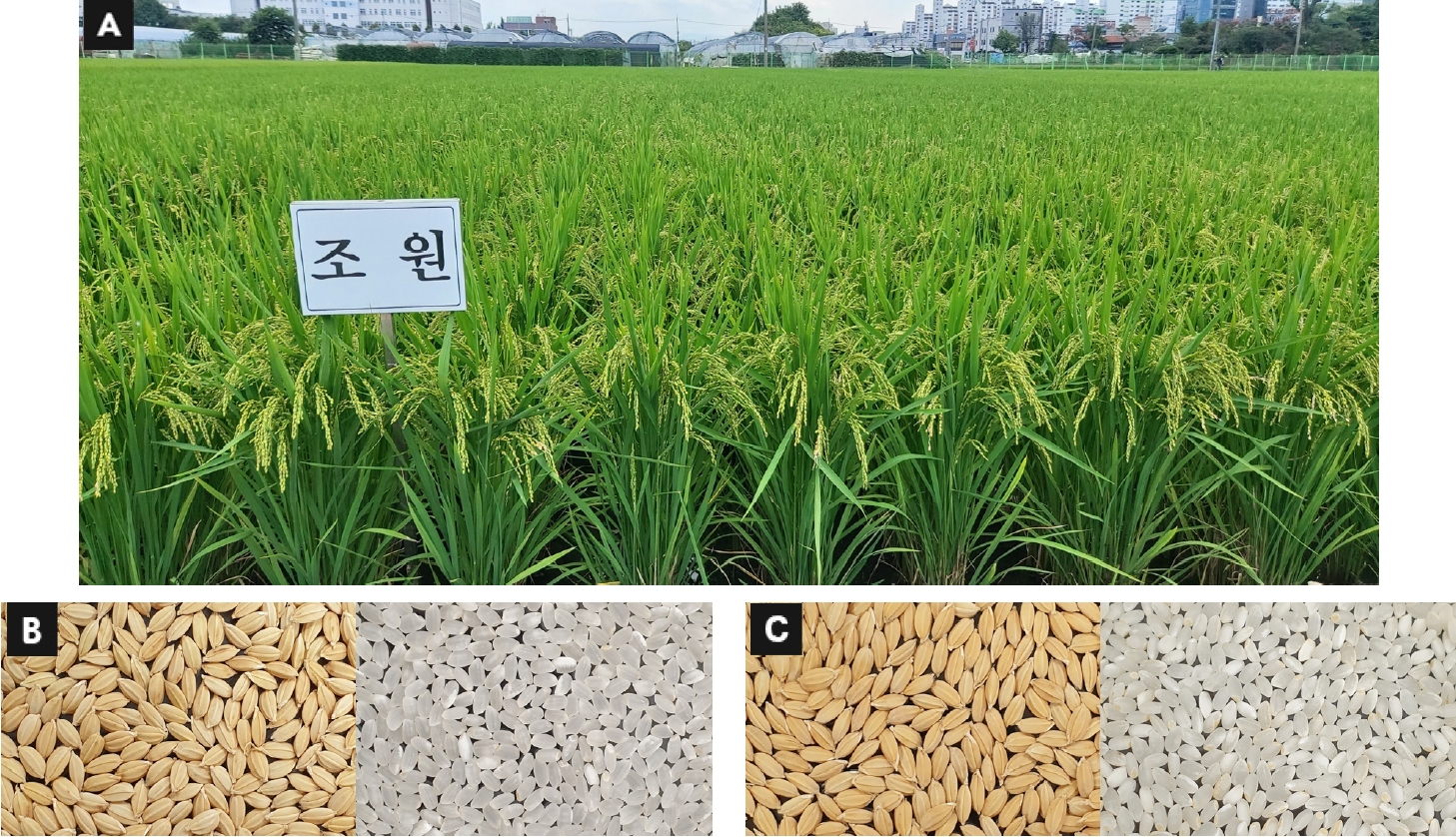
Table 1.Heading date and yield components of ‘Joweon’ and check cultivar (‘Jopyeong’).
Table 1.
|
Variety |
Heading date |
Culm length (cm) |
Panicle length (cm) |
No. of panicle/hill |
No. of spikelet/panicle |
Ratio of ripened grain (%) |
1,000 grain weight of brown rice (g) |
|
Joweon |
Jul. 13 |
64±1.9* z
|
21±0.3ns
|
15±1.5ns
|
110±6.4ns
|
84.5±3.3ns
|
20.6±0.6ns
|
|
Jopyeong |
Jul. 14 |
72±2.7y
|
20±0.3 |
16±1.7 |
100±2.9 |
81.4±6.0 |
20.9±0.6 |
Table 2.Response to physiological and abiotic stresses of ‘Joweon’ and check cultivar (‘Jopyeong’ and ‘Keumo’).
Table 2.
|
Variety |
Premature heading in 50-day-old seedling (%) |
Appearance of wilting |
Adult leaf senescence |
Cold tolerancez
|
Viviparous germinationx (%) |
|
Heading delay (day) |
Grain fertility (%) |
PAy (1~9) |
|
Joweon |
34.8 |
Strong |
Late |
16±0.9aw
|
23±2.2b |
7±0.2a |
26.3±5.2a |
|
Jopyeong |
22.5 |
Strong |
Late |
19±2.3a |
42±3.0a |
6±0.3b |
21.4±2.2a |
|
Keumo |
12.5 |
Strong |
Late |
18±2.9a |
21±1.7b |
7±0.2a |
9.3±6.8a |
Table 3.Characteristics related to lodging of ‘Joweon’ and check cultivar (‘Jopyeong’ and ‘Keumo’).
Table 3.
|
Variety |
Culm length (cm) |
3th Culm length (cm) |
Breaking weight of 3rd internode (g) |
Lodging indexz
|
Field lodging (1~9) |
|
Joweon |
71 |
14 |
996 |
120 |
3 |
|
Jopyeong |
75 |
17 |
784 |
140 |
3 |
|
Keumo |
77 |
17 |
932 |
134 |
3 |
Table 4.Resistance reaction to blast disease of ‘Joweon’ and check cultivar (‘Jopyeong’ and ‘Keumo’).
Table 4.
|
Variety |
Reaction to leaf blast at nursery test
|
No. of susceptible race (24) |
Reaction to neck blast
|
No. of tested sites (12)
|
Rate of disease panicles (%)
|
|
Rz
|
M |
S |
Mean |
Jinju |
Miryang |
Jeonju |
Yaesan |
|
Joweon |
11 |
1 |
0 |
2.8 |
3 |
8.1 |
0.5 |
6.0 |
10.3 |
|
Jopyeong |
12 |
0 |
0 |
1.6 |
2 |
7.0 |
0.0 |
20.9 |
3.6 |
|
Keumo |
8 |
4 |
0 |
2.7 |
9 |
8.1 |
0.0 |
6.1 |
0.0 |
Table 5.Resistance reaction to bacterial blight, virus disease and resistance to insects of ‘Joweon’ and check cultivar (‘Jopyeong’ and ‘Keumo’).
Table 5.
|
Variety |
Bacterial blight
|
Virus disease (%)
|
Resistance to insects
|
|
K1 |
K2 |
K3 |
K3a |
RSVy
|
RDV |
BPHx
|
SBPH |
|
Joweon |
Rz
|
R |
R |
S |
R (7.2) |
S (92) |
S |
S |
|
Jopyeong |
R |
R |
R |
S |
R (14.8) |
R (83) |
S |
S |
|
Keumo |
S |
S |
S |
S |
S (66.8) |
S (87) |
S |
S |
Table 6.Results of yield potential of ‘Joweon’ and check cultivar (‘Jopyeong’ and ‘Keumo’).
Table 6.
|
Culture season |
Region |
Yield of milled rice (kg/10a)
|
Index (B/A) |
Jopyeong (Keumo)
|
Joweon
|
|
'18 |
'19 |
'20 |
Ave (A) |
'18 |
'19 |
'20 |
Ave (B) |
|
Early planting |
Jinju |
515 |
561 |
518 |
531 |
514 |
551 |
515 |
527 |
99 |
|
Miryang |
507 |
587 |
487 |
527 |
485 |
569 |
517 |
524 |
100 |
|
Jeonju |
469 |
508 |
503 |
493 |
459 |
481 |
500 |
480 |
97 |
|
Naju |
576 |
638 |
474 |
563 |
545 |
575 |
484 |
535 |
96 |
|
Mean |
517 |
574 |
496 |
529ns z
|
501 |
544 |
504 |
516 |
98 |
|
Late planting |
Miryang |
(479) |
(487) |
(449) |
(472) |
526 |
497 |
472 |
498 |
106 |
|
Jeonju |
(477) |
(489) |
(331) |
(432) |
490 |
508 |
395 |
464 |
109 |
|
Suweon |
(514) |
(452) |
(424) |
(463) |
538 |
478 |
460 |
492 |
106 |
|
Mean |
(490) |
(476) |
(401) |
(456)*
|
518 |
494 |
442 |
485 |
107 |
Table 7.Characteristics related to grain shape and grain quality of ‘Joweon’ and check cultivar (‘Jopyeong’).
Table 7.
|
Variety |
Brown rice
|
White core/belly |
Protein content (%) |
Amylose content (%) |
Toyo valuez
|
|
Length (mm) |
Width (mm) |
L/W ratio |
|
Joweon |
4.65 |
2.69 |
1.73 |
0/0 |
7.0 |
18.5 |
69.2 |
|
Jopyeong |
4.77 |
2.79 |
1.71 |
0/0 |
7.6 |
17.8 |
68.3 |
Table 8.Characteristics related to milling quality of ‘Joweon’ and check cultivar (‘Jopyeong’).
Table 8.
|
Variety |
Brown/rough rice ratio (%) |
Milled/brown rice ratio (%) |
Milling ratio (%) |
Quality of milled rice (%)
|
|
Head |
Chalky |
Broken |
Damaged |
|
Joweon |
83.8 |
90.1 |
75.6 |
87.0 |
10.0 |
2.1 |
0.1 |
|
Jopyeong |
83.9 |
89.2 |
74.9 |
68.5 |
17.3 |
13.1 |
0.4 |
References
- 1. Chang JK, Kim HY, Yeo US, Lim SJ, Lee KY, Choi HC, Kim SC, Sohn JK. 1999. Varietal difference and factor analysis of lodging tolerance in wet-seeded rice. Korea J Breed 31: 232-238.
- 2. Guh JO, Lee DJ, Heo SM. 2003. Quality and taste of rice. Rural development administration. pp. 261-270.
- 3. Inaba K, Sato K. 1976. High temperature injury of ripening in rice plant, 6: Enzyme activities of kernel as influenced by high temperature. Proc Crop Sci Soc Japan 45: 162-176.
- 4. International Rice Research Institute (IRRI). 1988. Standard evaluation system for rice. 3rd ed. p. 14.
- 5. Juliano BO. 1985. Criteria and test for rice grain qualities. Rice chemistry and technology. St Paul, MN: American Assn. of Cereal Chemists (AACC). pp. 443-524.
- 6. Kobata T, Uemuki N. 2004. High temperatures during the grain-filling period do not reduce the potential grain dry matter increase of rice. Agron J 96: 406-414.
- 7. Korea Seed and Variety Service (KSVS). 2005. The guidelines of characteristics for application and registration on new varieties in rice. Anyang, Korea. pp. 8-14.
- 8. Kwak TS, Choi HC. 1998. Variation of major physico-chemical properties related to grain quality by the rapidity of grain filling in rice. Korean J Breed Sci 30: 44-45.
- 9. Lee JH, Lee JY, Yeo US, Song YC, Park DS, Hwang UH, Park SG, Park NB, Kim SY, Oh SH, Han SI, Nam MH, Lee JG, Cho JH. 2018. ‘Hwawang’: A good quality and early-maturing rice variety adaptable for rice-cash crop rotation system. Korean J Breed Sci 50: 534-539.
- 10. Lim JT, Lee HJ, Cho KS, Song DS. 1992. Analysis of lodging related characteristics in rice plants. Korean J Crop 37: 78-85.
- 11. Rural Development Administration (RDA). 2012. Standard analysis method of agricultural science & technology. pp. 315-338.
- 12. Rural Development Administration (RDA). 2018. 2018 project plan for collaborative research program to develop new variety of summer crop. pp. 4-50.
- 13. Rural Development Administration (RDA). 2019. 2019 project plan for collaborative research program to develop new variety of summer crop. pp. 3-51.
- 14. Rural Development Administration (RDA). 2020. 2020 project plan for collaborative research program to develop new variety of summer crop. pp. 3-47.
- 15. Shin MS, Kim KY, Park HS, Ko JK. 2011. Breeding for resistance to bacterial blight in rice. Korean J Breed Sci 43: 251-261.
- 16. Tashiro T, Wardlaw IF. 1989. A comparison of the effect of high temperature on grain development in wheat and rice. Ann Bot 64: 59-65.