적요
‘Koshihikari’는 일본의 대표적인 고품질 자포니카 품종으로 우리나라에서는 준조생의 출수 특성을 보이며 키가 크고 도복에 약한 특성을 나타낸다. ‘IS592BB’는 우리나라 자포니카 조생종으로 단간 내도복 특성과 복합내병성을 갖춘 재배안정성 품종이다. 본 연구는 ‘Koshihikari’와 ‘IS592BB’를 이용한 재조합 자식 집단을 육성하고 출수기와 수량 관련 형질에 대한 QTL 분석을 수행하였다. 출수기 관련 QTL은 3번, 6번, 8번 염색체에서 탐색되었으며 후보 유전자로 Hd16, Hd1, Hd17, Hd18이 특정되었다. 이 중 Hd1은 출수기 변이에 가장 큰 영향을 미치는 주동 유전자로 확인되었으며, 출수기뿐 아니라 간장, 수장, 수당립수, 제현율 및 1주 수량 등 여러 수량구성요소에 영향을 미치는 다면발현 현상을 나타냈다. 또한 Hd17 역시 출수기와 수당립수 및 천립중 등에 영향을 미치는 것으로 나타났으며, Hd16은 다른 출수기 유전자와의 상호작용에 의해 효과가 가려지는 masking 현상이 관찰되었다. Hd1, Hd16, Hd17, Hd18의 대립유전자형 조합에 따라 출수일수는 약 20일 범위의 변이를 나타냈으며, 일부 조합은 ‘IS592BB’보다 약 4-5일 빠른 출수 특성을 보여 조기 출하형 품종 육성에 활용 가능성이 확인되었다. 간장 관련 QTL은 1번과 11번 염색체에서 탐색되었으며 후보 유전자로 SD1과 OsCPL3가 확인되었다. SD1은 간장뿐 아니라 수장, 수당립수 및 천립중 등 일부 수량 관련 형질 변이와 관련된 것으로 나타났다. OsCPL3는 간장과 제현율이 관련된 QTL 영역에서 탐색되어 간장 및 도정 관련 형질 변이에 관여할 가능성이 제시되었다. 특히 ‘Koshihikari’ 대립유전자형 OsCPL3KS는 ‘IS592BB’ 대립유전자형에 비해 제현율이 높은 특성을 나타내어, 간장 조절과 함께 도정률 향상을 위한 유용한 대립유전자 로 활용될 수 있을 것으로 판단된다.
Abstract
‘Koshihikari’ is a high-quality japonica rice cultivar from Japan, exhibiting a medium-early heading type under Korean conditions, with tall plant height and susceptibility to lodging. ‘IS592BB’ is an early-maturing japonica rice cultivar in Korea, characterized by short culm, lodging tolerance, and multiple disease resistance. In this study, a recombinant inbred line population derived from a cross between ‘Koshihikari’ and ‘IS592BB’ (KSIS_RIL) was developed to investigate the genetic basis of heading date (HD) and yield-related traits through QTL analysis. QTLs associated with HD were identified on chromosomes 3, 6, and 8, and the candidate genes were assigned as Hd1 (Heading date 1), Hd16, Hd17, and Hd18. Among these, Hd1 was identified as the major QTL with the largest effect on HD variation and exhibited pleiotropic effects on multiple yield-related traits, including culm length (CL), panicle length (PL), number of spikelets per panicle (NS), ratio of ripened grain (RRG), brown/rough rice ratio (BRR), and grain yield per plant. Hd17 also affected HD, NS, and 1,000-grain weight (TGW), whereas Hd16 showed a masking effect because of interactions with other heading date genes. Combinations of alleles at Hd1, Hd16, Hd17, and Hd18 resulted in approximately 20 days of variation in HD, and specific allele combinations exhibited 4-5 days earlier heading than ‘IS592BB,’ indicating their potential for developing early-harvest cultivars. QTLs for CL were detected on chromosomes 1 and 11, with SD1 (Semi-dwarf 1) and OsCPL3 (C-terminal domain phosphatase-like 3) identified as candidate genes. SD1 was associated with variations in the CL, PL, NS, and TGW. OsCPL3 was identified within QTL associated with CL and BRR, suggesting its potential involvement in variations in plant architecture and milling-related traits. Notably, the OsCPL3 allele from ‘Koshihikari’ was associated with higher BRR compared to that from ‘IS592BB,’ indicating its potential utility as a favorable allele for improving milling quality in rice breeding programs.
-
Key words: culm length, heading date, Hd1, OsCPL3, QTL, SD1
서언
벼의 출수기는 이삭이 엽초 밖으로 출현하는 시기를 의미하며, 영양생장에서 생식생장으로 전환되는 시점을 나타내는 대표적인 생육 단계이다(
Yoshida 1981). 출수시기는 영양생장 기간의 길이를 조절하여 간장과 같은 초형 형성에 영향을 미치고, 수수 및 수당립수 등 주요 수량구성요소의 형성에도 중요한 역할을 한다. 또한 출수 이후 등숙기 환경조건과 밀접하게 연관되어 종실중, 등숙률 및 제현율 등에 영향을 주며, 결과적으로 최종 수량과 품질을 좌우한다(
Hua et al. 2025,
Liu et al. 2024).
우리나라에서는 벼 품종을 출수시기에 따라 조생종, 중생종, 중만생종으로 구분하며, 이는 지역별 기상 조건과 작부체계에 적합한 품종 선택을 위한 중요한 기준으로 활용된다. 생육기간이 짧은 조생종 벼는 주로 중산간지와 북부평야지에서 재배되어 왔으나, 추석 전 햅쌀 출하, 이모작 등 작부체계의 다양화, 수확시기 다변화를 통한 노동력 분산을 위해 남부평야지 등에서도 재배면적이 증가하고 있다(
Park et al. 2020a). 조생종 재배면적이 확대됨에 따라 재배 목적에 따른 출수기 조절의 필요성이 더욱 커지고 있다. 추석 전 햅쌀 출하를 위해서는 보다 빠른 출수가 요구되는 반면, 고온 등숙에 따른 품질 저하를 회피하기 위해서는 출수기를 일정 수준 지연시킬 필요가 있어 상반된 재배 요구가 동시에 존재한다. 따라서 출수기에 관여하는 유전적 요인에 대한 이해는 다양한 재배환경과 작부체계에 대응할 수 있는 적정 출수형 품종을 개발하는 데 있어 중요한 기반이 된다.
벼의 출수기는 광주기와 온도 등 환경요인과 유전적 요인이 복합적으로 작용하여 결정되는 대표적인 양적 형질로, 그 유전적 기작을 규명하기 위한 연구가 지속적으로 수행되어 왔다. 특히 QTL 분석과 분자유전학적 연구를 통해 다수의 출수기 관련 유전자들이 보고되었으며, 이들은 광주기 반응 경로를 중심으로 상호작용하며 출수시기를 조절하는 것으로 알려져 있다(
Hori et al. 2016). 대표적으로
Hd1, Ehd1, Ghd7, DTH8 등은 상위 조절 유전자로서 출수를 촉진하거나 억제하는 기능을 수행하며,
Hd3a와
RFT1은 플로리겐으로 작용하여 생식생장을 유도하는 핵심 유전자로 밝혀졌다(
Komiya et al. 2008,
Tsuji et al. 2011). 최근에는 유전자 간 상호작용과 대립유전자 조합이 출수기 변이에 중요한 역할을 하는 것으로 보고되면서, 출수기 조절이 단일 유전자 효과가 아닌 복합적인 유전적 네트워크에 의해 결정됨이 강조되고 있다(
Chen et al. 2025,
Hori et al. 2016). 이러한 유전자들은 유전적 배경에 따라 효과가 다르게 발현되므로, 특정 품종을 기반으로 한 유전분석은 유전자 기능과 상호작용을 보다 명확히 규명하는 데 중요한 역할을 한다.
‘Koshihikari’는 일본의 대표적인 자포니카 밥쌀용 품종으로 1956년에 육성되었고 1979년(일본 벼 재배면적의 13.2%) 부터 최근까지 일본에서 가장 넓은 면적(최대 약 30~34%)에서 재배되고 있는 품종이다(
Kobayashi et al. 2018). ‘Koshihikari’는 도정 특성과 밥맛이 우수한 반면, 키가 크고 쓰러짐에 약하며 도열병 등 병해충에 취약하여 재배안정성이 낮은 것으로 알려져 있다. ‘Koshihikari’는 출수기, 초형 및 수량구성요소와 관련된 다양한 형질 변이에 대한 유전적 연구에서 널리 활용되어 왔다. 우리나라에는 2002년 경기도에서 도입하여 국립종자원에 ‘고시히카리’라는 품종명으로 국가품종목록에 등재(등재번호: 01-0001-2002-1, 등재유효기간: 2002년 12월 18일~2032년 12월 31일, 등재 후 10년 단위 유효기간 연장 가능)하였다. ‘Koshihikari’는 우리나라에서도 재배면적이 증가하여 2018년 국내 벼 품종별 재배면적 11위(재배면적 12,925 ha, 비율 1.8%)까지 이를 정도로 재배가 늘었다가 2025년 8,509 ha (품종별 13위, 비율 1.3%)로 재배면적이 줄어들고 있는 것으로 파악되고 있다(RDA 2025, unpublished data). ‘Koshihikari’는 우리나라 남부평야지 보통기 재배 시 출수기가 대략 8월 5일로 일반적인 조생종(약 7월 30일)보다 늦고 중생종(약 8월 10일)보다는 빨라 다른 출수 양식을 가지고 있는 것으로 판단되나 이에 대한 유전적 연구는 미흡한 실정이다(
Ha et al. 2020).
‘IS592BB’는 우리나라 조생종의 평야지 적응성을 향상시키고자 단간 내도복 다수성인 ‘운광’의 유전배경에 벼흰잎마름병 저항성 유전자
Xa21과 줄무늬잎마름병 저항성 유전자
Stvb-i를 도입한 계통이다(
Park et al. 2020b). 여교배와 내병성 저항성 유전자에 대한 분자표지 선발을 통해 육성되었으며, ‘운광’과 유전적 유사도가 95.2%에 이르는 근동질 계통으로서 ‘운광’의 우수한 농업형질을 대부분 유지하면서 병 저항성이 개선되었다(
Lee et al. 2026,
Park et al. 2020b). ‘IS592BB’는 단간 내도복의 우수한 초형과 도열병, 벼흰잎마름병, 줄무늬잎마름병에 대한 복합내병성 특성을 바탕으로 우리나라 밥쌀용 벼 품종의 재배안정성 향상을 위한 교배모본으로 널리 이용되고 있다. 또한 외래자원과의 원연교잡에서 불임률이 낮고 후대계통들의 농업형질 특성이 양호하여, 외래자원이 보유한 세균벼알마름병 저항성과 같은 유용 유전인자를 우리나라 자포니카 벼에 도입하기 위한 유전분석 연구에도 활용되고 있다(
Park et al. 2026). 그러나 ‘IS592BB’의 반복친인 ‘운광’은 중북부 중간지와 남부 중산간지를 주요 적응지역으로 하는 품종으로, 평야지 재배 시 고온 등숙 조건에서 완전미율 저하와 외관 품위 저하 등 쌀 품질 저하가 나타날 가능성이 지적되어 왔다(
Park et al. 2020a). ‘IS592BB’는 ‘운광’의 유전배경을 대부분 유지하는 근동질 계통이므로, 평야지 고온 등숙 조건에서 반복친과 유사한 품질 저하가 나타날 가능성이 있으며, 재배품종으로 활용되기 위해서는 고온 등숙 조건에서의 품질 안정성 개선이 필요할 것으로 판단된다.
본 연구는 일본 고품질 품종 ‘Koshihikari’와 우리나라 재배안정성 품종 ‘IS592BB’를 교배모본으로 이용하여 재조합 자식 집단을 육성하고, 출수기와 수량 관련 형질에 대한 QTL 분석을 수행하였다. 이를 통해 형질 변이에 관여하는 주요 유전자와 대립유전자 조합의 작용을 이해하고, 이러한 정보를 육종사업에 반영하여 고품질 밥쌀용 품종 개발에 기여하고자 하였다.
재료 및 방법
시험재료 및 재배방법
시험재료로 ‘Koshihikari/IS592BB’ 재조합 자식 집단을 이용하였다. 재조합 자식 집단은 ‘Koshihikari’을 모본으로 하고 ‘IS592BB’를 부본으로 2018년 인공교배하여 F1 식물체를 양성한 후 육성되었다. F2 분리집단에서 무작위로 120여 개체의 종실 3립씩 채취한 후 F3세대부터 F6세대까지는 단립계통 육종법(SSD; single seed descent method)으로 세대를 진전하여 동형접합성이 높아진 개체를 선발하였고, 이후 재조합 자식 집단을 구성하는 과정 중 농업적 특성이 비슷한 계통은 제외하고 최종적으로 89개의 재조합 자식 계통(RIL; recombinant inbred line)을 확보하였다. 작성된 ‘Koshihikari/IS592BB’ 재조합 자식 집단을 모부본의 영문 글자를 따 KSIS_RIL로 명명하고 시험에 이용하였다. 2023년 F7세대, 2024년 F8세대 KSIS_RIL과 모부본을 국립식량과학원 벼 포장에 4월 30일 파종하여 5월 30일에 재식거리 30 × 15 cm로 주당 1본씩 2열(52주, 26개체/열)를 2반복으로 이앙하여 예비선발시험을 수행하였다. 시비량은 완효성 비료인 단한번(성분함량 N-P2O5-K2O-Mg, 18-7-9-2%, (주)조비, Seoul, Korea)을 보비 재배 기준에 따라 기비 시기에 1회 살포하였다. 기타 재배관리는 농촌진흥청 표준 재배법에 준하여 실시하였다.
수량 및 입형 관련 형질 조사
예비선발시험에 공시된 재료의 출수기를 조사하고, 성숙기에 평균이 되는 5개체에 대해서 간장, 수장, 수수를 측정하였다. 성숙기에 3주를 예취하여 등숙률 및 수당립수를 조사하였고 30주를 예취하여 정조중을 측정하였다. 수량성은 측정된 정조중을 30주로 나누어 1주당 수량으로 환산하였다. 수확한 정조 500 g을 제현기(FC2R-Y, Yamamoto Co. Ltd, Yamagata, Japan)로 제영하여 제현율을 측정하였다. 선별된 현미 100립에 대한 무게를 3반복으로 측정하여 평균 값을 천립중으로 환산하였다.
DNA 추출 및 유전자형 분석
Genomic DNA 추출은 BioSprint 96 (Qiagen Co., Düren, Germany)을 이용하였다. 샘플을 TissueLyserⅡ (Qiagen Co., Düren, Germany)를 이용하여 마쇄한 후 BioSprint 96 DNA Plant Kit (Qiagen Co., Düren, Germany)를 이용하여 DNA를 추출하였다. KSIS_RIL과 모부본에 대한 유전자형 분석은 우리나라 자포니카 벼 1,225 SNP, 인디카 벼 1,339 SNP에 대한 정보, 단간 유전자
sd1 내 1 SNP, 총 2,565개 SNP로 구성된 Target capture sequencing SNP-genotyping platform을 이용하였다(
Cheon et al. 2019,
Lee et al. 2022). Target capture sequencing SNP-genotyping은 (주)인실리코젠(Yongin, Korea) incoFIT Targeted seq panel을 통해 분석되었다. 모부본 게놈에 대한 resequencing은 (주)인실리코젠(Yongin, Korea) incoFIT Genome Sequencing & Analzer package를 통해 분석되었다.
유전자형 분석을 통해 모부본에 다형성을 나타내는 SNP로 622개를 확보하였다. 이들 SNP 중 시험재료의 유전자형에 대한 결측치가 10개 이상인 마커는 제외하고 총 591개 SNP에 대한 유전자형을 QTL 분석에 이용하였다.
유전자지도 작성 및 QTL 분석
유전자 연관지도는 IciMapping Ver. 4.2 (Chinese Academy of Agricultural Sciences, China)의 Kosambi 방법을 이용한 cM (centiMorgan)을 적용하여 작성하였다(
Meng et al. 2015). 모부본에 다형성을 보인 591개 SNP 마커에 대해 12개 염색체의 연관군별로 Grouping하고 Anchor 순서로 Ordering하여 연관군내 마커의 최적순위를 결정하였다.
KSIS_RIL의 수량 관련 형질에 대한 QTL 분석은 ICIM (Inclusive composite interval mapping) 방법으로 수행하였다. 유의한 QTL을 탐색하기 위한 LOD의 임계값은
p≤0.05 조건으로 1,000회 반복한 permutation test에 의해 결정하였다. 본 연구에서는 탐색된 QTL 중 2년 연속으로 탐색되었으며 LOD 값이 3.7이상인 QTL만 제시하였으며, PVE (Phenotypic Variation Explained by the QTL) 값이 20% 이상인 것은 주동 QTL로 규정하였다(
Ashfaq et al. 2023). 탐색된 QTL과 인접한 후보유전자는 Rice Annotation Project Database (RAP-DB,
https://rapdb.dna.affrc.go.jp/, last updated: 19/March/2025)를 이용하여 검색하였다. 후보유전자에 대한 모부본의 염기서열 다형성은 RiceVarMap v2.0 (
https://ricevarmap.ncpgr.cn/, last updated: 16/September/2024)을 이용하여 확인하였다.
통계분석은 R (The R Foundation for Statistical Computing Platform, Version 4.3.2, released: 31/October/2023)을 이용하였다. 수량 관련 형질에 대한 평균 등 기술통계는 psych 패키지를 이용하였고, t-test를 이용한 유전자의 대립유전자형에 따른 형질 값의 비교, 분산분석 및 Duncan’s Multiple Range Test (DMRT)를 이용한 대립유전자형 조합에 따른 형질 값의 평균간 비교는 agricolae 패키지를 이용하여 수행하였다. 2년간의 각 형질들의 분포에 대한 히스토그램은 ggplot2, ggpubr, cowplot을 이용하여 작성하였고, 형질들의 표현형 분포 판단은 LaplacesDemon을 이용하였다. 형질들의 상관관계는 corrplot을 이용하여 상관분석을 수행하였고, 형질들의 기여도를 판단하기 위해 lavaan, semPlot, OpenMx, tidyverse, knitr, kableExtra, GGally 패키지를 이용하여 경로계수분석을 수행하였다. 출수기 관련 유전자 Hd1, Hd16, Hd17, Hd18이 출수기 변이에 미치는 영향을 선형회귀분석으로 분석하고 ggplot2 패키지를 이용하여 시각화하였다. 출수기 및 간장 관련 유전자형 조합에 따른 형질 값을 비교 분석하기 위하여 ggplot2 패키지를 이용하여 boxplot을 작성하였다.
결과 및 고찰
출수기 및 수량 관련 형질 표현형 분석
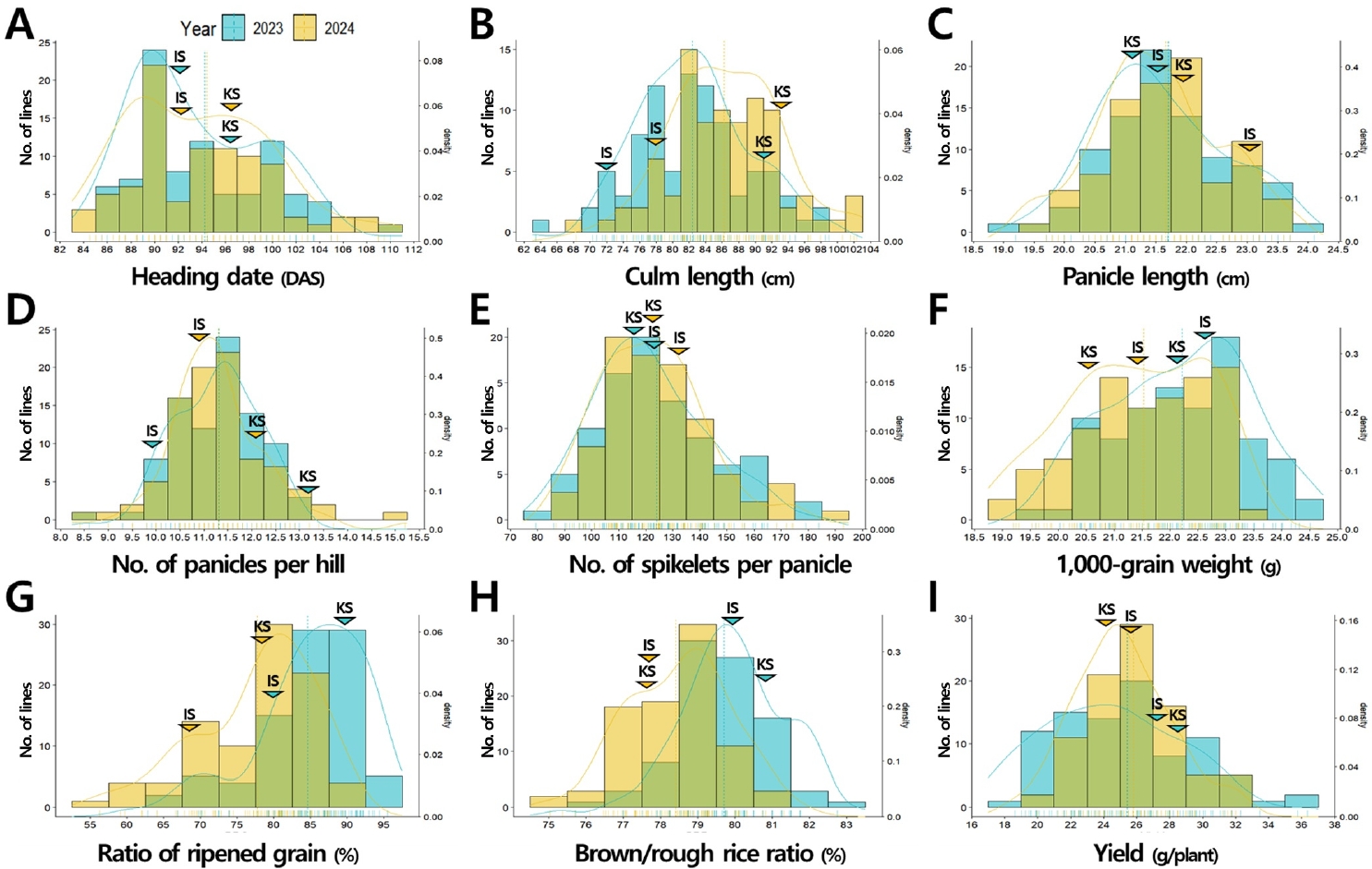
‘Koshihikari/IS592BB’ 재조합 자식 집단(이하 KSIS_RIL)의 출수기 및 수량 관련 형질 QTL 분석을 위하여 모부본과 KSIS_RIL의 출수기, 간장, 수장, 수수, 수당립수, 천립중, 등숙률, 제현율, 1주 수량을 2023년, 2024년 2년간 조사하였다(
Fig. 1). ‘Koshihikari’는 ‘IS592BB’에 비해 출수가 늦었고 간장이 길고 수장은 짧았으며 수수가 많았다(
Figs. 1A-
1D). ‘IS592BB’는 ‘Koshihikari’에 비해 수당립수가 많고 천립중이 무거운 편이었다(
Figs. 1E,
1F). 등숙률은 ‘Koshihikari’가 ‘IS592BB’에 비해 높았으며, 제현율은 2023년에는 ‘Koshihikari’가 높았으나 2024년에는 모부본이 비슷하였고, 수량은 2023년에는 ‘Koshihikari’가 많은 반면 2024년에는 ‘IS592BB’가 높아 경향이 일정치 않았다(
Figs. 1G-
1I). 출수기 및 수량 관련 형질들은 대부분 왜도에 의한 치우침은 있으나 평균을 중심으로 연속적인 정규분포를 나타냈고, 2023년 출수기, 등숙률, 제현율, 2024년 출수기, 수장, 천립중, 등숙률과 같은 일부 형질들은 쌍봉형 분포를 나타냈다(
Fig. 1,
Supplementary Table 1). 여러 유전자가 형질 발현에 영향을 주는 양적형질의 경우 대부분 정규분포를 나타내나 주동 QTL이 작용하는 경우 쌍봉형과 같은 다른 분포를 나타낼 수 있다(
Park et al. 2024a). 2년간 연속적으로 쌍봉형 분포를 나타낸 출수기와 등숙률의 경우 주동 QTL에 영향에 의한 것인지에 대해서는 추가 분석이 필요할 것으로 판단되었다.
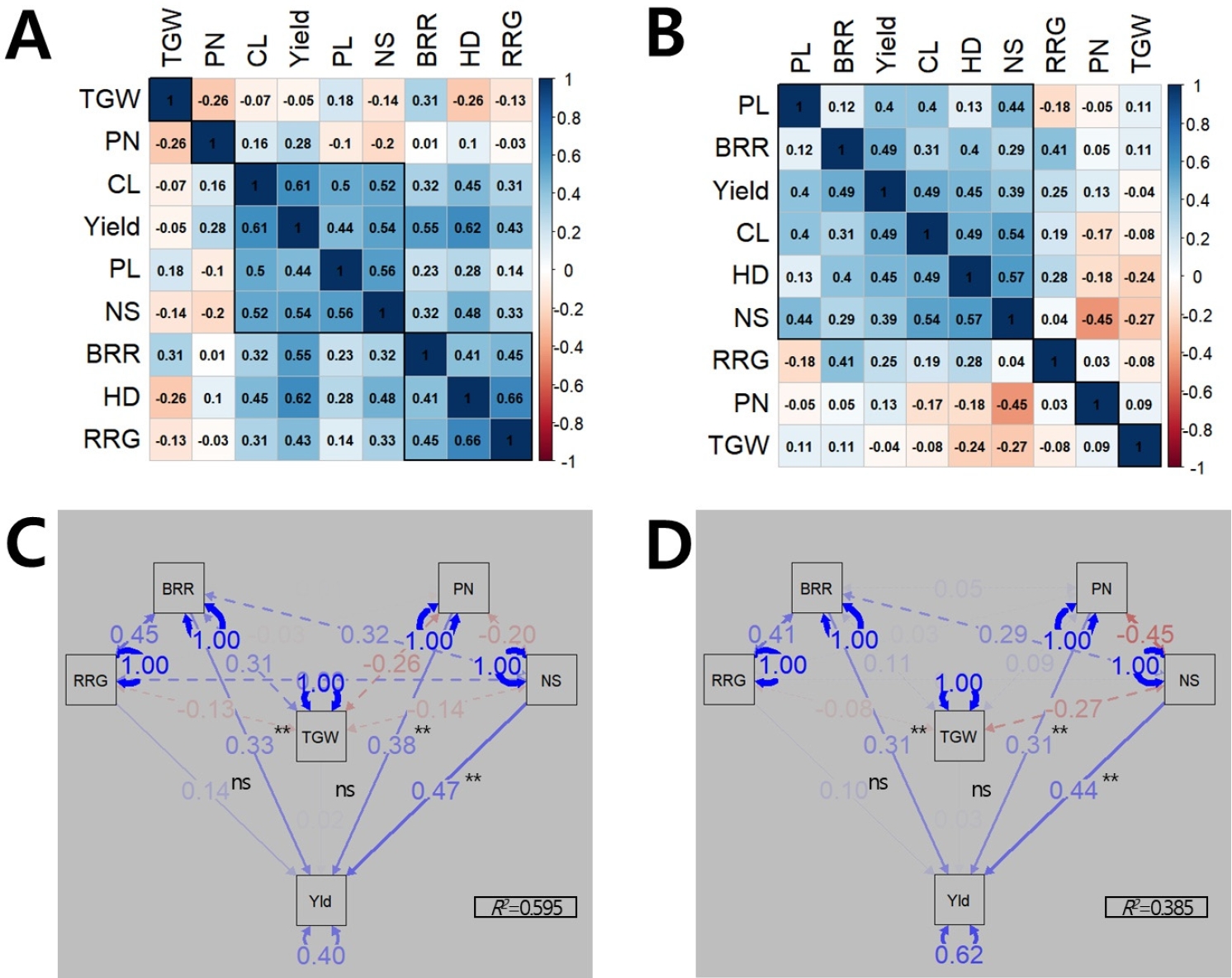
출수기 및 수량 관련 형질들에 간의 상호 관련성을 분석한 결과, 출수기는 2년 연속으로 1주 수량, 수당립수, 간장, 제현율, 등숙률과 정의 상관관계를 나타낸 반면 수수와는 상관이 적었으며 천립중과는 부의 상관관계를 나타냈다(
Figs. 2A,
2B). 간장은 수수와 천립중과 상관이 적었으며 나머지 형질들과는 정의 상관을 나타냈다. 수수는 수당립수와 부의 상관을 나타냈으며 1주 수량과는 정의 상관을 나타냈고 나머지 형질들과는 상관이 적었다. 수량성에 직접적으로 작용하는 수량구성요소(수수, 수당립수, 천립중, 등숙률, 제현율)들의 1주 수량에 대한 기여율을 분석하기 위하여 경로계수분석을 수행하였다(
Figs. 2C,
2D). 경로계수 분석 결과, 수량구성요소들이 수량성을 설명하는 정도를 나타내는 결정계수(
R2)가 2023년에는 0.595, 2024년에는 0.385를 나타내 2023년에는 50%이상을 설명할 수 있었으나, 2024년에는 38.5%에 그쳤다. 2024년에 비해 2023년의 결정계수가 낮게 나타난 것은 연도간 외부 요인에 의한 것으로 판단된다. 두 해 모두 통계적으로 유의한 수준에서 수당립수가 수량성에 관여하는 바가 가장 컸고, 이후 수수, 제현율 순이었으며, 등숙률과 천립중은 수량성에 미치는 영향이 통계적으로 유의하지 않았다.
QTL 분석에 이용한 모부본간 다형성을 나타내는 마커는 591개로 염색체 당 마커 수는 26개(12번 염색체)-105개(11번 염색체)로 Mbp당 평균 마커 밀도는 1.6개(0.9-3.6개)였다(
Supplementary Table 2). 각 염색체의 물리적 위치(Mbp)당 마커 수는
Supplementary Fig. 1과 같다. KSIS_RIL을 대상으로 2년간 조사된 표현형 값을 이용하여 출수기 및 수량 관련 형질에 대한 QTL을 탐색하였다.
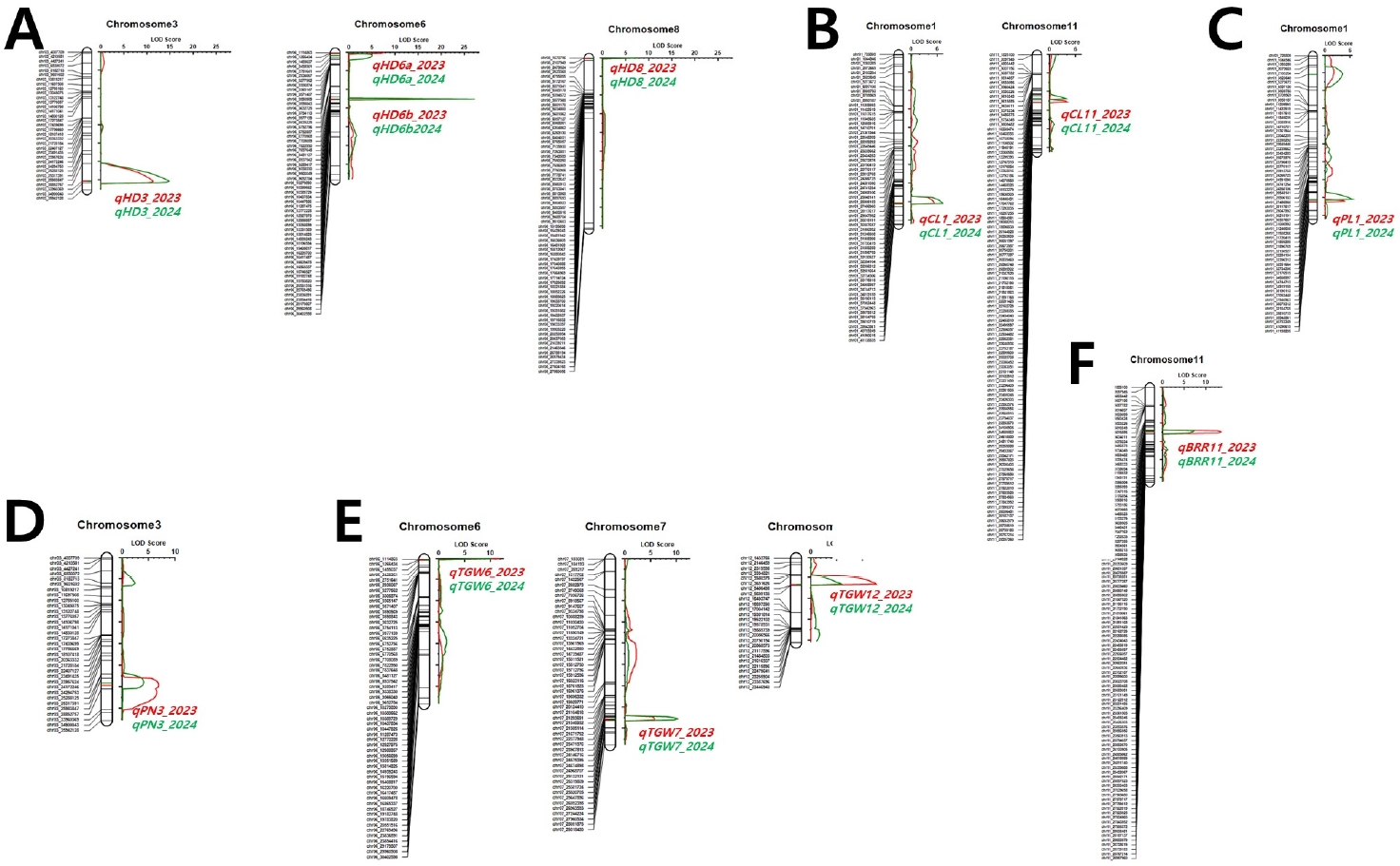
출수기 관련 QTL은 3번, 6번, 8번 염색체의 동일한 유전적 구간으로 간주되는 영역에서 2년 연속으로 탐색되었으며,
qHD3, qHD6a, qHD6b, qHD8로 명명하였다(
Table 1,
Fig. 3A). 해당 3번 염색체에서 탐색된
qHD3는 QTL과 형질 간의 통계적 유의미한 연관성을 나타내는 LOD 값과 QTL이 전체 표현형 변이를 설명할 수 있는 PVE 값이 2023년 11.4, 13.8%였고 2024년은 14.8, 18.2%이었다.
qHD3의 상가적 효과는 -2.40 (2023년), -3.04 (2024년)로 ‘Koshihikari’의 대립유전자형을 가진 계통은 ‘IS592BB’의 대립유전자형을 가진 계통에 비해 출수기가 4.8일(2023년), 6일(2024년) 가량 빨라졌다. 6번 염색체에서는 두 개의 QTL
qHD6a와
qHD6b 탐색되었다. 단완의 선단에서 탐색된
qHD6a는 LOD와 PVE 값이 2023년 7.7, 8.3%였고 2024년 5.1, 5.4%이었다.
qHD6a의 상가적 효과는 1.75 (2023년), 1.56 (2023년)으로 ‘Koshihikari’의 대립유전자형을 가진 계통은 ‘IS592BB’의 대립유전자형을 가진 계통에 비해 출수기가 3.5일(2023년)에서 3.1일(2024년) 가량 늦어졌다. 6번 염색체의 다른 영역에서 탐색된
qHD6b는 LOD와 PVE 값이 2023년 22.5, 40.0%였고 2024년 26.3, 48.3%로 KSIS_RIL의 출수기 표현형 변이를 40% 이상 설명할 수 있을 정도의 주동 QTL이었다.
qHD6b의 상가적 효과는 3.92 (2023년), 4.77 (2024년)으로 ‘Koshihikari’의 대립유전자형을 가진 계통은 ‘IS592BB’의 대립유전자형을 가진 계통에 비해 출수기가 7.8일(2023년)에서 9.5일(2024년) 가량 늦어졌다. 8번 염색체에서 탐색된
qHD8는 LOD와 PVE 값이 2023년 7.9, 8.6%였고 2024년은 7.8, 7.8%이었다.
qHD8의 상가적 효과는 -1.90 (2023년), -2.00 (2024년)로 ‘Koshihikari’의 대립유전자형을 가진 계통은 ‘IS592BB’의 대립유전자형을 가진 계통에 비해 출수기가 3.8일(2023년), 4일(2024년) 가량 빨라졌다.
qHD3, qHD6a, qHD6b, qHD8의 영역에 인접한 출수기 관련 후보유전자를 검색한 결과,
qHD3에서는
Hd16 유전자(Os03g0793500, chr03:32,999,502..33,006,898),
qHD6a에서는
Hd17 (Os06g0142600, chr06:2,234,581..2,239,058),
qHD6b에서는
Hd1 (Os06g0275000, chr06:9336376..9338569),
qHD8에서는
Hd18 (Os08g0143400, chr08:2,385,537..2,389,276)을 확인하였다(
Table 1). KSIS_RIL의 집단 규모가 89개로 적음에도 불구하고 출수기에 관련되는 QTL이 4개가 탐색되었고, 이들은 모두 2년 연속 동일한 위치에서 높은 LOD 값(최대 26.3)과 유의성을 보이며 탐색되었다. 일반적으로 집단 크기가 작을 경우 QTL 검출력이 제한될 수 있으나, 본 연구에서 탐색된 QTL들은 연차 간 재현성이 뚜렷하고 기보고된 주동 유전자들과 위치가 일치한다는 점에서 분석 결과의 신뢰성이 높은 것으로 판단된다.
출수기 변동에 가장 많은 영향을 미치는 것으로 나타난
qHD6b의 후보유전자
Hd1은 우리나라와 같이 고위도에 위치하여 벼의 재배환경이 장일일 경우 정상기능형
Hd1은 출수를 지연하는 기능을 나타낸다(
Yano et al. 2000). 기존 연구결과에서 ‘Koshihikari’는 정상기능형
Hd1을 보유하고 있는 것으로 알려져 있으며(
Mo et al. 2020), 본 연구에서도 ‘Koshihikari’의 대립유전자형을 보유한 계통들은 출수가 지연되는 정상기능형의 특성을 나타냈다(
Table 1). 우리나라 벼 품종에 대한
Hd1 대립유전자형 분석 결과, ‘IS592BB’의 반복친으로 활용된 ‘Unkwang’은 Type 14의 기능상실형 대립유전자를 보유하고 있는 것으로 보고되었다(
Mo et al. 2021). ‘IS592BB’는 ‘Unkwang’을 반복친으로 여교배된 근동질 계통으로 출수 특성이 ‘Unkwang’과 유사하고, 660개 KASP 마커를 이용하여 유전배경을 분석한 결과 ‘Unkwang’으로 93.6%가 회복되었으며
Hd1이 위치하고 있는 6번 염색체의 경우에는 ‘Unkwang’과 유전자형이 동일하였다(
Park et al. 2020b). QTL이 탐색된 물리적 위치, ‘IS592BB’의 반복친이 보유하고 있는
Hd1의 대립유전자형에 대한 기존 보고 결과를 종합하여 볼 때, 본 연구에서 ‘IS592BB’의 대립유전자형을 보유한 계통들이 출수가 빨라지는 특성을 나타내는 점은
qHD6b는
Hd1이며 ‘IS592BB’는 출수가 빨라지는 기능상실형 대립유전자형(
hd1IS)을 보유하는 것으로 판단된다.
3번 염색체에서 탐색된
qHD3의 후보유전자
Hd16은 장일조건에서 출수를 지연하는 기능을 나타내는데, ‘Koshihikari’ 는
Hd16의 10번 엑손에서 비동의성 변이(G-to-A; alanine-to-threonine)가 발생하여 기능상실형 대립유전자형을 보유하고 있고 우리나라 환경조건에서 출수가 촉진되는 것으로 보고되었다(
Hori et al. 2013,
Mo et al. 2020). 본 연구에서 ‘Koshihikari’의 대립유전자형을 보유한 계통들은
Hd16의 기능상실형과 같이 출수가 빨라지는 특성을 나타냈다(
Table 1). KSIS_RIL의 모부본인 ‘Koshihikari’와 ‘IS592BB’의 벼 표준유전체에 대한 염기서열 분석 결과,
Os03g0793500의 10번 엑손 내의 33,002,789 bp 위치에서 ‘Koshihikari’는 기능상실 돌연변이가 발생한 반면 ‘IS592BB’는 표준유전체 ‘Nipponbare’에 같은 염기서열을 가지고 있는 것으로 나타났다(
Supplementary Table 3). QTL이 탐색된 물리적 위치와 모부본에 대한 염기서열 분석 및 출수 특성을 감안할 때,
qHD3는
Hd16이며 ‘IS592BB’는 출수가 지연되는 정상기능형 대립유전자형(
Hd16IS)을 보유하는 것으로 판단된다.
Hd1 (
qHD6b) 이외에 6번 염색체에서 탐색된
qHD6a의 후보유전자
Hd17은 장일조건에서 출수를 지연하는 기능을 나타내는데, ‘Koshihikari’는 출수를 지연하는 정상기능형 대립유전자형을 보유하고 있으며 표준유전체 ‘Nipponbare’는
Hd17 내 염기서열 변이가 발생하여 출수가 촉진되는 기능상실형 대립유전자형으로 가지는 것으로 보고되었다(
Matsubara et al. 2012). 본 연구에서 ‘Koshihikari’의 대립유전자형을 보유한 계통들은
Hd17의 정상기능형과 같이 출수가 지연되는 특성을 나타냈다(
Table 1). KSIS_RIL의 모부본인 ‘Koshihikari’와 ‘IS592BB’의 벼 표준유전체에 대한 염기서열 분석 결과,
Os06g0142600 내 4번째 엑손의 2,235,191 bp 위치에서 ‘Koshihikari’는 정상기능형 염기서열을 가지고 있는 반면 ‘IS592BB’는 표준유전체 ‘Nipponbare’와 같은 기능상실 돌연변이가 발생한 것으로 나타났다(
Supplementary Table 3). QTL이 탐색된 물리적 위치와 모부본에 대한 염기서열 분석 및 출수 특성을 감안할 때,
qHD6a는
Hd17이며 ‘IS592BB’는 출수가 촉진되는 기능상실형 대립유전자형(
hd17IS)을 보유하는 것으로 판단된다.
8번 염색체에서 탐색된
qHD8의 후보유전자
Hd18은 ‘Koshihikari’ 대립유전자형(표준유전체 Nipponbare 동일)에 비해
Hd18 내 염기서열 변이가 발생한 기능상실형 대립유전자 및
Hd18 발현의 억제는 낮 길이 조건에 관계없이 벼의 출수기를 지연하는 것으로 보고되었다(
Shibaya et al. 2016). 본 연구 결과에서 ‘Koshihikari’의 대립유전자형을 보유한 계통들은
Hd18의 정상기능형과 같이 출수가 빨라지는 특성을 나타냈다(
Table 1). KSIS_RIL의 모부본인 ‘Koshihikari’와 ‘IS592BB’의 벼 표준유전체에 대한 염기서열 분석 결과,
Os08g0143400의 1번 엑손 내의 2,388,554 bp 위치에서 ‘Koshihikari’는 표준유전체 ‘Nipponbare’에 같은 염기서열을 나타낸 반면, ‘IS592BB’는 기능상실 돌연변이가 발생한 것으로 나타났다(
Supplementary Table 3). QTL이 탐색된 물리적 위치와 모부본에 대한 염기서열 분석 및 출수 특성을 감안할 때,
qHD8는
Hd18이며 ‘IS592BB’는 출수가 지연되는 기능상실형 대립유전자형(
hd18IS)을 보유하는 것으로 판단된다.
간장 관련 QTL은 1번과 11번 염색체의 동일한 유전적 구간으로 간주되는 영역에서 2년 연속으로 탐색되었으며,
qCL1, qCL11로 명명하였다(
Table 1,
Fig. 3B). 1번 염색체에서 탐색된
qCL1의 LOD와 PVE 값은 2023년 5.2, 22.4%였고 2024년은 7.2, 31.2%로 KSIS_RIL의 간장에 대한 표현형 변이를 20% 이상 설명할 수 있을 정도의 주동 QTL이었다.
qCL1의 상가적 효과는 2.91 (2023년), 3.54 (2024년)으로 ‘Koshihikari’의 대립유전자형을 가진 계통은 ‘IS592BB’의 대립유전자형을 가진 계통에 비해 간장이 5.8 cm (2023년)에서 7.1 cm (2024년) 가량 길어졌다. 11번 염색체에서 탐색된
qCL11는 LOD와 PVE 값이 2023년 4.1, 15.9%였고 2024년은 3.7, 14.5%이었다.
qCL11의 상가적 효과는 2.66 (2023년), 2.60 (2024년)로 ‘Koshihikari’의 대립유전자형을 가진 계통은 ‘IS592BB’의 대립유전자형을 가진 계통에 비해 간장이 5.3 cm (2023년), 5.2 cm (2024년) 가량 길어졌다.
qCL1,
qCL11의 영역에 인접한 간장 관련 후보유전자를 검색한 결과,
qCL1에서는
SD1 유전자(
Os01g0883800, chr01:38382385..38385469),
qCL11에서는
OsCPL3 유전자(
Os11g0521900, chr11:18,740,614..18,747,164)를 확인하였다(
Table 1).
SD1 (
semi-dwarf 1)은 벼의 지베렐린 합성 기작의 후기 단계를 촉진하는 gibberellin 20 oxidase 2 (GA20ox-2)를 암호화하는 반왜성 열성 유전자로 유전자의 기능이 상실된
sd1 대립유전자형들은 정상기능형
SD1에 비해 간장이 줄어든다(
Sasaki et al. 2002). 반왜성 열성 유전자
sd1은 정상 유전자인
SD1의 염기서열의 결실(deletion), 치환(substitution) 또는 프레임쉬프트 돌연변이 등 다양한 원인에 의한 기능 상실 대립유전자형에 의해 발생하고, 5,459개 벼 계통에서 총 11개의
sd1 haplotype들이 보고되었다(
Asano et al. 2007,
Sha et al. 2022). 간장이 길고 도복에 취약한 것으로 알려진 ‘Koshihikari’는 정상기능형 대립유전자형
SD1을 가지고 있는 것으로 보고되었다(
Tomita 2009). KSIS_RIL의 모부본인 ‘Koshihikari’과 ‘IS592BB’의 벼 표준유전체에 대한 염기서열 분석 결과, 단간인 ‘IS592BB’는 ‘Reimei’에서 유래한
sd1-r (g.38385083G>C, 3번 엑손 1 bp 치환) 대립유전자형을 보유하고 있고 ‘Koshihikari’는 해당 영역에서 변이가 발생하지 않은 정상기능형 대립유전자형을 보유하고 있는 것으로 확인되어 간장 관련 탐색된 QTL인
qCL1은
SD1 유전자인 것으로 판단된다(
Supplementary Table 3).
OsCPL3 (C-terminal domain phosphatase-like 3)는 벼에서 RNA polymerase II C-terminal domain phosphatase-like 단백질로서,
OsGSK2 (Glycogen Synthase Kinase 2)의 탈인산화를 통해 브라시노스테로이드(brassinosteroid, BR) 신호전달을 양성 조절하는 것으로 보고되었다(
Gong et al. 2022).
OsCPL3의 기능이 상실될 경우 BR 반응성이 저하되며, 절간 단축에 따른 반왜성화, 잎 직립성 증가에 따른 초형의 compact화, 종실중 감소, 수장 및 지경 감소 등 수량 및 초형 관련 주요 농업형질 전반에 부정적인 영향을 미치는 것으로 나타났다(
Gong et al. 2022). 현재까지
OsCPL3의 기능에 직접적으로 관여하는 자연돌연변이에 대한 보고는 없는 것으로 알려져 있다. 그러나 본 연구에서 KSIS_RIL의 모부본인 ‘Koshihikari’와 ‘IS592BB’를 벼 표준유전체와 비교 분석한 결과, 장간형인 ‘Koshihikari’에서는
OsCPL3 유전자 내 변이가 탐색되지 않은 반면, 단간형인 ‘IS592BB’에서는 총 11개의 SNP와 2개의 INDEL이 탐색되었다. 이들 변이 중 5개 SNP (vg1118744679, vg1118744841, vg1118745356, vg1118745357, vg1118746332)는 아미노산 치환을 유발하는 비동의 치환(non-synonymous substitution) 변이로 분류되었으며, 기능적 영향도는 MODERATE 수준으로 예측되었다(
Supplementary Table 3). 반왜성 형질과 관련된 QTL (
qCL11)이
OsCPL3를 포함하는 염색체 물리적 구간에서 탐색되었고, 모부본 간 유전자 내 염기서열 변이의 존재와 브라시노스테로이드 신호전달을 통한 절간 신장 조절이라는
OsCPL3의 분자적 기능을 종합적으로 고려할 때,
OsCPL3는
qCL11의 유력한 후보유전자로 추정된다(이후
qCL11의 후보유전자로
OsCPL3 표기). 다만, 개별 변이가
OsCPL3의 기능 변화 및 반왜성 표현형에 미치는 직접적인 영향을 규명하기 위해서는 형질전환체를 통한 검증 등 추가적인 유전적⋅기능적 검증 연구가 필요할 것으로 판단된다.
수장 관련 QTL은 1번 염색체의 동일한 유전적 구간으로 간주되는 영역에서 2년 연속으로 탐색되었으며
qPL1으로 명명하였다(
Table 1,
Fig. 3C).
qPL1의 LOD 값과 PVE 값은 2023년 4.6, 22.0%였고 2024년은 6.5, 24.8%로 수장에 대한 표현형 변이를 20% 이상 설명할 수 있을 정도의 주동 QTL이었다.
qPL1의 상가적 효과는 0.47 (2023년), 0.45 (2024년)로 ‘Koshihikari’의 대립유전자형을 가진 계통은 ‘IS592BB’의 대립유전자형을 가진 계통에 비해 수장이 1 cm 가량 길어졌다. 해당 영역은 간장 관련 QTL인
qCL1과 같은 위치로 후보 유전자인
SD1은 간장 뿐만 아니라 수장에도 영향을 주는 것으로 보고되었다(
Park et al. 2024b,
Su et al. 2021).
qPL1의 물리적 위치와
SD1이 수장에 미치는 영향을 고려할 때
qPL1는
SD1인 것으로 판단된다.
수수 관련 QTL은 3번 염색체의 동일한 영역에서 2년 연속으로 탐색되었으며, 해당 QTL을
qPN3으로 명명하였다(
Table 1,
Fig. 3D).
qPN3의 LOD 값과 PVE 값은 2023년 6.9, 23.6%였고 2024년은 4.1, 17.0%이었다.
qPN3의 상가적 효과는 0.53 (2023년), 0.47 (2024년)로 ‘Koshihikari’의 대립유전자형을 가진 계통은 ‘IS592BB’의 대립유전자형을 가진 계통에 비해 평균적으로 수수가 약 1개 정도 많은 것으로 나타났다.
qPN3 영역 인근의 수수 관련 후보유전자를 탐색한 결과,
OsTB1 유전자(
Os03g0706500, chr03:28428504..28430438)가 확인되었다.
OsTB1는
MP3 (
more panicles 3),
SCM3 (
strong culm 3)와 동일유전자로, 식물 뿌리에서 생성되는 스트리골락톤(strigolactone) 신호전달 경로에 관여하여 분지 및 수수 형성을 조절하는 것으로 보고되었다(
Takai et al. 2023,
Yano et al. 2015). 온대 자포니카 벼에서는 수수가 감소하지 않는 ‘Koshihikari’ 대립유전자형(Hap2)이 약 74%로 대부분을 차지하는 반면, 5′UTR에 TGTG 삽입이 존재하여 수수가 감소하는 대립유전자형(Hap6)이 약 26%를 차지하는 등 두 개의 주요 대립유전자형이 보고되었다(
Takai et al. 2023). KSIS_RIL의 모부본인 ‘Koshihikari’와 ‘IS592BB’를 벼 표준유전체와 비교한 염기서열 분석 결과, ‘Koshihikari’는 표준유전체와 동일한 대립유전자형을 나타낸 반면, 수수가 적은 ‘IS592BB’는 5′UTR에 TGTG 삽입이 존재하는 대립유전 자형을 보유하고 있는 것으로 확인되었다(
Supplementary Table 3). 이러한 QTL의 위치 정보, 수수에 대한 상가적 효과, 그리고 모부본 간
OsTB1 대립유전자형 차이를 종합적으로 고려할 때, 수수 관련 QTL인
qPN3의 후보유전자는
OsTB1인 것으로 판단된다.
천립중 관련 QTL은 6번, 7번, 12번 염색체의 동일한 영역에서 2년 연속으로 탐색되었으며,
qTGW6, qTGW7, qTGW12 로 명명하였다(
Table 1,
Fig. 3E). 6번 염색체에서 탐색된
qTGW6의 LOD 값과 PVE 값은 2023년 11.8, 20.9%였고 2024년은 10.1, 21.3%이었다.
qTGW6의 상가적 효과는 -0.52 (2023년), -0.50 (2024년)로 ‘Koshihikari’의 대립유전자형을 가진 계통은 ‘IS592BB’의 대립유전자형을 가진 계통에 비해 천립중이 약 1 g 정도 가벼웠다. 7번 염색체에서 탐색된
qTGW7의 LOD 값과 PVE 값은 2023년 5.8, 8.7%였고 2024년은 10.2, 21.9%이었다.
qTGW7의 상가적 효과는 0.34 (2023년), 0.51 (2024년)로 ‘Koshihikari’의 대립유전자형을 가진 계통은 ‘IS592BB’의 대립유전자형을 가진 계통에 비해 천립중이 0.68 g (2023년), 1.02 g (2024년) 무거웠다. 12번 염색체에서 탐색된
qTGW12의 LOD 값과 PVE 값은 2023년 12.7, 23.8%였고 2024년은 5.9, 11.6%이었다.
qTGW12의 상가적 효과는 -0.55 (2023년), -0.37 (2024년)로 ‘Koshihikari’ 의 대립유전자형을 가진 계통은 ‘IS592BB’의 대립유전자형을 가진 계통에 비해 천립중이 1.10 g (2023년), 0.74 g (2024년) 가벼웠다.
qTGW6, qTGW7, qTGW12의 영역에 인접한 천립중 관련 유전자를 검색한 결과(RAP-DB의 Curated genes에서 ‘grain weight’로 filltering),
qTGW6에서는
Hd17 유전자(
Os06g0142600, chr06:2,234,581..2,239,058),
qTGW7에서는
GW7 유전자(
Os07g0603300, chr7:24,664,328-24,669,321)가 확인되었고,
qTGW12에서는 천립중과 직⋅간접적으로 관련된 유전자는 확인할 수 없었다.
본 연구에서 출수기와 천립중은 2년 연속 유의한 부의 상관관계를 나타내어, 출수가 지연될수록 천립중이 감소하는 경향을 보였다(
Figs. 2A,
2B). 또한 출수기 관련 QTL 분석에서 6번 염색체에서 탐색된
qHD6a의 후보유전자로 추정된
Hd17에 대해 ‘Koshihikari’ 대립유전자형을 가진 계통은 출수가 지연되는 특성을 나타냈다(
Table 1). 출수기 관련 유전자는 출수기 조절뿐만 아니라 수량 형질에 다면발현(pleiotropy) 효과를 나타내는 것으로 보고된 바 있어(
Lee et al. 2024,
Park et al. 2025),
qTGW6은 동일 염색체 영역에서 탐색된 출수기 조절 유전자
Hd17의 간접적인 영향에 의해 검출된 QTL일 가능성이 높은 것으로 판단된다.
GW7 (
Grain Width 7)은 벼에서 세포 분열 방향과 세포 신장을 조절하여 종실 폭 방향의 세포 증식을 억제하고 길이 방향의 세포 신장을 촉진하는 종실 형태 조절 유전자로 보고되었다(
Wang et al. 2015). 국내 육성 272품종을 대상으로 한 대립유전자형 분석에서는
gw7Nipponbare 대립유전자형을 보유한 품종이
GW79311 대립유전자형을 보유한 품종보다 현미 폭과 두께 및 천립중이 증가하는 경향을 나타내었으며, 이는
GW7 유전자가 종실 형태뿐 아니라 천립중에도 영향을 미칠 수 있음을 시사하였다(
Lee et al. 2020). 최근 3,000 Rice Genomes Project 기반 haplotype 분석에서는
GL7/GW7/SLG7 유전자가 상류 조절영역 및 코딩서열의 SNP와 InDel 변이에 따라 9개의 주요 haplotype (H1-H9)으로 구분되었으며, 이 중 11 bp 결실을 포함하는 H1-H4는 기능형, H5-H8은 비기능형 대립유전자로 분류되었다(
Xia et al. 2025). 기능형 대립유전자는 종실 길이를 증가시키고 폭을 감소시키는 경향이 있으며, 열대자포니카 집단에서 주로 분포하는 것으로 보고되었다(
Xia et al. 2025). KSIS_RIL 집단의 모부본 염기서열 분석 결과, ‘Koshihikari’는 표준유전체와 동일한 비기능형 대립유전자형을 보유한 반면,
qTGW7 영역에서 천립중 감소 효과를 나타낸 ‘IS592BB’ 유래 대립유전자에서는 vg0724669233 위치의 11 bp (TATCACTTTCT) 결실이 확인되었다(
Supplementary Table 3). 이러한 결과는 ‘IS592BB’가 기능형
GW7 대립유전자를 보유함을 시사하며, 기능형 대립유전자가 종실 폭 감소를 통해 상대적으로 낮은 천립중과 연관될 수 있다는 선행 연구 결과와도 대체로 일치하였다. 따라서
qTGW7의 후보유전자는
GW7인 것으로 판단된다.
제현율 관련 QTL은 11번 염색체의 동일한 물리적 영역에서 2년 연속으로 탐색되었으며,
qBRR11로 명명하였다(
Table 1,
Fig. 3F).
qBRR11의 LOD 값과 PVE 값은 2023년 13.5, 35.2%였고 2024년은 7.3, 32.2%로 제현율에 대한 표현형 변이를 20% 이상 설명할 수 있을 정도의 주동 QTL이었다.
qBRR11의 상가적 효과는 0.87 (2023년), 0.77 (2024년)로 ‘Koshihikari’의 대립유전자형을 가진 계통은 ‘IS592BB’의 대립유전자형을 가진 계통에 비해 제현율이 1.74% (2023년), 1.54% (2024년) 높았다.
qBRR11이 탐색된 영역은 간장 관련 QTL인
qCL11과 물리적으로 중복되는 영역으로, 해당 구간의 유력한 후보 유전자로
OsCPL3가 추정되었다. 모부본의 염기서열 비교 분석 결과, ‘Koshihikari’는 표준유전체와 동일한 정상기능형 대립유전자형을 보인 반면, ‘IS592BB’는 브라시노스테로이드 신호전달 저하와 연관될 가능성이 있는 다수의 유전자 내 변이를 보유하고 있어 기능 저하형 대립유전자형일 가능성이 제시되었다. 현재까지
OsCPL3가 종실의 제현율에 직접적으로 관여한다는 보고는 없으나,
OsCPL3의 기능 저하는 반왜성화, 잎 직립화, 종실중의 감소 등에 영향을 미치는 것으로 보고되어 식물체 생장과 동화산물 축적에 영향을 미치는 형질 변화를 유발하는 것으로 알려져 있다(
Gong et al. 2022). 이러한 생육 및 초형 변화는 등숙 과정과 제현율에도 간접적인 영향을 미칠 수 있으므로,
qBRR11에서 탐색된 제현율 변이에
OsCPL3가 관여할 가능성이 제기된다. 다만, 해당 유전자의 제현율에 대한 직접적인 기능을 규명하기 위해서는 추가적인 검증이 필요할 것으로 판단된다.
출수기 관련 형질 QTL의 후보유전자인
Hd1,
Hd16,
Hd17,
Hd18이 수량 관련 형질에 미치는 영향을 분석하였다. 네 개의 출수기 관련 유전자 중
Hd1,
Hd17,
Hd18은 대립유전자형 간 비교에서 출수일수에서 통계적으로 유의한 차이를 보인 반면,
Hd16은 통계적으로 유의한 차이가 나타나지 않았다(
Table 2). 우리나라 환경 조건에서 출수가 지연되는것으로 알려진 정상기능형 대립유전자형
Hd16IS는 기능상실형
hd16KS에 비해 출수기에 대한 차이는 확인되지 않았으나, 수수가 0.5개 감소하였으며 천립중이 0.5 g 증가하였고 1주 수량은 1.8 g 감소하였다. 본 연구에서 출수기 관련 QTL인
qHD3의 후보유전자로 탐색된
Hd16에서 대립유전자형에 따른 출수기 변이가 관찰되지 않은 것은 출수기 조절에 관여하는 다른 유전자들의 작용으로 인해
Hd16의 효과가 가려지는 masking 현상이 발생했기 때문으로 판단된다. 이와 같은 출수기 관련 주동유전자에 의한 미동유전자의 masking 현상은 ‘보람찬/Pecos’ 재조합 자식집단을 이용한 선행 연구에서도 보고된 바 있으며, 주동유전자인
Hd1의 대립유전자형이 고정된 조건에서만 미동유전자인
Hd6의 대립유전자형에 따른 출수기 표현형 차이가 통계적으로 유의하게 나타나는 것이 확인되었다(
Park et al. 2025). 본 연구에서 탐색된
Hd16의 경우에도 출수기 관련 대립유전자형 조합에 따른 층화 분석을 수행하여 다른 출수기 유전자의 영향을 배제할 경우, masking 현상 없이
Hd16이 출수기 및 수량 관련 형질에 미치는 고유한 효과를 보다 명확히 평가할 수 있을 것으로 판단된다. 한편,
Hd16의 대립유전자형에 따라 수수, 천립중 및 1주 수량성에서 차이가 나타난 것은
Hd16이 위치한 3번 염색체 하단부가 수수의 후보유전자인
OsTB1과 물리적으로 인접한 영역에 해당하며(
Supplementary Fig. 2A), 출수가 지연되는
Hd16IS와 수수가 감소하는
OsTBTGTG (IS592BB 대립유전자형) 간의 연관에 따른 간접적 효과가 반영된 결과로 해석된다.
출수기 관련 주동 유전자로 알려진
Hd1은 출수기 뿐만 아니라 간장, 수장, 수당립수, 등숙률, 제현율, 1주 수량에 영향을 미치는 다면발현(pleiotropy) 현상을 나타냈다(
Table 2).
Hd1에 의한 이러한 다면발현 효과는 국내 육성 293개 품종 및 ‘보람찬/Pecos’ 재조합 자식집단을 이용한 선행 연구에서도 보고된 바 있다(
Mo et al. 2021,
Park et al. 2025). 우리나라 재배 환경에서 출수를 지연시키는 것으로 알려진 정상기능형 대립유전자형
Hd1KS은 기능상실형
hd1IS에 비해 출수일수가 7일 늦어졌으며 간장은 6 cm 증가하였으며 수당립수는 23개 증가하였다. 또한 등숙률과 제현율은 각각 4.3%와 0.9% 증가하였고, 그 결과 1주 수량은 3.9 g 증가하였다.
Hd1과 동일한 6번 염색체에서 탐색된
Hd17 역시 출수기 뿐만 아니라 간장, 수당립수, 천립중, 제현율 및 1주 수량성에 영향을 미치는 다면발현 현상을 나타냈다(
Table 2). 정상기능형 대립유전자형
Hd17KS는 기능상실형
hd17IS에 비해 출수일수가 5일 지연되었고, 간장은 4 cm, 수당립수는 13개, 제현율은 0.7%, 1주 수량은 2.3 g 증가한 반면, 천립중은 0.8 g 감소하였다. 이와 같이
Hd1과
Hd17은 출수일수가 증가하는 대립유전자형에서 수당립수는 증가하고 천립중은 감소하는 공통적인 경향을 보였다(
Table 2). 특히
Hd17은 천립중에 대한 후보유전자로 추정되었으며(
Table 1), 수당립수에 대한 QTL 분석 결과, 2024년에는 6번 염색체의
Hd1 및
Hd17 인근 영역에서 두 개의 QTL (
qNS6a_2024, qNS6b_2024)이 탐색되었고 2023년에는 동일한 두 유전자 사이의 영역에서 하나의 QTL (
qNS6_2023)이 탐색되어(
Supplementary Fig. 2B), 6번 염색체 단완 영역은 출수기 조절과 함께 수당립수 및 천립중에 동시에 영향을 미치는 주요 유전자 영역으로 판단된다. 이러한 현상은 출수기 관련 유전자가 수당립수와 천립중의 sink size를 직접적으로 조절하기보다는, 출수 지연에 따른 영양생장 기간의 연장이 수당립수 증가를 유도하고, 그 결과 립수 증가에 따른 종실당 동화산물 분배의 제한이 종실 크기 감소로 이어지는 상충 관계(trade-off)가 작동한 결과로 추정된다.
Hd18은 출수기와 1주 수량에 영향을 미쳤으며,
Hd1 및
Hd17과는 달리 기능상실형 대립유전자(
hd18IS)가 정상기능형 대립유전자(
Hd18KS)에 비해 출수일수가 5일 지연되고 1주 수량이 1.2 g 증가하는 특성을 보였다(
Table 2). ‘참동진/영호진미’ 재조합 자식집단을 이용한 선행 연구에서는 출수가 지연되는 기능상실형 대립유전자
hd18의 도입 시 제현율 감소 가능성(0.3% 감소, 통계적 유의함)에 대한 검토가 필요함을 제시한 바 있다(
Park et al. 2024b). 그러나 ‘고시히카리/IS592BB’ 재조합 자식집단을 이용한 본 연구에서는 제현율에 있어 대립유전자형 간 통계적으로 유의한 차이가 나타나지 않았으며, 오히려 기능상실형 대립유전자(
hd18IS)가 정상기능형(
Hd18KS)에 비해 제현율이 0.2% 높은 경향을 보였다. 이러한 결과로부터 고온 등숙 회피를 목적으로
hd18 대립유전자를 활용할 경우, 제현율 감소를 포함한 다른 수량 관련 형질에 대한 부정적 영향은 제한적일 것으로 판단된다.
Hd1, Hd16, Hd17, Hd18 대립유전자형 조합이 출수기 및 수량 관련 형질에 미치는 영향
출수기 관련 유전자 간 상호작용에 따른 masking 효과를 배제하고,
Hd1,
Hd16,
Hd17,
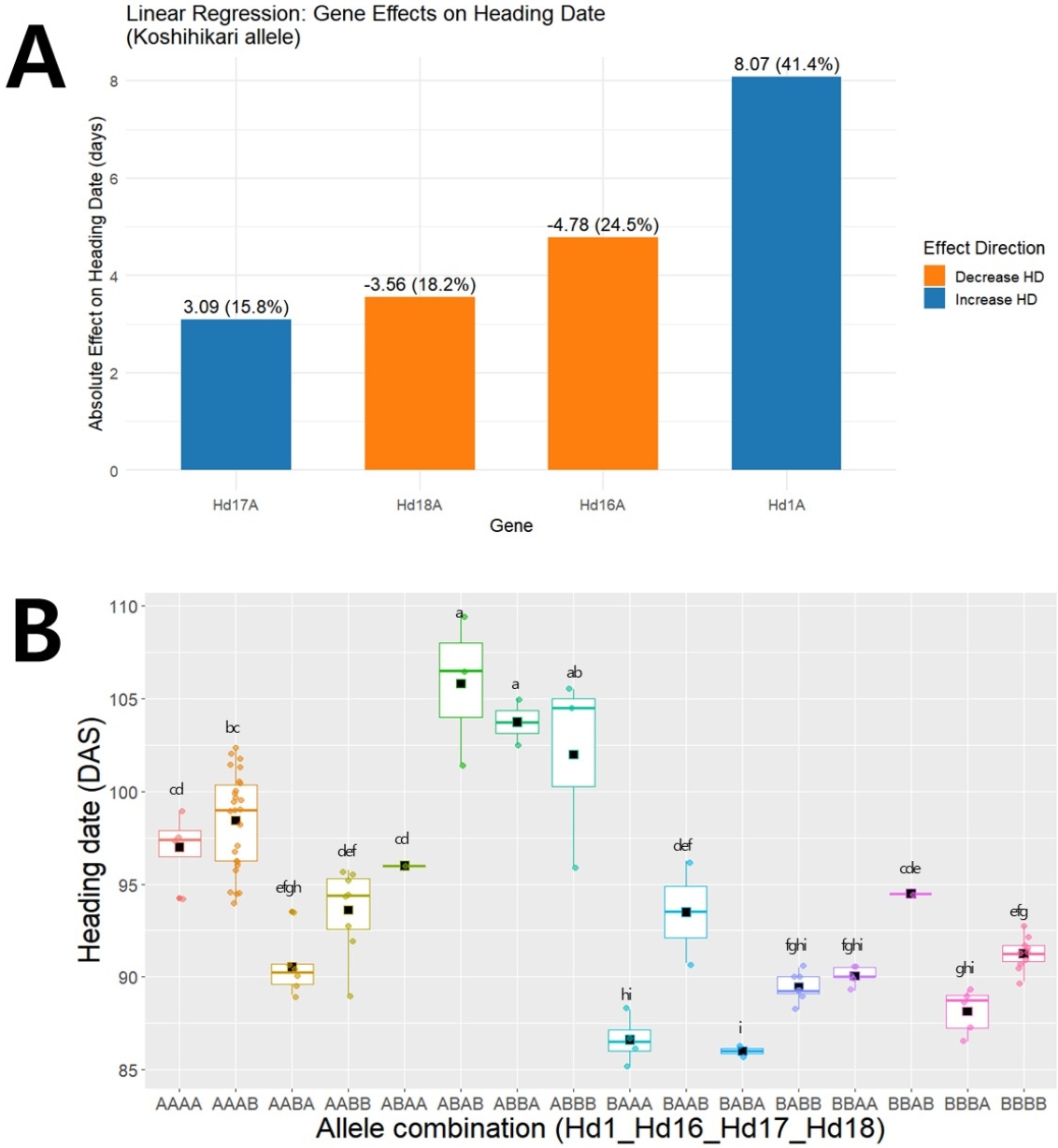
Hd18 각각의 대립유전자형이 출수기와 수량 관련 형질에 미치는 영향을 확인하고자 대립유전자의 누적 효과를 선형회귀 분석으로 분석하였다(
Fig. 4A). 그 결과, Hd1A (
Hd1KS)와
Hd17A (
Hd17KS)는 출수기를 지연시키는 방향으로,
Hd16A (
hd16KS)와
Hd18A (
Hd18KS)는 출수기를 촉진하는 방향으로 작용하였다. 출수기에 대한 유전자의 절대적 영향 크기는
Hd1이 8.07일로 가장 컸으며, 그 다음으로
Hd16 (4.78일),
Hd18 (3.56일),
Hd17 (3.09일) 순으로 나타났다.
Hd16의 경우 단독 대립유전자형 간 비교에서는 출수기에서 유의한 차이가 나타나지 않았으나(
Table 2), 다른 출수기 관련 유전자와의 대립유전자형 조합을 고려한 분석을 통해 그 효과가 명확히 드러났다(
Fig. 4A). 이는
Hd16의 출수기 조절 효과가
Hd1 등 다른 유전자의 영향에 의해 가려지는 masking 현상이 발생했기 때문으로 판단되며, 유전자 간 상호작용을 배제한 조건에서
Hd16 본연의 출수기 조절 기능을 확인할 수 있음을 보여준다.
유전자별 출수기 조절 효과를 바탕으로,
Hd1,
Hd16,
Hd17,
Hd18의 대립유전자형 조합에 따른 출수기 분포를 비교 분석하였다(
Fig. 4B,
Table 3). KSIS_RIL 집단에서는 네 개 유전자로 구성 가능한 총 16개 대립유전자형 조합이 모두 존재하는 것으로 확인되었다. 출수를 촉진하는 방향으로 작용하는 대립유전자형들로 구성된
hd1IS-
hd16KS-
hd17IS-
Hd18KS 조합(BABA)은 2년 평균 출수일수 86일로 가장 빠른 출수를 보였으며, 반대로 출수를 지연하는 방향으로 작용하는 대립유전자형들로 구성된
Hd1KS-
Hd16IS-
Hd17KS-
hd18IS 조합(ABAB)은 평균 출수일수 106일로 가장 늦은 출수를 나타냈다. 모부본과 동일한 대립유전자형 조합을 비교한 결과, ‘Koshihikari’와 동일한
Hd1KS-
hd16KS-
Hd17KS-
Hd18KS 조합(AAAA)은 평균 출수일수 97일을 나타냈으며, ‘IS592BB’와 동일한
hd1IS-
Hd16IS-
hd17IS-
hd18IS 조합(BBBB)은 91일로 나타나, 모부본의 대립유전자형 조합 간 출수기 차이는 약 6일 수준이었다. 반면, 전체 집단에서 가장 빠른 조합과 가장 늦은 조합 간 출수기 차이는 약 20일로 크게 확대되어, 대립유전자형 조합에 따라 출수기 변이가 현저히 증가함을 확인할 수 있었다(
Fig. 4B). 이러한 결과는 개별 유전자의 대립유전자형 효과가 조합에 따라 누적되거나 상호작용함으로써 출수기 변이가 보다 명확하게 분화됨을 보여준다.
출수기 관련 유전자의 대립유전자형 조합은 수량 관련 형질에도 영향을 미치는 것으로 확인된다(
Table 3). 출수일수가 짧은 조합은 출수일수가 긴 조합에 비해 간장과 수장이 짧고 수당립수가 적으며, 등숙률, 제현율 및 1주 수량이 전반적으로 낮은 경향을 보였다. 이는 출수 지연에 의해 확보된 영양생장 기간의 증가가 sink 형성 및 동화산물 축적에 유리하게 작용하여 수량 관련 형질의 향상으로 이어진 것으로 판단된다. 그러나 대립유전자형 조합 간 수량 관련 형질의 변화 양상은 출수일수의 증가에 따라 단순히 선형적으로 나타나지 않았으며, 일부 조합에서는 출수일수가 증가함에도 불구하고 천립중 감소나 수량성 정체가 관찰되었다. 따라서 출수기 관련 유전자 조합은 출수일수 조절을 통해 수량 관련 형질 전반에 영향을 미치되, 그 효과는 개별 형질 간 균형과 조합에 따라 달라지는 것으로 판단된다.
간장 관련 형질 QTL의 후보유전자인
SD1과
OsCPL3가 수량 관련 형질에 미치는 영향을 분석하였다.
SD1은 간장, 수장, 수당립수, 천립중 및 1주 수량성에 영향을 미치는 것으로 나타났다(
Table 4). ‘Koshihikari’가 보유한 정상기능형 대립유전자
SD1KS는 ‘IS592BB’가 보유한 기능상실형 대립유전자
sd1IS에 비해 간장과 수장을 길게 하고, 수당립수와 천립중 및 1주 수량성을 증가시키는 것으로 나타났다. ‘보람찬/Pecos’ 재조합 자식집단을 이용한 수량 관련 QTL 분석에서는 ‘보람찬’ 유래 단간 대립유전자형
sd1-r이 간장을 단축시키는 효과를 보였으나, 다른 수량 관련 형질에는 유의한 영향을 미치지 않는 것으로 보고되었다(
Park et al. 2025). 반면, ‘참동진/영호진미’ 재조합 자식집단을 이용한 분석에서는 ‘영호진미’ 유래 단간 대립유전자형
sd1-r의 도입이 간장 단축을 통해 도복 경감에는 긍정적으로 작용할 수 있으나, 등숙률과 수량을 감소시키는 부정적인 영향도 나타나는 것으로 보고되었다(
Park et al. 2024b). 또한
Park et al. (2024b)는
sd1 도입 효과가 유전적 배경에 따라 달라질 수 있으며, 향후 국내 벼 재배에서 질소질 비료 사용량이 감소할 가능성을 고려할 때, 국내 재배품종 배경에서
sd1 대립유전자형의 효과를 면밀히 평가하고 이를 육종사업에 반영할 필요가 있다고 제안하였다. 본 연구에서도
SD1의 단간 대립유전자형의 도입 시 간장 단축의 효과는 발생하였으나 수장, 수당립수, 천립중이 같이 줄어들며 수량성이 낮아지는 점이 확인되어 육종사업에서
SD1 활용 시 유전 배경에 따라 대립유전자형이 간장 이외에 다른 형질 특성에 부정적인 영향을 미치는 지에 대한 대한 검토가 필요할 것으로 판단된다.
OsCPL3은 간장, 수당립수 및 제현율에 영향을 미치는 것으로 나타났다(
Table 4). ‘Koshihikari’가 보유한 정상기능형 대립유전자
OsCPL3KS가 ‘IS592BB’가 보유한 기능상실형 대립유전자
OsCPL3IS에 비해 간장이 길고 수당립수가 많으며 제현율이 높은 것으로 나타났다. 본 연구결과에서
OsCPL3는 간장뿐만 아니라 제현율에 대한 후보유전자로 추정되었으며(
Table 2), 수당립수에도 영향을 미치는 것으로 확인되었다. 이는 브라시노스테로이드 신호전달에 관여하는
OsCPL3의 기능에 의한 것으로 추정된다. 간장뿐만 아니라 제현율에도 영향을 미치는 것으로 확인된
OsCPL3은
SD1에 비해 연구결과가 많지 않고 우리나라 벼 육종사업에서 활용된 사례 또한 보고된 바 없어 향후 이에 대한 추가 연구가 수행된다면 간장 조절과 제현율 향상에 도움이 될 것으로 생각된다.
SD1, OsCPL3 대립유전자형 조합이 간장 및 수량 관련 형질에 미치는 영향
SD1과
OsCPL3의 대립유전자형 조합이 간장 및 수량 관련 형질에 미치는 영향과 유전자들의 상호작용을 분석하였다. ANOVA (Analysis of Variance) 분석 결과,
SD1과
OsCPL3 모두 간장에 영향을 미쳤으며
SD1이 더 큰 영향을 미치는 것으로 나타났다(
Supplementary Table 4). 간장 이외에
SD1은 수장, 수당립수, 천립중 및 1주 수량성에 영향을 미쳤으며,
OsCPL3는 수당립수와 제현율에 영향을 미쳤다. 수량 관련 형질에 대해서 두 개의 유전자간 상호작용 효과는 없는 것으로 나타났다. KSIS_RIL 집단에서는 두 개 유전자로 구성 가능한 4개의 대립유전자형 조합이 존재하는 것으로 확인되었다(
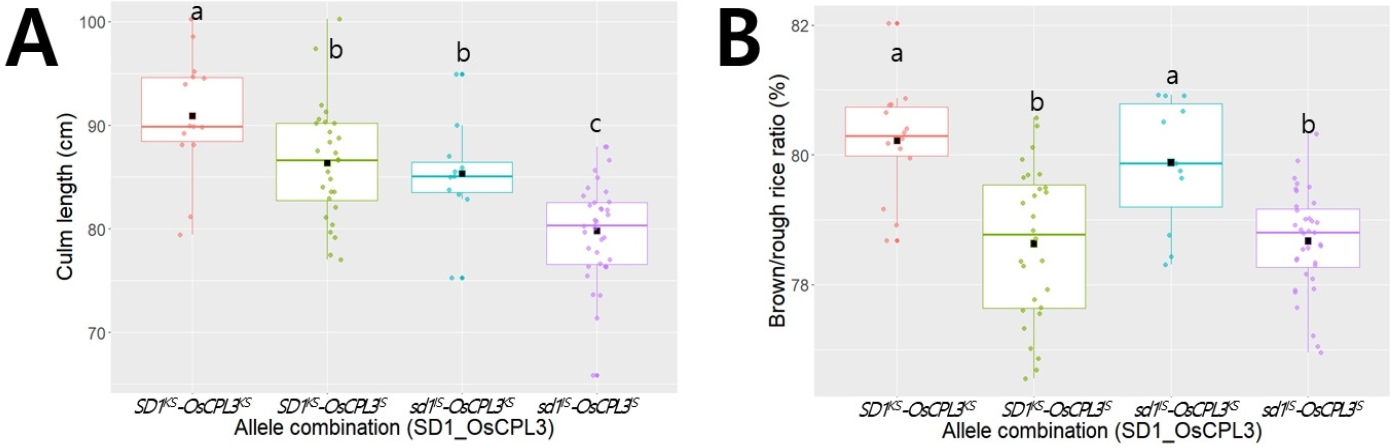
Table 5). 이들 조합들은 출수기, 수수, 천립중 및 등숙률에서는 통계적 차이가 없는 것으로 나타났다. 간장은 ‘Koshihikari’가 보유한 대립유전자형 조합인
SD1KS-
OsCPL3KS가 가장 긴 91 cm, ‘IS592BB’가 보유한
sd1IS-
OsCPL3IS가 가장 짧은 80 cm를 나타냈으며 재조합형인
SD1KS-
OsCPL3IS (86 cm)와
sd1IS-
OsCPL3KS (85 cm)가 통계적으로 차이가 나지 않으면서 중간 값에 속하였다(
Fig. 5A). 수장은
OsCPL3의 대립유전자의 변경에 의해서는 영향을 받지 않으며
SD1의 대립유전자형 변경에 의해서만 통계적 차이가 발생하는 것으로 확인되었다(
Table 5). 수당립수는
SD1 대립유전자형과 무관하게
OsCPL3의 ‘Koshihikari’ 대립유전자형
OsCPL3KS를 포함한 대립유전자형 조합
SD1KS-
OsCPL3KS과
sd1IS-
OsCPL3KS가 각각 132개, 133개로 통계적으로 가장 많았고, 이후
SD1KS-
OsCPL3IS (127개),
sd1IS-
OcCPL3IS (117개) 순이었다. 제현율은
SD1의 대립유전자의 변경에 의해서는 영향을 받지 않으며
OsCPL3의 대립유전자형 변경에 의해서만 통계적 차이가 발생하는 것으로 확인되었다(
Fig. 5B). 1주 수량성은
SD1KS-
OsCPL3KS가 가장 높은 27.2 g,
sd1IS-
OsCPL3IS가 가장 낮은 24.6 g을 나타냈으며 재조합형인
SD1KS-
OsCPL3IS (26.1 g)와
sd1IS-
OsCPL3KS (25.5 g)가 통계적으로 차이가 나지 않으면서 중간 값에 속하였다.
연구결과의 육종적 활용방안
‘IS592BB’는 우리나라 일반적인 조생종과 유사한 출수 특성을 나타내며, 복합내병성을 갖춘 직립 초형의 단간 내도복 품종이다(
Park et al. 2020b). ‘IS592BB’는 국내 밥쌀용 벼의 재배안정성 향상을 위한 교배모본으로 활용될 뿐만 아니라, 외래자원의 유용 유전인자를 도입하기 위한 반복친으로도 널리 이용되고 있다. 그러나 출수기와 단간 특성에 대한 유전적 해석은 아직 충분히 이루어지지 않았으며, 육종 과정에서 선발된 일부 후대 계통에서는 도정률이 낮은 등 개선이 필요한 형질이 확인되고 있다. ‘Koshihikari’는 일본의 대표적인 고품질 품종으로 우리나라에서 재배할 경우 국내 조생종보다 출수가 늦고 중생종보다는 빠른 준조생의 출수기를 나타낸다. ‘Koshihikari’는 밥맛과 품질은 우수하지만 일반적으로 병해충에 약하고 초장이 길어 도복에 취약한 것으로 알려져 있다(
Kobayashi et al. 2018). 본 연구에서는 농업적 활용 가치가 높고 상호 보완적인 특성을 지닌 ‘IS592BB’와 ‘Koshihikari’의 유전적 특성을 파악하기 위해 KSIS_RIL 유전분석 집단을 육성하였으며, 우리나라 재배 환경에서 출수기와 수량 관련 농업형질에 대한 양적형질 유전자좌 분석을 수행하였다. 그 결과, 출수기와 관련된 4개의 후보유전자
Hd1,
Hd16,
Hd17,
Hd18가 탐색되었다. 또한 이들 대립유전자형 조합에 따라 모부본의 출수기 표현형 범위를 벗어나 매우 빠른 조생부터 늦은 중만생까지 다양한 출수기를 나타내는 계통이 존재함을 확인하였다. 이러한 결과는 국내 조생종 품종과 ‘Koshihikari’를 교배할 때 나타나는 다양한 출수기 변이에 대한 유전적 해석을 가능하게 할 것으로 판단된다. 예를 들어 조생종 품종인 ‘해담쌀’과 ‘Koshihikari’를 교배모본으로 하여 육성되어 2026년에 품종 출원된 ‘일선진미’(해담쌀*2/Koshihikari)는 모부본의 표현형 범위를 크게 벗어난 만생종에 가까운 출수 특성을 내는데, 이는 이번 연구에서 확인된
Hd1KS-
Hd16IS-
Hd17KS-
hd18IS와 같이 출수를 지연시키는 대립유전자형 조합에 의해 나타난 결과로 추정된다. 또한 출수기 관련 유전자의 대립유전자형과 그 조합에 대한 정보는 출수기 예측을 가능하게 하며, 분자표지를 활용하여 대립유전자형을 조절함으로 써 목표 출수기를 갖는 품종 육성에 활용될 수 있다. 최근 남부평야지에서 조생종 재배면적이 증가하고 있으며, 그 주요 요인 중하나는 추석 전 햅쌀 출하 수요이다(
Park et al. 2020a). 이에 따라 현장에서는 ‘IS592BB’와 같은 기존 국내 조생종보다 출수가 더 빠른 품종의 육성을 요구하고 있다. 이번 연구에서 확인된
hd1IS-
hd16KS-
hd17IS-
Hd18KS 또는
hd1IS-
hd16KS-
Hd17KS-
Hd18KS 대립유전자형 조합은 ‘IS592BB’가 보유한
hd1IS-
Hd16IS-
hd17IS-
hd18IS 조합보다 약 4-5일 빠른 출수기를 나태내어, 추석 전 조기 출하용 품종 육성에 유용하게 활용될 수 있을 것으로 판단된다.
우리나라에서 통일형 품종이 자포니카형 품종으로 교체되는 시기인 1980년대 통일형 품종 개발에 활용하였던 반왜성 유전자
sd1을 장간(長稈)의 자포니카 품종에 도입함으로써 수량성과 재배안정성을 높이고자 노력하였다(
Cho et al. 2020). 국내 육성 벼 품종의 간장에 대한 표현형 분석은 다수 수행되었으나, 이러한 간장 변이가 어떤 유전자와 대립유전자형에 의해 발생하는지에 대한 유전적 해석은 아직 부족한 실정이다. 최근 ‘Reimei’에서 유래한
sd1-r를 탐지하는 분자표지와 유전자 염기서열 분석을 통해 ‘영호진미’, ‘보람찬’ 등 단간 내도복 품종이 해당 유전자를 보유하고 있음이 확인되었다(
Park et al. 2024b,
Park et al. 2025). 본 연구에서 KSIS_RIL을 대상으로 수행한 간장 관련 QTL 분석 결과, 단간 특성을 나타내는 ‘IS592BB’의 후보유전자로
sd1-r 외에도
OsCPL3이 새롭게 제시되었으며, 이 유전자가 간장 뿐만 아니라 제현율에도 영향을 미치는 것으로 확인되었다. ‘IS592BB’가 보유한
OsCPL3IS 대립유전자형은 간장을 감소시켜 내도복성 측면에서 유리한 반면, 제현율이 감소하는 부정적인 효과도 함께 나타났다. 이는 ‘IS592BB’를 교배모본으로 활용하여 단간 계통을 선발하는 과정에서 도정률 저하가 동반되는 원인 중 하나로 작용할 가능성을 시사한다. 단간 품종은 내도복성을 기반으로 다비 재배가 가능하여 수량성 향상이라는 장점을 가지지만, 고품질 쌀 소비 체계에서는 품질 저하로 인한 경쟁력 감소를 초래할 수 있다. 최근 벼 육종은 고품질 쌀 생산을 목표로 간장을 다소 증가시키는 방향으로 변화하고 있으며, 이를 통해 품질 안정성을 확보하려는 경향을 보이고 있다. 한편 ‘Koshihikari’ 가 보유한
OsCPL3KS 대립유전자는
OsCPL3IS에 비해 간장이 다소 증가하는 대신 제현율이 높아 도정률 향상에 유리한 특성을 나타내어, 고품질 품종 육종에 유용한 유전자로 활용될 수 있을 것으로 판단된다. 향후 본 연구에서 확인된
OsCPL3 유전자 내 염기서열 변이를 기반으로 대립유전자형을 탐지할 수 있는 분자표지를 개발하고, 간장과 제현율에 미치는 영향을 정밀하게 검증할 예정이다. 이를 통해 해당 정보를 육종사업에 반영하여 밥쌀용 품종의 도정률 향상에 기여하고자 한다.
Notes
-
사사
본 논문은 농촌진흥청 작물시험연구사업(남부지역 적응 품질과 재배안정성이 향상된 밥쌀용 벼 품종개발 연구, 과제번호: PJ017824022026)의 지원으로 수행된 결과의 일부입니다.
보충자료
본문의 Supplementary Tables 1-4와 Supplementary Figs. 1, 2는 한국육종학회지 홈페이지에서 확인할 수 있습니다.
Supplementary Table 1.
Descriptive statistics of yield and grain-related traits in the population of 89 RILs derived from a cross between ‘Koshihikari’ and ‘IS592BB’ across two years.
KJBS-2026-58-2-147-Supplementary-Table-1,2.pdf
Supplementary Fig. 1.
Genome-wide distribution of SNP markers used in QTL analysis. Columns represent chromosomes, and rows represent physical positions at 1 Mbp intervals. The numbers of SNP markers per Mbp are shown in each row, with cell colors indicating SNP marker density.
KJBS-2026-58-2-147-Supplementary-Fig-1.pdf
Supplementary Fig. 2.
Genetic map showing the LOD scores and locations of QTLs associated with yield-related traits in the population of 89 RILs derived from a cross between ‘Koshihikari’ and ‘IS592BB’ across two years. A: QTLs detected on chromosome 3, B: QTLs detected on chromosome 6. HD: heading date, PN: number of panicles per hill, NS: number of spikelets per panicle. The red and green curves represent LOD scores for the year 2023 and 2024, respectively. The red and green horizontal lines and symbols indicate the positions and names of QTLs for the years 2023 and 2024, respectively.
KJBS-2026-58-2-147-Supplementary-Fig-2.pdf
Fig. 1.Phenotypic distribution of yield-related traits in the population of 89 RILs derived from a cross between ‘Koshihikari’ and ‘IS592BB’ across two years (A-I). The blue and yellow bars represent the frequency distributions for 2023 and 2024, respectively, and the green areas indicate the overlap between the two years. The blue and yellow curves and dashed lines represent the density plots and mean values of KSIS_RIL for the years 2023 and 2024, respectively. The blue and yellow inverted triangles represent the mean values of parents for the years 2023 and 2024, respectively. KS: Koshihikari, IS: IS592BB.
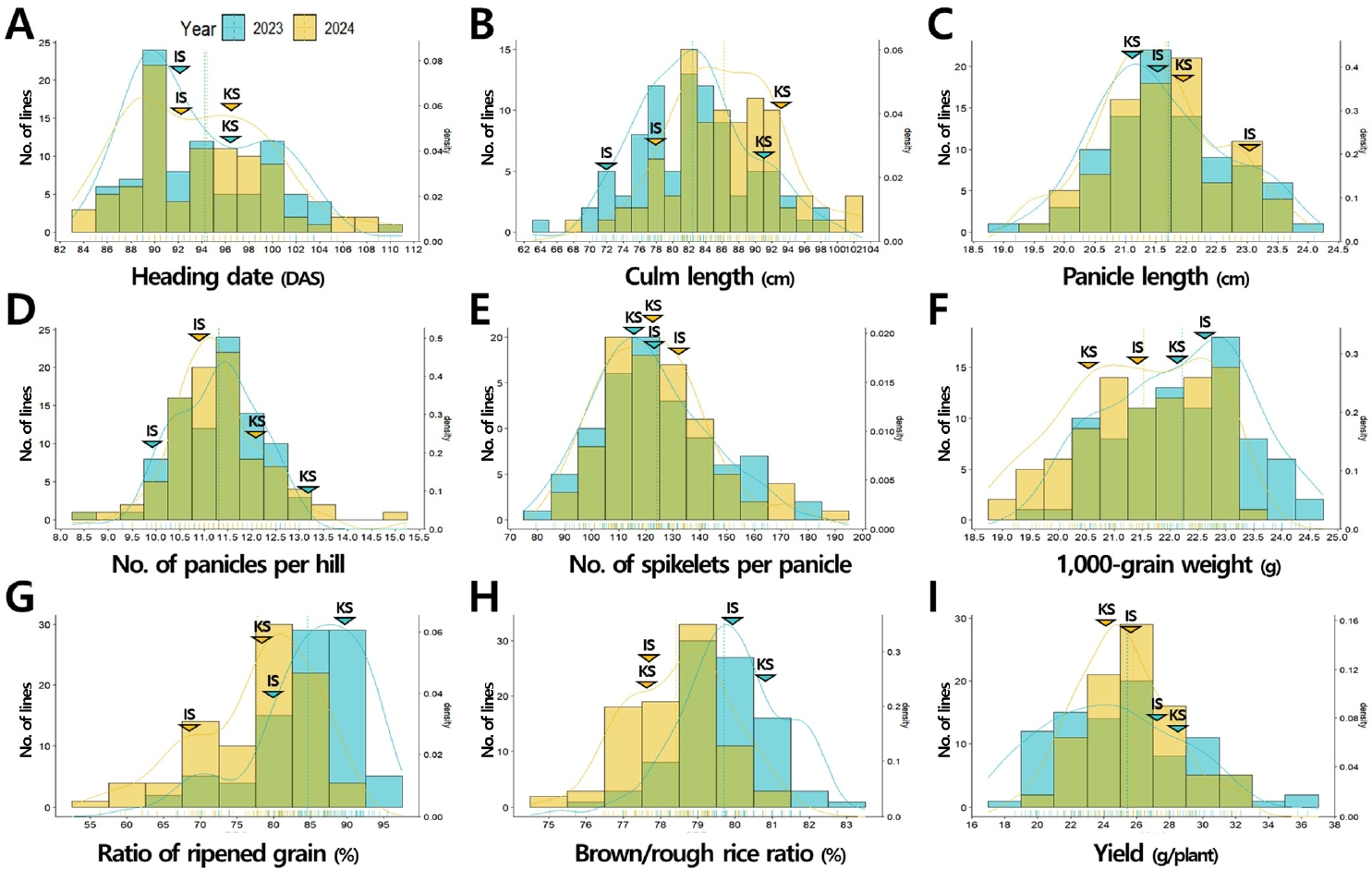
Fig. 2.Relationship among yield-related traits. Correlation analysis in 2023 (A) and 2024 (B). Path analysis of the causal relationship among yield-related traits to explain yield variation in 2023 (C) and 2024 (D). HD: heading date, CL: culm length, PL: panicle length, PN: number of panicles per hill, NS: number of spikelets per panicle, TGW: 1,000-grain weight, RRG: ratio of ripened grain, BRR: brown/rough rice ratio, Yld: yield. Single-headed continuous arrows represent linear dependencies (direct effects) calculated as standardized regression coefficients, while double-headed dotted arrows indicate correlation coefficients between each traits. Blue and red arrows indicate positive and negative effects, respectively. The arrow line thickness represents the proportion of the effect. Ns and ** indicate no significant and significant at 1% probability level, respectively.
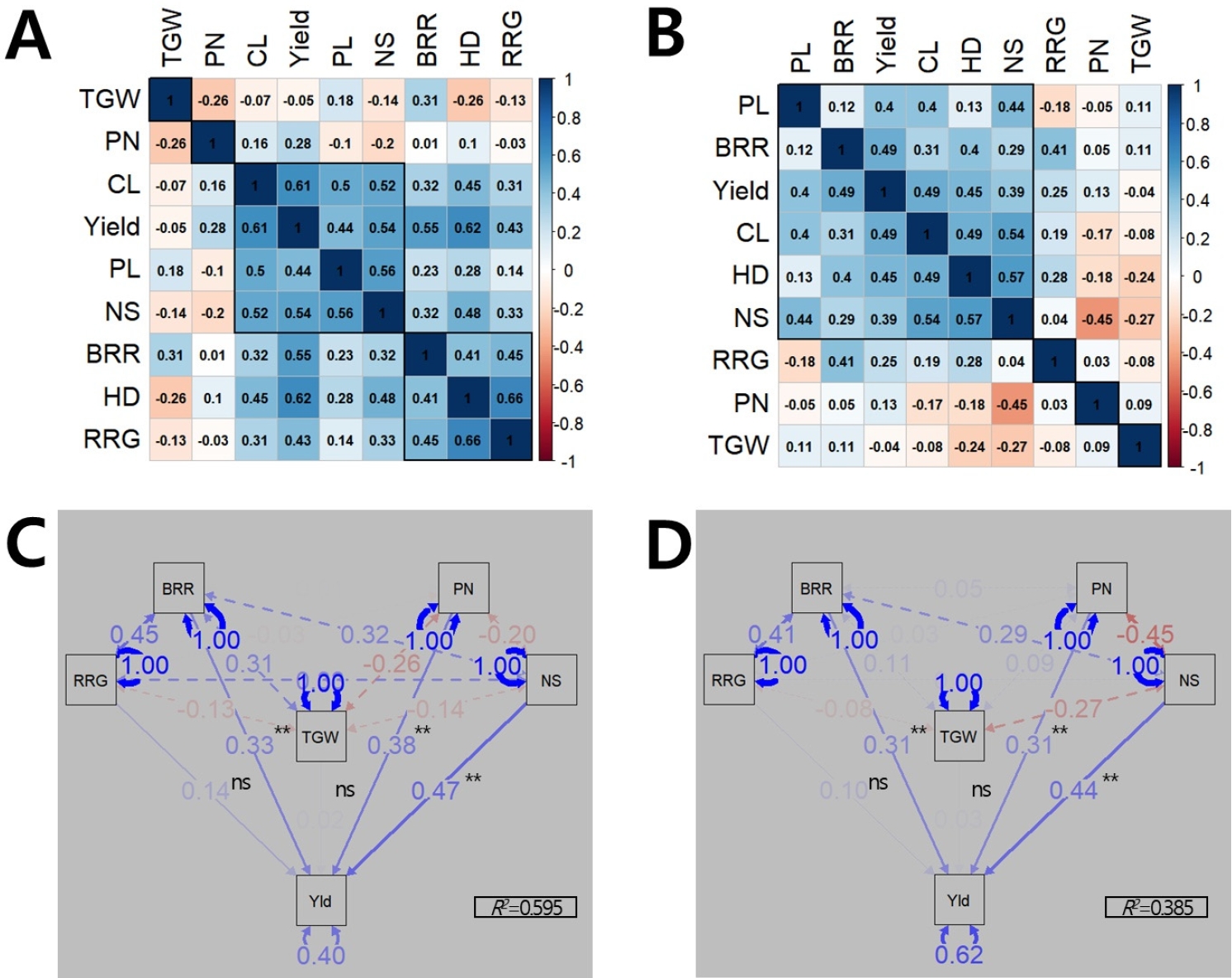
Fig. 3.Genetic map showing the LOD scores and locations of QTLs associated with yield-related traits in the population of 89 RILs derived from a cross between ‘Koshihikari’ and ‘IS592BB’ across two years. A: heading date (HD), B: culm length (CL), C: panicle length (PL), D: number of panicles per hill (PN), E: 1,000-grain weight (TGW), F: brown/rough rice ratio (BRR). The red and green curves represent LOD scores for the year 2023 and 2024, respectively. The red and green horizontal lines and symbols indicate the positions and names of QTLs for the years 2023 and 2024, respectively.
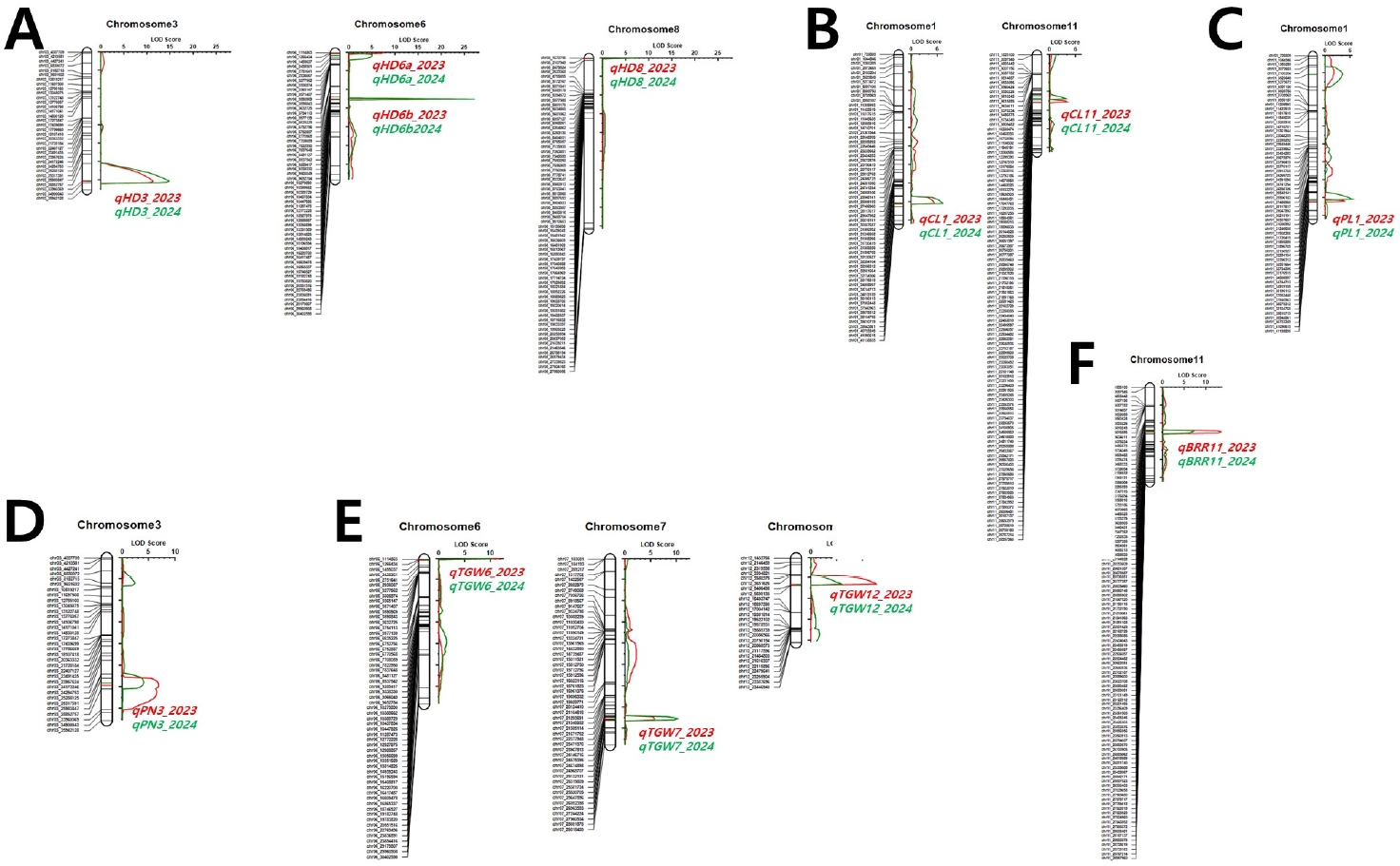
Fig. 4.Effects of ‘Koshihikari’ alleles (A) and allele combinations of Hd1, Hd16, Hd17, and Hd18 (B) on the heading date. The ‘Koshihikari’ allele is denoted as A and the ‘IS592BB’ allele as B. Box plots showing the variation in heading date by allele combinations. The same letters on the box plots indicate that the not significantly different at p<0.05 (ANOVA followed by DMRT).
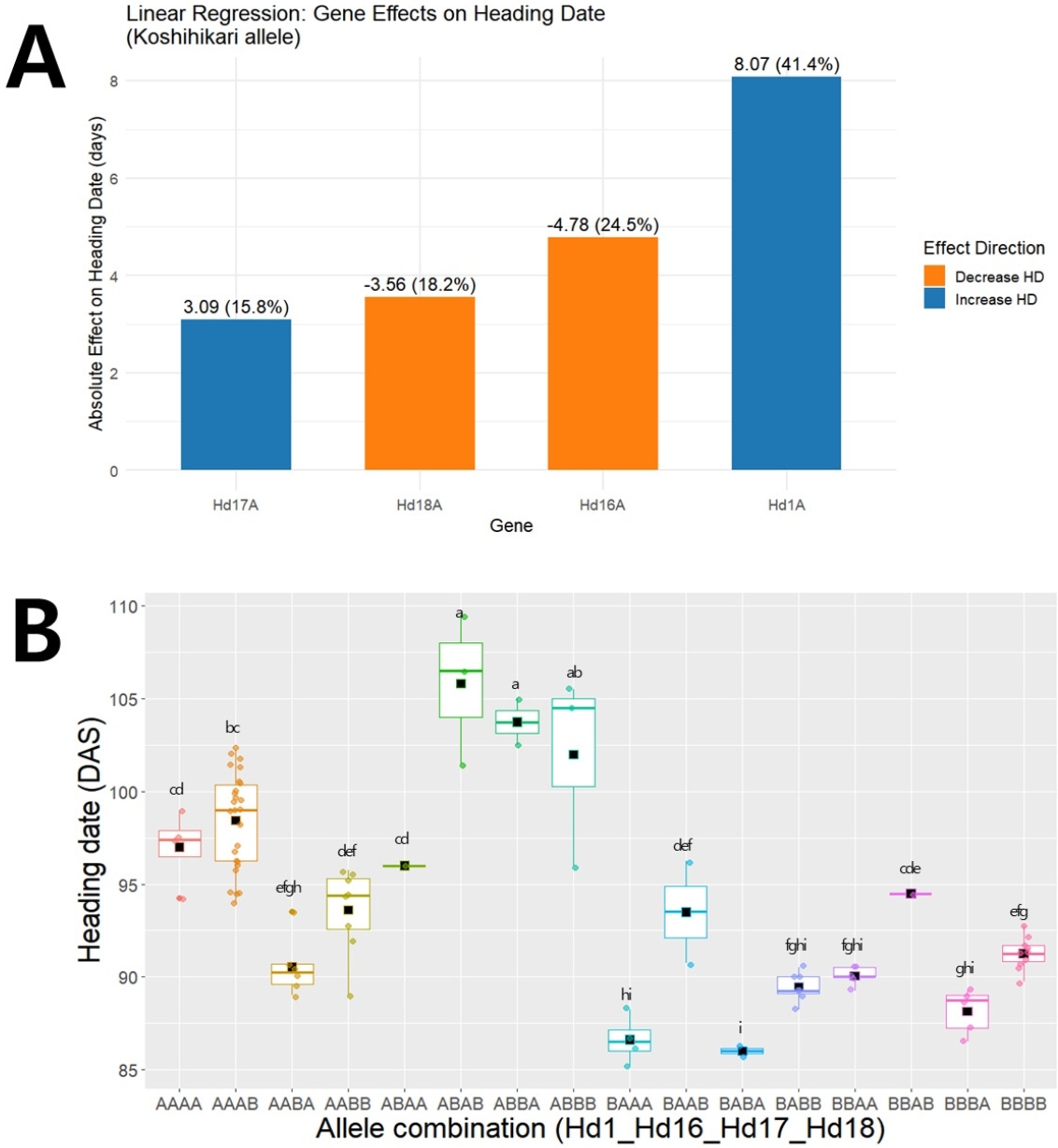
Fig. 5.Effects of allele combinations of SD1 and OsCPL3 on the culm length (A) and brown/rough rice ratio (B) in the KSIS_RIL population. Box plots showing the variation by allele combinations.The black rectangles indicate the means of traits. The same letters on the box plots indicate that the not significantly different at p<0.05 (ANOVA followed by DMRT).
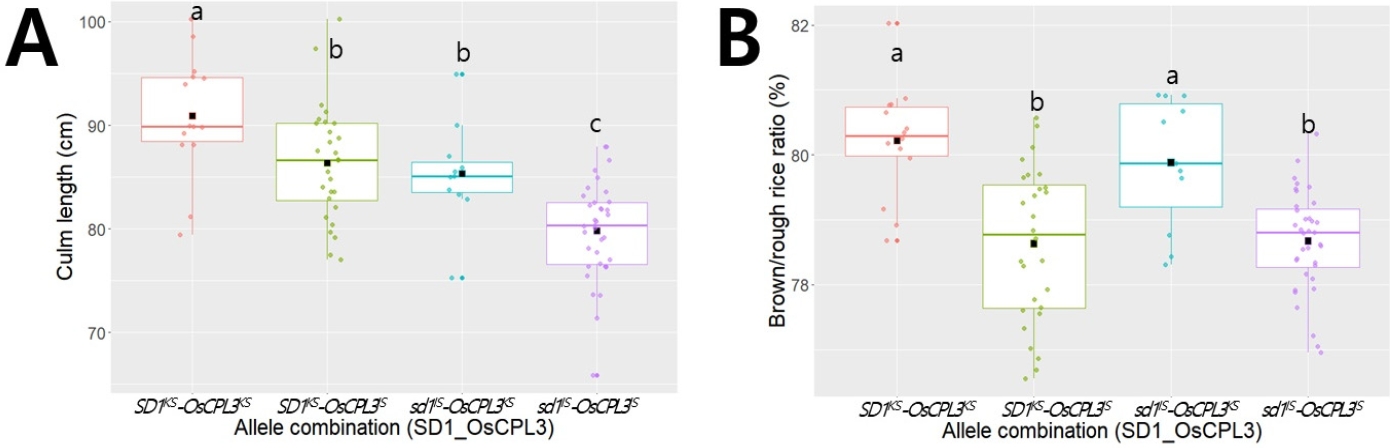
Table 1.QTLs associated with yield-related traits identified in the recombinant inbred line population derived from a cross between ‘Koshihikari’ (P1) and ‘IS592BB (P2) during the years 2023-2024.
Table 1.
|
Traitz
|
QTL name |
Chr.y
|
Position (cM) |
Interval-flanking markers
|
LODx
|
PVEw (%) |
Addv
|
Candidate geneu
|
|
left |
right |
|
HD |
qHD3_2023
|
3 |
141 |
chr03_33960369 |
chr03_34900043 |
11.4 |
13.8 |
-2.40 |
Hd16
|
|
qHD6a_2023
|
6 |
0 |
chr06_1114863 |
chr06_1266434 |
7.7 |
8.3 |
1.75 |
Hd17
|
|
qHD6b_2023
|
6 |
50 |
chr06_9289417 |
chr06_9338330 |
22.5 |
40.0 |
3.92 |
Hd1
|
|
qHD8_2023
|
8 |
0 |
chr08_2107949 |
chr08_2479524 |
7.9 |
8.6 |
-1.90 |
Hd18
|
|
qHD3_2024
|
3 |
141 |
chr03_33960369 |
chr03_34900043 |
14.8 |
18.2 |
-3.04 |
Hd16
|
|
qHD6a_2024
|
6 |
3 |
chr06_1455037 |
chr06_2438361 |
5.1 |
5.4 |
1.56 |
Hd17
|
|
qHD6b_2024
|
6 |
50 |
chr06_9289417 |
chr06_9338330 |
26.3 |
48.3 |
4.77 |
Hd1
|
|
qHD8_2024
|
8 |
0 |
chr08_2107949 |
chr08_2479524 |
7.8 |
7.8 |
-2.00 |
Hd18
|
|
CL |
qCL1_2023
|
1 |
161 |
chr01_35190113 |
chr01_37052448 |
5.2 |
22.4 |
2.91 |
SD1
|
|
qCL11_2023
|
11 |
51 |
chr11_18287255 |
chr11_18904361 |
4.1 |
15.9 |
2.66 |
OsCPL3
|
|
qCL1_2024
|
1 |
162 |
chr01_35190113 |
chr01_37052448 |
7.2 |
31.2 |
3.54 |
SD1
|
|
qCL11_2024
|
11 |
47 |
chr11_15133279 |
chr11_15638505 |
3.7 |
14.5 |
2.60 |
OsCPL3
|
|
PL |
qPL1_2023
|
1 |
164 |
chr01_37540963 |
chr01_38079312 |
4.6 |
22.0 |
0.47 |
SD1
|
|
qPL1_2024
|
1 |
162 |
chr01_35190113 |
chr01_37052448 |
6.5 |
24.8 |
0.45 |
SD1
|
|
PN |
qPN3_2023
|
3 |
118 |
chr03_25983847 |
chr03_28852757 |
6.9 |
23.6 |
0.53 |
OsTB1
|
|
qPN3_2024
|
3 |
116 |
chr03_25983847 |
chr03_28852757 |
4.1 |
17.0 |
0.47 |
OsTB1
|
|
TGW |
qTGW6_2023
|
6 |
0 |
chr06_1114863 |
chr06_1266434 |
11.8 |
20.9 |
-0.52 |
Hd17
|
|
qTGW7_2023
|
7 |
151 |
chr07_25132131 |
chr07_25319809 |
5.8 |
8.7 |
0.34 |
GW7
|
|
qTGW12_2023
|
12 |
26 |
chr12_3651626 |
chr12_5486498 |
12.7 |
23.8 |
-0.55 |
- |
|
qTGW6_2024
|
6 |
0 |
chr06_1114863 |
chr06_1266434 |
10.1 |
21.3 |
-0.50 |
Hd17
|
|
qTGW7_2024
|
7 |
151 |
chr07_25132131 |
chr07_25319809 |
10.2 |
21.9 |
0.51 |
GW7
|
|
qTGW12_2024
|
12 |
26 |
chr12_3651626 |
chr12_5486498 |
5.9 |
11.6 |
-0.37 |
- |
|
BRR |
qBRR11_2023
|
11 |
49 |
chr11_18287255 |
chr11_18904361 |
13.5 |
35.2 |
0.87 |
OsCPL3
|
|
qBRR11_2024
|
11 |
48 |
chr11_17292835 |
chr11_18287255 |
7.3 |
32.2 |
0.77 |
OsCPL3
|
Table 2.Effects of Hd1, Hd16, Hd17, and Hd18 alleles on the phenotype of yield-related traits.
Table 2.
|
Allele typez
|
n |
HDy (DAS) |
CL (cm) |
PL (cm) |
PN |
NS |
TGW (g) |
RRG (%) |
BRR (%) |
Yield (g/plant) |
|
Hd1KS
|
53 |
97**
|
87**
|
21.9*
|
11.3ns
|
134**
|
21.8ns
|
82.9**
|
79.4**
|
27.2**
|
|
hd1IS
|
36 |
90 |
81 |
21.4 |
11.3 |
111 |
22.1 |
78.6 |
78.5 |
23.3 |
|
hd16KS
|
59 |
94ns
|
85ns
|
21.7ns
|
11.5**
|
127ns
|
21.7*
|
80.8ns
|
79.1ns
|
26.2*
|
|
Hd16IS
|
30 |
94 |
83 |
21.6 |
11.0 |
119 |
22.2 |
81.9 |
79.0 |
24.4 |
|
Hd17KS
|
46 |
97**
|
86**
|
21.8ns
|
11.4ns
|
131**
|
21.5**
|
82.3ns
|
79.4**
|
26.7**
|
|
hd17IS
|
43 |
92 |
82 |
21.6 |
11.2 |
118 |
22.3 |
80.0 |
78.7 |
24.4 |
|
Hd18KS
|
29 |
91**
|
83ns
|
21.7ns
|
11.2ns
|
122ns
|
22.1ns
|
79.5ns
|
78.9ns
|
24.8*
|
|
hd18IS
|
60 |
96 |
85 |
21.7 |
11.4 |
126 |
21.8 |
82.0 |
79.1 |
26.0 |
Table 3.Effects of Hd1, Hd16, Hd17, and Hd18 allele combinations on the phenotype of yield-related traits.
Table 3.
|
Allele combinationz
|
n |
HDy (DAS) |
CL (cm) |
PL (cm) |
PN |
NS |
TGW (g) |
RRG (%) |
BRR (%) |
Yield (g/plant) |
|
Hd1KS-hd16KS-Hd17KS-Hd18KS
|
4 |
97cdx
|
88bc |
22ab |
10.6cd |
158a |
21.3b |
83.5abcd |
79.5abc |
27.4abc |
|
Hd1KS-hd16KS-Hd17KS-hd18IS
|
26 |
98bc |
87bc |
21.7ab |
11.4abcd |
135abcde |
21.2b |
83.5abcd |
79.4abc |
27.2abc |
|
Hd1KS-hd16KS-hd17IS-Hd18KS
|
6 |
91efgh |
84bc |
21.5ab |
11.2abcd |
118cdef |
23.3a |
78.2bcde |
79.2abc |
25.5bcde |
|
Hd1KS-hd16KS-hd17IS-hd18IS
|
8 |
94def |
85bc |
22.2ab |
11.7abc |
128bcdef |
22.1ab |
79.8abcd |
79.4abc |
26.9abc |
|
Hd1KS-Hd16IS-Hd17KS-Hd18KS
|
1 |
96cd |
90ab |
22.4ab |
10.4d |
140abc |
22.8ab |
87.6abc |
80.2ab |
24.9bcde |
|
Hd1KS-Hd16IS-Hd17KS-hd18IS
|
3 |
106a |
99a |
22.2ab |
11.5abcd |
126cdef |
22.2ab |
89.1a |
80.5a |
30.5a |
|
Hd1KS-Hd16IS-hd17IS-Hd18KS
|
2 |
104a |
89abc |
23a |
10.8bcd |
155ab |
22.4ab |
88.1ab |
78.9abc |
27abc |
|
Hd1KS-Hd16IS-hd17IS-hd18IS
|
3 |
102ab |
79bc |
21.8ab |
10.7bcd |
133abcde |
22.4ab |
84.1abcd |
79.8abc |
28.4ab |
|
hd1IS-hd16KS-Hd17KS-Hd18KS
|
4 |
87hi |
78c |
21.7ab |
11.7abc |
110def |
22.1ab |
69.2e |
78.7abcd |
24.1cde |
|
hd1IS-hd16KS-Hd17KS-hd18IS
|
2 |
94def |
81bc |
22.1ab |
12.2a |
118cdef |
22.5ab |
86.9abcd |
79.3abc |
26bcd |
|
hd1IS-hd16KS-hd17IS-Hd18KS
|
2 |
86i |
80bc |
22ab |
11.9ab |
102f |
22.2ab |
77.0cde |
76.9d |
23.5cde |
|
hd1IS-hd16KS-hd17IS-hd18IS
|
7 |
89fghi |
83bc |
21.2b |
11.5abcd |
106ef |
21.8ab |
78.6abcde |
78.3bcd |
23.8cde |
|
hd1IS-Hd16IS-Hd17KS-Hd18KS
|
5 |
90fghi |
82bc |
21.5ab |
11.4abcd |
109def |
21.9ab |
79.7abcd |
79.6abc |
25bcde |
|
hd1IS-Hd16IS-Hd17KS-hd18IS
|
1 |
95cde |
89abc |
21.7ab |
10.7bcd |
137abcd |
22.3ab |
76.3de |
78.9abc |
21.9e |
|
hd1IS-Hd16IS-hd17IS-Hd18KS
|
5 |
88ghi |
79c |
21.3b |
11.1abcd |
109def |
21.5ab |
81.9abcd |
77.8cd |
21.9e |
|
hd1IS-Hd16IS-hd17IS-hd18IS
|
10 |
91efg |
80bc |
21.2b |
10.9bcd |
113cdef |
22.5ab |
78.9abcde |
78.4bcd |
22de |
Table 4.Effects of Sd1 and OsCPL3 alleles on the phenotype of yield-related traits.
Table 4.
|
Allele typez
|
n |
HDy (DAS) |
CL (cm) |
PL (cm) |
PN |
NS |
TGW (g) |
RRG (%) |
BRR (%) |
Yield (g/plant) |
|
SD1KS
|
42 |
94ns
|
88**
|
22.2**
|
11.2ns
|
129*
|
22.2*
|
81.0ns
|
79.2ns
|
26.5**
|
|
sd1IS
|
47 |
94 |
81 |
21.2 |
11.4 |
120 |
21.6 |
81.3 |
79.0 |
24.8 |
|
OsCPL3KS
|
25 |
96ns
|
88**
|
21.7ns
|
11.1ns
|
132*
|
22.0ns
|
82.5ns
|
80.1**
|
26.5ns
|
|
OsCPL3IS
|
64 |
94 |
83 |
21.7 |
11.4 |
121 |
21.8 |
80.6 |
78.7 |
25.3 |
Table 5.Effects of Sd1 and OsCPL3 allele combinations on the phenotype of yield-related traits.
Table 5.
|
Allele combinationz
|
n |
HDy (DAS) |
CL (cm) |
PL (cm) |
PN |
NS |
TGW (g) |
RRG (%) |
BRR (%) |
Yield (g/plant) |
|
SD1KS-OsCPL3KS
|
14 |
97ax
|
91a |
22.1a |
11.2a |
132a |
22.2a |
82.8a |
80.2a |
27.2a |
|
SD1KS-OsCPL3IS
|
28 |
93a |
86b |
22.3a |
11.3a |
127ab |
22.2a |
80.1a |
78.6b |
26.1ab |
|
sd1IS-OsCPL3KS
|
11 |
95a |
85b |
21.3b |
11.0a |
133a |
21.8a |
82.2a |
79.9a |
25.5ab |
|
sd1IS-OsCPL3IS
|
36 |
94a |
80c |
21.2b |
11.5a |
117b |
21.5a |
81.1a |
78.7b |
24.6b |
References
- 1. Asano K, Takashi T, Miura K, Qian Q, Kitano H, Matsuoka M, Ashikari M. 2007. Genetic and molecular analysis of utility of sd1 alleles in rice breeding. Breed Sci 57: 53-58.
- 2. Ashfaq H, Rani R, Perveen N, Babar AD, Maqsood U, Asif M, Steele KA, Arif M. 2023. KASP mapping of QTLs for yield components using a RIL population in Basmati rice (Oryza sativa L.). Euphytica 219: 79.
- 3. Chen M, Hong Y, Fan J, Cao D, Yin C, Yu A, Qiu J, Huang X, Wei X. 2025. Genetic interaction network of quantitative trait genes for heading date in rice. J Genet Genomics 52: 747-760.
- 4. Cheon KS, Jeong YM, Lee YY, Oh J, Kang DY, Oh HJ, Kim SL, Kim NH, Lee EY, Baek JH. 2019. Kompetitive allele-specific PCR marker development and quantitative trait locus mapping for bakanae disease resistance in Korean japonica rice varieties. Plant Breed Biotech 7: 208-219.
- 5. Cho YC, Baek MK, Park HS, Cho JH, Ah EK, Suh JP, Jeung JU, Lee JH, Won YJ, Song YC, Jeong EG, Kim BK, Lee JH. 2020. History and results of rice breeding in Korea. Korean J Breed Sci 52: 58-72.
- 6. Gong L, Liao S, Duan W, Liu Y, Zhu D, Zhou X, Xue B, Chu C, Liang YK. 2022. OsCPL3 is involved in brassinosteroid signaling by regulating OsGSK2 stability. Journal of Integrative Plant Biol 64: 1560-1574.
- 7. Ha SK, Jeung JU, Jeong JM, Kim JH, Mo YJ. 2020. Genetic and agronomic analysis of a recombinant inbred line population to map quantitative trait loci for blast resistance and select promising lines in rice. Korean J Crop Sci 65: 172-181.
- 8. Hori K, Ogiso-Tanaka E, Matsubara K, Yamanouchi U, Ebana K, Yano M. 2013. Hd16, a gene for casein kinase I, is involved in the control of rice flowering time by modulating the day-length response. Plant J 76: 36-46.
- 9. Hori K, Matsubara K, Yano M. 2016. Genetic control of flowering time in rice: Integration of Mendelian genetics and genomics. Theor Appl Genet 129: 2241-2252.
- 10. Hua H, Yang R, Zhang Z, Yin C, Gong J, Wei X, Huang X, Fan J. 2025. A novel non-functional RFT1 allele delays heading date in rice. Rice 18: 106.
- 11. Kobayashi A, Hori K, Yamamoto T, Yano M. 2018. Koshihikari: A premium short-grain rice cultivar-its expansion and breeding in Japan. Rice 11: 15.
- 12. Komiya R, Ikegami A, Tamaki S, Yokoi S, Shimamoto K. 2008. Hd3a and RFT1 are essential for flowering in rice. Development 135: 767-774.
- 13. Lee CM, Lee KM, Baek MK, Kim WJ, Suh JP, Jeong OY, Cho YC, Park HS, Kim SM. 2020. Characterization of traits related to grain shape in Korean rice varieties. Korean J Crop Sci 65: 199-213.
- 14. Lee CM, Park HS, Seo JH, Park SH, Jeong OY, Lee KM, Park SG. 2026. Genetic diversity and structural network analysis of Korean rice varieties using TCS-based SNPs. Korean J Breed Sci 58: 1-12.
- 15. Lee CW, Cheon KS, Shin YJ, Oh HJ, Jeong YM, Jang H, Park YC, Kim KY, Cho HC, Won YJ, Baek JH, Cha YS, Kim SL, Kim KH, Ji HS. 2022. Development and application of a target capture sequencing SNP-genotyping platform in rice. Genes 13: 794.
- 16. Lee SY, Jeung JU, Mo Y. 2024. Allelic combinations of Hd1, Hd16, and Ghd7 exhibit pleiotropic effects on agronomic traits in rice. G3 14: jkad300.
- 17. Liu J, Yi Q, Dong G, Chen Y, Guo L, Gao Z, Zhu L, Ren D, Zhang Q, Li Q. 2024. Improving rice quality by regulating the heading dates of rice varieties without yield penalties. Plants 13: 2221.
- 18. Matsubara K, Ogiso-Tanaka E, Hori K, Ebana K, Ando T, Yano M. 2012. Natural variation in Hd17, a homolog of Arabidopsis ELF3 that is involved in rice photoperiodic flowering. Plant Cell Physiol 53: 709-716.
- 19. Meng L, Li H, Zhang L, Wang J. 2015. QTL IciMapping: Integrated software for genetic linkage map construction and quantitative trait locus mapping in biparental populations. Crop J 3: 269-283.
- 20. Mo YJ, Jeong JM, Ha SK, Kim JH, Lee CM, Lee GP, Jeung JU. 2020. Characterization of QTLs and candidate genes for days to heading in rice recombinant inbred lines. Genes 11: 957.
- 21. Mo YJ, Lee CM, Park HM, Ha SK, Kim MJ, Kwak JE, Lee HS, Lee JH, Jeung JU. 2021. Hd1 allele types and their associations with major agronomic traits in Korean rice cultivars. Plants 10: 2408.
- 22. Park HS, Suh JP, Baek MK, Lee CM, Kim WJ, Lee GM, Kim SM, Kim CS, Cho YC. 2020a. Characterization of yield and panicle-related traits of early maturing rice varieties by cultivation times in the Honam plain area of Korea. Korean J Breed Sci 52: 115-130.
- 23. Park HS, Baek MK, Kim WJ, Lee CM, Ji HS, Suh JP, Jeong OY, Cho YC, Lee JH. 2020b. Multiple disease resistant early maturing rice cultivar ‘IS592BB’with the genetic background of ‘Unkwang’. Korean J Breed Sci 52: 473-484.
- 24. Park HS, Seo JH, Lee CM, Park SH, Lee KM, Park JR, Jeong OY. 2024a. Quantitative trait loci analysis of quality-related traits using recombinant inbred lines derived from a cross between ‘Chamdongjin’and ‘Younghojinmi’. Korean J Breed Sci 56: 395-415.
- 25. Park HS, Seo JH, Park SH, Park JR, Lee CM, Jin MA, Jeong OY. 2024b. QTL analysis for yield-related traits using the recombinant inbred lines derived from a cross between ‘Chamdongjin’ and ‘Younghojinmi’. Korean J Breed Sci 56: 31-51.
- 26. Park HS, Lee CM, Seo JH, Park SH, Lee KM, Park JR, Jeong OY. 2025. QTL analysis of yield and grain-related traits using the recombinant inbred lines derived from a cross between ‘Boramchan’ and ‘Pecos’. Korean J Breed Sci 57: 131-157.
- 27. Park J-R, Lee G, Lee H-S, Lee SY, Ha S-K, Kang K, Jin M, Suh J-P, Seo J, Choi YM. 2026. Integrating image-based phenotyping and QTL mapping to enhance genetic resistance and accelerate breeding for bacterial grain rot resistance in rice. Theor Appl Genet 139: 108.
- 28. Rural Development Administration (RDA). 2025. Cultivated area by rice varieites. [unpubilished data].
- 29. Sasaki A, Swapan D, Ishiyama K, Saito T. 2002. A mutant gibberellin-synthesis gene in rice. Nature 416: 701-702.
- 30. Sha H, Liu H, Zhao G, Han Z, Chang H, Wang J, Zheng H, Zhang J, Yu Y, Liu Y, Zou D, Nie S, Fang J. 2022. Elite sd1 alleles in japonica rice and their breeding applications in northeast China. Crop J 10: 224-233.
- 31. Shibaya T, Hori K, Ogiso-Tanaka E, Yamanouchi U, Shu K, Kitazawa N, Shomura A, Ando T, Ebana K, Wu J. 2016. Hd18, encoding histone acetylase related to Arabidopsis FLOWERING LOCUS D, is involved in the control of flowering time in rice. Plant Cell Physiol 57: 1828-1838.
- 32. Su S, Hong J, Chen X, Zhang C, Chen M, Luo Z, Chang S, Bai S, Liang W, Liu Q. 2021. Gibberellins orchestrate panicle architecture mediated by DELLA-KNOX signalling in rice. Plant Biotechnol J 19: 2304-2318.
- 33. Takai T, Taniguchi Y, Takahashi M, Nagasaki H, Yamamoto E, Hirose S, Hara N, Akashi H, Ito J, Arai-Sanoh Y. 2023. MORE PANICLES 3, a natural allele of OsTB1/FC1, impacts rice yield in paddy fields at elevated CO2 levels. The Plant Journal 114: 729-742.
- 34. Tomita M. 2009. Introgression of green revolution sd1 gene into isogenic genome of rice super cultivar Koshihikari to create novel semidwarf cultivar ‘Hikarishinseiki’(Koshihikari-sd1). Field Crops Res 114: 173-181.
- 35. Tsuji H, Taoka K-I, Shimamoto K. 2011. Regulation of flowering in rice: two florigen genes, a complex gene network, and natural variation. Curr Opin Plant Biol 14: 45-52.
- 36. Wang S, Li S, Liu Q, Wu K, Zhang J, Wang S, Wang Y, Chen X, Zhang Y, Gao C. 2015. The OsSPL16-GW7 regulatory module determines grain shape and simultaneously improves rice yield and grain quality. Nature Genet 47: 949-954.
- 37. Xia D, Xu P, Zheng S, Xue L, Yin Y, Yao Z, Ding S, Lai Y, Wang Y, Ma X. 2025. Haplotype analysis of the GL7/GW7/SLG7 gene and its application in improving the grain quality of three-line hybrid rice. Rice 18: 38.
- 38. Yano K, Ookawa T, Aya K, Ochiai Y, Hirasawa T, Ebitani T, Takarada T, Yano M, Yamamoto T, Fukuoka S. 2015. Isolation of a novel lodging resistance QTL gene involved in strigolactone signaling and its pyramiding with a QTL gene involved in another mechanism. Mol Plant 8: 303-314.
- 39. Yano M, Katayose Y, Ashikari M, Yamanouchi U, Monna L, Fuse T, Baba T, Yamamoto K, Umehara Y, Nagamura Y. 2000. Hd1, a major photoperiod sensitivity quantitative trait locus in rice, is closely related to the Arabidopsis flowering time gene CONSTANS. Plant Cell 12: 2473-2483.
- 40. Yoshida S. 1981. Fundamentals of rice crop science. pp. 269-International Rice Research Institute, Los Baños, Philippines.