적요
-
‘까리1호’는 내병, 내도복의 아주까리콩 품종육성을 목표로 2009년에 ‘청자3호’를 모본으로, 재래 아주까리콩인 ‘IT105279’을 부본으로 교배하여 계통육종법에 의해 선발되었다. 2016년부터 2017년도에 실시한 생산력검정시험에서는 다수성 내도복 아주까리콩 계통으로 유망하여 ‘밀양350호’의 계통명을 부여하였고, 2018년부터 2020년까지 3년간 7개소에서 수행한 지역적응시험 결과 쓰러짐과 불마름병에 강한 특성을 나타내어 ‘까리1호’로 명명하였다.
‘까리1호’ 유한신육형, 엽형이 둥근형, 화색이 보라색이며, 검은색 종피에 그물무늬가 있다. 개화기는 8월 3일, 성숙기는 10월 23일로 ‘청자3호’와 개화기와 성숙기가 비슷하며, 100립중이 32.7 g으로 ‘청자3호’ 대비 다소 가볍다. 도복 정도는 지적 7개소 시험포장과, 검정포장에서 ‘2’로 평가되어 ‘청자3호’ 대비 강하였고, 탈립성 정도는 실내 검정에서 ‘청자3호’에 비해 낮아 탈립에 강하였다. 불마름병에 ‘청자3호’와 대등하여 강하였으나, 콩모자이크바이러스 접종 시 괴저 증상이 나타났다. ‘까리1호’는 ‘청자3호’ 대비 조단백, 조지방이 비슷하고 당 함량은 다소 낮았으며, 주요 기능성 성분인 이소플라 본 함량이 ‘청자3호’ 대비 높았다. 수량성은 전국 7개 지역 평균 252 kg/10a로 ‘청자3호’보다 4% 증수되었다.
Abstract
‘Kkari1ho’ is a net-like, cracking-patterned seed-coated soybean cultivar developed from a crossing of ‘Cheongja3ho’ and ‘IT105279 (landrace)’ in 2009. The F1 and F2 populations were grown for two years, and promising lines were selected using the pedigree method from F3 to F5. A preliminary yield trial (PYT) and an advanced yield trial (AYT) were conducted from 2016 to 2017, and a regional yield trial (RYT) was conducted in seven regions from 2018 to 2020. ‘Kkari1ho’ is determinate, has an oval leaflet shape, purple flowers, and net-like cracking-patterned seeds. The flowering and maturation dates were August 3 and October 23, respectively. For quantitative characteristics, ‘Kkari1ho’ had a smaller seed weight (32.7 g/100 seeds), while its plant height and first pod height were similar to those of ‘Cheongja3ho.’ While ‘Kkari1ho’ was highly resistant to lodging under standard field conditions, its lodging resistance tended to decrease in high-density plots. Regarding pod shattering, ‘Kkari1ho’ exhibited higher resistance than ‘Cheongja3ho’ in both RYT field and indoor tests. ‘Kkari1ho’ showed comparable resistance to bacterial pustule to that of ‘Cheongja3ho’ in both field and artificial inoculation tests. In contrast, its resistance to soybean mosaic virus (G6H strain) was lower in inoculation tests but comparable in field tests. The mean yield of ‘Kkari1ho’ in the RYT was 252 kg/10a, which was a 4% higher mean yield across the region than that of ‘Cheongja3ho.’ ‘Kkari1ho’ is expected to replace landraces due to its resistance to lodging and bacterial pustule (Registration number: 9450).
-
Key words: soybean, cultivar, Kkari1ho, net-like cracking pattern
서언
콩(
Glycine max (L.) Merr.)은 단백질과 지질의 주요 공급원일 뿐 아니라 필수 아미노산과 이소플라본(isoflavone), 사포닌(saponin) 등 다양한 기능성 성분을 함유한 중요한 식물성 단백질 자원이다(
Kim et al. 2021,
Lee et al. 2013). 국내 콩 재배는 식량 안보와 농가 소득 증대 측면에서 매우 중요한 위치를 차지한다. 최근 정부의 전략작물직불제 도입과 논 타작물 재배 지원 정책에 힘입어 국내 콩 재배면적은 2025년 기준 74,015 ha를 기록하며 안정적인 생산 기반을 유지하고 있다(
KOSIS 2025). 그러나 이러한 외형적 성장에도 불구하고, 국내 콩 자급률은 여전히 낮은 수준에 머물러 있으며, 특히 식용 콩의 경우 수입산과의 가격 경쟁력 및 생산성 차이로 인해 국산 콩만의 차별화된 전략이 절실한 실정이다(
Trade Statistics 2026).
우리나라를 포함한 아시아에서는 유색콩, 특히 검정색 종피를 가진 콩은 전통 식문화에서 오랜 기간 사용되어 왔으며, 최근에는 건강 기능성 측면에서도 주목받고 있다(
Ganesan &, Xu 2017). 검정콩은 안토시아닌(anthocyanin)과 같은 강력한 항산화 물질을 다량 함유하고 있어 세포 손상을 억제하고 노화 지연, 심혈관 질환 예방 등 다양한 생리활성을 나타내는 것으로 보고되고 있다(
Kim et al. 2006,
Lee et al. 2023). 또한 검정콩에는 사포닌(saponin)과 이소플라본(isoflavone) 등 생리활성 성분이 풍부하여 항염증, 항암, 콜레스테롤 저하, 혈당 조절 등 건강 개선 효과가 기대된다(
Jan et al. 2022,
Kim et al. 2015,
Kurimoto et al. 2013,
Park et al. 2024). 일부 연구에서는 검정콩의 페놀화합물과 플라보노이드 함량이 일반 노란콩보다 높아, 항산화 활성과 항비만 효과에서도 우수한 결과를 나타내는 것으로 보고되었다(
Jeong et al. 2023,
Lee et al. 2020). 이러한 기능성 성분들은 단순한 영양 공급을 넘어, 기능성 식품 소재로서 검정콩의 가치를 높이며, 국산 콩의 차별화 전략에 중요한 근거가 된다(
Mitharwal et al. 2024).
특히 한국의 재래종 콩은 오랜 기간 지역별 환경에 적응하며 독특한 풍미와 외관적 특성을 발달시켜 왔다. 그중 ‘아주까리콩’은 종피 표면에 피마자(아주까리) 종자와 유사한 독특한 무늬가 있어 불리던 이름이다. 아주까리콩은 주로 혼반용으로 이용되며, 특유의 높은 당 함량과 부드러운 식감으로 인해 가공 및 식용 측면에서 높은 가치를 평가받고 있다(
Lee et al. 2024).
재래종 아주까리콩은 유전자원으로서의 가치에도 불구하고, 포장 재배 시 도복(lodging)에 취약하고 불마름병(bacterial pustule) 등의 병에 약해 안정적인 생산이 어렵다는 한계가 있었다. ‘청자3호’는 2004년 국립식량과학원에서 육성한 유한신육형인 녹자엽 검정콩으로, 검정색 종피와 녹색 자엽을 가졌으며 SMV 바이러스에 대한 저항성과 높은 안토시아닌 함량이 특징이다(
Yun et al. 2005).
국립식량과학원에서는 재래 아주까리콩의 재배적 특성 및 생산성을 향상시키고 특히 도복성과 내병성을 개선하기 위해, 내병성 및 내도복성이 우수한 검정콩 품종인 ‘청자3호’를 모본으로 하고, 괴산 수집 재래종인 아주까리콩(IT105279) 교배하여 쓰러짐과 불마름병에 강한 아주까리콩 ‘까리1호’를 육성하였다.
재료 및 방법
육성과정
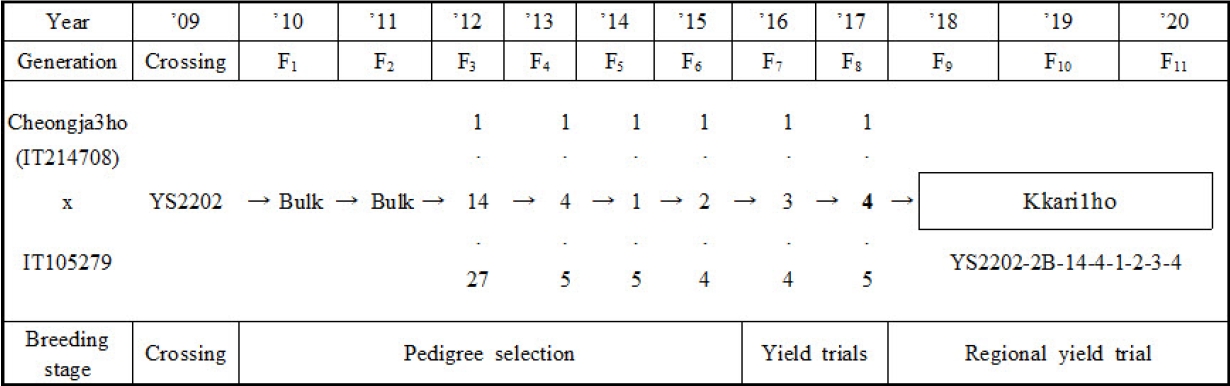
‘까리1호’는 내병, 내도복인 녹자엽의 검정 아주까리콩 품종 개발을 목표로 하여 밥밑용 특성이 우수한 대립 녹색자엽 검정콩 품종인 ‘청자3호(IT214708)’를 모본으로, 도복에 약한 재래종인 아주까리콩 ‘IT105279’을 부본으로 인공교배하고 계통육종법에 의해 개발된 품종이다.
2009년 인공교배 이후 2010년 F1, 2011년도에 F2 세대를 양성하고, F3 부터는 계통육종법으로 쓰러짐에 강하고 ‘청자3호’와 초형이 비슷한 계통을 선발하였다. 2016년부터 2017년도에 실시한 생산력검정시험에서는 쓰러짐에 강하고 불마름병 저항성이 우수한 아주까리콩 계통으로 유망시되어 ‘밀양350호’의 계통명을 부여한 후 2018년부터 2020년 3년간 지역적응시험을 실시한 결과, 수량성이 높고 쓰러짐에 강한 특성을 나타내어 2020년 12월 농작물직무육성신품종선정위원회에서 품종으로서 가치가 인정되어 ‘까리1호’로 명명하였다(
Fig. 1).
2016년 생산력검정예비시험(PYT, Preliminary Yield Trial), 2017년 생산력검정본시험(AYT, Advanced Yield Trial)을 국립식량과학원 밭작물개발부(경상남도 밀양시 소재, 35° 29' 32" N, 128° 44' 35" E)에서 수행하였다. 생산력검정예비시험은 시험구 면적 8.4 m2 (2.1 m × 4 m), 재식거리 70 × 15 cm, 1주2본으로 재배되고 난괴법 2반복으로 배치하였다. 생산력검정본시험은 시험구 면적 11.2 m2 (2.8 m × 4 m), 재식거리 70 × 15 cm, 1주2본으로 재배되고 난괴법 3반복으로 배치하였다. 생육특성과 수량성은 농업과학기술 연구조사분석기준에 따라 조사하였다(
RDA 2012).
지역적응시험(RYT, Regional Yield Trial)은 수원, 춘천, 연천, 나주, 달성, 예산, 대구 등 7개 지역에서 2018년부터 2020년까지 3년간 수행하였다. 재배방법은 시험구 면적 11.2 m2, 재식거리 70 × 15 cm, 1주2본으로 재배되고 난괴법 3반복으로 배치하였다. 파종기는 6월 중순이며 농업과학기술 연구조사분석기준에 따라 생육특성 및 수량성을 조사하고, 표준품종인 ‘청자3호’와 비교하였다.
내병성 검정
병해 검정을 위해 5월 상순에 검정포장에 파종하여 콩모자이크바이러스와 불마름병의 자연 이병률을 조사하였다. 콩모자이크바이러스병 저항성 검정을 위해 각 시험 전년도에 접종 및 증식한 후 저온 보관해둔 콩모자이크바이러스 G6H (
Seo et al. 2009a) 균계를 지닌 잎을 마쇄하여 2 mole 농도의 인산 나트륨 버퍼에 녹인 후 즙액을 만들고, 온실에서 초생엽 전개시 carborandom을 이용하여 잎 표면에 상처를 낸 후 접종하였다. 접종 2주 경과 후 접종한 하위엽을, 10일 뒤 접종한 상위 엽을 병반 없음(-), 갈색 병반(L), 엽맥 병반(V), 모자이크 증상(M), 괴사(N), 얼룩무늬(Mo) 등의 병징으로 구분하고 조사하였다. 불마름병 저항성 검정을 위해 8ra를 증식하여 증류수에 희석하여 OD값 0.2-0.3으로 농도를 맞추어 제2본엽기에 충분히 분무 접종하고 습식처리 하였다. 균주 접종 후 10일이 경과하고 2회에 걸쳐 잎에 나타난 병징 발현 정도를 조사하였다(
Seo et al. 2009b).
내도복성 검정을 위해 2개 수준의 재식밀도인 70 × 15 cm (표준)와 70 × 7.5 cm (2배 밀식)를 설정하였다. 시험은 난괴법 2반복으로 배치하였으며, 각 반복을 하나의 블록으로 하여 각 블록 내에 모든 재식밀도 처리구를 1회씩 포함시키고 처리구의 위치는 무작위로 배정하였다. 도복 정도는 성숙기에 45° 이상 기울어진 개체의 비율로 등급화(1: 5% 이하, 3: 6~10%, 5: 11~50%, 7: 51~75%, 9: 76% 이상)하였다. 반복 및 연차 간 도복 정도 등급을 평균하여 반올림 후 1~9로 최종등급을 표시하였다. 탈립성 정도는 내도복성 검정 시험구에서 각 계통별 꼬투리 20개를 성숙기에 채취하여 40℃ 건조기에 48시간 건조한 후 꼬투리의 개열 정도를 조사하였다.
품질 분석
단백질 함량은 질소 분석기( RapidN111, Elementar Analysen system, Langenselbold, Germany)를 이용하여 분석하였으며 지방 함량은 자동유지추출장치(B-811, BUCHI Labortechnik AG, Flawil, Switzerland)에 넣고 n-hexane으로 3시간 열수 추출한 후 지방 함량을 구하였다(
Choung 2006).
당 성분 분석은 분쇄한 시료 1 g을 정밀히 칭량하여 튜브에 넣은 후 70% 에탄올 10 ml를 첨가하여 실온에서 shaking 하여 전처리물을 추출하였다. 추출된 시료를 24시간 후 여과하여 증류수와 여과된 시료 각 0.7 ml를 마이크로튜브에 혼합하여 이 중 0.7 ml를 액체크로마토그래피(Ultimate 3000, Dionex, Sunnyvale, USA)에 넣고 분석하였다.
안토시아닌 분석을 위해 콩 껍질 0.1 g을 정밀히 칭량하여 튜브에 넣고 40% 메탄올 용매 30 ml를 첨가하여 4℃ 200 rpm에서 48시간 shaking 하여 추출하였다. 추출된 시료용액을 No2 여과지로 여과한 후 여액 1.0 ml을 취하여 0.45 ㎛ 필터로 여과하였고 안토시아닌은 액체크로마토그래피(Ultimate 3000, Dionex, Sunnyvale, USA)로 분석하였다.
이소플라본 함량 분석을 위해 분쇄한 시료 1.0 g을 50% 메탄올 용액 20 mL에 12시간 실온에서 교반한 뒤 추출액을 여과지(Whatman NO. 2)를 이용하여 여과하였다. 여과된 시료는 다시 HPLC 분석을 위해 0.2 ㎛ 필터를 하였다. 이소플라본 분석은 액체크로마토그래피(1100 Series, Agilent Technologies, Santa Clara, USA)로 분석하였다. 이소플라본은 Daidzin, Glycitin, Genistin, Daidzein, Glycitein, Genistein, Mal-Daidzin, Mal-Glycitin, Mal-Genistin, Ac-Daidzin, Ac-Genistin, Ac-Glycitin 등 12종을 분석하였으며, 배당체와 비배당체의 함량을 모두 합하여 제시하였다.
수분흡수율은 건조 종자 50립의 무게를 잰 후 상온의 물에 침종하여 2, 6, 12시간 후 무게를 각각 측정하여 구하였다{(침종후 종자무게-침종전 종자무게)/침종전 종자무게 × 100}
통계 분석
표준품종인 ‘청자3호’와 ‘까리1호’의 생육특성, 품질특성, 수량성 비교를 위해 R 프로그램(v 4.2.0)을 이용하여 Student t-검정을 수행하였다.
결과 및 고찰
고유특성 및 생육특성
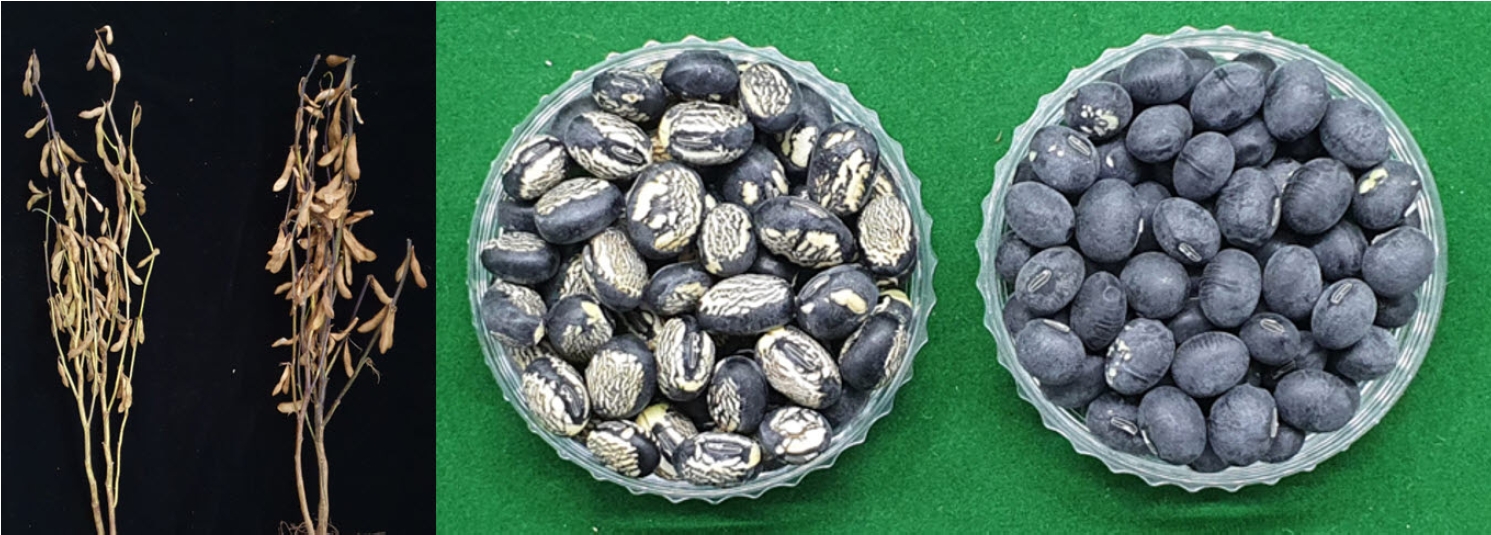
‘까리1호’는 유한신육형 초형으로 꽃색은 보라색, 엽형은 둥근형, 모용색과 협색은 갈색, 배꼽색은 검은색이며, 종실은 구형이고 검은색 종피에 그물무늬가 있다(
Table 1,
Fig. 2). 개화기는 8월 3일, 성숙기는 10월 23일로 ‘청자3호’와 개화기와 성숙기는 비슷하다. 경장, 마디수, 협수, 착협고는 각각 67 cm, 16개, 48개, 15 cm로 ‘청자3호’보다 경장은 조금 작고 착협고는 조금 높으며, 마디수는 비슷하고 협수는 ‘청자3호’보다 많다. 통계적으로는 경장 등 생육특성이 ‘청자3호’와 유의한 차이를 보이지 않았으며, 100립중은 32.7 g으로 ‘청자3호’ 대비 다소 가볍다(
Table 2).
지역적응성 시험 결과, ‘까리1호’는 표준재식밀도 재배시험과 2배 밀식재배시험에서 내도복성이 각각 2, 7로 평가되어 ‘청자3호’(3, 5)보다 전국 7개소(수원, 춘천, 연천, 나주, 달성, 예산, 대구 등) 시험포장에서는 강하나 밀식포장에서 다소 약한 것으로 나타났으며, 탈립성 정도는 포장에서 4로 평가되고 실내검정에서 81.7%로 측정되어 ‘청자3호’(포장검정 5, 실내검정 98.7%)보다 높은 것으로 나타났다(
Table 2). ‘까리1호’의 불마름병 저항성은 시험포장과 인공접종에서 각 각 ‘1’, ‘2’으로 평가되어 ‘청자3호’와 대등하여 강하였고, 콩모자이크바이러스는 접종시에 상위엽에서 괴저 증상이 발생하였으나, 검정포장에서는 ‘3’로 평가되어 ‘청자3호’ 와 비슷하였다. 검은뿌리썩음병에는 ‘청자3호’와 대등한 특성을 나타내었다(
Table 3).
‘까리1호’의 조단백질 함량은 43.4%, 조지방 함량은 16.1%로 ‘청자3호’ 대비 조단백 함량은 높고, 조지방 함량은 낮았으나 통계적으로는 유의하지 않았다. 침종 후 6시간부터 경실종자가 없었고, 초기 수분흡수율은 174%로 ‘청자3호’(168%)보다 높고, 2시간 경실률이 30%로 ‘청자3호’(62%)보다 낮았다. 종실의 총 당 함량과 sucrose 함량은 75.5 mg/g, 43.5 mg/g으로 ‘청자3호’(83.6, 49.2 mg/g) 대비 다소 낮았으나 통계적으로 유의하지는 않았다. 안토시아닌과 이소플라본 함량은 각각 10,617 ㎍/종피g, 2,566 ㎍/g으로 ‘청자3호’(21,981 ㎍/종피g, 2,115 ㎍/g) 대비 안토시아닌 함량은 낮았으며, 이소플라본 함량은 다소 높았다(
Table 4).
안토시아닌은 검정콩 종피에 주로 축적되는 색소 성분으로 항산화 특성에 관여하는 주요 성분이며, 이소플라본은 콩 종실의 대표적인 생리활성 성분으로 기능성 품질 평가에 중요한 지표로 이용된다. ‘까리1호’의 안토시아닌 함량은 ‘청자3호’ 대비 낮은 수준을 나타냈으나, 이소플라본 함량은 ‘청자3호’보다 높은 특성을 보여, ‘까리1호’가 표준품종인 ‘청자3호’와는 다른 기능성 성분 양상을 나타냄을 확인하였다.
수량성
전국 7개소(수원, 춘천, 연천, 나주, 달성, 예산, 대구 등)에서 2018년부터 2020년까지 3년간 수행된 지역적응시험 결과, 전국 평균 수량은 252 kg/10a로 ‘청자3호’(242 kg/10a) 대비 4% 증수하였다(
Table 5). 지역별로는 ‘까리1호’가 7개 시험지역 중 4개 지역에서 ‘청자3호’보다 높은 수량을 보였으나, 3개 지역에서는 낮은 수량을 나타내어 지역별 수량 안정성에는 차이가 있었다. 콩의 수량은 품종 고유의 유전적 특성뿐만 아니라 재배지역의 기상, 토양 및 생육기간 중 환경조건에 크게 영향을 받으므로, 본 시험에서 나타난 지역 간 수량 차이는 품종과 환경 간 상호작용에 기인한 것으로 판단된다.
‘까리1호’의 내탈립성이 표준품종인 ‘청자3호’에 비해 높은 수준으로 평가되었으나, 성숙기 이후 포장 조건에 따라 실질적인 탈립 현상이 발생할 수 있으므로 수확 적기를 놓치지 않도록 유의해야 한다.
Notes
-
사사
본 연구는 농촌진흥청 연구사업(과제명: 콩 가공적성 및 기능성 향상 신품종 육성(2공동), 과제번호: PJ014839022024)의 지원으로 수행되었습니다.
Fig. 1.Pedigree diagram of ‘Kkari1ho’.
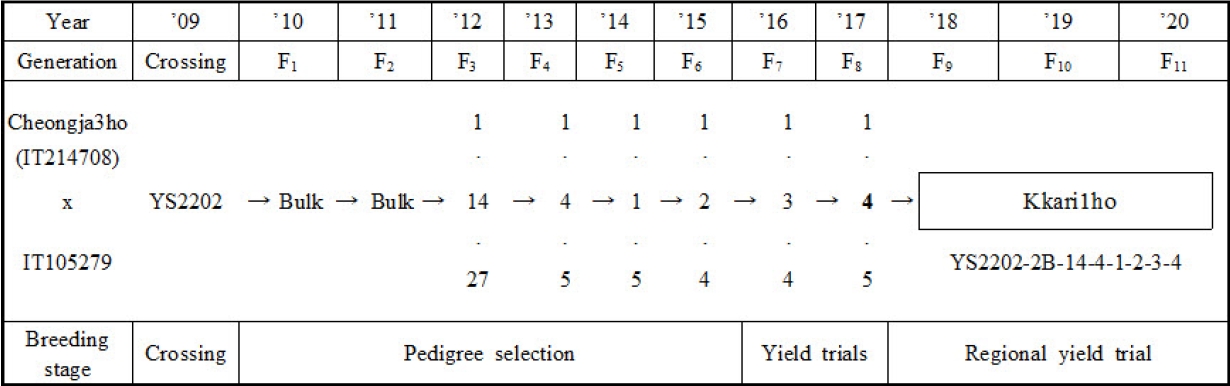
Fig. 2.Comparison of individual plants and seeds between ‘Kkari1ho’ (left) and ‘Cheongja3ho’ (right).
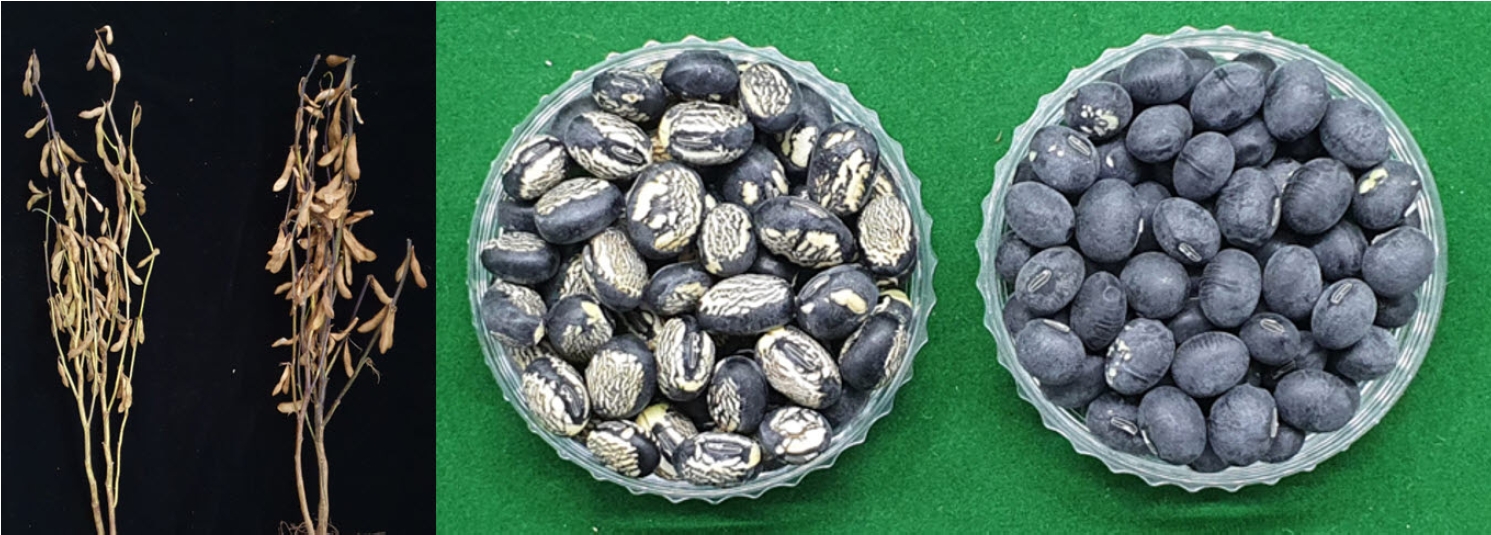
Table 1.Qualitative characteristics of ‘Kkari1ho’.
Table 1.
|
Cultivar |
Growth Habit |
Leaflet Shape |
Flower Color |
Pubescence Color |
Seed Coat Color |
Cotyledon Color |
Seed Shape |
|
Kkari1ho |
Determinate |
Oval |
Purple |
Brown |
Net-like Cracking type (Black) |
Green |
Spherical |
|
Cheongja3ho |
Determinate |
Oval |
Purple |
Brown |
Black |
Green |
Spherical |
Table 2.Mean value of quantitative characteristics of ‘Kkari1ho’ in the regional yield trial from 2018 to 2020.
Table 2.
|
Cultivar |
Flowering Date |
Maturity Date |
Height (cm) |
No. of Nodes |
No. of Branches |
No. of Pods |
First Pod Height (cm) |
100-Seed Weight (g) |
Lodging (1-9)z
|
Shattering
|
|
Normal Culture |
Dense Culture |
Field |
Ratio by Oven Test (%)y
|
Field (1-9)z
|
|
Kkari1ho |
8.3 |
10.23 |
67 |
16 |
4 |
48 |
15 |
32.7 |
2 |
7 |
2 |
81.7 |
4 |
|
Cheongja3ho |
8.3 |
10.21 |
69 |
15 |
4 |
40 |
13 |
35.5 |
2 |
5 |
3 |
98.7 |
5 |
|
t-valuex
|
- |
- |
-0.49ns
|
0.89ns
|
0.71ns
|
1.88ns
|
1.31ns
|
-3.71**
|
- |
- |
- |
- |
- |
Table 3.The resistance of ‘Kkari1ho’ to the diseases of soybean evaluated from 2018 to 2020.
Table 3.
|
Cultivar |
Bacterial Pustule (0-9)z
|
Soybean Mosaic Virusy
|
Root Rot (%)x
|
|
Field |
Inoculation |
Inoculation (G6H) |
Field (0-9)z
|
|
Kkari1ho |
1 |
2 |
Mo / N-M |
3 |
0 |
|
Cheongja3ho |
1 |
2 |
- / M |
3 |
0 |
Table 4.Seed quality-related characteristics of ‘Kkari1ho’ evaluated from 2018 to 2020.
Table 4.
|
Cultivar |
Crude Protein (%) |
Crude Oil (%) |
Ratio of Water Absorption (%)
|
Sugar Content (mg/g)
|
Anthocyanin Content (μg/g) |
Isoflavone Content (μg/g) |
|
2 hr |
6 hr |
12 hr |
Sucrose |
Total |
|
Kkari1ho |
43.4 |
16.1 |
174 |
208 |
220 |
43.5 |
75.5 |
10,671 |
2,566 |
|
Cheongja3ho |
42.3 |
16.4 |
168 |
214 |
233 |
49.2 |
83.6 |
21,981 |
2,115 |
|
t-valuez
|
2.25ns
|
-0.59ns
|
0.85ns
|
-0.74ns
|
-1.57ns
|
-0.9ns
|
-0.53ns
|
-8.42**
|
1.51ns
|
Table 5.Yield of ‘Kkari1ho’ in the regional yield trials at 7 locations.
Table 5.
|
Location |
Kkari1ho
|
Cheongja3ho
|
|
2018 |
2019 |
2020 |
Mean |
Indexz
|
2018 |
2019 |
2020 |
Mean |
|
Suwon |
260 |
279 |
252 |
264 |
92 |
298 |
285 |
277 |
287 |
|
Yeoncheon |
293 |
273 |
213 |
260 |
115 |
292 |
233 |
155 |
227 |
|
Chuncheon |
292 |
326 |
245 |
288 |
127 |
230 |
274 |
226 |
243 |
|
Naju |
340 |
266 |
237 |
281 |
93 |
334 |
272 |
298 |
301 |
|
Dalseong |
220 |
248 |
235 |
234 |
110 |
189 |
219 |
229 |
212 |
|
Yesan |
257 |
163 |
163 |
194 |
98 |
221 |
181 |
189 |
197 |
|
Daegu |
238 |
253 |
250 |
247 |
110 |
218 |
227 |
228 |
224 |
|
Mean |
271 |
258 |
228 |
252 |
104 |
255 |
242 |
229 |
242 |
|
t-valuey
|
0.79ns
|
References
- 1. Choung MG. 2006. Variation of oil contents and fatty acid compositions in Korean soybean germplasm. Korean J Crop Sci 51(S):139-149.
- 2. Ganesan K, Xu B. 2017. A critical review on polyphenols and health benefits of black soybeans. Nutrients 9: 455.
- 3. Jan SA, Shinwari ZK, Faizan M. 2022. Anticancer properties of soybean: An updated review. J Cancer Prev Curr Res 13: 22-23.
- 4. Jeong EW, Dhungana SK, Yang YS, Baek Y, Seo JH, Kang BK, Jung CS, Han SI, Lee HG. 2023. Black and yellow soybean consumption prevents high-fat diet-induced obesity by regulating lipid metabolism in C57BL/6 mice. Evid.-Based Complement Altern Med 2023: 6139667.
- 5. Kim HT, Han WY, Seo JH, Kang BK, Shin SO, Kim HS, Lee YH, Lee BW, Yun HT, Park CH, Kwak DY. 2018. Pod shattering tolerant black soybean cultivar ‘Cheongja4’ with green cotyledon and without seed coat cracking. Korean J Breed Sci 50: 289-295.
- 6. Kim IS, Kim CH, Yang WS. 2021. Physiologically active molecules and functional properties of soybeans in human Health-A current perspective. Int J Mol Sci 22: 4054.
- 7. Kim SY, Wi HR, Choi S, Ha TJ, Lee BW, Lee M. 2015. Inhibitory effect of anthocyanin-rich black soybean testa (Glycine max (L.) Merr.) on the inflammation-induced adipogenesis in a DIO mouse model. J Funct Foods 14: 623-633.
- 8. Kim YH, Lee JH, Lee YS, Yun HT. 2006. Antioxidant activity and extraction efficiency of anthocyanin pigments in black soybean. Korean Soybean Digest 23: 1-9.
- 9. Korean Statistical Information Service (KOSIS) 2025. Available at: https://kosis.kr/statHtml/statHtml.do?sso=ok&returnurl=https%3A%2F%2Fkosis.kr%3A443%2FstatHtml%2FstatHtml.do%3Flist_id%3DK1_15%26obj_var_id%3D%26seqNo%3D%26tblId%3DDT_1ET0012%26vw_cd%3DMT_ZTITLE%26orgId%3D101%26path%3D%252FstatisticsList%252FstatisticsListIndex.do%26conn_path%3DMT_ZTITLE%26itm_id%3D%26lang_mode%3Dko%26scrId%3D%26
- 10. Kurimoto Y, Shibayama Y, Inoue S. 2013. Black soybean seed coat extract ameliorates hyperglycemia and insulin sensitivity via the activation of AMP-activated protein kinase in diabetic mice. J Agric Food Chem 61: 5558-5564.
- 11. Lee JH, Seo EY, Lee YM. 2023. Comparative investigation on variations of nutritional components in whole seeds and seed coats of Korean black soybeans for different crop years and screening of their antioxidant and anti-aging properties. Food Chem X 17: 100572.
- 12. Lee KJ, Baek DY, Lee GA, Cho GT, So YS, Lee JR, Ma KH, Chung JW, Hyun DY. 2020. Phytochemicals and antioxidant activity of Korean black soybean (Glycine max L.) landraces. Antioxidants 9: 213.
- 13. Lee S, Lee YB, Kim HS. 2013. Analysis of the general and functional components of various soybeans. J Korean Soc Food Sci Nutr 42: 1255-1262.
- 14. Lee SE, Kim JY, Cho MS, Park Y. 2024. Study on sensory characteristics of Korean native soybean varieties. J East Asian Soc Diet Life 34: 432-443.
- 15. Mitharwal S, Saini A, Chauhan K, Taneja NK, Oberoi HS. 2024. Unveiling the nutrient-wealth of black soybean: A holistic review of its bioactive compounds and health implications. Compr Rev Food Sci Food Saf 23: e70001.
- 16. Park HR, Seo JH, Kang BK, Kim JH, Heo SV, Lee YH, Han WY, Seo MC, Park GR. 2024. Comparison of antioxidant components and activities of Korean black soybeans. Plant Breed Biotechnol 12: 175-192.
- 17. Rural Development Administration (RDA). 2012. Agricultural science technology standards for investigation of research. RDA, Jeonju, Korea.
- 18. Seo JH, Han WY, Baek IY, Kim HS, Kim HT, Kang BK, Ko JM, Yun HT, Lee BW, Oh JH, Shin SO, Kwak DY. 2020. Lodging and pod shattering tolerance of large-seeded black soybean cultivar ‘Taecheong’. Korean J Breed Sci 52: 426-432.
- 19. Seo JH, Han WY, Ko JM, Baek IY, Lee BW, Yun HT, Lee YH, Shin SO, Oh KW, Ha TJ, Choi MS, Kang BK, Kim HY, Park JH, Kim JH, Sung JS, Jung CS. 2021. Large-seeded green seed-coated soybean cultivar ‘Cheongmiin’ with pod shattering tolerance. Korean J Breed Sci 53: 311-317.
- 20. Seo JH, Kang BK, Baek IY, Han WY, Choi MS, Lee BW, Yun HT, Kim HS, Ko JY, Kim JH, Heo SV, Hwang JB, Kim CS. 2022. Black soybean cultivar ‘Cheongja5’ with high yield and pod shattering tolerance. Korean J Breed Sci 54: 469-475.
- 21. Seo JH, Kang BK, Kim JH, Heo SV, Han WY, Lee YH, Park GR, Kim KY. 2025. Lodging and bacterial pustule resistant soybean cultivar ‘Saedeul’ with a saddle-patterned seed coat. Korean J Breed Sci 57: 189-197.
- 22. Seo JK, Ohshima K, Lee HG, Son M, Choi HS, Lee SH, Sohn SH, Kim KH. 2009a. Molecular variability and genetic structure of the population of soybean mosaic virus based on the analysis of complete genome sequence. Virology 393: 91-103.
- 23. Seo MJ, Kang ST, Moon JK, Lee SK, Kim YH, Jeong KH, Yun HT. 2009b. Identification of quantitative trait loci associated with resistance to bacterial pustle (Xanthomonas axonopodis pv. glycines) in soybean. Korean J Breed Sci 41: 456-462.
- 24. Trade Statistics. 2026. Available online: https://stat.kita.net
- 25. Yun HT, Park KY, Moon JK, Kim YH, Kim SL, Ku JH, Lee YH, Ryu YH, Baek IY, Han WY, Kim HT, Cho JH, Ko JM, Shin DC, Suh DY, Kim HY, Kim SK, Ha KS, Lee SS, Son CK, Kim YD. 2005. A new black soybean cultivar, “Cheongja 3” with green cotyledon, medium-late maturity and high anthocyanin. Korean J Breed Sci 37: 261-262.